anaheim-gazette 1915-11-11
Scanned page
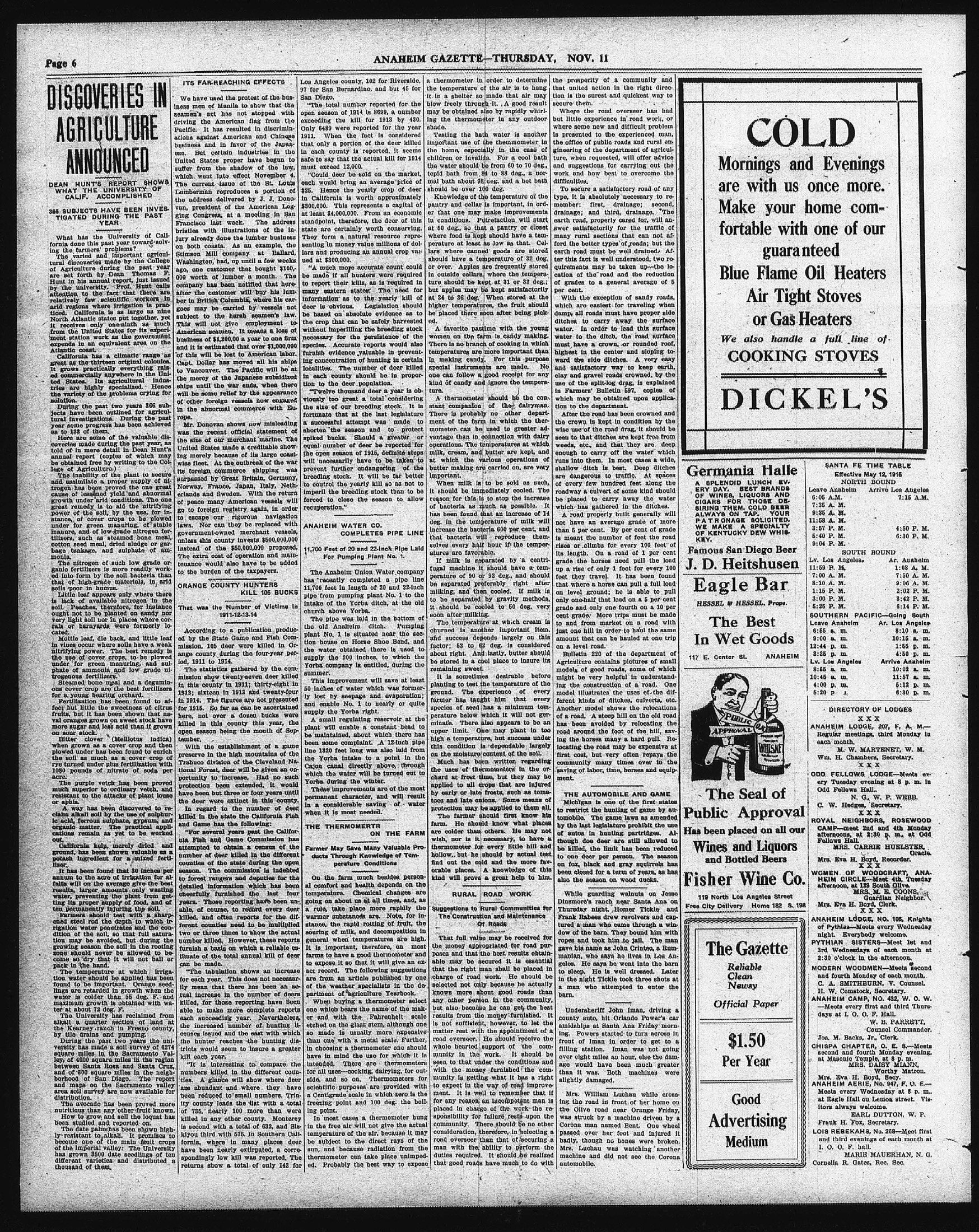
Searchable text
DISGOVERIES IN AGRICULTURE ANNOUNCED
DEAN HUNT'S REPORT SHOWS WHAT THE UNIVERSITY OF CALIF. ACCOMPLISHED
366 SUBJECTS HAVE BEEN INVESTIGATED DURING THE PAST YEAR
What has the University of California done this past year toward solving the farmers' problems?
The varied and important agricultural discoveries made by the College of Agriculture during the past year are set forth by Dean Thomas F. Hunt in his annual report, just issued by the university. Prof. Hunt calls attention to the fact that there are relatively few scientific workers in arid regions where irrigation is practiced. California is as large as nine North Atlantic states put together, yet it receives only one-ninth as much from the United States for its experiment station work as the government expends in an equivalent area on the Atlantic coast.
California has a climatic range as great as the thirteen original colonies. It grows practically everything raised commercially anywhere in the United States. Its agricultural industries are highly specialized. Hence the variety of the problems crying for solution.
During the past two years 366 subjects have been outlined for agricultural investigations. During the past year some progress has been achieved as to 183 of them.
Here are some of the valuable discoveries made during the past year, as told in mere detail in Dean Hunt's annual report (copies of which may
ITS FAR-REACHING EFFECTS
We have used the protest of the business men of Manila to show that the seamen's act has not stopped with driving the American flag from the Pacific. It has resulted in discriminations against American and Chinese business and in favor of the Japanese. But certain industries in the United States proper have begun to suffer from the shadow of the law, which went into effect November 4.
The current issue of the St. Louis Lumberman reproduces a portion of the address delivered by J. J. Donovan, president of the American Logging Congress, at a meeting in San Francisco last week. The address bristles with illustrations of the injury already done the lumber business on both coasts. As an example, the Stimson Mill company at Ballard, Washington, had, up until a few weeks ago, one customer that bought $100,000 worth of lumber a month. The company has been notified that hereafter the customer will buy his lumber in British Columbia, where his cargoes may be carried by vessels not subject to the harsh seamen's law. This will not give employment to American seamen. It means a loss of business of $1,200,000 a year to one firm and it is estimated that over $1,000,000 of this will be lost to American labor. Capt. Dollar has moved all his ships to Vancouver. The Pacific will be at the mercy of the Japanese subsidized ships until the war ends, when there will be some relief by the appearance of other foreign vessels now engaged in the abnormal commerce with Europe.
Mr. Donovan shows now misleading was the recent official statement of the size of our merchant marine. The United States made a creditable showing merely because of its large coast.
Los Angeles county, 97 for San Bernardino San Diego.
"The total number open season of 1914 exceeding the kill Only 6489 were reported 1911. When the foe that only a portion in each county is safe to say that the s must exceed 12,000.
"Could deer be so each would bring an $25. Hence the year in California is worth $300,000. This represents at least $4,000,000. In standpoint, therefore state are certainly They form a natural sentiment in money valuing and producing added at $300,000.
"A much more acute be made if all hunts to report their kills many eastern states information as to deer is obvious. I be based on absolute crop that can be without imperilling necessary for the species. Accurate furnish evidence varying concentration of localities. The number in each county sho rtion to the deer po."
"Twelve thousand visually too great as the size of our brew fortunate that at t a successful attempt shorten the season spiked bucks. Show equal number of dee the open season of."
It grows practically everything raised commercially anywhere in the United States. Its agricultural industries are highly specialized. Hence the variety of the problems crying for solution.
During the past two years 366 subjects have been outlined for agricultural investigations. During the past year some progress has been achieved as to 183 of them.
Here are some of the valuable discoveries made during the past year, as told of in mere detail in Dean Hunt's annual report (copies of which may be obtained free by writing to the College of Agriculture.)
The inability of the plant to secure and assimilate a proper supply of nitrogen has been proved the one great cause of lessened yield and abnormal growth under arid conditions. The one great remedy is to aid the nitrifying power of the soil, by the use, for instance, of cover crops to be plowed under for green manuring, of stable manure, and of low-grade nitrogen fertilizers, such as steamed bone meal, cotton seed meal, dried sludge or garbage tankage, and sulphate of ammonia.
The nitrogen of such low grade organic fertilizers is more readily worked into form by the soil bacteria than that of high-grade materials, in arid soils poor in humus.
Little leaf appears only where there is lack of available nitrogen in the soil. Peaches, therefore, for instance ought not to be planted on sandy nor very light soil nor in places where corals or barnyards were formerly located.
Mottle leaf, die back, and little leaf in vines occur where soils have a weak nitrifying power. The best remedy is the use of cover crops, to be plowed under for green manuring, and sulphate of ammonia and low grade nitrogenous fertilizers.
Steamed bone meal and a deguminous cover crop are the best fertilizers for a young bearing orchard.
Fertilization has been found to affect but little the sweetness of citrus fruits, but it has been shown that naval oranges grown on sweet stock have more sugar and less acid than if grown on sour stock.
Bitter clover (Meillotus indica) when grown as a cover crop and then plowed under has been found to enrich the soil as much as a cover crop of rye turned under plus fertilization with 1080 pounds of nitrate of soda per acre.
The purple vetch has been proved much superior to ordinary vetch, and resistant to the attacks of plant louse or aphia.
A way has been discovered to reclaim alkali soil by the use of sulphuric acid, ferrous sulphate, gypsum, and organic matter. The practical applications remain as yet to be worked out.
California kelp, merely dried and ground, has been shown valuable as a potash ingredient for a mixed fertilizer.
Mr. Donovan shows now misleading was the recent official statement of the size of our merchant marine. The United States made a creditable showing merely because of its large coastwise fleet. At the outbreak of the war its foreign commerce shipping was surpassed by Great Britain, Germany, Norway, France, Japan, Italy, Netherlands and Sweden. With the return of peace many American vessels will go to foreign registry again, in order to escape our rigorous navigation laws. Nor can they be replaced with government-owned merchant vessels, unless this county invests $500,000,000 instead of the $50,000,000 proposed. The extra cost of operation and maintenance would also have to be added to the burden of the taxpayers.
ORANGE COUNTY HUNTERS
KILL 105 BUCKS
That was the Number of Victims in 1911-12-13-14
According to a publication produced by the State Game and Fish Commission, 105 deer were killed in Orange county during the four-year period, 1911 to 1914.
The statistics gathered by the commission show twenty-seven deer killed in this county in 1911; thirty-eight in 1912; sixteen in 1913 and twenty-four in 1914. The figures are not presented for 1915. So far as can be ascertained here, not over a dozen bucks were killed in this county this year, the open season being the month of September.
With the establishment of a game preserve in the high mountains of the Trabuco division of the Cleveland National Forest, deer will be given an opportunity to increase. Had no such protection been extended, it would have been but three or four years until the deer were extinct in this county.
In regard to the number of deer killed in the state the California Fish and Game has the following:
"For several years past the California Fish and Game Commission has attempted to obtain a census of the number of deer killed in the different counties of the state during the open season. The commission is indebted to Vancouver. The Pacific will be at the meroy of the Japanese subsidized ships until the war ends, when there will be some relief by the appearance of other foreign vessels now engaged in the abnormal commerce with Europe.
Mr. Donovan shows now misleading was the recent official statement of the size of our merchant marine. The United States made a creditable showing merely because of its large coastwise fleet. At the outbreak of the war its foreign commerce shipping was surpassed by Great Britain, Germany, Norway, France, Japan, Italy, Netherlands and Sweden. With the return of peace many American vessels will go to foreign registry again, in order to escape our rigorous navigation laws. Nor can they be replaced with government-owned merchant vessels, unless this county invests $500,000,000 instead of the $50,000,000 proposed. The extra cost of operation and maintenance would also have to be added to the burden of the taxpayers."
ANAHEIM WATER COMPANY
11,700 Feet of 20 and For Pumping
The Anaheim Unit has recently compiled 11,700 feet in length pipe from pumping intake of the Yorba church above Yorba.
The pipe was laid at the old Anaheim plant No. 1 is situated house on Horse Creek water obtained supply the 200 inch Yorba company is on summer.
This improvement 50 inches of water lost by seepage and enable No. 1 supply the Yorba river.
A small regulating plant will enable a be maintained about been some complaining line 1320 feet long the Yorba intake Cajon canal direct which the water will Yorba during the winter.
These improvements permanent character in a considerable when it is most new.
The purple vetch has been proved much superior to ordinary vetch, and resistant to the attacks of plant louse or aphis.
A way has been discovered to reclaim alkali soil by the use of sulphuric acid, ferrous sulphate, gypsum, and organic matter. The practical applications remain as yet to be worked out.
California kelp, merely dried and ground, has been shown valuable as a potash ingredient for a mixed fertilizer.
It has been found that 30 inches per annum to the acre of irrigation for alfalfa will on the average give the best results, larger amounts only wasting water, preventing the plant from getting its proper supply of food, and of ten permanently injuring the soil.
Farmers should test with a sharpened steel rod the depth to which irrigation water penetrates and the condition of the soil, so that full saturation may be avoided, but during the growing season the soil in the rooting zone should never be allowed to become so dry that it will not ball or pack in the hand.
The temperature at which irrigation water should be applied has been found to be important. Orange seedlings are retarded in growth when the water is colder than 55 deg. F. and maximum growth is obtained with water at about 72 deg. F.
The University has reclaimed from alkali a quarter section of land at the Kearney ranch in Fresno county, by tile drains and pumping.
During the past two years the university has made a soil survey of 6274 square miles in the Sacramento Valley, of 4000 square miles in the region between Santa Rosa and Santa Cruz, and of 800 square miles in the neighborhood of San Diego. The report and maps on the Sacramento valley area soil survey are now available for distribution.
The avocado has been proved more nutritious than any other fruit known.
How to grow and sell the loquat has been studied and reported on.
The date palm has been shown highly resistant to alkali. It promises to become one of the main fruit crops of the imperial valley. The University has grown 3500 date seedlings of ten different varieties and distributed a thousand of them.
For several years past the California Fish and Game Commission has attempted to obtain a census of the number of deer killed in the different counties of the state during the open season. The commission is indebted to forest rangers and deputies for the detailed information which has been cheerfully furnished the last four years. Those reporting have been unable, of course, to record every deer killed, and often reports for the different counties need to be multiplied two or three times to show the actual number killed. However, these reports furnish a basis on which a reliable estimate of the total annual kill of deer can be made.
"The tabulation shows an increase for each year. This does not necessarily mean that there has been an actual increase in the number of deer killed, for those reporting have been able to make more complete reports each succeeding year. Nevertheless, the increased number of hunting licenses issued and the east with which the hunter reaches the hunting districts would seem to insure a greater kill each year.
"It is interesting to compare the numbers killed in the different counties. A glance will show where deer are abundant and where they have been reduced to small numbers. Trinity county leads the list with a total of 735, nearly 100 more than were killed in any other county. Monterey is second with a total of 632, and Siskiyou third with 575. In Southern California, where in many places deer have been nearly extirpated, a correspondingly low kill was reported. The returns show a total of only 143 for opportunity to increase. Had no such protection been extended, it would have been but three or four years until the deer were extinct in this county.
In regard to the number of deer killed in the state the California Fish and Game has the following:
"For several years past the California Fish and Game Commission has attempted to obtain a census of the number of deer killed in the different counties of the state during the open season. The commission is indebted to forest rangers and deputies for the detailed information which has been cheerfully furnished the last four years. Those reporting have been unable, of course, to record every deer killed, and often reports for the different counties need to be multiplied two or three times to show the actual number killed. However, these reports furnish a basis on which a reliable estimate of the total annual kill of deer can be made."
On the farm must maintain comfort and heat temperature. Cheese going on about us is a rule, take place warmer substances stance, the rapid souring of milk, and general when temp. It is important, farms to have a good act record. The farmer are from an article of the weather department of agriculture.
When buying a one which bears ther er and with it etched on the glass so made is usually than one with a m in choosing a ther have in mind ther intended. There for all uses—cooking side, and so on, scientific purposes a Centigrade scale freezing point and ing point.
In most cases in the free air will temperature of ther be subject to ther sun, and because thermometer can ed. Probably ther
ANAHEIM GAZETTE—THURSDAY, NOV. 11
Los Angeles county, 102 for Riverside, 97 for San Bernardino, and but 45 for San Diego.
"The total number reported for the open season of 1914 is 8699, a number exceeding the kill for 1913 by 430. Only 6489 were reported for the year 1911. When the fact is considered that only a portion of the deer killed in each county is reported, it seems safe to say that the actual kill for 1914 must exceed 12,000.
"Could deer be sold on the market, each would bring an average price of $25. Hence the yearly crop of deer in California is worth approximately $300,000. This represents a capital of at least $4,000,000. From an economic standpoint, therefore, the deer of this state are certainly worth conserving. They form a natural resource representing in money value millions of dollars and producing an annual crop valued at $300,000.
"A much more accurate count could be made if all hunters were required to report their kills, as is required in many eastern states. The need for information as to the yearly kill of deer is obvious. Legislation should be based on absolute evidence as to the crop that can be safely harvested without imperilling the breeding stock necessary for the persistence of the species. Accurate reports would also furnish evidence valuable in preventing concentration of hunting in certain localities. The number of deer killed in each county should be in proportion to the deer population.
Twelve thousand deer a year is obviously too great a total considering the size of our breeding stock. It is fortunate that at the last legislature a successful attempt was made to shorten the season and to protect spiked bucks. Should a greater or equal number of deer be reported for the open season of 1915, definite steps will have to taken to
a thermometer in order to determine the temperature of the air is to hang it in a shelter so made that air may blow freely through it. A good result may be obtained also by rapidly whirling the thermometer in any outdoor shade.
Testing the bath water is another important use of the thermometer in the home, especially in the case of children or invalids. For a cool bath the water should be from 60 to 70 deg., tepid bath from 84 to 88 deg., a normal bath about 98 deg., and a hot bath should be over 100 deg.
Knowledge of the temperature of the pantry and cellar is important, in order that one may make improvements in conditions. Putrefaction will start at 50 deg., so that a pantry or closet where food is kept should have a temperature at least as low as that. Cellars where canned goods are stored should have a temperature of 32 deg. or over. Apples are frequently stored in outside cellars, where the temperature should be kept at 31 or 32 deg.; but apples may be kept satisfactorily at 34 to 36 deg. When stored at the higher temperatures, the fruit should be placed there soon after being picked.
A favorite pastime with the young women on the farm is candy making. There is no branch of cooking in which temperatures are more important than in making candy. For this purpose special instruments are made. No one can follow a good receipt for any kind of candy and ignore the temperature.
A thermometer should be the constant companion of the dairyman. There is probably no other department of the farm in which the thermometer can be used to greater advantage than in connection with dairy operations. The temperatures at which milk, cream, and butter are kept, and at which the various operations of
the prosperity of a community and that united action in the right direction is the surest and quickest way to secure them.
Where the road overseer has had but little experience in road work, or where some new and difficult problem is presented to the experienced man, the office of public roads and rural engineering of the department of agriculture, when requested, will offer advice and suggestions for carrying out the work and how best to overcome the difficulties.
To secure a satisfactory road of any type, it is absolutely necessary to remember: first, drainage; second, drainage; and third, drainage. The earth road, properly cared for, will answer satisfactorily for the traffic of many rural sections that can not afford the better types of roads; but the earth road must be well drained. After this fact is well understood, two requirements may be taken up—the location of the road and the reduction of grades to a general average of 5 per cent.
With the exception of sandy roads, which are easiest for traveling when damp, all roads must have proper side ditches to carry away the surface water. In order to lead this surface water to the ditch, the road surface must have a crown, or rounded roof, highest in the center and sloping toward the side ditches. A very easy and satisfactory way to keep earth, clay and gravel roads crowned, by the use of the split-log drag, is explained in Farmers' Bulletin 597, copies of which may be obtained upon application to the department.
After the road has been crowned and the crown is kept in condition by the wise use of the road drag, it should be seen to that ditches are kept free from weeds, etc., and that they are deep enough to carry off the water which
The number of deer killed in each county should be in proportion to the deer population.
Twelve thousand deer a year is obviously too great a total considering the size of our breeding stock. It is fortunate that at the last legislature a successful attempt was made to shorten the season and to protect spiked bucks. Should a greater or equal number of deer be reported for the open season of 1915, definite steps will necessarily have to be taken to prevent further endangering of the breeding stock. It will be far better to control the yearly kill so as not to imperil the breeding stock than to be forced to close the season to allow recuperation."
ANAHEIM WATER CO.
COMPLETES PIPE LINE
11,700 Feet of 20 and 22-inch Pipe Laid For Pumping Plant No. 1.
The Anaheim Union Water company has recently completed a pipe line 11,700 feet in length of 20 and 22-inch pipe from pumping plant No. 1 to the intake of the Yorba ditch, at the old church above Yorba.
The pipe was laid in the bottom of the old Anaheim ditch. Pumping plant No. 1 is situated near the section house on Horse Shoe Bend, and the water obtained there is used to supply the 200 inches, to which the Yorba company is entitled, during the summer.
This improvement will save at least 50 inches of water which was formerly lost by seepage and evaporation; and enable No. 1 to nearly or quite supply the Yorba right.
A small regulating reservoir at the plant will enable a constant head to be maintained, about which there has been some complaint. A 12-inch pipe line 1320 feet long was also laid from the Yorba intake to a point in the Cajon canal directly above, through which the water will be turned out to Yorba during the winter.
These improvements are of the most permanent character, and will result in a considerable saving of water when it is most needed.
THE THERMOMERTR
ON THE FARM
Farmer May Save Many Valuable Products Through Knowledge of Temperature Conditions
special instruments are made. No one can follow a good receipt for any kind of candy and ignore the temperature.
A thermometer should be the constant companion of the dairyman. There is probably no other department of the farm in which the thermometer can be used to greater advantage than in connection with dairy operations. The temperatures at which milk, cream, and butter are kept, and at which the various operations of butter making are carried on, are very important.
When milk is to be sold as such, it should be immediately cooled. The reason for this is to stop the increase of bacteria as much as possible. It has been found that an increase of 14 deg. in the temperature of milk will increase the bacteria 600 per cent, and that bacteria will reproduce themselves every half hour if the temperatures are favorable.
If milk is separated by a centrifugal machine it should have a temperature of 90 or 92 deg., and should be separated preferably right after milking, and then cooled. If milk is to be separated by gravity methods, it should be cooled to 50 deg. very soon after milking.
The temperature at which cream is churned is another important item, and success depends largely on this factor; 52 to 62 deg. is considered about right. And lastly, butter should be stored in a cool place to insure its remaining sweet.
It is sometimes desirable before planting to test the temperature of the ground. The experience of every farmer has taught him that every species of seed has a minimum temperature below which it will not germinate. There also appears to be an upper limit. One may plant in too high a temperature, but success under this condition is dependably largely on the moisture content of the soil.
Much has been written regarding the uses of thermometers in the orchard at frost time, but they may be applied to all crops that are injured by early or late frosts, such as tomatoes and late onions. Some means of protection may be applied to them all.
The farmer should first know his farm. He should know what places are colder than others. He may not wish, nor is it necessary, to have a thermometer for every little hill and hollow., but he should by actual test find out the cold and the more favorable places. A knowledge of this and satisfactory way to keep earth, clay and gravel roads crowned, by the use of the split-log drag, is explained in Farmers' Bulletin 597, copies of which may be obtained upon application to the department.
After the road has been crowned and the crown is kept in condition by the wise use of the road drag, it should be seen to that ditches are kept free from weeds, etc., and that they are deep enough to carry off the water which runs into them. In most cases a wide, shallow ditch is best. Deep ditches are dangerous to traffic. At spaces of every few hundred feet along the roadway a culvert of some kind should be placed to carry away the water which has gathered in the ditches.
A road properly built generally will not have an average grade of more than 5 per cent. By per cent of grade is meant the number of feet the road rises or climbs for every 100 feet of its length. On a road of 1 per cent grade the horses need pull the load up a rise of only 1 foot for every 100 feet they travel. It has been found that where a horse can pull a full load on level ground; he is able to pull only one-half that load on a 5 per cent grade and only one fourth on a 10 per cent grade. More trips must be made to and from market on a road with just one hill in order to haul the same amount that can be hauled at one trip on a level road.
Bulletin 220 of the department of Agriculture contains pictures of small models of good roads, some of which might be very helpful in understanding the construction of a road. One model illustrates the uses of different kinds of ditches, culverts, etc. Another model shows the relocations of a road. A steep hill on the old road has been avoided by relocating the road around the foot of the hill, saving the horses many a hard pull. Relocating the road may be expensive at first cost, but very often repays the community many times over in the saving of labor, time, horses and equipment.
THE AUTOMOBILE AND GAME
Michigan is one of the first states to restrict the hunting of game by automobile. The game laws as amended by the last legislature prohibit the use of autos in hunting partridges. Although doe deer are still allowed to be killed, the limit has been reduced to one deer per person. The season on fox, black and gray squirrels has
THE THERMOMERTR ON THE FARM
Farmer May Save Many Valuable Products Through Knowledge of Temperature Conditions
On the farm much besides personal comfort and health depends on the temperature. Chemical changes are going on about us at all times, and, as a rule, take place more rapidly the warmer substances are. Note, for instance, the rapid rotting of fruit, the souring of milk, and decomposition in general when temperatures are high.
It is important, therefore, on most farms to have a good thermometer and to expose it so that it will give an exact record. The following suggestions are from an article published by one of the weather specialists in the department of agriculture Yearbook.
When buying a thermometer select one which bears the name of the maker and with the Fahrenheit scale etched on the glass stem, although one so made is usually more expensive than one with a metal scale. Further, in choosing a thermometer one should have in mind the use for which it is intended. There are thermometers for all uses—cooking, dairying, for outside, and so on. Thermometers for scientific purposes are provided with a Centigrade scale in which zero is the freezing point and 100 deg. the boiling point.
In most cases a thermometer hung in the free air will not give the actual temperature of the air, because it may be subject to the direct rays of the sun, and because radiation from the thermometer can take place unimpeded. Probably the best way to expose chard at frost time, but they may be applied to all crops that are injured by early or late frosts, such as tomatoes and late onions. Some means of protection may be applied to them all.
The farmer should first know his farm. He should know what places are colder than others. He may not wish, nor is it necessary, to have a thermometer for every little hill and hollow., but he should by actual test find out the cold and the more favorable places. A knowledge of this kind will prove a great help to him.
RURAL ROAD WORK
Suggestions to Rural Communities for The Construction and Maintenance Of Roads
That full value may be received for the money appropriated for road purposes and that the best results obtainable may be secured it is essential that the right man shall be placed in charge of road work. He should be selected not only because he actually knows more about good roads than any other person in the community, but also because he can get the best results from the money furnished. It is not sufficient, however, to let the matter rest with the appointment of a road overseer. He should receive the whole hearted support of the community in the work. It should be seen to that under the conditions and with the money furnished the community is getting what it has a right to expect in the way of road improvement. It is well to remember that if for any reason an incompetent man is placed in charge of the work the responsibility for failure rests upon the community. There should be no other consideration, therefore, in selecting a road overseer than that of securing a man with the ability to perform the duties required. It should be realized that good roads have much to do with
While guarding walnuts on Jesse Dinsmore's ranch near Santa Ana on Thursday night, Homer Tickle and Frank Rabees drew revolvers and captured a man who came through a window of the barn. They bound him with ropes and took him to jail. The man gave his name as John Crinteo, a Rummanian, who says he lives in Los Angeles. He says he went into the barn to sleep. He is well dressed. Later in the night Tickle took three shots at a man who attempted to enter the barn.
Undersheriff John Iman, driving a county auto, hit Orlando Power's car amidships at Santa Ana Friday morning. Powers started to turn across in front of Iman in order to get to a filling station. Iman was not going over eight miles an hour, else the damage would have been much greater than it was. Both machines were slightly damaged.
Mrs. William Luchau while crossing the road in front of her home on the Olive road near Orange Friday, was struck by a machine driven by a Corona man named Bent. One wheel passed over her foot and injured it badly, though no bones were broken. Mrs. Luchau was watching another machine and did not see the Corona automobile.
COLD
Mornings and Evenings
are with us once more.
Make your home comfortable with one of our
guaranteed
Blue Flame Oil Heaters
Air Tight Stoves
or Gas Heaters
We also handle a full line of
COOKING STOVES
DICKEL'S
DICKEL'S
Germania Halle
A SPLENDID LUNCH EVERY DAY. BEST BRANDS OF WINES, LIQUORS AND CIGARS FOR THOSE DESIRED THEM. COLD BEER ALWAYS ON TAP. YOUR PATRONAGE SOLICITED. WE MAKE A SPECIALTY OF KENTUCKY DEW WHISKEY.
Famous San Diego Beer
J. D. Heitshusen
Eagle Bar
HESSEL & HESSEL, Props.
The Best In Wet Goods
117 E. Center St. ANAHEIM
The Seal of Public Approval
Has been placed on all our Wines and Liquors and Bottled Beers
SANTA FE TIME TABLE
Effective May 12, 1915
NORTH BOUND
Leave Anaheim Arrive Los Angeles
6:05 A.M. 7:15 A.M.
7:35 A.M.
9:35 A.M.
11:58 A.M.
3:57 P.M. 4:50 P.M.
5:40 P.M. 6:30 P.M.
9:04 P.M.
SOUTH BOUND
Lv. Los Angeles Ar. Anaheim
11:59 P.M. 1:08 A.M.
7:00 A.M. 7:50 A.M.
8:10 A.M. 9:06 A.M.
1:15 P.M. 2:02 P.M.
3:00 P.M. 3:42 P.M.
5:25 P.M. 6:14 P.M.
SOUTHERN PACIFIC—Going South
Leave Anaheim Arrive Los Angeles
6:55 a.m. 8:10 a.m.
9:00 a.m. 10:15 a.m.
12:44 p.m. 1:55 p.m.
8:35 p.m. 4:50 p.m.
Lv. Los Angeles Arrive Anaheim
8:55 a.m. 10:02 a.m.
10:45 a.m. 11:57 a.m.
4:00 p.m. 5:12 p.m.
5:20 p.m. 6:30 p.m.
DIRECTORY OF LODGES
XXX
ANAHEIM LODGE, 207, F. A. M.—Regular meetings, third Monday in each month.
M. W. MARTENET, W. M.
Wm. H. Chambers, Secretary.
XXX
ODD FELLOWS LODGE—Meets every Tuesday evening at 8 p.m. in Odd Fellows Hall.
N. G., W. P. WEBB.
C. W. Hedges, Secretary.
XXX
ROYAL NEIGHBORS, ROSEWOOD CAMP—meet 2nd and 4th Monday afternoons, at 2:30 p.m., at Odd Fellows Hall.
MRS. CARRIE HUELSTER,
Oracle.
Mrs. Eva H. Boyd, Recorder.
XXX
The Seal of Public Approval Has been placed on all our Wines and Liquors and Bottled Beers Fisher Wine Co.
119 North Los Angeles Street Free City Delivery Home 182 S. 198
The Gazette
Reliable Clean Newsy
Official Paper
$1.50 Per Year
Good Advertising Medium
ODD FELLOWS LODGE—Meets every Tuesday evening at 8 p.m. in Odd Fellows Hall.
N. G., W. P. WEBB.
C. W. Hedges, Secretary.
ROYAL NEIGHBORS, ROSEWOOD CAMP—meet 2nd and 4th Monday afternoons, at 2:30 p.m., at Odd Fellows Hall.
MRS. CARRIE HUELSTER, Oracle.
Mrs. Eva H. Boyd, Recorder.
WOMEN OF WOODCRAFT, ANAHEIM CIRCLE—meet 4th Tuesday afternoon, at 129 South Olive.
MRS. M. E. COONS, Guardian Neighbor.
Mrs. Eva H. Boyd, Clerk.
ANAHEIM LODGE, NO. 105, Knights of Pythias—Meets every Wednesday night. Everybody welcome.
PYTHIAN SISTERS—Meet 1st and 3rd Wednesdays of each month at 2:30 o'clock in the afternoon.
MODERN WOODMEN—Meets second and fourth Monday of each month.
C. A. SMITHBURN, V. Counsel.
H. W. Comstock, Secretary.
ANAHEIM CAMP, NO. 432, W. O. W.—Meets every first and third Thursdays at I. O. O. F. Hall.
W. B. PARRETT, Counsel Commander.
Jos. M. Backs, Jr., Clerk.
CHISPA CHAPTER, O. E. S.—Meets second and fourth Monday evening, at Masonlo Temple, at 8 p.m.
MRS. DAISY MIANN, Worthy Matron.
Mrs. Eva H. Boyd, Secy.
ANAHEIM AERIE, No. 947, F. O. E.—Meets every Wednesday at 8 p.m., at Eagle Hall on Lemon street. Visitors always welcome.
EARL DUTTON, W. P.
Frank H. Fox, Secretary.
LOIS REBEKAHS, No. 268—Meet first and third evenings of each month at I. O. O. F. hall.
MARIE MAUERHAN, N. G.
Cornella R. Gates, Rec. Sec.