anaheim-gazette 1915-11-11
Scanned page
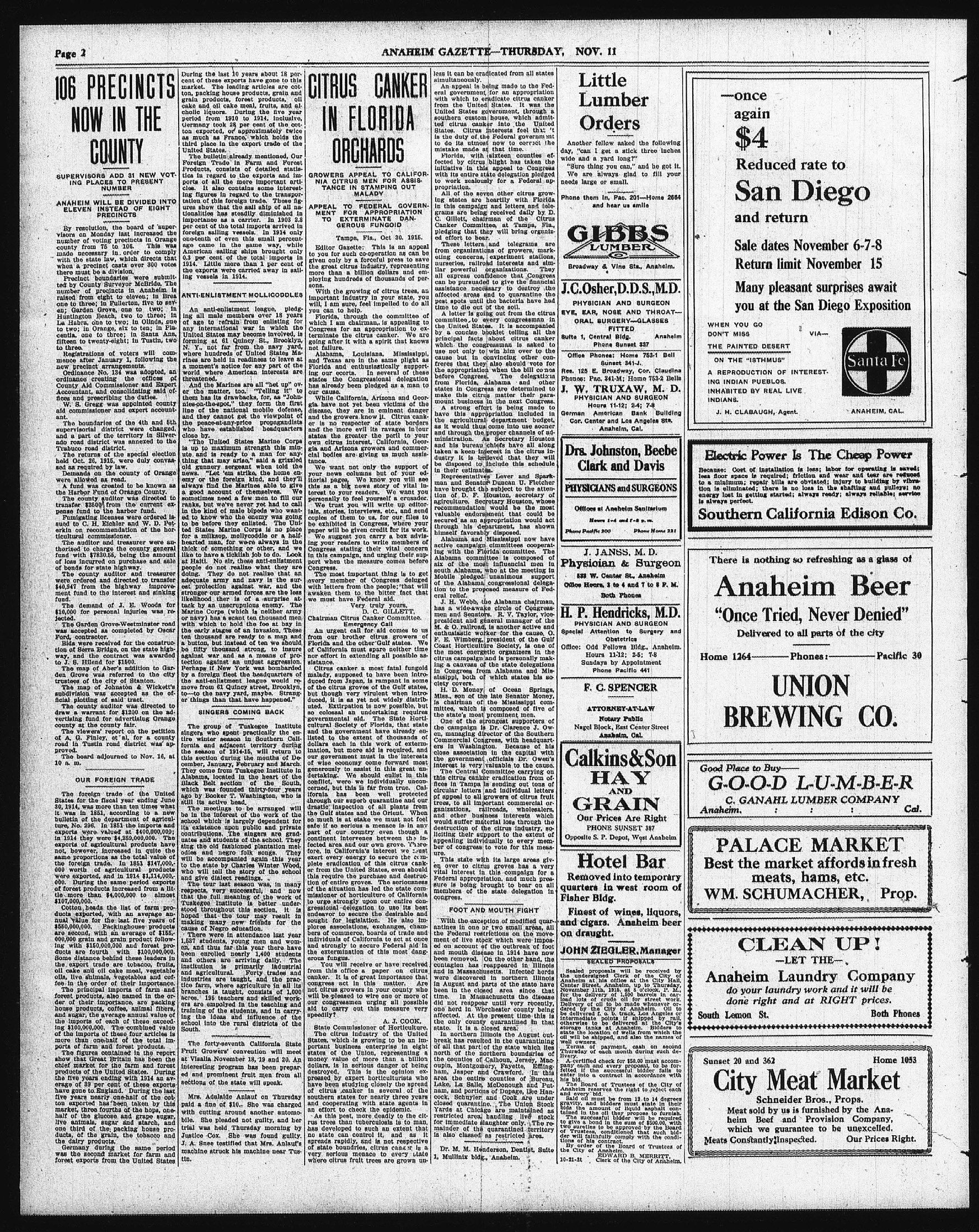
Searchable text
106 PRECINCTS NOW IN THE COUNTY
SUPERVISORS ADD 31 NEW VOTING PLACES TO PRESENT NUMBER
ANAHEIM WILL BE DIVIDED INTO ELEVEN INSTEAD OF EIGHT PRECINCTS
By resolution, the board of supervisors on Monday last increased the number of voting precincts in Orange county from 75 to 106. This was made necessary in order to comply with the state law, which directs that when a precinct casts over 300 votes there must be a division.
Precinct boundaries were submitted by County Surveyor McBride. The number of precincts in Anaheim is raised from eight to eleven; in Brea one to three; in Fullerton, five to seven; Garden Grove, one to two; in Huntington Beach, two to three; in La Habra, one to two; in Olinda, one to two; in Orange, six to ten; in Placentia, one to three; in Santa Ana, fifteen to twenty-eight; in Tustin, two to three.
Registrations of voters will commence after January 1, following the new precinct arrangements.
Ordinance No. 134 was adopted, an ordinance creating the offices of County Aid Commissioner and Expert Accountant, and consolidating said offices and prescribing the duties.
W. S. Gregg was appointed county aid commissioner and expert accountant.
The boundaries of the 4th and 5th supervisorial district were changed, and a part of the territory in Silverado road district was annexed to the Trabuco road district.
The returns of the special election held October 29, 1915, more than a year ago.
During the last 10 years about 18 percent of these exports have gone to this market. The leading articles are cotton, packing house products, grain and grain products, forest products, oil cake and oil cake meal, fruits, and alcoholic liquors. During the five year period from 1910 to 1914, inclusive, Germany took 28 per cent of the cotton exported, or approximately twice as much as France, which holds the third place in the export trade of the United States.
The bulletin already mentioned, Our Foreign Trade in Farm and Forest Products, consists of detailed statistics in regard to the exports and imports of all the more important articles. It also contains some interesting figures in regard to the transportation of this foreign trade. These figures show that the sail ship of all nationalities has steadily diminished in importance as a carrier. In 1903 2.8 per cent of the total imports arrived in foreign sailing vessels. In 1914 only one-tenth of even this small percentage came in the same way, while American sailing ships brought only 0.3 per cent of the total imports in 1914. Little more than 1 per cent of the exports were carried away in sailing vessels in 1914.
ANTI-ENLISTMENT MOLLICODDLES
An anti-enlistment league, pledging all male members over 18 years of age to refrain from enlisting for any international war in which the United States may become involved, is forming at 61 Quincy St., Brooklyn, N. Y., not far from the navy yard, where hundreds of United States Marines are held in readiness to leave at a moment's notice for any part of the world where American interests are threatened.
And the Marines are all "het up" over the matter, too. "Telling it" to them has its drawbacks, for, as "Johnies-on-the-spot," they form the first line of the national mobile defense, and they cannot get the viewpoint of the peace-at-any-price propagandists who have established headquarters close by.
"The United States Marine Corps is up to maximum strength this minute and is ready to a man for anything that may arise."
new precinct arrangements.
Ordinance No. 134 was adopted, an ordinance creating the offices of County Aid Commissioner and Expert Accountant, and consolidating said offices and prescribing the duties.
W. S. Gregg was appointed county aid commissioner and expert accountant.
The boundaries of the 4th and 5th supervisorial district were changed, and a part of the territory in Silverado road district was annexed to the Trabuco road district.
The returns of the special election hold Oct. 26, 1915, were duly convaused as required by law.
Demands on the county of Orange were allowed as read.
A fund was created to be known as the Harbor Fund of Orange County.
The county auditor was directed to transfer $2500 from the current expense fund to the harbor fund.
Fumigating licenses were ordered issued to C. H. Eichler and W. D. Peterkin on recommendation of the horticultural commissioner.
The auditor and treasurer were authorized to charge the county general fund with $7830.55, being the amount of loss incurred on purchase and sale of bonds for state highway.
The county auditor and treasurer were ordered and directed to transfer $40,947 from the highway improvement fund to the interest and sinking fund.
The demand of J. E. Woods for $10,000 for personal injuries was rejected.
The Garden Grove-Westminster road was accepted as completed by Oscar Ford, contractor.
Blds were received for the construction of Serra Bridge, on the state highway, and the contract was awarded to J. S. Hillend for $1500.
The map of Aber's addition to Garden Grove was referred to the city trustees of the city of Stanton.
The map of Johnston & Wickett's subdivision was accepted as the official plotting of said tract.
The county auditor was directed to draw a warrant for $1200 on the advertising fund for advertising Orange county at the county fair.
The viewers' report on the petition of A. G. Finley, et al., for a county road in Tustin road district was approved.
The board adjourned to Nov. 16, at 10 a.m.
OUR FOREIGN TRADE
The foreign trade of the United States for the fiscal year ending June 30, 1914, was more than ten times what it was in 1851, according to a new bulletin of the department of agriculture, No. 296. In 1851 the imports and exports were valued at $400,000,000; in 1914 they were $4,259,000,000. The exports of agricultural products have not, however, increased in quite the same proportions as the total value of the foreign trade. In 1851 $147,000,000 worth of agricultural products a moment's notice for any part of the world where American interests are threatened.
And the Marines are all "het up" over the matter, too. "Telling it" to them has its drawbacks, for, as "Johnies-on-the-spot," they form the first line of the national mobile defense, and they cannot get the viewpoint of the peace-at-any-price propagandists who have established headquarters close by.
"The United States Marine Corps is up to maximum strength this minute and is ready to a man for anything that may arise," said a grizzled old gunnery sergeant when told the news. "Let 'em strike, the home enemy or the foreign kind, and they'll always find the Marines able to give a good account of themselves. We sometimes need a few men to fill our ranks, but we've never yet had to call in the kind of male bipeds who wanted to know who the enemy was going to before they enlisted. The United States Marine Corps is no place for a milkskop, mollycodle or a half-hearted man, for we're always in the thick of something or other, and we like to have a ticklish job to do. Look at Haiti. No sir, these anti-enlistment people do not realize what they are doing. They do not realize that an adequate army and navy is the surrest protection against war, and the stronger our armed forces are the less likelihood there is of a surprise attack by an unscrupulous enemy. The Marine Corps (which is neither army or navy) has a scant ten thousand men with which to hold the foe at bay in the early stages of an invasion. These ten thousand are ready to a man and a button, but instead of ten we should be fifty thousand strong, to insure against war and as a moans of protection against an unjust aggression. Perhaps if New York was bombarded by a foreign fleet the headquarters of the anti-enlistment league would remove from 61 Quincy street, Brooklyn, to—the navy yard, maybe. Stranger things than that have happened."
SINGERS COMING BACK
The group of Tuskegee Institute singers who spent practically entire winter season in Southern California and adjacent territory during the season of 1914-15, will return to this section during the months of December, January, February and March. They come from Tuskegee Institute in Alabama, located in the heart of the Black Belt section of the South, which was founded thirty-four years ago by Booker T. Washington, who is still its active head.
The meetings to be arranged will be in the interest of the work of the school which is largely dependent for its existence upon public and private contributions. The singers are graduates and students of the school. They sing the old fashioned plantation melodies and negro folk songs. They will be accompanied again this year to the state by Charles Winter Wood, Florida and enthiring our ecorts, states the Congress has already been given cause.
While California gia have not yet disease, they are aware and the growers know it is no respectable states the greatest own citrus interest gia and Arizona grafic bodies are giance.
We want not only your news column tutorial pages. We this as a big news terest to your read personally to feel.
We trust you will lals, stories, interviews copies of them too be exhibited in Co paper will be given.
We suggest you ing your readers to Congress stating in this campaign, so port when the main Congress.
The most important every member oof with letters from tawaken them to we must have Feec Very
Chairman Citrus C Emerging
An urgent call from our brother Florida and the other of California must nor effort in extent distance.
Citrus canker a malady, supposed duced from Japan, of the citrus grove but though very induced it is as yet uted. Extirpation so colossal an ugo governmental aid cultural Society oof and the government listed to the exten dollars each in th inflation, but more our government mof wise economy generously to assist derakting. We sh conflict, were we cerned, but this is ifiornia has been through our superb drastic inspection the Gulf states and so much is at stalk safe if so serious part of our coun continent intervened area and our fore, in California exert every energy plete eradication ofrom the United
OUR FOREIGN TRADE
The foreign trade of the United States for the fiscal year ending June 30, 1914, was more than ten times what it was in 1851, according to a bulletin of the department of agriculture, No. 296. In 1851 the imports and exports were valued at $400,000,000; in 1914 they were $4,259,000,000. The exports of agricultural products have not, however, increased in quite the same proportions as the total value of the foreign trade. In 1851 $147,000,000 worth of agricultural products were exported, and in 1914 $1,114,000,000. During the same period exports of forest products increased from a little more than $4,000,000 to almost $107,000,000.
Cotton heads the list of farm products exported, with an average annual value for the last five years of $550,000,000. Packinghouse products are second, with an average of $155,000,000 grain and grain product following with $150,000,000 and forest products are fourth with $100,000,000. Some distance behind these leaders in the export trade are tobacco, fruits, oil cake and oil cake meal, vegetable oils, live animals, vegetables and coffee in the order of their importance.
The principal imports of farm and forest products, also named in the order of their importance, are packing house products, coffee, animal fibers, and sugar, the average annual value of the imports of each of these exceeding $100,000,000. The combined value of the imports of these four articles is more than one-half of the total imports of farm and forest products.
The figures contained in the report show that Great Britain has been the chief market for the farm and forest products of the United States. During the five years ending with 1914 an average of 89 per cent of these exports have gone to England. During the last five years nearly one-half of the cotton exported has been taken by this market, three fourths of the hops, one half of the glucose and grape sugar, live animals, sugar and starch, and one third of the packing house products, of the grain, the tobacco and the dairy products.
Germany during the same period was the second market for farm and forest exports from the United States.
Alabama, located in the heart of the Black Belt section of the South, which was founded thirty-four years ago by Booker T. Washington, who is still its active head.
The meetings to be arranged will be in the interest of the work of the school which is largely dependent for its existence upon public and private contributions. The singers are graduates and students of the school. They sing the old fashioned plantation melodies and negro folk songs. They will be accompanied again this year to the state by Charles Winter Wood, who will tell the story of the school and give dialect readings.
The tour last season was, in many respects, very successful, and now that the full meaning of the work of Tuskegee Institute is better understood throughout this section, it is hoped that the tour may result in making many new friends for the cause of Negro education.
There were in attendance last year 1,637 students, young men and women, and thus far this year there have been enrolled nearly 1,400 students and others are arriving daily. The institution is primarily industrial and agricultural. Forty trades and industries are taught, and the practice farm, where agriculture in all its branches is taught consists of 1,000 acres. 195 teachers and skilled workers are employed in the teaching and training of the students, and in carrying the ideas and influence of the school into the rural districts of the South.
The forty-seventh California State Fruit Growers' convention will meet at Visalia November 18, 19 and 20. An interesting program has been prepared and prominent fruit men from all sections of the state will speak.
Mrs. Adalalde Anlauf on Thursday paid a fine of $10. She was charged with cutting around another automobile. She pleaded not guilty, and her trial was held Thursday morning by Justice Cox. She was found guilty. J. A. Snee testified that Mrs. Anlauf's machine struck his machine near Tustin.
State Commission
The citrus industry states, which is great business states of the United States money value of no dollars, is in serious destroyed. This pressured by experts have been studying of citrus canker southern states for and cooperating with an effort to check As this pest, most rhus trees than tuber has developed to no state can contain spreads rapidly, all of state boundaries very serious men where citrus fruit
ANAHEIM GAZETTE—THURSDAY, NOV. 11
GITRUS CANKER IN FLORIDA ORCHARDS
GROWERS APPEAL TO CALIFORNIA CITRUS MEN FOR ASSISTANCE IN STAMPING OUT MALADY
APPEAL TO FEDERAL GOVERNMENT FOR APPROPRIATION TO EXTERMINATE DANGEROUS FUNGOID
Tampa, Fla., Oct 30. 1915.
Editor Gazette: This is an appeal to you for such co-operation as can be given only by a forceful press to save the great citrus industry, representing more than a billion dollars and employing hundreds of thousands of persons.
With the growing of citrus trees, an important industry in your state, you will, I am sure, feel impelled to do all you can to help.
Florida, through the committee of which I am chairman, is appealing to Congress for an appropriation to exterminate the citrus canker. We are going after it with a spirit that knows not failure.
Alabama, Louisiana, Mississippi, and Texas are in the same plight as Florida and enthusiastically supporting our ecorts. In several of these states the Congressional delegation has already been pledged as a man to our cause.
While California, Arizona and Georgia have not yet been victims of the disease, they are in eminent danger and the growers know it. Citrus canker is no respecter of state borders and the more evil its ravages in our states the greater the peril to your own citrus interest, California, Georgia and Arizona growers and commercial bodies are giving us much assistance it can be eradicated from all states simultaneously.
An appeal is being made to the Federal government for an appropriation with which to eradicate citrus canker from the United States. It was the United States government, through a southern custom house, which admitted citrus canker into the United States. Citrus interests feel that it is the duty of the Federal government to do its utmost now to correct the mistake made at that time.
Florida, with sixteen counties effected by citrus blight has taken the initiative in this appeal to Congress with its entire state delegation pledged to work zealously for a Federal appropriation.
All of the seven other citrus growing states are heartily with Florida in this campaign and letters and telegrams are being received daily by D. C. Gillett, chairman of the Citrus Canker Committee, at Tampa, Fla., pledging that they will bring organized effort to bear.
These letters and telegrams are from organizations of growers, marketing concerns, experiment stations, nurseries, railroad interests and similar powerful organizations. They all express confidence that Congress can be pursued to give the financial assistance necessary to destroy the affected areas and to quarantine the pest spots until the bacteria have had time to die out of the soil.
A letter is going out from the citrus committee to every congressman in the United States. It is accompanied by a concise booklet telling all the principal facts about citrus canker which the congressman is asked to use not only to win him over to the cause but in convincing other conferences that they also should vote for the appropriation when the bill comes before Congress. The delegations from Florida, Alabama and other states in Congress are determined to make this citrus matter their paramount business in the next Congress.
A strong effort is being made to have this appropriation included in the agricultural department budget, as it would thus come into use sooner and through the proper channels of administration. As Secretary Houston and his bureau chiefs have all along taken a keen interest in the citrus industry it is believed that they will
Little Lumber Orders
Another fellow asked the following day, "can I get a stick three inches wide and a yard long?"
"Sure thing you can," and he got it.
We are always glad to fill your needs large or small.
Phone them In, Pac. 201—Home 2684 and hear us smile
GIBBS LUMBER
Broadway & Vine Sts., Anaheim.
J.C.Osher,D.D.S.,M.D.
PHYSICIAN AND SURGEON
EYE, EAR, NOSE AND THROAT—ORAL SURGERY—GLASSES FITTED
Suite 1, Central Bldg. Anaheim Phone Sunset 337
Office Phones: Home 753-1 Bell Sunset 341-J.
Res. 125 E. Broadway, Cor. Claudina Phones: Pac. 341-M; Home 753-2 Bells
J.W.TRUXAW,M.D.
PHYSICIAN AND SURGEON
Hours 11-12; 2-4; 7-8
German American Bank Building Cor. Center and Los Angeles Sta. Anahelm, Cal.
Drs. Johnston, Beebe
Florida and enthusiastically supporting our ecorts. In several of these states the Congressional delegation has already been pledged as a man to our cause.
While California, Arizona and Georgia have not yet been victims of the disease, they are in eminent danger and the growers know it. Citrus canker is no respecter of state borders and the more evil its ravages in our states the greater the peril to your own citrus interest, California, Georgia and Arizona growers and commercial bodies are giving us much assistance.
We want not only the support of your news columns but of your editorial pages. We know you will see this as a big news story of vital interest to your readers. We want you personally to feel yourself a crusader.
We trust you will write up editorials, stories, interviews, etc., and send copies of them to us, for our files to be exhibited in Congress, where your paper will be given credit for its work.
We suggest you carry a box advising your readers to write members of Congress stating their vital concern in this campaign, and urging their support when the measure comes before Congress.
The most important thing is to get every member of Congress deluged with letters from the people; that will awaken them to the bitter fact that we must have Federal aid.
Very truly yours,
D. C. GILLETT,
Chairman Citrus Canker Committee.
Emergency Call
An urgent call for aid comes to us from our brother citrus growers of Florida and the other Gulf states. We of California must spare neither time nor effort in extending all possible assistance.
Citrus canker a most fatal fungal malady, supposed to have been introduced from Japan, is rampant in some of the citrus groves of the Gulf states, but though very virulent when introduced, it is as yet not widely distributed. Extirpation is now possible, but so colossal an undertaking requires governmental aid. The State Horticultural Society of Florida, that state and the government have already enlisted to the extent of thousands of dollars each in this work of extermination, but more aid is required, and our government must in the interests of wise economy come forward most generously to assist in this great undertaking. We should enlist in this conflict, were we individually unconcerned, but this is far from true. California has been well protected through our superb quarantine and our drastic inspection of all plants from the Gulf states and the Orient. When so much is at stake we must not feel safe if so serious a menace is in any part of our country even though a continent intervenes between the infected area and our own grove. Therefore, in California's interest we must exert every energy to secure the complete eradication of this citrus canker from the United States, even should that they also should vote for the appropriation when the bill comes before Congress.
The delegations from Florida, Alabama and other states in Congress are determined to make this citrus matter their paramount business in the next Congress.
A strong effort is being made to have this appropriation included in the agricultural department budget, as it would thus come into use sooner and through the proper channels of administration. As Secretary Houston and his bureau chiefs have all along taken a keen interest in the citrus industry it is believed that they will be disposed to include this schedule in their estimates.
Representatives Lever and Sparkman and Senator Duncan U. Fletcher have brought the subject to the attention of D. F. Houston, secretary of agriculture. Secretary Houston, whose recommendation would be the most valuable endorsement that could be secured as an appropriation would act through his department, has shown himself favorably disposed.
Alabama and Mississippi now have active campaign committees cooperating with the Florida committee. The Alabama committee is composed of six of the most influential men in south Alabama, who at the meeting in Mobile pledged unanimous support of the Alabama congressional delegation to the proposed measure of Federal relief.
J. H. Webb, the Alabama chairman, has a wide-awake circle of Congressmen and Senators. R. V. Taylor, vice-president and general manager of the M. & O. railroad, is another active and enthusiastic worker for the cause. O. F. E. Wimberg, president of the Gulf Coast Horticulture Society, is one of the most energetic organizers in the citrus campaign and is personally making a canvass of the state delegations in Congress from Alabama and Mississippi, both of which states his society covers.
H. D. Money of Ocean Springs, Miss., son of the late Senator Money, is chairman of the Mississippi committee, which is composed of five of the state's most prominent men.
One of the strongest supporters of the campaign is Dr. Clarence J. Owen, managing director of the Southern Commercial Congress, with headquarters in Washington. Because of his close association in the capital with the government officials Dr. Owen's interest is very valuable to the cause.
The Central Committee carrying on this citrus canker eradication from offices in Tampa is sending out tons of circular letters and individual letters of appeal to all growers of citrus fruit trees, to all important commercial organizations, railroads, wholesalers, and other business interests which would suffer material loss through the destruction of the citrus industry, soliciting their support to the extent of appealing individually to every member of congress to vote for this measure.
This state with its large areas given over to citrus groves has a very
We should enlist in this conflict, were we individually unconcerned, but this is far from true. California has been well protected through our superb quarantine and our drastic inspection of all plants from the Gulf states and the Orient. When so much is at stake we must not feel safe if so serious a menace is in any part of our country even though a continent intervenes between the infected area and our own grove. Therefore, in California's interest we must exert every energy to secure the complete eradication of this citrus canker from the United States, even should this require the purchase and destruction of entire groves. The seriousness of the situation has led the state commissioner of horticulture of California to urge strongly upon our entire congressional delegation to use its best endeavor to secure the desirable and sought for legislation. He also implores associations, exchanges, chambers of commerce, boards of trade and individuals of California to act at once and strongly to secure Federal aid in the extermination of this most dangerous fungus.
You will receive or have received from this office a paper on citrus canker. It is of great importance that congress act in this matter. Are not citrus growers in your county who will be pleased to wire one or more of our congressmen urging all possible aid to carry out this measure very speedily?
A. J. COOK,
State Commissioner of Horticulture.
The citrus industry of the United States, which is growing to be an important business enterprise in eight states of the Union, representing a money value of more than a billion dollars, is in serious danger of being destroyed. This is the opinion expressed by expert horticulturists who have been studying closely the spread of citrus canker in several of the southern states for nearly three years and cooperating with state agents in an effort to check the epidemic.
As this pest, more deadly to the citrus trees than tuberculosis is to man, has developed to such an extent that no state can control it, and as it spreads rapidly, and is not respective of state boundaries, citrus canker is a very serious menace to every state where citrus fruit trees are grown un-
With the exception of modified quartines in one or two small areas, all the Federal restrictions on the movement of live stock which were imposed on account of the outbreak of foot and mouth disease in 1914 have now been removed. On the other hand, the contagion has reappeared in Illinois and in Massachusetts. Infected herds were discovered in northern Illinois in August and parts of the state have been in the closed area since that time. In Massachusetts the disease did not reappear until very recently, one herd in Worcester county being affected. At the present time this is the only county quarantined in that state. It is a closed area:
In northern Illinois the August outbreak has resulted in the quarantining of all that part of the state which lies north of the northern boundaries of the counties of Calhoun, Jersey, Macoupin, Montgomery, Fayette, Effingham, Jasper and Crawford. In this area the entire counties of Bureau, Lake, La Salle, McDonough and Putnam, and portions of Dupage, Lee Hancock, Schuyler and Cook are under closed quarantine. The Union Stock Yards at Chicago are maintained as restricted area, handling live stock for immediate slaughter only. The remainder of the quarantined territory is also classed as restricted area.
Dr. M. M. Henderson, Dentist, Suite 1, Mullinix bldg., Anaheim.
HAY AND GRAIN
Our Prices Are Right
PHONE SUNSET 387
Opposite S. P. Depot, West Anaheim
Hotel Bar
Removed into temporary quarters in west room of Fisher Bldg.
Finest of wines, liquors, and cigars. Anaheim beer on draught.
JOHN ZIEGLER, Manager
SEALED PROPOSALS
Sealed proposals will be received by the undersigned Clerk of the City of Anaheim at his office at the City Hall, Center Street, Anaheim, up to Thursday, November 11th, 1915, at 8 o'clock, P.M., for the delivery of 1,500 barrels in carload lots of crude oil for street work. Delivery of oil to be made whenever ordered by the City of Anaheim. Oil to be delivered f. o. b. track, Los Angeles or intermediate points shipped by rail; otherwise to be delivered at the City's storage tanks at Anaheim. Bidders to state the location of wells from which the oil will be shipped, and also the names of well owners.
Terms of payment, cash on second Thursday of each month during such delivery.
A certified check for $50.00 must accompany each and every proposal, to be forfeited if the successful bidder fails to enter into a contract in accordance with his bid.
The Board of Trustees of the City of Anaheim reserves the right to reject each and every bid.
Said oil must be from 12 to 14 degrees gravity, and bidders must state in their bids the amount of liquid asphalt contained in the oil they propose to furnish.
The successful bidder will be required to give a bond in the sum of $500.00, with two sureties to be approved by the Board of Trustees, conditioned that such bidder will faithfully comply with the conditions of his contract.
By order of the Board of Trustees of the City of Anaheim,
EDWARD B. MERRITT,
Clerk of the City of Anaheim.
once again
$4
Reduced rate to San Diego
and return
Sale dates November 6-7-8
Return limit November 15
Many pleasant surprises await you at the San Diego Exposition
WHEN YOU GO
DON'T MISS VIA—
THE PAINTED DESERT
ON THE "ISTHMUS"
A REPRODUCTION OF INTERESTING INDIAN PUEBLOS.
INHABITED BY REAL LIVE INDIANS.
J. H. CLABAUGH, Agent.
ANAHEIM, CAL.
Electric Power Is The Cheap Power
A REPRODUCTION OF INTERESTING INDIAN PUEBLOS.
INHABITED BY REAL LIVE
INDIANS.
J. H. CLABAUGH, Agent.
Electric Power Is The Cheap Power
Because: Cost of installation is less; labor for operating is saved;
less floor space is required; friction and wear and tear are reduced
to a minimum; repair bills are obviated; injury to building by vibration is eliminated; there is no loss in the shafting and pulleys; no
energy lost in getting started; always ready; always reliable; service
is always perfect.
Southern California Edison Co.
There is nothing so refreshing as a glass of
Anaheim Beer
“Once Tried, Never Denied”
Delivered to all parts of the city
Home 1264 Phones: Pacific 30
UNION
BREWING CO.
Good Place to Buy—
G-O-O-D L-U-M-B-E-R
C. GANAHL LUMBER COMPANY
Anaheim, Cal.
PALACE MARKET
Best the market affords fresh
G-O-O-D L-U-M-B-E-R
C. GANAHL LUMBER COMPANY
Anaheim, Cal.
PALACE MARKET
Best the market affords in fresh
meats, hams, etc.
WM. SCHUMACHER, Prop.
CLEAN UP!
—LET THE—
Anaheim Laundry Company
do your laundry work and it will be
done right and at RIGHT prices.
South Lemon St. Both Phones
Sunset 20 and 362 Home 1053
City Meat Market
Schneider Bros., Props.
Meat sold by us is furnished by the Anaheim Beef and Provision Company,
which we guarantee to be unexcelled.
Meats Constantly Inspected. Our Prices Right.