anaheim-gazette 1915-11-04
Scanned page
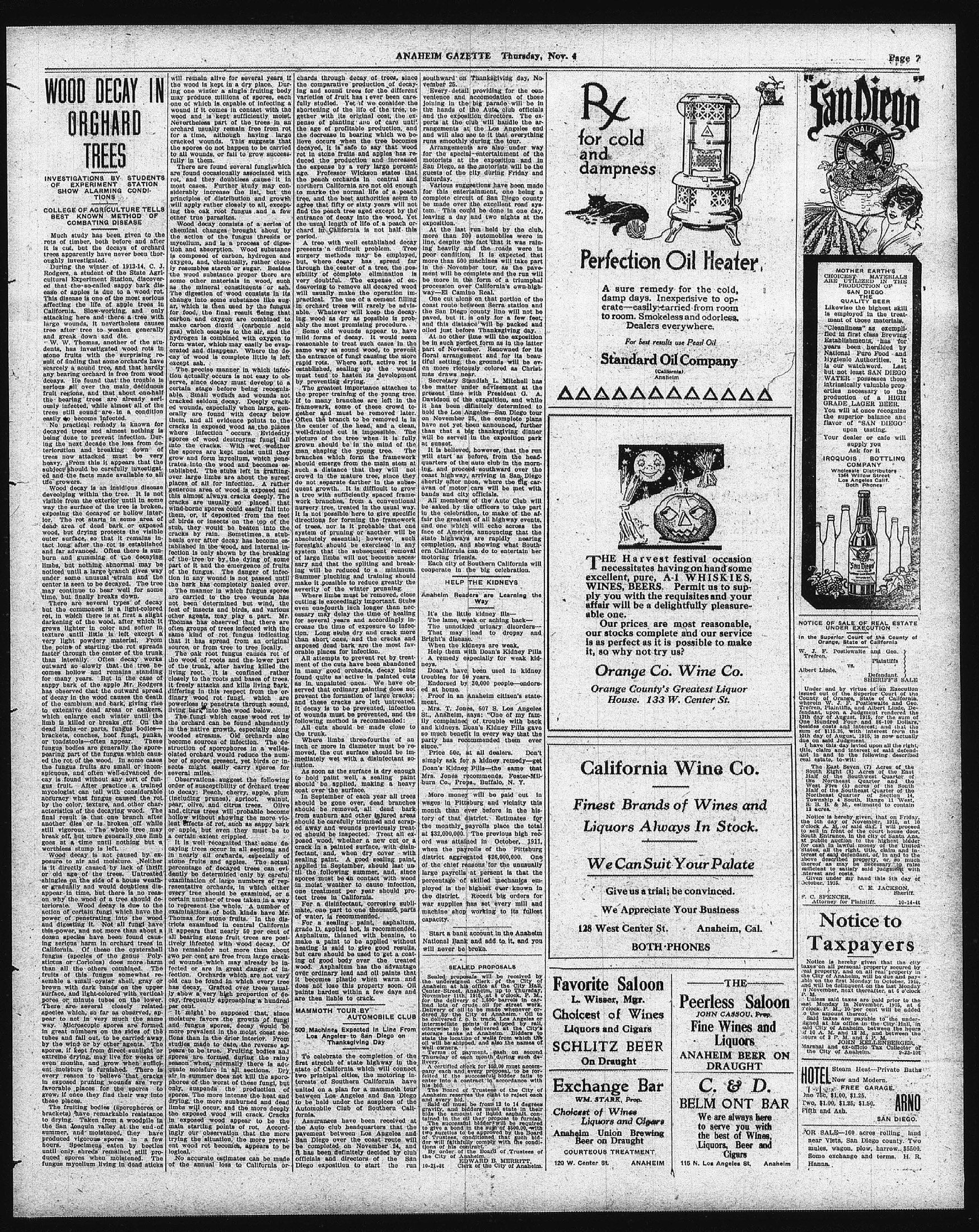
Searchable text
WOOD DECAY IN ORGHARD TREES
INVESTIGATIONS BY STUDENTS OF EXPERIMENT STATION SHOW ALARMING CONDITIONS
COLLEGE OF AGRICULTURE TELLS BEST KNOWN METHOD OF COMBATING DISEASE
Much study has been given to the rots of timber, both before and after it is cut, but the decays of orchard trees apparently have never thoroughly investigated.
During the winter of 1913-14, C. J. Rodgers, a student of the State Agricultural Experiment Station, discovered that the so-called sappy bark disease of apples is due to a wood rot. This disease is one of the most serious affecting the life of apple trees in California. Slow-working, and only attacking here and there a tree with large wounds, it nevertheless causes tree after tree to weaken generally and break down and die.
W. W. Thomas, another of the students, has investigated wood rots in stone fruits with the surprising result of finding that some orchards have scarcely a sound tree, and that hardly any bearing orchard is free from wood decays. He found that the trouble is serious all over the main deciduous fruit regions, and that about one-half the bearing trees are already seriously infected, while almost all of the trees still sound are—in a condition easily become infected.
No practical remedy is known for decayed trees and almost nothing is being done to prevent infection. During the next decade the loss from deterioration and breaking down of trees now attacked must be very will remain alive for several years if the wood is kept in a dry place. During one winter a single fruiting body may produce millions of spores, each one of which is capable of infecting a wound if it comes in contact with the wood and is kept sufficiently moist. Nevertheless part of the trees in an orchard usually remain free from rot for a time, although having large cracked wounds. This suggests that the spores do not happen to be carried to all wounds, or fail to grow successfully in them.
There are found several fungi which are found occasionally associated with rot, and they doubtless cause it in most cases. Further study may considerably increase the list, but the principles of distribution and growth will apply rather closely to all, excepting the oak root fungus and a few other true parasites.
Wood decay consists of a series of chemical changes brought about by the action of the fungus threads or mycelium, and is a process of digestion and absorption. Wood substance is composed of carbon, hydrogen and oxygen, and chemically, rather closely resembles starch or sugar. Besides the wood substance proper there are some other materials in wood, such as the mineral constituents or ash. The digestion of wood consists in its change into some substance like sugar, which is then used by the fungus for food, the final result being that carbon and oxygen are combined to make carbon dioxide (carbonic acid gas) which escapes to the air, and the hydrogen is combined with oxygen to form water, which may easily be evaporated and disappear. Where the decay of wood is complete little is left except ash.
The precise manner in which infection actually occurs is not easy to observe, since decay must develop to a certain stage before being recognizable. Small wounds and wounds not cracked seldom decay. Deeply cracked wounds, especially when large, generally are found with decay below them, and all evidence points to the cracks in exposed wood as the places where infection occurs. Evidently spores of wood destroying fungi fall into the cracks. With wet weather the spores are kept moist until they grow and form mycelium, which bene-chards through decay the comparative production and sound trees varieties of fruit has fully studied. Yet if shortening of the life gether with its origin pense of planting and the age of profitable use the decrease in bearer lieve occurs when the decayed, it is safe to rot in stone fruits anduced the productionthe expense by a very age. Professor Wickhill the peach orchards in northern California are to marke the normal tree, and the best an agree that fifty or six find the peach tree age entrance of decay inthe usual length of life chard in California be period.
A tree with well established surgery methods may but, where decay through the center of stability of complete very doubtful. The deavoring to remove will usually make this practical. The use of in orchard trees will enable. Whatever will ing wood as dry as probably the most promising Some old wounds mild forms of decay reasonable to treat same way as sound wthe entrance of fungi on rapid rots. Where so established, sealing t must tend to hasten by preventing drying.
The greatest importthe proper training offIf to many branches framework, some of gether and must be Often the branch to be the center of the heart well-drained cut is in picture of the tree wgrown should be in th man shaping the young branches which form
No practical remedy is known for decaying trees and almost nothing is being done to prevent infection. During the next decade the loss from deterioration and breaking down of trees now attacked must be very heavy. From this it appears that the subject should be carefully investigated and the facts made available to all tree growers.
Wood decay is an insidious disease developing within the tree. It is not visible from the exterior until in some way the surface of the tree is broken, exposing the decayed or hollow interior. The rot starts in some area of dead area of dead bark or exposed wood, but drying protects the visible outer surface, so that it remains intact long after the rot is established and far advanced. Often there is sunburn and gumming of the decaying limbs, but nothing abnormal may be noticed until a large branch gives way under some unusual strain and the center is seen to be decayed. The tree may continue to bear well for some time, but finally breaks down.
There are several types of decay but the commonest is a light-colored rot, in which there is at first a slight darkening of the wood, after which it grows lighter in color and softens in texture until little is left except a very light powdery material. From the point of starting the rot spreads faster through the center of the trunk than laterally. Often decay works outward so slowly that the tree becomes hollow and remains standing for many years. But in the case of sappy bark of the apple Mr. Rodgers has observed that the outward spread of decay in the wood causes the death of the cambium and bark, giving rise to extensive dead areas or cankers, which enlarge each winter until the limb is killed or breaks off. On the dead limbs or parts, fungus bodies—brackets, conches, hoof fungi, punks, or toadstools—often appear. These fungus bodies are generally the spore-pearing part of the fungus which caused the rot of the wood. In some cases the fungus fruits are small or inconspicuous, and often well-advanced decay is found without any sort of fungus fruit. After practice a trained mycologist can tell with considerable accuracy what fungus caused the rot by the color, texture, and other characteristics of the decaying wood. The final result is that one branch after another dies or is broken off while still vigorous. The whole tree may break off, but more generally one limb goes at a time until nothing but a worthless stump is left.
Wood decay is not caused by exposure to air and moisture. Neither is it directly caused by lack of thrift.
The precise manner in which infection actually occurs is not easy to observe, since decay must develop to a certain stage before being recognizable. Small wounds and wounds not cracked seldom decay. Deeply cracked wounds, especially when large, generally are found with decay below them, and all evidence points to the cracks in exposed wood as the places where infection occurs. Evidently spores of wood destroying fungi fall into the cracks. With wet weather the spores are kept moist until they grow and form mycelium, which penetrates into the wood and becomes established. The stubs left in grafting over large limbs are about the surest places of all for infection. A rather generous area of wood is exposed and this almost always cracks deeply. The cracks are usually so placed that wind-borne spores could easily fall into them, or if deposited from the feet of birds or insects on the top of the stub, they would be beaten into the cracks by rain. Sometimes a stub-heals over after decay has become established in the wood, and internal infection is only shown by the breaking of the tree or by the dying of some part of it and the emergence of fruits of the fungus. The danger of infection in any wound is not passed until the bark has completely healed over.
The manner in which fungus spores are carried to the tree wounds has not been determined but wind, the feet of insects and birds, and various other agents, may play a part. Mr. Thomas has observed that there are often groups of trees infected with the same kind of rot fungus indicating that it has spread from an original source, or from tree to tree locally.
The oak root fungus causes rot of the wood of roots and the lower part of the trunk, after having killed the living root. It is confined rather closely to the roots and bases of trees. It freely attacks and kills living bark, differing in this respect from the ordinary wood rot fungi, which are powerless to penetrate through sound, living bark into the wood below.
The fungi which cause wood rot in the orchard can be found abundantly in the native growth, especially along wooded streams. Old orchards also become sources of infection. The destruction of sporophores in a well-isolated orchard would reduce the number of spores present, yet birds or insects might easily carry spores for several miles.
Observations suggest the following order of susceptibility of orchard trees to decay: Peach, cherry, apple, plum (including prunes), apricot, walnut, pear, olive, and citrus trees. Olive and citrus trees will probable become hollow without showing the more violent effects of rot, such as sappy bark or apple, but even they must be to a certain extent crippled.
It is well recognized that some decaying trees occur in all sections and in nearly all orchards, especially of stone fruits and apples. The actual percentage of decayed trees can evil rapid rots. Where no established sealing must tend to hasten by preventing drying.
The greatest importance to proper training of if to many branches framework, some of gether and must be often the branch to be in the center of the heart well-drained cut is in picture of the tree with grown should be in man shaping the young branches which form should emerge from such a distance that crowd in the mature do not separate farther growth. It is on a tree with sufficiently work branches, from nursery tree, treated it. It is not possible here directions for forming of trees, nor is it pre system of pruning or absolutely essential; foresight should be eased system that the subs of large limbs will not crease the time of extinction. Long stubs dry than short ones, and exposed dead bark areirable places for infestation.
All attempts to provement of the cuts have in many good orchard found quite as active as in unpainted ones served that ordinary person prevent the formation and these cracks are It decay is to be prevent of wounds must be pre followng method is re All cuts should be in the trunk.
Where limbs three inch or more in diameter moved, the cut surface mediately wet with a lution.
As soon as the surface to hold paint well, should be applied, new coat over the surface.
In September each should be gone over, should be removed, as from sunburn and other should be carefully trim ed away and wounded should be inspected posed wood, whether crack in a painted surfactant, and when de sealing paint. A good applied in September
Wood decay is not caused by exposure to air and moisture. Neither is it directly caused by lack of thrift or old age of the trees. Untreated shingles on the side of a house weather gradually and would doubtless disappear in time, but there is no reason why the wood of a tree should deteriorate. Wood decay is due to the action of certain fungi which have the power of penetrating into the wood and digesting it. Not all fungi have this power, and not more than about a dozen species have been found causing serious harm in orchard trees in California. Of these the oystershell fungus (species of the genus Polystictus or Coriolus) does more harm than all the others combined. The fruits of this fungus somewhat resemble a small oyster shell, gray or brown with dark bands on the upper surface, and light-colored with vertical pores or minute tubes on the lower. There are several closely related species which, so far as observed, appear to act in very much the same way. Microscopic spores are formed in great numbers on the sides of the tubes and fall out, to be carried away by the wind or by other agents. The spores, if kept from direct sunlight or extreme drying, may live for weeks or even months, and grow when sufficient moisture is furnished. There is every reason to believe that cracks in exposed pruning wounds are very favorable places for the spores to grow, if once they find their way into these places.
The fruiting bodies (sporophores or brackets) have remarkable resistance to drying. Taken from a woodpile in the San Loquin valley at the end-of-summer, and moistened, they have produced vigorous spores in a few hours. Specimens eaten by beetles until only shreds remained still produced spores when moistened. The fungus mycelium living in dead sticks
Observations suggest the following order of susceptibility of orchard trees to decay: Peach, cherry, apple, plum (including prunes), apricot, walnut, pear, olive, and citrus trees. Olive and citrus trees will probably become hollow without showing the more violent effects of rot, such as sappy bark or apple, but even they must be to a certain extent crippled.
It is well recognized that some decaying trees occur in all sections and in nearly all orchards, especially of stone fruits and apples. The actual percentage of decayed trees can evidently be determined only by careful examination of large numbers of representative orchards, in which either every tree should be examined, or a certain number of trees taken in a way to represent the whole. A number of examinations of both kinds have Mr. Thomas for stone fruits. In the districts examined in central California it appears that nearly 50 per cent of all bearing stone fruit trees are positively infected with wood decay. Of the remainder not more than about two per cent are free from large cracked wounds which may already be infected or are in great danger of infection. Orchards which are not very old can be found in which every tree has decay. Grafted over trees usually show a very high proportion of decay, frequently approaching a hundred per cent.
It might be supposed that, since moisture favors the growth of fungi and fungus spores, decay would be more prevalent in the moist coast sections than in the drier interior. From studies made to date, the reverse appears to be true. Fruiting bodies and spores are formed during the rainy season when, normally there is adequate moisture in all sections. Dry air in summer does not kill the sporophores of the worst of these fungi, but only suspends the production of spores. The more intense the heat and drying, the more sunburned and dead limbs will occur, and the more deeply the exposed wood will crack. Cracks in exposed wood appear to be the main starting points of rot. Accordingly our observation that the more trying the situation, the more prevalent wood rot becomes, appears to be logical.
No accurate estimates can be made of the annual loss to California or several miles.
In September of each should be gone over, should be removed, from sunburn and other should be carefully trimmed away and wounds should be inspected posed wood, whether crack in a painted surfacefectant, and when de sealing paint. A good applied in September, till the following summer spores must be in coorin moist weather to one treatment per year infect trees in California.
For a disinfectant mate, one part to one part of water is recommended.
For a sealing paint grade D, applied hot, Asphaltum, thinned worm make a paint to be heated is said to give but care should be used of good body over wood. Asphaltum hard over ordinary lead and it becomes plastic worm does not lose this pre-paint hardness within one then liable to crack.
MAMMOTH TOUR-BE AUTO
500 Machines Expected Los Angeles to S Thanksgiving
To celebrate the first stretch of state line of California who two principal cities, the treats of Southern Oregon united on a plan for a between Los Angeles to be held under the Automobile Club of California.
Assurances have been made by the Auto club headquarter pavement between Los Angeles San Diego over the completed on Nov It has been definitely officials and directors Diego exposition to
chards through decay of trees, since the comparative production of decaying and sound trees for the different varieties of fruit has never been carefully studied. Yet if we consider the shortening of the life of the tree, together with its original cost, the expense of planting and of care until the age of profitable production, and the decrease in bearing which we believe occurs when the tree becomes decayed, it is safe to say that wood rot in stone fruits and apples has reduced the production and increased the expense by a very large percentage. Professor Wickson states that the peach orchards in central and northern California are not old enough to mark the normal life of a peach tree, and the best authorities seem to agree that fifty or sixty years will not find the peach tree aged except by the entrance of decay into the wood. Yet the usual length of life of a peach orchard in California is not half this period.
A tree with well established decay presents a difficult problem. Tree surgery methods may be employed, but, where decay has spread far through the center of a tree, the possibility of complete elimination is very doubtful. The expense of endeavoring to remove all decayed wood will usually make the operation impractical. The use of a cement filling in orchard trees will rarely be advisable. Whatever will keep the decaying wood as dry as possible is probably the most promising procedure.
Some old wounds appear to have mild forms of decay. It would seem reasonable to treat such cases in the same way as sound wood, to prevent the entrance of fungi causing the more rapid rots. Where soft, active rot is established, sealing up the wound must tend to hasten its development by preventing drying.
The greatest importance attaches to the proper training of the young tree. If to many branches are left in the framework, some of these crowd together and must be removed later. Often the branch to be removed is in the center of the head, and a clean, well-drained cut is impossible. The picture of the tree when it is fully grown should be in the mind of the man shaping the young tree. The branches which form the framework southward on Thanksgiving day, November 25.
Every detail providing for the convenience and accommodation of those joining in the big parade will be in the hands of the Auto club officials and the exposition directors. The experts at the club will handle the arrangements at the Los Angeles end and will also see to it that everything runs smoothly during the tour.
Arrangements are also under way for the special entertainment of the motorists at the exposition and in San Diego, as the motorist will be the guests of the city during Friday and Saturday.
Various suggestions have been made for this entertainment, one being a complete circuit of San Diego county be made over the excellent road system. This could be done in one day, leaving a day and two nights at the exposition.
At the last run held by the club, more than 200 automobiles were in line, despite the fact that it was raining heavily and the roads were in poor condition. It is expected that more than 500 machines will take part in the November tour, as the pavement will be complete and the run will be more in the form of a triumphal procession over California's own-highway—El Camino Real.
One cut alone on that portion of the coast route between Serra station and the San Diego county line will not be paved, but it is only for a few feet, and this distance will be packed and oiled just before Thanksgiving day.
At no other time will the exposition be in such perfect form as in the latter part of November. Renowned for its floral arrangement and for its beautiful setting, the grounds will be even more riotously colored as Christmas draws near.
Secretary Standish L. Mitchell has the matter under advisement at the present time with President G. A. Davidson of the exposition, and while it has been definitely determined to hold the Los Angeles—San Diego tour on November 25, the complete plans have not yet been announced, further than that a big thanksgiving dinner will be served in the exposition park at sunset.
It is believed, however, that the run will start as before, from the head-
The greatest importance attaches to the proper training of the young tree. If to many branches are left in the framework, some of these crowd together and must be removed later. Often the branch to be removed is in the center of the head, and a clean, well-drained cut is impossible. The picture of the tree when it is fully grown should be in the mind of the man shaping the young tree. The branches which form the framework should emerge from the main stem at such a distance that they will not crowd in the mature tree, since they do not separate farther in the subsequent growth. It is difficult to grow a tree with sufficiently spaced framework branches, from a conventional nursery tree, treated in the usual way. It is not possible here to give specific directions for forming the framework of trees, nor is it probable that one system of pruning or another will be absolutely essential; however, such foresight should be exercised in any system that the subsequent removal of large limbs will not become necessary and that the splitting and breaking will be reduced to a minimum. Summer pinching and training should make it possible to reduce greatly the severity of the winter prunning.
Where limbs must be removed, close cutting is exceedingly important. Stubs even one-fourth inch longer than necessary may delay the time of healing for several years and accordingly increase the time of exposure to infection. Long stubs dry and crack more than short ones, and the cracks and exposed dead bark are the most favorable places for infection.
All attempts to prevent rot by treatment of the cuts have been abandoned in many good orchards, decay being found quite as active in painted cuts as in unpainted ones. We have observed that ordinary painting does not prevent the formation of large cracks; and these cracks are left untreated. It decay is to be prevented, infection of wounds must be prevented, and the following method is recommended:
All cuts should be made close to the trunk.
Where limbs three-fourths of an inch or more in diameter must be removed, the cut surface should be immediately wet with a disinfectant solution.
As soon as the surface is dry enough to hold paint well, a sealing paint should be applied, making a heavy coat over the surface.
In September of each year all trees should be gone over, dead branches should be removed, all dead bark from sunburn and other injured areas should be carefully trimmed and scraped away and wounds previously treated should be inspected. Treat all exposed wood, whether a new cut or a crack in a painted surface, with disinfectant, and when dry cover with sealing paint. A good sealing paint, applied in September, should last uninterrupted.
Secretary Standish L. Mitchell has the matter under advisement at the present time with President G. A. Davidson of the expedition, and while it has been definitely determined to hold the Los Angeles—San Diego tour on November 25, the complete plans have not yet been announced, further than that a big thanksgiving dinner will be served in the exposition park at sunset.
It is believed, however, that the run will start as before, from the headquarters of the auto club in the morning, and proceed southward over the coast highway, arriving in San Diego shortly after noon, where the big caravan of motor cars will be met with bands and city officials.
All members of the Auto Club will be asked by the officers to take part in the celebration, to make of the affair the greatest of all highway events, and one which will echo across the face of America, announcing that the state highways are rapidly nearing completion, and showing what Southern California can do to entertain her motoring friends.
Each city of Southern California will cooperate in the big celebration.
HELP THE KIDNEYS
Anaheim Readers are Learning the Way
It's the little kidney lilies—
The lame, weak or aching back—
The unnoticed urinary disorders—
That may lead to dropsy and Bright's disease.
When the kidneys are weak,
Help them with Doan's Kidney Pills
A remedy especially for weak kidneys.
Doan's have been used in kidney troubles for 50 years.
Endorsed by 30,000 people—and endorsed at home.
Proof in an Anaheim citizen's statement.
Mrs. T. Jones, 507 S. Los Angeles St., Anaheim, says: "One of my family complained of trouble with back and kidneys. Doan's Kidney Pills gave so much benefit in every way that the party has recommended them ever since."
Price 50c, at all dealers. Don't simply ask for a kidney remedy—get Doan's Kidney Pills—the same that Mrs. Jones recommends. Foster-Milburn Co., Props., Buffalo, N. Y.
More money will be paid out in wages in Pittsburg and vicinity this month than ever before in the history of that district. Estimates for the monthly payrolls place the total at $32,000,000. The previous high record was attained in October, 1911, when the payrolls of the Pittsburgh district aggregated $26,000,000. One of the chief reasons for the unusually rapid growth is established, sealing up the wound must tend to hasten its development by preventing drying.
The greatest importance attaches to the proper training of the young tree. If to many branches are left in the framework, some of these crowd together and must be removed later. Often the branch to be removed is in the center of the head, and a clean, well-drained cut is impossible. The picture of the tree when it is fully grown should be in the mind of the man shaping the young tree. The branches which form the framework should emerge from the main stem at such a distance that they will not crowd in the mature tree, since they do not separate farther in the subsequent growth. It is difficult to grow a tree with sufficiently spaced framework branches, from a conventional nursery tree, treated in the usual way. It is not possible here to give specific directions for forming the framework of trees, nor is it probable that one system of pruning or another will be absolutely essential; however, such foresight should be exercised in any system that the subsequent removal of large limbs will not become necessary and that the splitting and breaking will be reduced to a minimum. Summer pinching and training should make it possible to reduce greatly the severity of the winter prunning.
Where limbs must be removed, close cutting is exceedingly important. Stubs even one-fourth inch longer than necessary may delay the time of healing for several years and accordingly increase the time of exposure to infection. Long stubs dry and crack more than short ones, and the cracks and exposed dead bark are the most favorable places for infection.
All attempts to prevent rot by treatment of the cuts have been abandoned in many good orchards, decay being found quite as active in painted cuts as in unpainted ones. We have observed that ordinary painting does not prevent the formation of large cracks; and these cracks are left untreated. It decay is to be prevented, infection of wounds must be prevented, and the following method is recommended:
All cuts should be made close to the trunk.
Where limbs three-fourths of an inch or more in diameter must be removed, the cut surface should be immediately wet with a disinfectant solution.
As soon as the surface is dry enough to hold paint well, a sealing paint should be applied, making a heavy coat over the surface.
In September of each year all trees should be gone over, dead branches should be removed, all dead bark from sunburn and other injured areas should be carefully trimmed and scraped away and wounds previously treated should be inspected. Treat all exposed wood, whether a new cut or a crack in a painted surface, with disinfectant, and when dry cover with sealing paint. A good sealing paint, applied in September, should last uninterrupted.
THE Harvest festival necessitates having excellent, pure, A-1 WINES, BEERS. Perform you with the requisite affair will be a delightful able one.
Our prices are most our stocks complete and is as perfect as it is possible it, so why not try us?
Orange Co. W
Orange County's Green House. 133 W. C
California W
Finest Brands of Liquors Always
We Can Suit You
to hold paint well, a sealing paint should be applied, making a heavy coat over the surface.
In September of each year all trees should be gone over, dead branches should be removed, all dead bark from sunburn and other injured areas should be carefully trimmed and scraped away and wounds previously treated should be inspected. Treat all exposed wood, whether a new cut or a crack in a painted surface, with disinfectant, and when dry cover with sealing paint. A good sealing paint, applied in September, should last until the following summer, and, since spores must be in contact with wood in moist weather to cause infection, one treatment per year should protect trees in California.
For a disinfectant, corrosive sublimate, one part to one thousand parts of water, is recommended.
For a sealing paint, asphaltum, grade D, applied hot, is recommended. Asphaltum, thinned with benzine, to make a paint to be applied without heating is said to give good results, but care should be used to get a coating of good body over the treated wood. Asphaltum has the advantage over ordinary lead and oil paints that it becomes plastic when warm and does not lose this property soon. Oil paints harden within a few days and are then liable to crack.
MAMMOTH TOUR BY AUTOMOBILE CLUB
500 Machines Expected In Line From Los Angeles to San Diego on Thanksgiving Day
To celebrate the completion of the first stretch of state highway in the state of California which will connect two principal cities, the motoring interests of Southern California have united on a plan for a mammoth tour between Los Angeles and San Diego to be held under the auspices of the Automobile Club of Southern California.
Assurances have been received at the Auto club headquarters that the pavement between Los Angeles and San Diego over the coast route will be completed on November 24, and it has been definitely decided by club officials and directors of the San Diego exposition to start the run
More money will be paid out in wages in Pittsburg and vicinity this month than ever before in the history of that district. Estimates for the monthly payrolls place the total at $32,000,000. The previous high record was attained in October, 1911, when the payrolls of the Pittsburg district aggregated $26,000,000. One of the chief reasons for the unusually large payrolls at present is that the percentage of skilled mechanics employed is the highest ever known in the district. Recent big orders for war supplies has set every mill and machine shop working to its fullest capacity.
Start a bank account in the Anaheim National Bank and add to it, and you will never be broke.
SEALED PROPOSALS
Sealed proposals will be received by the undersigned Clerk of the City of Anaheim at his office at the City Hall, Center-Street, Anaheim, up to Thursday, November 11th, 1915, at 8 o'clock, P.M., for the delivery of 1,500 barrels in carload lots of crude oil for street work. Delivery of oil to be made whenever ordered by the City of Anaheim. Oil to be delivered f. b. b. track, Los Angeles or intermediate points. If shipped by rail, otherwise to be delivered at the City storage park at Anaheim. Bidders to state the location of walls from which the oil will be shipped, and also the names of well owners.
Terms of payment, cash on second Thursday of each month during such delivery.
A certified check for $50.00 must accompany each and every proposal, to be forfeited if the successful bidder fails to enter into a contract in accordance with his bid.
The Board of Trustees of the City of Anaheim reserves the right to reject each and every bid.
Said oil must be from 13 to 14 degrees gravity, and bidders must state in their bids the amount of liquid asphalt contained in the oil they propose to furnish.
The successful bidder will be required to give a bond in the sum of $500.00, with two sureties to be approved by the Board of Trustees, conditioned that such bidder will faithfully comply with the conditions of his contract.
By order of the Board of Trustees of the City of Anaheim.
EDWARD B. MERRITT.
10-21-2t
Clerk of the City of Anaheim.
Cold
pness
Section Oil Heater.
sure remedy for the cold,
imp days. Inexpensive to opate—easily carried from room
room. Smokeless and odorless.
Dealers everywhere.
For best results use Pearl Oil
Standard Oil Company
(California).
Annaheim
SAN DIEGO
THE QUALITY BEER
MOTHER EARTH'S
CHOICE MATERIALS
ARE UTILIZED IN THE
PRODUCTION OF
SAN DIEGO
THE
QUALITY BEER
Likewise the highest skill is employed in the treat-ment of those materials.
"Cleanliness" as exemplified in first class Brewing Establishments, has for years been heralded by National Pure Food and Hygienic Authorities. It is our watchword. Last but not least SAN DIEGO WATER possesses those intrinsically valuable properties necessary to the production of a HIGH GRADE LAGER BEER.
You will at once recognize the superior balance and flavor of "SAN DIEGO" upon tasting.
Your dealer or cafe will supply you
Ask for it
IROQUOIS BOTTLING
Harvest festival occasion necessitates having on hand some present, pure, A-1 WHISKIES, BEERS. Permit us to supply with the requisites and your will be a delightfully pleasure-me.
Or prices are most reasonable, stocks complete and our service perfect as it is possible to make why not try us?
Orange Co. Wine Co.
County's Greatest Liquor House. 133 W. Center St.
California Wine Co.
Brands of Wines and Alms Always In Stock.
Can Suit Your Palate
NOTICE OF SALE OF REAL ESTATE UNDER EXECUTION
In the Superior Court of the County of Orange, State of California
W. J. F. Postlewalte and Geo. Trefren,
vs.
Albert Linde,
Defendant.
SHERIFF'S SALE
Under and by virtue of an Execution issued out of the Superior Court of the County of Orange, State of California, wherein W. J. F. Postlewalte and Geo. Trefren, Plaintiffs, and Albert Linde, Defendant, upon a Judgment, rendered the 13th day of August, 1915, for the sum of One Hundred Four and 86-100 Dollars, besides costs and interest; and that the sum of $115.36, with interest from the 13th day of August, 1915, is now actually due on said Judgment.
I have this day levied upon all the right, title, claim and interest of said defendant in and to the following described real estate, to-wit:
The East Seven. (7) Acres of the South Eight (8) Acres of the East Half of the Southwest Quarter of the Northeast Quarter and the West Five (5) acres of the South Half of the Southeast Quarter of the Northeast Quarter of Section 14, Township 4 South, Range 11 West, S. B. B. & M., estimated to contain 12 acres.
Notice is hereby given, that on Friday, the 5th day of November, 1915, at 10 o'clock A.M. of said day, I will proceed to sell in front of the court house door, South Entrance, in the city of Sancti Ana, at public auction to the highest bidder for cash in lawful money of the United States, all the right, title, claim and interest of said defendant, of, in and to the above described property, or, so much thereof as may be necessary, to raise sufficient to satisfy said judgment with
Brands of Wines and
Ours Always In Stock.
Can Suit Your Palate
ive us a trial; be convinced.
Appreciate Your Business
Center St. Anaheim, Cal.
BOTH PHONES
THE
Peerless Saloon
JOHN CASSOU, Prop.
Fine Wines and Liquors
ANAHEIM BEER ON DRAUGHT
C. & D.
BELM ONT BAR
We are always here to serve you with the best of Wines,
Liquors, Beer and Cigars
115 N. Los Angeles St. Anaheim
Notice is hereby given, that on Friday,
the 5th day of November, 1915, at 10 o'clock A.M., of said day, I will proceed
to sell in front of the court house door,
South Entrance, in the city of Santa Ana,
at public auction to the highest bidder
for cash in lawful money of the United
States, all the right, title, claim and interest of said defendant, of, in and to the above described property, or, so much thereof as may be necessary to raise sufficient to satisfy said judgment with interest and costs.
Given under my hand this 8th day of October, 1915.
C. E. JACKSON,
Sheriff.
F. C. SPENCER,
Attorney for Plaintiff.
Notice to Taxpayers
Notice is hereby given that the city taxes on all personal property secured by real property, and on all real property in the City of Anaheim, will be due and payable on the first Monday in October, 1916,
and will be delinquent on the last Monday in November, next thereafter, at 6 o'clock P.M.
Unless said taxes are paid prior to the last Monday in November, 1915, at 6 o'clock P.M., 10 per cent will be added to the amount thereof.
Said taxes are payable to the under-signed at this office in the City Hall, between the hours of 10 A.M. and 12 M., and between the hours of 2 P.M. and 5 P.M.
JOHN KELLENBERGER,
Marshal and ex-officio Tax Collector of the City of Anaheim.
Steam Heat—Private Baths
New and Modern.
FREE GARAGE.
One 75c., $1.00, $1.25.
Two, $1.00, $1.25, $1.50.
Fifth and Ash.
SAN DIEGO.
FOR SALE—160 acres rolling land near Vista, San Diego county. Two mules, wagon, plow, harrow. $5500. Some exchange and terms. H. R. Hanna.