anaheim-gazette 1915-10-28
Scanned page
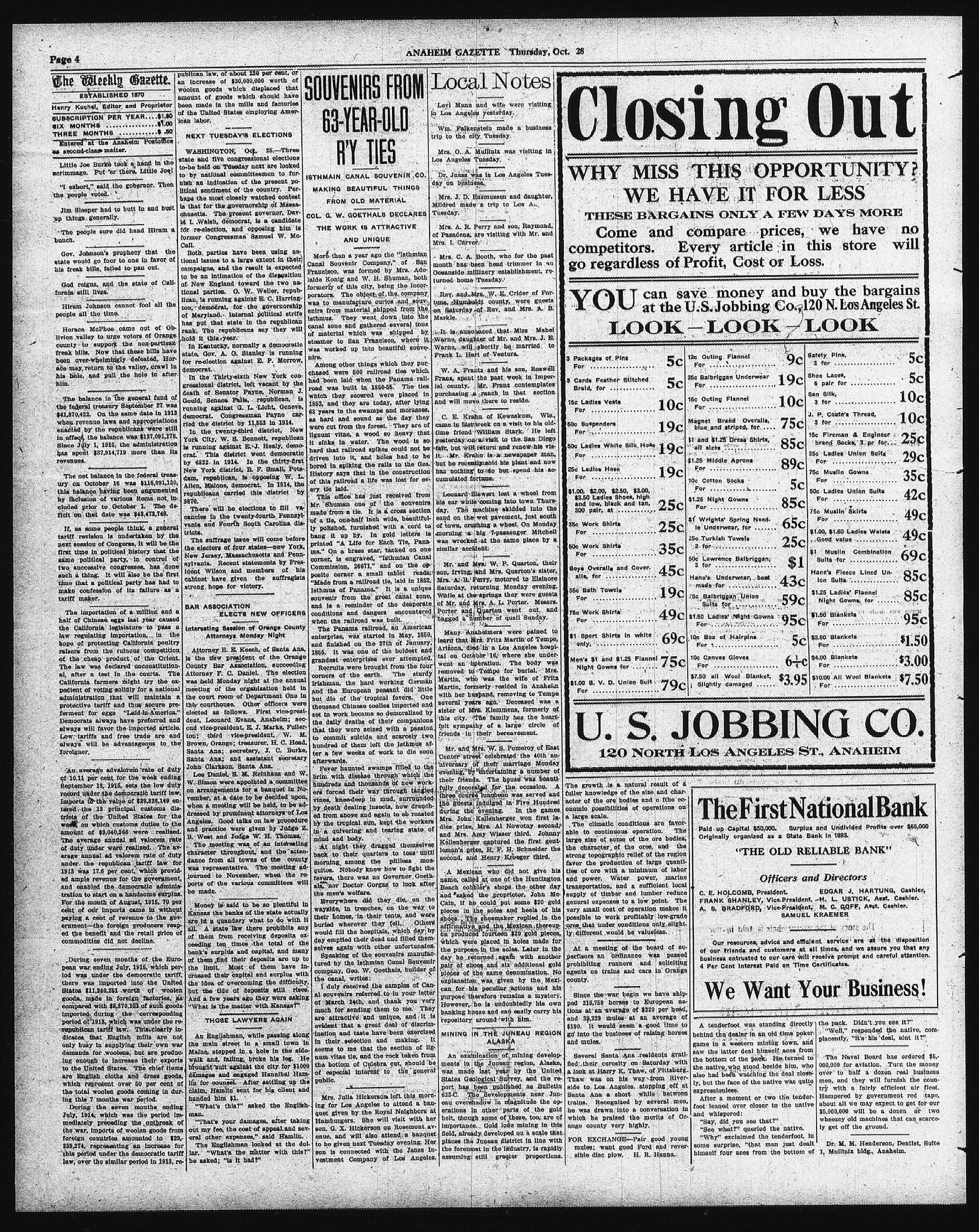
Searchable text
The Weekly Gazette.
ESTABLISHED 1870
Henry Kuchel, Editor and Proprietor
SUBSCRIPTION PER YEAR...$1.50
SIX MONTHS ...$1.00
THREE MONTHS ...$ .50
Entered at the Anaheim Postoffice as second-class matter.
Little Joe Burke took a hand in the scrimmage. Put 'er there, Little Joel!
"I exhort," said the governor. Then the people voted.
Jim Sleeper had to butt in and bust up things generally.
The people sure did hand Hiram a bunch.
Gov. Johnson's prophecy that the state would go four to one in favor of his freak bills, failed to pan out.
God reigns, and the state of California still lives.
Hiram Johnson cannot fool all the people all the time.
Horace McPhee came out of Oblivion valley to urge voters of Orange county to support the non-partisan freak bills. Now that these bills have been over-whelmingly defeated, Horace may return to the valley, crawl in his hole, and pull the hole in after him.
The balance in the general fund of the federal treasury September 27 was $41,870,422. On the same date in 1913 when revenue laws and appropriations enacted by the republicans were still in effect, the balance was $127,091,178. Since July 1, 1915, the administration has spent $37,914,719 more than its publican law, of about 230 per cent, or an increase of $20,000,000 worth of woolen goods which displaced that amount of goods which should have been made in the mills and factories of the United States employing American labor.
NEXT TUESDAY'S ELECTIONS
WASHINGTON, Oct. 25. Three state and five congressional elections to be held on Tuesday next are looked to by national committeemen to furnish an indication of the present political sentiment of the country. Perhaps the most closely watched contest is that for the governorship of Massachusetts. The present governor, David I. Walsh, democrat, is a candidate for re-election, and opposing him is former Congressman Samuel W. McCall.
Both parties have been using national issues to a large extent in their campaigns, and the result is expected to be an intimation of the disposition of New England toward the two national parties. O. W. Weller, republican, is running against E. C. Harrington, democrat, for the governorship of Maryland. Internal political strife has put that state in the republican rank. The republicans say they will hold it this year.
In Kentucky, normally a democratic state, Gov. A. O. Stanley is running for re-election against E. P. Morrow, democrat.
In the Thirty-sixth New York congressional district, left vacant by the death of Senator Payne, Norman J. Gould, Senaca Falls, republican, is running against G. L. Licht, Geneva, democrat. Congressman Payne carried the district by 11,553 in 1914.
In the twenty-third district, New York City, W. S. Bennett, republican is running against E. J. Healy, democrat. This district went democratic.
SOUVENIR
63-YEAR
R'Y
ISTHMAIN CANAL
MAKING BEAU
FROM OLD
COL. G. W. GOETE
THE WORK IS
AND U
More than a year Canal Souvenir C Francisco, was fo laide Konig and W formerly of this clorators. The obje was to manufactur enirs from materi lsthmus. They w canal zone and ga of material which steamer to San was worked up in nires.
Among other th chased were 500 had been laid wh road was built in which they secon 1852; and they an 63 years in the sw as hard and sou were cut from th iignum vitae, a v it sinks in water hard that railroad driven into it, an
The balance in the general fund of the federal treasury September 27 was $41,870,422. On the same date in 1913 when revenue laws and appropriations enacted by the republicans were still in effect, the balance was $127,091,178. Since July 1, 1915, the administration has spent $37,914,719 more than its revenues.
The net balance in the federal treasury on October 16 was $116,091,130, this balance having been augmented by inclusion of various items not included prior to October 1. The deficit on that date was $43,473,748.
If, as some people think, a general tariff revision is undertaken by the next session of Congers, it will be the first time in political history that the same political party, in control of two successive congresses, has done such a thing. It will also be the first time that a political party has had to make confession of its failure as a tariff maker.
The importation of a million and a half of Chinese eggs last year caused the California legislature to pass a law regulating importation in the hope of protecting California poultry raisers from the ruinous competition of the cheap product of the Orient. The law was declared unconstitutional, after a test in the courts. The California farmers might try the expedient of voting solidly for a national administration that will maintain a protective tariff and thus secure preferment for eggs "Laid-in-America." Democrats always have preferred and always will favor the imported article. Low tariffs and free trade are and always will be advantageous to the foreigner.
An average advalorem rate of duty of 10.11 per cent for the week ending September 18, 1915, sets the low duty record under the democratic tariff law. Imports of the value of $29,826,149 entered the 13 principal customs districts of the United States for the week on which customs duties to the amount of $3,040,368 were realized. The average annual ad valorem rate of duty under were realized. The average annual ad valorem rate of duty under the republican tariff law for 1915 was 17.6 per cent which provided for reelection against in New York congressional district, left vacant by the death of Senator Payne, Norman J. Gould, Seneca Falls, republican, is running against G. L. Licht, Geneva, democrat. Congressman Payne carried the district by 11,553 in 1914.
In the twenty-third district, New York City, W. S. Bennett, republican is running against E. J. Healy, democrat. This district went democratic by 6822 in 1914. In the thirty-first New York district, B. F. Small, Potsdam, republican, is opposing W. L. Allen, Malone, democrat. In 1914, the republicans carried this district by 9870.
There will be elections to fill vacancies in the twenty-fourth Pennsylvania and Fourth South Carolina districts.
The suffrage issue will come before the electors of four states—new York, New Jersey, Massachusetts and Pennsylvania. Recent statements by President Wilson and members of his cabinet have given the suffragists strong hope for victory.
BAR ASSOCIATION
ELECTS NEW OFFICERS
Interesting Session of Orange County Attorneys Monday Night
Attorney E. E. Keech, of Santa Ana, is the new president of the Orange County Bar Association, succeeding Attorney F. C. Daniel. The election was held Monday night at the annual meeting of the organization held in the court room of Department One in the courthouse. Other officers were elected as follows. First vice-president, Leonard Evans, Anaheim; second vice-president, E. J. Marks, Fullerton; third vice-president, W. M. Brown, Orange; treasurer, H. C. Head, Santa Ana; secretary, J. C. Burke, Santa Ana; and assistant secretary John Clarkson, Santa Ana.
Lee Daniel, S. M. Reinhaus and W. W. Simon were appointed a committee on arrangements for a banquet in November, at a date to be decided upon, when a meeting will be held, to be addressed by prominent attorneys of Los Angeles. Good talks on law procedure and practice were given by Judge Z. B. West and Judge W. H. Thomas.
The meeting was of an interesting character throughout, and the attendance from all towns of the county was representative. The meeting adjudged were 500 had been laid while road was built in which they seceded 1852, and they are 63 years in the swat as hard and sound were cut from their lignum vitae, a wilt sinks in water hard that railroad driven into it, and bored in spiking History says that of this railroad a very tie laid.
This office has Mr. Shuman one made from a tie of a tie, one-half polished, furnish hang it up by printed "A Life ma." On a brass corner is engraved Commission, 2667 posite corner a "Made from a rail Isthmus of Panama souvenir from tha and is a reminder conditions and d when the railroad.
The Panama renterprise was s and finished on 1855. It was one grandest enterprise.
Recruits were b corners of the Irishman, the ha and the Europe but die of the thousand Chinese set to work because the daily deaths that they were sent to commit suicide hundred of them ter a few weeks afterwards.
Fever haunted brim with dishears hundreds and ther ers forced their vines, knee-deep by death dealing ed from above and by the tropical s in a quivering mind and body.
At night they back to their q morning among Nobody
During seven months of the European war ending July, 1915, which period was under the democratic tariff law, there was imported into the United States $11,240,251 worth of woolen goods, made in foreign factories, as compared with $8,870,101 of such goods imported during the corresponding period of 1913, which was under the republican tariff law. This clearly indicates that English mills are not only busy in supplying their own war demands for woolens; but are producing enough to increase their exports to the United States. The chief items are English cloths and dress goods, which represent over 50 per cent of the total woolen goods coming in during this 7 months war period.
During the seven months ending July, 1914, which was the period immediately preceding the outbreak of the war, imports of woolen goods from foreign countries amounted to $29,239,274, representing an increase for this period under the democratic tariff law, over the similar period in 1913, re-
Lee Daniel, B. M. Reinhann and W. W. Simon were appointed a committee on arrangements for a banquet in November, at a date to be decided upon, when a meeting will be held, to be addressed by prominent attorneys of Los Angeles. Good talks on law procedure and practice were given by Judge Z. B. West and Judge W. H. Thomas.
The meeting was of an interesting character throughout, and the attendance from all towns of the county was representative. The meeting adjourned to November, when the reports of the various committees will be made.
Money is said to be so plentiful in Kansas the banks of the state actually are in a quandary what to do with it all. A state law there prohibits any of them from receiving deposits exceeding ten times the total of the bank's surplus and capital, and many of them find their deposits are up to the limit. Most of them have increased their capital and surplus with the idea of overcoming the difficulty, but the tide of deposits still rises. And a few years ago they were asking "What is the matter with Kansas?"
THOSE LAWYERS AGAIN
An Englishman, while passing along the main street in a small town in Maine, stepped in a hole in the sidewalk and, falling, broke his leg. He brought suit against the city for $1000 damages and engaged Hannibal Hamlin for counsel. After settling up the claim, Hamlin sent for his client and handed him $1.
"What's this?" asked the Englishman.
"That's your damages, after taking out my fee, the cost of appeal and several other expenses," said Hamlin.
The Englishman looked at the dollar. "What's the matter with this?" he asked; "is it bad?"
SOUVENIRS FROM
63-YEAR-OLD
R'Y TIES
ISTHMAIN CANAL SOUVENIR CO.
MAKING BEAUTIFUL THINGS
FROM OLD MATERIAL
COL. G. W. GOETHALS DECLARES
THE WORK IS ATTRACTIVE
AND UNIQUE
More than a year ago the "Isthmian Canal Souvenir Company," of San Francisco, was formed by Mrs. Adelaide Konig and W. H. Shuman, both formerly of this city, being the incorporators. The object of the company was to manufacture curios and souvenirs from material shipped from the Isthmus. They went down into the canal zone and gathered several tons of material which was shipped by steamer to San Francisco, where it was worked up into beautiful souvenirs.
Among other things which they purchased were 500 railroad ties which had been laid when the Panama railroad was built in 1850-55. The ties which they secured were placed in 1852, and they are today, after lying 63 years in the swamps and morasses, as hard and sound as the day they were cut from the forest. They are of lignum vitae, a wood so heavy that it sinks in water. The wood is so hard that railroad spikes could not be driven into it, and holes had to be
Local Notes
Levl Mann and wife were visiting in Los Angeles yesterday.
Wm. Falkenstein made a business trip to the city Tuesday.
Mrs. O. A. Mullinix was visiting in Los Angeles Tuesday.
Dr. Jnasss was in Los Angeles Tuesday on business.
Mrs. J. D. Rasmussen and daughter, Mildred made a trip to Los An. Tuesday.
Mrs. A. R. Perry and son, Raymond, of Pasadena, are visiting with Mr. and Mrs. I. Carver.
Mrs. C. A. Booth, who for the past month has been head trimmer in au Oceanside millinery establishment, returned home Tuesday.
Rev. and Mrs. W. E. Crider of Fortuna, Humboldt county, were guests on Saturday of Rev. and Mrs. A. B. Markle.
It is announced that Miss Mabel Warne, daughter of Mr. and Mrs. J. E. Warne, will shortly be married to Frank L. Hart of Ventura.
W. A. Frantz and his son, Roswell Franz, spent the past week in Imperial county. Mr. Franz contemplates purchasing a ranch in that section and will move there to reside.
C. E. Krahn of Kewaskum, Wis., came in last week on a visit to his old-time friend William Stark. He left yesterday on a visit to the San Diego fair, but will return and renew his visit.
Mr. Krahn is a newspaper man,
WHY MISS WE HAVE THESE BARGAINS
Come and compete. Evil go regardless of P
YOU can save at the U LOOK
Among other things which they purchased were 500 railroad ties which had been laid when the Panama railroad was built in 1850-55. The ties which they secured were placed in 1852, and they are today, after lying 63 years in the swamps and morasses, as hard and sound as the day they were cut from the forest. They are of lignum vitae, a wood so heavy that it sinks in water. The wood is so hard that railroad spikes could not be driven into it, and holes had to be bored in spiking the rails to the ties. History says that in the construction of this railroad a life was lost for every tie laid.
This office has just received from Mr. Shuman one of the souvenirs made from a tie. It is a cross section of a tie, one-half inch wide, beautifully polished, furnished with a cord to hang it up by. In gold letters is printed "A Life for Each Tie, Panama." On a brass star, tacked on one corner, is engraved, "Isthmian Canal Commission, 26671," and on the opposite corner a small tablet reads: "Made from a railroad tie, laid in 1852, Isthmus of Panama." It is a unique souvenir from the great canal zone, and is a reminder of the desperate conditions and dangers encountered when the railroad was built.
The Panama railroad, an American enterprise, was started in May, 1850, and finished on the 27th of January, 1855. It was one of the boldest and grandest enterprises ever attempted.
Recruits were brought from the four corners of the earth. The sturdy Irishman, the hard working German and the European peasant did little but die of the tropical fevers. One thousand Chinese coolies imported and set to work became so demoralized by the daily deaths of their companions that they were seized with a passion to commit suicide and scarcely two hundred of them left the Isthmus after a few weeks of work to die soon afterwards.
Fever haunted swamps filled to the brim with disease through which the hundreds and thousands of new workers forced their way through tangled vines, knee-deep in mud, surrounded by death dealing insects, now drenched from above and again to ebroasted by the tropical sun, kept the workers in a quivering and tearing state of mind and body.
At night they dragged themselves back to their quarters to toss until morning among the pitiless mosquitoes. Nobody knew how to fight the
W. A. Frantz and his son, Roswell Franz, spent the past week in Imperial county. Mr. Franz contemplates purchasing a ranch in that section and will move there to reside.
C. E. Krahn of Kewaskum, Wis., came in last week on a visit to his old-time friend William Stark. He left yesterday on a visit to the San Diego fair, but will return and renew his visit. Mr. Krahn is a newspaper man, but he recently sold his plant and now has nothing to do but spend his accumulated fortune.
Leonard Siewert lost a wheel from his car while coming into town Thursday. The machine skidded into the sand on the wet pavement, just south of town, crushing a wheel. On Monday morning a big 7-passenger Mitchell was wrecked at the same place by a similar accident.
Mr. and Mrs. W. P. Quarton, their son, Irving, and Mrs. Quarton's sister, Mrs. A. R. Perry, motored to Elsinore Saturday, returning Monday evening. While at the springs they were guests of Mr. and Mrs. A. L. Porter. Messrs. Porter and Quarton went out and bagged a number of quail Sunday.
Many Anaheimers were palmed to learn that Mrs. Fritz Martin of Tempe, Arizona, died in a Los Angeles hospital on October 16; where she underwent an operation. The body was removed to Tempe for burial. Mrs. Martin, who was the wife of Fritz Martin, formerly resided in Anahelen with her husband, removing to Tempe several years ago. Deceased was a sister of Mrs. Klemmens, formerly of this city. The family has the heartfelt sympathy of a large circle of friends in their bereavement.
Mr. and Mrs. W. S. Pomeroy of East Center street celebrated the 40th anniversary of their marriage Monday evening by entertaining a number of their friends. The house was beautifully decorated for the occasion. A three course luncheon was served and the guests indulged in Five Hundred during the evening. In the games Mrs. John Kellenberger won first ladies prize, Mrs. Al Nowotny second, and Mrs. Amy Wisser third. Johnny Kellenberger captured the first gentleman's prize, H. F. H. Schneider the second, and Henry Kroeger third.
The growth is a natural result of a fuller knowledge of the size and character of the ore bodies and o fthe economic possibilities of operations on a large scale.
The climatic conditions are favorable to continuous operation. The large size of some of the ore bodies, the character of the ores, and the strong topographic relief of the region favor the production of large quantities of ore with a minimum of labor.
brim with disease through which the hundreds and thousands of new workers forced their way through tangled vines, knee-deep in mud, surrounded by death dealing insects, now drenched from above and again to eb roasted by the tropical sun, kept the workers in a quivering and tearing state of mind and body.
At night they dragged themselves back to their quarters to toss until morning among the pitiless mosquitos. Nobody knew how to fight the fevers, there was no Governor Goethals, nor Doctor Gorgas to look after the men's welfare.
Everywhere did they die, on the wayside, in trenches, on the way to their homes, in their tents, and were buried wherever they fell. Others would fill the hospitals, which day by day emptied their dead and filled themselves again with other unfortunates.
Speaking of the souvenirs manufactured by the Isthmian Canal Souvenir company, Geo. W. Goethals, builder of the canal, writes:
I duly received the samples of Canal souvenirs referred to in your letter of March 24th, and thank you very much for sending them to me. They are attractive and unique, and it is evident that a great deal of discrimination and taste have been exercised in their selection and making. It seems to me that the section of ligum vitae tie, and the rock taken from the bottom of Culebra cut, should be of especial interest to the general public.
Mrs. Julla Hickerson left this morning for Los Angeles to attend a banquet given by the Royal Neighbors at Hamburgers. She will visit with her son, G. X. Hickerson on Rosemont avenue, and will also attend a banquet to be given next Tuesday evening. Her son is connected with the Janss Investment Company of Los Angeles.
A Mexican who did not give his name, called at one of the Huntington Beach cobbler's shops the other day and asked the proprietor, John McCain, if he could put some $20 gold pieces in the soles and heels of his shoes. The shoemaker replied in the affirmative, and the Mexican thereupon produced fourteen $20 gold pieces, which were placed in holes made for the purpose in the soles. Later in the day he returned again with another pair of shoes and six additional gold pieces of the same denomination. No explanation was given by the Mexican for his peculiar actions and his purpose therefore remains a mystery. However, he is undoubtedly his own banking house and can easily carry his repository around with him.
MINING IN THE JUNEAU REGION ALASKA
An examination of mining developments in the Juneau region, Alaska, was made last year by the United States Geological Survey, and the report has been published as Bulletin 622-C. The developments near Juneau overshadow in magnitude the operations in other parts of the gold belt, though some of these, too, are of importance. Gold lode mining in this field, already developed on a scale that places the Juneau district in line with the foremost in the industry, is rapidly assuming still greater proportions.
The growth is a natural result of a fuller knowledge of the size and character of the ore bodies and o fthe economic possibilities of operations on a large scale.
The climatic conditions are favorable to continuous operation. The large size of some of the ore bodies, the character of the ores, and the strong topographic relief of the region favor the production of large quantities of ore with a minimum of labor and power. Water power, marine transportation, and a sufficient local supply of timber and lumber reduce general expenses to a low point. The very small cost of operation makes it possible to work profitably low-grade ores that under conditions only slightly different would be valueless.
At a meeting of the board of superfisors an ordinance was passed prohibiting runners and soliciting agents on trains and cars in Orange county.
Since the war begin we have shipped 215,759 horses to European nations at an average of $220 per head, and 39,229 mules at an average of $190. It would seem a good time to go into the business of raising horses and mules.
Several Santa Ana residents gratified their curiosity on Saturday with a look at Harry K. Thaw, of Pittsburg. Thaw was on his way from Riverside to Los Angeles, stopping off at Santa Ana a short while between trains. Recognized by several men, he was drawn into a conversation in which he praised the merits of Orange county very highly.
FOR EXCHANGE—Pair good young mules; want good Ford and reversible disc plow. H. R. Hanna.
Closing Out
Y MISS THIS OPPORTUNITY?
WE HAVE IT FOR LESS
USE BARGAINS ONLY A FEW DAYS MORE
home and compare prices, we have no
titors. Every article in this store will
hardless of Profit, Cost or Loss.
You can save money and buy the bargains
at the U.S. Jobbing Co., 120 N. Los Angeles St.
LOOK—LOOK—LOOK
Pins 5c
12c Outing Flannel For 9c
Safety Pins, 3 for 5c
Stitched 5c
35c Balbriggan Underwear For 19c
Shoe Laces, 6 pair for 5c
ta 10c
15c Outing Flannel For 10c
San Silk, 3 for 10c
19c
Magnet Brand Overalls, blue and striped, for 75c
J. P. Coate's Thread, 3 for 10c
Silk Hose 19c
$1 and $1.25 Dress Shirts, all sizes 85c
15c Fireman & Engineer brand Socks, 3 pr for 25c
35c Ladies Union Suits 29c
S. JOBBING CO.
20 NORTH LOS ANGELES ST., ANAHEIM
TheFirstNationalBank
Paid up Capital $50,000. Surplus and Undivided Profits over $65,000
Originally organized as a State Bank in 1893.
“THE OLD RELIABLE BANK”
The First National Bank
Paid up Capital $50,000. Surplus and Undivided Profits over $65,000 Originally organized as a State Bank in 1893.
"The Old Reliable Bank"
Officers and Directors
C. E. HOLCOMB, President. EDGAR J. HARTUNG, Cashier,
FRANK SHANLEY, Vice-President. H. L. USTICK, Asst. Cashler.
A. S. BRADFORD, Vice-President. M. C. GOFF, Asst. Cashler.
SAMUEL KRAEMER
Our resources, advice and efficient service are at the disposition of our friends and customers at all times, and we assure you that any business entrusted to our care will receive prompt and careful attention.
4 Per Cent Interest Paid on Time Certificates.
We Want Your Business!
A tenderfoot was standing directly behind the dealer in an old time poker game in a western mining town, and saw the latter deal himself aces from the bottom of the pack. He turned to the native who stood beside him, who also had been watching the deal closely, but the face of the native was quite expressionless.
After a moment or two the tender-foot leaned over closer to the native and whispered:
"Say, did you see that?"
"See what?" queried the native.
"Why" exclaimed the tender-foot, in some surprise, "that man just dealt himself four aces from the bottom of the pack. Didn't you see it?"
"Well," responded the native, complacently, "it's his deal, alnt it?"
The Naval Board has ordered $5,000,000 for aviation. Turn the money over to half a dozen real business men, and they will furnish the country with a fairly efficient air fleet. Hampered by government red tape, about all we may expect to get for our $5,000,000 will be a dozen or two wheezy old machines that can scarcely get off the ground.
Dr. M. M. Henderson, Dentist, Suite 1, Mullinix bldg., Anaheim.