anaheim-gazette 1915-09-16
Scanned page
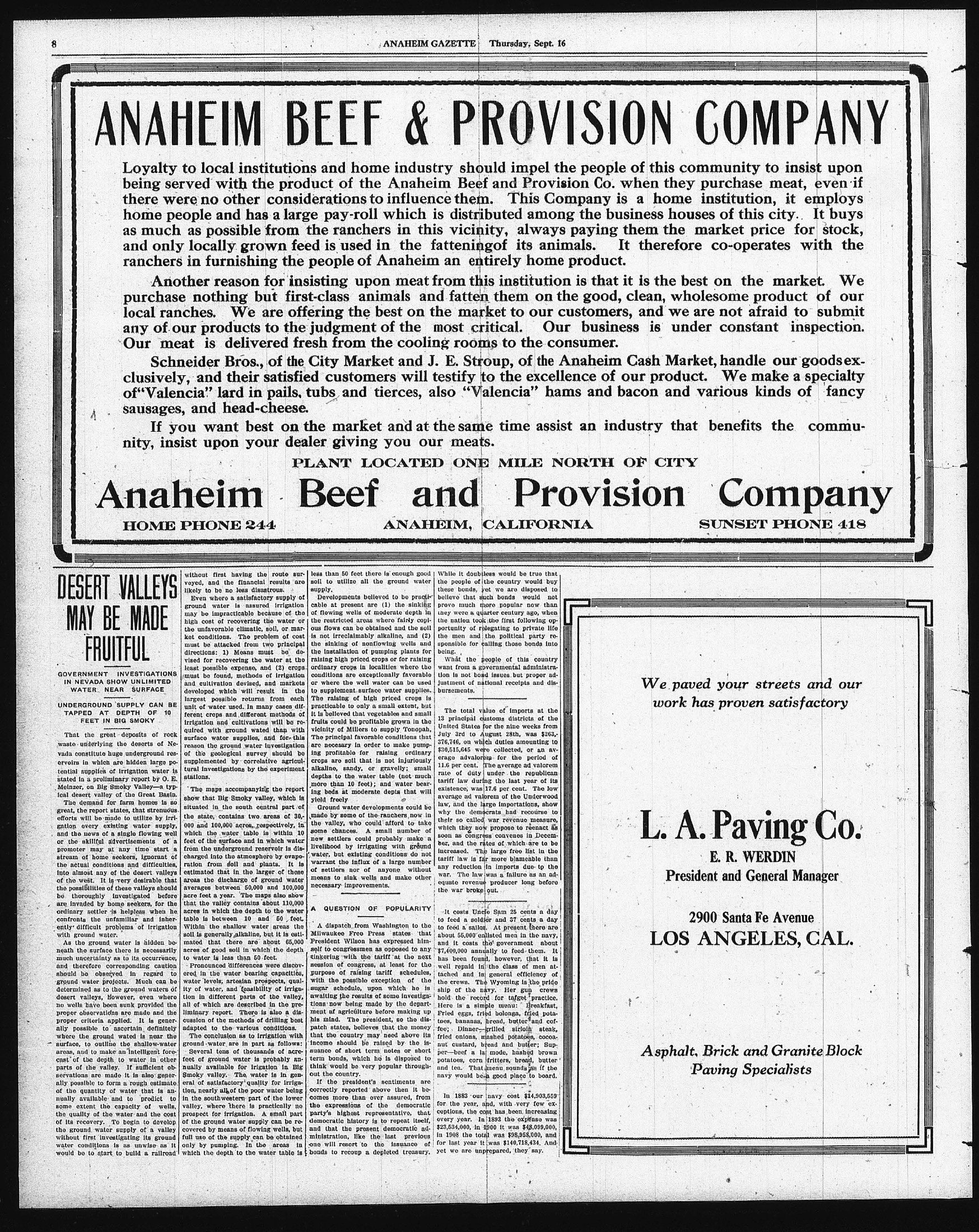
Searchable text
ANAHEIM BEER
Loyalty to local institutions and how being served with the product of the there were no other considerations home people and has a large pay-ro as much as possible from the ranch and only locally grown feed is used ranchers in furnishing the people o
Another reason for insisting up purchase nothing but first-class a local ranches. We are offering the any of our products to the judgment Our meat is delivered fresh from
Schneider Bros., of the City Ma clusively, and their satisfied custo of“Valencia” lard in pails, tubs and sausages, and head-cheese.
If you want best on the mark nity, insist upon your dealer givin
DESERT VALLEYS
MAY BE MADE
FRUITFUL
GOVERNMENT INVESTIGATIONS
IN NEVADA SHOW UNLIMITED
WATER NEAR SURFACE
UNDERGROUND SUPPLY CAN BE
TAPPED AT DEPTH OF 10
FEET IN BIG SMOKY
That the great deposits of rock waste underlying the deserts of Nevada constitute huge underground reservoirs in which are hidden large potential supplies of irrigation water is stated in a preliminary report by O. E. Meinzer, on Big Smoky Valley—a typical desert valley of the Great Basin.
The demand for farm homes is so great, the report states, that strenuous efforts will be made to utilize irrigation every existing water supply, and the news of a single flowing well or the skillful advertisements of a promoter may at any time start a stream of home seekers, ignorant of the actual conditions and difficulties,
without first having the route surveyed, and the financial results are likely to be no less disastrous.
Even where a satisfactory supply of ground water is assured irrigation may be impracticable because of the high cost of recovering the water or the unfavorable climatic, soil, or market conditions. The problem of cost must be attacked from two principal directions: (1) Means must be devised for recovering the water at the least possible expense, and (2) crops must be found, methods of irrigation and cultivation devised, and markets developed which will result in the largest possible returns from each unit of water used. In many cases different crops and different methods of irrigation and cultivations will be required with ground water than with surface water supplies, and for this reason the ground water investigation of the geological survey should be supplemented by correlative agricultural investigations by the experiment stations.
The maps accompanying the report show that Big Smoky valley, which is situated in the south central part of the state, contains two areas of 30,000 and 100,000 acres, respectively, in which the water table is within 10 feet of the surface and in which water from the underground reservoir is discharged into the atmosphere by evaporation from soil and plants. It is less than 50 feet soil to utilize all supply.
Developments cable at present of flowing wells restricted area flows can be not irreclaimable the installation of raising high price ordinary crops conditions are exor where the well to supplement suction The raising of practicable to only it is believed that fruits could be pr vicinity of Millers. The principal favors are necessary in ing profitable for crops are soil the alkaline, sandy, depths to the wa more than 10 feeding beds at moderate yield freely.
Ground water made by some of the valley, who some chances. new settlers could livelihood by irr water, but existi warrant the influ
The demand for farm homes is so great, the report states, that strenuous efforts will be made to utilize by irrigation every existing water supply, and the news of a single flowing well or the skillful advertisements of a promoter may at any time start a stream of home seekers, ignorant of the actual conditions and difficulties, into almost any of the desert valleys of the west. It is very desirable that the possibilities of these valleys should be thoroughly investigated before are invaded by home seekers, for the ordinary settler is helpless when he confronts the unfamiliar and inherently difficult problems of irrigation with ground water.
As the ground water is hidden beneath the surface there is necessarily much uncertainty as to its occurrence, and therefore corresponding caution should be observed in regard to ground water projects. Much can be determined as to the ground waters of desert valleys, however, even where no wells have been sunk provided the proper observations are made and the proper criteria applied. It is generally possible to ascertain definitely where the ground water is near the surface, to outline the shallow-water areas, and to make an intelligent forecast of the depth to water in other parts of the valley. If sufficient observations are made it is also generally possible to form a rough estimate of the quantity of water that is annually available and to predict to some extent the capacity of wells, the quality of the water and the cost of its recovery. To begin to develop the ground water supply of a valley without first investigating its ground water conditions is as unwise as it would be to start to build a railroad stations.
The maps accompanying the report show that Big Smoky valley, which is situated in the south central part of the state, contains two areas of 30,000 and 100,000 acres, respectively, in which the water table is within 10 feet of the surface and in which water from the underground reservoir is discharged into the atmosphere by evaporation from soil and plants. It is estimated that in the larger of these areas the discharge of ground water averages between 50,000 and 100,000 acre feet a year. The maps also show that the valley contains about 110,000 acres in which the depth to the water table is between 10 and 50 feet. Within the shallow water areas the soil is generally alkaline, but it is estimated that there are about 65,000 acres of good soil in which the depth to water is less than 50 feet.
Pronounced differences were discovered in the water bearing capacities, water levels, artesian prospects, quality of water, and feasibility of irrigation in different parts of the valley, all of which are described in the preliminary report. There is also a discussion of the methods of drilling best adapted to the various conditions.
The conclusion as to irrigation with ground water are in part as follows:
Several tens of thousands of acre-feet of ground water is probably annually available for irrigation in Big Smoky valley. The water is in general of satisfactory quality for irrigation, nearly all of the poor water being in the southwestern part of the lower valley, where there is practically no prospect for irrigation. A small part of the ground water supply can be recovered by means of flowing wells, but full use of the supply can be obtained only by pumping. In the areas in which the depth to the water table is depths to the waist more than 10 feet ing beds at moderate yield freely.
Ground water made by some of the valley, who some chances, new settlers could livelihood by irrigation, but existing warrant the influence of settlers nor means to sink waste necessary improvem
A QUESTION
A dispatch from Milwaukee Free President Wilson self to congressman tinkering with the session of congress purpose of raising with the possible sugar schedule, awaiting the results now being ment af agriculture his mind. The patch states, believing that the country income should puissance of short term bonds, which think would be vowed out the country.
If the president correctly reported comes more than the expressions party's highest democratic history and that the presi-ministration, like one will resort to bonds to recoup
BEEF & PROVISION
ions and home industry should impel the people of this co
product of the Anaheim Beef and Provision Co. when they
considerations to influence them. This Company is a homet
large pay-roll which is distributed among the business hou
from the ranchers in this vicinity, always paying them the
feed is used in the fatteningof its animals. It therefor
the people of Anaheim an entirely home product.
insisting upon meat from this institution is that it is the be
first-class animals and fatten them on the good, clean, wh
offering the best on the market to our customers, and we
the judgment of the most critical. Our business is un
fresh from the cooling rooms to the consumer.
the City Market and J. E. Stroup, of the Anaheim Cash Mar
sified customers will testify to the excellence of our produc
ils, tubs and tierces, also “Valencia” hams and bacon and
ese.
on the market and at the same time assist an industry tha
dealer giving you our meats.
less than 50 feet there is enough good soil to utilize all the ground water supply.
Developments believed to be practicable at present are (1) the sinking of flowing wells of moderate depth in the restricted areas where fairly copious flows can be obtained and the soil is not irreclaimably alkaline, and (2) the sinking of nonflowing wells and the installation of pumping plants for raising high priced crops or for raising ordinary crops in localities where the conditions are exceptionally favorable or where the well water can be used to supplement surface water supplies.
The raising of high priced crops is practicable to only a small extent, but it is believed that vegetables and small fruits could be profitable grown in the vicinity of Millers to supply Tonopah. The principal favorable conditions that are necessary in order to make pumping profitable for raising ordinary crops are soil that is not injuriously alkaline, sandy, or gravelly; small depths to the water table (not much more than 10 feet); and water bearing beds at moderate depts that will yield freely.
Ground water developments could be made by some of the ranchers now in the valley, who could afford to take some chances. A small number of new settlers could probably make a livelihood by irrigating with ground water, but existing conditions do not warrant the influx of a large number of settlers nor of anyone without While it doubtless would be true that the people of the country would buy these bonds, yet we are disposed to believe that such bonds would not prove much more popular now than they were a quarter century ago, when the nation took the first following opportunity of relegating to private life the men and the political party responsible for calling those bonds into being.
What the people of this country want from a governmental administration is not bond issues but proper adjustment of national receipts and disbursements.
The total value of imports at the 13 principal customs districts of the United States for the nine weeks from July 3rd to August 28th, was $263,-376,746, on which duties amounting to $30,515,645 were collected, or an average advalorem for the period of 11.6 per cent. The average ad valorem rate of duty under the republican tariff law during the last year of its existence, was 17.6 per cent. The low average ad valorem of the Underwood law, and the large importations, show why the democrats had recourse to their so called war revenue measure, which they now propose to reenact as soon as congress convenes in December, and the rates of which are to be increased. The large free list in the tariff law is far more blameable than any reduction in imports due to the
We pay work
L.A.
A QUESTION OF POPULARITY
A dispatch from Washington to the Milwaukee Free Press states that President Wilson has expressed himself to congressmen as opposed to any tinkering with the tariff at the next session of congress, at least for the purpose of raising tariff schedules, with the possible exception of the sugar schedule, upon which he is awaiting the results of some investigations now being made by the department of agriculture before making up his mind. The president, so the dispatch states, believes that the money that the country may need above its income should be raised by the issuance of short term notes or short term bonds, which he is disposed to think would be very popular throughout the country.
If the president's sentiments are correctly reported above then it becomes more than ever assured, from the expressions of the democratic party's highest representative, that democratic history is to repeat itself, and that the present democratic administration, like the last previous one will resort to the issuance of bonds to recoup a depleted treasury.
It costs Uncle Sam 25 cents a day to feed a soldier and 37 cents a day to feed a sailor. At present there are about 55,000 emlisted men in the navy, and it costs the government about $7,400,000 annually to feed them. It has been found, however, that it is well repaid in the class of men attached and in general efficiency of the crews. The Wyoming is the pride ship of the navy. Her gun crews hold the record for target practice. Here is a simple menu: Breakfast, Fried eggs, fried bolonga, fried potatoes, bananas, bread, butter and coffee; Dinner—grilled sirloin steak, fried onions, mashed potatoes, cocoa nut custard, bread and butter; Supper—beef a la mode, hashed brown potatoes, corn fritters, bread, butter and tea. That menu sounds as if the navy would be a good place to board.
In 1883 our navy cost $14,903,559 for the year, and, with very few exceptions, the cost has been increasing every year. In 1893 the expense was $23,534,000, in 1900 it was $48,099,000, in 1908 the total was $98,958,000, and for last year it was $140,718,434. And yet we are unprepared, they say.
ION COMPANY
rule of this community to insist upon
when they purchase meat, even if
is a home institution, it employs
business houses of this city. It buys
them the market price for stock,
It therefore co-operates with the
ct.
it is the best on the market. We
d, clean, wholesome product of our
ers, and we are not afraid to submit
ness is under constant inspection.
in Cash Market, handle our goodsexour product. We make a specialty
bacon and various kinds of fancy
industry that benefits the commu-
Cash Market, handle our goodsexof our product. We make a specialty
bacon and various kinds of fancy
industry that benefits the commu-
OF CITY
ision Company
SUNSET PHONE 418
We paved your streets and our
work has proven satisfactory
L. A. Paving Co.
E. R. WERDIN
L. A. Paving Co.
E. R. WERDIN
President and General Manager
2900 Santa Fe Avenue
LOS ANGELES, CAL.
Asphalt, Brick and Granite Block
Paving Specialists