anaheim-gazette 1915-09-09
Scanned page
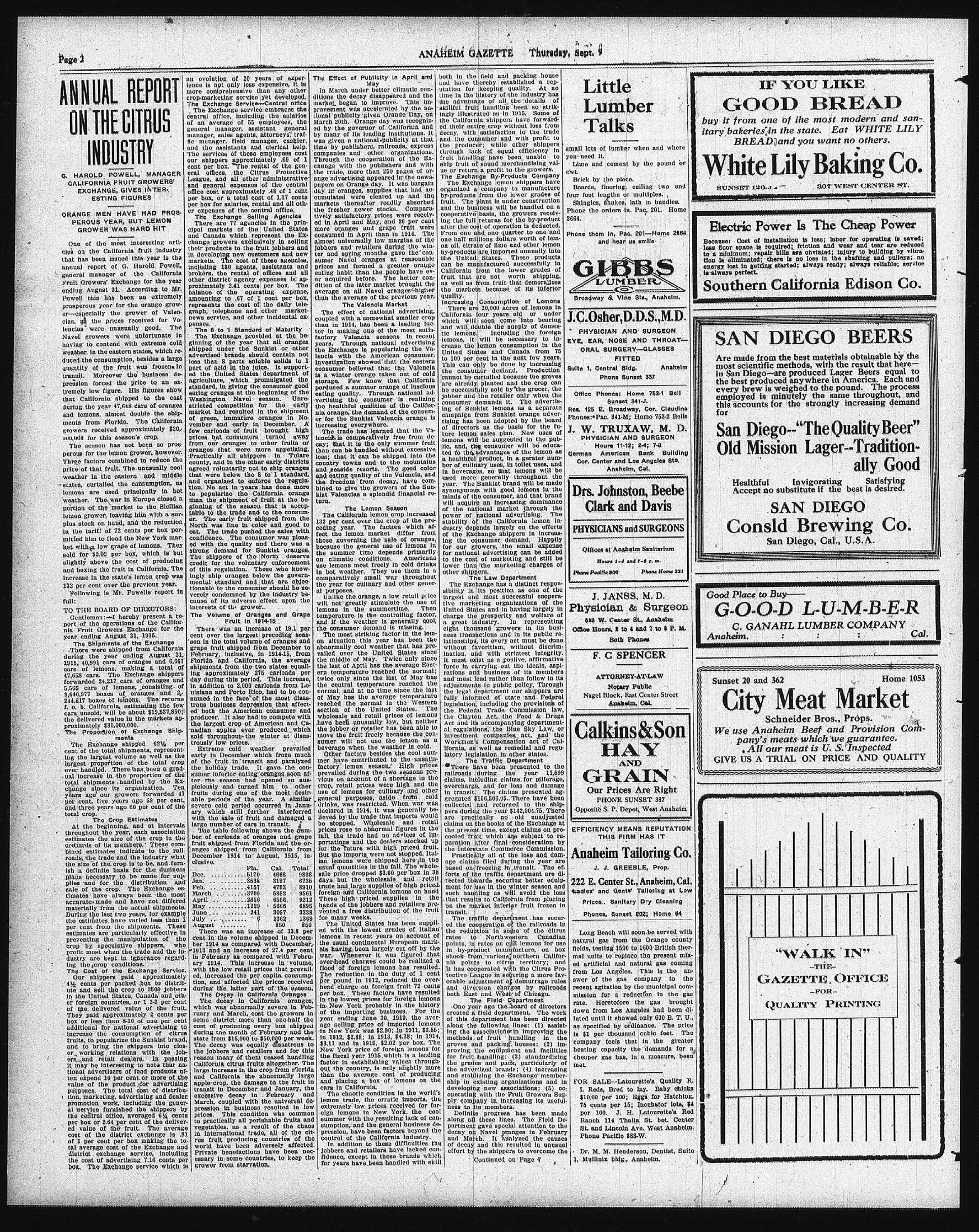
Searchable text
ANNUAL REPORT ON THE CITRUS INDUSTRY
G. HAROLD POWELL, MANAGER
CALIFORNIA FRUIT GROWERS' EXCHANGE, GIVES INTERESTING FIGURES
ORANGE MEN HAVE HAD PROSPEROUS YEAR, BUT LEMON GROWER WAS HARD HIT
One of the most interesting articles on the California fruit industry that has been issued this year is the annual report of G. Harold Powell, general manager of the California Fruit Growers' Exchange for the year ending August 31. According to Mr. Powell this has been an extremely prosperous year for the orange grower—especially the grower of Valencias, at the prices received for Valencias were unusually good. The Navel growers were unfortunate in having to contend with extreme cold weather in the eastern states, which reduced the consumption, besides a large quantity of the fruit was frozen in transit. Moreover the business depression forced the price to an extremely low figure. His figures show that California shipped to the east during the year 47,648 cars of oranges and lemons, almost double the shipments from Florida. The California growers received approximately $20,900,000 for this season's crop.
The season has not been so prosperous for the lemon grower, however, an evolution of 20 years of experience is not only less expensive, it is more comprehensive than any other crop-marketing service yet developed. The Exchange Service—Central office
The Exchange service embraces the central office, including the salaries of an average of 55 employees, the general manager, assistant general manager, sales agents, attorneys, traffic manager, field manager, cashier, and the assistants and clerical help. The services of these employees cost our shippers approximately .69 of 1 cent per box. The rental of the general offices, the Citrus Protective League, and all other administrative and general expenses of the central office cost approximately .48 of 1 cent per box, or a total cost of 1.17 cents per box for salaries, rental and all other expenses of the central office.
The Exchange Selling Agencies
There are 77 agencies in the principal markets of the United States and Canada which represent the Exchange growers exclusively in selling their products to the fruit jobbers and in developing new customers and new markets. The cost of these agencies, including 180 agents, assistants and brokers, the rental of offices and all other district agency expenses is approximately 2.41 cents per box. The balance of the operating expense, amounting to .67 of 1 cent per box, represents the cost of the daily telegraph, telephone and other market news service, and other incidental expenses.
The 8 to 1 Standard of Maturity
The Exchange provided at the beginning of the year that all oranges shipped under the Sunkist or other advertised brands should contain not less than 8 parts soluble solids to 1 part of acid in the juice. It supported the United States department of agriculture, which promulgated the standard, in giving the consumer good eating oranges at the beginning of the Washington Navel season. Unrestricted competition for the early market had resulted in the shipment of green, immature oranges in November and early in December. A few carloads of fruit brought high prices but consumers turned away from our oranges to other fruits or oranges that were more appetizing. Practically all shippers in Tulare
The Effect of Price
In March underditions the decay market began to provement was a tional publicity given by the government by many of its lions was given a natl time by published companies and Through the coenance with the trade, more advertisin papers on Orange day in oranges, cumulated were markets thereafter the fresher new tively satisfactoried in April and more oranges are consumed in April almost universal jobbers and retainer and spring summer Navel prices and form eating habit that er acquired before dition of the late average on all than the average.
The effect of coupled with a sale in April in making o factory Valencia years. Through the Exchange is lencia with the Investigation sh consumer believe is a winter orange storage. Few produced a summe eating quality vertising the cation healthful qulaia orange, the er for the Sunken increasing every.
The trade hain lencia is compay; that it is no than can be ham loss; that it can
The season has not been so prosperous for the lemon grower, however. Three factors combined to reduce the price of that fruit. The unusually cool weather in the eastern and middle states, curtailed the consumption, as lemons are used principally in hot weather. The war in Europe closed a portion of the market to the Sicilian lemon grower, leaving him with a surplus stock on hand, and the reduction in the tariff of 72 cents per box permitted him to flood the New York market within a low grade of lemons. They sold for $2.02 per box, which is but slightly above the cost of producing and boxing the fruit in California. The increase in the state's lemon crop was 132 per cent over the previous year.
Following is Mr. Powells report in full:
TO THE BOARD OF DIRECTORS:
Gentlemen:—I hereby present a report of the operations of the California Fruit Growers Exchange for the year ending August 31, 1915.
The Shipments of the Exchange
There were shipped from California during the year ending August 31, 1915, 40,991 cars of oranges and 6,667 cars of lemons, making a total of 47,658 cars. The Exchange shippers forwarded 24,217 cars of oranges and 5,565 cars of lemons, consisting of 9,640,977 boxes of oranges and 2,244,617 boxes of lemons. The returns f.o.b. California, estimating the few cars unsold, will be about $19,537,850; the delivered value in the markets approximately $30,000,000.
The Proportion of Exchange Shipments
The Exchange shipped 62½ per cent of the total shipments, representing the largest volume as well as the largest proportion of the total crop ever handled. There has been a gradual increase in the proportion of the total shipments handled by the Exchange since its organization. Ten years ago our growers forwarded 47 per cent, five years ago 59 per cent, and three years ago 60 per cent of the total crop.
The Crop Estimates
At the beginning, and at intervals throughout the year, each association estimates the size of the crop in the orchards of its members. These combined estimates indicate to the railroads, the trade and the industry what the size of the crop is to be, and furnish a definite basis for the business quantity of the fruit was frozen in transit. Moreover the business depression forced the price to an extremely low figure. His figures show that California shipped to the east during the year 47,648 cars of oranges and lemons, almost double the shipments from Florida. The California growers received approximately $20,000,000 for this season's crop.
The season has not been so prosperous for the lemon grower, however. Three factors combined to reduce the price of that fruit. The unusually cool weather in the eastern and middle states, curtailed the consumption, as lemons are used principally in hot weather. The war in Europe closed a portion of the market to the Sicilian lemon grower, leaving him with a surplus stock on hand, and the reduction in the tariff of 72 cents per box permitted him to flood the New York market within a low grade of lemons. They sold for $2.02 per box, which is but slightly above the cost of producing and boxing the fruit in California. The increase in the state's lemon crop was 132 per cent over the previous year.
Following is Mr. Powells report in full:
TO THE BOARD OF DIRECTORS:
Gentlemen:—I hereby present a report of the operations of the California Fruit Growers Exchange for the year ending August 31, 1915.
The Shipments of the Exchange
There were shipped from California during the year ending August 31, 1915, 40,991 cars of oranges and 6,667 cars of lemons, making a total of 47,658 cars. The Exchange shippers forwarded 24,217 cars of oranges and 5,565 cars of lemons, consisting of 9,640,977 boxes of oranges and 2,244,617 boxes of lemons. The returns f.o.b. California, estimating the few cars unsold, will be about $19,537,850; the delivered value in the markets approximately $30,000,000.
The Proportion of Exchange Shipments
The Exchange shipped 62½ per cent of the total shipments, representing the largest volume as well as the largest proportion of the total crop ever handled. There has been a gradual increase in the proportion of the total shipments handled by the Exchange since its organization. Ten years ago our growers forwarded 47 per cent, five years ago 59 per cent, and three years ago 60 per cent of the total crop.
The Crop Estimates
At the beginning, and at intervals throughout the year, each association estimates the size of the crop in the orchards of its members. These combined estimates indicate to the railroads, the trade and the industry what the size of the crop is to be, and furnish a definite basis for the business quantity of the fruit was frozen in transit. Moreover the business depression forced the price to an extremely low figure. His figures show that California shipped to the east during the year 47,648 cars of oranges and lemons, almost double the shipments from Florida. The California growers received approximately $20,000,000 for this season's crop.
The season has not been so prosperous for the lemon grower, however. Three factors combined to reduce the price of that fruit. The unusually cool weather in the eastern and middle states, curtailed the consumption, as lemons are used principally in hot weather. The war in Europe closed a portion of the market to the Sicilian lemon grower, leaving him with a surplus stock on hand, and the reduction in the tariff of 72 cents per box permitted him to flood the New York market within a low grade of lemons. They sold for $2.02 per box, which is but slightly above the cost of producing and boxing the fruit in California. The increase in the state's lemon crop was 132 per cent over the previous year.
Following is Mr. Powells report in full:
TO THE BOARD OF DIRECTORS:
Gentlemen:—I hereby present a report of the operations of the California Fruit Growers Exchange for the year ending August 31, 1915.
The Shipments of the Exchange
There were shipped from California during the year ending August 31, 1915, 40,991 cars of oranges and 6,667 cars of lemons, making a total of 47,658 cars. The Exchange shippers forwarded 24,217 cars of oranges and 5,565 cars of lemons, consisting of 9,640,977 boxes of oranges and 2,244,617 boxes of lemons. The returns f.o.b. California, estimating the few cars unsold, will be about $19,537,850; the delivered value in the markets approximately $30,000,000.
The Proportion of Exchange Shipments
The Exchange shipped 62½ per cent of the total shipments, representing the largest volume as well as the largest proportion of the total crop ever handled. There has been a gradual increase in the proportion of the total shipments handled by the Exchange since its organization. Ten years ago our growers forwarded 47 per cent, five years ago 59 per cent,and three years ago 60 per cent ofthe total crop.
The Crop Estimates
At the beginning, and at intervals throughoutthe year,each association estimatesthe sizeofthecropintheorchardsofitsmembers.Thecombinedestimatesindicatetotherailroads,thetradeandtheindustrywhatthesizeofthecropistobe,andfurnishadefinitebasisforthebusinessquantityofthefruitwasfrozenintransit.Moreoverthebusinessdepressionforcedthepricetoanextremelylowfigure.HistoredthatCaliforniashippedtoetheeastduringtheyear47648carsofarangeandlemonsalmostdoubletheresultsfromtheearthenduringthemarkethadresultedintheshipmentofgreenimmatureorangesinNovemberandearlyDecember.Afewcarloadsfruitbroughthighpricesbutconsumersturnedawayfromourorangestootherfruitsororangesthatweremoreappetizing.PracticallyallshippersinTularecounty,andintheotherearlydistrictseguid voluntarilynottoshiporangesthatwerebelowthe8to1standard,andorganizedtor enforcetheregulation.NoactinyearshasdonemoretopularizetheCaliforniaorangethantheshipmentoffruitatbethebeginningoftheseasonthatisacceptabletothasacceptabletothetradeandtoconsumer.TheearlyfruitshippedfromtheNorthwasfineincolorandgoodtoeat.Thetradepushedthe saleswithconfidence.TheconsumerwaspleasedwiththequalityandtherewasastrongdemandforSunkistoranges.TheshippersoftheNorthdeservecreditforthevoluntaryenforcementofthisregulation.Thosewhoknowinglyshiporangesbelowthegovernmentalstandardandthatareobjectionabletotheconsumershouldbeseverelycondemnedbytheindustrybecauseofitsadverseeffectupontheinterestsofthegrower.TheVolumeOfOrangesandGrapeFruitIn1914-15
There was an increaseof19.1percentoverthelargestprecedingseasoninthetotalvolumeoforangesandgrapefruitshippedfromDecembertoFebruary,intlisease,intliseasewithconfidence.Theconsumerinferioreatingorangessoonaftertheseasonhadopenedsoauspiciouslyandturnedhimtootherfuitsduringoneofthemostdesirableperiodsoftheyear.AsimilarseverecoldperiodoccurredinJanuarywhichstillfurtherinterferredwiththesaleoffruitanddamagedalargenumberofcarsintransit.
The table following shows therumber.ofcarloadsoforangesandgrapefruitshippedfromFloridaandtheorangesshippedfromCaliforniafromDecember1914toAugust,1915inclusive.
Fla.Cal.Total
The Crop Estimates
At the beginning, and at intervals throughout the year, each association estimates the size of the crop in the orchards of its members. These combined estimates indicate to the railroads, the trade and the industry what the size of the crop is to be, and furnish a definite basis for the business plans necessary to be made for supplies and for the distribution and sale of the crop. The Exchange estimates have always been the most accurate made and have not differed materially from the actual shipments. During the last two years, for example the estimates have varied less than 1 per cent from the shipments. These estimates are particularly effective in preventing the manipulation of the crop by speculative shippers, who profit most when the trade and the industry are kept in ignorance regarding the crop conditions.
The Cost of the Exchange Service.
Our shippers paid approximately 4½ cents per packed box to distribute and sell the crop to 2500 jobbers in the United States, Canada and other foreign countries, or 1 2-3 per cent of the delivered value of the fruit. They paid approximately 2 cents per box or less than 8-10 of one per cent additional for national advertising to increase the consumption of citrus fruits, to popularize the Sunkist brand, and to bring the shippers into closer working relations with the jobbers and retail dealers. In passing it may be interesting to note that national advertisers of food products often expend 10 per cent or more of the value of the product for advertising purposes. The total cost of distribution, marketing, advertising and dealer promotion work, including the general service furnished the shippers by the central office, averaged 6¼ cents per box or 2.64 per cent of the delivered value of the fruit. The average cost of the district exchange is 91 of 1 per cent per box making the total average cost of the Exchange and district exchange service, including the cost of advertising 7.16 cents per box. The Exchange service which is
Fla. Cal. Total
Dec. .5170 4668 9838
Jan. .3538 3197 6735
Feb. .4157 4753 8910
March .3709 5852 9561
April .2656 6556 9212
May .1229 5666 6895
June .241 3097 3338
July .6 1362 1368
August .850 850
There was an increase of 33.8 per cent in the volume shipped in December 1914 as compared with December, 1913 and an increase of 27.4 per cent in February as compared with February 1914. This increase in volume, with the low retail prices that prevail, increased the per capita consumption, and affected the prices received during the latter part of the season.
The Decay in California Oranges
The decay in California oranges, which was abnormally severe in February and March, cost the growers in some district more than one-half the cost of producing every box shipped during the month of February and the state from $15,000 to $50,000 per week. The decay was equally disastrous to the jobbers and retailers and for this reason many of them ceased handling California citrus fruits altogether. The large increase in the crop from Florida and California the abnormal large apple-crop, the damage to the fruit in transit in December and January, the excessive decay in February and March, coupled with the universal depression in business resulted in low prices. This condition was common to practically all perishable fruits and vegetables, as a result of the chaos in international trade, all of the citrus fruit producing countries of the world have been adversely affected. Private benefactions have been necessary in some countries, to keep the grower from starvation.
The lowest price on New York stock of the import year ending June age selling price in New York was in 1912, $2.88; $3.11 and in 1913 New York price for fiscal year factor out the country than the average and placing a car in California.
The chaotic lemon trade, extremely low summer with high sumption, and pressure, have led to control of the crop.
In addition jobbers and re-fidences except for years have...
The Effect of Publicity in April and May
In March under better climatic conditions the decay disappeared and the market began to improve. This improvement was accelerated by the national publicity given Orande Day, on March 20th. Orange day was recognized by the governor of California and by many of its leading institutions. It was given a national publicity at that time by publishers, railroads, express companies and other organizations. Through the cooperation of the Exchange with the publishers and with the trade, more than 250 pages of orange advertising appeared in the newspapers on Orange day. It was bargain day in Oranges, supplies that had accumulated were cleared up and the markets thereafter readily absorbed the fresher newer stocks. Comparatively satisfactory prices were received in April and May, and 26 per cent more oranges and grape fruit were consumed in April than in 1914. The almost universally low margins of the jobbers and retailers during the winter and spring months gave the consumer Navel oranges at reasonable prices and formed a greater orange eating habit than the people have ever acquired before. The better condition of the later market brought the average on all Navel oranges higher than the average of the previous year.
The Valencia Market
The effect of national advertising, coupled with a somewhat smaller crop than in 1914, has been a leading factor in making one of the most satisfactory Valencia seasons in recent years. Through national advertising the Exchange is popularizing the Valencia with the American consumer. Investigation showed that the eastern consumer believed that the Valencia is a winter orange taken out of cold storage. Few knew that California produced a summer orange of luscious eating quality. Through national advertising the consumer is realizing the healthful qualities of the California orange, the demand of the consumer for the Sunkist Valencia orange is increasing everywhere.
The trade has learned that the Valencia is comparatively free from decay; that it is the only summer fruit than can be handled without excessive loss; that it can be shipped into both in the field and packing house and have thereby established a reputation for keeping quality. At no time in the history of the industry has the advantage of all the details of skillful fruit handling been so strikingly illustrated as in 1915. Some of the California shippers have forwarded their entire crop without loss from decay, with satisfaction to the trade and the consumer and with profit to the producer; while other shippers through lack of equal efficiency in fruit handling have been unable to ship fruit of sound merchandising value or return a profit to the growers.
The Exchange By-Products Company
The Exchange lemon shippers have organized a company to manufacture by-products from the lower grades of fruit. The plant is under construction and the business will be handled on a cooperative basis, the growers receiving the full returns for the by-product after the cost of operation is deducted. From one and one quarter to one and one half millions dollars worth of lemon oil, citrate of lime and other lemon by-products are imported annually into the United States. These products can be manufactured successfully in California from the lower grades of fruit that are not worth shipping, as well as from fruit that demoralizes the markets because of its inferior quality.
Increasing Consumption of Lemons
There are 20,000 acres of lemons in California four years old or under which will soon come into bearing and will double the supply of domestic lemons. Including foreign lemons, it will be necessary to increase the lemon consumption in the United States and Canada from 75 to 100 per cent in the next few years. This can only be done by increasing the consumer demand. Production cannot be curtailled because the groves are already planted and the crop can be successfully sold by the grocer, the jobber and the retailer only when the consumer demands it. The advertising of Sunkist lemons as a separate campaign from Sunkist orange advertising has been adopted by the board of directors as the basis for the future lemon safes plan. New uses of lemons will be suggested to the public, and, the consumer will be educated to the advantages of the lemon as a healthful product in a gerater num-
The Lemon Season
The California lemon crop increased 132 per cent over the crop of the preceding year. The factors which affect the lemon market differ from those governing the sale of oranges, because the general use of lemons in the summer time depends primarily on climatic conditions. Americans use lemons most freely in cold drinks in hot weather. They use them in a comparatively small way throughout the year for culinary and other general purposes.
Unlike the orange, a low retail price will not greatly stimulate the use of lemons in the summertime. Then temperature is the controlling factor, and if the weather is generally cool, the consumer demand is missing.
The most striking factor in the lemon situation this year has been the abnormally cool weather that has prevailed over the United States since the middle of May. Twice only since the last of April has the average Eastern temperature reached the normal; twice only since the last of May has the central temperature reached the normal, and at no time since the last of May has the average temperature reached the normal in the Western section of the United States. The wholesale and retail prices of lemons have been unusually low, but neither the jobber or retailer has been able to move the fruit freely because the consumer will not use the lemon as a beverage when the weather is cold.
Other factors besides the cool summer have contributed to the unsatisfactory lemon season. High prices prevailed during the two seasons previous on account of a shortage in the crop, retail prices were high and the use of lemons for culinary and other general purposes, aside from cold drinks, was restricted. When war was declared in 1914, it was generally believed by the trade that imports would be stopped. Wholesale and retail prices rose to abnormal figures in fall, the trade had no advances of importations and the dealers stocked up for the future with high priced fruit. But the imports were not stopped. Italian lemons were shipped in the usual quantities in fall. The whole investigation showed that the eastern consumer believed that the Valencia is a winter orange taken out of cold storage. Few knew that California produced a summer orange of luscious eating quality. Through national advertising the consumer is realizing the healthful qualities of the California orange, the demand of the consumer for the Sunkist Valencia orange is increasing everywhere.
The trade has learned that the Valencia is comparatively free from decay; that it is the only summer fruit than can be handled without excessive loss; that it can be shipped into the country towns and to the mountains and seaside resorts. The good color and eating quality of the Valencia, and the freedom from decay, have combined to give the growers of the Sunkist Valencias a splendid financial return.
The Law Department
The Exchange has a distinct responsibility in its position as one of the largest and most successful cooperative marketing organizations of the United States and in having largely in charge of prosperity and welfare of a great industry. In representing eight thousand growers in its business transactions and in its public relationships, its every act must be done without favoritism, without discrimination, and with strictest integrity. It must exist as a positive, affirmative force in carrying out the ideals, aspirations and business of its members and must lead rather than follow in its adjustments to public policy. Through the legal department our shippers are fully informed of state and Federal legislation, including the provisions of the Federal Trade Commission law, the Clayton Act, the Food & Drugs Act and its accompanying departmental regulations, the Blue Sky Law, or investment companies act, and the Workmen's Compensation act of California, as well as remedial and regulatory legislation in other states.
The Traffic Department
There have been presented to railroads during the year 11,599 claims, including claims for pilferage, overcharge, and for loss and damage in transit. The claims presented aggregated $156,506.05. There have been collected and returned to the shippers during the year $142,004.75. There are practically no old unadjusted claims on the books of the Exchange at present time, except claims on precooled fruit which are subject to reparation after final consideration by the Interstate Commerce Commission.
Practically all of the loss and damage claims filed during the year are based on freezing in transit. The ef-
prevailing during the two seasons previous on account of a shortage in the crop, retail prices were high and the use of lemons for culinary and other general purposes, aside from cold drinks, was restricted. When war was declared in 1914, it was generally believed by the trade that imports would be stopped. Wholesale and retail prices rose to abnormal figures in the fall, the trade had no advices of importations and the dealers stocked up for the future with high priced fruit. But the imports were not stopped. Italian lemons were shipped here in the usual quantities in the fall. The wholesale price dropped $3.00 per box in 30 days but the wholesale and retail trade had large supplies of high priced foreign and California lemons on hand. These high priced supplies in the hands of the jobbers and retailers prevented a free distribution of the fruit for many weeks.
The United States has been supplied with the lowest grades of Italian lemons in recent years on account of the usual continental European markets having largely cut off by the war. Whenever it was figured that overhead charges could be realized a flood of foreign lemons has resulted. The reduction in the duty of 1 cent per pound in 1912, reduced the overhead charge on foreign fruit 72 cents per box. These factors have resulted in the lowest prices for foreign lemons in New York probably in the history of the importing business. For the year ending June 30, 1910, the average selling price of imported lemons in New York was $2.90; in 1911, $3.55; in 1912, $2.88; in 1913, $4.38; in 1914, $3.11 and in 1915, $2.02 per box. The New York price of foreign lemons for the fiscal year 1915 which is a leading factor in establishing values throughout the country, is only slightly more than the average cost of producing and placing a box of lemons on the cars in California.
The chaotic condition in the world's lemon trade, the erratic imports, the extremely low prices received for foreign lemons in New York, the cool summer with the resulting lack of consumption, and the general business depression, have been factors beyond the control of the California industry.
In addition to these difficulties the jobbers and retailers have lacked confidence, except in those brands which for years have been handled with skill
GRAIN
Our Prices Are Right
PHONE SUNSET 387
Opposite S. P. Depot, West Anaheim
EFFICIENCY MEANS REPUTATION
THIS FIRM HAS IT
Anaheim Tailoring Co.
J. J. GREEBLE, Prop.
222 E. Center St., Anaheim, Cal.
Ladies' and Gent's Tailoring at Low
Prices.. Sanitary Dry Cleaning
Phones, Sunset 202; Home 64
Long Beach will soon be served with natural gas from the Orange county fields, testing 1500 to 1600 British thermal units to replace the present mixed artificial and natural gas coming from Los Angeles. This is the answer of the gas company to the recent agitation by the municipal commission for a reduction in the gas rate. Heretofore the gas brought down from Los Angeles had been diluted until it showed only 600 B. T. U., as specified by ordinance. The price is $1 per thousand cubic feet. The company feels that in the greater heating capacity the demands for a cheaper gas has, in a measure, been met.
FOR SALE—Latourette's Quality Rent I. Reds, Bred to lay. Baby chicks $10.00 per 100; Eggs for Hatching 75 cents per 15; Incubator lots, $6 per 100. J. H. Latourette's Red Ranch 114 Thalia St. bet. Center St. and Lincoln Ave. West Anaheim Phone Pacific 388-W.
Dr. M. M. Henderson, Dentist, Suite 1, Mullinix bldg., Anaheim.
IF YOU LIKE
GOOD BREAD
buy it from one of the most modern and sanitary bakeries in the state. Eat WHITE LILY BREAD and you want no others.
White Lily Baking Co.
SUNSET 120-J
307 WEST CENTER ST.
Electric Power Is The Cheap Power
Because Cost of installation is less; labor for operating is saved;
less floor space is required; friction and wear and tear are reduced to a minimum; repair bills are obviated; injury to building by vibration is eliminated; there is no loss in the shafting and pulleys; no energy lost in getting started; always ready; always reliable; service is always perfect.
Southern California Edison Co.
SAN DIEGO BEERS
Are made from the best materials obtainable by the most scientific methods, with the result that here—in San Diego—are produced Lager Beers equal to the best produced anywhere in America. Each and every brew is weighed to the pound. The process employed is minutely the same throughout, and this accounts for the strongly increasing demand for
San Diego--“The Quality Beer”
Old Mission Lager--Tradition-
San Diego--“The Quality Beer”
Old Mission Lager--Traditionally Good
Healthful Invigorating Satisfying
Accept no substitute if the best is desired.
SAN DIEGO
Consld Brewing Co.
San Diego, Cal., U.S.A.
Good Place to Buy—
G-O-O-D L-U-M-B-E-R
C. GANAHL LUMBER COMPANY
Anaheim, Cal.
Sunset 20 and 362 Home 1053
City Meat Market
Schneider Bros., Props.
We use Anaheim Beef and Provision Company’s meats which we guarantee.
All our meat is U. S. Inspected
GIVE US A TRIAL ON PRICE AND QUALITY
"WALK IN"
THE
GAZETTE OFFICE
FOR
QUALITY PRINTING