anaheim-gazette 1915-09-02
Scanned page
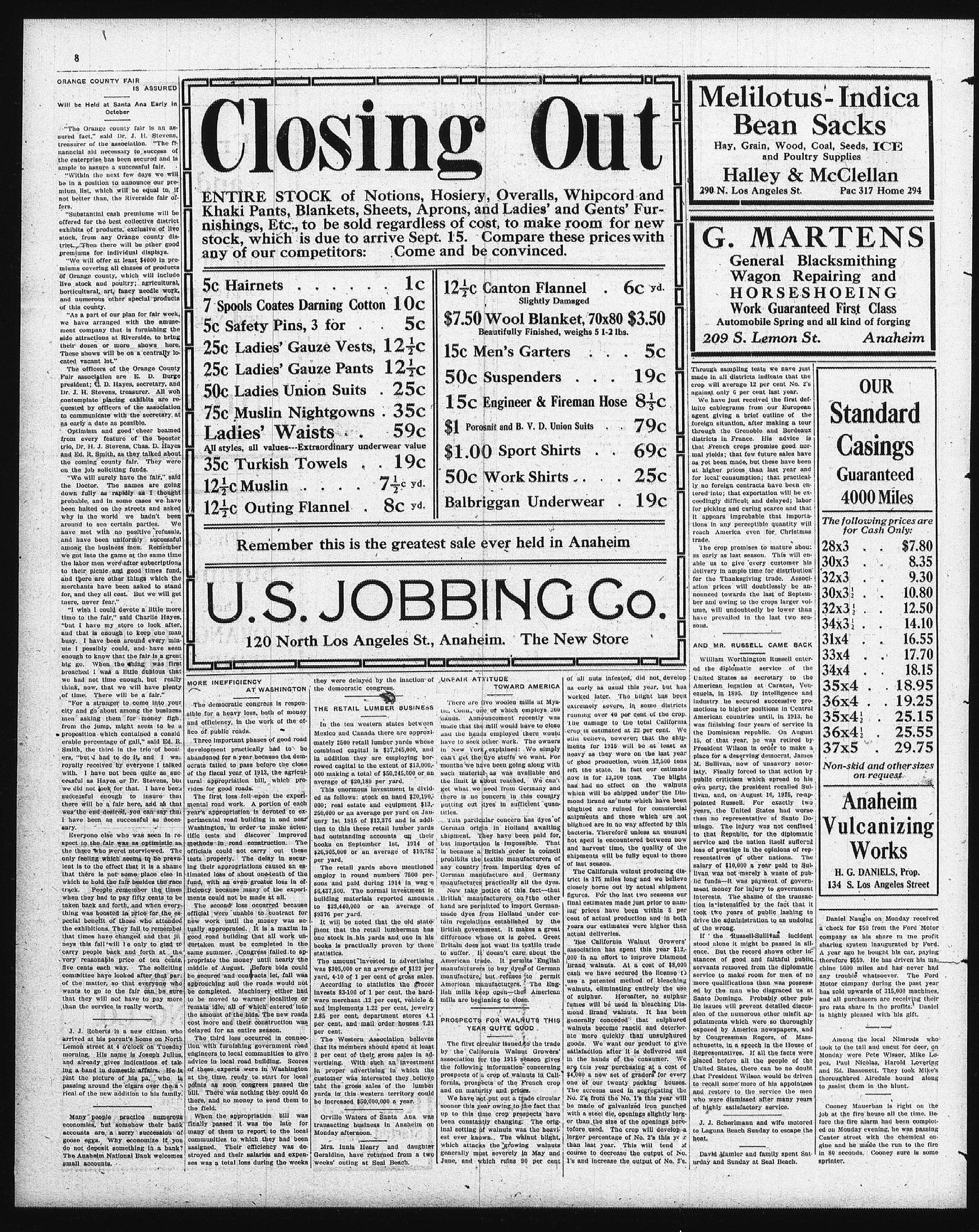
Searchable text
ORANGE COUNTY FAIR
IS ASSURED
Will be Held at Santa Ana Early in October
"The Orange county fair is an assured fact," said Dr. J. H. Stevens, treasurer of the association. "The financial aid necessary to success of the enterprise has been secured and is ample to assure a successful fair.
"Within the next few days we will be in a position to announce our premium list, which will be equal to, if not better than, the Riverside fair offers.
"Substantial cash premiums will be offered for the best collective district exhibits of products, exclusive of live stock, from any Orange county district. Then there will be other good premiums for individual displays.
"We will offer at least $4000 in premiums covering all classes of products of Orange county, which will include live stock and poultry; agricultural, horticultural, art, fancy needle work, and numerous other special products of this county.
"As a part of our plan for fair week, we have arranged with the amusement company that is furnishing the side attractions at Riverside, to bring their dozen or more shows here. These shows will be on a centrally located vacant lot."
The officers of the Orange County Fair association are E. D. Burge president; C. D. Hayes, secretary, and Dr. J. H. Stevens, treasurer. All who contemplate placing exhibits are requested by officers of the association to communicate with the secretary at as early a date as possible.
Optimism and good cheer beamed from every feature of the booster trio, Dr. H. J. Stevens, Chas. D. Hayes and Ed. R. Smith, as they talked about
The officers of the Orange County Fair association are E. D. Burge president; C. D. Hayes, secretary, and Dr. J. H. Stevens, treasurer. All who contemplate placing exhibits are requested by officers of the association to communicate with the secretary at as early a date as possible.
Optimism and good cheer beamed from every feature of the booster trio, Dr. H. J. Stevens, Chas. D. Hayes and Ed. R. Smith, as they talked about the coming county fair. They were on the job soliciting funds.
"We will surely have the fair," said the Doctor. The names are going down fully as rapidly as I thought probable, and in some cases we have been halted on the streets and asked why in the world we hadn't been around to see certain parties. We have met with no positive refusals, and have been uniformly successful among the business men. Remember we got into the game at the same time the labor men were after subscriptions to their picnic and good times fund, and there are other things which the merchants have been asked to stand for, and they all cost. But we will get there, never fear."
"I wish I could devote a little more time to the fair," said Charlie Hayes, "but I have my store to look after, and that is enough to keep one man busy. I have been around every minute I possibly could, and have seen enough to know that the fair is a great big go. When the thing was first broached I was a little dubious that we had not time enough, but really think, now, that we will have plenty of time. There will be a fair."
"For a stranger to come into your city and go about among the business men asking them for money figh from the jump, might seem to be a proposition which contained a considerable percentage of gall," said Ed. R. Smith, the third in the trio of boosters, "but I had to do it, and I was royally received by everyone I talked with. I have not been quite as successful as Hayes or Dr. Stevens, but we did not look for that. I have been successful enough to insure that there will be a fair here, and all that was the end desired, you can say that I have been as successful as necessary.
Everyone else who was seen in respect to the fair was as optimistic as the three who were interviewed. The only feeling which seems to be prevalent is to the effect that it is a shame...
I have not been quite as successful as Hayes or Dr. Stevens, but we did not look for that. I have been successful enough to insure that there will be a fair here, and as that was the end desired, you can say that I have been as successful as necessary.
Everyone else who was seen in respect to the fair was as optimistic as the three who were interviewed. The only feeling which seems to be prevalent is to the effect that it is a shame that there is not some place else in which to hold the fair besides the race track. People remember the times when they had to pay fifty cents to be taken back and forth, and when everything was boosted in price for the special benefit of those who attended the exhibitions. They fail to remember that times have changed and that jilneys this fall will be only to glad to carry people back and forth at the very reasonable price of ten cents, five cents each why. The soliciting committee have looked after that part of the matter, so that everyone who wants to go to the fair can be sure that they will not have to pay more than the service is really worth.
J. J. Roberts is a new citizen who arrived at his parent's home on North Lemon street at 4 o'clock on Tuesday morning. His name is Joseph Julius, and already gives indications of taking a hand in domestic affairs. He is just the picture of his pa, who is passing around the cigars over the arical of the new addition to his family.
Many people practice numerous economies, but somehow their bank accounts are a sorry succession of goose eggs. Why economize if you do not deposit something in a bank? The Anaheim National Bank welcomes small accounts.
The first loss fell upon the experimental road work. A portion of each year's appropriation is devoted to experimental road building in and near Washington, in order to make scientific tests and discover improved methods in road construction. The officials could not carry out these tests properly. The delay in securing their appropriations caused an estimated loss of about one-tenth of the fund, with an even greater loss in efficiency because many of the experiments could not be made at all.
The second loss occurred because official were unable to contract for new work until the money was actually appropriated. It is a maxim in good road building that all work undertaken must be completed in the same summer. Congress failed to appropriate the money until nearly the middle of August. Before bids could be secured and contracts let, fall was approaching and the roads would not be completed. Machinery either had to be moved to warmer localities or remain idle, all of which entered into the amount of the bids. The new roads cost more and their construction was delayed for an entire season.
The third loss occurred in connection with furnishing government road engineers to local communities to give advice in local road building. Scores of these experts were in Washington at the time, ready to start for local points as soon congress passed the bill. There was nothing they could do there, and no money to send them to the field.
When the appropriation bill was finally passed it was too late for many of them to report to the local communities to which they had been assigned. Their efficiency was destroyed and their salaries and expenses was a total loss during the weeks
This enormous ed as follows: s 000; real estate 250,000 or an average 1915 of tion to this these had outstanding books on September $26,905,000 or a per yard.
The retail year employ in rounds sons and paid o $6,437,500. The building materials to $23,440,000 $9376 per yard.
It will be noted that the one stock in his books is practic statistics.
The amount In was $395,000 or a yard, 4-10 of 1 p
According to invests 83-100 of ware merchant and implements 2.85 per cent, o per cent, and m per cent.
The Western that its members 2 per cent of the vertising. With in proper adven customer was in taht the gross yards in this w be increased $50
Orville Waters transacting bush Monday afternoon
Mrs. Innis H Geraldine, have weeks' outing a
Closing Out
STOCK of Notions, Hosiery, Overalls, Whipcord and
Blankets, Sheets, Aprons, and Ladies' and Gents' Furc., to be sold regardless of cost, to make room for new
is due to arrive Sept. 15. Compare these prices with
competitors: Come and be convinced.
1c
s Darning Cotton 10c
ns, 3 for . . . 5c
Gauze Vests, 12½c
Gauze Pants 12½c
Union Suits . 25c
Nightgowns . 35c
Vaists . . . 59c
12½c Canton Flannel . 6c yd.
Slightly Damaged
$7.50 Wool Blanket, 70x80 $3.50
Beautifully Finished, weighs 5 1-2 lbs.
15c Men's Garters . . . 5c
50c Suspenders . . . 19c
15c Engineer & Fireman Hose 8½c
$1 Porosnit and B. V. D. Union Suits . . . 79c
$1.00 Sport Shirts . . . 69c
they were delayed by the inaction of the democratic congress.
THE RETAIL LUMBER BUSINESS
In the ten western states between Mexico and Canada there are approximately 2500 retail lumber yards whose combined capital is $37,245,000, and in addition they are employing borrowed capital to the extent of $13,000,000 making a total of $50,245,000 or an average of $20,189 per yard.
This enormous investment is divided as follows: stock on hand $20,190,000; real estate and equipment $13,250,000 or an average per yard on January 1st 1915 of $13,376 and in addition to this these retail lumber yards had outstanding accounts on their books on September 1st, 1914 of $26,905,000 or an average of $10,782 per yard.
The retail yards above mentioned
UNFAIR ATTITUDE TOWARD AMERICA
There are five woolen mills at Mystic, Conn., one of which employs 300 hands. Announcement recently was made that the mill would have to close and the hands employed there would have to seek other work. The owners in New York explained: We simply can't get the dye stuffs we want. For months we have been going along with such material as was available and the limit is about reached. We can't get what we need from Germany and there is no concern in this country putting out dyes in sufficient quantities.
This particular concern has dyes of German origin in Holland awaiting shipment. They have been paid for, but importation is impossible. That is because a British order in council prohibits the textile manufacturers of any country from importing dyes of all nuts infested, did not develop as early as usual this year, but has worked later. The blight has been extremely severe, in some districts running over 40 per cent of the crop. The damage to the total California crop is estimated at 22 per cent. We still believe, however, that the shipments for 1915 will be at least as heavy as they were on the last year of good production, when 12,500 tons left the state. In fact our estimate now is for 13,200 tons. The blight has had no effect on the walnuts which will be shipped under the Diamond Brand as nuts which have been blighted are ruined for commercial saliments and those which are not blighted are in no way affected by this bacteria. Therefore unless an unusual hot spell is encountered between now and harvest time, the quality of the shipments will be fully equal to those of last season.
This enormous investment is divided as follows: stock on hand $20,190,000; real estate and equipment $13,250,000 or an average per yard on January 1st 1915 of $13,376 and in addition to this these retail lumber yards had outstanding accounts on their books on September 1st, 1914 of $26,905,000 or an average of $10,782 per yard.
The retail yards above mentioned employ in round numbers 7500 persons and paid during 1914 in wag's $6,437,500. The normal investment in building materials reported amounts to $23,440,000 or an average of $937 per yard.
It will be noted that the old statement that the retail lumberman has one stock in his yards and one in his books is practically proven by these statistics.
The amount invested in advertising was $365,000 or an average of $122 per yard, 4-10 of 1 per cent of gross sales.
According to statistics the grocer invests 83-100 of 1 per cent, the hardware merchant .12 per cent, vehicle & implements 1.22 per cent, jewelry 2.85 per cent, department stores 4.1 per cent, and mail order houses 7.21 per cent.
The Western Association believes that its members should spend at least 2 per cent of their gross sales in advertising. With such an investment in proper advertising in which the customer was interested they believe the gross sales of the lumber yards in this western territory could be increased $50,000,000 a year.
Orville Waters of Santa Ana was transacting business in Anaheim on Monday afternoon.
Mrs. Innis Henry and daughter Geraldine, have returned from a two weeks' outing at Seal Beach.
PROSPECTS FOR WALNUTS THIS YEAR QUITE GOOD
The first circular issued to the trade by the California Walnut Growers' association for the 1915 season gives the following information concerning prospects of a crop of walnuts in California, prospects of the French crop and on maturity and prices.
We have not put out a trade circular sooner this year owing to the fact that up to this time crop prospects have been constantly changing. The original setting of walnuts was the heaviest ever known.. The walnut blight, which attacks the growing walnuts generally most severely in May and June, and which ruins 90 per cent now is for 13,200 tons. The blight has had no effect on the walnuts which will be shipped under the Diamond Brand as nuts which have been blighted are ruined for commercial shipments and those which are not blighted are in no way affected by this bacteria. Therefore unless an unusual hot spell is encountered between now and harvest time, the quality of the shipments will be fully equal to those of last season.
The California walnut producing district is 175 miles long and we believe closely borne out by actual shipment figures. For the last two seasons our final estimates made just prior to naming prices have been within 5 percent of actual production and in both years our estimates were higher than actual deliveries.
The California Walnut Growers' association has spent this year $12,000 in an effort to improve Diamond Brand walnuts. At a cost of $8,000 cash we have secured the license to use a patented method of bleaching walnuts, eliminating entirely the use of sulphur. Hereafter, no sulphur fumes will be used in bleaching Diamond Brand walnuts. It has been generally conceded that sulphured walnuts become rancid and deteriorate more quickly than unsulphured goods. We want our product to give satisfaction after it is delivered and in the hands of the consumer. We are this year purchasing at a cost of $4,000 a new set of graders for every one of our twenty packing houses. The screens used in segregating the No. 2's from the No. 1's this year will be made of galvanized iron punched with a steel die, openings slightly larger than the size of the openings hereof used. The crop will develop a larger percentage of No. 2's this year than last year. This will tend of course to decrease the output of No. 1's and increase the output of No. 2's.
Melilotus-Indica Bean Sacks
Hay, Grain, Wood, Coal, Seeds, ICE and Poultry Supplies
Halley & McClellan
290 N. Los Angeles St. Pac 317 Home 294
G. MARTENS
General Blacksmithing
Wagon Repairing and HORSESHOEING
Work Guaranteed First Class
Automobile Spring and all kind of forging
209 S. Lemon St. Anaheim
Through sampling tests we have just made in all districts indicate that the crop will average 12 per cent No. 2's against only 6 per cent last year.
We have just received the first definite cablegrams from our European agent giving a brief outline of the foreign situation, after making a tour through the Grenoble and Bordeaux districts in France. His advice is that French crops promise good normal yields; that few future sales have
Through sampling tests we have just made in all districts indicate that the crop will average 12 per cent No. 2's against only 6 per cent last year.
We have just received the first definite cablegrams from our European agent giving a brief outline of the foreign situation, after making a tour through the Grenoble and Bordeaux districts in France. His advice is that French crops promise good normal yields; that few future sales have as yet been made, but these have been at higher prices than last year and for local consumption; that practically no foreign contracts have been entered into; that exportation will be exceedingly difficult and delayed; labor for picking and curing scarce and that it appears improbable that importations in any perceptible quantity will reach America even for Christmas trade.
The crop promises to mature about as early as last season. This will enable us to give every customer his delivery in ample time for distribution for the Thanksgiving trade. Association prices will doubtlessly be announced towards the last of September and owing to the crops larger volume, will undoubtedly be lower than have prevailed in the last two seasons.
AND MR. RUSSELL CAME BACK
William Worthington Russell entered the diplomatic service of the United States as secretary to the American legation at Caracas, Venezuela, in 1895. By intelligence and industry he secured successive promotions to higher positions in Central American countries until, in 1913, he was finishing four years of service in the Dominican republic. On August 15, of that year, he was retired by President Wilson in order to make a place for a deserving democrat, James M. Sullivan, now of unsavory notoriety. Finally forced to that action by public criticism which spread to his own party, the president recalled Sullivan, and, on August 16, 1915, re-appointed Russell. For exactly two years, the United States had worse than no representative at Santo Domingo. The injury was not confined to that Republic, for the diplomatic service and the nation itself suffered loss of prestige in the opinions of representatives of other nations. The salary of $10,000 a year paid to Sul-
OUR Standard Casings Guaranteed 4000 Miles
The following prices are for Cash Only:
28x3 . . . $7.80
30x3 . . . 8.35
32x3 . . . 9.30
30x3½ . . . 10.80
32x3½ . . . 12.50
34x3½ . . . 14.10
31x4 . . . 16.55
33x4 . . . 17.70
34x4 . . . 18.15
35x4 . . . 18.95
36x4 . . . 19.25
35x4½ . . . 25.15
36x4½ . . . 25.55
37x5 . . . 29.75
Non-skid and other sizes on request
Anaheim Vulcanizing Works
Anaheim Vulcanizing Works
H. G. DANIELS, Prop.
134 S. Los Angeles Street
Daniel Naugle on Monday received a check for $50 from the Ford Motor company as his share in the profit sharing system inaugurated by Ford. A year ago he bought his car, paying therefore $559. He has driven his machine 5000 miles and has never had any trouble whatsoever. The Ford Motor company during the past year has sold upwards of 315,000 machines, and all purchasers are receiving their pro rata share in the profits. Daniel is highly pleased with his gift.
Among the local Nimrods who took to the tall and uncut for deer, on Monday were Pete Wisser, Mike Lopez, Paul Nicolas, Harold Lovering and Ed. Bassonett. They took Mike's thoroughbred Airedale hound along to assist them in the hunt.
Cooney Mauerhan is right on the job at the fire house all the time. Before the fire alarm had been completed on Monday evening, he was passing Center street with the chemical engine and he made the run to the fire in 80 seconds. Cooney sure is some sprinter.