anaheim-gazette 1915-08-19
Scanned page
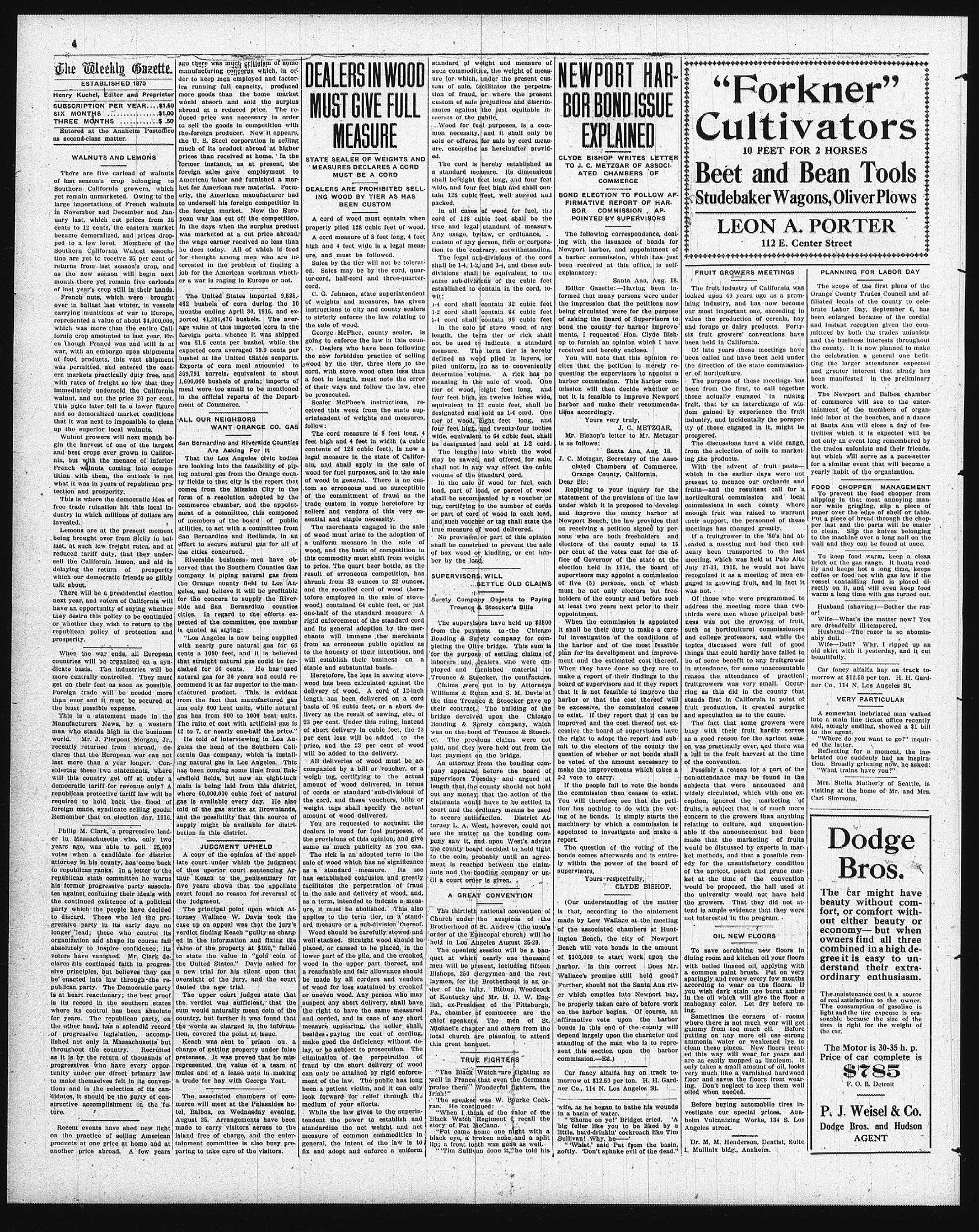
Searchable text
The Weekly Gazette.
ESTABLISHED 1870
Henry Kuchel, Editor and Proprietor
SUBSCRIPTION PER YEAR...$1.50
SIX MONTHS ...$1.00
THREE MONTHS ...$ .50
Entered at the Anaheim Postoffice as second-class matter.
WALNUTS AND LEMONS
There are five carload of walnuts of last season's crop belonging to Southern California growers, which yet remain unmarketed. Owing to the large importations of French walnuts in November and December and January last, which cut prices from 15 cents to 12 cents, the eastern market became demoralized, and prices dropped to a low level. Members of the Southern California Walnut association are yet to receive 25 per cent of returns from last season's crop, and as the new season will begin next month there yet remain five carloads of last year's crop still in their hands.
French nuts, which were brought over in ballast last winter, in vessels carrying munitions of war to Europe, represented a value of about $4,000,000, which was more than the entire California crop amounted to last year. Even though France was and still is at war, with an embargo upon shipments of food products, this vast shipment was permitted, and entered the eastern markets practically duty free, and with rates of freight so low that they immediately undersold the California walnut, and cut the price 20 per cent. This price later fell to a lower figure and so demoralized market conditions that it was next to impossible to clean up the superior local walnuts.
Walnut growers will next month begin the harvest of one of the largest and best crops ever grown in California, but with the mercies of inferior ago there was much griefism of some manufacturing concerns which, in order to keep men employed and factors running full capacity, produced more goods than the home market would absorb and sold the surplus abroad at a reduced price. The reduced price was necessary in order to sell the goods in competition with the foreign producer. Now it appears, the U. S. Steel corporation is selling much of its product abroad at higher prices than received at home. In the former instance, as at present, the foreign sales gave employment to American labor and furnished a market for American raw material. Formerly, the American manufacturer had to undersell his foreign competitor in the foreign market. Now the European war has cut off the competition. In the days when the surplus product was marketed at a cut price abroad, the wage earner received no less than he does today. All of which is food for thought among men who are interested in the problem of finding a job for the American workman whether a war is raging in Europe or not.
The United States imported 9,528,462 bushels of corn during the 10 months ending April 30, 1915, and exported 41,206,476 bushels. The average value of this imported corn in the foreign ports whence it was shipped was 61.5 cents per bushel, while the exported corn averaged 79.9 cents per bushel at the United tSates seaports. Exports of corn meal amounted to 369,791 barrels, equivalent to about 1,600,000 bushels of grain; imports of meal were too small to be mentioned in the official reports of the Department of Commerce.
ALL OUR NEIGHBORS WANT ORANGE CO. GAS
San Bernardino and Riverside Counties Are Asking For It
That the Los Angeles civic bodies
was permitted, and entered the eastern markets practically duty free, and with rates of freight so low that they immediately undersold the California walnut, and cut the price 20 per cent. This price later fell to a lower figure and so demoralized market conditions that it was next to impossible to clean up the superior local walnuts.
Walnut growers will next month begin the harvest of one of the largest and best crops ever grown in California, but with the menace of inferior French walnuts coming into competition with them, the outlook is not what it was in years of republican protection and prosperity.
This is where the democratic idea of free trade ruination hit this local industry in which millions of dollars are invested.
Lemons are at the present moment being brought over from Sicily in ballast, at such low freight rates, and at reduced tariff duty, that they undersell the California lemon, and aid in delaying the return of prosperity which our democratic friends so glibly talk about.
There will be a presidential election next year, and voters of California will have an opportunity of saying whether they desire this policy to be continued or whether they wish to return to the republican policy of protection and prosperity.
When the war ends, all European countries will be organized on a syndicate basis. The industries will be more centrally controlled. They must get on their feet as soon as possible. Foreign trade will be needed more than ever and it must be secured at the least possible expense.
This is a statement made in the Manufacturers News, by a western man who stands high in the business world. Mr. J. Pierpont Morgan, Jr., recently returned from abroad, declares that the European war can not last more than a year longer. Considering these two statements, where will this country get off at under a democratic tariff for revenue only? A republican protective tariff law will be required to hold back the flood of foreign made, syndicate selling goods. Remember that on election day, 1916.
Philip M. Clark, a progressive leader in Massachusetts who, only two years ago, was able to poll 25,000 votes when a candidate for district attorney in his county, has come back to republican ranks. In a letter to the
Exports of corn meal amounted to 369,791 barrels, equivalent to about 1,600,000 bushels of grain; imports of meal were too small to be mentioned in the official reports of the Department of Commerce.
ALL OUR NEIGHBORS WANT ORANGE CO. GAS
San Bernardino and Riverside Counties Are Asking For It
That the Los Angeles civic bodies are looking into the feasibility of piping natural gas from the Orange county fields to that city is the report that comes from the Mission City in the form of a resolution adopted by the commerce chamber, and the appointment of a committee, this composed of members of the board of public utilities, to act with a committee from San Bernardino and Redlands, in an effort to secure natural gas for all of the cities concerned.
Riverside business men have observed that the Southern Counties Gas company is piping natural gas from the Orange county field to Los Angeles, and believe it will be profitable for the concern to supply the Riverside and San Bernardino counties cities. In regard to the efforts expected of the committee, one member is quoted as saying:
"Los Angeles is now being supplied with nearly pure natural gas for 66 cents a 1000 feet, and it is believed that straight natural gas could be furnished for 50 cents. He has used natural gas for 30 years and could recommend it as far superior to the manufactured product. This is evident from the fact that manufactured gas has only 600 heat units, while natural gas has from 900 to 1000 heat units. The raito of cost with artificial gas is 12 to 7, or nearly one-half the price."
He told of interviewing in Los Angeles the head of the Southern California Gas company, which is installing natural gas in Los Angeles. This has been coming some time from Bakersfield fields, but now an eight-inch main is being laid from this district, where 60,000,000 cubic feet of natural gas is available every day. He also told of the gas strike at Brownlands, and the possibility that this source of supply might be available for distribution in this district.
JUDGMENT UPHELD
A copy of the opinion of the appellate court under which the judgment of their superior court sentencing Arwood by the tier, cord, with stove wood a foot in length, moss of their ways and fice be prosecuted.
Sealer McPhee's received this week for enintendent of weigh follow:
The cord measure feet high and 4 feet contents of 128 cul legal measure in thalia, and shall app wood for fuel purpose of wood in general tom so erroneous of the commitment trade custom in vow sellers and vendor sential and staple.
The merchants eof wood must arise a uniform measure wood, and the basis this commodity must to price. The quart result of erroneous shrunk from 32 ounces and the so-called coftofore employed in wood) contained 64 one-half of the star rigid enforcement oi and its general add chants will immunity from an erroneous to the honesty of th will establish their staple and substant.
Heretofore, the low wood has been called delivery of wood. length has been de basis of 96 cubic feet livery as the result 23 per cent. Under r of short delivery in per cent loss will price, and the 23 will be added to th.
All deliveries of companies by a bill weigh tag, certifying amount of wood due of cords or standard the cord, and these weight tags shall not amount of wood de.
You are requested dealers in wood for the provisions of this same as much publThe rick is an ad sale of wood which is as a standard m
Philip M. Clark, a progressive leader in Massachusetts who, only two years ago, was able to poll 25,000 votes when a candidate for district attorney in his county, has come back to republican ranks. In a letter to the republican state committee he warns his former progressive party associates against confusing their ideals with the continued existence of a political party which the people have decided to discard. Those who led the progressive party in its early days no longer lead; those who control its organization and shape its course absolutely to inspire confidence; its voters have vanished. Mr. Clark declares his continued faith in progressive principles, but believes they can be enacted into law through the republican party. The Democratic party is at heart reactionary; the best proof is its record in the southern states where its control has been absolute for years. The republican party, on the other hand, has a splendid record of progressive legislation, accomplished not only in Massachusetts but throughout the country. Recruited as it is by the return of thousands of progressives who have every opportunity under our direct primary law to make themselves felt in its conventions and in the selection of its candidates, it should be the party of constructive accomplishment in the future.
Recent events have shed new light on the practice of selling American products at one price at home and at another price abroad. A few years
JUDGMENT UPHELD
A copy of the opinion of the appellate court under which the judgment of these superior court sentencing Arthur Keach to the penitentiary for five years shows that the appellate court found no reason for reversal of the judgment.
The principal point upon which Attorney Wallace W. Davis took the case up on appeal was that the jury's verdict finding Keach "guilty as charged in the information and fixing the value of the property at $150," failed to state the value in "gold coin of the United States." Davis asked for a new trial for his client upon that oversight of the jury, and the court denied the new trial.
The upper court judges state that the verdict was sufficient, that the sum would naturally mean coin of the country, but further it was found that the words as charged in the information, covered the point at issue.
Keach was sent to prison on a charge of getting property under false pretenses. It was proved that he misrepresented the value of a team of mules and of a lease note in making a trade for hay with George Yost.
The associated chambers of commerce will meet at the Palasales hotel, Balboa, on Wednesday evening, August 25. Arrangements have been made to carry visitors across to the island free of charge, and the entertainment committee is also busy preparing to take care of the visitors.
You are requested to deal with the provisions of this same as much public.
The rick is an adult sale of wood which has established contact facilitates the perp in the sale and delicat as a term, intended secure, it must be about applies to the term and measure or a su.
Wood should be carefully stacked. Straight placed, or caused to lower part of the pile wood in the upper area a reasonable and fair be made by all parts of wood for loss susu or uneven wood. An suspect any short day right to have th and corded, and in measure appearing besides paying them make good the definite lay, or be subject to elimination of the fraud by the short can only be attained ment of the law. There been a patient victim look forward for re medium of your eff.
While the law gives tendent the power to standardize the net measure of common general, the intent fix and adopt and o
DEALERS IN WOOD MUST GIVE FULL MEASURE
STATE SEALER OF WEIGHTS AND MEASURES DECLARES A CORD MUST BE A CORD
DEALERS ARE PROHIBITED SELLING WOOD BY TIER AS HAS BEEN CUSTOM
A cord of wood must contain when properly piled 128 cubic feet of wood.
A cord measure of 8 feet long, 4 feet high and 4 feet wide is a legal measure, and must be followed.
Sales by the tier will not be tolerated. Sales may be by the cord, quarter-cord, half-cord and three-quarter-cord.
C. G. Johnson, state superintendent of weights and measures, has given instructions to city and county sealers to strictly enforce the law relating to the sale of wood.
George McPhee, county sealer, is going to enforce the law in this county. Dealers who have been following the now forbidden practice of selling wood by the tier, three tiers to the cord, with stove wood often less than a foot in length, must note the error of their ways and follow the law, else be prosecuted.
Sealer McPhee's instructions, received this week from the state superintendent of weights and measures, follow:
The cord measure is 8 feet long, 4 feet high and 4 feet in width (a cubic contents of 128 cubic feet), is now a legal measure in the state of California.
standard of weight and measure of suca commodities, the weight of measure for which, under the present custom of sale, facilitates the perpetration of fraud, or where the present custom of sale prejudices and discriminates against the just equitable interests of the public.
Wood for fuel purposes, is a common necessity, and it shall only be sold or offered for sale by cord measure, excepting as hereinafter provided.
The cord is hereby established as a standard measure. Its dimensions shall be eight feet long, and four feet wide, and four feet high and shall contain 128 cubic feet, well stowed and packed.
In all cases of wood for fuel, the cord of 128 cubic feet shall be the true and legal standard of measure. Any usage, by law, or ordinance, custom of any person, firm or corporation to the contrary, notwithstanding.
The legal sub-divisions of the cord shall be 1-4, 1-2, and 3-4, and these sub-divisions shall be equivalent to the same sub-divisions of the cubic feet established to contain in the cord, to wit:
1-4 cord shall contain 32 cubic feet
1-2 cord shall contain 64 cubic feet
3-4 cord shall contain 96 cubic feet
In the sale of stove wood of any length, the term tier or rick shall not be used to indicate a standard measure.
The term tier is hereby defined as wood piled in layers, or piled uniform, so as to conveniently determine volume. A rick has no meaning in the sale of wood. One tier of wood, eight feet long, and four feet high, an twelve inches wide, equivalent to 32 cubic feet, shall be designated and sold as 1-4 cord. One tier of wood, eight feet long, and four feet high, and twenty-four inches wide, equivalent to 64 cubic feet, shall be designated and sold at 1-2 cord.
The lengths into which the wood may be sawn and offered for sale...
wood by the tier, three tiers to the cord, with stove wood often less than a foot in length, must note the error of their ways and follow the law, else be prosecuted.
Sealer McPhee's instructions, received this week from the state superintendent of weights and measures, follow:
The cord measure is 8 feet long, 4 feet high and 4 feet in width (a cubic contents of 128 cubic feet), is now a legal measure in the state of California, and shall apply in the sale of wood for fuel purposes, and in the sale of wood in general. There is no custom so erroneous and so susceptible of the commitment of fraud as the trade custom in vogue heretofore by sellers and vendors of this very essential and staple necessity.
The merchants engaged in the sale of wood must arise to the adoption of a uniform measure in the sale of wood, and the basis of competition in this commodity must shift from weight to price. The quart beer bottle, as the result of erroneous competition, has shrunk from 32 ounces to 22 ounces, and the so-called cord of wood (heretofore employed in the sale of stewe-wood) contained 64 cubic feet, or just one-half of the standard measure. A rigid enforcement of the standard cord and its general adoption by the merchants will immune the merchants from an erroneous public opinion as to the honesty of their intentions, and will establish their business on a staple and substantial basis.
Heretofore, the loss in sawing stewe-wood has been calculated against the delivery of wood. A cord of 12-inch length has been delivered on a cord basis of 96 cubic feet, or a short delivery as the result of sawing, etc., of 23 per cent. Under this ruling, instead of short delivery in cubic feet, the 23 per cent loss will be added to the price, and the 23 per cent of wood will be added to the delivery.
All deliveries of wood must be accompanied by a bill or voucher, or a weigh tag, certifying to the actual amount of wood delivered, in terms of cords or standard sub-divisions of the cord, and these vouchers, bills or weight tags shall specify the actual amount of wood delivered.
You are requested to acquaint the dealers in wood for fuel purposes, of the provisions of this opinion, and give same as much publicity as you can.
The rick is an adopted term in the sale of wood which has no significance as a standard measure. Its use piled uniform, so as to conveniently determine volume. A rick has no meaning in the sale of wood. One tier of wood, eight feet long, and four feet high, an twelve inches wide, equivalent to 32 cubic feet, shall be designated and sold as 1-4 cord. One tier of wood, eight feet long, and four feet high, and twenty-four inches wide, equivalent to 64 cubic feet, shall be designated and sold at 1-2 cord.
The lengths into which the wood may be sawed, and offered for sale, shall not in any way effect the cubic volume of the standard cord.
In the sale of wood for fuel, each load, part of load, or parcel of wood shall be accompanied by a voucher or tag, certifying to the number of cords or part of cord of wood in each load, and such voucher or tag shall state the true measure of wood delivered.
No provision or part of this opinion shall be construed to prevent the sale of box wood or kindling, or cut lumber by the load.
SUPERVISORS WILL SETTLE OLD CLAIMS
Surety Company Objects to Paying Trounce & Stoecker's Bills
The supervisors have held up $3500 from the payment to the Chicago Bonding & Surety company for completing the Olive bridge. This sum is for the purpose of settling claims of laborers and dealers who were employed and furnished material to Trounce & Stoecker, the contractors.
Claims were put in by Attorneys Williams & Rutan and S. M. Davis at the time Trounce & Stoecker gave up their contract. The building of the bridge devolved upon the Chicago Bonding & Surety company, which was on the bond of Trounce & Stoecker. The previous claims were not paid, and they were held out from the last payment on the bridge.
An attorney from the bonding company appeared before the board of supervisors Tuesday and argued at length that the county should not hold out any money; that the action of the claimants would have to be settled in court and the ordinary means be used to secure satisfaction. District Attorney L. A. West, however, could not see the matter as the bonding company saw it, and upon West's advice the county board decided to hold tight to the coin, probably until an agreement is reached between the claim-citing uniform, so as to conveniently determine volume. A rick has no meaning in the sale of wood. One tier of wood, eight feet long, and four feet high, an twelve inches wide, equivalent to 32 cubic feet, shall be designated and sold as 1-4 cord. One tier of wood, eight feet long, and four feet high, and twenty-four inches wide, equivalent to 64 cubic feet, shall be designated and sold at 1-2 cord.
The lengths into which the wood may be sawed, and offered for sale, shall not in any way effect the cubic volume of the standard cord.
In the sale of wood for fuel, each load, part of load, or parcel of wood shall be accompanied by a voucher or tag, certifying to the number of cords or part of cord of wood in each load, and such voucher or tag shall state the true measure of wood delivered.
No provision or part of this opinion shall be construed to prevent the sale of box wood or kindling, or cut lumber by the load.
SUPERVISORS WILL SETTLE OLD CLAIMS
Surety Company Objects to Paying Trounce & Stoecker's Bills
The supervisors have held up $3500 from the payment to the Chicago Bonding & Surety company for completing the Olive bridge. This sum is for the purpose of settling claims of laborers and dealers who were employed and furnished material to Trounce & Stoecker, the contractors.
Claims were put in by Attorneys Williams & Rutan and S. M. Davis at the time Trounce & Stoecker gave up their contract. The building of the bridge devolved upon the Chicago Bonding & Surety company, which was on the bond of Trounce & Stoecker. The previous claims were not paid, and they were held out from the last payment on the bridge.
An attorney from the bonding company appeared before the board of supervisors Tuesday and argued at length that the county should not hold out any money; that the action of the claimants would have to be settled in court and the ordinary means be used to secure satisfaction. District Attorney L. A. West, however, could not see the matter as the bonding company saw it, and upon West's advice the county board decided to hold tight to the coin, probably until an agreement is reached between the claim-citing uniform, so as to conveniently determine volume. A rick has no meaning in the sale of wood. One tier of wood, eight feet long, and four feet high, an twelve inches wide, equivalent to 32 cubic feet, shall be designated and sold as 1-4 cord. One tier of wood, eight feet long, and four feet high, and twenty-four inches wide, equivalent to 64 cubic feet,shall be designated和 sold at1-2cord.
The lengths into which the wood may be sawed,and offered for sale,shall not in any way effectthe cubicvolumeofthestandardcordanditsgeneraladoptionbythemerchantswillimmunethemerchantsfromanerroneouspublicopinionastothehonestyoftheintentions,andwillestablishthebusinessonastapleandsubstantialbasis.
Heretofore,thelossinsawingstewe-woodhasbeencalculatedagainstthedeliveryofwood.Acordof12-inchlengthhasbeendeliveronedonacordbasisof96cubicfeet.orashortdeliveryastheresultofsawing,eetc.,of23percent.Underthisruling,iinstudiedshortdeliveryincubicfeet,the23percentlosswillbesaddedtotheprice,andthe23percentofwoodwillbeloadtedtothedelivery.
Alldeliveriesofwoodmustbeaccompaniedbya billorvoucherorawightag,certifyingtotheactualamountofwooddelivered.intermsofcordsorstandardsub-divisionsofthecord,andthesevouchers,billsorweighttagsshallspecifytheactualamountofwooddelivered.
Youarerequestedtocquirethedealersinwoodforfuelpurposes.oftheprovisionsofthisopinion,andgivesameasmuchpublicityasyoucan.
Therickisanadoptedterminothe Saleofwoodwhichhasnosignificanceasstandardmeasure.Itsusepileduniform,sоastoconvenientlydeterminevolume.Arickhasnomeaninginthesaleofwood.Atlierofwood,eightfeetlong,andfourfeethigh,thetwelveincheswide,equivalentto32cubicfeetshallbedesignatedandsoldat1-4cord.Atlierofwood,eightfeetlong,andfourfeethigh,thetwelveincheswide,equivalentto32cubicfeetshallbedesignatedandsoldat1-2cord.
weigh tag, certifying to the actual amount of wood delivered, in terms of cords or standard sub-divisions of the cord, and these vouchers, bills or weight tags shall specify the actual amount of wood delivered.
You are requested to acquaint the dealers in wood for fuel purposes, of the provisions of this opinion, and give same as much publicity as you can.
The rick is an adopted term in the sale of wood which has no significance as a standard measure. Its use has established confusion and greatly facilitates the perpetration of fraud in the sale and delivery of wood, and, as a term, intended to indicate a measure, it must be abolished. This also applies to the term tier, as a standard measure or a sub-division thereof.
Wood should be carefully stowed and well stacked. Straight wood should be placed, or caused to be placed, in the lower part of the pile, and the crooked wood in the upper part thereof, and a reasonable and fair allowance should be made by all corders and vendors of wood for loss sustained by crooked or uneven wood. Any person who may suspect any short delivery, shall have the right to have the same measured and corded, and in case of any short measure appearing, the seller shall, besides paying the cost of cording, make good the deficiency without delay, or be subject to prosecution. The elimination of the perpetration of fraud by the short delivery of wood can only be attained by rigid enforcement of the law. The public has long been a patient victim, and it can only look forward for relief through the medium of your efforts.
While the law gives to the superintendent the power to establish and standardize the net weight and net measure of common commodities in general, the intent of the law is to fix and adopt and enforce a uniform
A GREAT CONVENTION
The thirtieth national convention of Church under the auspices of the Brotherhood of St. Andrew (the men's order of the Episcopal church) will be held in Los Angeles August 25-29.
The opening session will be a banquet at which nearly one thousand men will be present, including fifteen Bishops, 250 clergymen and the rest laymen, for the Brotherhood is an order of the laity. Bishop Woodcock of Kentucky and Mr. H. D. W. English, ex-President of the Pittsburgh, Pa., chamber of commerce are the chief speakers. The men of St. Michael's chapter and others from the local church are planning to attend this great banquet.
TRUE FIGHTERS
"The Black Watch are fighting so well in France that even the Germans praise them." Wonderful fighters, the Irish!
The speaker was W. Bourke Cockran. He continued:
"When I think of the valor of the Black Watch Regiment I recall the story of Pat McCann.
"Pat came home one night with a black eye, a broken nose and a split lip; a front tooth was gone as well.
"Tim Sullivan done it," he told his supervisors Tuesday and argued at length that the county should not hold out any money that the action of the claimants would have to be settled in court and the ordinary means be used to secure satisfaction. District Attorney L. A. West, however, could not see the matter as the bonding company saw it, and upon West's advice the county board decided to hold tight to the coin, probably until an agreement is reached between the claimants and the bonding company or until a court order is given.
Our understanding of the matter is that, according to the statement made by Lew Wallace at the meeting of the associated chambers at Huntington Beach, the city of Newport Beach will vote bonds in the amount of $100,000 to start work upon the harbor. Is this correct Does Mr. Wallace's promise still hold good? Further, should not the Santa Ana river which empties into Newport bay, be properly taken care of before work on the harbor begins. Of course, an affirmative vote upon the harbor bonds in this end of the county will depend largely upon the character and standing of the man who is to represent this section upon the harbor commission.—Ed.)
Car fancy alfalfa hay on track tomorrow at $12.50 per ton. H. H. Gardner Co., 114 N. Los Angeles St.
wife, as he began to bathe his wounds in a basin of water.
"'Shame on ye!' Bridget eried. 'A big feller like you to be liked by a little, hard-drinkin' cockroach like Tim Sullivan! Why, he——'
"'Whist,' said Pat from the basin, softly. 'Don't sphake evil of the dead.'
"Forkner"
Cultivators
10 FEET FOR 2 HORSES
Beet and Bean Tools
Studebaker Wagons, Oliver Plows
LEON A. PORTER
112 E. Center Street
FRUIT GROWERS MEETINGS
The fruit industry of California was looked upon 40 years ago as a promising industry, and has now become our most important one, exceeding in value the production of cereals, hay and forage or dairy products. Forty-six fruit growers' conventions have been held in California.
Of late years these meetings have been called and have been held under the direction of the state commissioner of horticulture.
The purpose of these meetings has been from the first, to call together those actually engaged in raising fruit, that by an interchange of wisdom gained by experience the fruit industry, and incidentally the porosity of those engaged in it, might be prospered.
The discussions have a wide range, from the selection of soils to marketing the products.
PLANNING FOR LABOR DAY
The scope of the first plans of the Orange County Trades Council and affiliated locals of the county to celebrate Labor Day, September 6, has been enlarged because of the cordial and instant reception given the committees by both the trades unionists and the business interests throughout the county. It is now planned to make the celebration a general one befitting the larger attendance expected and greater interest that already has been manifested in the preliminary work.
The Newport and Balboa chamber of commerce will see to the entertainment of the members of organized labor at the beaches, and a dance at Santa Ana will close a day of festivities which it is expected will be not only an event long remembered by the trades unionists and their friends, but which will serve as a pace-setter.
their recommendations to appoint a
inquiry for the provisions of the law
proposed to develop the county harbor at
the law provides that citation signed by perth freeholders and county equal to 15
notes cast for the office of the state at the
1914, the board of appoint a commission
onions, each of which may electors but freeunity and before such next prior to their
commission is appointed duty to make a careof the conditions of the most feasible
operation and improve-eliminated cost thereof.
done so they are to their findings to the
tors and if they report
sible to improve the cost thereof will
the commission ceases report that it can be
cost thereof not exof supervisors have
the report and subscribes of the county the
ter or not bonds shall
amount necessary to
ments which takes a
full to vote the bonds
then ceases to exist.
see that the petito do with the votIt simply starts the
which a commission is
estigate and make a
if the voting of the
wards and is entireower of the board of
The purpose of these meetings has been from the first, to call together those actually engaged in raising fruit, that by an interchange of wisdom gained by experience the fruit industry, and incidentally the porosity of those engaged in it, might be prospered.
The discussions have a wide range, from the selection of soils to marketing the products.
With the advent of fruit pests—which in the earlier days were not present to menace our orchards and fruits—and the resultant call for a horticultural commission and local commissions in each county where enough fruit was raised to warrant their support, the personnel of these meetings has changed greatly.
If a fruitgrower in the '80's had attended a meeting and had then suddenly been transported to the last meeting, which was held at Palo Alto July 27-31, 1915, he would not have recognized it as a meeting of men engaged in growing fruit, and in fact it was not.
Of those who were programmed to address the meeting more than two-thirds were men whose principal business was not the growing of fruit, such as horticultural commissioners and college professors, and while the topics discussed were full of good things that could hardly have failed to be of some benefit to any fruitgrower in attendance, for some unaccountable reason the attendance of practical fruitgrowers was very small. Occurring as this did in the county that stands first in California in point of fruit production, it created surprise and speculation as to the cause.
The fact that some growers were busy with their fruit hardly serves as a good reason for the apricot season was practically over, and there was a lull in the fruit harvest at the time of the convention.
Possibly a reason for a part of the non-attendance may be found in the subjects that were announced and widely circulated, which with one exception, ignored the marketing of fruits, a subject that is of much more concern to the growers than anything relating to culture, and unquestionable if the announcement had been made that the marketing of fruits would be discussed by experts in market methods, and that a possible remedy for the unsatisfactory condition of the apricot branch and prune mar-
ing the larger attendance expected and greater interest that already has been manifested in the preliminary work.
The Newport and Balboa chamber of commerce will see to the entertainment of the members of organized labor at the beaches, and a dance at Santa Ana will close a day of festivities which it is expected will be not only an event long remembered by the trades unionists and their friends, but which will serve as a pace-setter for a similar event that will become a yearly habit of the organization.
FOOD CHOPPER MANAGEMENT
To prevent the food chopper from slipping in that most annoying manner while grinding, slip a piece of paper over the edge of shelf or table. Put a piece of bread through the chopper last and the parts will be easier to clean. Slip the knives belonging to the machine over a long nail on the wall and they can be found at once.
To keep food warm, keep a clean brick on the gas range. It heats readily and keeps hot a long time, keeps coffee or food hot with gas low if the vessel containing food is placed directly on it, and will even keep food warm a long time with gas turned out.
Husband (shaving)—Bother the razor!
Wife—What's the matter now? You are dreadfully ill-tempered.
Husband—The razor is so abominably dull.
Wife—Dull? Why, I ripped up an old skirt with it yesterday, and it cut beautifully.
Car fancy alfalfa hay on track tomorrow at $12.50 per ton. H. H. Gardner Co., 114 N. Los Angeles St.
VERY PARTICULAR
A somewhat inebriated man walked into a main line ticket office recently and, smugly smiling, showed a $1 bill to the agent.
"Where do you want to go?" inquired the latter.
Reflecting for a moment, the inebriated one suddenly had an inspiration. Broadly grinning now, he asked: "What trains have you?"
Mrs. Stella Matherly of Seattle, is visiting at the home of Mr. and Mrs. Carl Simmons.
Dodge Bros.
The car might have beauty without comfort, or comfort without either beauty or economy—but when owners find all three combined in a high degree it is easy to understand their extraordinary enthusiasm.
The maintenance cost is a source of real satisfaction to the owner. The consumption of gasoline is light and the tire expense is reasonable because the size of the tires is right for the weight of the car.
The Motor is 30-35 h. p. Price of car complete is $785 F. O. B. Detroit
P. J. Weisel & Co.
Dodge Bros. and Hudson AGENT