anaheim-gazette 1915-07-22
Scanned page
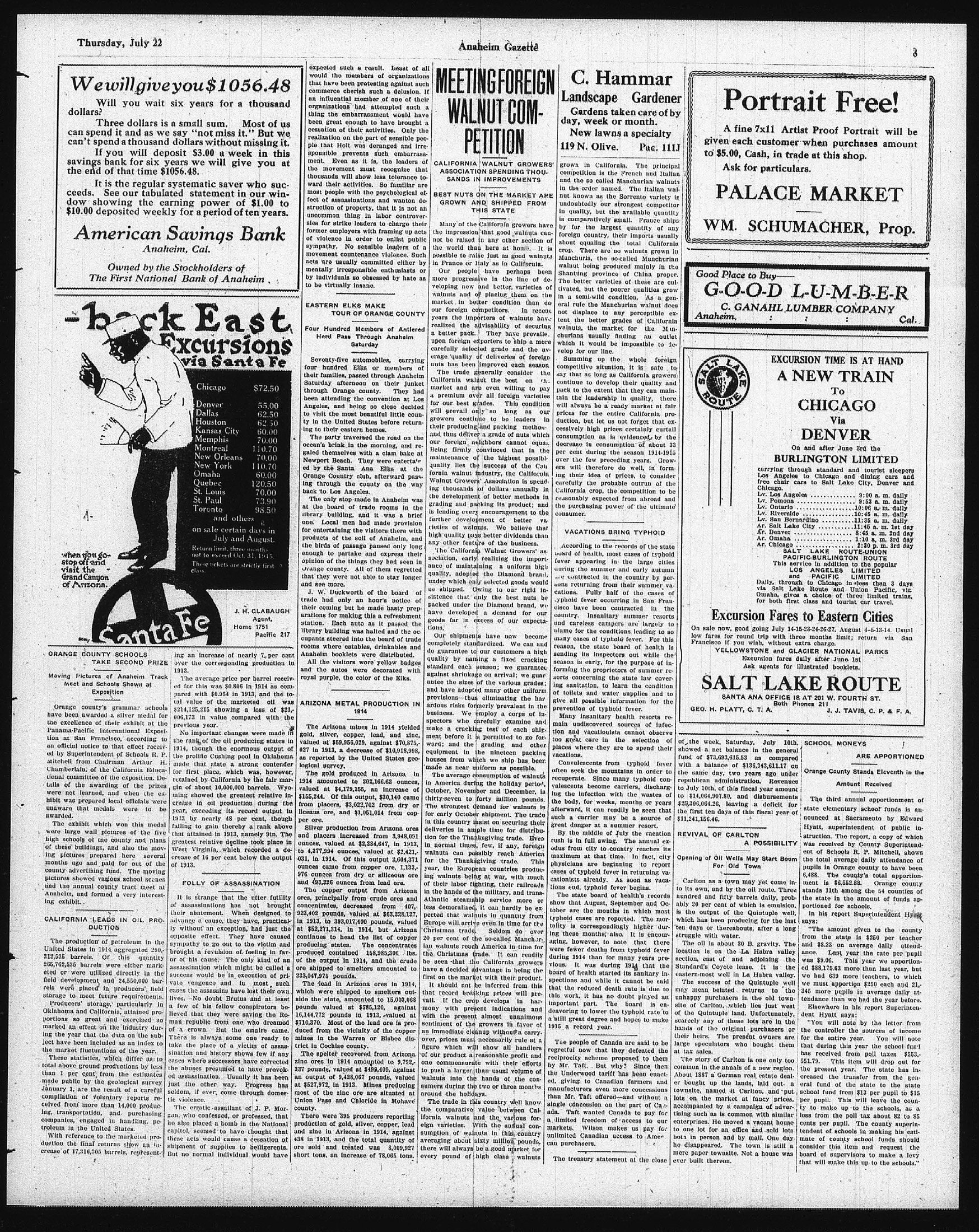
Searchable text
Thursday, July 22
We will give you $1056.48
Will you wait six years for a thousand dollars?
Three dollars is a small sum. Most of us can spend it and as we say "not miss it." But we can't spend a thousand dollars without missing it.
If you will deposit $3.00 a week in this savings bank for six years we will give you at the end of that time $1056.48.
It is the regular systematic saver who succeeds. See our tabulated statement in our window showing the earning power of $1.00 to $10.00 deposited weekly for a period of ten years.
American Savings Bank
Anaheim, Cal.
Owned by the Stockholders of The First National Bank of Anaheim
- back East Excursions via Santa Fe
Chicago $72.50
Denver 55.00
Dallas 62.50
Houston 62.50
Kansas City 60.00
Memphis 70.00
Montreal 110.70
New Orleans 70.00
ORANGE COUNTY SCHOOLS
TAKE SECOND PRIZE
Moving Pictures of Anaheim Track Meet and Schools Shown at Exposition
Orange county's grammar schools have been awarded a silver medal for the excellence of their exhibit at the Panama-Pacific International Exposition at San Francisco, according to an official notice to that effect received by Superintendent of Schools R. P. Mitchell from Chairman Arthur H. Chamberlain, of the California Educational committee of the exposition. Details of the awarding of the prizes were not learned, and when the exhibit was prepared local officials were unaware that medals were to be awarded.
The exhibit which won this medal were large wall pictures of the five high schools of the county and plans of these buildings, and also the moving pictures prepared here several months ago and paid for out of the county advertising fund.
In an increase of nearly 7 per cent over the corresponding production in 1913,
The average price per barrel received for this was $0.806 in 1914 as compared with $0.954 in 1913, and the total value of the marketed oil was $214,125,215 showing a loss of $23,006,173 in value compared with the previous year.
No important changes were made in the rank of the oil producing states in 1914, though the enormous output of the prolific Cushing pool in Oklahoma made that state a strong contender for first place, which was, however, retained by California by the fair margin of about 10,000,000 barrels. Wyoming showed the greatest relative increase in oil production during the year, exceeding its record output in 1913 by nearly 48 per cent, though failing to gain thereby a rank above that attained in 1913, namely 9tn. The greatest relative decline took place in West Virginia, which recorded a decrease of 16 per cent below the output of 1913.
The party traverses ocean's brink in the galeted themselves while Newport Beach. They ed by the Santa Ana Orange Country club through the coast back to Los Angeles.
The only stop made at the board of trust library building, and one. Local men had for entertaining the products of the soil the birds of passage enough to partake in opinion of the things Orange county. All that they were not aware and see more.
J. W. Duckworth trade had only an their coming but her arations for making station. Each auto library building was cupants steered into rooms where eatable Anaheim booklets were all the visitors we and the autos were royal purple, the colo-
ARIZONA METAL FILM
The Arizona miner gold, silver, copper, valued at $59,956,029,027 in 1913, a decrease as reported by the Urological survey.
The gold produced 1914 amounted to 2 valued at $4,179,155,155,244. Of this out from placers, $3,022,17ceaus ore, and $1,0per ore.
Silver production f and placers increases ounces, valued at $2to 4,377,994 ounces, v 031, in 1914. Of this ounces came from co
CALIFORNIA LEADS IN OIL PRODUCTION
The production of petroleum in the United States in 1914 aggregated 290,312,535 barrels. Of this quantity 255,762,535 barrels were either marketed or were utilized directly in the field development and 24,550,000 barrels were placed in producers' field storage to meet future requirements.
Producers' storage, particularly in Oklahoma and California, attained proportions so great and exercised so marked an effect on the industry during the year that the data on the subject have been included as an index to the market fluctuations of the year.
These statistics, which differ as to total above ground productions by less than 1 per cent from the estimates made public by the geological survey January 1, are the result of a careful compilation of voluntary reports received from more than 14,000 producing, transportation, and purchasing companies, engaged in handling, petroleum in the United States.
With reference to the marketed production the final returns show an increase of 17,316,305 barrels, represent-
It is strange that the utter futility of assassinations has not brought their abatement. When designed to advance a cause, they have practically without an exception, had just the opposite effect. They have caused sympathy to go out to the victim and brought a revulsion of feeling in favor of his cause. The only kind of an assassination which might be called a success would be in execution of private vengeance and in most cases the assassins have lost their own lives. No doubt Brutus and at least a few of his fellow conspirators believed that they were saving the Roman republic from one who dreamed of a crown. But the empire came. There is always some one ready to take the place of a victim of assassination and history shows few if any cases where successors have corrected the abuses presumed to have provoked assassination. Usually it has been just the other way. Progress has seldom, if ever, come through domestic violence.
The erratic assailant of J. P. Morgan, who confessed, or professed, that he also placed a bomb in the National capitol, seemed to have thought that these acts would cause a cessation of shipment of supplies to belligerents. But no normal individual would have retained by California by the fair margin of about 10,000,000 barrels. Wyoming showed the greatest relative increase in oil production during the year, exceeding its record output in 1913 by nearly 48 per cent, though failing to gain thereby a rank above that attained in 1913, namely 9tn. The greatest relative decline took place in West Virginia, which recorded a decrease of 16 per cent below the output of 1913.
FOLLY OF ASSASSINATION
The copper output ores, principally from concentrates, decreased 923,402 pounds, valued at $28,104 to 4,377,994 ounces, worth $031, in 1914. Of this ounces came from coils 976 ounces from dry ore and 493,226 ounces from copper.
The lead in Arizona which were shipped outside the state, amounted to $516,144,772 pounds in $710,370. Most of the ore produced from the vicinity mines in the Warren trict in Cochise county.
The spelter recovered zinc ores in 1914 amounting to 337 pounds, valued at $38 an output of 9,428,067 at $527,972, in 1913. Most of the zinc ore sold and treated short tons, an increase...
expected such a result. Least of all would the members of organizations that have been protesting against such commerce cherish such a delusion. If an influential member of one of their organizations had attempted such a thing the embarrassment would have been great enough to have brought a cessation of their activities. Only the realization on the part of sensible people that Holt was deranged and irresponsible prevents such embarrassment. Even as it is, the leaders of the movement must recognize that thousands will show less tolerance toward their activities. So familiar are most people with the psychological effect of assassinations and wanton destruction of property, that it is not an uncommon thing in labor controversies for strike leaders to charge their former employers with framing up acts of violence in order to enlist public sympathy. No sensible leaders of a movement countenance violence. Such acts are usually committed either by mentally irresponsible enthusiasts or by individuals so obsessed by hate as to be virtually insane.
EASTERN ELKS MAKE TOUR OF ORANGE COUNTY
Four Hundred Members of Antlered Herd Pass Through Anaheim Saturday
Seventy-five automobiles, carrying four hundred Elks or members of their families, passed through Anaheim Saturday afternoon on their junket through Orange county. They had been attending the convention at Los Angeles, and being so close decided to visit the most beautiful little county in the United States before returning to their eastern homes.
The party traversed the road on the ocean's brink in the morning, and regaled themselves with a clam bake at Newport Beach.
MEETING FOREIGN WALNUT COMPETITION
CALIFORNIA WALNUT GROWERS' ASSOCIATION SPENDING THOUSANDS IN IMPROVEMENTS
BEST NUTS ON THE MARKET ARE GROWN AND SHIPPED FROM THIS STATE
Many of the California growers have the impression that good walnuts cannot be raised in any other section of the world than here at home. It is possible to raise just as good walnuts in France or Italy as in California.
Our people have perhaps been more progressive in the line of developing new and better varieties of walnuts and of placing them on the market in better condition than do our foreign competitors. In recent years the importers of walnuts have realized the advisability of securing a better pack. They have prevailed upon foreign exporters to ship a more carefully selected grade and the average quality of deliveries of foreign nuts has been improved each season.
The trade generally consider the California walnut the best on the market and are even willing to pay a premium over all foreign varieties for our best grades. This condition will prevail only so long as our growers continue to be leaders in their producing and packing method and thus deliver a grade of nuts which our foreign neighbors cannot equate. Being firmly convinced that in the maintenance of the highest possible grown in California. The principal competition is the French and Italian and the so called Manchurian walnuts in the order named. The Italian walnut known as the Sorrento variety is undoubtedly our strongest competitor in quality, but the available quantity is comparatively small. France ships by far the largest quantity of any foreign country, their imports usually about equaling the total California crop. There are no walnuts grown in Manchuria, the so-called Manchurian walnut being produced mainly in the Shantung province of China proper. The better varieties of these are cultivated, but the poorer qualities grow in a semi-wild condition. As a general rule the Manchurian walnut does not displace to any perceptible extent the better grades of California walnuts, the market for the Manchurians usually finding an outlet which it would be impossible to develop for our line.
Summing up the whole foreign competitive situation, it is safe to say that as long as California growers continue to develop their quality and pack to the extent that they can maintain the leadership in quality, there will always be a ready market at fair prices for the entire California production, but let us not forget that excessively high prices certainly curtail consumption as is evidenced by the decrease in consumption of about 33 per cent during the season 1914-1915 over the few preceding years.
four hundred Elks or members of their families, passed through Anaheim Saturday afternoon on their junket through Orange county. They had been attending the convention at Los Angeles, and being so close decided to visit the most beautiful little county in the United States before returning to their eastern homes.
The party traversed the road on the ocean's brink in the morning, and regaled themselves with a clam bake at Newport Beach. They were entertained by the Santa Ana Elks at the Orange Country club, afterward passing through the county on the way back to Los Angeles.
The only stop made in Anaheim was at the board of trade rooms in the library building, and it was a brief one. Local men had made provision for entertaining the visitors there with products of the soil of Anaheim, and the birds of passage paused only long enough to partake and express their opinion of the things they had seen in Orange county. All of them regretted that they were not able to stay longer and see more.
J. W. Duckworth of the board of trade had only an hour's notice of their coming but he made hasty preparations for making this a refreshment station. Each auto as it passed the library building was halted and the occupants steered into the board of trade rooms where eatables, drinkables and Anaheim booklets were distributed.
All the visitors wore yellow badges and the autos were decorated with royal purple, the color of the Elks.
ARIZONA METAL PRODUCTION IN 1914
The Arizona mines in 1914 yielded gold, silver, copper, lead, and zinc, valued at $59,956,029, against $70,875,-027 in 1913, a decrease of $10,918,998, as reported by the United States geological survey.
The gold produced in Arizona in 1914 amounted to 202,166.62 ounces, valued at $4,179,155, an increase of $155,244. Of this output, $30,140 came from placers, $3,022,702 from dry or liceaus ore, and $1,051,014 from copper ore.
Silver production from Arizona ores and placers increased from 3,948,091 ounces, valued at $2,384,647, in 1913, to 4,377,994 ounces, valued at $2,421,-031, in 1914. Of this output 2,604,371 ounces came from copper ore, 1,133,-
The trade generally consider the California walnut the best on market and are even willing to pay a premium over all foreign varieties for our best grades. This condition will prevail only so long as our growers continue to be leaders in their producing and packing method and thus deliver a grade of nuts which our foreign neighbors cannot equal. Being firmly convinced that in the maintenance of the highest possible quality lies the success of the California walnut industry, the California Walnut Growers' Association is spending thousands of dollars annually in the development of better methods in grading and packing its product; and is lending every encouragement to the further development of better varieties of walnuts. We believe that high quality pays better dividends than any other feature of the business.
The California Walnut Growers' as sociation, early realizing the importance of maintaining a uniform high quality, adopted the Diamond brand under which only selected goods would be shipped. Owing to our rigid insistence that only the best nuts be packed under the Diamond brand, we have developed a demand for our goods far in excess of our expectations.
Our shipments have now become completely standardized. We can and do guarantee to our customers a high quality by naming a fixed cracking standard each season; we guarantee against shrinkage on arrival; we guarantee the sizes of the various grades; and have adopted many other uniform provisions—thus eliminating the hazardous risks formerly prevalent in the business. We employ a corps of inspectors who carefully examine and make a cracking test of each shipment before it is permitted to go forward; and the grading and other equipment in the nineteen packing houses from which we ship has beer made as near uniform as possible.
The average consumption of walnuts in America during the holiday period, October, November and December, is thirty-seven to forty million pounds. The strongest demand for walnuts is for early October shipment. The trade in this country insist on securing their deliveries in ample time for distribution for the Thanksgiving trade. Even in normal times, few, if any, foreign walnuts can possibly reach America for the Thanksgiving trade. This year, the European countries produce competitive situation, it is safe to say that as long as California growers continue to develop their quality and pack to the extent that they can maintain the leadership in quality, there will always be a ready market at fair prices for the entire California production, but let us not forget that excessively high prices certainly curtail consumption as is evidenced by the decrease in consumption of about 33 per cent during the season 1914-1915 over the few preceding years. Growers will therefore do well, in forming their idea of prices, to consider carefully the probable outrun of the California crop, the competition to be reasonably expected from abroad and the purchasing power of the ultimate consumer.
VACATIONS BRING TYPHOID
According to the records of the state board of health, most cases of typhoid fever appearing in the large cities during the summer and early autumn are contracted in the country by persons returning from their summer vacations. Fully half of the cases of typhoid fever occurring in San Francisco have been contracted in the country. Insanitary summer resorts and careless campers are largely to blame for the conditions leading to so many cases of typhoid fever. For this reason, the state board of health is sending its inspectors out while the season is early, for the purpose of informing the proprietors of summer resorts concerning the state law covering sanitation, to learn the condition of toiletts and water supplies and to give all possible information for the prevention of typhoid fever.
Many insanitary health resorts remain undiscovered sources of infection and vacationists cannot observe too great care in the selection of places where they are to spend their vacations.
Convalescents from typhoid fever often seek the mountains in order to recuperate. Since many typhoid convalescents become carriers, discharging the infection with the wastes of the body, for weeks, months or years afterward, it can readily be seen that such a carrier may be a source of great danger at a summer resort.
By the middle of July the vacation rush is in full swing. The annual exodus from city to country reaches its maximum at that time. In fact, city physicians are beginning to report
The gold produced in Arizona in 1914 amounted to 202,166.62 ounces, valued at $4,179,155, an increase of $155,244. Of this output, $30,140 came from placers, $3,022,702 from dry or liceaus ore, and $1,051,014 from copper ore.
Silver production from Arizona ores and placers increased from 3,948,091 ounces, valued at $2,384,647, in 1913, to 4,377,994 ounces, valued at $2,421,031, in 1914. Of this output 2,604,371 ounces came from copper ore, 1,133,976 ounces from dry or siliceous ore and 493,226 ounces from lead ore.
The copper output from Arizona ores, principally from crude ores and concentrates, decreased from 407,923,402 pounds, valued at $63,228,127, in 1913, to 393,017,400 pounds, valued at $52,271,314, in 1914, but Arizona continues to head the list of copper producing states. The concentrates produced contained 158,985,306 lbs. of the output in 1914, and the crude ore shipped to smelters amounted to 233,047,975 pounds.
The lead in Arizona ores in 1914, which were shipped to smelters outside the state, amounted to 15,003,068 pounds valued at $585,120, against 16,144,772 pounds in 1913, valued at $710,370. Most of the lead ore is produced from the vicinity of the copper mines in the Warren or Blisbee district in Cochise county.
The spelter recovered from Arizona zinc ores in 1914 amounted to 9,792,337 pounds, valued at $499,409, against an output of 9,428,067 pounds, valued at $527,972, in 1913. Mines producing most of the zinc ore are situated at Union Pass and Chloride in Mohave county.
There were 395 producers reporting production of gold, silver, copper, lead and zinc in Arizona in 1914, against 438 in 1913, and the total quantity of ore sold and treated was 8,009,927 short tons, an increase of 78,065 tons.
The average consumption of walnuts in America during the holiday period October November and December is thirty-seven to forty million pounds. The strongest demand for walnuts is for early October shipment. The trade in this country insist on securing their deliveries in ample time for distribution for the Thanksgiving trade. Even in normal times few if any foreign walnuts can possibly reach America for the Thanksgiving trade. This year, the European countries producing walnuts being at war with much of their labor fighting their railroads in the hands of the military and transAtlantic steamship service more or less demoralized it can hardly be expected that walnuts in quantity from Europe will arrive even in time for the Christmas trade. Seldom do over 20 per cent of the so-called Manchurian walnuts reach America in time for the Christmas trade. It can readily be seen that the California growers have a decided advantage in being the first on the market with their product.
It should not be inferred from this that record breaking prices will prevail. If the crop develops in harmony with present indications and with the present almost unanimous sentiment of the growers in favor of an immediate cleanup without a carry-over, prices must necessarily rule at a figure which will show all handlers of our product a reasonable profit and one commensurate with their efforts to push a larger than usual volume of walnuts into the hands of the consumers during the two or three months around the holidays.
The trade in this country well know the comparative value between California walnuts and the various foreign varieties. With the annual consumption of walnuts in this country averaging about sixty million pounds there will always be a good market for every pound of high class walnuts recuperate. Since many typhoid convalescents become carriers, discharging the infection with the wastes of the body, for weeks months or years afterward it can readily be seen that such a carrier may be a source of great danger at a summer resort.
By the middle of July the vacation rush is in full swing. The annual exodus from city to country reaches its maximum at that time. In fact, city physicians are beginning to report cases of typhoid fever in returning vacationists already. As soon as vacations end, typhoid fever begins.
The state board of health's records show that August, September and October are the months in which most typhoid cases are reported. The mortality is correspondingly higher during these months also. It is encouraging; however, to note that there were fewer deaths from typhoid fever during 1914 than for many years previous. It was during 1914 that the board of health started its sanitary inspections and while it cannot be said that the reduced death rate is due to this work it has no doubt played an important part. The board is endeavoring to lower the typhoid rate to a still great degree and hopes to make 1915 a record year.
The people of Canada are said to be regretful now that they defeated the reciprocity scheme proposed to them by Mr. Taft. But why? Since then the Underwood tariff has been enacted giving to Canadian farmers and manufacturers even more concessions than Mr. Taft offered—and without a single concession on the part of Canada. Taft wanted Canada to pay for a limited freedom of access to our markets. Wilson makes us pay for unlimited Canadian access to American purchasers.
The treasury statement at the close
Portrait Free!
A fine 7x11 Artist Proof Portrait will be given each customer when purchases amount to $5.00, Cash, in trade at this shop.
Ask for particulars.
PALACE MARKET
WM. SCHUMACHER, Prop.
Good Place to Buy—
G-O-O-D L-U-M-B-E-R
C. GANAHL LUMBER COMPANY
Anaheim, Cal.
EXCURSION TIME IS AT HAND
A NEW TRAIN
To CHICAGO
Via DENVER
On and after June 3rd the BURLINGTON LIMITED
A NEW TRAIN
To
CHICAGO
Via
DENVER
On and after June 3rd the
BURLINGTON LIMITED
carrying through standard and tourist sleepers
Los Angeles to Chicago and dining cars and free chair cars to Salt Lake City, Denver and Chicago.
Lv. Los Angeles ... 9:00 a.m. daily
Lv. Pomona ... 9:53 a.m. daily
Lv. Ontario ... 10:06 a.m. daily
Lv. Riverside ... 10:45 a.m. daily
Lv. San Bernardino ... 11:35 a.m. daily
Ar. Salt Lake City ... 11:45 a.m. 1st day
Ar. Denver ... 8:45 a.m. 2nd day
Ar. Omaha ... 1:10 a.m. 3rd day
Ar. Chicago ... 2:30 p.m. 3rd day
SALT LAKE ROUTE-UNION
PACIFIC-BURLINGTON ROUTE
This service in addition to the popular
LOS ANGELES LIMITED
and PACIFIC LIMITED
Daily, through to Chicago In less than 3 days via Salt Lake Route and Union Pacific, via Omaha, gives a choice of three limited trains, for both first class and tourist car travel.
Excursion Fares to Eastern Cities
On sale now, good going July 14-15-23-24-26-27, August 4-5-13-14. Usual low fares for round trip with three months limit; return via San Francisco if you wish, without extra charge.
YELLOWSTONE and GLACIER NATIONAL PARKS
Excursion fares daily after June 1st
Ask agents for illustrated booklets.
SALT LAKE ROUTE
SANTA ANA OFFICE IS AT 201 W. FOURTH ST.
Both Phones 211
GEO. H. PLATT, C. T. A.
J. J. TAVIS, C. P. & F. A.
of the week, Saturday, July 10th, showed a net balance in the general fund of $73,693,615.53 as compared with a balance of $136,343,611.17 on the same day, two years ago under republican administration. Revenues to July 10th, of this fiscal year amount to $14,064,907.80, and disbursements $25,306,064.26, leaving a deficit for the first ten days of this fiscal year of $11,241,156.46.
REVIVAL OF CARLTON
A POSSIBILITY
Opening of Oil Wells May Start Boom For Old Town
SCHOOL MONEYS
ARE APPORTIONED
Orange County Stands Eleventh in the Amount Received
The third annual apportionment of state elementary school funds is announced at Sacramento by Edward Hyatt, superintendent of public instruction. The report, a copy of which was received by County Superintendent of Schools R. P. Mitchell, shows the total average daily attendance of pupils in Orange county to have been
REVIVAL OF CARLTON
A POSSIBILITY
Opening of Oil Wells May Start Boom For Old Town
Carlton as a town may yet come into its own, and by the oil route. Three hundred and fifty barrels daily, probably 20 per cent of which is emulsion, is the output of the Quintuple well, which has been producing for the last ten days or thereabouts, after a long struggle with water.
The oil is about 30 B. gravity. The location is on the La Habra valley section, east of and adjoining the Standard's Coyote lease. It is the eastern-most well in La Habra valley.
The success of the Quintuple well may mean belated returns to the unhappy purchasers in the old townsite of Carlton, which lies just west of the Quintuple land. Unfortunately, scarcely any of these lots are in the hands of the original purchasers or their heirs. The present owners are large speculators who bought them at tax sales.
The story of Carlton is one only too common in the annals of a new region. About 1887 a German real estate dealer bought up the lands, laid out a townsite, named it Carlton, and put lots on the market at fancy prices, accompanied by a campaign of advertising such as is common with similar enterprises. He moved a vacant house to one lot for an office and sold lots both in person and by mail. One day he disappeared. The town is still a mere paper townsite. Not a house was ever built thereon.
Amount Received
The third annual apportionment of state elementary school funds is announced at Sacramento by Edward Hyatt, superintendent of public instruction. The report, a copy of which was received by County Superintendent of Schools R. P. Mitchell, shows the total average daily attendance of pupils in Orange county to have been 6,488. The county's total apportionment is $6,552.88. Orange county stands 11th among the 54 counties of the state in the amount of funds apportioned for schools.
In his report Superintendent Hyatt says:
"The amount given to the county from the state is $250 per teacher and $8.23 on average daily attendance. Last year the rate per pupil was $9.06. This year we apportioned $88,175.63 more than last year, but we had 639 more teachers, to which we must apportion $250 each and 21,345 more pupils in average daily attendance than we had the year before.
Elsewhere in his report Superintendent Hyatt says:
"You will note by the letter from the controller the sources of income for the entire year. You will note that during this year the school fund has received from poll taxes $553,-551.79. This item will drop out for the present year. The state has increased the transfer from the general fund of the state to the state school fund from $13 per pupil to $15 per pupil. This will leave the county to make up to the schools, as a loss from the poll tax about 82 to 85 cents per pupil. The county superintendent of schools in making his estimate of county school funds should consider this item and request the board of supervisors to make a levy that will make this up to the schools."