anaheim-gazette 1915-07-15
Scanned page
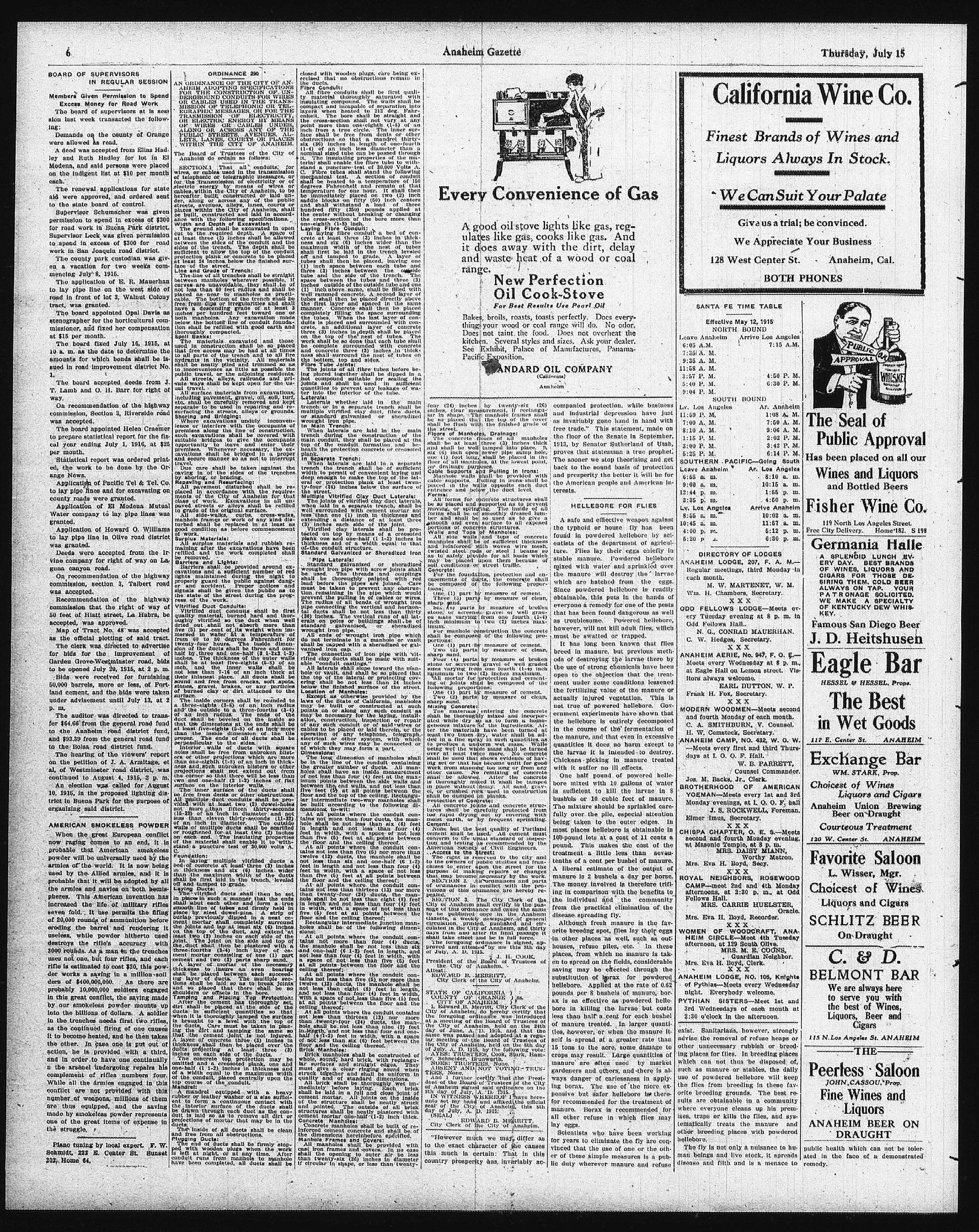
Searchable text
BOARD OF SUPERVISORS
IN REGULAR SESSION
Members Given Permission to Spend
Excess Money for Road Work
The board of supervisors at is session last week transacted the following:
Demands on the county of Orange were allowed as read.
A deed was accepted from Ellas Hadley and Ruth Hadley for lot in El Modena, and said persons were placed on the indigent list at $10 per month each.
The renewal applications for state aid were approved, and ordered sent to the state board of control.
Supervisor Schumacher was given permission to spend in excess of $300 for road work in Buena Park district. Supervisor Leck was given permission to spend in excess of $300 for road work in San Joaquin road district.
The county park custodian was given a vacation for two weeks commencing July 8, 1915.
The application of E. R. Mauorhan to lay pipe line on the west side of road in front of lot 3, Walnut Colony tract, was granted.
The board appointed Opal Davis as stenographer for the horticultural commissioner, and fixed her compensation at $15 per month.
The board fixed July 16, 1915, at 10 a.m. as the date to determine the amounts for which bonds shall be issued in road improvement district No. 1.
The board accepted deeds from J. T. Lamb and O. H. Barr for right of way.
On recommendation of the highway commission, Section 3, Riverside road was accepted.
The board appointed Helen Craemer to prepare statistical report for the fiscal year ending July 1, 1916, at $25 per month.
ORDINANCE OF THE CITY OF ANAHEIM ADOPTING SPECIFICATIONS FOR THE CONSTRUCTION OF UNDERGROUND CONDUITS FOR WIRES OR CABLES USED IN THE TRANSMISSION OF TELEPHONIC OR TELEGRAPHIC MESSAGES, OR FOR THE TRASMISSION OF ELECTRICITY, OR ELECTRIC ENERGY BY MEANS OF WIRES OR CABLES UNDER ALONG OR ACROSS ANY OF THE PUBLIC STREETS, AVENUES, ALLEYS, LANES, COURTS OR PLACES WITHIN THE CITY OF ANAHEIM.
The Board of Trustees of the City of Anaheim do ordain as follows:
SECTION.1 That all conduits, for wires, or cables used in the transmission of telephonic or telegraphic messages, or for the transmission of electricity or electric energy by means of wires or cables within the City of Anaheim, to be hereafter built, constructed or laid under, along or across any of the public streets, avenues, alleys, lanes, courts or places within the City of Anaheim, shall be built, constructed and laid in accordance with the following specifications.
Width and Depth of Excavation:
The ground should be excavated in open cut to the required depth. A space of at least three (3) inches shall be allowed between the sides of the conduit and the sides of the trench. The depth shall be sufficient to allow the top of the conduit protection plank or concrete to be placed at least 24 inches below the finished surface of the trench.
Line and Grade of Trench:
The line of all trenches shall be straight between manholes wherever possible. If curves are unavoidable, they shall be of not less than 60 feet radius and shall be placed near to manholes as practicable. The bottom of the trench shall be free from dips or irregularities and shall have a descending grade of at least 3 inches per hundred feet toward one or both manholes. Any excavation made below the bottom line of conduit foundation should be filled with good earth and thoroughly compacted.
Spoll Banks:
The materials excavated and those used in construction shall be so placed that free access may be had at all times to all parts of the trench and to all fire hydrants in the vicinity. All materials shall be neatly piled and trimmed so as to inconvenience as little as possible the public travel, or the adjoining residents.
All street, alleys, railroads and private walls shall be kept open for the usual travel.
All surface materials from excavations, including pavement, gravel, oil, soil, turf, etc., shall be carefully removed and kept separate to be used in repairing and resurfacing the streets, alleys or grounds.
Shoring and Bridging:
Where excavations unduly inconvenience or interfere with the occupants of premises along the line of construction, such excavations shall be covered with suitable bridges to give occupants easy access and clear that premises. Whenever necessary, the excavations shall be bridged in a proper and secure manner so as not to interrupt closed with wooden planks erased that no obstruction the ducts.
Fibre Conduit:
A fibre conduits should comply material thorough insulating compound, compact and incapable layers when heated enheit. The bore shall the cross-section shall point more than one inch from a true circumference shall be free from obstructions so that six (36) inches in length (1-8) inch of less nominal sized tube can it. The insulating material shall enable the stand a puncture test. C. Fibre tubes shall be mechanical test. A shaft shall be heated to a degrees Fahrenheit and temperature for one minute immediately placed saddle blocks on fifty inches and shall withstand hundreds of fathoms without break the cross-section of the one-eighth (1-8) inch.
Laying Fibre Conduit:
In laying fibre conduits at least three (3) inches and six (6) maximum width of tubes first be laid in off and tamped to get tubes then be grinded (3) inches between three (3) inches between tubes shall then be placed first layer and sander manner. Concrete should completely fill them in the tubes. When the dults is placed and suction quantities to prevent ter into the interior of Laterals;
Laterals whether liner or in a separator multiple vitrified clay or standard galvanized iron pipe.
In Main Trace:
When laterals are coined main conduit they should heat the protection coil. In Separate Trace:
The board accepted deeds from J. T. Lamb and O. H. Barr for right of way.
On recommendation of the highway commission, Section 3, Riverside road was accepted.
The board appointed Helen Craemer to prepare statistical report for the fiscal year ending July 1, 1916, at $25 per month.
Statistical report was ordered printed, the work to be done by the Orange News.
Application of Pacific Tel & Tel Co. to lay pipe lines and for excavating on county roads were granted.
Application of El Modena Mutual Water company to lay pipe lines was granted.
Application of Howard O. Williams to lay pipe line in Olive road district was granted.
Deeds were accepted from the Irvine company for right of way on Laguna canyon road.
On recommendation of the highway commission, section 3, Talbert road was accepted.
Recommendation of the highway commission that the right of way of 50 feet of Hiatt street, La Habra, be accepted, was approved.
Map of Tract No. 48 was accepted as the official plotting of said tract.
The clerk was directed to advertise for bids for the improvement of Garden Grove-Westminster road, bids to be opened July 20, 1915, at 2 p.m.
Bids were received for furnishing 50,000 barrels, more or less, of Portland cement, and the bids were taken under advisement until July 13, at 2 p.m.
The auditor was directed to transfer $64.66 from the general road fund to the Anaheim road district fund, and $93.39 from the general road fund to the Bolsa road district fund.
The hearing of the viewers' report on the petition of J. A. Armitage, et al., of Westminster road district, was continued to August 4, 1915, 2 p.m.
An election was called for August 10, 1915, in the proposed lighting district in Buena Park for the purpose of organizing said district.
AMERICAN SMOKELESS POWDER
When the great European conflict now raging comes to an end, it is probable that American smokeless powder will be universally used by the armies of the world. It is now being shall be neatly piled and trimmed so as to inconvenience as little as possible the public travel, or the adjoining residents.
All streets, alleys, railroads and private ways shall be kept open for the usual travel.
All surface materials from excavations including pavement, gravel, all soot; ash should be carefully removed and kept separate to be used in repairing and resurfacing the streets, alleys or grounds. Shoring and Bridging:
Where excavations unduly inconvenience or interfere with the occupants of premises along the line of construction, such excavations shall be covered with suitable bridges to give the occupants opportunity to leave and enter their premises. Whenever necessary, the excavations shall be bridged in a proper and secure manner so as not to interrupt traffic.
Due care shall be taken against the caving in of the sides of the trenches by shoring, or bracing.
Repaving and Resurfacing:
All pavement disturbed shall be replaced in accordance with the requirements of the City of Anaheim for that class of work. Excavations in all unpaved streets or alleys shall be refilled to grade of the original surface.
All side-walks, curbs, cross-walks, manhole frames or work of any kind disturbed shall be replaced in at least as good condition as before commencement of work.
Surplus Materials:
All surplus materials and rubblish remaining after the excavations have been refilled and the work completed shall be removed.
Barriers and Lights:
Barriers shall be provided around excavations and a sufficient number of red lights maintained during the night to properly guard the public against dangerous accident. Proper signs shall be given as the public as to the state of the street during the progress of the work.
Vitrified Duct Conduits:
Vitrified duct conduits shall be first quality material, burned hard and thoroughly vitrified so the duct when well dried out shall not absorb more than five (5) per cent of its weight when immersed in water at a temperature of from 60 to 80 degrees Fahrenheit for twenty-four hours. The inside dimension of the ducts shall be three and one-half by three and one-half (3.1-2x3 1-2) inches. The thickness of the outer walls shall be at least five-eighths (5-8) of an inch, and the inner walls shall be greater than 7-16 of an inch back their thinnest place. All ducts shall sound and free from cracks, soft spots, stones, gravel, brakes, or any particles of burned clay or dirt attached to the surface.
The inside corners shall be rounded to a three-eighths (3-8) of an inch radius and the outside to a three-fourths (3-4) of an inch radius. The ends of the duct shall be beveled on the inside so that the dimensions at the ends shall be at least five-eighths (5-8) of an inch more than the insulae length of the tile proper. The ends of all ducts shall be perpendicular to the sides.
Interior walls of ducts with square holes shall be free from unbroken blisters or other projections which are more than one-eighth (1-8) of an inch in thickness and such unbroken blisters or other projections shall not extend out from the corner so that there will be less than two and one-half (2 1-2) inches of flat surface on the interior walls.
The inner surface of the ducts shall be from dents or other projections. All multiple duct conduits shall be vided with at least two (2) dowel-holes not more than fifteen thirty-seconds (15-32) of an inch in diameter and not less than eleven thirty-seconds (11-32) of an inch in diameter. The outside walls of multiple ducts shall be scarified or roughened for at least two (2) inches on each end. The insulating properties of the material shall enable it to withstand a puncture test of 30,000 volts A.C.
Foundation:
In laying multiple vitrified ducts a bed-of-concrete at least three (3) inches in thickness, and six (6) inches wider Fibra Tube Joints:
The joints of all fibre placed together should not compound suitable joints and should be quantities to prevent interruption into the interior wall laterals.
In separate Trench:
When lateral joints are trench during the main conduit they should top off the conduit if heath protection coated plank.
In Separate Trench:
When lateral joints are trench during the main conduit they should top off the conduit if heath protection coated plank.
Multiple Vitrified Clay:
The joints of vitrified when laid in a separate well surrounded with less than one (1) inch extending a distance (2) inch each. Vitrified clay interposed on top by mastic plank one and one-half thickness and of a width-of-the conduit structure Standard Galvanized Pipe Laterals:
Standard galvanized pipe connecting veil ducts should be no more than five (5) inches on either side. In laterals should stop hole or vault, and should then tap into the laterals on poles or bushes standard galvanized pipe connecting veil ducts should be no more than five (5) inches on either side. In laterals should stop hole or vault, and should then tap into the laterals on poles or bushes standard galvanized pipe connecting veil ducts should be no more than five (5) inches on either side. In laterals should stop hole or vault, and should then tap into the laterals on poles or bushes standard galvanized pipe connecting veil ducts should be no more than five (5) inches on either side. In laterals should stop hole or vault, and should then tap into the laterals on poles or bushes standard galvanized pipe connecting veil ducts should be no more than five (5) inches on either side. In laterals should stop hole or vault, and should then tap into the laterals on poles or bushes standard galvanized pipe connecting veil ducts should be no more than five (5) inches on either side. In laterals should stop hole or vault, and should then tap into the laterals on poles or bushes standard galvanized pipe connecting veil ducts should be no more than five (5) inches on either side. In laterals should stop hole or vault, and should then tap into the laterals on poles or bushes standard galvanized pipe connecting veil ducts should be no more than five (5) inches on either side. In laterals should stop hole or vault, and should then tap into the laterals on poles or bushes standard galvanized pipe connecting veil ducts should be no more than five (5) inches on either side. In laterals should stop hole or vault, and should then tap into the laterals on poles or bushes standard galvanized pipe connecting veil ducts should be no more than five (5) inches on either side. In laterals should stop hole or vault, and should then tap into the laterals on poles or bushes standard galvanized pipe connecting veil ducts should be no more than five (5) inches on either side. In laterals should stop hole or vault, and should then tap into the laterals on poles or bushes standard galvanized pipe connecting veil ducts should be no more than five (5) inches on either side. In laterals should stop hole or vault, and should then tap into the laterals on poles or bushes standard galvanized pipe connecting veil ducts should be no more than five (5) inches on either side. In laterals should stop hole or vault, and should then tap into the laterals on poles or bushes standard galvanized pipe connecting veil ducts should be no more than five (5) inches on either side. In laterals should stop hole or vault, and should then tap into the laterals on poles or bushes standard galvanized pipe connecting veil ducts should be no more than five (5) inches on either side. In laterals should stop hole or vault, and should then tap into the laterals on poles or bushes standard galvanized pipe connecting veil ducts should be no more than five (5) inches on either side. In laterals should stop hole or vault, and should then tap into the laterals on poles or bushes standard galvanized pipe connecting veil ducts should be no more than five (5) inches on either side. In laterals should stop hole or vault, and should then tap into the laterals on poles or bushes standard galvanized pipe connecting veil ducts should be no more than five (5) inches on either side. In laterials should stop hole or vault, and should then tap into the laterials on poles or bushes standard galvanized pipe connecting veil ducts should be no more than five (5) inches on either side. In laterials should stop hole or vault, and should then tap into the laterials on poles or bushes standard galvanized pipe connecting veil ducts should be no more than five (5) inches on either side. In laterials should stop hole or vault, and should then tap into the latterials on poles or bushes standard galvanized pipe connecting veil ductsshouldbenomorethanfive(5)inchesoneachside.Inlaterialsshouldstopholleandbushessstandardgalvanizedpipeconnectingveilductsdouldbenomorethanfive(5)inchesoneachside.Inlaterialsshouldstopholleandbushessstandardgalvanizedpipeconnectingveilductsdouldbenomorethanfive(5)inchesoneachside.Inlaterialsshouldstopholleandbushessstandardgalvanizedpipeconnectingveilductsdouldbenomorethanfive(5)inchesoneachside.Inlaterialsshouldstopholleandbushessstandardgalvanizedpipeconnectingveilductsdouldbenomorethanfive(5)inchesoneachside.Inlaterialsshouldstopholleandbushessstandardgalvanizedpipeconnectingveilductsdouldbenomorethanfive(5)inchesoneachside.Inlaterialsshouldstopholleandbushessstandardgalvanizedpipeconnectingveilductsdouldbenomorethanfive(5)inchesoneachside.Inlaterialsshouldstopholleandbushessstandardgalvanizedpipeconnectingveilductsdouldbenomorethanfive(5)inchesoneachside.Inlaterialsshouldstopholleandbushessstandardgalvanizedpipeconnectingveilductsdouldbenomorethanfive(5)inchesoneachside.Inlaterialsshouldstopholleandbushessstandardgalvanizedpipeconnectingveilductsdouldbenomorethanfive(5)inchesoneachside.Inlaterialsshouldstopholleandbushessstandardgalvanizedpipeconnectingveilductsdouldbenomorethanfive(5)inchesoneachside.Inlaterialsshouldstopholleandbushessstandardgalvanizedpipeconnectingveilductsdouldbenomorethanfive(5)inchesoneachside.Inlaterialsshouldstopholleandbushessstandardgalvanizedpipeconnectingveilductsdouldbenomorethanfive(5)inchesoneachside.Inlaterialsshouldstopholleandbushessstandardgalvanizedpipeconnectingveilductsdouldbenomorethanfive(5)inchesoneachside.Inlaterialsshouldstopholleandbushessstandardgalvanizedpipeconnectingveilductsdouldbenomorethanfive(5)inchesoneachside.Inlaterialsshouldstopholleandbushessstandardgalvanizedpipeconnectingveilductsdouldbenomorethanfive(5)inchesoneachside.Inlaterialsshouldstopholleandbushessstandardgalvanizedpipeconnectingveilductsdouldbenomorethanfive(5)inchesoneachside.Inlaterialsshouldstopholleandbushessstandardgalvanizedpipeconnectingveilductsdouldbenomorethanfive(5)inchesoneachside.Inlaterialsshouldstopholleandbushessstandardgalvanizedpipe.connectingveilductsdouldbenomorethanfive(5)inchesoneachside.Inlaterialsshouldstopholleandbushess标准galvanizedpipe connectivingveilductsdouldbenomorethanfive(5)inchesoneachside.Inlaterialsshouldstopholleandbushess标准galvanizedpipe connectivingveilductsdouldbenomorethanfive(5)inchesoneachside.Inlaterialsshouldstopholleandbushess标准galvanizedpipe connectivingveilductsdouldbenomorethanfive(5)inchesoneachside.Inlaterialsshouldstopholleandbushess标准galvanizedpipe connectivingveilductsdouldbenomorethanfive(5)inchesoneachside.Inlaterialsshouldstopholleandbushess标准galvanizedpipe connectivingveilductsdouldbenomorethanfive(5)inchesoneachside.Inlaterialsshouldstopholleandbushess标准galvanizedpipe connectivingveilductsdouldbenomorethanfive(5)inchesoneachside.Inlaterialsshouldstopholleandbushess标准galvanizedpipe connectivingveilductsdouldbenomorethanfive(5)inchesoneachside.Inlaterialsshouldstopholleandbushess标准galvanizedpipe connectivingveilductsdouldbeNoMoreThanFive(5)inchesonEachSide.Inlaterialsshouldstopholleandbushess标准galvanizedpipe connectivingveilductsdouldbeNoMoreThanFive(5)inchesonEachSide.Inlaterialsshouldstopholleandbushess标准galvanizedpipe connectivingveilductsdouldbeNoMoreThanF五个(五)inchesonEachSide.Inlaterialsshouldstopholle和bushess标准galvanizedPipe connectivingveilductsdouldbeNoMoreThanF五个(五)inchesonEachSide.Inlaterialsshouldstopholle和bushess标准galvanizedPipe connectivingveilductsdouldbeNoMoreThanF五个(五)inchesonEachSide.INLATERIALSHOLDERDISTRICTWHERETHERATEOFRAILINGISREQUIREDTOADMINISTRYFORTHESECONDITIONSWHERETHERATEOFRAILINGISREQUIREDTOADMINISTRYFORTHESECONDITIONSWHERETHERATEOFRAILINGISREQUIRED TOADMINISTRYFORTHESECONDITIONSWHERE THE RATE OF RAILING IS REQUIRED TO ADMINISTRY FOR THESE CONDITIONS WHERE THE RATE OF RAILING IS REQUIRED TO ADMINISTRY FOR THESE CONDITIONS WHERE THE RATE OF RAILING IS REQUIRED TO ADMINISTRY FOR THESE CONDITIONS WHERE THE RATE OF RAILING IS REQUIRED TO ADMINISTRY FOR THESE CONDITIONS WHERE THE RATE OF RAILING IS REQUIRED TO ADMINISTRY FOR THESE CONDITIONS WHERE THE RATE OF RAILING IS REQUIRED TO ADMINISTRY FOR THESE CONDITIONS WHERE THE RATE OF RAILING IS REQUIRED TO ADMINISTRY FOR THESE CONDITIONS WHERE THE RATE OF RAILING IS REQUIRED TO ADMINISTRY FOR THESE CONDITIONS WHERE THE RATE OF RAILING IS REQUIRED TO ADMINISTRY FOR THESE CONDITIONS WHERE THE RATE OF RAILING IS REQUIRED TO ADMINISTRY FOR THESE CONDITIONS WHERE THE RATE OF RAILING IS REQUIRED TO ADMINISTRY FOR THESE CONDITIONS WHERE THE RATE OF RAILING IS REQUIRED TO ADMINISTRY FOR THESE CONDITIONS WHERE THE RATE OF RAILING IS REQUIRED TO ADMINISTRY FOR THESE CONDITIONS WHERE THE RATE OF RAILING IS REQUIRED TO ADMINISTRY FOR THESE CONDITIONS WHERE THE RATE OF RAILING IS REQUIRED TO ADMINISTRY FOR THESE CONDITIONS WHERE THE RATE OF RAILING IS REQUIRED TO ADMINISTRY FOR THESE CONDITIONS WHERE THE RATE OF RAILING IS REQUIRED TO ADMINISTRY FOR THESE CONDITIONS WHERE THE RATE OF RAILING IS REQUIRED TO ADMINISTRY FOR THESE CONDITIONS WHERE THE RATE OF RAILING IS REQUIRED TO ADMINISTRY FOR THESE CONDITIONS WHERE THE RATE OF RAILING IS REQUIRED TO ADMINISTRY FOR THESE CONDITIONS WHERE THE RATE OF RAILING IS REQUIRED TO ADMINISTRY FOR THESE CONDITIONS WHERE THE RATE OF RAILING IS REQUIRED TO ADMINISTRY FOR THESE CONDITIONS WHERE THE RATE OF RAILING IS REQUIRED TO ADMINISTRY FOR THESE CONDITIONS WHERE THE RATE OF RAILING IS REQUIRED TO ADMINISTRY FOR THESE CONDITIONS WHERE THE RATE OF RAILING IS REQUIRED TO ADMINISTRY FOR THESE CONDITIONS WHERE THE RATE OF RAILING IS REQUIRED TO ADMINISTRY FOR THESE CONDITIONS WHERE THE RATE OF RAILING IS REQUIRED TO ADMINISTRY FOR THESE CONDITIONS WHERE THE RATE OF RAILING IS REQUIRED TO ADMINISTRY FOR THESE CONDITIONS WHERE THE RATE OF RAILING IS REQUIRED TO ADMINISTRY FOR THESE CONDITIONS WHERE THE RATE OF RAILING IS REQUIRED TO ADMINISTRY FOR THESE CONDITIONS WHERE The RATE OF RAILING IS REQUIRED TO ADMINISTRY FOR THESE CONDITIONS WHERE The RATE OF RAILING IS REQUIRED TO ADMINISTRY FOR THESE CONDITIONS WHERE The RATE OF RAILING IS REQUIRED TO ADMINISTRY FOR THESE CONDITIONS WHERE The RATE OF RAILING IS REQUIRED TO ADMINISTRY FOR THESE CONDITIONS WHERE The RATE OF RAILING IS REQUIRED TO ADMINISTRY FOR THESE CONDITIONS WHERE The RATE OF RAILING IS REQUIRED TO ADMINISTRY FOR THESE CONDITIONS WHERE The RATE OF RAILING IS REQUIRED TO ADMINISTRY FOR THESE CONDITIONS WHERE The RATE OF RAILING IS REQUIRED TO ADMINISTRY FOR THESE CONDITIONS WHERE The RATE OF RAILING IS REQUIRED TO ADMINISTRY FORTHESE CONDITIONS WHERE The RATE OF RAILING IS REQUIRED TO ADMINISTRY FORTHESE CONDITIONS WHERE The RATE OF RAILING IS REQUIRED TO ADMINISTRY FORTHESE CONDITIONS WHERE The RATE OF RAILING IS REQUIRED TO ADMINISTRY FORTHESE CONDITIONS WHERE The RATE OF RAILING IS REQUIRED TO ADMINISTRY FORTHESE CONDITIONS WHERE The RATE OF RAILING IS REQUIRED TO ADMINISTRY FORTHESE CONDITIONS WHERE The RATE OF RAILING IS REQUIRED TO ADMINISTRY FORTHESE CONDITIONS WHERE The RATE OF RAILING IS REQUIRED TO ADMINISTRY FORTHESE CONDITIONS WHERE The RATE Of RAILING Is Required To Admnistry For These Conditions Where The Rate Of Railing Is Required To Admnistry For These Conditions Where The Rate Of Railing Is Required To Admnistry For These Conditions Where The Rate Of Railing Is Required To Admnistry For These Conditions Where The Rate Of Railing Is Required To Admnistry For These Conditions Where The Rate Of Railing Is Required To Admnistry For These Conditions Where The Rate Of Railing Is Required To Admnistry For These Conditions Where The Rate Of Railing Is Required To Admnistry For These Conditions Where The Rate Of Railing Is Required To Admnistry ForThese Conditions Where The Rate Of Railing Is Required To Admnistry ForThese Conditions Where The Rate Of Railing Is Required To Admnistry ForThese Conditions Where The Rate Of Railing Is Required To Admnistry ForThese Conditions Where The Rate Of Railing Is Required To Admnistry ForThese Connections Where The Rate Of Railing Is Required To Admnistry ForThese Connections Where The Rate Of Railing Is Required To Admnistry ForThese Connections Where The Rate Of Railing Is Required To Admnistry ForThese Connections Where The Rate Of Railing Is Required To Admnistry ForThese Connections Where The Rate Of Railing Is Required To Admnistry ForThese Connections Where The Rate Of Railing Is RequiredTo Admnistry ForThese Connections Where The Rate Of Railing Is Required To Admnistry ForThese Connections Where The Rate Of Railing Is Required To Admnistry ForThese Connections Where The Rate Of Railing Is Required To Admnistry ForThese Connections Where The Rate Of Railing Is Required To Admnistry ForThese Connections Where The Rate Of Railing Is RequiredTo AdmnistryForThese Connections Where The Rate Of Railing Is Required To Admnistry ForThese Connections Where The Rate Of Railing Is Required To Admnistry ForThese Connections Where The Rate Of Railing Is Required To Admnistry ForThese Connections Where The Rate Of Railing Is Required To Admnistry ForThese Connections Where The Rate Of Railing Is RequiredTo AdmnistryForTheseConnectionsWhereTheRateOfRailingIsRequiredToAdmnistryForTheseConnectionsWhereTheRateOfRailingIsRequiredToAdmnistryForTheseConnectionsWhereTheRateOfRailingIsRequiredToAdmnistryForTheseConnectionsWhereTheRateOfRailingIsRequiredToAdmnistryForTheseConnectionsWhereTheRateOfRailingIsRequiredToAdmnistryForTheseConnectionsWhereTheRateOfRailingIsRequiredToAdmnistryForTheseConnectionsWhereTheRateOfRailingIsRequiredToAdmnistryForTheseConnectionsWhereTheRateOfRailingIsRequiredToAdmnistryFortheseConnectionsWhereTheRateOfRailingIsRequiredToAdmnistryForTheseConnectionsWhereTheRateOfRailingIsRequiredToAdmnistryForTheseConnectionsWhereTheRateOfRailingIsRequiredToAdmnistryForTheseConnectionsWhereTheRateOfRailingIsRequiredToAdmnistryForTheseConnectionsWhereTheRateOfRaulingIsRequiredToAdmnistryForTheseConnectionsWhereTheRateOfRaulingIsRequiredToAdmnistryForTheseConnectionsWhereTheRateOfRaulingIsRequiredToAdmnistryForTheseConnectionsWhereTheRateOfRaulingIsRequiredToAdmnistryForTheseConnectionsWhereTheRateOfRaulingIsRequiredToAdmnistryForTheseConnectionsWhereTheRateOfRaulingIsRequiredToAdmnistryFortheseConnectionsWhereTheRateOfRaulingIsRequiredToAdmnistryFortheseConnectionsWhereTheRateOfRaulingIsRequiredToAdmnistryFortheseConnectionsWhereTheRateOfRaulingIsRequiredToAdmnistryFortheseConnectionsWhereTheRateOfRaulingIsRequiredToAdmnistryFortheseConnectionsWhereTheRateOfRaulingIsRequiredToAdmnistryFortheseConnectionsWhereTheRateOfRaulingIsRequiredToAdmnistryFortheseConnectionsWhereTheRateOfRaulingIsRequiredToAdmnistryFortheseConnectionsWhereTheRateOfRaulingIsRequiredToAdmnistryFortheseConnectionsWhereTheRateOfRaulingIsRequiredToAdmnistryFortheseConnectionsWhereTheRateOfRaulingIsRequiredToAdmnistryFortheseConnectionsWhereTheRateOfRaulingIsRequiredToAdmnistryFortheseConnectionsWhereTheRateOfRaulingIsRequiredToAdmnistryFortheseConnectionsWhereTheRateOfRaulingIsRequiredToAdmnistryForthe
AMERICAN SMOKELESS POWDER
When the great European conflict now raging comes to an end, it is probable that American smokeless powder will be universally used by the armies of the world. It is now being used by the Allied armies, and it is probable that it will be adopted by all the armies and navies on both hemispheres. This American invention has increased the life of military rifles seven fold. It use permits the firing of 20,000 rounds of ammunition before eroding the barrel and rendering it useless, while powder hitherto used destroys the rifle's accuracy with 3000 rounds. As a man in the trenches uses not one, but four rifles, and each rifle is estimated to cost $20, this powder works a saving in a million-soldiers of $400,000,000. As there are probably 10,000,000 soldiers engaged in this great conflict, the saving made by our smokeless powder mounts up into the billions of dollars. A soldier in the trenches needs first two rifles, as the continued firing of one cause it to become heated, and he then takes the other. In case one is put out of action, he is provided with a third, and in order to have one continually in the arsenal undergoing repairs his complement of rifles numbers four. While all the armies engaged in this conflict are not provided with this number of weapons, millions of them are thus equipped, and the saving made by smokeless powder represents one of the great items of expense in the struggle.
Plano tuning by local expert. F. W. Schmidt, 222 E. Center St. Sunset 202, Home 64.
closed with wooden plugs, care being exercised that no obstructions remain in the ducts.
Fibre Conduit:
All fibre conduits shall be first quality material thoroughly saturated with insulating compound. The walls shall be compact and incapable of separation into layers when heated to 212 deg. Fahrenheit. The bore shall be straight and the cross-section shall not vary at any point more than one-eighth (1-8) of an inch from a true circle. The inner surface shall be free from dents or other obstructions so that a mandrel thirty-six (36) inches in length of one-fourth (1-4) of an inch less diameter than a nominal sized tube can be passed through it. The insulating properties of the material shall enable the fibre tube to withstand a puncture-test of 30,000 Volts A.C. Fibre tubes shall stand the following mechanical test. A section of conduit shall be heated to a temperature of 150 degrees Fahrenheit and remain at that temperature for one hour. It shall then be immediately placed on two (2) inch saddle blocks on fifty (50) inch centers and shall withstand a load of three pounds fifty (350) pounds applied at the center without breaking or changing the cross-section of the bore more than one-eighth (1-8) inch.
Laying Fibre Conduit:
In laying fibre conduit a bed of concrete at least three (3) inches in thickness and six (6) inches wider than the maximum width of the nest of tubes shall first be laid in the trench leveled off and tamped to grade. A layer of tubes shall then be placed, leaving one (1) inch space between each tube and one (1) inch above same, shall be filled with well rammed concrete. A second layer of tubes shall then be placed directly above the first layer and spaced in the same manner. Concrete shall then be placed completely filling the space surrounding the tubes. When the last layer of conduits is placed and surrounded with concrete an additional layer of concrete three (3) inches in depth shall be placed on the top of the nest of tubes. The work shall be so done that each tube shall be complete surrounded with concrete and concrete three (3) inches in thickness shall surround the nest of tubes on the bottom, top and sides.
Fibra Tube Joints:
The joints of all fibre tubes before being placed together shall be dipped in a hot compound suitable for sealing the joints and shall be used in sufficient quantities to prevent any leakage of water into the interior of the tube.
Laterals whether laid in the main trench or in a separate trench shall be multiple vitrified clay duct, fibre ducts, or standard galvanized or shearadized wrought iron pipe.
In Main Trench:
When laterals are laid in the main trench during the construction of the main conduit they shall be placed at the end of the conduit formation and be heath the protection concrete or crosSED plank.
In Separate Trench:
Every Convenience of Gas
A good oil stove lights like gas, regulates like gas, cooks like gas. And it does away with the dirt, delay and waste heat of a wood or coal range.
New Perfection Oil Cook-Stove
For Best Results Use Pearl Oil
Bakes, broils, roasts, toasts perfectly. Does everything your wood or coal range will do. No odor. Does not taint the food. Does not overheat the kitchen. Several styles and sizes. Ask your dealer. See Exhibit, Palace of Manufactures, Panama-Pacific Exposition.
ANDARD OIL COMPANY
(California)
Anaheim
four (24) inches by twenty-six (26) inches, clear measurement, if rectangular in shape. The manhole frames shall be so placed that the top of the cover shall be flush with the finished grade of the street.
Floors of Manholes, Drainage:
The concrete floors of all manholes shall be at least three (3) inches thick and shall be well tumped into place. A six (6) inch open sewer pipe sump hole, one (1) foot long, shall be placed in the companied protection, while business and industrial depression have just as invariably gone hand in hand with free trade. This statement, made on the floor of the Senate in September, 1913, by Senator Sutherland of Utah, proves that statesman a true prophet.
The sooner we stop thoraking and get
ANDARD OIL COMPANY
(California)
Anahelm
Fibre Tube Joints:
The joints of all fibre tubes before being placed together shall be dipped in a hot compound suitable for sealing the joints and shall be used in sufficient quantities to prevent any leakage of water into the interior of the tube.
Laterat:
The joints whether laid in the main trench or in a separate trench shall be multiple vitrified clay duct, fibre ducts, or standard galvanized or sheradized wrought iron pipe.
In Main Trench:
When laterals are laid in the main trench during the construction of the main conduit, they shall be placed at the top of the conduit formation and beath the protection concrete or creosod plank.
In Separate Trench:
The laterals are laid in a separate trench the trench shall be of sufficient width to permit of convenient laying and deep enough to make the top of the lateral or protection plank at least twenty-four (24) inches below the surface of the street.
Multiple Vitrified Clay Duct Laterals:
The joints of vitrified clay duct laterals, when laid in a separate trench, shall be well surrounded with cement mortar not less than one (1) inch in thickness and extend a distance of least three (3) inches along the oil. Vitrified clay laterals shall be protected on top by means of a creosod plank one and one-half (1-2) inches in thickness and one width equal to that of the conduit structure.
Standard Galvanized or Sheradized Iron Pipe Laterals:
Standard galvanized or sheradized wrought iron pipe with screw joints shall be used. The threads and couplings shall be thoroughly painted with red lead before the pipes are joined. Care must be taken to prevent any obstruction remaining in the pipe which would prevent the pulling in of cables or wires. The radius of all bends of wrought iron pipe connecting the vertical and horizontal ducts shall not less than thirty (30) inches. If vertical runs of all laterals on poles or buildings shall be of standard galvanized, or sheradized wrought iron pipe.
All ends of wrought iron pipe do not terminate in a manhole or vault shall be capped with a sheradized or galvanized iron cap.
The connection of iron pipe with vitrified clay ducts shall be made with suitable "conduit castings."
All laterals shall slope toward the manhole or vault, and shall be so placed that the lateral or protecting covering shall be no more than 24 inches below the finished surface of the street.
Location of Manholes:
Except as otherwise provided by the laws of the State of California, manholes may be built or constructed at such points on or along any such conduit as may be necessary for the laying, installation, construction, inspection or repair of any such conduit or of said wires or cables to be placed or laid therein, or the operation of any telephone, telegraphical or other system, with which such wires may be connected or of which they may form a part.
Dimensions:
The long dimension of manholes shall be in the line of the conduit containing the greater number of ducts. All manholes shall have an inside measurement of not less than four (4) feet at the maximum points between the side walls and between the end walls, and not less than five feet (5) at all points between the floor and the top of the ceiling. Rectangular intermediate two-way manholes shall utilize conduits to the following dimensions: to-wait.
At all points where the conduit contains not more than four ducts, the manhole shall be not less than six (6) feet in length and not less than four (4) feet in width, with a space of not less than five (5) feet at all points between the floor and the ceiling thereof.
At all points where the conduit contains not less than five (5) nor more than twelve (12) ducts, the manhole shall be not less than six and one-half (6 1/2) feet in length and not less than four (4) feet in width.
Four (24) inches by twenty-six (26) inches, clear measurement, if rectangular in shape. The manhole frames shall be so placed that the top of the cover shall be flush with the finished grade of the street.
Floors of Manholes, Drainage:
The concrete floors of 1 manholes shall be at least three (3) inches thick and shall be well tumped into place. A six (6) inch open sewer pipe sump hole, one (1) foot long, shall be placed in the floor of all manholes, at the lowest point, or drainage purposes.
Cable Supports and Pulling in Irons:
Manhole walls shall be provided with cable supports. Pulling in irons shall be placed in the walls opposite each duct entrance and below the duct level.
Forms:
All forms for concrete structures shall be so placed and supported as to prevent moving or springing. The inside of all forms shall be smoothly dressed lumber and shall be so used as to give a smooth and even surface to all exposed portions of concrete structures.
Walls and Tops of Manholes:
All side walls and tops of concrete manholes shall be of sufficient thickness and reinforced with woven wire mesh, twisted steel rods or steel I beams so as to safely provide for all loads which may place upon them because of soil conditions or street traffic.
Concrete:
For the foundation, protection and encasements of ducts, the concrete shall be composed of the following proportions:
One (1) part by measure of cement.
Three (3) parts by measure of clean, sharp sand.
Six (6) parts by measure of broken stone or screened gravel of well graded sizes varying from one fourth (1-4) inch minimum to two (2) inches maximum.
All mortar for protection and cementing of joints should be composed of the following proportion:
One (1) part by measure of cement.
Two (2) parts by measure of clean, sharp sand.
Mixing Concrete:
The maternal entering the concrete shall be thoroughly mixed and incorporated while dry so as to form a homogeneous mixture of the ingredients. After the materials have been turned at least two times dry, water shall be added in a fine spray in such quantities as to produce a uniform wet mass. While digging a small mass shall be done over at least two times dry. No concrete shall use that shows evidence of having set or that has become unfit for good work from standing too long or from any other cause. No remixing of concrete should be allowed. After the concrete is thoroughly mixed it shall be tamped in place without delay. All sand, gravel, or crushed rock used in construction shall be dumped on planks.
Protection of Concrete:
All concrete joints and concrete structures shall be carefully protected from too rapid drying due to swelling with moist earth, or by frequent sprinkling.Cement:
None but the best quality of Portland cement shall be used. All cement must conform to the usual standard of inspection and testing as recommended by the American Society of Civil Engineers.
Access to the Street:
The right is reserved to the city and to the owners of public utilities and franchises to enter upon the street for the companied protection, while business and industrial depression have just as invariably gone hand in hand with free trade." This statement, made on the floor of the Senate in September, 1913, by Senator Sutherland of Utah, proves that statesman a true prophet. The sooner we stoptheorizing and get back to the sound basis of protection and prosperity the better it will be for the American people and American interests.
HELLEBORE FOR FLIES
A safe and effective weapon against the typhoid or house fly has been found in powdered hellebore by scientists of the department of agriculture. Flies lay their eggs chiefly in stable manure. Powdered hellebore mixed with water and sprinkled over the manure will destroy the larvae which are hatched from the eggs. Since powdered hellebore is readily obtainable, this puts in the hands of everyone a remedy for one of the stones that has been found dangerous as well as troublesome. Powered hellebore, however, will not kill adult flies, which must be swatted or trapped.
It has long been known that flies breed in manure, but previous methods of destroying the larvae there by use of strong chemicals have been open to the objection that the treatment under some conditions lessened the fertilizing value of the manure or actually injured vegetation. This is not true of powered hellebore. Government experiments have shown that hellebore is entirely decomposed in the course of the fermentation of the manure, and that even in excessive quantities it does no harm except to the larvae it is intended to destroy. Chickens-picking in manure treated with it suffer no ill effects.
One half pound of powered hellebore mixed with 10 gallons of water is sufficient to kill the larvae in 8 bushels or 10 cubic feet of manure. The mixture should be sprinkled carefully over the pile, especially attention being taken to the outer edges. In most places hellebore is obtainable in 100-pound lots at a cost of 11 cents a pound. This makes the cost of the treatment a little less than seventenths of a cent per bushel of manure. A liberal estimate of the output of
One half pound of powered hellebore mixed with 10 gallons of water is sufficient to kill the larvae in 8 bushels or 10 cubic feet of manure. The mixture should be sprinkled carefully over the pile, especially attention being taken to the outer edges. In most places hellebore is obtainable in 100-pound lots at a cost of 11 cents a pound. This makes the cost of the treatment a little less than sevenths of a cent per bushel of manure. A liberal estimate of the output of manure is 2 bushels a day per horse. The money involved is therefore trifling in comparison with the benefits to the individual and the community from the practical elimination of the disease spreading fly.
Although fresh manure is the favorite breeding spot, files lay their eggs in other places as well, such as outhouses, refuse piles, etc. In these places, from which no manure is taken to spread on the fields, considerable saving may be effected through the substitution of borax for powdered hellebore. Applied at the rate of 0.62 pounds per 8 bushels of manure, borax is as effective as powdered hellebore in killing the larvae but costs less than half a cent for each bushel of manure treated. In larger quantities, however, or when the manure itself is spread at a greater rate than 15 tons to the acre, some damage to crops may result. Large quantities of manure are often used by market gardeners and others, and there is always danger of carlessness in applying borax. The use of the more expensive but safer hellebore is therefore recommended for the treatment of manure. Borax is recommended for all other refuse in which files may lay eggs.
Scientists who have been working for years to eliminate the fly are convinced that the use of one or the other of these simple measures is a public duty wherever manure and refuse
California Wine Co.
Finest Brands of Wines and
Liquors Always In Stock.
We Can Suit Your Palate
Give us a trial; be convinced.
We Appreciate Your Business
128 West Center St. Anaheim, Cal.
BOTH PHONES
SANTA FE TIME TABLE
Effective May 12, 1915
NORTH BOUND
Leave Anaheim Arrive Los Angeles
6:05 A.M. 7:15 A.M.
7:35 A.M.
9:35 A.M.
11:58 A.M.
3:57 P.M. 4:50 P.M.
5:40 P.M. 6:30 P.M.
9:04 P.M.
SOUTH BOUND
Lv. Los Angeles Ar. Anaheim
11:59 P.M. 1:08 A.M.
7:00 A.M. 7:50 A.M.
8:10 A.M. 9:06 A.M.
1:15 P.M. 2:02 P.M.
3:00 P.M. 3:42 P.M.
5:25 P.M. 6:14 P.M.
The Seal of Public Approval
Has been placed on all our
The Seal of Public Approval
Has been placed on all our Wines and Liquors and Bottled Beers
Fisher Wine Co.
119 North Los Angeles Street.
Free City Delivery. Home*182. S 198
Germania Halle
A SPLENDID LUNCH EVERY DAY. BEST BRANDS OF WINES, LIQUORS AND CIGARS FOR THOSE DESIRED THEM. COLD BEER ALWAYS ON TAP. YOUR PATRONAGE SOLICITED. WE MAKE A SPECIALTY OF KENTUCKY DEW WHISKEY.
Famous San Diego Beer
J. D. Heitshusen
Eagle Bar
HESSEL & HESSEL, Props.
The Best in Wet Goods
117 E. Center St. ANAHEIM
Exchange Bar
WM. STARK, Prop.
Choicest of Wines
Liquors and Cigars
Anaheim Union Brewing
Beer on Draught
Courteous Treatment
120 W. Center St. ANAHEIM
Favorite Saloon
of powered helle20 gallons of water
the larvae in 8
feet of manure.
be sprinkled carespecial attention
outer edges.
is obtainable in
cost of 11 cents a
less than sevenbushel of manure.
of the output of
a day per horse.
is therefore triflwith the benefits to
the community
elimination of the
manure is the favflies lay their eggs
well, such as outs, etc. In these
no manure is takfields, considerable
sected through the
ax for powdered
at the rate of 0.62
cols of manure, boras powdered hellelarvae but costs
for each bushel
In larger quantithen the manure it
greater rate than
some damage to
Large quantities of
used by market
ers, and there is allessness in applyance of the more exhellebore is there,
or the treatment of
recommended for
which flies may
have been working
the fly are conof one or the othmeasures is a pubmanure and refuse
exist. Sanitarians, however, strongly
advise the removal of refuse heaps or
other unnecessary rubbish or breeding places for flies. In breeding places which can not thus be disposed of,
such as manure or stables, the daily use of powdered hellebore will keep the flies from breeding in these favorite breeding grounds. The best results are obtainable in a community where everyone cleans up his premises, traps or kills the flies, and systematically treats the manure and other breeding places with powdered hellebore.
The fly is not only a nuisance to human beings and live stock, it spreads disease and filth and is a menace to
public health which can not be tolerated in the face of a demonstrated remedy.