anaheim-gazette 1915-07-01
Scanned page
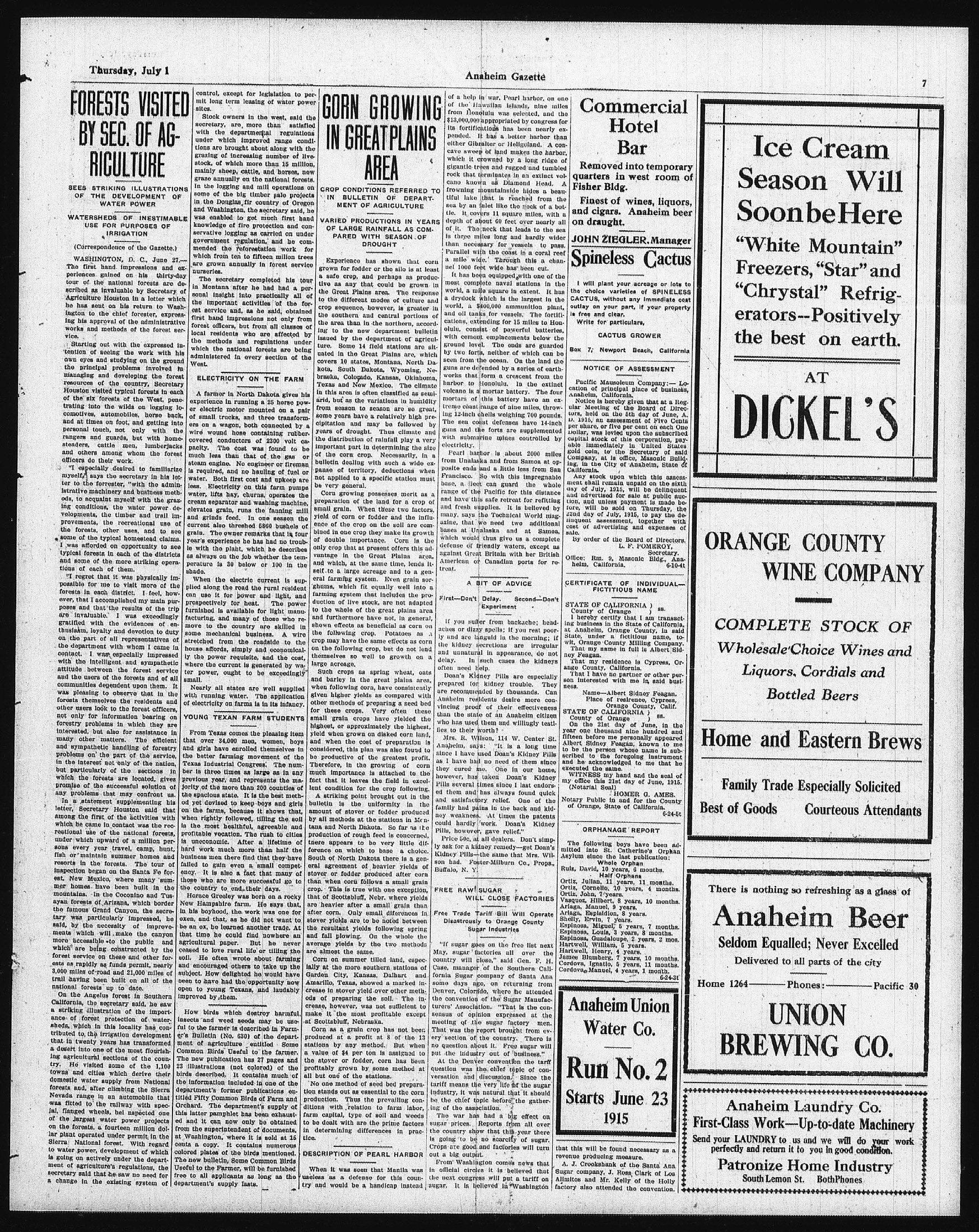
Searchable text
Thursday, July 1
FORESTS VISITED BY SEC. OF AGRICULTURE
SEES STRIKING ILLUSTRATIONS OF THE DEVELOPMENT OF WATER POWER
WATERSHEDS OF INESTIMABLE USE FOR PURPOSES OF IRRIGATION
(Correspondence of the Gazette.)
WASHINGTON, D. C., June 27.—The first hand impressions and experiences gained on his thirty-day tour of the national forests are described as invaluable by Secretary of Agriculture Houston in a letter which he has sent on his return to Washington to the chief forester, expressing his approval of the administrative works and methods of the forest service.
Starting out with the expressed intention of seeing the work with his own eyes and studying on the ground the principal problems involved in managing and developing the forest resources of the country, Secretary Houston visited typical forests in each of the six forests of the West, penetrating into the wilds on logging locomotives, automobiles, horse back, and at times on foot, and getting into personal touch, not only with the rangers and guards, but with home-steaders, cattle men, lumberjacks and others among whom the forest officers do their work.
control, except for legislation to permit long term leasing of water power sites.
Stock owners in the west, said the secretary, are more than satisfied with the departmental regulations under which improved range conditions are brought about along with the grazing of increasing number of livestock, of which more than 15 million, mainly sheep, cattle, and horses, now graze annually on the national forests.
In the logging and mill operations on some of the big timber sale projects in the Douglas fir country of Oregon and Washington, the secretary said, he was enabled to get much first hand knowledge of fire protection and conservative logging as carried on under government regulation, and he commended the reforestation work for which from ten to fifteen million trees are grown annually in forest service nurseries.
The secretary completed his tour in Montana after he had had a personal insight into practically all of the important activities of the forest service and, as he said, obtained first hand impressions not only from forest officers, but from all classes of local residents who are affected by the methods and regulations under which the national forests are being administered in every section of the West.
ELECTRICITY ON THE FARM
A farmer in North Dakota gives his experience in running a 25 horse power electric motor mounted on a pair of small trucks, and three transformers on a wagon, both connected by a wire wound hose containing rubber-coated conductors of 2300 volt capacity. The cost was found to be much less than that of the gas or control, except for legislation to permit long term leasing of water power sites.
Experience grown for fodder is safe crop, alive as any thief in the Great Plains to the different crop sequence, to the southern area than ling to the new issued by the nature. Some 14% utilized in the G covers 10 states kota, South D braska, Colorado Texas and New in this area is o arid, but as the from season to some years have cipitation and years of drought the distribution important part is of the corn cro
the principal problems involved in managing and developing the forest resources of the country, Secretary Houston visited typical forests in each of the six forests of the West, penetrating into the wilds on logging locomotives, automobiles, horse back, and at times on foot, and getting into personal touch, not only with the rangers and guards, but with homesteaders, cattle men, lumberjacks and others among whom the forest officers do their work.
"I especially desired to familiarize myself," says the secretary in his letter to the forester, "with the administrative machinery and business methods, to acquaint myself with the grazing conditions, the water power developments, the timber and trail improvements, the recreational use of the forests, other uses, and to see some of the typical homestead claims. I was afforded on opportunity to see typical forests in each of the districts and some of the more striking operations of each of them.
"I regret that it was physically impossible for me to visit more of the forests in each district. I feel, however, that I accomplished my main purposes and that the results of the trip are invaluable. I was exceedingly gratified with the evidences of enthusiasm, loyalty and devotion to duty on the part of all representatives of the department with whom I came in contact. I was especially impressed with the intelligent and sympathetic attitude between the forest service and the users of the forests and of all communities dependent upon them. It was pleasing to observe that in the forests themselves the residents and other users look to the forest officers, not only for information bearing on forestry problems in which they are interested, but also for assistance in many other matters. The efficient and sympathetic handling of forestry problems on the part of the service, in the interest not only of the nation, but particularly of the sections in which the forests are located, gives promise of the successful solution of any problems that may confront us.
In a statement supplementing his letter, Secretary Houston said that among the first of the activities with which he came in contact was the recreational use of the national forests, under which upward of a million persons every year travel, camp, hunt, fish or maintain summer homes and resorts in the forests. The tour of inspection began on the South Dakota West.
ELECTRICITY ON THE FARM
A farmer in North Dakota gives his experience in running a 25 horse power electric motor mounted on a pair of small trucks, and three transformers on a wagon, both connected by a wire wound hose containing rubber-covered conductors of 2300 volt capacity. The cost was found to be much less than that of the gas or steam engine. No engineer or fireman is required, and no hauling of fuel or water. Both first cost and upkeep are less. Electricity on this farm pumps water, lifts hay, churns, operates the cream separator and washing machine, elevates grain, runs the fanning mill and grinds feed. In one season the current also threshed 5860 bushels of grain. The owner remarks that in four year's experience he has had no trouble with the plant, which he describes as always on the job whether the temperature is 30 below or 100 in the shade.
When the electric current is supplied along the road the rural resident can use it for power and light, and prospectively for heat. The power furnished is available for light manufacturing, and many of those who remove to the country are skilled in some mechanical business. A wire stretched from the roadside to the house affords, simply and economically the power requisite, and the cost, where the current is generated by water power, ought to be exceedingly small.
Nearly all states are well supplied with running water. The application of electricity on farms is in its infancy.
YOUNG TEXAN FARM STUDENTS
From Texas comes the pleasing item that over 34,000 men, women, boys and girls have enrolled themselves in the better farming movement of the Texas Industrial Congress. The number is three times as large as in any previous year, and represents the majority of the more than 200 counties of the spacious state. It is the best method yet devised to keep boys and girls on the farms, because it shows that, when rightly followed, tilling the soil is the most healthful, agreeable and profitable vocation. The rush to cities is uneconomic. After a lifetime of hard work much more than half the business men there find that they have failed to gain even a small competitor.
A striking point bulletin is the amount of stover by all methods at tana and North Dane production of rough there appears to be very general agreement o
which the forests are located, gives promise of the successful solution of any problems that may confront us.
In a statement supplementing his letter, Secretary Houston said that among the first of the activities with which he came in contact was the recreational use of the national forests, under which upward of a million persons every year travel, camp, hunt, fish or maintain summer homes and resorts in the forests. The tour of inspection began on the Santa Fe forest, New Mexico, where many summer homes have been built in the mountains. In the Coconino and Tusayan forests of Arizona, which border the famous Grand Canyon, the secretary was particularly impressed, he said, by the necessity of improvements which will make the canyon more accessible to the public and which are being constructed by the forest service on these and other forests as rapidly as funds permit, nearly 3,000 miles of road and 21,000 miles of trail having been built on all of the national forests up to date.
On the Angelus forest in Southern California, the secretary said, he saw a striking illustration of the importance of forest protection of watersheds, which in this locality has contributed to the irrigation development that in twenty years has transformed a desert into one of the most flourishing agricultural sections of the country. He visited some of the 1,100 towns and cities which derive their domestic water supply from National forests and, after climbing the Sierra Nevada range in an automobile that was fitted to the railway with special flanged wheels, he inspected one of the largest water power projects on the forests, a fourteen million dollar plant operated under permit in the Sierra National forest. With regard to water power, development of which is going on actively under the department of agriculture's regulations, the secretary said that he saw no need for a change in the existing system of
How birds which destroy harmful insects and weed seeds may be useful to the farmer is described in Farmer's Bulletin (No. 630) of the department of agriculture entitled Some Common Birds Useful to the farmer. The new publication has 27 pages and 23 illustrations (not colored) of the birds described. It contains much of the information included in one of the department's former publications entitled Fifty Common Birds of Farm and Orchard. The department's supply of this latter pamphlet has been exhausted and it can now only be obtained from the superintendent of documents, at Washington, where it is sold at 15 cents a copy. It contains numerous colored plates of the birds mentioned. The new bulletin, Some Common Birds Useful to the Farmer, will be furnished free to all applicants as long as the department's supply lasts.
A striking point bulletin is the amount of stover by all methods at tana and North Dakota production of rough stover appears to be ference on which South of North Dakota agreement on stover or fodder less than when corn for crop. This is true that of Scottsbluff, are heavier after after corn. Only stover yields are to the resultant yield and fall plowing. average yields by are almost the same.
Corn on summer lally at the more south Garden City, Kansas Amarillo, Texas, she crease in stover yields of preparing creease, however, we make it the most at Scottsbluff, Nebraska.
Corn as a grain produced at a prox stations by any m value of $4 per hectare stover or fodder profitably grown but all but one of the
No one method of tion stands out as e production. Thus ditions with relative farm capital, type to be dealt with are in determining difice.
DESCRIPTION OF
Anaheim Gazette
GORN GROWING IN GREAT PLAINS AREA
CROP CONDITIONS REFERRED TO IN BULLETIN OF DEPARTMENT OF AGRICULTURE
VARIED PRODUCTIONS IN YEARS OF LARGE RAINFALL AS COMPARED WITH SEASON OF DROUGHT
Experience has shown that corn grown for fodder or the silo is at least a safe crop, and perhaps as productive as any that could be grown in the Great Plains area. The response to the different modes of culture and crop sequence, however, is greater in the southern and central portions of the area than in the northern, according to the new department bulletin issued by the department of agriculture. Some 14 field stations are situated in the Great Plains are, which covers 10 states, Montana, North Dakota, South Dakota, Wyoming, Nebraska, Colorado, Kansas, Oklahoma, Texas and New Mexico. The climate in this area is often classified as semi-arid, but as the variations in humidity from season to season are so great, some years have a relatively high precipitation and may be followed by years of drought. Thus climate and the distribution of rainfall play a very important part in determining the size of the corn crop. Necessarily, in a help in war, Pearl harbor, on one of the Hawaiian islands, nine miles from Honolulu was selected, and the $13,000,000 appropriated by congress for its fortifications has been nearly expended. It has a better harbor than either Gibraltar or Heliogaland. A concave sweep of land makes the harbor, which it crowned by a long ridge of gigantic trees and rugged and tumbled rock that terminates in an extinct volcano known as Diamond Head. A frowning mountainside hides a beautiful lake that is reached from the sea by an inlet like the neck of a bottle. It covers 11 square miles, with a depth of about 60 feet over nearly all of it. The neck that leads to the sea is three miles long and hardly wider than necessary for vessels to pass. Parallel with the coast is a coral reef a mile wide. Through this a channel 1000 feet wide has been cut.
It has been equipped with one of the most complete naval stations in the world, a mile square in extent. It has a drydock which is the largest in the world, a $100,000 ammunition plant, and oil tanks for vessels. The fortifications, extending for 15 miles to Honolulu, consist of powerful batteries, with cement emplacements below the ground level. The ends are guarded by two forts, neither of which can be seen from the ocean. On the land the guns are defended by a series of earthworks that form a crescent from the harbor to Honolulu. In the extinct volcano is a mortar battery. The four mortars of this battery have an extreme coast range of nine miles, throwing 12-inch shells weighing 700 pounds. The sea coast defenses have 14-inch guns and the forts are supplemented with submarine mines controlled by electricity.
Pearl harbor is about 2000 miles from Honolulu and forms part of Anaheim's main port.
Commercial Hotel Bar
Removed into temporary quarters in west room of Fisher Bldg.
Finest of wines, liquors, and cigars. Anaheim beer on draught.
JOHN ZIEGLER.Manager
Spineless Cactus
I will plant your acreage or lots to the choice varieties of SPINELESS CACTUS, without any immediate cost outlay on your part, if your property is free and clear.
Write for particulars,
CACTUS GROWER
Box 7; Newport Beach, California
NOTICE OF ASSESSMENT
Pacific Mausoleum Company: — Location of principal place of business, Anaheim, California.
Notice is hereby given that at a Regular Meeting of the Board of Directors, held on the 5th day of June, A.D. 1915, an assessment of Five Cents per share, or five per cent on each One Dollar, was levied upon the subscribed capital stock of this corporation, payable immediately in United States gold coin, to the Secretary of said Company, at office. Masonic Build-
Corn growing possesses merit as a preparation of the land for a crop of small grain. When these two factors, yield of corn or fodder and the influence of the crop on the soil are combined in one crop they make its growth of double importance. Corn is the only crop that at present offers this advantage in the Great Plains area, and which, at the same time, lends itself to a large acreage and to a general farming system. Even grain sorghums, which fit equally well into a farming system that includes the production of live stock, are not adapted to the whole of the great plains area and furthermore have not, in general, shown effects as beneficial as corn on the following crop. Potatoes as a crop may have the same effects as corn on the following crop, but do not lend themselves so well to growth on a large acreage.
Such crops as spring wheat, oats and barley in the great plains area, when following corn, have consistently given higher yields as compared with other methods of preparing a seed bed for these crops. Very often these small grain crops have yielded the highest, or approximately the highest, yield when grown on disked corn land, and when the cost of preparation is considered, this plan was also found to be productive of the greatest profit. Therefore, in the growing of corn much importance is attached to the fact that it leaves the field in excellent condition for the crop following.
A striking point brought out in the bulletin is the uniformity in the amount of stover or fodder produced by all methods at the stations in Montana and North Dakota. So far as the production of rough feed is concerned, there appears to be very little difference on which to base a choice. South of North Dakota there is a general agreement of heavier yields of covers 10 states, Montana, North Dakota, South Dakota, Wyoming, Nebraska, Colorado, Kansas, Oklahoma, Texas and New Mexico. The climate in this area is often classified as semi-arid, but as the variations in humidity from season to season are so great, some years have a relatively high precipitation and may be followed by years of drought. Thus climate and the distribution of rainfall play a very important part in determining the size of the corn crop. Necessarily, in a bulletin dealing with such a wide expanse of territory, deductions when not applied to a specific station must be very general.
Corn growing possesses merit as a preparation of the land for a crop of small grain. When these two factors, yield of corn or fodder and the influence of the crop on the soil are combined in one crop they make its growth of double importance. Corn is the only crop that at present offers this advantage in the Great Plains area, and which, at the same time, lends itself to a large acreage and to a general farming system. Even grain sorghums, which fit equally well into a farming system that includes the production of live stock, are not adapted to the whole of the great plains area and furthermore have not, in general, shown effects as beneficial as corn on the following crop. Potatoes as a crop may have the same effects as corn on the following crop, but do not lend themselves so well to growth on a large acreage.
Such crops as spring wheat, oats and barley in the great plains area, when following corn, have consistently given higher yields as compared with other methods of preparing a seed bed for these crops. Very often these small grain crops have yielded the highest, or approximately the highest, yield when grown on disked corn land, and when the cost of preparation is considered, this plan was also found to be productive of the greatest profit. Therefore, in the growing of corn much importance is attached to the fact that it leaves the field in excellent condition for the crop following.
A striking point brought out in the bulletin is the uniformity in the amount of stover or fodder produced by all methods at the stations in Montana and North Dakota. So far as the production of rough feed is concerned, there appears to be very little difference on which to base a choice. South of North Dakota there is a general agreement of heavier yields of covers 10 states, Montana, North Dakota, Nebraska, Colorado, Kansas, Oklahoma, Texas and New Mexico. The climate in this area is often classified as semi-arid, but as the variations in humidity from season to season are so great, some years have a relatively high precipitation and may be followed by years of drought. Thus climate and the distribution of rainfall play a very important part in determining the size of the corn crop. Necessarily, in a bulletin dealing with such a wide expanse of territory, deductions when not applied to a specific station must be very general.
Corn growing possesses merit as a preparation of the land for a crop of small grain. When these two factors, yield of corn or fodder and the influence of the crop on the soil are combined in one crop they make its growth of double importance. Corn is the only crop that at present offers this advantage in the Great Plains area, and which, at the same time, lends itself to a large acreage and to a general farming system. Even grain sorghums, which fit equally well into a farming system that includes the production of live stock, are not adapted to the whole of the great plains area and furthermore have not, in general, shown effects as beneficial as corn on the following crop. Potatoes as a crop may have the same effects as corn on the following crop, but do not lend themselves so well to growth on a large acreage.
Such crops as spring wheat, oats and barley in the great plains area, when following corn, have consistently given higher yields as compared with other methods of preparing a seed bed for these crops. Very often these small grain crops have yielded the highest, or approximately the highest, yield when grown on disked corn land, and when the cost of preparation is considered, this plan was also found to be productive of the greatest profit. Therefore, in the growing of corn much importance is attached to the fact that it leaves the field in excellent condition for the crop following.
A striking point brought out in the bulletin is the uniformity in the amount of stover or fodder produced by all methods at the stations in Montana and North Dakota. So far as the production of rough feed is concerned, there appears to be very little difference on which to base a choice. South of North Dakota there is a general agreement of heavier yields of covers 10 states, Montana, North Dakota, Nebraska, Colorado, Kansas, Oklahoma, Texas and New Mexico. The climate in this area is often classified as semi-arid, but as the variations in humidity from season to season are so great, some years have a relatively high precipitation and may be followed by years of drought. Thus climate and the distribution of rainfall play a very important part in determining the size of the corn crop. Necessarily, in a bulletin dealing with such a wide expanse of territory, deductions when not applied to a specific station must be very general.
Corn growing possesses merit as a preparation of the land for a crop of small grain. When these two factors, yield of corn or fodder and the influence of the crop on the soil are combined in one crop they make its growth of double importance. Corn is the only crop that at present offers this advantage in the Great Plains area, and which, at the same time, lends itself to a large acreage and to a general farming system. Even grain sorghums, which fit equally well into a farming system that includes the production of live stock, are not adapted to the whole of the great plains area and furthermore have not, in general, shown effects as beneficial as corn on the following crop. Potatoes as a crop may have the same effects as corn on the following crop, but do not lend themselves so well to growth on a large acreage.
Such crops as spring wheat, oats and barley in the great plains area, when following corn, have consistently given higher yields as compared with other methods of preparing a seed bed for these crops. Very often these small grain crops have yielded the highest, or approximately the highest, yield when grown on disked corn land, and when the cost of preparation is considered, this plan was also found to be productive of the greatest profit. Therefore, in the growing of corn much importance is attached to the fact that it leaves the field in excellent condition for the crop following.
A striking point brought out in the bulletin is the uniformity in the amount of stover or fodder produced by all methods at the stations in Montana and North Dakota. So far as the production of rough feed is concerned, there appears to be very little difference on which to base a choice. South of North Dakota there is a general agreement of heavier yields of covers 10 states, Montana, North Dakota, Nebraska, Colorado, Kansas,Oklahoma,Texas和New Mexico.The climate in this area is often classified as semi-arid,但作为 variation 的 territory,deductions when not applied to specific station must be very general.
Corn growing possesses merit as a preparation of the land for a crop of small grain. When these two factors,yield of corn or fodder and their influence onthe soil are combined in one crop they make its growthof double importance.Corn istheonlycropthatatpresentoffersthisadvantageintheGreatPlainsarea,andwhich.atthesametime.lenditselftoalargeacreageandtoageneralfarmingsystem.Evengrain sorghums,whichfitequallywellintoafarmingsystemthatincludestheproductionoflivestock,arenotadaptedtothewholeofthegreatplainsareaandfurthermorehavenot,ingeneral,showneffectssasbeneficialascornonthefollowingcrop.Potatoesasacropmayhavethesameeffectsascornonthefollowingcrop,但donotlendthemselvessowelltogrowthonalargeacreage.
Such crops as spring wheat,oats and barley inthegreatplainsarea,whenfollowingcorn,haveconsistentlygivenhigheryieldsascomparedwithothermethodsofpreparingaseedbedforthesecrops.Veryoftenthesesmallgraincropshavetheyielddothehighestorapproximatelythehighest,yieldwhengrownonthesdiskedcornland,andwhenthecostofpreparationisconsidered,theplanwouldalsofoundtobeproductiveofthegreatestprofitTherefore,在thegrowingofcornmuchimportanceisattachedtocethefactthatitleavesthefieldinexcellentconditionfordirecyprepartirecyprepartirecyprepartirecyprepartirecyprepartirecyprepartirecyprepartirecyprepartirecyprepartirecypreppartirecyprepartirecypreppartirecypreppartirecypreppartirecypreppartirecypreppartirecypreppartirecypreppartirecypreppartirecypreppartirecypreppartirecypreppartirecypreppartirecypreppartirecypreppartirecypreppartirecypreppartirecypreppartirecypreppartirecypreppartirecypreppartirecypreppartirecypreppartirecypreppartirecypreppartirecypreppartirecypreppartirecypreppartirecypreppartirementofindividual-fictitiousname
STATE OF CALIFORNIA) ss.
CountyofOrange ) I herebycertifythatIamtransactingbusinessintheStateofCalifornia,
atAnaheimOrangeCounty.insaidStateunderafictitiousname,towritOrangeCountyMillingCompany.
ThatmynameinfullisAlbertSidneyFegan.
ThatmyresidenceisCypressOrangeCounty.Callifornia.
STATE OF CALIFORNIA) ss.
CountyofOrange ) I herebycertifythatIamtransactingbusinessintheStateofCalifornia,
atAnaheimOrangeCounty.insaidStateunderafictitiousname,towritOrangeCountyMillingCompany.
ThatmynameinfullisAlbertSidneyFegan.
ThatmyresidenceisCypressOrangeCounty.Callifornia.
ORPHANAGE REPORT
ThefollowingboyshavebeenadmittedintoSt.Catherine'sOrphanAsylumsincethelastpublication:WholeOrphanRulzDavid10years6months
A striking point brought out in the bulletin is the uniformity in the amount of stover or fodder produced by all methods at the stations in Montana and North Dakota. So far as the production of rough feed is concerned, there appears to be very little difference on which to base a choice. South of North Dakota there is a general agreement of heavier yields of stover or fodder produced after corn than when corn follows a small grain crop. This is true with one exception, that of Scottsbluff, Nebraska, where yields are heavier after a small grain than after corn. Only small differences in stover yields are to be noted between the resultant yields following spring and fall plowing. On the whole the average yields by the two methods are almost the same.
Corn on summer tilled land, especially at the more southern stations of Garden City, Kansas, Dalhart and Amarillo, Texas, showed a marked increase in stover yield over other methods of preparing the soil. The increase, however, was not sufficient to make it the most profitable except at Scottsbluff, Nebraska.
Corn as a grain crop has not been produced at a profit at 8 of the 13 stations by any method. But when a value of $4 per ton is assigned to the stover or fodder, corn has been profitably grown by some method at all but one of the stations.
No one method of seed bed preparation stands out as essential to the corn production. Thus the prevailing conditions with relation to farm labor, farm capital, type of soil and weeds to be dealt with are the prime factors in determining differences in practice.
DESCRIPTION OF PEARL HARBOR
When it was seen that Manila was useless as a defense for this country and would be a handicap instead however, has taken Doan's Kidney Pills several times since I last endorsed them and has always found quick and satisfactory relief. One of the family had pains in the back and kidney weakness. At times the patents could hardly work. Doan's Kidney Pills, however, gave relief."
Price 50c, at all dealers. Don't simply ask for a kidney remedy—get Doan's Kidney Pills—the same that Mrs. Wilson had. Foster-Milburn Co., Props., Buffalo, N.Y.
FREE RAW SUGAR WILL CLOSE FACTORIES
Free Trade Tariff Bill Will Operate Disastrously to Orange County Sugar Industries
"If sugar goes on the free list next May, sugar factories all over the country will close," said Gen. F. H. Case, manager of the Southern California Sugar company of Santa Ana some days ago, on returning from Denver, Colorado, where he attended the convention of the Sugar Manufacturers' Association. "That is the consensus of opinion expressed at the meeting of the sugar factory men. That was the report brought from every section of the country. There is no question about it. Free sugar will put the industry out of business."
At the Denver convention the tariff question was the chief topic of conversation and discussion. Since the tariff means the very life of the sugar industry, it was natural that it should be the chief topic before the gathering of the association.
The war has had a big effect on sugar prices. Reports from all over the country show that this year there is going to be no scarcity of sugar. Crops are good and factories will turn out a big output.
From Washington comes news that in official circles it is believed that the next congress will put a tariff on sugar. It is believed in Washington
WITNESS my hand and the seal of my office this 21st day of June, 1915.
(Notarial Seal)
HOMER G. AMES.
Notary Public in and for the County of Orange, State of California.
6-24-5t
ORPHANAGE REPORT
The following boys have been admitted into St. Catherine's Orphan Asylum since the last publication:
Whole Orphan
Rulz, David, 10 years, 6 months.
Half Orphans
Ortiz, Julian, 11 years, 11 months.
Ortiz, Cornello, 10 years, 4 months.
Ortiz, John, 7 years.
Vasquez, Hilbert, 8 years, 10 months.
Ariaga, Manuel, 9 years.
Ariaga, Esplidion, 8 years.
Shelly, Ervin, 7 years.
Espinosa, Miguel, 5 years, 7 months.
Espinosa, Louis, 3 years, 8 months.
Espinosa, Guadaloupe, 2 years, 2 mos.
Hartwell, William, 5 years.
Hartwell, Henry, 4 years.
James Blumberg, 7 years, 10 months.
Cordova, Ignatlo, 5 years, 11 months.
Cordova, Manuel, 4 years, 1 month.
Anaheim Union Water Co.
Run No. 2
Starts June 23
1915
that this will be found necessary as a revenue producing measure.
A. J. Crookshank of the Santa Ana Sugar company, J. Ross Clark of Los Almitos and Mr. Kelly of the Holly factory also attended the convention.
Ice Cream Season Will SoonbeHere
“White Mountain” Freezers, “Star” and “Chrystal” Refrigerators--Positively the best on earth.
AT
DICKEL'S
OF ASSESSMENT
ooleum Company:— Locipal place of business,
california.
reby given that at a Regof the Board of Directhe 5th day of June, A.
assessment of Five Cents
ave per cent on each One
led upon the subscribed
of this corporation, payly in United States
the Secretary of said
s office, Masonic Buildy of Anaheim, State of
pon which this assessain unpaid on the sixth
1915, will be delinquent
for sale at public aucpayment is made beold on Thursday, the
ly, 1915, to pay the dement, together with
rising and expenses of
the Board of Directors.
L. F. POMEROY,
Secretary.
Masonic Bldg., Anania.
6-10-4t
OF INDIVIDUAL—
TIOUS NAME
CALIFORNIA )
range )
ss.
ify that I am transactthe State of California,
orange County, in said
fictitious name, tonity Milling Company.
e in full is Albert Sididence is Cypress, Orallifornia.
o partner or other perwith me in said busibert Sidney Feagan.
resirence, Cypress,
range County, Calif.
CALIFORNIA )
range )
ss.
day of June, in the
and nine hundred and
he personally appeared
Feagan, known to me
whose name is subforegoing instrument
edged to me that he
me.
hand and the seal of
last day of June, 1915.
) HOMER G. AMES.
and for the County
state of California.
6-24-5t
AGE REPORT
boys have been adCatherine's Orphan
the last publication:
e Orphan
years, 6 months.
AT
DICKEL'S
ORANGE COUNTY
WINE COMPANY
COMPLETE STOCK OF
Wholesale'Choice Wines and
Liquors, Cordials and
Bottled Beers
Home and Eastern Brews
Family Trade Especially Solicited
Best of Goods Courteous Attendants
Family Trade Especially Solicited
Best of Goods Courteous Attendants
There is nothing so refreshing as a glass of
Anaheim Beer
Seldom Equalled; Never Excelled
Delivered to all parts of the city
Home 1264——Phones:——Pacific 30
UNION
BREWING CO.
Anaheim Laundry Co.
First-Class Work—Up-to-date Machinery
Send your LAUNDRY to us and we will do your work perfectly and return it to you in good condition.
Patronize Home Industry
South Lemon St. BothPhones