anaheim-gazette 1915-07-01
Scanned page
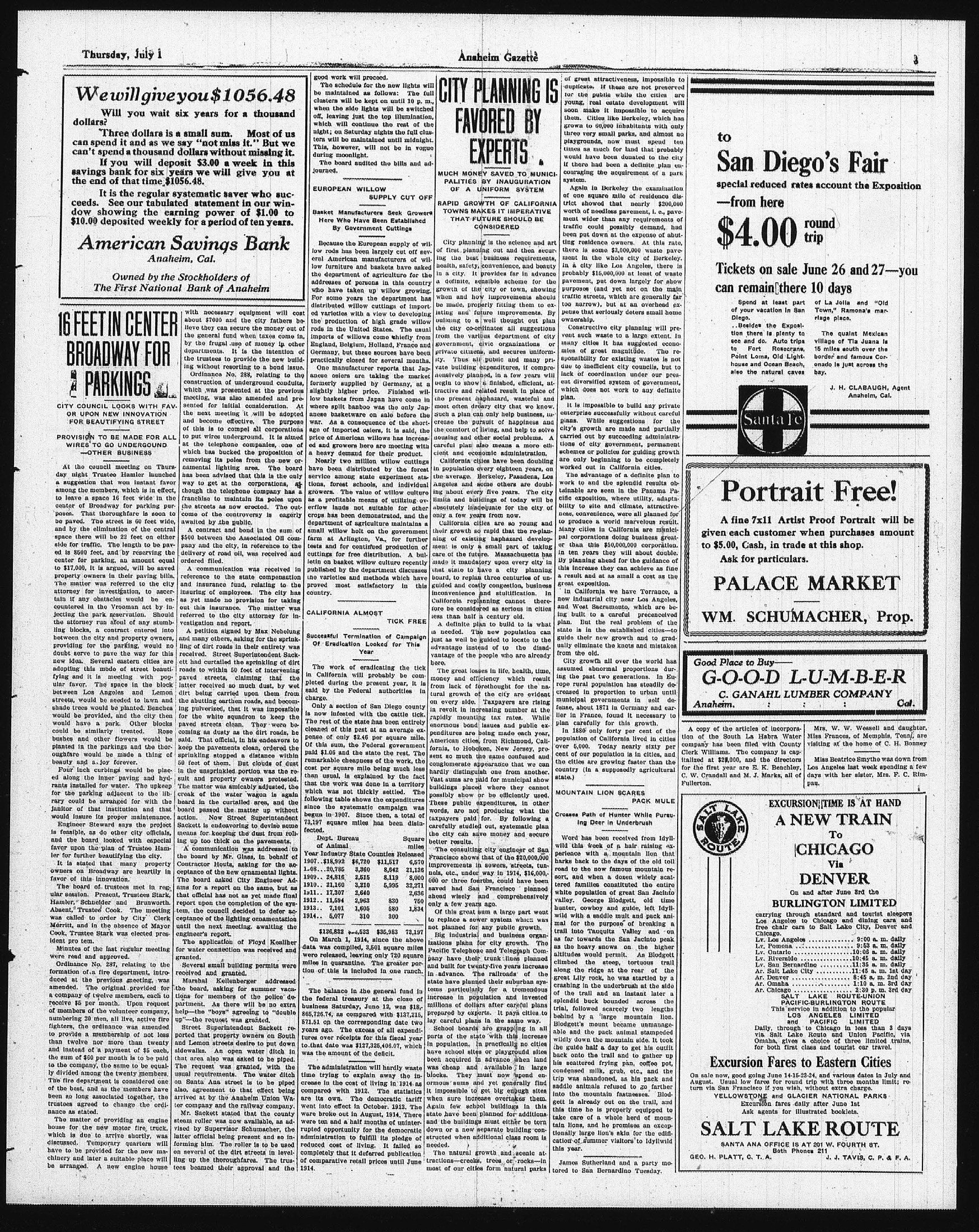
Searchable text
Thursday, July 1
We will give you $1056.48
Will you wait six years for a thousand dollars?
Three dollars is a small sum. Most of us can spend it and as we say "not miss it." But we can't spend a thousand dollars without missing it.
If you will deposit $3.00 a week in this savings bank for six years we will give you at the end of that time $1056.48.
It is the regular systematic saver who succeeds. See our tabulated statement in our window showing the earning power of $1.00 to $10.00 deposited weekly for a period of ten years.
American Savings Bank
Anaheim, Cal.
Owned by the Stockholders of The First National Bank of Anaheim
16 FEET IN CENTER
BROADWAY FOR PARKINGS
CITY COUNCIL LOOKS WITH FAVOR UPON NEW INNOVATION FOR BEAUTIFYING STREET
PROVISION TO BE MADE FOR ALL WIRES TO GO UNDERGOUND — OTHER BUSINESS
with necessary equipment will cost about $7000 and the city fathers believe they can secure the money out of the general fund when taxes come in, by the frugal use of money in other departments. It is the intention of the trustees to provide the new building without resorting to a bond issue.
Ordinance No. 288, relating to the construction of underground conduits, which was presented at the previous meeting, was also amended and presented for initial consideration. At the next meeting it will be adopted and become effective. The purpose of this is to compel all corporations to put wires underground. It is aimed at the telephone companies, one of which has bucked the proposition of removing its poles from the pavement.
The schedule will be maintained at clusters will be when the side lift off, leaving just which will continue night; on Saturday ters will be main This, however, during moonlight The board audited.
EUROPEAN WI
Basket Manufacture
Here Who Have
By Governm
Because the Euro low rods has been general American m low furniture and the department of addresses of people who have taken For some years distributed willow ed varieties with the production o rods in the United imports of willows England, Belgium Germany, but they practically closed.
One manufactur anese osiers are formerly supplied slightly higher p low baskets from where split banbane anese basketware war. As a consec age of imported c price of American ed and growers he a heavy demand
At the council meeting on Thursday night Trustee Hamler launched a suggestion that won instant favor among the members, which is in effect, to leave a space 16 feet wide in the center of Broadway for parking purposes. That thoroughfare is soon to be paved. The street is 60 feet wide, and by the elimination of the central space there will be 22 feet on either side for traffic. The length to be paved is 8500 feet, and by reserving the center for parking, an amount equal to $17,000, it is argued, will be saved property owners in their paving bills. The matter was referred to the city attorney for investigation, to ascertain if any obstacles would be encountered in the Vrooman act by injecting the park reservation. Should the attorney run afoul of any stumbling blocks, a contract entered into between the city and property owners, providing for the parking, would no doubt serve to pave the way for this new idea. Several eastern cities are adopting this mode of street beautifying and it is meeting with popular favor. The space in the block between Los Angeles and Lemon streets, would be seeded to lawn and shade trees would be planted. Benches would be provided, and the city then would have a park. Other blocks could be similarly treated. Rose bushes and other flowers would be planted in the parkings and the thoroughfare would be made a thing of beauty and a joy forever.
Four inch curbings would be placed along the inner paving and hydrants installed for water. The upkeep for the parking adjacent to the library could be arranged for with the janitor of that institution and that would insure its proper maintenance.
Engineer Steward says the project is feasible, as do other city officials, and the board looked with especial favor upon the plan of Trustee Hamler for further beautifying the city.
It is stated that many property owners on Broadway are heartily ing without resorting to a bond issue.
Ordinance No. 288, relating to the construction of underground conduits, which was presented at the previous meeting, was also amended and presented for initial consideration. At the next meeting it will be adopted and become effective. The purpose of this is to compel all corporations to put wires underground. It is aimed at the telephone companies, one of which has bucked the proposition of removing its poles from the new ornamental lighting area. The board has been advised that this is the only way to get at the corporations, though the telephone company has a franchise to maintain its poles upon the streets as now erected. The outcome of the controversy is eagerly awaited by the public.
A contract and bond in the sum of $500 between the Associated Oil company and the city, in reference to the delivery of road oil, was received and ordered filed.
A communication was received in reference to the state compensation and insurance fund, relating to the insuring of employees. The city has as yet made no provision for taking out this insurance. The matter was referred to the city attorney for investigation and report.
A petition signed by Max Nebelung and many others, asking for the sprinkling of dirt roads in their entirety was received. Street Superintendent Sackett had curtalled the sprinkling of dirt roads to within 50 feet of intervening paved streets, claiming that the latter received so much dust, by wet dirt being carried upon them from the abutting earthen roads, and becoming pulverized, that it was impossible for the white squadron to keep the paved streets clean. They were becoming as dusty as the dirt roads, he said. That official, in his endeavors to keep the pavements clean, ordered the sprinkling stopped a distance within 50 feet of them. But clouds of dust in the unsprinkled portion was the result and property owners protested. The matter was amicably adjusted, the creak of the water wagon is again heard in the curtailed area, and the board passed the matter up without action.
Now Street Superintendent Sackett is endeavoring to devise some means for keeping the dust from rolling up too thick on the pavements.
A communication was addressed to the board by Mr. Glass, in behalf of Contractor Houts, asking for the acceptance without resorting to a bond issue.
Ordinance No. 288, relating to the construction of underground conduits, which was presented at the previous meeting, was also amended and presented for initial consideration. At the next meeting it will be adopted and become effective. The purpose of this is to compel all corporations to put wires underground. It is aimed at the telephone companies, one of which has bucked the proposition of removing its poles from the new ornamental lighting area. The board has been advised that this is the only way to get at the corporations, though the telephone company has a franchise to maintain its poles upon the streets as now erected. The outcome of the controversy is eagerly awaited by the public.
A contract and bond in the sum of $500 between the Associated Oil company and the city, in reference to the delivery of road oil, was received and ordered filed.
A communication was received in reference to the state compensation and insurance fund, relating to the insuring of employees. The city has as yet made no provision for taking out this insurance. The matter was referred to the city attorney for investigation and report.
A petition signed by Max Nebelung and many others, asking for the sprinkling of dirt roads in their entirety was received. Street Superintendent Sackett had curtalled the sprinkling of dirt roads to within 50 feet of intervening paved streets, claiming that the latter received so much dust, by wet dirt being carried upon them from the abutting earthen roads, and becoming pulverized, that it was impossible for the white squadron to keep the paved streets clean. They were becoming as dusty as the dirt roads, he said. That official, in his endeavors to keep the pavements clean, ordered the sprinkling stopped a distance within 50 feet of them. But clouds of dust in the unsprinkled portion was the result and property owners protested. The matter was amicably adjusted, the creak of the water wagon is again heard in the curtailed area, and the board passed the matter up without action.
Now Street Superintendent Sackett is endeavoring to devise some means for keeping the dust from rolling up too thick on the pavements.
One manufacturer cananese osiers are formerly supplied slightly higher price of American ed and growers have a heavy demand
Nearly two million have been distributed service among stations, forest schools growers. The value as a profitable meadowflow lands not crops has been developed department of agriculture small willow hollow farm at Arlington tests and for control cuttings for free lettin on basket will published by the dale varieties and most proved most sai country.
CALIFORNIA ALM
Successful Termination Of Eradication
The work of en in California will pleted during thie said by thie Federal charge.
Only a section oi is now infested wi The rest of thie state cleaned of this pest sense of only $2.40 Of this sum, thie F paid $1.06 and thie remarkable cheapne cost per square mile than usual, is expai that thie work was which was not this following table show since thie systema begun in 1907. Sin 73,197 square mille fected.
Dept. Bureau of Animal Year Industry States 1907...$18,992 $6,721.08...20,785 3.36
ed along the inner paving and hydrants installed for water. The upkeep for the parking adjacent to the library could be arranged for with the janitor of that institution and that would insure its proper maintenance.
Engineer Steward says the project is feasible, as do other city officials, and the board looked with especial favor upon the plan of Trustee Hamler for further beautifying the city.
It is stated that many property owners on Broadway are heartily in favor of this innovation.
The board of trustees met in regular session. Present, Trustees Stark, Hamler, Schneider and Brunworth. Absent, Trustee Cook. The meeting was called to order by City Clerk Merritt, and in the absence of Mayor Cook, Trustee Stark was elected president pro tem.
Minutes of the last regular meeting were read and approved.
Ordinance No. 287, relating to the formation of a fire department, introduced at the previous meeting, was amended. The original provided for a company of twelve members, each to receive $5 per month. Upon request of members of the volunteer company, numbering 20 men, all live, active fire fighters, the ordinance was amended to provide a membership of not less than twelve nor more than twenty and instead of a payment of $5 each, the sum of $60 per month is to be paid to the company, the same to be equally divided among the twenty members. The fire department is considered one of the best, and as the members have been so long associated together, the trustees agreed to change the ordinance as stated.
The matter of providing an engine house for the new motor fire truck, which is due to arrive shortly, was discussed. Temporary quarters will have to be provided for the new machinery and later a suitable place will be arranged. A new engine house suit and property owners protested. The matter was amicably adjusted, the creak of the water wagon is again heard in the curtailed area, and the board passed the matter up without action. Now Street Superintendent Sackett is endeavoring to devise some means for keeping the dust from rolling up too thick on the pavements.
A communication was addressed to the board by Mr. Glass, in behalf of Contractor Houts, asking for the acceptance of the new ornamental lights. The board asked City Engineer Adams for a report on the same, but as that official has not as yet made final report upon the completion of the system, the council decided to defer acceptance of the lighting ornamentation until the next meeting, awaiting the engineer's report.
The application of Floyd Keallier for water connection was received and granted.
Several small building permits were received and granted.
Marshal Kellenberger addressed the board, asking for summer vacations for members of the police department. As there will be no extra help—the "boys" agreeing to "double up"—the request was granted.
Street Superintendent Sackett reported that property owners on South and Lemon streets desire to put down sidewalks. An open water ditch in that area also was asked to be piped. The request was granted, with the usual requirements. The water ditch on Santa Ana street is to be piped also, agreement to that effect being arrived at by the Anaheim Union Water company and the railway company.
Mr. Sackett stated that the county steam roller was now available, as advised by Supervisor Schumacher, the latter official being present and so informing him. The roller is to be used on several of the dirt streets in leveling up the thoroughfares. The trustees beamed their approval and the
than usual, is explained that the work was not this following table shows since the system began in 1907. Since 73,197 square miles affected.
Dept. Bureau of Animal
Year Industry States
1907..$18,992 $6,723
1.08...20,785 3,367
1909..24,816 2,537
1910..21,160 3,217
1911..17,307 2,647
1912..11,594 2,967
1913..7,101 1,607
1914..5,077 317
$126,832 $5,522
On March 1, 1914 data was compiled, were released, leaving miles in quarantine. Of this is included.
The balance in this federal treasury business Saturday, at 865,726.74, as compared 571.51 on the corrections years ago. The excuses over receipts fled to that date was $126 was the amount of this administration time trying to explain crease in the cost of compared with 1913 are its own. The went into effect in Oware broke out in A were ten and a half ruptured opportunity for administration to further reduced cost of living completely that it decof comparative retail 1914.
good work will proceed.
The schedule for the new lights will be maintained as follows: The full clusters will be kept on until 10 p.m., when the side lights will be switched off, leaving just the top illumination, which will continue the rest of the night; on Saturday nights the full clusters will be maintained until midnight. This, however, will not be in vogue during moonlight.
The board audited the bills and adjourned.
EUROPEAN WILLOW
SUPPLY CUT OFF
Basket Manufacturers Seek Growers Here Who Have Been Established By Government Cuttings
Because the European supply of willow rods has been largely cut off several American manufacturers of willow furniture and baskets have asked the department of agriculture for the addresses of persons in this country who have taken up willow growing. For some years the department has distributed willow cuttings of imported varieties with a view to developing the production of high grade willow rods in the United States. The usual imports of willows come chiefly from England, Belgium, Holland, France and Germany, but these sources have been practically closed for several months.
One manufacturer reports that Japanese osiers are taking the market formerly supplied by Germany, at a slightly higher price. Finished willow baskets from Japan have come in where split banboo was the only Japanese basketware on sale before the war. As a consequence of the shortage of imported osiers, it is said, the price of American willows has increased and growers here are meeting with a heavy demand for their product.
CITY PLANNING IS FAVORED BY EXPERTS
MUCH MONEY SAVED TO MUNICIPALITIES BY INAUGURATION OF A UNIFORM SYSTEM
RAPID GROWTH OF CALIFORNIA TOWNS MAKES IT IMPERATIVE THAT FUTURE SHOULD BE CONSIDERED
City planning is the science and art of first planning out and then securing the best business requirements, health, safety, convenience, and beauty in a city. It provides far in advance a definite, sensible scheme for the growth of the city or town, showing when and how improvements should be made, properly fitting them to existing and future improvements. By building to a well thought out plan the city co-ordinates all suggestions from the various department of city government, civic organizations or private citizens, and secures uniformity. Thus all public and many private building expenditures, if comprehensively planned, in a few years will begin to show a finished, efficient, attractive and related result in place of the present haphazard, wasteful and most often dreary city that we know. Such a plan can only help business, increase the pursuit of happiness and the comfort of living, and help to solve housing and other social problems. A careful plan also means a more efficient and economic administration.
of great attractiveness, impossible to duplicate. If these are not preserved for the public while the cities are young, real estate development will soon make it impossible to acquire them. Cities like Berkeley, which has grown to 60,000 inhabitants with only three very small parks, and almost no playgrounds, now must spend ten times as much for land that probably would have been donated to the city if there had been a definite plan encouraging the acquirement of a park system.
Again in Berkeley the examination of one square mile of residence district showed that nearly $200,000 worth of needless pavement, i.e., pavement wider than any requirements of traffic could possibly demand, had been put down at the expense of abutting residence owners. At this rate, there is some $3,000,000 waste pavement in the whole city of Berkeley. In a city like Los Angeles, there is probably $15,000,000 at least of waste pavement, put down largely for show purposes (and yet not on the main traffic streets, which are generally far too narrow), but at an overhead expense that seriously deters small home ownership.
Constructive city planning will prevent such waste to a large extent. In many cities it has suggested economies of great magnitude. The responsibility for existing wastes is not due to inefficient city councils, but to lack of coordination under our present diversified system of government, which does not work to any definite plan.
It is impossible to build any private enterprise successfully without careful plans. While suggestions for the city's growth are made and partially carried out by succeeding administrations of city government, permanent schemes or policies for guiding growth are only beginning to be completely
One manufacturer reports that Japanese osiers are taking the market formerly supplied by Germany, at a slightly higher price. Finished willow baskets from Japan have come in where split banboo was the only Japanese basketware on sale before the war. As a consequence of the shortage of imported osiers, it is said, the price of American willows has increased and growers here are meeting with a heavy demand for their product.
Nearly two million willow cuttings have been distributed by the forest service among state experiment stations, forest schools, and individual growers. The value of willow culture as a profitable means of utilizing overflow lands not suitable for other crops has been demonstrated, and the department of agriculture maintains a small willow holt on the government farm at Arlington, Va., for further tests and for continued production of cuttings for free distribution. A bulletin on basket willow culture recently published by the department discusses the varieties and methods which have proved most satisfactory in this country.
CALIFORNIA ALMOST
TICK FREE
Successful Termination of Campaign Of Eradication Looked for This Year
The work of eradicating the tick in California will probably be completed during the present year, it is said by the Federal authorities in charge.
Only a section of San Diego county is now infested with the cattle tick. The rest of the state has been entirely cleaned of this pest at an average expense of only $2.46 per square mile. Of this sum, the Federal government paid $1.06 and the state the rest. The remarkable cheapness of the work, the cost per square mile being much less than usual, is explained by the fact that the work was done in a territory which was not thickly settled. The following table shows the expenditures since the systematic campaign was begun in 1907. Since then, a total of 73,197 square miles has been disinfected.
Dept. Bureau Square of Animal miles
Year Industry State Counties Released 1907...$18,992 $6,720 $11,517 6,570 1.08...20,785 3,360 8,642 21,136
California cities have been doubling in population every eighteen years, on the average. Berkeley, Pasadena, Los Angeles and some others are doubling about every five years. The city limits and buildings of today will be absolutely inadequate for the city of only a few years from now.
California cities are so young and their growth so rapid that the re-planning of existing haphazard development is only a small part of taking care of the future. Massachusetts has made it mandatory upon every city in that state to have a city planning board, to replan three centuries of unguided and costly congestion, business inconvenience and stultification. In California replanning cannot therefore be considered as serious in cities less than half a century old.
A definite plan to build to is what is needed. The new population can just as well be guided to locate to the advantage instead of to the disadvantage of the people who are already here.
The great losses in life, health, time, money and efficiency which result from lack of forethought for the natural growth of the city are evident on every side. Taxpayers are rising in revolt in increasing number at the rapidly mounting tax rates. While enormous bond issues and public expenditures are being made each year, American cities from Richmond, California, to Hoboken, New Jersey, present so much the same confused and conglomerate appearance that we can hardly distinguish one from another. Vast sums are paid for municipal show buildings placed where they cannot possibly show or be efficiently used. These public expenditures, in other words, are not producing what the taxpayers paid for. By following a carefully studied out, systematic plan the city can save money and secure better results.
The consulting city engineer of San Francisco shows that of the $20,000,000 improvements in sewers, streets, tunnels due to inefficient city councils, but to lack of coordination under our present diversified system of government, which does not work to any definite plan.
It is impossible to build any private enterprise successfully without careful plans. While suggestions for the city's growth are made and partially carried out by succeeding administrations of city government, permanent schemes or policies for guiding growth are only beginning to be completely worked out in California cities.
The advantage of a definite plan to work to and the splendid results obtainable are seen in the Panama Pacific exposition, where utility, adaptability to site and climate, attractiveness, convenience, were all planned for to produce a world marvelous result. Many cities in California are municipal corporations doing business greater than this $50,000,000 corporation. In ten years they will about double. By planning ahead for the guidance of this increase they can achieve as fine a result and at as small a cost as the great exposition.
In California we have Torrance, a new industrial city near Los Angeles, and West Sacramento, which are being built to a careful preceived plan. But the real problem of the state is in the established cities—to guide their new growth and to gradually eliminate the knots and mistakes from the old.
City growth all over the world has assumed abnormal proportions during the past two generations. In Europe rural population has steadily decreased in proportion to urban until municipal governments in self defense, about 1871 in Germany and earlier in France, found it necessary to plan carefully for this growth.
In 1880 only forty per cent of the population of California lived in cities over 5,000. Today nearly sixty per cent of our population is in cities, and the cities are growing faster than the country (in a supposedly agricultural state.)
than usual, is explained by the fact that the work was done in a territory which was not thickly settled. The following table shows the expenditures since the systematic campaign was begun in 1907. Since then, a total of 73,197 square miles has been disinfected.
Dept. Bureau Square of Animal miles
Year Industry State Counties Released
1907..$18,992 $6,720 $11,517 6,570
1.08...20,785 3,360 8,642 21,136
1909...24,816 2,515 8,119 8,000
1910...21,160 3,210 5,995 32,271
1911...17,307 2,640 2,636
1912...11,594 2,963 830 750
1913...7,101 1,605 580 1,834
1914..5,077 310 300
$126,832 $5,523 $35,983 73,197
On March 1, 1914, since the above data was compiled, 3,501 square miles were released, leaving only 720 square miles in quarantine. The greater portion of this is included in one ranch.
The balance in the general fund in the federal treasury at the close of business Saturday, June 12, was $18,865,726.74, as compared with $137,215,571.51 on the corresponding date two years ago. The excess of all expenditures over receipts for this fiscal year to that date was $127,325,406.07, which was the amount of the deficit.
The administration will hardly waste time trying to explain away the increase in the cost of living in 1914 as compared with 1912. The statistics are its own. The democratic tariff went into effect in October, 1913. The ware broke out in August, 1914. There were ten and a half months of uninterrupted opportunity for the democratic administration to fulfill its pledge of reduced cost of living. It failed so completely that it deferred publication of comparative retail prices until June 1914.
Vast sums are paid for municipal show buildings placed where they cannot possibly show or be efficiently used. These public expenditures, in other words, are not producing what the taxpayers paid for. By following a carefully studied out, systematic plan the city can save money and secure better results.
The consulting city engineer of San Francisco shows that of the $20,000,000 improvements in sewers, streets, tunnels, etc., under way in 1914, $16,000,-000 or three fourths could have been saved had San Francisco planned ahead wisely and comprehensively only a few years ago.
Of this great sum a large part went to replace a sewer system which was not planned for any public growth.
Big industrial and business organizations plann for city growth. The Pacific Telephone and Telegraph Company have their trunk lines planned and built for twenty-five years increase in advance. The railroads of the state have planned their suburban systems particularly for a tremendous increase in population and invested millions of dollars after careful plans prepared by experts. It pays cities to lay careful plans in the same way.
School boards are grappling in all parts of the state with this increase in population. In practically no cities have school sites or playground sites been acquired in advance when land was cheap and available in large blocks. They must now spend enormous sums and yet generally find it impossible to get big enough sites when sure increase overtakes them. Again few school buildings in this state have been planned for additions and the buildings must either be torn down or a new separate building constructed when additional class room is needed.
The natural growth and scenic attractions—creeks, trees or rocks—in most of our cities form natural parks.
Word has been received from Idyllwild this week of a hair raising experience with a mountain lion that harks back to the days of the old toll road to the now famous mountain resort, and when a dozen widely scattered families constituted the entire white population of great San Jacinto valley. George Blodgett, old time hunter, cowboy and guide, left Idyllwild with a saddle mult and pack animal for the purpose of breaking a trail into Tauquitz Valley and on as far towards the San Jacinto peak as the heavy snows on the higher altitudes would permit. As Blodgett climbed the steep, tortuous trail along the ridge at the rear of the great Lilly rock, he was startled by a crashing in the underbrush at the side of the trail and an instant later a splendid buck bound across the trial, followed scarcely two lengths behind by a large mountain lion. Blodgett's mount became unmanageable and the pack animal stampeded wildly down the mountain side. It took the guide half a day to get his outfit back onto the trail and to gather up his scattered frying pan, coffee pot, condensed milk, grub, etc., and the trip was abandoned, as his pack and saddle animals refused to go farther into the mountain fastnesses. Blodgett is already out on the trail, and this time he is properly equipped to take care of a whole herd of mountain lions, and he promises an exceptionally large lion's skin for the edification of summer visitors to Idyllwild this year.
James Sutherland and a party motored to San Bernardino Tuesday.
to San Diego’s Fair
special reduced rates account the Exposition
—from here
$4.00 round trip
Tickets on sale June 26 and 27—you can remain there 10 days
Spend at least part of your vacation in San Diego.
Besides the Exposition there is plenty to see and do. Auto trips to Fort Rosecrans, Point Loma, Old Lighthouse and Ocean Beach, also the natural caves of La Jolla and “Old Town,” Ramona’s marriage place.
The quaint Mexican village of Tla Juana is 15 miles south over the border and famous Coronado is just across the bay.
J. H. CLABAUGH, Agent
Anaheim, Cal.
Portrait Free!
A fine 7x11 Artist Proof Portrait will be given each customer when purchases amount to $5.00, Cash, in trade at this shop.
Ask for particulars.
PALACE MARKET
WM. SCHUMACHER, Prop.
Good Place to Buy—
G-O-O-D L-U-M-B-E-R
C. GANAHL LUMBER COMPANY
Anaheim. Cal.
A copy of the articles of incorporation of the South La Habra Water company has been filed with County Clerk Williams. The company is capitalized at $29,000, and the directors for the first year are E. K. Benchley, C. W. Crandall and M. J. Marks, all of Fullerton.
Mrs. W. W. Wessell and daughter, Miss Frances, of Memphis, Tenn., are visiting at the home of C. H. Bonney.
Miss Beatrice Smythe was down from Los Angeles last week spending a few days with her sister, Mrs. F. C. Rimpau.
EXCURSION | TIME IS AT HAND
A NEW TRAIN
To CHICAGO
Via
EXCURSION TIME IS AT HAND
A NEW TRAIN
To
CHICAGO
Via
DENVER
On and after June 8th the
BURLINGTON LIMITED
carrying through standard and tourist sleepers
Los Angeles to Chicago and dining cars and free chair cars to Salt Lake City, Denver and Chicago.
Lv. Los Angeles ... 9:00 a.m. daily
Lv. Pomona ... 9:53 a.m. daily
Lv. Ontario ... 10:06 a.m. daily
Lv. Riverside ... 10:45 a.m. daily
Lv. San Bernardino ... 11:35 a.m. daily
Ar. Salt Lake City ... 11:45 a.m. 1st day
Ar. Denver ... 8:45 a.m. 2nd day
Ar. Omaha ... 1:10 a.m. 3rd day
Ar. Chicago ... 2:30 p.m. 3rd day
SALT LAKE ROUTE-UNION
PACIFIC-BURLINGTON ROUTE
This service in addition to the popular
LOS ANGELES LIMITED
and PACIFIC LIMITED
Daily, through to Chicago in less than 3 days via Salt Lake Route and Union Pacific, via Omaha, gives a choice of three limited trains, for both first class and tourist car travel.
Excursion Fares to Eastern Cities
On sale now, good going June 14-15-23-24, and various dates in July and August. Usual low fares for round trip with three months limit; return via San Francisco if you wish, without extra charge.
YELLOWSTONE and GLACIER NATIONAL PARKS
Excursion fares daily after June 1st
Ask agents for illustrated booklets.
SALT LAKE ROUTE
SANTA ANA OFFICE IS AT 201 W. FOURTH ST.
Both Phones 211
GEO. H. PLATT, C. T. A.
J. J. TAVIS, C. P. & F. A.