anaheim-gazette 1915-06-17
Scanned page
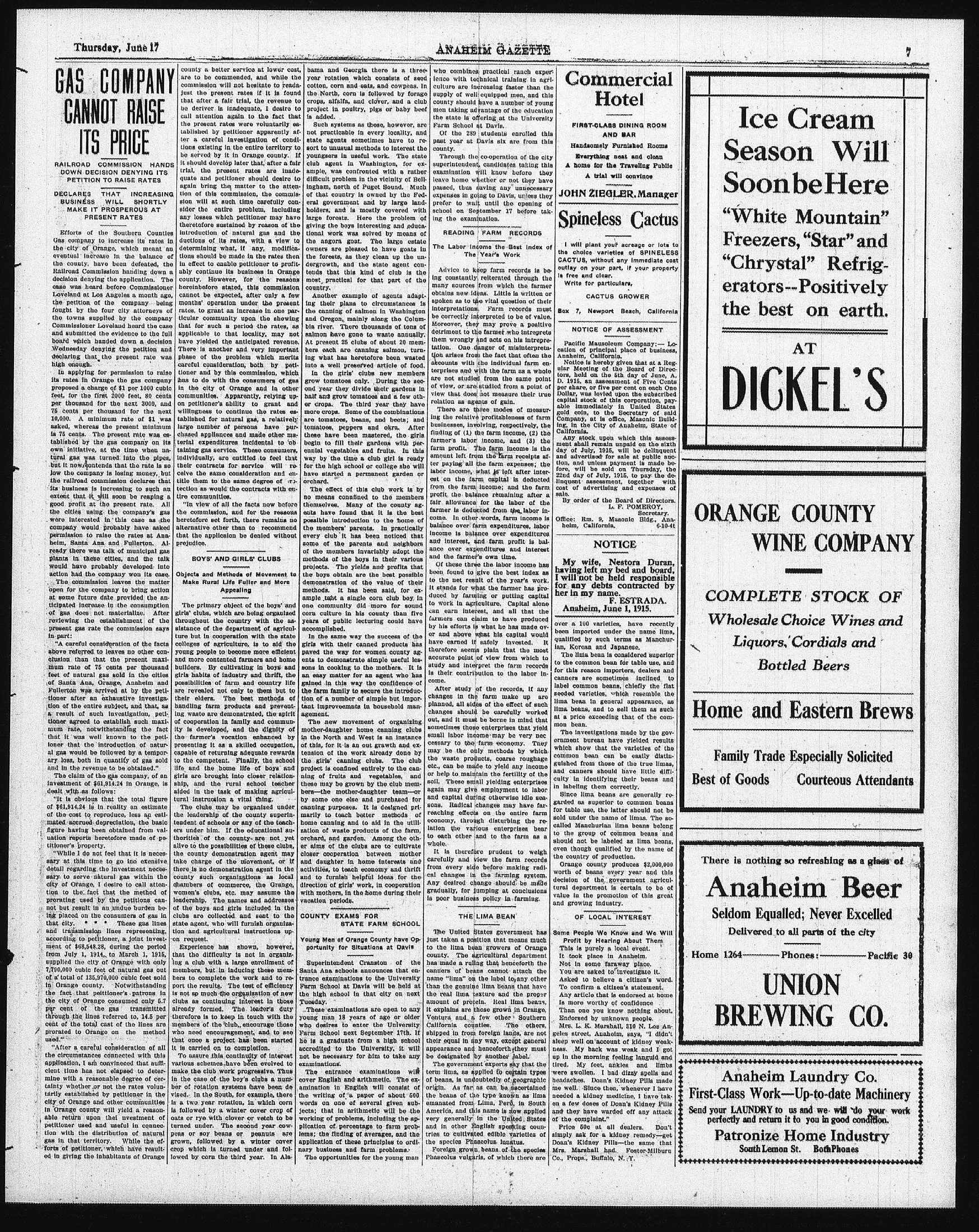
Searchable text
GAS COMPANY CANNOT RAISE ITS PRICE
RAILROAD COMMISSION HANDS DOWN DECISION DENYING ITS PETITION TO RAISE RATES
DECLARES THAT INCREASING BUSINESS WILL SHORTLY MAKE IT PROSPEROUS AT PRESENT RATES
Efforts of the Southern Counties Gas company to increase its rates in the city of Orange, which meant an eventual increase in the balance of the county, have been defeated, the Railroad Commission handing down a decision denying the application. The case was heard before Commissioner Loveland at Los Angeles a month ago, the petition of the company being fought by the four city attorneys of the towns supplied by the company Commissioner Loveland heard the case and submitted the evidence to the full board which handed down a decision Wednesday denying the petition and declaring that the present rate was high enough.
In applying for permission to raise its rates in Orange the gas company proposed a charge of $1 per 1000 cubic feet, for the first 2000 feet, 80 cents per thousand for the next 3000, and 75 cents per thousand for the next 10,000. A minimum rate of $1 was asked, whereas the present minimum is 75 cents. The present rate was established by the gas company on its own initiative, at the time when natural gas was turned into the pipes, county a better service at lower cost, are to be commended, and while the commission will not hesitate to readjust the present rates if it is found that after a fair trial, the revenue to be deriver is inadequate, I desire to call attention again to the fact that the present rates were voluntarily established by petitioner apparently after a careful investigation of conditions existing in the entire territory to be served by it in Orange county. If it should develop later that, after a fair trial, the present rates are inadequate and petitioner should desire to again bring the matter to the attention of this commission, the commission will at such time carefully consider the entire problem, including any losses which petitioner may have theretofore sustained by reason of the introduction of natural gas and the ductions of its rates, with a view to determining what, if any, modifications should be made in the rates then in effect to enable petitioner to profitably continue its business in Orange county. However, for the reasons hereinbefore stated, this commission cannot be expected, after only a few months' operation under the present rates, to grant an increase in one particular community upon the showing that for such a period the rates, as applicable to that locality, may not have yielded the anticipated revenue. There is another and very important phase of the problem which merits careful consideration, both by petitioner and by this commission, which has to do with the consumers of gas in the city of Orange and in other communities. Apparently, relying upon petitioner's ability to grant and willingness to continue the rates established for natural gas, a relatively large number of persons have purchased appliances and made other material expenditures incidental to obtaining gas service. These consumers, individually, are entitled to feel that bama and Georgia year rotation while cotton, corn and as the North, corn is crops, alfalfa, and project in poultry is added.
Such systems as not practicable in state agents some sort to unusual met youngsters in useful club agent in W ample, was confro difficult problem in ingham, north of F of that country is eral government a holders, and is m large forests. He giving the boys intional work was as angora goat. Owners are pleased the forests, as they dergrowth, and thends that this k most practical for country.
Another example ing their plans to the canning of salm and Oregon, mainly bla river. There the salmon have gone At present 25 clubs bers each are can ing what has here into a well preserv.
In the girls' clu grow tomatoes only end year they divi half and grow tomato or crops. The thil more crops. Some are tomatoes, bean tomatoes, peppers these have been n begin to fill their ennial vegetables a way by the time
In applying for permission to raise its rates in Orange the gas company proposed a charge of $1 per 1000 cubic feet, for the first 2000 feet, 80 cents per thousand for the next 3000, and 75 cents per thousand for the next 10,000. A minimum rate of $1 was asked, whereas the present minimum is 75 cents. The present rate was established by the gas company on its own initiative, at the time when natural gas was turned into the pipes, but it now contends that the rate is so low the company is losing money, but the railroad commission declares that its business is increasing to such an extent that it will soon be reaping a good profit at the present rate. All the cities using the company's gas were interested in this case as the company would probably have asked permission to raise the rates at Anaheim, Santa Ana and Fullerton. Already there was talk of municipal gas plants in these cities, and the talk would have probably developed into action had the company won its case.
The commission leaves the matter open for the company to bring action at some future date provided the anticipated increase in the consumption of gas does not materialize. After reviewing the establishment of the present gas rate the commission says in part:
"A careful consideration of the facts above referred to leaves no other conclusion than that the present maximum rate of 75 cents per thousand feet of natural gas sold in the cities of Santa Ana, Orange, Anaheim and Fullerton was arrived at by the petitioner after an exhaustive investigation of the entire subject, and that, as a result of such investigation, petitioner agreed to establish such maximum rate, notwithstanding the fact that it was well known to the petitioner that the introduction of natural gas would be followed by a temporary loss, both in quantity of gas sold and in the revenue to be obtained."
The claim of the gas company, of an investment of $61,914.24 in Orange, is dealt with as follows:
"It is obvious that the total figure of $61,914.24 is in reality an estimate of the cost to reproduce, less an estimated accrued depreciation, the basic figure having been obtained from valuation reports heretofore made of petitioner's property.
"While I do not feel that it is necessary at this time to go into extensive detail regarding the investment neces-
careful consideration, both by petitioner and by this commission, which has to do with the consumers of gas in the city of Orange and in other communities. Apparently, relying upon petitioner's ability to grant and willingness to continue the rates established for natural gas, a relatively large number of persons have purchased appliances and made other material expenditures incidental to obtaining gas service. These consumers individually, are entitled to feel that their contracts for service will receive the same consideration and entitle them to the same degree of protection as would the contracts with entire communities.
"In view of all the facts now before the commission, and for the reasons heretofore set forth, there remains no alternative other than to recommend that the application be denied without prejudice.
BOYS' AND GIRLS' CLUBS
Objects and Methods of Movement to Make Rural Life Fuller and More Appealing
The primary object of the boys' and girls' clubs, which are being organized throughout the country with the assistance of the department of agriculture but in cooperation with the state colleges of agriculture, is to aid the young people to become more efficient and more contented farmers and home builders. By cultivating in boys and girls habits of industry and thrift, the possibilities of farm and country life are revealed not only to them but to their elders. The best methods of handling farm products and preventing waste are demonstrated, the spirit of cooperation in family and community is developed, and the dignity of the farmer's vocation enhanced by presenting it as a skilled occupation, capable of returning adequate rewards to the competent. Finally, the school life and the home life of boys and girls are brought into closer relationship, and the rural school teacher aided in the task of making agricultural instruction a vital thing.
The clubs may be organized under the leadership of the county superintendent of schools or any of the teachers under him. If the educational authorities of the county are not yet alive to the possibilities of these clubs, the county demonstration agent may take charge of the movement, or if there is no demonstration agent in the
into a well preserved themselves. Many girls grow tomatoes only once year they divide half and grow tomato crops. The third more crops. Some o are tomatoes, beans tomatoes, peppers these have been m begin to fill their ennial vegetables a way by the time a for the high school have started a per orchard.
The effect of this no means confined themselves. Many o ents have found th possible introduction to members' parent every club it has some of the parents of the members in methods of the boy's projects. The yield the boys obtain are demonstration of t methods. It has b sample tight a single one community did corn culture in his years of public lec accomplished.
In the same way girls with their canvases paved the way for oents to demonstrate sons in cooking to t an easy matter for gained in this way in the farm family to se tion of a number of o tant improveemnts l agement.
The new movement mother-daughter home in the North and West of this, for it is an o tension of the work othe girls' canning o project is confined o ning of fruits and these may be grown bers—the mother-day by some one else a canning purposes. In marily to teach bet home canning and t zation of waste prod orchard, and garden er aims of the clubs closer cooperation and daughter in hoi activities to teach e
The claim of the gas company, of an investment of $61,914.24 in Orange, is dealt with as follows:
"It is obvious that the total figure of $61,914.24 is in reality an estimate of the cost to reproduce, less an estimated accrued depreciation, the basic figure having been obtained from valuation reports heretofore made of petitioner's property.
"While I do not feel that it is necessary at this time to go into extensive detail regarding the investment necessary to serve natural gas within the city of Orange, I desire to call attention to the fact that the method of prorating used by the petitions cannot but result in an undue burden being placed on the consumers of gas in that city. These gas lines and transmission lines representing, according to petitioner, a joint investment of $68,548.28, during the period from July 1, 1914, to March 1, 1915, supplied the city of Orange with only 7,790,000 cubic feet of natural gas out of a total of 135,970,000 cubic feet sold in Orange county. Notwithstanding the fact that petitioner's patrons in the city of Orange consumed only 5.7 per cent of the gas transmitted through the lines referred to, 14.5 per cent of the total cast of the lines are prorated to Orange on the method used."
"After a careful consideration of all circumstances connected with this application, I am convinced that sufficient time has not elapsed to determine with a reasonable degree of certainty whether or not the rates voluntarily established by petitioner in the city of Orange and other communities in Orange county will yield a reasonable return upon the investment of petitioner used and useful in connection with the distribution of natural gas in that territory. While the efforts of petitioner, which have resulted in giving the inhabitants of Orange girls are brought into closer relationship, and the rural school teacher aided in the task of making agricultural instruction a vital thing.
The clubs may be organized under the leadership of the county superintendent of schools or any of the teachers under him. If the educational authorities of the county are not yet alive to the possibilities of these clubs, the county demonstration agent may take charge of the movement, or if there is no demonstration agent in the county such organizations as local chambers of commerce, the Grange, women's clubs, etc. may assume the leadership. The names and addresses of the boys and girls included in the clubs are collected and sent to the state agent, who will furnish organization and agricultural instructions upon request.
Experience has shown, however, that the difficulty is not in organizing a club with a large enrollment of members, but in inducing these members to complete the work and to report the results. The test of efficiency is not so much the organization of new clubs as continuing interest in those already formed. The leader's duty therefore is to keep in touch with the members of the club,, encourage those who need encouragement, and to see that once a project has been started it is carried on to completion.
To assure this continuity of interest various schemes have been evolved to make the club work progressive. Thus in the case of the boy's clubs a number of rotation systems have been developed. In the South, for example, there is a two year rotation, in which corn is followed by a winter cover crop of oats or rye with clover or vetch to be turned under. The second year cowpeas or soy beans or peanuts are grown, followed by a winter cover crop which is turned under and followed by corn the third year. In Ala-
The entrance exceeds English and arithmetic examination in English; the writing of a paper words on one of subjects; that in arithmetic working problems,plication of percentages; the finding of an application of these principles business and fact.
The opportunities for
ANAHEIM GAZETTE
bama and Georgia there is a three-year rotation which consists of seed cotton, corn and oats, and cowpeas. In the North, corn is followed by forage crops, alfalfa, and clover, and a club project in poultry, pigs or baby beef is added.
Such systems as these, however, are not practicable in every locality, and state agents sometimes have to resort to unusual methods to interest the youngsters in useful work. The state club agent in Washington, for example, was confronted with a rather difficult problem in the vicinity of Bellingham, north of Puget Sound. Much of that country is owned by the Federal government and by large landholders, and is mostly covered with large forests. Here the problem of giving the boys interesting and educational work was solved by means of the angora goat. The large estate owners are pleased to have goats in the forests, as they clean up the undergrowth, and the state agent contends that this kind of club is the most practical for that part of the country.
Another example of agents adapting their plans to circumstances is the canning of salmon in Washington and Oregon, mainly along the Columbia river. There thousands of tons of salmon have gone to waste annually. At present 25 clubs of about 20 members each are canning salmon, turning what has heretofore been wasted into a well preserved article of food.
In the girls' clubs new members grow tomatoes only. During the second year they divide their gardens in half and grow tomatoes and a few other crops. The third year they have more crops. Some of the combinations are tomatoes, beans, and beets; and tomatoes, peppers and okra. After these have been mastered, the girls begin to fill their gardens with perennial vegetables and fruits. In this way by the time a club girl is ready who combines practical ranch experience with technical training in agriculture are increasing faster than the supply of well-equipped men, and this county should have a number of young men taking advantage of the education the state is offering at the University Farm School at Davis.
Of the 289 students enrolled this past year at Davis six are from this county.
Through the co-operation of the city superintendent, candidates taking this examination will know before they leave home whether or not they have passed, thus saving any unnecessary expenses in going to Davis, unless they prefer to wait until the opening of school on September 17 before taking the examination.
READING FARM RECORDS
The Labor Income the Best Index of The Year's Work
Advice to keep farm records is being constantly reiterated through the many sources from which the farmer obtains new ideas. Little is written or spoken as to the vital question of their interpretations. Farm records must be correctly interpreted to be of value. Moreover, they may prove a positive detriment to the farmer who interprets them wrongly and acts on his interpretation. One danger of misinterpretation arises from the fact that often the accounts with the individual farm enterprises and with the farm as a whole are not studied from the same point of view, or are studied from a point of view that does not measure their true relation as agents of gain.
There are three modes of measuring the relative profitability of farm businesses, involving, respectively, the finding of (1) the farm income, (2) the farmer's labor income, and (3) the farm profit. The farm income is the amount left from the farm receipts after stock upon which this assessment shall remain unpaid on the sixth day of July, 1915, will be delinquent and advertised for sale at public auctions.
into a well preserved article of food.
In the girls' clubs new members grow tomatoes only. During the second year they divide their gardens in half and grow tomatoes and a few other crops. The third year they have more crops. Some of the combinations are tomatoes, beans, and beets; and tomatoes, peppers and okra. After these have been mastered, the girls begin to fill their gardens with perennial vegetables and fruits. In this way by the time a club girl is ready for the high school or college she will have started a permanent garden or orchard.
The effect of this club work is by no means confined to the members themselves. Many of the county agents have found that it is the best possible introduction to the home of the members' parents. In practically every club it has been noticed that some of the parents and neighbors of the members invariably adopt the methods of the boys in their various projects. The yields and profits that the boys obtain are the best possible demonstration of the value of their methods. It has been said, for example that a single corn club boy, in one community did more for sound corn culture in his county than five years of public lecturing could have accomplished.
In the same way the success of the girls with their canned products has paved the way for women county agents to demonstrate simple useful lessons in cooking to the mothers. It is an easy matter for an agent who has gained in this way the confidence of the farm family to secure the introduction of a number of simple but important improveemnts in household management.
The new movement of organizing mother-daughter home canning clubs in the North and West is an instance of this, for it is an out graft and extension of the work already done by the girls' canning clubs. The club project is confined entirely to the canning of fruits and vegetables, and these may be grown by the club members—the mother-daughter team—or by some one else and purchased for canning purposes. It is designed primarily to teach better methods of home canning and to aid in the utilization of waste products of the farm, orchard, and garden. Among the other aims of the clubs are to cultivate closer cooperation between mother and daughter in home interests and activities, to teach economy and thrift accounts with the individual farm enterprises and with the farm as a whole are not studied from the same point of view, or are studied from a point of view that does not measure their true relation as agents of gain.
There are three modes of measuring the relative profitableness of farm businesses, involving, respectively, the finding of (1) the farm income, (2) the farmer's labor income, and (3) the farm profit. The farm income is the amount left from the farm receipts after paying all the farm expenses; the labor income, what is left after interest on the farm capital is deducted from the farm income; and the farm profit the balance remaining after a fair allowance for the labor of the farmer is deducted from the labor income. In other words, farm income is balance over farm expenditures, labor income is balance over expenditures and interest, and farm profit is balance over expenditures and interest and the farmer's own time.
Of these three the labor income has been found to give the best index as to the net result of the year's work. It stands for what the farmer has produced by farming or putting capital to work in agriculture. Capital alone can earn interest, and all that the farmers can claim to have produced by his efforts is what he has made over and above what his capital would have earned if safely invested. It therefore seems plain that the most accurate point of view from which to study and interpret the farm records is their contribution to the labor income.
After study of the records, if any changes in the farm make up are planned, all sides of the effect of such changes should be carefully worked out, and it must be borne in mind that sometimes those enterprises that yield small labor income may be very necessary to the farm economy. They may be only methods by which the waste products, coarse roughage etc., can be made to yield any income or help maintain the fertility of the soil. These small yielding enterprises again may give employment to labor and capital during otherwise idle seasons. Radical changes may have far-reaching effects on the entire farm economy, through disturbing the relation the various enterprises bear to each other and to the farm as a whole.
It is therefore prudent to weigh carefully and view the farm records from every side before making radii.
Notice is hereby given that at a Regular Meeting of the Board of Directors, held on the 5th day of June, A.D. 1915, an assessment of Five Cents per share, or five per cent on each One Dollar, was levied upon the subscribed capital stock of this corporation, payable immediately in United States gold coin, to the Secretary of said Company, at its office, Masonic Building, in the City of Anaheim, State of California.
Any stock upon which this assessment shall remain unpaid on the sixth day of July, 1915, will be delinquent and advertised for sale at public auction, and unless payment is made before, will be sold on Thursday, the 22nd day of July, 1915, to pay the delinquent assessment, together with cost of advertising and expenses of sale.
By order of the Board of Directors.
L. F. POMEROY,
Secretary.
Office: Rm. 9, Masonic Bldg., Anaheim, California.
NOTICE
My wife, Nestora Duran, having left my bed and board, I will not be held responsible for any debts contracted by her in my name.
F. ESTRADA.
Anaheim, June 1, 1915.
over a 100 varieties, have recently been imported under the name lima, qualified by such terms as Manchurian, Korean and Japanese.
The lima bean is considered superior to the common bean for table use, and for this reason importers, dealers and canners are sometimes inclined to label common beans, chiefly the flat seeded varieties, which resemble the lima bean in general appearance, as lima beans, and to sell them as such at a price exceeding that of the common bean.
The investigations made by the government bureau have yielded results which show that the varieties of the common bean can be easily distinguished from those of the true limas, and canners should have little difficulty in identifying their beans and in labeling them correctly.
Since lima beans are generally regarded as superior to common beans for table use, the latter should not be sold under the name limas. The so-called Manchurian lima beans belong to the group of common beans and should not be labeled as lima beans, even though qualified by the name of the country of production.
Orange county produces $2,000,000
COUNTY EXAMS FOR STATE FARM SCHOOL
Young Men of Orange County have Opportunity for Situations at Davis
Superintendent Cranston of the Santa Ana schools announces that entrance examinations to the University Farm School at Davis will be held at the high school in that city on next Tuesday.
These examinations are open to any young man 18 years of age or older who desires to enter the University Farm School next September 17th. If he is a graduate from a high school accredited to the University, it will not be necessary for him to take any examinations.
The entrance examinations will cover English and arithmetic. The examination in English will consist of the writing of a paper of about 500 words on one of several given subjects; that in arithmetic will be the working of problems, including the application of percentage to farm problems; the finding of averages, and the application of these principles to ordinary business and farm problems.
The opportunities for the young man
The United States government has just taken a position that means much to the lima bean growers of Orange county. The agricultural department has made a ruling that henceforth the canners of beans cannot attach the name "lima" on the label to any other than the genuine lima beans that have the real lima texture and the proper amount of protein. Real lima beans, it explains are those grown in Orange, Ventura and a few other Southern California counties. The others, shipped in from foreign lands, are not their equal in any way, except general appearance and henceforth they must be designated by another label.
The government experts say that the term lima, as applied to certain types of beans, is undoubtedly of geographic origin. As far as can be ascertained the beans of the type known as lima emanated from Lima, Peru, in South America, and this name is now applied very generally in the United States and in other English speaking countries to cultivated edible varieties of the species Phaseolus lunatus.
Foreign grown beans of the species Phaseolus vulgaris, of which there are or help to maintain the fertility of the soil. These small yielding enterprises again may give employment to labor and capital during otherwise idle seasons. Radical changes may have far-reaching effects on the entire farm economy, through disturbing the relation the various enterprises bear to each other and to the farm as a whole.
It is therefore prudent to weigh carefully and view the farm records from every side before making radical changes in the farming system. Any desired change should be made gradually, for jumping at conclusions is poor business policy in farming.
THE LIMA BEAN
The United States government has just taken a position that means much to the lima bean growers of Orange county. The agricultural department has made a ruling that henceforth the canners of beans cannot attach the name "lima" on the label to any other than the genuine lima beans that have the real lima texture and the proper amount of protein. Real lima beans, it explains are those grown in Orange, Ventura and a few other Southern California counties. The others, shipped in from foreign lands, are not their equal in any way, except general appearance and henceforth they must be designated by another label.
The government experts say that the term lima, as applied to certain types of beans, is undoubtedly of geographic origin. As far as can be ascertained the beans of the type known as lima emanated from Lima, Peru, in South America, and this name is now applied very generally in the United States and in other English speaking countries to cultivated edible varieties of the species Phaseolus lunatus.
Foreign grown beans of the species Phaseolus vulgaris, of which there are or help to maintain the fertility of the soil. These small yielding enterprises again may give employment to labor and capital during otherwise idle seasons. Radical changes may have far-reaching effects on the entire farm economy, through disturbing the relation the various enterprises bear to each other and to the farm as a whole.
It is therefore prudent to weigh carefully and view the farm records from every side before making radical changes in the farming system. Any desired change should be made gradually, for jumping at conclusions is poor business policy in farming.
OF LOCAL INTEREST
Some People We Know and We Will Profit by Hearing About Them
This is purely a local event. It took place in Anaheim. Not in some faraway place. You are asked to investigate it. Asked to believe a citizen's word. To confirm a citizen's statement. Any article that is endorsed at home Is more worthy of confidence Than one you know nothing about. Endorsed by unknown people.
Mrs. L. K. Marshall, 310 N. Los Angeles street, Anaheim, says, "I didn't sleep well on account of kidney weakness. My back was weak and I got up in the morning feeling languid and tired. My feet, ankles and limbs were swollen. I had dizzy spells and headaches. Doan's Kidney Pills made me well. Since then, whenever I have needed a kidney medicine, I have taken a few doses of Doan's Kidney Pills and they have warded off any attack of the complaint."
Price 50c at all dealers. Don't simply ask for a kidney remedy—get Doan's Kidney Pills—the same that Mrs. Marshall had. Foster-Milburn Co., Props., Buffalo, N.Y.
Ice Cream
Season Will
SoonbeHere
“White Mountain”
Freezers, “Star” and
“Chrystal” Refrigerators--Positively the best on earth.
AT
DICKEL'S
DICKEL'S
ORANGE COUNTY
WINE COMPANY
COMPLETE STOCK OF
Wholesale Choice Wines and
Liquors,'Cordials and
Bottled Beers
Home and Eastern Brews
Family Trade Especially Solicited
Best of Goods Courteous Attendants
There is nothing so refreshing as a glass of
Best of Goods Courteous Attendants
There is nothing so refreshing as a glass of
Anaheim Beer
Seldom Equalled; Never Excelled
Delivered to all parts of the city
Home 1264——Phones:——Pacific 30
UNION
BREWING CO.
Anaheim Laundry Co.
First-Class Work—Up-to-date Machinery
Send your LAUNDRY to us and we will do your work perfectly and return it to you in good condition.
Patronize Home Industry
South Lemon St. Both Phones