anaheim-gazette 1915-05-27
Scanned page
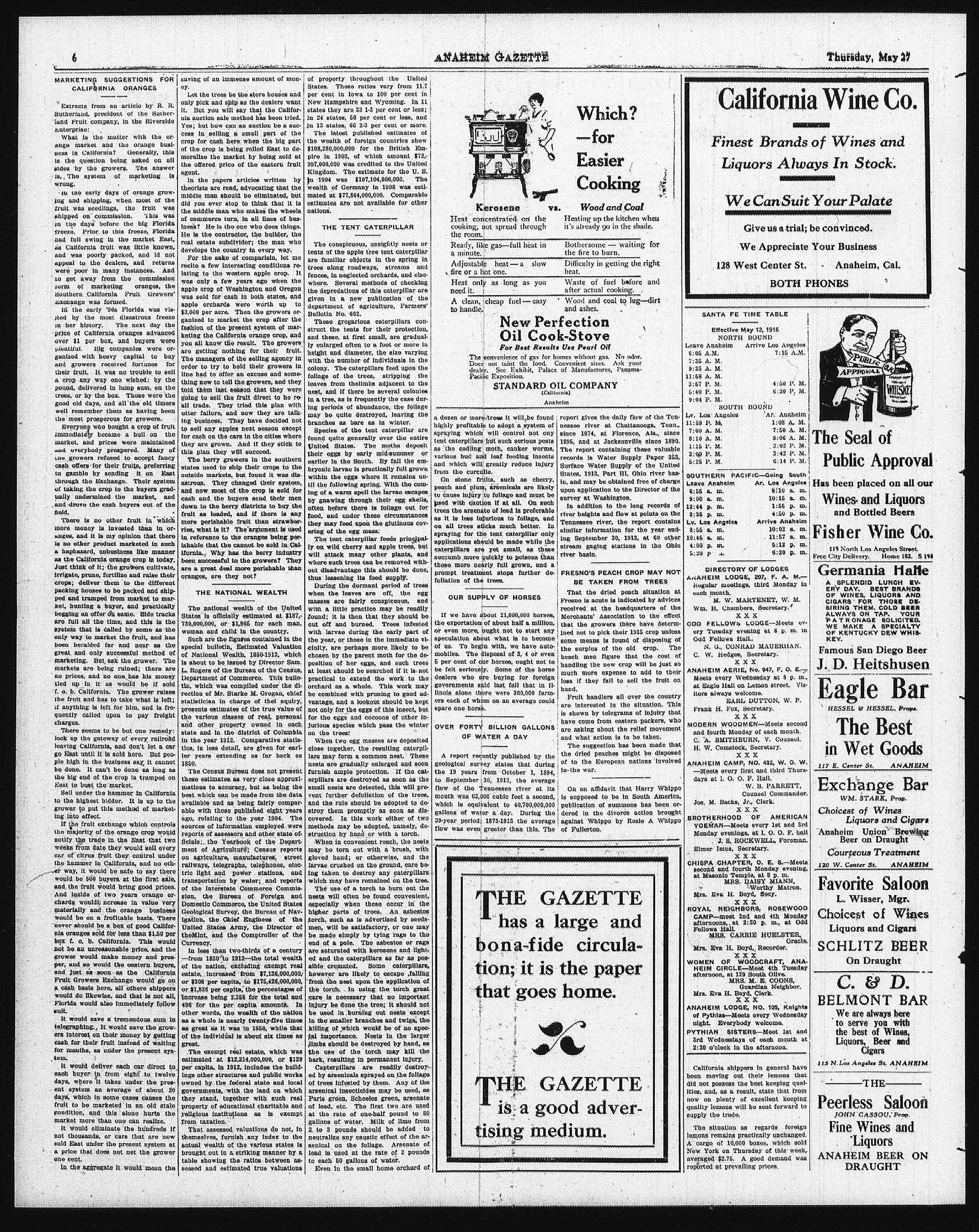
Searchable text
MARKETING SUGGESTIONS FOR CALIFORNIA ORANGES
Extracts from an article by R. R. Sutherland, president of the Sutherland Fruit company, in the Riverside Enterprise:
What is the matter with the orange market and the orange business in California? Generally, this is the question being asked on all sides by the growers. The answer is, The system of marketing is wrong.
In the early days of orange growing and shipping, when most of the fruit was seedlings, the fruit was shipped on commission. This was in the days before the big Florida freeze. Prior to this freeze, Florida had full swing in the market East, as California fruit was little known, and was poorly packed, and did not appeal to the dealers, and returns were poor in many instances. And to get away from the commission form of marketing oranges, the Southern California Fruit Growers' Exchange was formed.
In the early '90s Florida was visited by the most disastrous freeze in her history. The next day the price of California oranges advanced over $1 per box, and buyers were plentiful. Big companies were organized with heavy capital to buy and growers received fortunes for their fruit. It was no trouble to sell a crop any way one wished: by the pound, delivered in lump sum, on the trees, or by the box. Those were the good old days, and all the old timers well remember them as having been the most prosperous for growers.
Everyone who bought a crop of fruit immediately became a bull on the market, and prices were maintained and everybody prospered. Many of the growers refused to accept fancy saving of an immense amount of money.
Let the trees be the store houses and only pick and ship as the dealers want it. But you will say that the California auction sale method has been tried. Yes; but how can an auction be a success in selling a small part of the crop for cash here when the big part of the crop is being rolled East to demoralize the market by being sold at the offered price of the eastern fruit agent.
In the papers articles written by theorists are read, advocating that the middle man should be eliminated, but did you ever stop to think that it is the middle man who makes the wheels of commerce turn, in all lines of business? He is the one who does things. He is the contractor, the builder, the real estate subdivider; the man who develops the country in every way.
For the sake of comparison, let me recite a few interesting conditions relating to the western apple crop. It was only a few years ago when the apple crop of Washington and Oregon was sold for cash in both states, and apple orchards were worth up to $3,000 per acre. Then the growers organized to market the crop after the fashion of the present system of marketing the California orange crop, and you all know the result. The growers are getting nothing for their fruit. The managers of the selling agency in order to try to hold their growers in line had to offer an excuse and something new to tell the growers, and they told them last season that they were going to sell the fruit direct to he real trade. They tried this plan with utter failure, and now they are talking business. They have decided not to sell any apples next season except for cash on the cars in the cities where they are grown. And if they stick to this plan they will succeed.
The conspicuous tents of the apple trees along roadwides, in neglected where. Several mills depreciated owing given in a new department of agriculture Bulletin No. 662.
These gregarious structures the tents for these at firstly enlarged often with height and diameter with the number of colony. The caterpillar foliage of the tree leaves fromthe nest, and if there is a tree, as is freezing periods of abu may be quite deser branches as bare.
Species of the found quite genera United States. Their eggs by ear
and growers received fortunes for their fruit. It was no trouble to sell a crop any way one wished: by the pound, delivered in lump sum, on the trees, or by the box. Those were the good old days, and all the old timers well remember them as having been the most prosperous for growers.
Everyone who bought a crop of fruit immediately became a bull on the market, and prices were maintained and everybody prospered. Many of the growers refused to accept fancy cash offers for their fruits, preferring to gamble by sending it on East through the Exchange. Their system of taking the crop to the buyers gradually undermined the market, and drove the cash buyers out of the field.
There is no other fruit in which more money is invested than in oranges, and it is my opinion that there is no other product marketed in such a haphazard, unbusiness like manner as the California orange crop is today. Just think of it; the growers cultivate, irrigate, prune, fertilize and raise their crops; deliver them to the different packing houses to be packed and shipped and tramped from market to market, hunting a buyer, and practically begging an offer on same. Side tracks are full all the time, and this is the system that is called by some as the only way to market the fruit, and has been heralded far and near as the great and only successful method of marketing. But ask the grower. The markets are being ruined; there are no prices, and no one has his money tied up in it as would be if sold f. o. b. California. The grower raises the fruit and has to take what is left; if anything is left for him, and is frequently called upon to pay freight charges.
There seems to be but one remedy: lock up the gateway of every railroad leaving California, and don't let a car go East until it is sold here. But people high in the business say, it cannot be done. It can't be done as long as the big end of the crop is tramped on East to bust the market.
Sell under the hammer in California to the highest bidder. It is up to the grower to put this method of marketing into effect.
If the fruit exchange which controls the majority of the orange crop would notify the trade in the East that two weeks from date they would sell every car of citrus fruit they control under the hammer in California, and no other way it would be safe to say order to try to hold their growers in line had to offer an excuse and something new to tell the growers, and they told them last season that they were going to sell the fruit direct to he reall trade. They tried this plan with utter failure, and now they are talking business. They have decided not to sell any apples next season except for cash on the cars in the cities where they are grown. And if they stick to this plan they will succeed.
The berry growers in the southern states used to ship their crops to the outside markets, but found it was disastrous. They changed their system, and now most of the crop is sold for cash and the buyers send their men down to the berry districts to buy the fruit as loaded, and if there is any more perishable fruit than strawberries, what is it? The argument is used in reference to the oranges being perishable that the cannot be sold in California. Why has the berry industry been successful to the growers? They are a great deal more perishable than oranges, are they not?
THE NATIONAL WEALTH
The national wealth of the United States is officially estimated at $187,739,000,000, or $1,965 for each man, woman and child in the country.
Such are the figures contained in the special bulletin, Estimated Valuation of National Wealth, 1850-1912, which is about to be issued by Director Sam L. Rogers of the Bureau of the Census, Department of Commerce. This bulletin, which was compiled under the direction of Mr. Starke M. Grogan, chief statistician in charge of their inquiry, presents estimates of the true value of the various classes of real, personal and other property owned in each state and in the district of Columbia in the year 1912. Comparative statistics, in less detail, are given for earlier years extending as far back as 1850.
The Census Bureau does not present these estimates as very close approximations to accuracy, but as being the best which can be made from the data available and as being fairly comparable with those published eight years ago, relating to the year 1904. The sources of information employed were reports of assessors and other state officials; the Yearbook of the Department of Agriculture; Census reports on agriculture, manufactures, street railways, telegraphs, telephones, elec-
the big end of the crop is tramped on East to bust the market.
Sell under the hammer in California to the highest bidder. It is up to the grower to put this method of marketing into effect.
If the fruit exchange which controls the majority of the orange crop would notify the trade in the East that two weeks from date they would sell every car of citrus fruit they control under the hammer in California, and no other way, it would be safe to say there would be 500 buyers at the first sale, and the fruit would bring good prices. And inside of two years orange orchards would increase in value very materially and the orange business would be on a profitable basis. There never should be a box of good California oranges sold for less than $1.50 per box f. o. b. California. This would not be an unreasonable price, and the grower would make money and prosper, and so would the eastern buyers, and just as soon as the California Fruit Growers Exchange would go on a cash basis here, all other shippers would do likewise, and that is not all, Florida would also immediately follow suit.
It would save a tremendous sum in telegraphing. It would save the growers interest on their money by getting cash for their fruit instead of waiting for months, as under the present system.
It would deliver each car direct to each buyer in from eight to twelve days, where it takes under the present system an average of about 20 days, which in some cases causes the fruit to be marketed in an old stale condition, and this alone hurts the market more than one can realize.
It would eliminate the hundreds if not thousands, or cars that are now sold East under the present system at a price that does not not the grower one cent.
In the aggregate it would mean the
these estimates as very close approximations to accuracy, but as being the best which can be made from the data available and as being fairly comparable with those published eight years ago, relating to the year 1904. The sources of information employed were reports of assessors and other state officials; the Yearbook of the Department of Agriculture; Census reports on agriculture, manufactures, street railways, telegraphs, telephones, electric light and power stations, and transportation by water; and reports of the Interstate Commerce Commission, the Bureau of Foreign and Domestic Commerce, the United States Geological Survey, the Bureau of Navigation, the Chief Enginees of the United States Army, the Director of the Mint, and the Comptroller of the Currency.
In less than two-thirds of a century—from 1850 to 1912—the total wealth of the nation, excluding exempt real estate, increased from $7,136,000,000, or $308 per capita, to $175,426,000,000, or $1,836 per capita, the percentages of increase being 2.358 for the total and 496 for the per capita amounts. In other words, the wealth of the nation as a whole is nearly twenty-five times as great as it was in 1850, while that of the individual is about six times as great.
The exempt real estate, which was estimated at $12,314,000,000, or $129 per capita, in 1912 includes the buildings other structures and public works owned by the federal state and local governments, with the land on which they stand, together with such real property of educational charitable and religious institutions as is exempt from taxation.
That assessed valuations do not, in themselves, furnish any index to the actual wealth of the various states is brought out in a striking manner by a table showing the ratios between assessed and estimated true valuations
When in convention may be torn out or gloved hand; or larvae crushed on ing taken to destitute which may have relied on use of a to-nests will often be especially when higher parts of the torch, such as is seen men, will be satisfied be made simply by end of a pole. They are saturated with ed and the caterpillarible cremated. However are likely from the nest upon the torch. In use care is necessary injury be done then be used in burning in the smaller braking of which vital importance. Limbs should be done the use of the bark, resulting in Caplerpillars added by arsenicals spared trees infested by arsenical insecticides Paris green, Scheffler lead, etc. The at the rate of one gallon of water. 2 to 3 pounds sligh neutralize any cause senical on the foil lead is used at this to each 50 gallons Even in the sm
ANAHEIM GAZETTE
of property throughout the United States. These ratios vary from 11.7 per cent in Iowa to 100 per cent in New Hampshire and Wyoming. In 11 states they are 33 1-3 per cent or less; in 24 states, 50 per cent or less, and in 13 states, 66 2-3 per cent or more.
The latest published estimates of the wealth of foreign countries show $108,280,000,000 for the British Empire in 1903, of which amount $72,997,000,000 was credited to the United Kingdom. The estimate for the U.S. in 1904 was $107,104,000,000. The wealth of Germany in 1908 was estimated at $77,864,000,000. Comparable estimates are not available for other nations.
THE TENT CATERPILLAR
The conspicuous, unsightly nests or tents of the apple tree tent caterpillar are familiar objects in the spring in trees along roadways, streams and fences, in neglected orchards, and elsewhere. Several methods of checking the depredations of this caterpillar are given in a new publication of the department of agriculture, Farmers' Bulletin No. 662.
These gregarious caterpillars construct the tents for their protection, and these, at first small, are gradually enlarged often to a foot or more in height and diameter, the size varying with the number of individuals in the colony. The caterpillars feed upon the foliage of the trees, stripping the leaves from the limbs adjacent to the nest, and if there be several colonies in a tree, as is frequently the case during periods of abundance, the foliage may be quite destroyed, leaving the branches as bare as in winter.
Species of the tent caterpillar are found quite generally over the entire United States. The moths deposit their eggs by early mid-summer or report gives the daily flow of the Tennessee river at Chattanooga, Tenn., since 1874, at Florence, Ala., since 1895, and at Jacksonville since 1890. The report containing these valuable records is Water Supply Paper 353.
Which?
—for Easier Cooking
Kerosene vs. Wood and Coal
Heat concentrated on the cooking, not spread through the room.
Ready, like gas—full heat in a minute.
Bothersome — waiting for the fire to burn.
Adjustable heat—a slow fire or a hot one.
Difficulty in getting the right heat.
Heat only as long as you need it.
Waste of fuel before and after actual cooking.
A clean, cheap fuel—easy to handle.
Wood and coal to lug—dirt and ashes.
New Perfection Oil Cook-Stove
For Best Results Use Pearl Oil
The convenience of gas for homes without gas. No odor. Does not taint the food. Convenient sizes. Ask your dealer. See Exhibit, Palace of Manufactures, Panama-Pacific Exposition.
STANDARD OIL COMPANY
(California)
Anahlm
The caterpillars feed upon the foliage of the trees, stripping the leaves from the limbs adjacent to the nest, and if there be several colonies in a tree, as is frequently the case during periods of abundance, the foliage may be quite destroyed, leaving the branches as bare as in winter.
Species of the tent caterpillar are found quite generally over the entire United States. The moths deposit their eggs by early mid-summer or earlier in the South. By fall the embryonic larvae is practically full grown within the eggs where it remains until the following spring. With the coming of a warm spell the larvae escapes by gnawing through their egg shells, often before there is foliage out for food, and under these circumstances they may feed upon the glutinous covering of the egg mass:
The tent caterpillar feeds principally on wild cherry and apple trees, but will attack many other plants, and where such trees can be removed without disadvantage this should be done, thus lessening its food supply.
During the dormant period of trees when the leaves are off, the egg masses are fairly conspicuous, and with a little practice may be readily found; it is then that they should be cut off and burned. Trees infested with larvae during the early part of the year, or those in the immediate vicinity, are perhaps more likely to be chosen by the parent moth for the deposition of her eggs, and such trees at least should be searched if it is not practical to extend the work to the orchard as a whole. This work may be combined with pruning to good advantage, and a lookout should be kept not only for the eggs of this insect, but for the eggs and cocoons of other injurious species which pass the winter on the trees:
When two egg masses are deposited close together, the resulting caterpillars may form a common nest. These nests are gradually enlarged and soon furnish ample protection. If the caterpillars are destroyed as soon as the small nests are detected, this will prevent further defoliation of the trees, and the rule should be adopted to destroy them promptly as soon as discovered. In this work either of two methods may be adopted, namely, destruction by hand or with a torch.
When in convenient reach, the nests may be torn out with a brush, with gloved hand; or otherwise, and the larvae crushed on the ground, care be-
a dozen or more trees it will be found highly profitable to adopt a system of spraying which will control not only tent caterpillars but such serious pests as the codling moth, canker worms, various bud and leaf feeding insects and which will greatly reduce injury from the curculio.
On stone fruits, such as cherry, peach and plum, arsenicals are likely to cause injury to foliage and must be used with caution if at all. On such trees the arsenate of lead is preferable as it is less injurious to foliage, and on all trees sticks much better. In spraying for the tent caterpillar only applications should be made while the caterpillars are yet small, as these succumb more quickly to poisons than those more nearly full grown, and a prompt treatment stops further defoliation of the trees.
OUR SUPPLY OF HORSES
If we have about 21,000,000 horses, the exportation of about half a million, or even more, ought not to start any speculation about what is to become of us. To begin with, we have automobiles. The disposal of 3,4 or even 5 per cent of our horses, ought not to be felt seriously. Some of the horse dealers who are buying for foreign governments said last fall that in Illinois alone there were 300,000 farmers each of whom on an average could spare one horse.
OVER FORTY BILLION GALLONS OF WATER A DAY
A report recently published by the geological survey states that during the 19 years from October 1, 1894, to September 30, 1913, the average flow of the Tennessee river at its mouth was 63,000 cubic feet a second, which is equivalent to 40,700,000 gallons of water a day. During the 39-year period, 1875-1913 the average flow was even greater than this. The report gives the daily flow of the Tennessee river at Chattanooga, Tennessee since 1874, at Florence, Ala., since 1895, and at Jacksonville since 1890. The report containing these valuable records is Water Supply Paper 353, Surface Water Supply of the United States, 1913, Part III, Ohio river basin, and may be obtained free of charge upon application to the Director of the survey at Washington.
In addition to the long records of river heights and flow at points on the Tennessee river, the report contains similar information for the year ending September 30, 1913, at 60 other stream gaging stations in the Ohio river basin.
FRESNO'S PEACH CROP MAY NOT BE TAKEN FROM TREES
That the dried peach situation at Fresno is acute is indicated by advices received at the headquarters of the Merohants' Association to the effect that the growers there have determined not to pick their 1915 crop unless some means is found of disposing of the surplus of the old crop. The beach men figure that the cost of handling the new crop will be just so much more expense to add to their loss if they fail to sell the fruit on hand.
Fruit handlers all over the country are interested in the situation. This is shown by telegrams of injury that have come from eastern packers, who are asking about the relief movement and what action is to be taken.
The suggestion has been made that the dried peaches might be disposed of to the European nations involved in-the war.
On an affidavit that Harry Whippo is supposed to be in South America, publication of summons has been ordered in the divorce action brought against Whippo by Rosie A Whippo of Fullerton.
THE GAZETTE has a large and bona-fide circulation; it is the paper that goes home.
THE GAZETTE is a good advertising medium.
California Wine Co.
Finest Brands of Wines and
Liquors Always In Stock.
We CanSuit Your Palate
Give us a trial; be convinced.
We Appreciate Your Business
128 West Center St. Anaheim, Cal.
BOTH PHONES
SANTA FE TIME TABLE
Effective May 12, 1915
NORTH BOUND
Leave Anaheim Arrive Los Angeles
6:05 A.M. 7:15 A.M.
7:35 A.M.
9:35 A.M.
11:58 A.M.
3:57 P.M. 4:50 P.M.
5:40 P.M. 6:30 P.M.
9:04 P.M.
SOUTH BOUND
Lv. Los Angeles Ar. Anaheim
11:59 P.M. 1:08 A.M.
7:00 A.M. 7:50 A.M.
8:10 A.M. 9:06 A.M.
1:15 P.M. 2:02 P.M.
3:00 P.M. 3:42 P.M.
The Seal of Public Approval
The Seal of Public Approval
Has been placed on all our Wines and Liquors and Bottled Beers
Fisher Wine Co.
119 North Los Angeles Street. Free City Delivery. Home 182. S 198
DIRECTORY OF LODGES
ANAHEIM LODGE, 207, F. A. M.—Regular meetings, third Monday in each month.
M. W. MARTENET, W. M.
Wm. H. Chambers, Secretary.
XX X
ODD FELLOWS LODGE—Meets every Tuesday evening at 8 p.m. in Odd Fellows Hall.
N. G., CONRAD MAUERHAN.
C. W. Hedges, Secretary.
XX X
ANAHEIM AERIE, No. 947, F. O. E.—Meets every Wednesday at 8 p.m., at Eagle Hall on Lemon street. Visitors always welcome.
EARL DUTTON, W. P.
Frank H. Fox, Secretary.
XX X
MODERN WOODMEN—Meets second and fourth Monday of each month.
C. A. SMITHBURN, V. Counsel.
H. W. Comstock, Secretary.
XX X
ANAHEIM CAMP, NO. 432, W. O. W.—Meets every first and third Thursdays at I. O. O. F. Hall.
W. B. PARRETT,
Counsel Commander.
Jos. M. Backs, Jr., Clerk.
XX X
BROTHERHOOD OF AMERICAN YOEMAN—Meets every 1st and 3rd Monday evenings, at I. O. O. F. hall
J. S. ROCKWELL, Foreman.
Elmer Imus, Secretary.
XX X
CHISPA CHAPTER, O. E. S.—Meets second and fourth Monday evening,
APPROVAL
WHISKY
The Seal of Public Approval
Has been placed on all our Wines and Liquors and Bottled Beers
Fisher Wine Co.
119 North Los Angeles Street. Free City Delivery. Home 182. S 198
Germania Hahe
A SPLENDID LUNCH EVERY DAY. BEST BRANDS OF WINES, LIQUORS AND CIGARS FOR THOSE DESIRED THEM. COLD BEER ALWAYS ON TAP. YOUR PATRONAGE SOLICITED WE MAKE A SPECIALTY OF KENTUCKY DEW WHISKEY.
Famous San Diego Beer
J. D. Heitshusen
Eagle Bar
HESSEL & HESSEL, Props.
The Best in Wet Goods
117 E. Center St. ANAHEIM
Exchange Bar
WM. STARK, Prop.
Choicest of Wines
Liquors and Cigars
Anaheim Union Brewing Beer on Draught
Courteous Treatment
120 W. Center St. ANAHEIM
California shippers in general have been moving out their lemons that did not possess the best keeping qualities, and, as a result, state that from now on plenty of excellent keeping quality lemons will be sent forward to supply the trade.
The situation as regards foreign lemons remains practically unchanged. A cargo of 10,000 boxes, which sold New York on Thursday of this week, averaged $2.75. A good demand was reported at prevailing prices.