anaheim-gazette 1915-05-20
Scanned page
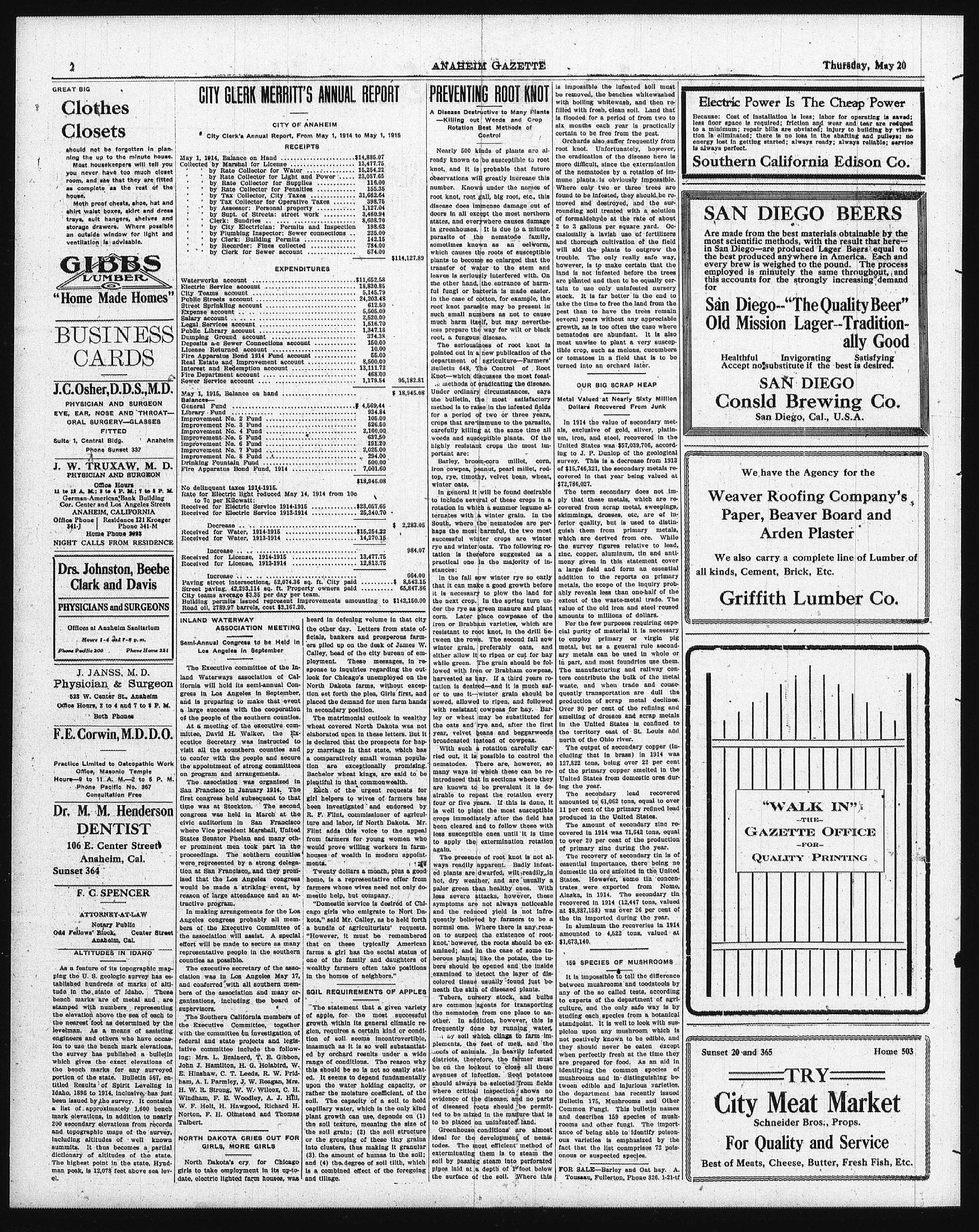
Searchable text
GREAT BIG
Clothes
Closets
should not be forgotten in planning the up to the minute house.
Most housekeepers will tell you you never have too much closet room, and see that they are fitted as complete as the rest of the house.
Moth proof chests, shoe, hat and shirt waist boxes, skirt and dress trays, suit hangers, shelves and storage drawers. Where possible an outside window for light and ventilation is advisable.
GIBBS LUMBER
"Home Made Homes"
BUSINESS CARDS
J.C.Osher,D.D.S.,M.D.
PHYSICIAN AND SURGEON
EYE, EAR, NOSE AND THROAT—ORAL SURGERY—GLASSES FITTED
Suite 1, Central Bldg. Anaheim
Phone Sunset 337
CITY GLERK MERRITT'S ANNUAL F
CITY OF ANAHEIM
City Clerk's Annual Report, From May 1, 1914 to
RECEIPTS
May 1, 1914, Balance on Hand ... $14
Collected by Marshal for License ... 13
by Rate Collector for Water ... 15
by Rate Collector for Light and Power ... 23
by Rate Collector for Supplies ... 26
by Rate Collector for Penalties ... 28
by Tax Collector, City Taxes ... 31
by Tax Collector for Operative Taxes ... 32
by Assessor: Personal property ... 1
by Supt. of Streets: street work ... 3
Clerk: Sundries ... 8
by City Electrician: Permits and Inspection
by Plumbing Inspector: Sewer connections ...
by Clerk: Building Permits ...
by Recorder: Fines collected ...
by Clerk for Sewer account ...
EXPENDITURES
Waterworks account ... $11
Electric Service account ... 18
City Teams account ... 5
Public Streets account ... 24
Street Sprinkling account ... 5
Expense account ... 5
Salary account ... 2
Legal Services account ... 1
Public Library account ... 1
Dumping Ground account ... 1
Deposits a-c Sewer Connections account ... 1
License Returned account ... 1
Fire Apparatus Bond 1914 Fund account ... 8
Real Estate and Improvement account ... 8
Interest and Redemption account ... 13
Fire Department account ... 1
Sewer Service account ... 1
May 1, 1915, Balance on hand
Balances—
General Fund ... 4
Library Fund ... 4
Improvement No. 2 Fund ... 4
Improvement No. 3 Fund ... 4
Improvement No. 4 Fund ... 2
Improvement No. 5 Fund ... 2
Improvement No. 6 Fund ... 2
Improvement No. 7 Fund ... 2
Improvement No. 8 Fund ... 2
J.C.Osher,D.D.S.,M.D.
PHYSICIAN AND SURGEON
EYE, EAR, NOSE AND THROAT—ORAL SURGERY—GLASSES FITTED
Suite 1, Central Bldg. Anaheim
Phone Sunset 337
J.W. TRUXAW, M.D.
PHYSICIAN AND SURGEON
Office Hours
11 to 12 A.M.; 2 to 4 P.M.; 7 to 8 P.M.
German-American Bank Building
Cor. Center and Los Angeles Streets
ANAHEIM, CALIFORNIA
Office Phone Residence 121 Kroeger
341-J Phone 341-M
Home Phone 2093
NIGHT CALLS FROM RESIDENCE
Drs. Johnston, Beebe Clark and Davis
PHYSICIANS and SURGEON
Offices at Anaheim Sanitarium
Hours 1-4 and 7-8 p.m.
Phone Pacific 200 Phone Home 221
J.JANSS, M.D.
Physician & Surgeon
523 W. Center St., Anaheim
Office Hours, 2 to 4 and 7 to 8 P.M.
Both Phones
F.E.Corwin, M.D.D.O.
Practice Limited to Osteopathic Work
Office, Massonic Temple
Hours—9 to 11 A.M.—2 to 5 P.M.
Phone Pacific No. 367 Consultation Free
Dr. M.M. Henderson DENTIST
106 E. Center Street Anaheim, Cal.
INLAND WATERWAY ASSOCIATION MEETING
Semi-Annual Congress to be Held in Los Angeles in September
The Executive committee of the Inland Waterways association of California will hold its semi-annual Congress in Los Angeles in September, and is preparing to make that event a large success with the cooperation of the people of the southern counties.
At a meeting of the executive committee, David H. Walker, the Executive Secretary was instructed to visit all the southern counties and to confer with the people and secure the appointment of strong committees on program and arrangements.
The association was organized in San Francisco in January 1914. The first congress held subsequent to that time was at Stockton. The second congress was held in March at the civic auditorium in San Francisco where Vice president Marshall, United States Senator Phelan and many other prominent men took part in the proceedings. The southern counties were represented by a strong delegation at San Francisco and they promthed in defending the other day. Officials, bankers and others piled up on the Calley, head of the ployment. These sponsors to inquiries look for Chicago's North Dakota farm set forth the planned demand in secondary position.
The matrimonial wheat covered Northern elaborated upon in is declared that the py marriage in that comparatively srion are except Bachelor wheat kid plantful in that co.
Each of the u girl helpers to wi been investigated R.F.Filint, commu ture and labor, inf Filint adds this v from farmers for would prove willing houses of wealth ments.
Dr. M. M. Henderson
DENTIST
106 E. Center Street
Anaheim, Cal.
Sunset 364
F. C. SPENCER
ATTORNEY-AT-LAW
Notary Public
Odd Fellows' Block, Center Street
Anaheim, Cal.
ALTITUDES IN IDAHO
As a feature of its topographic mapping the U.S. geologic survey has established hundreds of marks of altitude in the state of Idaho. These bench marks are of metal and are stamped with numbers representing the elevation above the sea of each to the nearest foot as determined by the levelman. As a means of assisting engineers and others who have occasion to use the benchmark elevations, the survey has published a bulletin which gives the exact elevations of the bench marks for any surveyed portion of the state. Bulletin 567, entitled Results of Spirit Leveling in Idaho, 1896 to 1914, inclusive, has just been issued by the survey. It contains a list of approximately 1,600 bench mark elevations, in addition to nearly 200 secondary elevations from records and topographic maps of the survey, including altitudes of well known summits. It thus becomes a partial dictionary of altitudes of the state. The highest point in the state, Hyndman peak, is 12,078 feet above sea level.
The association was organized in San Francisco in January 1914. The first congress held subsequent to that time was at Stockton. The second congress was held in March at the civic auditorium in San Francisco where Vice president Marshall, United States Senator Phelan and many other prominent men took part in the proceedings. The southern counties were represented by a strong delegation at San Francisco, and they promised that the Los Angeles congress would be made a striking event, by reason of large attendance and an attractive program.
In making arrangements for the Los Angeles congress probably all members of the Executive Committee of the association will assist. A special effort will be made to secure as many representative people in the southern counties as possible.
The executive secretary of the association was in Los Angeles May 17, and conferred with all southern members of the association and many organizations, including the board of supervisors.
The Southern California members of the Executive Committee, together with the committee on investigation of federal and state projects and legislative committee include the following: Mrs. L. Brainerd, T. E. Gibbon, John J. Hamilton, H. G. Holabird, W. E. Hinshaw, C. T. Leeds, R. W. Pridham, A. I. Parmley, J. W. Reagan, Mrs. H. W. R. Strong, W. W. Wilcox, C. H. Windham, F. E. Woodley, A. J. Hill, W. F. Holt, H. Hawgood, Richard H. Norton, F. H. Olmstead and Thomas Talbert.
NORTH DAKOTA CRIES OUT FOR GIRLS, MORE GIRLS
North Dakota's cry for Chicago girls to take employment in its up-to-date, electric lighted farm houses, was
MITT'S ANNUAL REPORT
Y OF ANAHEIM
Port, From May 1, 1914 to May 1, 1915
RECEIPTS
$14,885.07
13,477.75
15,254.22
23,057.65
116.00
155.35
31,662.64
398.75
1,127.04
3,460.94
8,608.70
198.63
225.00
142.15
784.00
574.00
$114,127.89
PENDITURES
$11,652.58
18,830.85
5,145.79
24,203.48
612.50
5,505.09
2,520.00
1,516.70
1,347.18
374.38
150.00
10.00
55.00
8,500.00
13,111.72
468.00
1,179.54
95,182.81
$18,945.08
PREVENTING ROOT KNOT
A Disease Destructive to Many Plants —Killing out Weeds and Crop Rotation Best Methods of Control
Nearly 500 kinds of plants are already known to be susceptible to root knot, and it is probable that future observations will greatly increase this number. Known under the names of root knot, root gall, big root, etc., this disease does immense damage out of doors in all except the most northern states, and everywhere causes damage in greenhouses. It is due to a minute parasite of the nematode family, sometimes known as an eelworm, which causes the roots of susceptible plants to become so enlarged that the transfer of water to the stem and leaves is seriously interfered with. On the other hand, the entrance of harmful fungi or bacteria is made easier in the case of cotton, for example, the root knot parasite may be present in such small numbers as not to cause much harm itself, but may nevertheless prepare the way for wilt or black root, a fungous disease.
The seriousness of root knot is pointed out in a new publication of the department of agriculture—Farmers' Bulletin 648, The Control of Root Knot—which discusses the most feasible methods of eradicating the disease. Under ordinary circumstances, says the bulletin, the most satisfactory method is to raise in the infested fields for a period of two or three years, crops that are immune to the parasite, carefully killing at the same time all weeds and susceptible plants. Of the highly resistant crops the most important are:
is impossible the infested soil must be removed, the benches whitewashed with boiling whitewash, and then re-filled with fresh, clean soil. Land that is flooded for a period of from two to six months each year is practically certain to be free from the pest.
Orchards also suffer frequently from root knot. Unfortunately, however, the eradication of the disease here is more difficult, since the extermination of the nematodes by a rotation of immune plants is obviously impossible. Where only two or three trees are found to be infested, they should be removed and destroyed, and the surrounding soil treated with a solution of formaldehyde at the rate of about 2 to 3 gallons per square yard. Occasionally a lavish use of fertilizers and thorough cultivation of the field will aid the plants to outgrow the trouble. The only really safe way, however, is to make certain that the land is not infested before the trees are planted and then to be equally certain to use only uninfested nursery stock. It is far better in the end to take the time to free the land from the pest than to have the trees remain several years without any appreciable growth, as is too often the case where nematodes are abundant. It is also most unwise to plant a very susceptible crop, such as melons, cucumbers or tomatoes in a field that is to be turned into an orchard later.
OUR BIG SCRAP HEAP
Metal Valued at Nearly Sixty Million Dollars Recovered From Junk
In 1914 the value of secondary metals, exclusive of gold, silver, platinum, iron, and steel, recovered in the United States was $57,039,706, according to J. P. Dunlop of the geological
heard in defening volume in that city the other day. Letters from state officials, bankers and prosperous farmers piled up on the deck of James W. Calley, head of the city bureau of employment. These messages, in response to inquiries regarding the outlook for Chicago's unemployed on the North Dakota farms, without exception set forth the plea, Girls first, and placed the demand for men farm hands in secondary position.
The matrimonial outlook in wealthy wheat covered North Dakota was not elaborated upon in these letters. But it is declared that the prospects for happy marriage in that state, which has a comparatively small woman population are exceptionally promising. Bachelor wheat kings, are said to be plentiful in that commonwealth.
Each of the urgent requests for girl helpers to wives of farmers has been investigated and endorsed by R. F. Flint, commissioner of agriculture and labor, in North Dakota. Mr. Flint adds this voice to the appeal from farmers for young women who would prove willing workers in farmhouses of wealth in modern appointments.
Department of Agriculture Farmers Bulletin 648, The Control of Root Knot—which discusses the most feasible methods of eradicating the disease. Under ordinary circumstances, says the bulletin, the most satisfactory method is to raise in the infested fields for a period of two or three years, crops that are immune to the parasite, carefully killing at the same time all weeds and susceptible plants. Of the highly resistant crops the most important are:
Barley, broom-corn millet, corn, Iron cowpea, peanut, pearl millet, redtop, rye, timothy, velvet bean, wheat, winter oats.
In general it will be found desirable to include several of these crops in a rotation in which a summer legume alternates with a winter grain. In the South, where the nematodes are perhaps the most harmful, the two most successful winter crops are winter rye and winter oats. The following rotation is therefore suggested as a practical one in the majority of instances:
In the fall sow winter rye so early that it can make a good growth before it is necessary to plow the land for the next crop. In the spring turn under the rye as green manure and plant corn. Later place cowpeas of the iron or Brabham varieties, which are resistant to root knot, in the drill between the rows. The second fall sow winter grain, preferably oats, and either allow it to ripen or cut for hay while green. The grain should be followed with Iron or Brabham cowpeas, harvested as hay. If a third year rotation is desired—and it is much safer to use it—winter grain should be sowed, allowed to ripen, and followed with resistant cowpeas for hay. Barley or wheat may be substituted for the oats and rye, and, after the first year, velvet beans and beggarweeds broadcast instead of cowpeas.
With such a rotation carefully carried out, it is possible to control the nematodes. There are, however, so many ways in which these can be introduced that in sections where they are known to be prevalent it is desirable to repeat the rotation every four or five years. If this is done, it is well to plant the most susceptible crops immediately after the field has been cleared and to follow these with less susceptible ones until it is time to apply the extermination rotation again.
The presence of root knot is not always readily apparent. Badly infested into an orchard later.
OUR BIG SCRAP HEAP
Metal Valued at Nearly Sixty Million Dollars Recovered From Junk
In 1914 the value of secondary metals, exclusive of gold, silver, platinum, iron, and steel, recovered in the United States was $57,039,706, according to J. P. Dunlop of the geological survey. This is a decrease from 1913 of $15,746,321, the secondary metals recovered in that year being valued at $72,786,027.
The term secondary does not imply that these metals, which are recovered from scrap metal, sweepings, skimmings, drosses, etc., are of inferior quality, but is used to distinguish them from primary metals, which are derived from ore. While the survey figures relative to lead, zinc, copper, aluminum, tin and antimony given in this statement cover a large field and form an essential addition to the reports on primary metals, the scope of the inquiry probably reveals less than one-half of the extent of the waste-metal trade. The value of the old iron and steel reused amounts to millions of dollars.
For the few purposes requiring especial purity of material it is necessary to employ primary or virgin pig metal, but as a general rule secondary metals can be used in whole or in part, and most foundries use them. The manufacturing and railway centers contribute the bulk of the metal waste, and when trade and consequently transportation are dull the production of scrap metal declines. Over 90 per cent of the refining and smelting of drosses and scrap metals in the United States is confined to the territory east of St. Louis and north of the Ohio river.
The output of secondary copper (including that in brass) in 1914 was 127,822 tons, being over 22 per cent of the primary copper smelted in the United States from domestic ores during the year.
The secondary lead recovered amounted to 61,062 tons, equal to over 11 per cent of the primary refined lead produced in the United States.
The amount of secondary zinc recovered in 1914 was 71,642 tons, equal to over 20 per cent of the production of primary zinc during the year.
The recovery of secondary tin is of essential importance; there being no doubt that it is an important resource for industrial applications.
Bachelor wheat kings, are said to be plentiful in that commonwealth.
Each of the urgent requests for girl helpers to wives of farmers has been investigated and endorsed by R. F. Flint, commissioner of agriculture and labor, if North Dakota. Mr. Flint adds this voice to the appeal from farmers for young women who would prove willing workers in farmhouses of wealth in modern appointments.
Twenty dollars a month, plus a good home, is a representative offer from farmers whose wives need not only domestic help, but company.
"Domestic service is desired of Chicago girls who emigrate to Nort Dakota," said Mr. Calley, as he held forth a bundle of agriculturists' requests. "However, it must be remembered that on these typically American farms a girl has the social status of one of the family and daughters of wealthy farmers often take positions in the homes of neighbors."
SOIL REQUIREMENTS OF APPLES
The statement that a given variety of apple, for the most successful growth within its general climatic region, requires a certain kind or condition of soil seems incontrovertible, inasmuch as it is so well substantiated by orchard results under a wide range of conditions. The reason why this should be so is not so easily stated. It seems to depend fundamentally upon the water holding capacity, or rather the moisture coefficient, of the soil. The capacity of a soil to hold capillary water, which is the only kind plant growth can use, depends on (1) the soil texture, meaning the size of the soil grain; (2) the soil structure or the grouping of these tiny grains into clusters, thus making it granular (3). the amount of humas in the soil; and (4) the degree of soil tilth, which is a combined effect of the foregoing and tillage.
Tubers, nursery stock, and bulbs are common agents for transporting the nematodes from one place to another. In addition, however, this is frequently done by running water by soil which clings to farm implements, the feet of men, and the roots of animals. In heavily infested districts, therefore, the farmer must be on the lookout to close all these avenues of infection. Seed potatoes should always be selected from fields where critical inspection shows no evidence of the disease, and no parts of diseased roots should be permitted to be mixed in the manure that is to be placed on uninfested land.
Greenhouse conditions are almost ideal for the development of nematodes. The most efficient method of exterminating them is to steam the soil by passing steam into perforated pipes laid at a depth of 1 foot below the surface of the soil. Where this introduced that in sections where they are known to be prevalent it is desirable to repeat the rotation every four or five years. If this is done, it is well to plant the most susceptible crops immediately after the field has been cleared and to follow these with less susceptible ones until it is time to apply the extermination rotation again.
The presence of root knot is not always readily apparent. Badly infested plants are dwarfed, wilt readily in hot, dry weather, and are usually a paler green than healthy ones. With less severe attacks, however, these symptoms are not always noticeable and the reduced yield is not infrequently believed by farmers to be a normal one. Where there is any reason to suspect the existence of root knot, however, the roots should be examined; and in the case of some tuberous plants, like the potato, the tubers should be opened and the inside examined to detect the layer of discolored tissue usually found just beneath the skin of diseased plants.
Tubers, nursery stock, and bulbs are common agents for transporting the nematodes from one place to another. In addition, however, this is frequently done by running water by soil which clings to farm implements, the feet of men, and the roots of animals. In heavily infested districts, therefore, the farmer must be on the lookout to close all these avenues of infection. Seed potatoes should always be selected from fields where critical inspection shows no evidence of the disease, and no parts of diseased roots should be permitted to be mixed in the manure that is to be placed on uninfested land.
Greenhouse conditions are almost ideal for the development of nematodes. The most efficient method of exterminating them is to steam the soil by passing steam into perforated pipes laid at a depth of 1 foot below the surface of the soil. Where this introduced that in sections where they are known to be prevalent it is desirable to repeat the rotation every four or five years. If this is done, it is well to plant the most susceptible crops immediately after the field has been cleared and to follow these with less susceptible ones until it is time to apply the extermination rotation again.
The presence of root knot is not always readily apparent. Badly infested plants are dwarfed, wilt readily in hot, dry weather, and are usually a paler green than healthy ones. With less severe attacks, however, these symptoms are not always noticeable and the reduced yield is not infrequently believed by farmers to be a normal one. Where there is any reason to suspect the existence of root knot, however, the roots should be examined; and in the case of some tuberous plants, like the potato, the tubers should be opened and the inside examined to detect the layer of discolored tissue usually found just beneath the skin of diseased plants.
Tubers, nursery stock, and bulbs are common agents for transporting the nematodes from one place to another. In addition, however, this is frequently done by running water by soil which clings to farm implements, the feet of men, and the roots of animals. In heavily infested districts, therefore, the farmer must be on the lookout to close all these avenues of infection. Seed potatoes should always be selected from fields where critical inspection shows no evidence of the disease, and no parts of diseased roots should be permitted to be mixed in the manure that is to be placed on uninfested land.
Greenhouse conditions are almost ideal for the development of nematodes. The most efficient method of exterminating them is to steam the soil by passing steam into perforated pipes laid at a depth of 1 foot below the surface of the soil. Where this introduced that in sections where they are known to be prevalent it is desirable to repeat the rotation every four or five years. If this is done, it is well to plant the most susceptible crops immediately after the field has been cleared and to follow these with less susceptible ones until it is time to apply the extermination rotation again.
The presence of root knot is not always readily apparent. Badly infested plants are dwarfed, wilt readily in hot, dry weather, and are usually a paler green than healthy ones. With less severe attacks, however, these symptoms are not always noticeable and the reduced yield is not infrequently believed by farmers to be a normal one. Where there is any reason to suspect the existence of root knot, however, the roots should be examined; and in the case of some tuberous plants, like the potato, the tubers should be opened and the inside examined to detect the layer of discolored tissue usually found just beneath the skin of diseased plants.
Tubers, nursery stock, and bulbs are common agents for transporting the nematodes from one place to another. In addition, however, this is frequently done by running water by soil which clings to farm implements, the feet of men, and the roots of animals. In heavily infested districts, therefore, the farmer must be on the lookout to close all these avenues of infection. Seed potatoes should always be selected from fields where critical inspection shows no evidence of the disease, and no parts of diseased roots should be permitted to be mixed in the manure that is to be placed on uninfested land.
Greenhouse conditions are almost ideal for the development of nematodes. The most efficient method of exterminating them is to steam the soil by passing steam into perforated pipes laid at a depth of 1 foot below the surface of the soil. Where this introduced that in sections where they are known to be prevalent it is desirable to repeat the rotation every four or five years. If this is done, it is well to plant the most susceptible crops immediately after the field has been cleared and to follow these with less susceptible ones until it is time to apply the extermination rotation again.
The presence of root knot is not always readily apparent. Badly infested plants are dwarfed, wilt readily in hot, dry weather, and are usually a paler green than healthy ones. With less severe attacks, however, these symptoms are not always noticeable and the reduced yield is not infrequently believed by farmers to be a normal one. Where there is any reason to suspect the existence of root knot, however, the roots should be examined; and in the case of some tuberous plants, like the potato, the tubers should be opened and the inside examined to detect the layer of discolored tissue usually found just beneath the skin of diseased plants.
Tubers, nursery stock, and bulbs are common agents for transporting the nematodes from one place to another. In addition, however, this is frequently done by running water by soil which clings to farm implements, the feet of men, and the roots of animals. In heavily infested districts, therefore, the farmer must be on the lookout to close all these avenues of infection. Seed potatoes should always be selected from fields where critical inspection shows no evidence of the disease, and no parts of diseased roots should be permitted to be mixed in the manure that is to be placed on uninfested land.
Greenhouse conditions are almost ideal for the development of nematodes. The most efficient method of exterminating them is to steam the soil by passing steam into perforated pipes laid at a depth of 1 foot below the surface of the soil. Where this introduced that in sections where they are known to be prevalent it is desirable to repeat the rotation every four or five years. If this is done, it is well to plant the most susceptible crops immediately after the field has been cleared and to follow these with less susceptible ones until it is time to apply the extermination rotation again.
The presence of root knot is not always readily apparent. Badly infested plants are dwarfed, wilt readily in hot, dry weather, and are usually a paler green than healthy ones. With less severe attacks, however, these symptoms are not always noticeable and the reduced yield is not infrequently believed by farmers to be a normal one. Where there is any reason to suspect the existence of root knot, however, the roots should be examined; and in the case of some tuberous plants like the potato,the tubers should be opened andthe inside examinedto detectthelayerofdiscoloredtissueusuallyfoundjustbeenplacedonuninfestedland.
FOR SALE—Barley and Oat hay. A.
Toussau, Fullerton, Phone 326. 1-21-tl
Thursday, May 20
Electric Power Is The Cheap Power
Because: Cost of installation is less; labor for operating is saved;
less floor space is required; friction and wear and tear are reduced
to a minimum; repair bills are obviated; injury to building by vibration is eliminated; there is no loss in the shafting and pulleys; no
energy lost in getting started; always ready; always reliable; service
is always perfect.
Southern California Edison Co.
SAN DIEGO BEERS
Are made from the best materials obtainable by the
most scientific methods, with the result that here—
in San Diego—are produced Lager Beers equal to
the best produced anywhere in America. Each and
every brew is weighed to the pound. The process
employed is minutely the same throughout, and
this accounts for the strongly increasing demand
for
San Diego--“The Quality Beer”
Old Mission Lager--Traditionally Good
Healthful Invigorating Satisfying
Accept no substitute if the best is desired.
SAN DIEGO
Consld Brewing Co.
San Diego, Cal., U.S.A.
Accept no substitute if the best is desired.
SAN DIEGO
Consld Brewing Co.
San Diego, Cal., U.S.A.
We have the Agency for the
Weaver Roofing Company's
Paper, Beaver Board and
Arden Plaster
We also carry a complete line of Lumber of all kinds, Cement, Brick, Etc.
Griffith Lumber Co.
"WALK IN"
THEGAZETTE OFFICE
FORQUALITY PRINTING
"WALK IN"
THE
GAZETTE OFFICE
FOR
QUALITY PRINTING
Sunset 20 and 365 Home 503
TRY
City Meat Market
Schneider Bros., Props.
For Quality and Service
Best of Meats, Cheese, Butter, Fresh Fish, Etc.