anaheim-gazette 1915-04-15
Scanned page
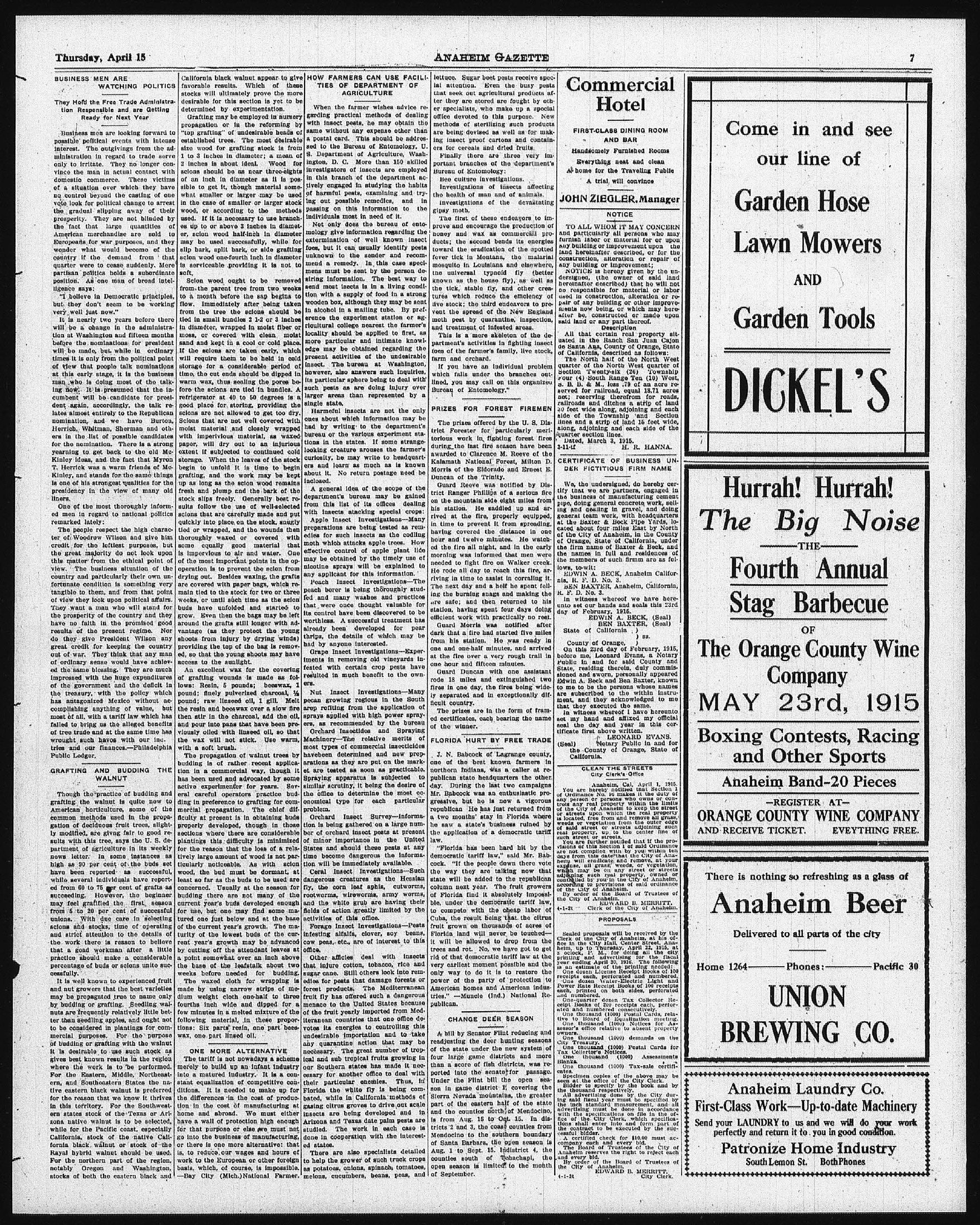
Searchable text
BUSINESS MEN ARE WATCHING POLITICS
They Hofd the Free Trade Administration Responsible and are Getting Ready for Next Year
Business men are looking forward to possible political events with intense interest. The outgivings from the administration in regard to trade serve only to irritate. They no longer convince the man in actual contact with domestic commerce. These victims of a situation over which they have no control beyond the casting of one vote look for political change to arrest the gradual slipping away of their prosperity. They are not blinded by the fact that large quantities of American merchandise are sold to Europeans for war purposes, and they wonder what would become of the country if the demand from that quarter were to cease suddenly. More partisan politics holds a subordinate position. As one man of broad intelligence says:
"I believe in Democratic principles, but they don't seem to be working very well just now."
It is nearly two years before there will be a change in the administration at Washington and fifteen months before the nominations for president will be made, but while in ordinary times it is only from the political point of view that people talk nominations at this early stage, it is the business man who is doing most of the talking now. It is presumed that the incumbent will be candidate for president again, accordingly, the talk relates almost entirely to the Republican nomination, and we have Burton, Herrich, Whitman, Sherman and others in the list of possible candidates for the nomination. There is a strong yearning to get back to the old McCarthy.
California black walnut appear to give favorable results. Which of these stocks will ultimately prove the more desirable for this section is yet to be determined by experimentation.
Grafting may be employed in nursery propagation or in the reforming by "top grafting" of undesirable heads of established trees. The most desirable size wood for grafting stock is from 1 to 3 inches in diameter; a mean of 2 inches is about ideal. Wood for scions should be as near three-eights of an inch in diameter as it is possible to get it, though material somewhat smaller or larger may be used in the case of smaller or larger stock wood, or according to the methods used. If it is necessary to use branches up to or above 3 inches in diameter, scion wood half-inch in diameter may be used successfully, while for slip bark, split bark, or side grafting scion wood one-fourth inch in diameter is serviceable providing it is not to soft.
Scion wood ought to be removed from the parent tree from two weeks to a month before the sap begins to flow. Immediately after being taken from the tree the scions should be tied in small bundles 2 1/2 or 3 inches in diameter, wrapped in moist fiber or moss, or covered with clean moist sand and kept in a cool or cold place. If the scions are taken early, which will require them to be held in cold storage for a considerable period of time, the cut ends should be dipped in warm wax, thus sealing the pores before the scions are tied in bundles. A refrigerator at 40 to 50 degrees is a good place for storing, providing the scions are not allowed to get too dry. Scions that are not well covered with moist material and closely wrapped with impervious material, as waxed paper, will dry out to an injurious extent if subjected to continued cold temperatures.
HOW FARMERS TIES OF DERBY AGRICULTURE
When the farmer gardening practical with insect pests, same without any postal card. This seed to the Bureau S. Department ofington, D. C. Most investigators of insects in this branch of agriculture engaged in of harmful pests, ing out possible passing on this individual most imminent.
Not only does mollogy give information extermination of worms, but it can us use unknown to the mend a remedy. Mens must be sent stiring information. Send most insects into with a supply wooden box, although in alcohol in a malicious cultural college not locality should be more particular and edge may be obtained present activities of insect. The bureau however, also answer its particular sphere such pests as are larger areas than single state.
Harmful insects ones about which I had by writing to bureau or the variegations in the states, looking creature are many.
GRAFTING AND BUDDING THE WALNUT
Though the practice of budding and grafting the walnut is quite new to American horticulture, some of the common methods used in the propagation of deciduous fruit trees, slightly modified, are giving fair to good results with this tree, says the U.S. department of agriculture in its weekly news letter. In some instances as high as 90 per cent of the buds set storage for a considerable period of time, the cut ends should be dipped in warm wax, thus sealing the pores before the scions are tied in bundles. A refrigerator at 40 to 50 degrees is a good place for storing, providing the scions are not allowed to get too dry. Scions that are not well covered with moist material and closely wrapped with impervious material, as waxed paper, will dry out to an injurious extent if subjected to continued cold storage. When the leaves of the stock begin to unfold it is time to begin grafting, and the work may be kept up as long as the scion wood remains fresh and plump and the bark of the stock slips freely. Generally best results follow the use of well-selected scions that are carefully made and put quickly into place on the stock, snugly tied or wrapped, and the wounds then thoroughly waxed or covered with some equally good material that is impervious to air and water. One of the most important points in the operation is to prevent the scion from drying out. Besides waxing, the grafts are covered with paper bags, which remain tied to the stock for two or three weeks, or until such time as the scion buds have unfolded and started to grow. Even then the bags may be left around the grafts still longer with advantage (as they protect the young shoots from injury by drying winds) providing the top of the bag is removed, so that the young shoots may have access to the sunlight.
An excellent wax for the covering of grafting wounds is made as follows: Resin, 5 pounds; beeswax, 1 pound; finely pulverized charcoal, ½ pound; raw linseed oil, 1 gill. Melt the resin and beeswax over a slow fire then stir in the charcoal, add the oil, and pour into pans that have been previously oiled with linseed oil, so that the wax will not stick. Use warm, with a soft brush.
The propagation of walnut trees by budding is of rather recent application in a commercial way, though it has been used and advocated by some active experimenter for years. Several careful operators practice budding in preference to grafting for commercial propagation. The chief difficulty at present is in obtaining buds properly developed, though in those sections where there are considerable plantings this difficulty is minimized for the reason that the loss of a relatively large amount of wood is not particularly noticeable. As with selon insect.
The bureau however, also answers its particular spheres such pests as are larger areas than single state.
Harmful insects ones about which I had by writing to bureau or the variations in the states, looking creature are curiosity, he maywers and learn as me about it. No return included.
A general idea of department's bureau from this list of lists with insects attacks.
Apple Insect preparations are best edies for such insects moth which attacks effective control of may be obtained by nicotine sprays with any applicant for this.
Peach Insect peach borer is being fed and many wasps that were once their control have been worthless. A success already been developed thrips, the details it had by anyone interested.
Grape Insect Investments in removing fested with certain resulted in much busers.
Nut Insect pecan growing regimen roffiting from sprays applied with ers, as recommended.
Orchard Insect Machinery—The reom most types of comm have been determined arations as they are et are tested as so Spraying apparatus similar scrutiny, it is the office to determineonomical type for problem.
Orchard Insect tion is being gathered bar of orchard insects of minor importance States and should t time become danger will be immediate.
Though the practice of budding and grafting the walnut is quite new to American horticulture, some of the common methods used in the propagation of deciduous fruit trees, slightly modified, are giving fair to good results with this tree, says the U.S. department of agriculture in its weekly news letter. In some instances high as 90 per cent of the buds set have been reported as successful, while several individuals have reported from 60 to 75 per cent of grafts as succeeding. However, the beginner may feel grafted the first season from 5 to 20 per cent of successful unions. With due care in selecting acorns and stocks, time of operating and strict attention to the details of the work there is reason to believe that a goad workman after a little practice should make a considerable percentage of buds or acorns unite successfully.
It is well known to experienced fruit and nut growers that the best varieties may be propagated true to name only by budding or grafting. Seedling walnuts are frequently relatively little better than seedling apples, and ought not to be considered in plantings for commercial purposes. For the purpose of budding or grafting with the walnut it is desirable to use such stock as gives best known results in the region where the work is to be performed. For the Eastern, Middle, Northeastern, and Southeastern States the native eastern black walnut is preferred for the reason that we know it thrives in this territory. For the Southwestern states stock of the Texas or Arizona native walnut is to be selected, while for the Pacific coast, especially California, stock of the native California black walnut or stock of the Rayal hybrid walnut should be used. For the northern part of the region, notably Oregon and Washington, stocks of both the eastern black and waxed cloth for wrapping is made by using narrow strips of medium weight cloth one-half to three fourths inch wide and dipped for a few minutes in a melted mixture of the following material, in these proportions: Six parts resin, one part beeswax, one part lined oil.
ONE MORE ALTERNATIVE
The tariff is not nowadays a scheme merely to build up an infant industry into a matured industry. It is a constant equalization of competitive conditions. It is needed to make up for the differences in the cost of production in the cost of manufacturing at home and abroad. We must either have a wall of protection high enough for that purpose or else we must not go into the business of manufacturing, or there is one more alternative: that is, to reduce our wages and hours of work to the European or other foreign basis, which, of course, is impossible.—Bay City (Mich.) National Farmer.
Orchard Insect tion is being gathered bar of orchard insects of minor importance States and should time become danger will be immediate Ceral Insect In dangerous creatures fly, the corn leaf rootworms, wreaths and the white grub fields of action great activities of this order. Forage Insect In infesting alfalfa, cow peas, etc., are officia.
Other afflicts do that injure cotton, sugar cane. Still other edios for pests that forest products. The fruit fly has offered menace to the United of the fruit yearly in literanean countries votes its energies undesirable import any quarantine act necessary. The grecical and sub tropical our Southern states essary for another their particular en Florida the white bated, while in Calgasing citrus groves insects are being o Arizona and Texas o studied. The work done in cooperation ed states.
There are also so to help the grower as potatoes, onions, melons, cucumbers,
HOW FARMERS CAN USE FACILITIES OF DEPARTMENT OF AGRICULTURE
When the farmer wishes advice regarding practical methods of dealing with insect pests, he may obtain the same without any expense other than a postal card. This should be addressed to the Bureau of Entomology, U.S. Department of Agriculture, Washington, D.C. More than 150 skilled investigators of insects are employed in this branch of the department actively engaged in studying the habits of harmful pests, examining and trying out possible remedies, and passing on this information to the individuals most in need of it.
Not only does the bureau of entomology give information regarding the extermination of well known insect pests, but it can usually identify pests unknown to the sender and recommend a remedy. In this case specimens must be sent by the person desiring information. The best way to send most insects is in a living condition with a supply of food in a strong wooden box, although they may be sent in alcohol in a mailing tube. By preference the experiment station or agricultural college nearest the farmer's locality should be applied to first, as more particular and intimate knowledge may be obtained regarding the present activities of the undesirable insect. The bureau at Washington, however, also answers such inquiries, its particular sphere being to deal with such pests as are doing injury over larger areas than represented by a single state.
Harmful insects are not the only ones about which information may be had by writing to the department's bureau or the various experiment stations in the states. If some strange-looking creature arouses the farmer's curiosity, he may write to headquarter Sugar beet pests receive special attention. Even the busy pests that seek out agricultural products after they are stored are fought by other specialists, who make up a special office devoted to this purpose. New methods of sterilizing such products are being devised as well as for making insect proof cartons and containers for cereals and dried fruits.
Finally there are three very important branches of the department's Bureau of Entomology:
Bee culture investigations.
Investigations of insects affecting the health of man and of animals.
Investigations of the devastating gipsy moth.
The first of these endeavors to improve and encourage the production of honey and wax as commercial products; the second bends its energies toward the eradication of the spotted fever tick in Montana, the malarial mosquito in Louisiana and elsewhere, the universal typhoid fly (better known as the house fly), as well as the tick, stable fly, and other creatures which reduce the efficiency of live stock; the third endeavors to prevent the spread of the New England moth pest by quarantine, inspection, and treatment of infested areas.
This is a mere skeleton of the department's activities in fighting insectoes of the farmer's family, live stock, farm and orchard.
If you have an individual problem which falls under the branches outlined, you may call on this organized Bureau of Entomology."
PRIZES FOR FOREST FIREMEN
The prizes offered by the U.S. District Forester for particularly meritorious work in fighting forest fires during the last fire season have been awarded to Clarence M. Reeve of the lettuce. Sugar beet pests receive special attention. Even the busy pests that seek out agricultural products after they are stored are fought by other specialists, who make up a special office devoted to this purpose. New methods of sterilizing such products are being devised as well as for making insect proof cartons and containers for cereals and dried fruits.
Finally there are three very important branches of the department's Bureau of Entomology:
Bee culture investigations.
Investigations of insects affecting the health of man and of animals.
Investigations of the devastating gipsy moth.
The first of these endeavors to improve and encourage the production of honey and wax as commercial products; the second bends its energies toward the eradication of the spotted fever tick in Montana, the malarial mosquito in Louisiana and elsewhere, the universal typhoid fly (better known as the house fly), as well as the tick, stable fly, and other creatures which reduce the efficiency of live stock; the third endeavors to prevent the spread of the New England moth pest by quarantine, inspection, and treatment of infested areas.
This is a mere skeleton of the department's activities in fighting insectoes of the farmer's family, live stock, farm and orchard.
If you have an individual problem which falls under the branches outlined, you may call on this organized Bureau of Entomology."
Insect. The bureau at Washington, however, also answers such inquiries, its particular sphere being to deal with such pests as are doing injury over larger areas than represented by a single state.
Harmful insects are not the only ones about which information may be had by writing to the department's bureau or the various experiment stations in the states. If some strange-looking creature arouses the farmer's curiosity, he may write to headquarters and learn as much as is known about it. No return postage need be inclosed.
A general idea of the scope of the department's bureau may be gained from this list of its offices dealing with insects attacking special crops:
Apple Insect Investigations—Many preparations are being tested as remedies for such insects as the codling moth which attacks apple trees. How effective control of apple plant lice may be obtained by the timely use of noctine sprays will be explained to any applicant for this information.
Peach Insect Investigations—The peach borer is being thoroughly studied and many washes and practices that were once thought valuable for its control have been discovered to be worthless. A successful treatment has already been developed for pear thrips, the details of which may be had by anyone interested.
Grape Insect Investigations—Experiments in removing old vineyards infested with certain crop pests have resulted in much benefit to the owners.
Nut Insect Investigations—Many pecan growing regions in the South are roffling from the application of sprays applied with high power sprayers, as recommended by the bureau.
Orchard Insectides and Spraying Machinery—The relative merits of most types of commercial insecticides have been determined and new preparations as they are put on the market are tested as soon as practicable. Spraying apparatus is subjected to similar scrutiny, it being the desire of the office to determine the most economical type for each particular problem.
Orchard Insect Survey—Information is being gathered on a large number of orchard insect pests at present of minor importance in the United States and should these pests at any time become dangerous the information will be immediately available.
If you have an individual problem which falls under the branches outlined, you may call on this organized Bureau of Entomology."
PRIZES FOR FOREST FIREMEN
The prizes offered by the U. S. District Forester for particularly meritorious work in fighting forest fires during the last fire season have been awarded to Clarence M. Reeve of the Kalamath National Forest, Milton D. Morris of the Eldorado and Ernest E. Duncan of the Trinity.
Guard Reeve was notified by District Ranger Phillips of a serious fire on the mountain side eight miles from his station. He saddled up and arrived at the fire, properly equipped, in time to prevent it from spreading, having covered the distance in one hour and twelve minutes. He watched the fire all night, and in the early morning was informed that men were needed to fight fire on Walker creek. He rode all day to reach this fire, arriving in time to assist in corraling it.
The next day and a half he spent felting the burning snags and making the safe; and then returned to his station, having spent four days doing efficient work with practically no rest.
Guard Morris was notified after dark that a fire had started five miles from his station. He was ready in one and one-half minutes, and arrived at the fire over a very rough trail in one hour and fifteen minutes.
Guard Duncan with one assistant rode 18 miles and extinguished two fires in one day, the fires being widely separated and in exceptionally difficult country.
The prizes are in the form of framed certificates, each bearing the name of the winner.
FLORIDA HURT BY FREE TRADE
J. N. Babcock of Lagrange county, one of the best known farmers in northern Indiana, was a caller at republican state headquarters the other day. During the last two campaigns Mr. Babcock was an enthusiastic progressive, but he is now a vigorous republican. He has just returned from a two months' stay in Florida where he saw a state's business ruined by the application of a democratic tariff law.
"Florida has been hard hit by the democratic tariff law," said Mr. Babcock.
"If the people down there vote quarter of the North West quarter of Section Twenty-six (26) Township Four (4) South Range Ten (10) West, S. B. B. & M., less 79 of an acre reserved for railroad, equal 18.71 acres net; reserving therefrom for roads, railroads and ditches a strip of land 30 feet wide along, adjoining and each side of the Township and Section lines and a strip of land 15 feet wide, along, adjoining and each side of the quarter section lines.
Dated, March 3, 1915.
3-11-tf H. R. HANNA.
CERTIFICATE OF BUSINESS UNDER FICTITIOUS FIRM NAME
We, the undersigned, do hereby certify that we are partners, engaged in the business of manufacturing cement pipe, doing general concrete work, selling and dealing in gravel, and doing general team work, with headquarters at the Baxter & Beck Pipe Yards, located about four miles East by North of the City of Anaheim, in the County of Orange, State of California, under the firm name of Baxter & Beck, and the names in full and residences of the members of such firm are as follows, to-wit:
EDWIN A. BECK, Anaheim California,
R. F. D. No. 3.
BEN BAXTER, Anaheim California,
R. F. D. No. 3.
In witness whereof we have hereunto set our hands and soals this 23rd day of February, 1915.
EDWIN A. BECK, (Seal)
BEN BAXTER, (Seal)
State of California )
County of Orange,
On this 23rd day of February, 1915, before me, Loonad Evans, a Notary Public in and for said County and State, residing therein, duly commissioned and sworn personally appeared Edwin A. Beck and Ben Baxter, known to me to be the persons whose names are subscribed to the within instrument, and they acknowledged to me that they executed the same.
In witness whereof I have hereunto set my hand and affixed my official seal the day and year in this certificate first above written.
LEONARD EVANS.
(Seal)
Notary Public in and for the County of Orange, State of California.
CLEAN THE STREETS
City Clerk's Office
Annaheim, Cal., April 1, 1915.
You are hereby notified that Section 1 of Ordinance No. 96 makes it the duty of any person or persons who own or controls any real property within the limits of the city or township to keep the street or streets upon which the real property is located, free from and remove all grass, weeds or vegetation from the outer edge of said street or streets adjoining such real property up to the center line of your streets.
You are further notified if the provisions of this Section 1 of said Ordinance are not complied with by you within ten days from this date that the City of Anaheim will sell your all grass, weeds or vegetation
at are tested as soon as practicable. Spraying apparatus is subjected to similar scrutiny, it being the desire of the office to determine the most economical type for each particular problem.
Orchard Insect Survey—Information is being gathered on a large number of orchard insect pests at present of minor importance in the United States and should these pests at any time become dangerous the information will be immediately available.
Coral Insect Investigations—Such dangerous creatures as the Hessian fly, the corn leaf aphis, cutworms, rootworms, wireworms, army worms, and the white grub are having their fields of action greatly limited by the activities of this office.
Forage Insect Investigations—Pests infesting alfalfa, clover, soy beans, cow peas, etc., are of interest to this office.
Other afflicies deal with insects that injure cotton, tobacco, rice and sugar cane. Still others look into remedies for pests that damage forests or forest products. The Mediterranean fruit fly has offered such a dangerous menace to the United States because of the fruit yearly imported from Mediterranean countries that one office devotes its energies to controlling this undesirable importation and to take any quarantine action that may be necessary. The great number of tropical and sub tropical fruits growing in our Southern states has made it necessary for another office to deal with their particular enemies. Thus, in Florida the white fly is being combated, while in California methods of gasing citrus groves to drive out scale insects are being developed and in Arizona and Texas date palm pests are studied. The work in each case is done in cooperation with the interested states.
There are also specialists detailed to help the grower of such truck crops as potatoes, onions, spinach, tomatoes, melons, cucumbers, beans, peas, and northern Indiana, was a caller at republican state headquarters the other day. During the last two campaigns Mr. Babcock was an enthusiastic progressive, but he is now a vigorous republican He has just returned from a two months' stay in Florida where he saw a state's business ruined by the application of a democratic tariff law.
"Florida has been hard hit by the democratic tariff law," said Mr. Babcock. "If the people down there vote the way they are talking now that state will be added to the republican column next year. The fruit growers of Florida find it absolutely impossible, under the democratic tariff law, to compete with the cheap labor of Cuba, the result being that the citrus fruit grown on thousands of acres of Florida land will never be touched—it will be allowed to drop from the trees and rot. No, we have got to get rid of that democratic tariff law at the very earliest moment possible and the only way to do it is to restore the power of the party of protection to American homes and American industries." —Muncie (Ind.) National Republican.
CHANGE DEER SEASON
A bill by Senator Flint reducing and readjusting the deer hunting seasons of the state under the new system of four large game districts and more than a score of fish districts, was reported into the senate for passage. Under the Flint bill the open season in game district 1, covering the Sierra Nevada mountains, the greater part of the eastern half of the state and the counties north of Mendocino, is from Aug. 15 to Oct. 15. In districts 2 and 3, the coast counties from Mondocino to the southern boundary of Santa Barbara, the open season is Aug. 1 to Sept. 15. Indistrict 4, the counties south of Tehachapi, the open season is limited to the month of September.
PROPOSALS
Sealed proposals will be received by the Clerk of the City of Anaheim, at his office in the City Hall, Center Street, Anaheim, up to Thursday, April 22, 1915, at 3 oclock, P.M., for doing all the city printing and advertising for a total year ending on April 30, 1918. The following is an estimate of the printing needed: One dozen License Receipt Books of 100 receipts each, perforated and numbered. One dozen Water-Electric Light and Power Rate Receipt Books of 100 receipts each printed on both sides, perforated and numbered. One-quarter dozen Tax Collector Receipt Books of 200 receipts each, perforated and numbered consecutively. One thousand (1000) Gadgets relative to Board of Equalization meeting. One thousand (1000) Notices for Assessor's office relative to absent property owners.
One thousand (1000) demands on the City Treasurer.
One thousand (1000) Postal Cards for Tax Collector's Notices.
One thousand (1000) Assessments Blanks.
One thousand (1000) Tax-sale certificates.
Specimen copies of the above may be seen at the office of the City Clerk.
Bldder to specify by the book and by the thousand respectively.
All advertising done by the City during and after publication must be specified by inch standard measurement, and all advertising must be done in accordance with the specifications on file in the office of the City Clerk, which specifications shall enter into and form part of the successful bidder.
A certified check for $10.00 must accompany each and every bid.
The Board of Trustees of the City of Anaheim reserves the right to reject each and any prey.
By order of the Board of Trustees of the City of Anaheim.
EDWARD B. MERRITT.
City Clerk.
4-1-2t
CLEAN THE STREETS
City Clerk's Office
Anaheim, Cal., April 1, 1915.
You are hereby notified that Section 1 of Ordinance No. 65 makes it the duty of any person or persons who own or controls any real property within the limits of the City of Anaheim except where real property is located, free from and remove all grass; weeds or vegetation from the outer edge of said street or streets adjoining such real property; owned or controlled by you in the City of Anaheim, according to provisions of said ordinance of the City of Anaheim.
EDWARD B. MERRITT.
Clerk of the City of Anaheim.
4-1-2t
Come in and see our line of
Garden Hose
Lawn Mowers
AND
Garden Tools
DICKEL'S
DICKEL'S
Hurrah! Hurrah!
The Big Noise
THE
Fourth Annual
Stag Barbecue
OF
The Orange County Wine Company
MAY 23rd, 1915
Boxing Contests, Racing and Other Sports
Anaheim Band-20 Pieces
—REGISTER AT—
ORANGE COUNTY WINE COMPANY
AND RECEIVE TICKET. EVEYTHING FREE.
Anaheim Band-20 Pieces
—REGISTER AT—
ORANGE COUNTY WINE COMPANY
AND RECEIVE TICKET. EVEYTHING FREE.
There is nothing so refreshing as a glass of
Anaheim Beer
Delivered to all parts of the city
Home 1264——Phones:——Pacific 30
UNION
BREWING CO.
Anaheim Laundry Co.
First-Class Work—Up-to-date Machinery
Send your LAUNDRY to us and we will do your work perfectly and return it to you in good condition.
Patronize Home Industry
South Lemon St. BothPhones