anaheim-gazette 1915-04-01
Scanned page
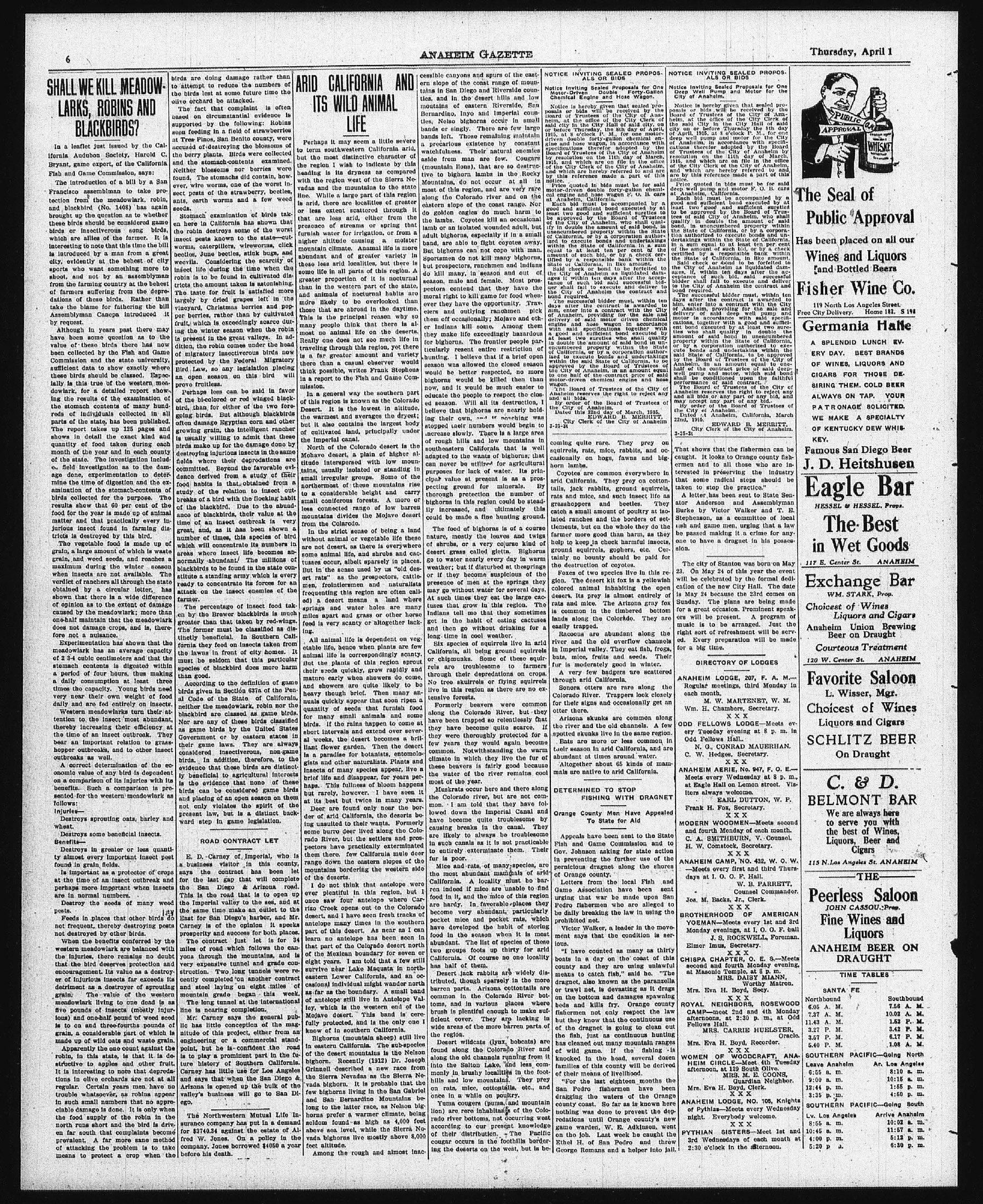
Searchable text
SHALL WE KILL MEADOW-LARKS, ROBINS AND BLACKBIRDS?
In a leaflet just issued by the California Audubon Society, Harold C. Bryant, game expert, of the California Fish and Game Commission, says:
The introduction of a bill by a San Francisco assembler to take protection from the meadowlark, robin, and blackbird (No. 1408) has again brought up the question as to whether these birds should be considered game birds or insectivorous song birds, which are allies of the farmer. It is interesting to note that this time the bill is introduced by a man from a great city, evidently at the behest of city sports who want something more to shoot, and not by an assemblyman from the farming country at the behest of farmers suffering from the depredations of these birds. Rather than take the blame for fathering the bill Assemblyman Canepa introduced it by request.
Although in years past there may have been some question as to the value of these birds there has now been collected by the Fish and Game Commission and the state university, sufficient data to show exactly where these birds should be classed. Especially is this true of the western meadowlark, for a detailed report showing the results of the examination of the stomach contents of many hundreds of individuals collected in all parts of the state, has been published. The report takes up 125 pages and shows in detail the exact kind and quantity of food taken during each bird are doing damage rather than to attempt to reduce the numbers of the birds lest at some future time the olive orchard be attacked.
The fact that complaint is often based on circumstantial evidence is supported by the following: Robins seen feeding in a field of strawberries at Tres Pinos, San Benito county, were accused of destroying the blossoms of the berry plants. Birds were collected and the stomach-contents examined. Neither blossoms nor berries were found. The stomachs did contain, however, wire worms, one of the worst insect pests of the strawberry, beetles, ants, earth worms and a few weed seeds.
Stomach examination of birds taken here in California has shown that the robin destroys some of the worst insect pests known to the state—cutworms, caterpillers, wreworms, click beetles, June beetles, stink bugs, and weevils. Considering the scarcity of insect life during the time when the robin is to be found in cultivated districts the amount taken is astonishing. The taste for fruit is satisfied more largely by dried grapes left in the vineyard, Christmas berries and pepper berries, rather than by cultivated fruit, which is exceedingly scarce during the winter season when the robin is present in the great valleys. In addition, the robin comes under the head of migratory insectivorous birds now protected by the Federal Migratory Bird Law, so any legislation placing an open season on this bird will prove fruitless.
Perhaps less can be said in favor of the bi-colored or red winged blackbird, than for either of the two foregoing birds. But although blackbirds often damage Egyptian corn and other growing grain, the intelligent rancher is usually willing to admit that these birds make up for the damage done by
ARID CALIFORNIA ITS WILD LIFE
Perhaps it may seem to term southwestern but the most distinctive region I wish to heading is its dryness with the region west of vadas and the mountain line. While a large part is arid, there are local or less extent scatters that are less arid, or presence of streams furnish water for irrigation higher altitude causing mountain climate. And abundant and of great these less arid localities some life in all parts greater proportion than in the western prairies and animals of nocturne more likely to be those that are abroad. This is the principal many people think that most no animal life Really one does not travel through this is a far greater amounthere than a casual think possible, writes in a report to the Fish mission.
In a general way to this region is known Desert. It is the lowest warmest and averages but it also contains of cultivated land, per the Imperial canal.
North of Colorado
Commission and the state university, sufficient data to show exactly where these birds should be classed. Especially is this true of the western meadowlark, for a detailed report showing the results of the examination of the stomach contents of many hundreds of individuals collected in all parts of the state, has been published. The report takes up 125 pages and shows in detail the exact kind and quantity of food taken during each month of the year and in each county of the state. The investigation includes field investigation as to the damage done, experimentation to determine the time of digestion and the examination of the stomach-contents of birds collected for the purpose. The results show that 60 per cent of the food for the year is made up of animal matter and that practically every injurious insect found in farming districts is destroyed by this bird.
The vegetable food is made up of grain, a large amount of which is waste grain, and weed seeds, and reaches a maximum during the winter season when insects are not available. The verdict of ranchers all through the state obtained by a circular letter, has shown that there is a wide difference of opinion as to the extent of damage caused by the meadowlark; more than one-half maintain that the meadowlark does not damage crops, and is, therefore not a nuisance.
Experimentation has shown that the meadowlark has an average capacity of 2-3 cubic centimeters and that the stomach contents is digested within a period of four hours, thus making a daily consumption at least three times the capacity. Young birds need very near their own weight of food daily and are fed entirely on insects.
Western meadowlarks turn their attention to the insect most abundant, thereby increasing their efficiency at the time of an insect outbreak. They bear an important relation to grasshopper outbreaks, and to other insect outbreaks as well.
A correct determination of the economic value of any bird is dependent on a comparison of its injuries with its benefits. Such a comparison is presented for the western meadowlark as follows:
Injuries—
Destroys sprouting oats, barley and wheat.
Destroys some beneficial insects.
Benefits—
Destroys in greater or less quanti-
ROAD CONTRACT LET
A correct determination of the economic value of any bird is dependent on a comparison of its injuries with its benefits. Such a comparison is presented for the western meadowlark as follows:
Injuries
Destroys sprouting oats, barley and wheat.
Destroys some beneficial insects.
Benefits
Destroys in greater or less quantity almost every important insect pest found in grain fields.
Is important as a protector of crops at the time of an insect outbreak and perhaps more important when insects are in normal numbers.
Destroy the seeds of many weed pests.
Feeds in places that other birds do not frequent, thereby destroying pests not destroyed by other birds.
When the benefits conferred by the western meadowlark are balanced with the injuries, there remains no doubt that the bird deserves protection and encouragement. Its value as a destroyer of injurious insects far exceeds its detriment as a destroyer of sprouting grain. The value of the western meadowlark living to one dead is as five pounds of insects (mostly injurious) and one-half pound of weed seed is to on and three-fourths pounds of grain, a considerable part of which is made up of wild oats and waste grain.
Apparently the one count against the robin, in this state, is that it is destructive to apples and other fruit. It is interesting to note that depredations in olive orchards are not at all regular. Certain years men have no trouble whatsoever, as robins appear in such small numbers that no appreciable damage is done. It is only when the food supply of the robin in the north runs short and the bird is driven far south that complaints become prevalent. A far more sane method of attacking the problem is to take means to protect a crop when the birds.
In addition, therefore, to the evidence that these birds are distinctly beneficial to agricultural interests is the evidence that none of these birds can be considered game birds and placing of an open season on them not only violates the spirit of the present law, but is a distinct backward step in game legislation.
ROAD CONTRACT LET
E. D. Carney of Imperial, who is a business visitor in this county, says the contract has been let for the last gap that will complete the San Diego & Arizona road. This is the road that is to open up the Imperial valley to the sea, and at the same time make an outlet to the East for San Diego's harbor, and Mr. Carney is of the opinion it speaks prosperity and success for both places.
The contract just let is for 34 miles of road which follows the canyons through the mountains, and is very expensive tunnel and grade construction. Two long tunnels were recently completed on another contract and steel laying on eight miles of mountain grade began this week.
The long tunnel at the international line is nearing completion.
Mr. Carney says the general public has little conception of the magnitude of this project, either from an engineering or a commercial standpoint, but he is confident the road is to play a prominent part in the future history of Southern California. Carney has little use for Los Angeles and says that when the San Diego & Arizona is opened up the bulk of the valley's business will go to San Diego.
The Northwestern Mutual Life Insurance company has put in a demand for $3740.34 against the estate of Alfred W. Jones. On a policy in the company, Jones borrowed $4050 a year before his death.
Deer are found over arid California unsuited to their some burro deer live rado River, but they expectors have practiced them there. few Carney range down the eastern mountains bordering of the deserts.
I do not think they ever plentiful in the once saw four antlers rizo Creek opens our desert, and I have seen antelope many times part of this desert. Learn no antelope that part of the Colony of the Mexican bounty eight years. I am to survive near Lake Chico Eastern Lower Californian individual as far as the bounds of antelope still livley, which is the w Mojave desert. The fully protected, and know of in southern Bighorns (mountains) in eastern California of the desert mount bighorn. Recently Grinnell described the Sierra Nevadas vada bighorn. It is few bighorns living and San Bernardino long to the latter rairhorns prefer a warmer solldom found as l above sea level, wh vada bighorns live feet altitude.
Among the rough
ARID CALIFORNIA AND ITS WILD ANIMAL LIFE
Perhaps it may seem a little severe to term southwestern California arid, but the most distinctive character of the region I wish to indicate by this heading is its dryness as compared with the region west of the Siorra Nevadas and the mountains to the state line. While a large part of this region is arid, there are localities of greater or less extent scattered through it that are less arid, either from the presence of streams or spring that furnish water for irrigation, or from a higher attitude causing a molster mountain climate. Animal life is more abundant and of greater variety in these less arid localities, but there is some life in all parts of this region. A greater proportion of it is nocturnal than in the western part of the state, and animals of nocturnal habits are more likely to be overlooked than those that are abroad in the daytime. This is the principal reason why so many people think that there is almost no animal life on the deserts. Really one does not see much life in traveling through this region, yet there is a far greater amount and variety there than a casual observer would think possible, writes Frank Stephens in a report to the Fish and Game Commission.
In a general way the southern part of this region is known as the Colorado Desert. It is the lowest in altitude, the warmest and averages the dryest; but it also contains the largest body of cultivated land, principally under the Imperial canal.
North of the Colorado desert is the accessible canyons and spurs of the eastern slope of the coast range of mountains in San Diego and Riverside counties, and in the desert hills and low moutains of eastern Riverside, San Bernardino, Inyo and Imperial counties, Nelso bighorns occur in small bands or singly. There are few large bands left. Those remaining maintain a precarious existence by constant watchfulness. Their natural enemies aside from man are few. Cougars (mountain lions), that are so destructive to bighorn lambs in the Rocky Mountains, do not occur at all in most of this region, and are very rare along the Colorado river and on the eastern slope of the coast range. Nor do golden eagles do much harm to the lambs. Coyotes kill an occasional lamb or an isolated wounded adult, but adult bighorns, especially if in a small band, are able to fight coyotes away. But bighorns can not cope with man. Sportsmen do not kill many bighorns, but prospectors, ranchers and Indians do kill many, in season and out of season, male and female. Most prospectors contend that they have the moral right to kill game for food whenever they have the opportunity. Travelers and outlying ranchmen pick them off occasionally; Molave and other Indians kill some. Among them they make life exceedingly hazardous for bighorns. The frontier people particularly resent entire restriction of hunting. I believe that if a brief open season was allowed the closed season would be better respected, no more bighorns would be killed then now, and it would be much easier to educate the people to respect the closed season. Will all its destruction, I believe that bighorns are nearly holding their own, and if nothing was stopped their numbers would begin to increase slowly. There is a large area of rough hills and low mountains in southeastern California that is well
NOTICE INVITING SEALED PROPOSALS OR BIDS
Notice Inviting Sealed Proposals for One Motor-Driven Double Forty-Gallon Chemical Engine and Hose Wagon.
Notice is herby given that sealed proposals or bids will be received by the board of Trustees of the City of Anaheim, at the office of the City Clerk of said city in the City Hall of said city, on April 19th at 8 o'clock P.M., for one motor-driven double forty-gallon chemical engine and hose wagon, in accordance with specifications thereof adopted by the board of Trustees of the City of Anaheim, by result on April 19th, 1915, and which are on file in the office of the City Clerk of the City of Anaheim, which are hereby referred to and are by this reference made a part of this notice.
Also quoted in bids must be for sold motor-driven double forty-gallon chemical engine and hose wagon F. O. B cars at Anaheim, California.
Each bid must be accompanied by a good and sufficient bond executed by at least two good and sufficient sureties to be approved by the Board of Trustees of the City of Anaheim, who shall qualify in double the amount of said bond, in unencumbered property within the State Thursday of each day untilized to execute bonds and undertakings within the State of California. In a sum equal to at least ten per cent of the amount of such bid, or by a check certified by a responsible bank within the State Thursday of each day accounted for such bid said successful bid shall fail to execute and deliver to the Anaheim contract and bond required.
The successful bidder must, within ten days after the contract is awarded to him, enter into a contract with the City of Anaheim by result on April 19th accounted for such bid said successful bid shall fail to execute and deliver to the Anaheim contract and bond required.
The successful bidder must, within ten days after the contract is awarded to him, enter into a contract with the City of Anaheim by result on April 19th accounted for such bid said successful bid shall fail to execute and deliver to the Anaheim contract and bond required.
The Board of Trustees of the City of Anaheim preserves the right to reject any and all bids.
Dated this 22nd day of March, 1915.
EDWARD B. MEHRITT,
City Clerk of the City of Anaheim
3-25-31
is a far greater amount and variety there than a casual observer would think possible, writes Frank Stephens in a report to the Fish and Game Commission.
In a general way the southern part of this region is known as the Colorado Desert. It is the lowest in altitude, the warmest and averages the dryest; but it also contains the largest body of cultivated land, principally under the Imperial canal.
North of the Colorado desert is the Mohave desert, a plain of higher altitude interspersed with low mountains, usually isolated or standing in small irregular groups. Some of the northernmost of these mountains rise to a considerable height and carry small coniferous forests. A more or less connected range of low barren mountains divides the Mojave desert from the Colarodo.
In the strict sense of being a land without animal or vegetable life these are not desert, as there is everywhere some animal life, and shrubs and cactuses occur, albeit sparsely in places. But in the sense used by us "old desert rats" as the prospectors, cattlemen, frogliersmen and naturalists frequenting this region are often called a desert means a land where springs and water holes are many miles apart and grass or other horse feed is very scanty or altogether lacking.
All animal life is dependent on vegetable life, hence when plants are few animal life is correspondingly scanty. But the plants of this region sprout their seeds quickly, grow rapidly and mature early when showers do come, and showers are quite likely to be heavy though brief. Then many annuals quickly appear that soon ripen a quantity of seeds that furnish food for many small animals and some birds. If the rains happen to come at short intervals and extend over several weeks, the desert becomes a brilliant flower garden. Then the desert is a paradise for botanists, entomologists and other naturalists. Plants and insects of many species appear, live a brief life and disappear, for years perhaps. This fullness of bloom happens but rarely, however. I have seen it at its best but twice in many years.
Deer are found only near the border of arid California, the deserts being unsuited to their wants. Formerly some burro deer lived along the Colorado River, but the settlers and prospectors have practically exterminated hunting. I believe that if a brief open season was allowed the closed season would be better respected, no more bighorns would be killed then than now, and it would be much easier to educate the people to respect the closed season. Will all its destruction, I believe that bighorns are nearly holding their own, and if nothing was stopped their numbers would begin to increase slowly. There is a large area of rough hills and low mountains in southeastern California that is well adapted to the wants of bighorns; that can never be utilized for agricultural purposes for lack of water. Its principal value at present is as a prospecting ground for minerals. By thorough protection the number of bighorns in this region could be steadily increased, and ultimately this could be made a fine hunting ground.
The food of bighorns is of a course nature, mostly the leaves and twigs of shrubs, or a very course kind of desert grass called gietta. Bighorns go to water nearly every day in warm weather; but if disturbed at the springs or if they become suspicious of the presence of men at the springs they may go without water for several days. At such times they eat the large cactuses that grow in this region. The Indians tell me that they sometimes get in the habit of eating cactuses and then go without drinking for a long time in cool weather.
Six species of squirrels live in arid California, all being ground squirrels or chipmunks. Some of these squirrels are troublesome to farmers through their depredations on crops. No tree skunkreals or flying squirrels live in this region as there are no extensive forests.
Formerly beavers were common along the Colorado River, but they have been trapped so relentlessly that they have become quite scarce. If they were thoroughly protected for a few years they would again become common. Notwithstanding the warm climate in which they live the fur of these beavers is fairly good because the water of the river remains cool most of the year.
Muskrats occur here and there along the Colorado river, but are not common. I am told that they have followed down the Imperial Canal and have become quite troublesome by causing breaks in the canal. They are likely to always be troublesome in such canals as it is not practicable to entirely exterminate them.
Coming quite rare. They prey on squirrels, rats, mice, rabbits, and occasionally on hogs, fawns and bighorn lambs.
Coyotes are common everywhere in arid California. They prey on cotton-tails, jack rabbits, ground squirrels, rats and mice, and such insect life as grasshoppers and beetles. They catch a small amount of poultry at isolated ranches and the borders of settlements, but on the whole they do the farmer more good than harm, as they help to keep in check harmful insects, ground squirrels, gophers, etc. Certainly no bounty should be paid for the destruction of coyotes.
Foxes of two species live in this region. The desert kit fox is a yellowish colored animal inhabiting the open deserts. Its prey is almost entirely of rats and mice. The Arizona gray狐 is common in the timbered bottom lands along the Colorado. They are easily trapped.
Raccoons are abundant along the river and the old overflow channels in Imperial valley. They eat fish, frogs, bats, mice, fruits and seeds. Their fur is moderately good in winter.
A very few badgers are scattered through arid California.
Sonora otters are rare along the Colorado River. Trappers look closely for their signs and occasionally get an otter there.
Arizona skunks are common along the river and the old channels. A few spotted skunks live in the same region.
Bats are more or less common in tuelr season in arid California, and are abundant at times around water.
Altogether about 65 kinds of mammals are native to arid California.
DETERMINED TO STOP FISHING WITH DRAGNET
Orange County Men Have Appealed To State for Aid
Appeals have been sent to the State Fish and Game Commission and to Gov. Johnson asking for state action
is a paradise for outliers, customers giats and other naturalists. Plants and insects of many species appear, live a brief life and disappear, for years perhaps. This fullness of bloom happens but rarely, however. I have seen it at its best but twice in many years.
Deer are found only near the border of arid California, the deserts being unsulted to their wants. Formerly some burro deer lived along the Colorado River, but the settlers and prospectors have practically exterminated them there. few California mule deer range down the eastern slopes of the mountains bordering the western side of the deserts.
I do not think that antelope were ever plentiful in this region, but I once saw four antelope where Carrizo Creek opens out to the Colorado desert, and I have seen fresh tracks of antelope many times in the southern part of this desert. As near as I can learn no antelope has been seen in that part of the Colorado desert north of the Mexican boundary for seven or eight years. I am told that a few still survive near Lake Maquata in northeastern Lower California, and an occasional individual might wander north as far as the boundary. A small band of antelope still live in Antelope Valley, which is the western end of the Mojave desert. This band is carefully protected, and is the only one I know of in southern California.
Bighorns (mountain sheep) still live in eastern California. The sub-species of the desert mountains is the Nelson bighorn. Recently (1912) Dr. Joseph Grinnell described a new race from the Sierra Nevadas as the Sierra Nevada bighorn. It is probable that the few bighorns living in the San Gabriel and San Bernardino Mountains belong to the latter race, as Nelson bighorns prefer a warmer climate, being seldom found—as high as 4,000 feet above sea level, while the Sierra Nevada bighorns live mostly above 8,000 feet altitude.
Among the rough and almost inac-
climate in which they live the fur of these beavers is fairly good because the water of the river remains cool most of the year.
Muskrat occur here and there along the Colorado river, but are not common. I am told that they have followed down the Imperial Canal and have become quite troublesome by causing breaks in the canal. They are likely to always be troublesome in such canals as it is not practicable to entirely exterminate them. Their fur is poor.
Mice and rats, of many species, are the most abundant mammals of arid California. A locality must be barren indeed if mice are unable to find food in it, and the mice of this region are hardy. In favorable places they become very abundant, particularly pocket mice and pocket rats, which have developed the habit of storing food in the season when it is most abundant. The list of species of these two groups fools up thirty for arid California. Of course no one locality has half of them.
Desert jack rabbits are widely distributed, though sparsely in the more barren parts. Arizona cottontails are common in the Colorado River bottoms, and in various places where brush is plentiful enough to make sufficient cover. They are lacking in wide areas of the more barren parts of the region.
Desert wildcats (lynx, bobcats) are found along the Colorado River and along the old channels running from it into the Salton Lake, and less commonly in brushy localities in the foothills and low mountains. They prey on rats, mice, cottontails, etc., and once in a while on poultry.
Yuma cougars (puma, and mountain lion) are rare inhabitants of the Colorado river bottoms, not occurring west according to our present knowledge of their distribution. The Pacific cougar occurs in the foothills bordering the deserts on the west, but is be-
abundant at times around water.
Allother about 65 kinds of mammals are native to arid California.
DETERMINED TO STOP FISHING WITH DRAGNET
Orange County Men Have Appealed To State for Aid
Appeals have been sent to the State Fish and Game Commission and to Gov. Johnson asking for state action in preventing the further use of the pernicious dragnet along the shores of Orange county.
Letters from the local Fish and Game Association have been sent urging that war be made upon San Pedro fishermen who are alleged to be daily breaking the law in using the prohibited net.
Victor Walker, a leader in the movement says that the condition is serious.
"I have counted as many as thirty boats in a day on the coast of this county and they are using unlawful means to catch fish," said he.
The dragnet, also known as the paranzella or trawl net, is devastating as it drags on the bottom and damages spawning beds and kills fry. Orange county fishermen not only respect the law but they know that the continuous use of the dragnet is going to clean out the fish, just as continuous hunting has cleaned out many mountain ranges of wild game. If the fishing is knocked in the head, several dozen families of this county will be derived of their means of livelihood.
"For the last eighteen months the San Pedro fishermen have been dragging the waters of the Orange county coast. So far as is known here nothing was done to prevent the depredations until Orange county's new game warden, W. E. Adkinson, went on the job. Last week he caught the Ethel H. of San Pedro and threw George Romans and a helper into jail."
NOTICE INVITING SEALED PROPOSALS OR BIDS
Notice Inviting Sealed Proposals for One Deep Well Pump and Motor for the City of Anaheim.
Notice is hereby given that sealed proposals or bids will be received by the Board of Trustees of the City of Anaheim, at the office of the City Clerk of the said City in the City Hall of said city on or before Thursday the 8th day of April, 1915, at 8 o'clock P.M., for one deep well pump and motor for the City of Anaheim, in accordance with specifications therefor adopted by the Board of Trustees of the City of Anaheim by resolution on the 11th day of March, 1915, and which are on file in the office of the City Clerk of the City of Anaheim, and which are hereby referred to and by this reference made a part of this notice.
Price quoted in bids must be for said deep well pump and motor F. O. B. cars at Anaheim, California.
Each bid must be accompanied by a good and sufficient bond executed by at least two good and sufficient sureties to be approved by the Board of Trustees of said City of Anaheim, who shall qualify in double the amount of said bond, in unencumbered property within State of California or by corporation authorized to execute bonds and undertakings within State of California, in a sum equal to at least ten per cent of the amount of such bid, or by a check certified by a responsible bank within State of California. If audited, said check or dond to be forfeited to the City of Anaheim as liquidated damages, if, within ten days after the acceptance of such bid, said successful bidder shall fail to execute and deliver City of Anaheim the contract and bond required.
The successful bidder must, within ten days after the contract is awarded to him, enter into a contract with the City Anaheim providing for the same delivery of said deep well pump and motor in accordance with said specifications, together with a good and sufficient bond executed by at least two sureties shall qualify in double the amount of said bond in unencumbered property within State of California, or by corporation authorized to execute bonds and undertakings within the said State of California, to be approved by the Board of Trustees of the City Anaheim, in an amount equal to one-half of the contract price of said deep well pump and motor, which said bond shall be conditioned upon the faithful performance of said contract.
Board of Trustees of the City of Anaheim reserves the right to reject any and all bids or any part of any bid, and may accept any part of any bid.
By order of the Board of Trustees of the City of Anaheim.
Dated: 41st Anaheim, California, March 22nd, 1915.
EDWARD B. MERRITT,
City Clerk of the City of Anaheim.
3-25-21
The Seal of Public Approval
Has been placed on all our Wines and Liquors and Bottled Beers
Fisher Wine Co.
119 North Los Angeles Street.
Free City Delivery. Home 182. S 198
Germania Halle
A SPLENDID LUNCH EVENY DAY. BEST BRANDS OF WINES, LIQUORS AND CIGARS FOR THOSE DESIRING THEM. COLD BEER ALWAYS ON TAP. YOUR PATRONAGE SOLICITED. WE MAKE A SPECIALTY OF KENTUCKY DEW WHISKEY.
They prey on rabbits, and ocelots and big rabbitles. They prey on cotton-ground squirrels, such insect life as beetles. They prey on poultry at isoide borders of set-whole they do the man harm, as they are harmful insects, sphers, etc. Cer could be paid for soyotes.
They live in this reef fox is a yellowish habiting the open almost entirely of Arizona gray fox timbered bottom morado. They areendant along the overflow channels they eat fish, frogs, and seeds. Theirood in winter. Theppers are scatteredonia.
Rare along theppers look closely occasionally get anere common along channels. A fewin the same region. Less common in California, and areground water.
65 kinds of mammal California.
STOP WITH DRAGNET
Have Appealed for Aid
sent to the State commission and to state action
That shows that the fishermen can be caught. It looks to Orange county fishermen and to all those who are interested in preserving the industry that some radical steps should be taken to stop the practice."
A letter has been sent to State Senator Anderson and Assemblyman Burke by Victor Walker and T. E. Stephenson, as a committee of local rush and game men, urging that a law be passed making it a crime for anyone to have a dragnet in his possession.
The city of Stanton was born on May 23. On May 24 of this year the event will be celebrated by the formal dedication of the new City Hall. The date is May 24 because the 23rd comes on Sunday. The plans are being made for a great occasion. Prominent speakers will be present. A program of music is to be arranged. Just the right sort of refreshment will be served. Every preparation will be made for a big time.
DIRECTORY OF LODGES
ANAHEIM LODGE, 207, F. A. M.—Regular meetings, third Monday in each month.
M. W. MARTENET, W. M. Wm. H. Chambers, Secretary.
XX X
ODD FELLOWS LODGE—Meets every Tuesday evening at 8 p.m. in Odd Fellows Hall.
N. G., CONRAD MAUERHAN.
C. W. Hedges, Secretary.
XX X
ANAHEIM AERIE, No. 947, F. O. E.—Meets every Wednesday at 8 p.m., at Eagle Hall on Lemon street. Visitors always welcome.
EARL DUTTON, W. P.
Frank H. Fox, Secretary.
XX X
MODERN WOODMEN—Meets second and fourth Monday of each month.
C. A. SMITHBURN, V. Counsel.
H. W. Comstock, Secretary.
ERY DAY.
BEST CHANCES OF WINES, LIQUORS AND CIGARS FOR THOSE DESIRING THEM. COLD BEER ALWAYS ON TAP. YOUR PATRONAGE SOLICITED.
WE MAKE A SPECIALTY OF KENTUCKY DEW WHISKEY.
Famous San Diego Beer
J. D. Heitshusen
Eagle Bar
HESSEL & HESSEL, Props.
The Best in Wet Goods
117 E. Center St.
ANAHEIM
Exchange Bar
WM. STARK, Prop.
Choicest of Wines
Liquors and Cigars
Anaheim Union Brewing
Beer on Draught
Courteous Treatment
120 W. Center St.
ANAHEIM
Favorite Saloon
L. Wisser, Mgr.
Choicest of Wines
Liquors and Cigars
SCHLITZ BEER
On Draught
C. & D.
BELMONT BAR
We are always here to serve you with the best of Wines,
Liquors, Beer and Cigars
ANAHEIM AERIE, No. 947, F. O. E.—Meets every Wednesday at 8 p.m., at Eagle Hall on Lemon street. Visitors always welcome.
EARL DUTTON, W. P.
Frank H. Fox, Secretary.
MODERN WOODMEN—Meets second and fourth Monday of each month.
C. A. SMITHBURN, V. Counsel.
H. W. Comstock, Secretary.
ANAHEIM CAMP, NO. 432, W. O. W.—Meets every first and third Thursdays at I. O. O. F. Hall.
W. B. PARRETT, Counsel Commander.
Jos. M. Backs, Jr., Clerk.
BROTHERHOOD OF AMERICAN YOEMAN—Meets every 1st and 3rd Monday evenings, at I. O. O. F. hall.
J. S. ROCKWELL, Foreman.
Elmer Imus, Secretary.
CHISPA CHAPTER, O. E. S.—Meets second and fourth Monday evening, at Masonic Temple, at 8 p.m.
MRS. DAISY MIANN,
Worthy Matron.
Mrs. Eva H. Boyd, Secy.
ROYAL NEIGHBORS, ROSEWOOD CAMP—meet 2nd and 4th Monday afternoons, at 2:30 p.m., at Odd Fellowes Hall.
MRS. CARRIE HUELSTER, Oracle.
Mrs. Eva H. Boyd, Recorder.
WOMEN OF WOODGRAFT, ANAHEIM CIRCLE—Meet 4th Tuesday afternoon, at 129 South Olive.
MRS. M. E. COONS,
Guardian Neighbor.
Mrs. Eva H. Boyd, Clerk.
ANAHEIM LODGE, NO. 105, Knights of Pythias—Meets every Wednesday night. Everybody welcome.
PYTHIAN SISTERS—Meet 1st and 3rd Wednesdays of each month at 2:30 o'clock in the afternoon.
C. & D.
BELMONT BAR
We are always here to serve you with the best of Wines,
Liquors, Beer and Cigars
THE
Peerless Saloon
JOHN CASSOU; Prop.
Fine Wines and Liquors
ANAHEIM BEER ON DRAUGHT
TIME TABLES
SANTA FE
Northbound
6.05 A. M.
7.37 A. M.
11.43 A. M.
3.27 P. M.
3.42 P. M.
3.57 P. M.
6.17 P. M.
5.40 P. M.
1.08 A.M.
SOUTHERN PACIFIC—Going North
Leave Anaheim
6:55 a.m.
8:10 a.m.
2:00 a.m.
10:15 a.m.
12:44 p.m.
1:55 p.m.
3:35 p.m.
4:50 p.m.
SOUTHERN PACIFIC—Going South
Lv. Los Angeles
8:55 a.m.
10:02 a.m.
10:45 a.m.
11:57 a.m.
4:00 p.m.
5:12 p.m.
5:20 p.m.