anaheim-gazette 1915-03-25
Scanned page
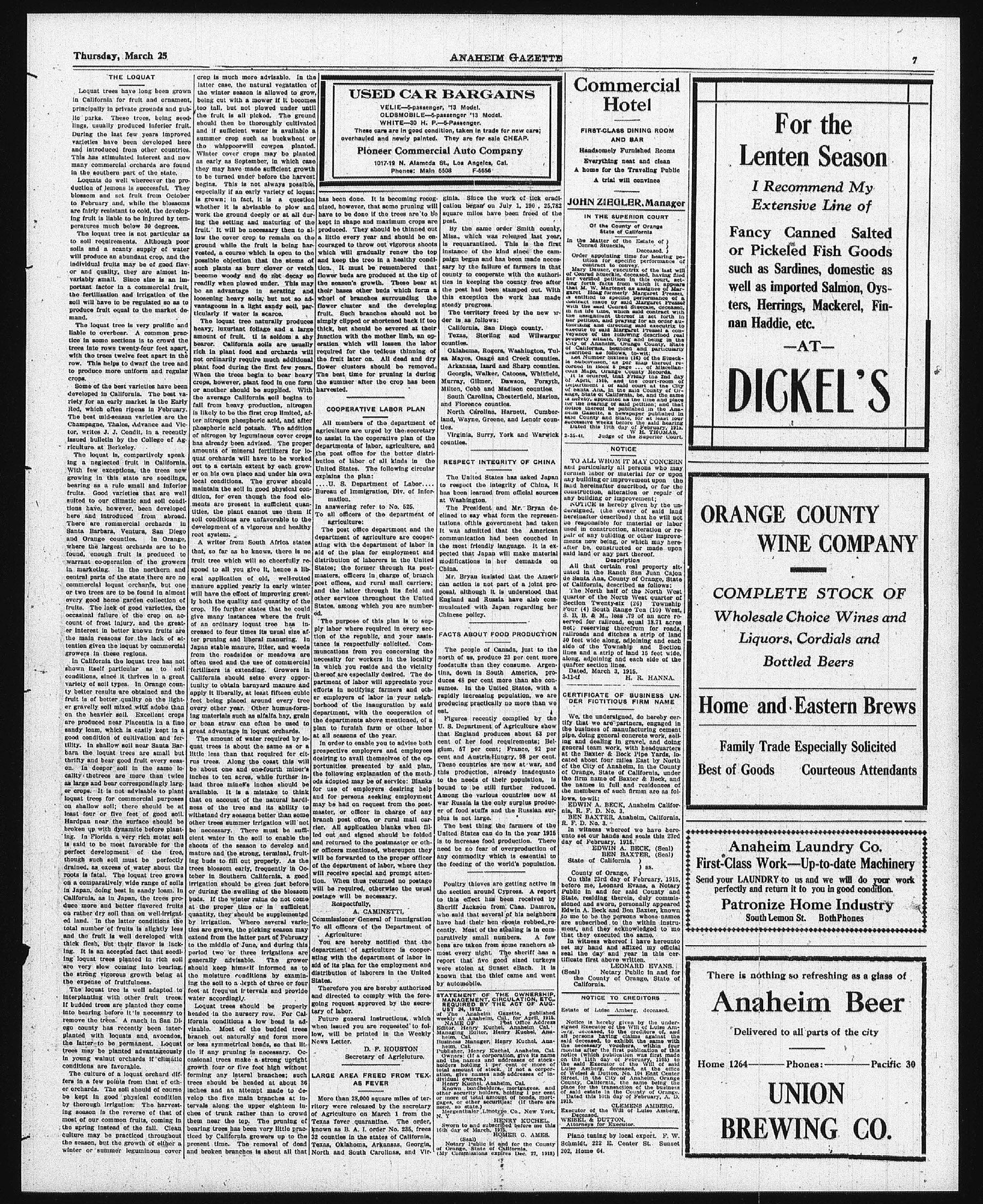
Searchable text
THE LOQUAT
Loquat trees have long been grown in California for fruit and ornament, principally in private grounds and public parks. These trees, being seedlings, usually produced inferior fruit. During the last few years improved varieties have been developed here and introduced from other countries. This has stimulated interest and now many commercial orchards are found in the southern part of the state.
Loquats do well wherever the production of lemons is successful. They blossom and set fruit from October to February and, while the blossoms are fairly resistant to cold, the developing fruit is liable to be injured by temperatures much below 30 degrees.
The loquat tree is not particular as to soil requirements. Although poor soils and a scanty supply of water will produce an abundant crop, and the individual fruits may be of good flavor and quality, they are almost invariably small. Since size is an important factor in a commercial fruit, the fertilization and irrigation of the soil will have to be regulated so as to produce fruit equal to the market demand.
The loquat tree is very prolific and liable to overbear. A common practice in some sections is to crowd the trees into rows twenty-four feet apart, with the trees twelve feet apart in the row. This helps to dwarf the tree and to produce more uniform and regular crops.
Some of the best varieties have been developed in California. The best variety for an early market is the Early Red, which often ripens in February. The best mid-season varieties are the Champagne, Thales, Advance and Victor, writes J. J. Condit, in a recently issued bulletin by the College of Agriculture at Berkeley.
crop is much more advisable. In the latter case, the natural vegetation of the winter season is allowed to grow, being cut with a mower if it becomes too tall, but not plowed under until the fruit is all picked. The ground should then be thoroughly cultivated and if sufficient water is available a summer crop such as buckwheat or the whippoorwill cowpea planted. Winter cover crops may be planted as early as September, in which case they may have made sufficient growth to be turned under before the harvest begins. This is not always possible, especially if an early variety of loquat is grown; in fact, it is a question whether it is abvisable to plow and work the ground deeply or at all during the setting and maturing of the fruit. It will be necessary then to allow the cover crop to remain on the ground while the fruit is being harvested, a course which is open to the possible objection that the stems of such plants as burr clover or vetch become woody and do not decay so readily when plowed under. This may be an advantage in aerating and loosening heavy soils; but not so advantageous in a light sandy soil, particularly if water is scarce.
The loquat tree naturally produces heavy, luxuriant foliage and a large amount of fruit. It is seldom a shy bearer. California soils are usually rich in plant food and orchards will not ordinarily require much additional plant food during the first few years. When the trees begin to bear heavy crops, however, plant food in one form or another should be supplied. With the average California soil begins to fall from heavy production, nitrogen is likely to be the first crop limited, after nitrogen phosphoric acid, and after phosphoric acid potash. The addition of nitrogen by leguminous cover crops has already been advised. The proper has been done. Nized, however, have to be done produced. They a little every year courageed to throw which will graze and keep the traction. It must flower buds are their bases other whirl of branch flower cluster fruit. Such brass simply clipped off thick, but should function with their erosion which required for the fruit later flowering clusters. The best time for the summer after harvested.
COOPERATION
All members agriculture are used to assist in the departments of
with the trees twelve feet apart in the row. This helps to dwarf the tree and to produce more uniform and regular crops.
Some of the best varieties have been developed in California. The best variety for an early market is the Early Red, which often ripens in February. The best mid-season varieties are the Champagne, Thales, Advance and Victor, writes J. J. Condit, in a recently issued bulletin by the College of Agriculture at Berkeley.
The loquat is, compartively speaking, a neglected fruit in California. With few exceptions, the trees now growing in this state are seedlings, bearing as a rule small and inferior fruits. Good varieties that are well suited to our climatic and soil conditions have, however, been developed here and introduced from abroad. There are commercial orchards in Santa Barbara, Ventura, San Diego and Orange counties. In Orange, where the largest orchards are to be found, enough fruit is produced to warrant co-operation of the growers in marketing. In the northern and central parts of the state there are no commercial loquat orchards, but one or two trees are to be found in almost every good home garden collection of fruits. The lack of good varieties, the occasional failure of the crop on account of frost injury, and the greater interest in better known fruits are the main reasons for the lack of attention given the loquat by commercial growers in these regions.
In California the loquat tree has not shown itself particular as to soil conditions, since it thrives in a great variety of soil types. In Orange county better results are obtained and the fruit is of better quality on the lighter gravelly soil mixed with adobe than on the heavier soil. Excellent crops are produced near Placentia in a fine sandy loam, which is easily kept in a good condition of cultivation and fertility. In shallow soil near Santa Barbara the loquat trees are small but thrifty and bear good fruit every season. In deeper soil in the same locality the trees are more than twice as large and bear correspondingly larger crops. It is not advisable to plant loquat trees for commercial purposes on shallow soil; there should be at least four or five feet of good soil. Hardpan near the surface should be broken up with dynamite before planting. In Florida a very rich moist soil is said to be most favorable for the perfect development of the fruit.
not ordinarily require much additional plant food during the first few years. When the trees begin to bear heavy crops, however, plant food in one form or another should be supplied. With the average California soil begins to fall from heavy production, nitrogen is likely to be the first crop limited, after nitrogen phosphoric acid, and after phosphoric acid potash. The addition of nitrogen by leguminous cover crops has already been advised. The proper amounts of mineral fertilizers for loquat orchards will have to be worked out to a certain extent by each grower on his own place and under his own local conditions. The grower should maintain the soil in good physical condition, for even though the food elements are present in sufficient quantities, the plant cannot use them if soil conditions are unfavorable to the development of a vigorous and healthy root system.
A writer from South Africa states that, so far as he knows, there is no fruit tree which will so cheerfully respond to all you give it, hence a liberal application of old, well-rotted manure applied yearly in early winter will have the effect of improving greatly both the quality and quantity of the crop. He further states that he could give many instances where the fruit of an ordinary loquat tree has increased to four times its usual size after pruning and liberal manuring. In Japan stable manure, litter, and weeds from the roadsides or meadows are often used and the use of commercial fertilizers is extending. Growers in California should seize every opportunity to obtain barnyard manure and apply it liberally, at least fifteen cubic feet being placed around every tree every other year. Other humus-forming materials such as alfalfa hay, grain or bean straw can often be used to great advantage in loquat orchards.
The amount of water required by loquat trees is about the same as or a little less than that required for citrus trees. Along the coast this will be about one and one-fourth minor inches to ten acres, while further inland three mine's inches should be available. It is a mistake to think that on account of the natural hardiness of the tree and its ability to withstand dry seasons better than some other trees summer irrigation will not be necessary. There must be sufficient water in the soil to enable the shoots of the season to develop and fruit later on flower clusters. The best time for harvested.
COOPERATION
All members of agriculture are urged to assist in the departments of the post office or institution of labor United States. Explains the plan...U.S.Department Bureau of Immigration.
In answering questions related to all officers of agriculture:
The post office department of agriculture with the department of the plant distribution of la States; the former masters, officers at post offices, and and the latter to other services the States, among wiled.
The purpose oply labor where a unit of the republicance is respectful muncations from necessity for work in which you rethereof are especially partment of labor efforts in notflyer employers of borhood of the department, with the departments a plan to furnish at all seasons of work.
In order to ensure prospective employees desiring to avail opportunities presentthe following expoads adopted may be for use of employees may be had on resmaster, or officer branch post office rier. All applicable led out and signaled returned to ther officers mentioned
thrifty and bear good fruit every season. In deeper soil in the same locality the trees are more than twice as large and bear correspondingly larger crops. It is not advisable to plant loquat trees for commercial purposes on shallow soil; there should be at least four or five feet of good soil. Hardpan near the surface should be broken up with dynamite before planting. In Florida a very rich moist soil is said to be most favorable for the perfect development of the tree, though such soil must be perfectly drained, as excess of water about the roots is fatal. The loquat tree grows on a comparatively wide range of soils in Japan, doing best in sandy loam. In California, as in Japan, the trees produce more and better flavored fruits on rather dry soil than on well-irrigated land. In the latter conditions the total number of fruits is slightly less and the fruit is well developed with thick flesh, but their flavor is lacking. It is an accepted fact that seedling loquat trees planted in rich soil are very slow coming into bearing, the strong vigorous growth being at the expense of fruitfulness.
The loquat tree is well adapted to interplanting with other fruit trees: If budded trees are planted they come into bearing before it is necessary to remove the trees. A ranch in San Diego county has recently been interplanted with loquats and avocados, the latter to be permanent. Loquat trees may be planted advantageously in young walnut orchards if climatic conditions are favorable.
The culture of a loquat orchard differs in a few points from that of other orchards. The soil should of course be kept in good physical condition by thorough irrigation: The harvesting season is the reverse of that of most of our common fruits, coming in the spring instead of the fall. Clean culture may be practiced throughout the season, but the growth of either a winter or summer leguminous cover along the coast this will be about one and one-fourth miner's inches to ten acres, while further inland three mine's inches should be available. It is a mistake to think that on account of the natural hardiness of the tree and its ability to withstand dry seasons better than some other trees summer irrigation will not be necessary. There must be sufficient water in the soil to enable the shoots of the season to develop and mature and the strong, terminal fruiting buds to fill out properly. As the trees blossom early, frequently in October in Southern California, a good irrigation should be given just before or during the swelling of the blossom buds. If the winter rains do not come at the proper time or in sufficient quantity, they should be supplemented by irrigation. Where several varieties are grown, the picking season may extend from the latter part of February to the middle of June, and during this period two or three irrigations are generally advisable. The grower should keep himself informed as to the moisture conditions by examining the soil to a depth of three or four feet at frequent intervals and provide water accordingly.
Loquat trees should be properly headed in the nursery row. For California conditions a low head is advisable. Most of the budded trees branch out naturally and form more or less symmetrical heads, so that little if any pruning is necessary. Occasional trees make a strong upright growth four or five feet high without forming any lateral branches; such trees should be headed at about 36 inches and an attempt made to develop the five main branches at intervals along the upper eighteen inches of trunk rather than to crowd them near the top. The pruning of bearing trees has been very little practiced by California growers up to the present time. The removal of dead and broken branches is about all that desiring to avail portunities presents the following opportunities adopted may be used for use of emplies and for persons may be had on re-master, or officers branch post officer. All applications led out and signed and returned to the er officers mentioned will be forwarded of the department will receive specification. When thus will be required, postage will be paid.
Respectfully,
A. C.
Commissioner Gen.
To all officers of Agriculture:
You are hereby department of assigning with the deaid of its plan for distribution of lal States.
Therefore you are and directed to cegoing request apprariy of labor.
Future general when issued you ulow, will be print News Letter.
I
Secreta
LARGE AREA F
AS I
More than 28,000
ritory were release
of Agriculture on
Texas fever quarknown as B. A. I.
32 counties in therTexas, Oklahoma,
North and South
USED CAR BARGAINS
VELIE—5-passenger, '13 Model.
OLDSMOBILE—5-passenger '13 Model.
WHITE—30 H. P.—5-Passenger.
These cars are in good condition, taken in trade for new cars; overhauled and newly painted. They are for sale CHEAP.
Pioneer Commercial Auto Company
1017-19 N. Alameda St., Los Angeles, Cal.
Phones: Main 5508 F-6656
has been done. It is becoming recognized, however, that some pruning will have to be done if the trees are to be kept in shape and maximum crops are produced. They should be thinned out a little every year and should be encouraged to throw out vigorous shoots which will gradually renew the top and keep the tree in a healthy condition. It must be remembered that flower buds are produced at the tip of the season's growth. These bear at their bases other buds which form a whirl of branches surrounding the flower cluster and the developing fruit. Such branches should not be simply clipped or shortened back if too thick, but should be severed at their function with the mother limb, an operation which will lessen the labor required for the tedious thinning of the fruit later on. All dead and dry flower clusters should be removed. The best time for pruning is during the summer after the crop has been harvested.
COOPERATIVE LABOR PLAN
All members of the department of agriculture are urged by the secretary to assist in the cooperative plan of the departments of labor, agriculture, and mining. Since the work of tick eradication began on July 1, 190 , 25,782 square miles have been freed of the pest.
By the same order Smith county, Miss., which was released last year, is requarantured. This is the first instance of the kind since the campaign began and has been made necessary by the failure of farmers in that county to cooperate with the authorities in keeping the county free after the pest had been stamped out. With this exception the work has made steady progress.
The territory freed by the new order is as follows:
California, San Diego county.
Texas, Sterling and Wilwarger counties.
Oklahoma, Rogers, Washington, Tulsa Mayca, Osage and Creek counties.
Arkansas, Izard and Sharp counties.
Georgia, Walker, Catoosa, Whitfield, Murray, Glimer, Dawson, Forayth, Milton, Cobb and Madison counties.
South Carolina, Chesterfield, Marion, and Florence counties.
North Carolina, Harnett, Cumberland, Wayne, Greene, and Lenoir counties.
Commercial Hotel
FIRST-CLASS DINING ROOM AND BAR
Handsomely Furnished Rooms
Everything neat and clean
A home for the Travelling Public
A trial will convince
JOHN ZIEGLER. Manager
IN THE SUPERIOR COURT
Of the County of Orange
State of California
In the Matter of the Estate of )
Conrad Stueckle,
Deceased.
Order appointing time for hearing petition for specific performance of contract to convey.
Mary Martenet as assignee of Margaret Stueckle, deceased, having filed her verified petition in this court, setting forth facts from which it appears that M. W. Martenet as assignee of Margaret Stueckle, entitled to sole performance of a contract made by said Margaret Pressel with the said Conrad Stueckle, deceased, in its life time, which said contract with the assignment thereof is set forth in our petition and praying for an order authorizing and directing sale according to executive to said Margaret Pressel a conveyance of the following described real property situate, tying and being in the City of Anheim, Orange County, State of California, bound and particularly described as follows:
Lot Number Sixteen (16) of the Stueckle subdivision, as per map thereof recorded in book 5 page ... of Miscellaneous Maps, Orange County Records.
It is pleased that we end day of April, 1915, and the court-room of department 1 of said court at the City of banta Ana, in the said County of Orange, State of California, be, and the same as appointed at the time and place for the near publication of notice thereof be published in the Anheim Gazette, a newspaper published in said County and State, for at least four successive weeks before the said hearing. Dated this 19th day of February, 1915.
Judge of the Superior Court.
NOTICE
COOPERATIVE LABOR PLAN
All members of the department of agriculture are urged by the secretary to assist in the cooperative plan of the departments of labor, agriculture, and the post office for the better distribution of labor of all kinds in the United States. The following circular explains the plan:
U. S. Department of Labor...
Bureau of Immigration, Div. of Information.
In answering refer to No. 525.
To all officers of the department of agriculture:
The post office department and the department of agriculture are cooperating with the department of labor in aid of the plan for employment and distribution of laborers in the United States; the former through its postmasters, officers in charge of branch post offices, and rural mail carriers; and the latter through its field and other services throughout the United States, among which you are numbered.
The purpose of this plan is to supply labor where required in every section of the republic, and your assistance is respectfully solicited. Communications from you concerning the necessity for workers in the locality in which you reside and the vicinity thereof are especially desired. The department of labor will appreciate your efforts in notifying farmers and other employers of labor in your neighborhood of the inauguration by said department, with the cooperation of the departments above mentioned, of a plan to furnish farm or other labor at all seasons of the year.
In order to enable you to advise both prospective employers and employees desirous to avail themselves of the opportunities presented by said plan, the following explanation of the methods adopted may be of service: Blanks for use of employers desiring help and for persons seeking employment may be had on request from the postmaster, or officer in charge of any branch post office, or rural mail carrier. All application blanks when filled out and signed should be folded and returned to the postmaster or other officers mentioned, wherever upon they sa Mayes, Osage and Creek counties.
Arkansas, Izard and Sharp counties.
Georgia, Walker, Catoosa, Whitfield,
Murray, Gilmer, Dawson, Forsyth,
Milton, Cobb and Madison counties.
South Carolina, Chesterfield, Marion,
and Florence counties.
North Carolina, Harnett, Cumberland,
Wayne, Greene, and Lenoir counties.
Virginia, Surry, York and Warwick counties.
RESPECT INTEGRITY OF CHINA
The United States has asked Japan to respect the integrity of China, it has been learned from official sources at Washington.
The President and Mr. Bryan declined to say what form the representations of this government had taken. It was admitted that the American communication had been couched in the most friendly language. It is expected that Japan will make material modifications in her demands on China.
Mr. Bryan insisted that the American action is not part of a joint proposal, although it is understood that England and Russia have ablated communicated with Japan regarding her Chinese policy.
FACTS ABOUT FOOD PRODUCTION
The people of Canada, just to the north of us, produce 23 per cent more foodstuffs than they consume. Argentina, down in South America, produces 48 per cent more than she consumes. In the United States, with a rapidly increasing population, we are producing practically no more than we eat.
Figures recently compiled by the U.S. Department of Agriculture show that England produces about 53 per cent of her food requirements; Belgium, 57 per cent; France, 92 per cent and Austria-Hungary, 98 per cent. These countries are now at war, and this production, already inadequate to the needs of their population, is bound to be still further reduced. Among the various countries now at war Russia is the only surplus producer of food stuffs and the Russian surplus is not large.
The best thing the farmers of the United States can do in the year 1915 is to increase food production. There need be no fear of overproduction of
NOTICE
TO ALL WHOM IT MAY CONCERN and particularly all persons who may turnish labor or material for or upon any building or improvement upon the land hereinafter described, or for the construction, alteration or repair of any building or improvement;
NOTICE is hereby given by the undersigned, (the owner of said land hereinafter described) that he will not be responsible for material or labor used in construction, alteration or repair of any building or other improvements now being or which may hereafter be constructed or made upon said land or any part thereof.
Description
All that certain real property situated in the Ranch San Juan Calon de Santa Ana, County of Orange, State of California, described as follows:
The North half of the North West quarter of the North West quarter of Section Twenty-six (26) Township Four (4) South Range Ten (10) West, S. B. B. & M., less .79 of an acre reserved for railroad, equal 18.71 acres net; reserving therefrom for roads, railroads and ditches a strip of land 30 feet wide along, adjoining and each side of the Township and Section lines and a strip of land 15 feet wide, along, adjoining and each side of the quarter section lines.
Dated, March 3, 1915.
H. R. HANNA.
CERTIFICATE OF BUSINESS UNDER FICTIOUS FIRM NAME
We, the undersigned, do hereby certify that we are partners, engaged in the business of manufacturing cement pipe, doing general concrete work, selling and dealing in gravel, and doing general team work, with headquarters at the Baxter & Beck Pipe Yards, located about four miles East by North of the City of Anaheim, In the County of Orange, State of California, under the firm name of Baxter & Beck, and the names in full and residences of the members of such firm are as follows, to-wit:
EDWIN A. BECK, Anaheim California,
R. F. D. No. 3.
BEN BAXTER, Anaheim California,
R. F. D. No. 3.
In witness whereof we have hereunto set our hands and seals this 23rd day of February, 1915.
EDWIN A. BECK,(Seal)
dearling to avail themselves of the opportunities presented by said plan,
the following explanation of the methods adopted may be of service: Blanks for use of employers desiring help and for persons seeking employment may be had on request from the postmaster, or officer in charge of any branch post office, or rural mail carrier. All application blanks when filled out and signed should be folded and returned to the postmaster or other officers mentioned, whereupon they will be forwarded to the proper officer of the department of labor, where they will receive special and prompt attention. When thus returned no postage will be required, otherwise the usual postage will be necessary.
Respectfully,
A. CAMINETTI, Commissioner General of Immigration To all officers of the Department of Agriculture:
You are hereby notified that the department of agriculture is cooperating with the department of labor in aid of its plan for the employment and distribution of laborers in the United States.
Therefore you are hereby authorized and directed to comply with the foregoing request approved by the secretary of labor.
Future general instructions, which when issued you are requested to follow, will be printed in the Weekly News Letter.
D. F. HOUSTON Secretary of Agriculture.
LARGE AREA FREED FROM TEXAS FEVER
More than 28,000 square miles of territory were released by the secretary of Agriculture on March 1 from the Texas fever quarantine. The order, known as B. A. I. order No. 235, frees 32 counties in the states of California, Texas, Oklahoma, Arkansas, Georgia, North and South Carolinas, and Vir-
STATEMENT OF THE OWNERSHIP MANAGEMENT, CIRCULATION, ETC., REQUIRED BY THE ACT OF AUGUST 24, 1912.
of the Anaheim Gazette, published weekly at Anaheim, Cal., for April, 1915.
NAME OF Editor, Henry Kuchel, Anaheim Cal., Managing Editor, Henry Kuchel, Anaheim, Cal.
Business Manager, Henry Kuchel, Anaheim, Cal.
Publisher, Henry Kuchel, Anaheim, Cal.
Owners: (If a corporation, give its name and the names and addresses of stockholders holding per cent or more of total amount of bonds, mortgages, or other securities; (If there are none, so state.))
Mergenthaler Limotype Co., New York, N.Y.
HENRY KUCHEL.
Sworn to and subscribed before me this 16th day of March, 1915.
HOMER G. AMES.
(Seal)
Notary Public in and for the County of Orange, State of California.
(My Commissions expires Dec. 27, 1918)
Piano tuning by local expert. F. W. Schmidt, 222 E. Center St. Sunset 202, Home 64.
Notice is hereby given by the undersigned Executor of the Will of Lulu Amberg, deceased, to the creditors of, and persons having claim against the same deceased to exhibit the same with the necessary vouchers, within four months after the first publication of this notice (which publication was first made on the 11th day of February, 1915) to the said Executor of the Will of Lulu Amberg, deceased, at the office of Weisel & Dutton, No. 104 East Center Street, in the City of Anaheim, Orange County, California, the same being the place for the transaction of the business of said estate in the County of Orange. Dated this 16th day of February, A. D. 1915.
CLEMENS AMBERG,
Executor of the Will of Lulu Amberg,
WEISEL & DUTTON,
Attorneys for Executor.
For the Lenten Season
I Recommend My Extensive Line of
Fancy Canned Salted or Pickeled Fish Goods such as Sardines, domestic as well as imported Salmon, Oysters, Herrings, Mackerel, Finnan Haddie, etc.
—AT—
DICKEL'S
DICKEL'S
ORANGE COUNTY
WINE COMPANY
COMPLETE STOCK OF
Wholesale Choice Wines and
Liquors, Cordials and
Bottled Beers
Home and Eastern Brews
Family Trade Especially Solicited
Best of Goods Courteous Attendants
Anaheim Laundry Co.
Best of Goods Courteous Attendants
Anaheim Laundry Co.
First-Class Work—Up-to-date Machinery
Send your LAUNDRY to us and we will do your work perfectly and return it to you in good condition.
Patronize Home Industry
South Lemon St. BothPhones
There is nothing so refreshing as a glass of
Anaheim Beer
Delivered to all parts of the city
Home 1264 Phones: Pacific 30
UNION BREWING CO.