anaheim-gazette 1915-03-18
Scanned page
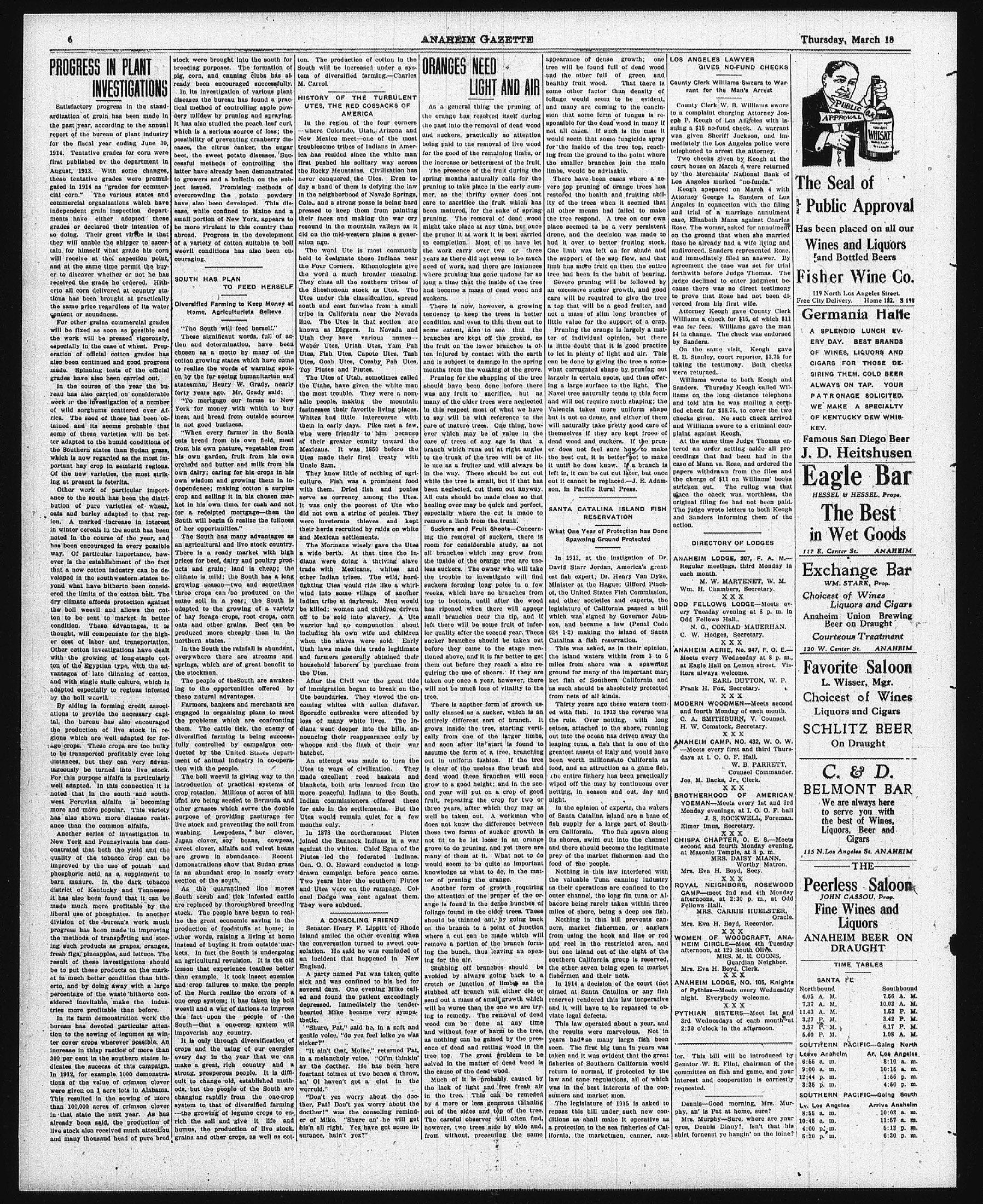
Searchable text
PROGRESS IN PLANT INVESTIGATIONS
Satisfactory progress in the standardization of grain has been made in the past year, according to the annual report of the bureau of plant industry for the fiscal year ending June 30, 1914. Tentative grades for corn were first published by the department in August, 1913. With some changes, these tentative grades were promulgated in 1914 as "grades for commercial corn." The various states and commercial organizations which have independent grain inspection departments have either adopted these grades or declared their intention of so doing. Their great virtue is that they will enable the shipper to ascertain for himself what grade his corn will receive at the inspection point, and at the same time permit the buyer to discover whether or not he has received the grade he ordered. Hitherto all corn delivered at country stations has been brought at practically the same price regardless of its water content or soundness.
For other grains commercial grades will be fixed as soon as possible and the work will be pressed vigorously, especially in the case of wheat. Preparation of official cotton grades has also been continued and good progress made. Spinning tests of the official grades have also been carried out.
In the course of the year the bureau has also carried on considerable work in the investigation of a number of wild sorghums scattered over Africa. The seed of those has been obtained and its seems probable that some of these varieties will be better adapted to the humid conditions of the Southern states than Northern ones.
stock were brought into the south for breeding purposes. The formation of pig, corn, and canning clubs has already been encouraged successfully.
In its investigation of various plant diseases the bureau has found a practical method of controlling apple powder mildew by pruning and spraying. It has also studied the peach leaf curl, which is a serious source of loss; the possibility of preventing cranberry diseases, the citrus canker, the sugar beet, the sweet potato diseases. Successful methods of controlling the latter have already been demonstrated to growers and a bulletin on the subject issued. Promising methods of overcrowding the potato powder have also been developed. This disease, while confined to Maine and a small portion of New York, appears to be more virulent in this country than abroad. Progress in the development of a variety of cotton suitable to boll weevil conditions has also been encouraging.
SOUTH HAS PLAN TO FEED HERSELF
Diversified Farming to Keep Money at Home, Agriculturists Believe
"The South will feed herself."
These significant words, full of action and determination, have been chosen as a motto by many of the cotton growing states which have come to realize the words of warning spoken by the far seeing humanitarian and statesman, Henry W. Grady, nearly forty years ago. Mr. Grady said:
"To mortgage our farms to New York for money with which to buy meat and bread from outside sources is not good business.
When every farmer in the South eats bread from his own field, meat from his own nature vegetables from"
The production of South will be increased tem of diversified farm M. Carrol.
HISTORY OF THE UTES, THE RED CROSS AMERICA
In the region of the —where Colorado, Utah New Mexico meet—troublesome tribes of Ica has resided since first pushed his solitary Rocky Mountains. never conquered, the day a band of them is in the neighborhood of Colo., and a strong posed pressed to keep them their faces and make resound in the mountain did on the mid-western action ago.
The word Ute is held to designate those Four Corners. Eddie the word a much berry class all the soils Shoshonean stock Utes under this class south and east fanlike tribe in California near known as Diggers. Utah they have var Weber Utes, Uriah Utes, Fish Utes, Cap Utes, Gosh Utes, Co Toy Plutes and Plutee.
The Utes of Utah, sothe Utahs, have given the most trouble. The adio people, making fastnesses their favorites Whites had little in them in early days who were friendly to of their greater enemies.
In the course of the year the bureau has also carried on considerable work in the investigation of a number of wild sorghums scattered over Africa. The seed of these has been obtained and its seems probable that some of these varieties will be better adapted to the humid conditions of the Southern states than Sudan grass, which is now regarded as the most important hay crop in semiarid regions. Of the new varieties, the most striking at present is feterita.
Other work of particular importance to the south has been the distribution of pure varieties of wheat, oats and barley adapted to that region. A marked increase in interest in winter cereals in the south has been noted in the course of the year, and has been encouraged in every possible way. Of particular importance, however is the establishment of the fact that a new cotton industry can be developed in the southwestern states beyond what have hitherto been considered the limits of the cotton belt. The dry climate affords protection against the boll weevil and allows the cotton to be sent to market in better condition. These advantages, it is thought, will compensate for the higher cost of labor and transportation. Other cotton investigations have dealt with the growing of long-staple cotton of the Egyptian type, with the advantages of late thinning of cotton, and with single stalk culture, which is adapted especially to regions infested by the boll weevil.
By alding in forming credit associations to provide the necessary capital, the bureau has also encouraged the production of live stock in regions which are well adapted fororage crops. These crops are too bulky to be transported profitably over long distances, but they can very advantageously be turned into live stock. For this purpose alfalfa is particularly well adapted. In this connection it is noted that in the south and southwest Peruvian alfalfa is becoming more and more popular. This variety has also shown more disease resistance than the common alfalfa.
Another series of investigation in New York and Pennsylvania has demonstrated that both the yield and the cotton growing states which have come to realize the words of warning spoken by the far seeing humanitarian and statesman, Henry W. Grady, nearly forty years ago. Mr. Grady said:
"To mortgage our farms to New York for money with which to buy meat and bread from outside sources is not good business.
"When every farmer in the South eats bread from his own field, meat from his own pasture, vegetables from his own garden, fruit from his own orchard and butter and milk from his own dairy; caring for his crops in his own wisdom and growing them in independence; making cotton a surplus crop and selling it in his chosen market in his own time, for cash and not for a redeemed mortgage—then the South will begin to realize the fullness of her opportunities."
The South has many advantages as an agricultural and livestock country. There is a ready market with high prices for beef, dairy and poultry products and grain; land is cheap; the climate is mild; the South has a long growing season—two and sometimes three crops can be produced on the same soil in a year; the South is adapted to the growing of a variety of hay forage crops, root crops, corn oats and other grains. Beef can be produced more cheaply than in the northern states.
In the South the rainfall is abundant, everywhere there are streams and springs, which are of great benefit to the stockman.
The people of the South are awakening to the opportunities offered by these natural advantages.
Farmers, bankers and merchants are engaged in organizing plans to meet the problems which are confronting them. The cattle tick, the enemy of diversified farming is being successfully controlled by campaigns conducted by the United States department of animal industry in co-operation with the people.
The boll weevil is giving way to the introduction of practical systems of crop rotation. Millions of acres of hill land are being seeded to Bermuda and other grasses which serve the double purpose of providing pasturage for live stock and preventing the soil from washing. Lespedeza, bur clover, Japan clover, soy beans, cowpeas, sweet clover, alfalfa and velvet beans
The Utes of Utah, at the Utahs, have given their most trouble. The adio people, making fastnesses their favorite Whites had little interest in them in early days who were friendly to their greater enemies Mexicans. It was that Utes made their first Uncle Sam.
They knew little of culture. Fish was added with them. Dried fish serve as currency as it was only the poor did not own a string were inveterate thus their herds recruited by Mexican settlers.
The Mormans wisely at wide berth. At their dians were doing trade with Mexican other Indian tribes fighting Utes would wind into some villain tribe at daybreak be killed; women and off to be sold into a warrior had no com-munication including his own wife when she slaves we Utah laws made this and farmers generally household laborers by the Utes.
After the Civil war of immigration began Ute boundaries. They coming whites with Sporadic outbreaks loss of many white dians went deeper into nouncing their reappositions whoops and the flask hatchet.
An attempt was made Utes to ways of civil made excellent reed blankets, both arts l more peaceful Indian Indian commissioners for sale in the settlement Utes would remain on months only.
In 1878 the north joined the Bannock I against the whites.
to be transported profitably over long distances, but they can very advantageously be turned into live stock. For this purpose alfalfa is particularly well adapted. In this connection it is noted that in the south and southwest Peruvian alfalfa is becoming more and more popular. This variety has also shown more disease resistance than the common alfalfa.
Another series of investigation in New York and Pennsylvania has demonstrated that both the yield and the quality of the tobacco crop can be improved by the use of potash and phosphoric acid as a supplement to barn manure. In the dark tobacco district of Kentucky and Tennessee it has also been found that it can be made much more profitable by the liberal use of phosphates. In another division of the bureau's work much progress has been made in improving the methods of transporting and storing such products as grapes, oranges, fresh figs, pineapples, and lettuce. The result of these investigations should be to put these products on the market in much better condition than hitherto, and by doing away with a large percentage of the waste hitherto considered inevitable, make the industries more profitable than before.
In its farm demonstration work the bureau has devoted particular attention to the sowing of legumes as winter cover crops wherever possible. An increase in this practice of more than 300 per cent in the southern states indicates the success of this campaign. In 1912, for example 1000 demonstrations of the value of crimson clover were given on 1 acre lots in Alabama. This resulted in the sowing of more than 100,000 acres of crimson clover in that state the next year. As has already been said, the production of live stock also received much attention and many thousand head of pure bred
An attempt was made Utes to ways of civil made excellent reed blankets, both arts I more peaceful Indian Indian commissioners for sale in the settle Utes would remain o months only.
In 1878 the north joined the Bannock Island against the whites. O Plutes led the fed Gen. O. O. Howard c drawn campaign before Two years later tho and Utes were on th one Dodge was sent They were subdued.
A CONSOLING Senator-Henry F. H Island smiled the other the conversation turned solution. He said he an incident that ha England.
A party named Pat slick and was confined several days. One ewed and found the pat depressed. Immediately hearted Mike became thetic.
"Shure, Pat," said I gentle voice, "do ye slicker?"
"It ain't that, Molk in a melancholy voice av the doether. He fourtant tolmes at two an' Ol haven't got worrul."
"Don't yez worry ther, Pat! Don't yez doother!" was the co er of Mike. "Shure his'n all right. Yez his surance, hain't yez?"
ANAHEIM GAZETTE
THE PRODUCTION OF COTTON IN THE SOUTH WILL BE INCREASED UNDER A SYSTEM OF DIVISIFIED FARMING.—Charles M. Carrol.
HISTORY OF THE TURBULENT UTES, THE RED COSSACKS OF AMERICA
In the region of the four corners—where Colorado, Utah, Arizona and New Mexico meet—one of the most troublesome tribes of Indians in America has resided since the white man first pushed his solitary way across the Rocky Mountains. Civilization has never conquered the Utes. Even today a band of them is defying the law in the neighborhood of Navajo Springs, Colo., and a strong posse is being hard pressed to keep them from painting their faces and making the war cry resound in the mountain valleys as it did on the mid-western plains a generation ago.
The word Ute is most commonly held to designate those Indians near the Four Corners. Ethnologists give the word a much broader meaning. They class all the southern tribes of the Shoshonean stock as Utes. The Utes under this classification, spread south and east fanwise from a small tribe in California near the Nevada line. The Utes in that section are known as Diggers. In Nevada and Utah they have various names—Weber Utes, Uriah Utes, Yam Pah Utes, Fish Utes, Capote Utes, Tash Utes, Gosh Utes, Cozaby Pah Utes, Toy Plutes and Plutes.
The Utes of Utah, sometimes called the Utahs, have given the white man the most trouble. They were a nomadic people, making the mountain fastnesses their favorite living places. Whites had little intercourse with them in early days. Pike met a few, who were friendly to him because of their greater enmity toward the Mexicans. It was 1850 before ORANGES NEED LIGHT AND AIR
As a general thing the pruning of the orange has resolved itself during the past into the removal of dead wood and suckers, practically no attention being paid to the removal of live wood for the good of the remaining limbs, or the increase or betterment of the fruit. The presence of the fruit during the spring months naturally calls for the pruning to take place in the early summer, as the thrifty owner does not care to sacrifice the fruit which has been matured, for the sake of spring pruning. The removal of dead wood might take place at any time, but once the pruner it at work it is best carried to completion. Most of us have let the work carry over two or three years as there did not seem to be much need of work, and there are instances where pruning has gone undone for so long a time that the inside of the tree had become a mass of dead wood and suckers.
There is now, however, a growing tendency to keep the trees in better condition and even to thin them out to some extent, also to see that the branches are kept off the ground, as the fruit on the lower branches is often injured by contact with the earth and is subject to damage in the spring months from the working of the grove.
Pruning for the shapping of the tree should have been done before there was any fruit to sacrifice, but as many of the older trees were neglected in this respect most of what we have to say will be with reference to the care of mature trees. One thing, however which may be of value in the care of trees of any age is that a branch which runs out at right angles appearance of dense growth; one tree will be found full of dead wood and the other full of green and healthy fruit wood. That there is some other factor than density of foliage would seem to be evident, and many are coming to the conclusion that some form of fungus is responsible for the dead wood in many if not all cases. If such is the case it would seem that some fungicide spray for the inside of the tree top, reaching from the ground to the point where the smaller branches join the main limbs, would be advisable.
There have been cases where a severe top pruning of orange trees has restored the health and fruiting ability of the trees when it seemed that all other means had failed to make the tree respond. A tree on our own place seemed to be a very persistent drone, and the decision was made to bud it over to better fruiting stock. One limb was left on for shade and the support of the sap flow, and that limb has more fruit on then the entire tree had been in the habit of bearing.
Severe pruning will be followed by an excessive sucker growth, and good care will be required to give the tree a top that will be a good fruler, and not a mass of slim branches of little value for the support of a crap.
Pruning the orange is largely a matter of individual opinion, but there is little doubt that it is good practice to let in plenty of light and air. This can be done by giving the tree a somewhat corrugated shape by pruning out largely in certain spots, and thus offering a large surface to the light. The Navel tree naturally tends to this form and will not require much shaping; the Valencia takes more uniform shape but is not so dense, and either of them will naturally take pretty good care of themselves if they are kept froze of dead wood and suckers. If the pruner does not feel sure how to make...
The Utes of Utah, sometimes called the Utahs, have given the white man the most trouble. They were a nomadic people, making the mountain fastnesses their favorite living places. Whites had little intercourse with them in early days. Pike met a few, who were friendly to him because of their greater empathy toward the Mexicans. It was 1850 before the Utes made their first treaty with Uncle Sam.
They knew little of nothing of agriculture. Fish was a prominent food with them. Dried fish and ponies serve as currency among the Utes. It was only the poorest of Ute who did not own a string of ponies. They were inveterate thieves and kept their herds recruited by raids on white and Mexican settlements.
The Mormans wisely gave the Utes a wide berth. At that time the Indians were doing a thriving slave trade with Mexicans, whites and other Indian tribes. The wild, hard-fighting Utes would ride like a whirlwind into some village of another Indian tribe at daybreak. Men would be killed; women and children driven off to be sold into slavery. A Ute warrior had no compunction about including his own wife and children when the slaves were sold. Early Utah laws made this trade legitimate and farmers generally obtained their household laborers by purchase from the Utes.
After the Civil war the great tide of immigration began to break on the Ute boundaries. They viewed the incoming whites with sullen disfavor. Sporadic outbreaks were attended by loss of many white lives. The Indians went deeper into the hills, announcing their reappearance only by whoops and the flash of their war hatchet.
An attempt was made to turn the Utes to ways of civilization. They made excellent reed baskets and blankets, both arts learned from the more peaceful Indians to the South. Indian commissioners offered these for sale in the settlements. But the Utes would remain quiet for a few months only.
In 1878 the northernmost Plutes joined the Bannock Indians in a war against the whites. Chief Egan of the
Pruning for the shapping of the tree should have been done before there was any fruit to sacrifice, but as many of the older trees were neglected in this respect most of what we have to say will be with reference to the care of mature trees. One thing, however which may be of value in the care of trees of any age is that a branch which runs out at right angles to the trunk of the tree will be of little use as a fruiter and will always be in the way. These should be cut out while the tree is small, but if that has been neglected, cut them out anyway. All cuts should be made close so that healing over may be quick and perfect, especially where the cut is made to remove a limb from the trunk.
Suckers and Fruit Shoots—Concerning the removal of suckers, there is room for considerable study, as not all branches which may grow from the inside of the orange tree are useless suckers. The owner who will take the trouble to investigate will find suckers forming long poles in a few weeks, which have no branches from top to bottom, until after the wood has ripened when there will appear small branches near the tip, and if left there will be some fruit of inferior quality after the second year. These sucker branches should be taken out before they came to the stage mentioned above, and it is far better to get them out before they reach a size requiring the use of shears. If they are taken out once a year, however, there will not be much loss of vitality to the tree.
There is another form of growth usually classed as a sucker, which is entirely different sort of branch. It grows inside the tree, starting vertically from one of the larger limbs, and soon after its start is found to assume the form of a tree, branching out in uniform fashion. If the tree is clear of the useless fine brush and dead wood these branches will soon grow to a good height; and in the second year will put on a crop of good fruit, repeating the crop for two or three years, after which they may as well be taken out. A workman who does not know the difference between these two forms of sucker growth is not fit to be let loose in an orange grove to do pruning, and yet there are subject to damage in the spring months from the working of the grove.
In David Starr Jordan, America's greatest fish expert; Dr. Henry Van Dyke, Minister at the Hague; Gifford Pinchot, the United States Fish Commission, and other societies and experts, the legislature of California passed a bill which was signed by Governor Johnson, and became a law (Penal Code 634 1-2) making the island of Santa Catalina a fish reservation.
This was asked, as In their opinion, the island waters within from 3 to 5 miles from shore was a spawning ground for many of the important market fish of Southern California and as such should be absolutely protected from nets of all kinds.
Thirty years ago these waters teemed with fish. In 1913 the reverse was the rule. Over netting, with long seines, attached to the shore, running out into the ocean has driven away the leaping tuna, a fish that is one of the greatest assets of Italy and would have been worth millions to California as food, and an attraction as a game fish. The entire fishery has been practically wiped off the may by continuous over netting, in season and out, day and night.
In the opinion of experts, the waters of Santa Catalina island are a base of fish supply for a large part of Southern California. The fish spawn along its shores, swim out into the channel and there become the legitimate
An attempt was made to turn the Utes to ways of civilization. They made excellent reed baskets and blankets, both arts learned from the more peaceful Indians to the South. Indian commissioners offered these for sale in the settlements. But the Utes would remain quiet for a few months only.
In 1878 the northernmost Plutes joined the Bannock Indians in a war against the whites. Chief Egan of the Plutes led the federated Indians. Gen. O. O. Howard conducted a long-drawn campaign before peace came. Two years later the southern Plutes and Utes were on the rampage. Colonel Dodge was sent against them. They were subdued.
A CONSOLING FRIEND
Senator-Henry F. Lippitt of Rhode Island smiled the other evening when the conversation turned to sweet consolation. He said he was reminded of an incident that happened in New England.
A party named Pat was taken quite slick and was confined to his bed for several days. One evening Mike called and found the patient exceedingly depressed. Immediately the tender-hearted Mike became very sympathetic.
"Shure, Pat," said he, in a soft and gentle voice, "do yez feel lolke ye was sklerer?"
"It aln't that, Molke," returned Pat, in a melancholy voice. "Ol'm thinkin' av the doether. He has been here fourtant tomes at two bones a throw, an' Ol haven't got a cint in the worruld."
"Don't yez worry about the doother, Pat! Don't yez worry about the doother!" was the consoling reminder of Mike. "Shure an' he will get his'n all right. Yez have got some insurance, hain't yez?"
Out in uniform fashion. If the tree is clear of the useless fine brush and dead wood these branches will soon grow to a good height; and in the second year will put on a crop of good fruit, repeating the crop for two or three years, after which they may as well be taken out. A workman who does not know the difference between these two forms of sucker growth is not fit to be let loose in an orange grove to do pruning, and yet there are many of them at it. What not to do would seem to be quite as important knowledge as what to do, in the matter of pruning the orange.
Another form of growth requiring the attention of the pruner of the orange is found in the dense bunches of foliage found in the older trees. These should be thinned out, by going back on the branch to a point of junction where a cut can be made which will remove a portion of the branch forming the bunch, thus leaving an opening for the air.
Stubbing off branches should be avoided by always going back to a crotch or junction of limbs as the stubbed off branch will either die or send out a mass of small growth which will be worse than the one we are trying to remedy. The removal of dead wood can be done at any time and without fear of harm to the tree, as nothing can be gained by the presence of dead and rotting wood in the tree top. The great problem to be solved in the matter of dead wood is the cause of the dead wood.
Much of it is probably caused by the lack of light and free fresh air in the tree. This can be remedied by a more or less generous thinning out of the sides and top of the tree. The careful observer will often find, however, two trees side by side and, from without, presenting the same
been worth millions to California as food, and an attraction as a game fish. The entire fishery has been practically wiped off the may by continuous over netting, in season and out, day and night.
In the opinion of experts, the waters of Santa Catalina island are a base of fish supply for a large part of Southern California. The fish spawn along its shores, swim out into the channel and there should become the legitimate prey of the market fishermen and the food of the people.
Nothing in this law interfered with the valuable Tuna canning industry as their operations are confined to the outer channel, the long fin tuna or Alacore being rarely taken within three miles of shore, being a deep sea fish.
Nothing in this bill prevents canners, market fishermen, or anglers from using the hook and line or rod and reel in the restricted area, and but one island out of the eight of the southern California group is reserved, the other seven being open to market fishermen and their nets.
In 1914 a decision of the court (not aimed at Santa Catalina or any fish reserve) rendered this law inoperative and it will have to be repassed to obviate legal defects.
This law operated about a year, and the results were marvelous. Not in years had so many large fish been seen. The first big tuna in years was taken and it was evident that the great fisheries of Southern California would return to normal, if protected by the law and same regulations, all of which was in the best interests of the consumers and market men.
The legislature of 1915 is asked to repass this bill under such new conditions as shall make it operative as a protection to the sea fisheries of California, the marketmen, canner, ang-
LOS ANGELES LAWYER
GIVES NO-FUND CHECKS
County Clerk Williams Swears to Warrant for the Man's Arrest
County Clerk W. B. Williams swore to a complaint charging Attorney Joseph P. Keogh of Los Angeles with issuing a $15 no-fund check. A warrant was given Sheriff Jackson, and immediately the Los Angeles police were telephoned to arrest the attorney.
Two checks given by Keogh at the court house on March 4 were returned by 'the Merchants' National Bank of Los Angeles marked "no-funds."
Keogh appeared on March 4 with Attorney George L. Sanders of Los Angeles in connection with the filing and trial of a marriage annulment case, Elizabeth Mann against Charles Rose. The woman asked for annulment on the ground that when she married Rose he already had a wife living and undivorced. Sanders represented Rose, and immediately filed an answer. By agreement the case was set for trial forthwith before Judge Thomas. The judge declined to enter judgment because there was no direct testimony to prove that Rose had not been divorced from his first wife.
Attorney Keogh gave County Clerk Williams a check for $15, of which $11 was for fees. Williams gave the man $4 in change. The check was endorsed by Sanders.
On the same visit, Keogh gave E. B. Stanley, court reporter, $3.75 for taking the testimony. Both checks were returned.
Williams wrote to both Keogh and Sanders. Thursday Keogh called Williams on the long distance telephone and told him he was mailing a certified check for $18.75, to cover the two checks given. No such check arrived and Williams swore to a criminal complaint against Keogh.
At the same time Judge Thomas entered an order setting aside all pro-
The Seal of Public Approval
Has been placed on all our Wines and Liquors and Bottled Beers
Fisher Wine Co.
119 North Los Angeles Street.
Free City Delivery.
Home 182. 3 198
Germania Halte
A SPLENDID LUNCH EV.
ERY DAY. BEST BRANDS
OF WINES, LIQUORS AND
CIGARS FOR THOSE DESIRING THEM. COLD BEER
ALWAYS ON TAP. YOUR
PATRONAGE SOLICITED.
WE MAKE A SPECIALTY
OF KENTUCKY DEW WHISKEY.
Famous San Diego Beer
E. B. Stanley, court reporter, $3.75 for taking the testimony. Both checks were returned.
Williams wrote to both Keogh and Sanders. Thursday Keogh called Williams on the long distance telephone and told him he was mailing a certified check for $18.75, to cover the two checks given. No such check arrived and Williams swore to a criminal complaint against Keogh.
At the same time Judge Thomas entered an order setting aside all proceedings that had been had in the case of Mann vs. Rose, and ordered the papers withdrawn from the files and the charge of $11 on Williams' books stricken out. The ruling was that since the check was worthless, the original filing fee had not been paid. The judge wrote letters to both Keogh and Sanders informing them of the action.
DIRECTORY OF LODGES
ANAHEIM LODGE, 207, F. A. M.—Regular meetings, third Monday in each month.
M. W. MARTENET, W. M.
Wm. H. Chambers, Secretary.
XX X
ODD FELLOWS LODGE—Meets every Tuesday evening at 8 p.m. in Odd Follows Hall.
N. G., CONRAD MAUERHAN.
C. W. Hedges, Secretary.
XX X
ANAHEIM AERIE, No. 947, F. O. E.—Meets every Wednesday at 8 p.m. at Eagle Hall on Lemon street. Visitors always welcome.
EARL DUTTON, W. P.
Frank H. Fox, Secretary.
XX X
MODERN WOODMEN—Meets second and fourth Monday of each month.
C. A. SMITHBURN, V. Counsel.
H. W. Comstock, Secretary.
XX X
ANAHEIM CAMP, NO. 432, W. O. W.—Meets every first and third Thursdays at I. O. O. F. Hall.
W. B. PARRETT,
Counsel Commander.
Jos. M. Backs, Jr., Clerk.
XX X
BROTHERHOOD OF AMERICAN YOEMAN—Meets every 1st and 3rd Monday evenings, at I. O. O. F. hall
J. S. ROCKWELL, Foreman.
Elmer Imus, Secretary.
XX X
CHISPA CHAPTER, O. E. S.—Meets second and fourth Monday evening.
Famous San Diego Beer
J. D. Heitshusen
Eagle Bar
HESSEL & HESSEL, Props.
The Best in Wet Goods
117 E. Center St.
ANAHEIM
Exchange Bar
WM. STARK, Prop.
Choicest of Wines
Liquors and Cigars
Anaheim Union Brewing
Beer on Draught
Courteous Treatment
120 W. Center St.
ANAHEIM
Favorite Saloon
L. Wisser, Mgr.
Choicest of Wines
Liquors and Cigars
SCHLITZ BEER
On Draught
C. & D.
BELMONT BAR
We are always here to serve you with the best of Wines,
Liquors, Beer and Cigars
C. & D.
BELMONT BAR
We are always here to serve you with the best of Wines,
Liquors, Beer and Cigars
115 N.Los Angeles St. ANAHEIM
THE
Peerless Saloon
JOHN CASSOU. Prop.
Fine Wines and Liquors
ANAHEIM BEER ON DRAUGHT
TIME TABLES
SANTA FE
Northbound Southbound
6.05 A.M. 7.56 A.M.
7.37 A.M. 10.02 A.M.
11.43 A.M. 1.52 P.M.
3.27 P.M. 3.42 P.M.
3.57 P.M. 6.17 P.M.
5.40 P.M. 1.08 A.M.
SOUTHERN PACIFIC—Going North
Leave Anaheim Ar. Los Angeles
6:55 a.m. 8:10 a.m.
9:00 a.m. 10:15 a.m.
12:44 p.m. 1:55 p.m.
3:35 p.m. 4:50 p.m.
SOUTHERN PACIFIC—Going South
Lv. Los Angeles Arrive Anaheim
8:55 a.m. 10:02 a.m.
10:45 a.m. 11:57 a.m.
4:00 p.m. 5:12 p.m.
5:20 p.m. 6:30 p.m.