anaheim-gazette 1915-03-18
Scanned page
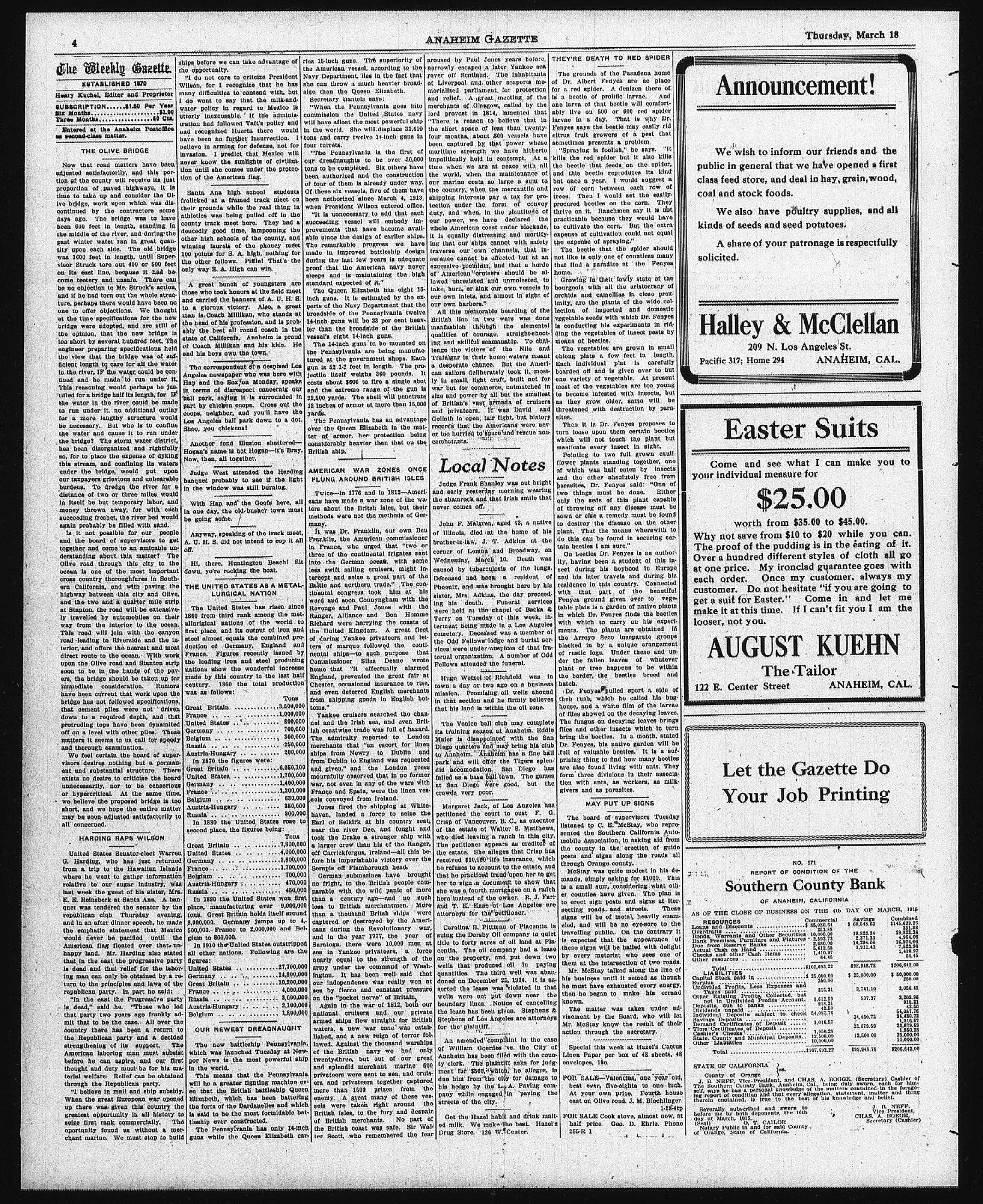
Searchable text
Now that road matters have been adjusted satisfactorily, and this portion of the county will receive its just proportion of paved highways, it is time to take up and consider the Olive bridge, work upon which was discontinued by the contractors some days ago. The bridge was to have been 600 feet in length, standing in the middle of the river, and during the past winter water ran in great quantity upon each side. The old bridge was 1600 feet in length, until Supervisor Struck tore out 400 or 500 feet on its east line, because it had become teetering and unsafe. There can be no objection to Mr. Struck's action, and if he had torn out the whole structure, perhaps there would have been no one to offer objections. We thought at the time specifications for the new bridge were adopted, and are still of the opinion, that the new bridge is too short by several hundred feet. The engineer preparing specifications held the view that the bridge was of sufficient length to care for all the water in the river, IF the water could be continued and be made to run under it. This reasoning would perhaps be justified for a bridge half its length, for IF the water in the river could be made to run under it, no additional outlay for a more lengthy structure would be necessary. But who is to confine the water and cause it to run under the bridge? The storm water district, has been disorganized and rightfully ships before we can take advantage of the opportunity.
"I do not care to criticize President Wilson, for I recognize that he has many difficulties to contend with, but I do want to say that the milk-and-water policy in regard to Mexico is utterly inexcusable." If the administration had followed Taft's policy and recognized Huerta there would have been no further insurrection. I believe in arming for defense, not for invasion. I predict that Mexico will never know the sunlights of civilization until she comes under the protection of the American flag.
Santa Ana high school students frolicled at a framed track meet on their grounds while the real thing in athletics was being pulled off in the county track meet here. They had a deucedly good time, lampooning the other high schools of the county, and winning laurels of the phone meet 100 points for S. A. high, nothing for the other fellows. Piffle! That's the only way S. A. High can win.
A great bunch of youngsters are those who took honors at the field meet and carried the banners of A. U. H. S. to a glorious victory. Also, a great man is Coach Millikan, who stands at the head of his profession, and is probably the best all round coach in the state of California. Anaheim is proud of Coach Millikan and his kids. He and his boys own the town.
The correspondent of a desplaced Los Angeles newspaper who was here with Hap and the Sox on Monday, speaks in terms of disrespect concerning our ball park, saying it is surrounded in part by chicken coops. Cross out the coops, neighbor, and you'll have the Los Angeles ball park down to a dot. Shoo, you chickens!
Another fond illusion shattered—riles 15-inch guns. To the American vessel, Navy Department, lie she can throw a mu-side than the Queen Secretary Daniels.
"When the Pennsylvania commission the Uni- will have afloat the ra- in the world. She w- tons and carry twelve four turrets.
"The Pennsylvanian our dreadnaughts t tons to be completed been authorized and of four of them is a Of these six vessels, been authorized since when President Wil- "It is unnecessary succeeding vessel provements that ha- able since the design The remarkable pro- made in improved during the last few proof that the Am- sleeps and is ma- standard expected o- The Queen Elizabeth inch guns. It is es- ports of the Navy D broadside of the Po 14-inch guns will be farer than the broadse vessel's eight 14-inch.
The 14-inch guns the Pennsylvania sit- tured at the govern- gun is 52.1-2 feet in jectile itself weigh costs about $600 to- and the extreme run 22,500 yards. The 12 inches of armor yards.
The Pennsylvanian over the Queen Elli- ter of armor, he considerably heavier
the view that the bridge was of sufficient length to care for all the water in the river, IF the water could be continued and be made to run under it. This reasoning would perhaps be justified for a bridge half its length, for IF the water in the river could be made to run under it, no additional outlay for a more lengthy structure would be necessary. But who is to confine the water and cause it to run under the bridge? The storm water district, has been disorganized and rightfully so, for to place the expense of dyking this stream, and confining its waters under the bridge, would put upon our taxpayers grievous and unbearable burdens. To dredge the river for a distance of two or three miles would in itself be but temporary labor, and money thrown away, for with each succeeding freshet, the river bed would again probably be filled with sand.
Is it not possible for our people and the board of supervisors to get together and come to an amicable understanding about this matter? The Olive road through this city to the ocean is one of the most important cross country thoroughfares in Southern California, and with paving the highway between this city and Olive, and the two and a quarter mile strip at Stanton, the road will be extensively travelled by automobiles on their way from the interior to the ocean. This road will join with the canyon road leading to Riverside and the interior, and offers the nearest and most direct route to the ocean. With work upon the Olive road and Stanton strip soon to be in the hands of the pavers, the bridge should be taken up for immediate consideration. Rumors have been current that work upon the bridge has not followed specifications, that cement piles were not driven down to a required depth, and that protruding tops have been dynamited off on a level with other piles. These matters it seems to us call for speedy and thorough examination.
We feel certain the board of supervisors desires nothing but a permanent and substantial structure. There exists no desire to criticise the board unnecessarily, nor to be censorious or hypercritical. At the same time, we believe the proposed bridge is too short, and we hope the entire matter may be soon adjusted satisfactorily to all concerned.
HARDING RAPS WILSON
The correspondent of a desplaced Los Angeles newspaper who was here with Hap and the Soxjon Monday, speaks in terms of disrespect concernlg our ball park, saying it is surrounded in part by chicken coops. Cross out the coops, neighbor, and you'll have the Los Angeles ball park down to a dot. Shoo, you chickens!
Another fond illusion shattered—Hogan's name is not Hogan—it's Bray. Now, then, all together.
Judge West attended the Harding banquet probably to see if the light in the window was still burning.
With Hap and the Goofs here, all in one day, the old busher town must be going some.
Anyway, speaking of the track meet, A. U. H. S. did not intend to cop it all off.
Hi, there, Huntington Beach! Sit down, you're rocking the boat.
THE UNITED STATES AS A METAL-LURGICAL NATION
The United States has risen since 1860 from third rank among the metallurgical nations of the world to first place, and its output of iron and steel almost equals the combined production of Germany, England and France. Figures recently issued by the leading iron and steel producing nations show the wonderful increase made by this country in the last half century. 1860 the total production was as follows:
Tons
Great Britain ...3,500,000
France ...1,000,000
United States ...800,000
Germany ...700,000
Belgium ...300,000
Russia ...250,000
Austria-Hungary ...200,000
In 1870 the figures were:
Great Britain ...6,050,100
United States ...1,700,000
Germany ...1,400,000
France ...1,200,000
Belglum ...630,000
Austria-Hungary ...350,000
Russia ...800,000
In 1880 the United States rose to second place, the figures being:
Tons
Great Britain ...7,800,000
HARDING RAPS WILSON
United States Senator-elect Warren G. Harding, who has just returned from a trip to the Hawaiian Islands where he went to gather information relative to our sugar industry, was last week the guest of his sister, Mrs. E. E. Reinsbark at Santa Ana. A banquet was tendered the senator by the republican club Thursday evening, and in an after dinner speech, he made the emphatic statement that Mexico would never be pacified until the American flag floated over that unhappy land. Mr. Harding also stated that in the east the progressive party is dead and that relief for the laboring man can only be obtained by a return to the principles and laws of the republican party. In part he said:
"In the east the Progressive party is dead," said he. "Those who led that party two years ago frankly admit that to be the case. All over the country there has been a return to the Republican party and a decided strengthening of its support. The American laboring man must subsist before he can aspire, and our first thought and duty must be for his material welfare: Relief can be obtained through the Republican party.
"I believe in mail and ship subsidy. When the great European war opened up there was given this country the greatest opportunity in all history to seize first rank commercially. The opportunity found us without a merchant marine. We must stop to build
In 1870 the figures were:
Great Britain ... 6,050,100
United States ... 1,700,000
Germany ... 1,400,000
France ... 1,200,000
Belgium ... 630,000
Austria-Hungary ... 350,000
Russia ... 800,000
In 1880 the United States rose to second place, the figures being:
Tons
Great Britain ... 7,800,000
United States ... 4,000,000
Germany ... 2,800,000
France ... 1,700,000
Belgium ... 700,000
Austria-Hungary ... 470,000
Russia ... 450,000
In 1890 the United States won first place, manufacturing over 9,000,000 tons. Great Britain holds itself around 8,000,000. Germany jumps up to 4,500,000. France to 2,000,000 and Belgium to 800,000.
In 1910 the United States outstripped all other nations. Following are the figures:
United States ... 27,700,000
Germany ... 14,800,000
Great Britain ... 10,200,000
France ... 4,000,000
Russia ... 3,000,000
Austria-Hungary ... 2,100,000
Belgium ... 1,800,000
OUR NEWEST DREADNAUGHT
The new battleship Pennsylvania, which was launched Tuesday at Newport News is the most powerful ship in the world.
This means that the Pennsylvania will be a greater fighting machine even that the British battleship Queen Elizabeth, which has been battering the forts of the Dardanelles and which is said to be the most formidable battleship ever constructed.
The Pennsylvania has only 14-inch guns while the Queen Elizabeth car-
ANAHEIM GAZETTE
ries 15-inch guns. The superiority of the American vessel, according to the Navy Department, lies in the fact that she can throw a much heavier broadside than the Queen Elizabeth.
Secretary Daniels says:
"When the Pennsylvania goes into commission the United States navy will have afford the most powerful ship in the world. She will displace 31,400 tons and carry twelve 14-inch guns in four turrets.
"The Pennsylvania is the first of our dreadnaughts to be over 30,000 tons to be completed. Six others have been authorized and the construction of four of them is already under way. Of these six vessels, five of them have been authorized since March 4, 1913, when President Wilson entered office.
"It is unnecessary to add that each succeeding vessel will embody improvements that have become available since the design of earlier ships. The remarkable progress we have made in improved battleship design during the last few years is adequate proof that the American navy never sleeps and is maintaining the high standard expected of it."
The Queen Elizabeth has eight 15-inch guns. It is estimated by the experts of the Navy Department that the broadside of the Pennsylvania twelve 14-inch guns will be 23 per cent heavier than the broadside of the British vessel's eight 14-inch guns.
The 14-inch guns to be mounted on the Pennsylvania are being manufactured at the government shops. Each gun is 52.1-2 feet in length. The project itself weighs 360 pounds. It costs about $600 to fire a single shot and the extreme range of the gun is 22,500 yards. The shell will penetrate 12 inches of armor at more than 15,000 yards.
The Pennsylvania has an advantage over the Queen Elizabeth in the matter of armor, her protection being considerably heavier than that on the aroused by Paul Jones years before, narrowly escaped a later Yankee sea rover off Scotland. The inhabitants of Liverpool and other seaports memorialized parliament for protection and relief. A great meeting of the merchants of Glasgow, called by the lord provost in 1814, lamented that "There is reason to believe that in the short space of less than twenty-four months, about 800 vessels have been captured by that power whose maritime strength we have hitherto impolitically held in contempt. At a time when we are at peace with all the world, when the maintenance of our marine costs so large a sum to the country, when the mercantile and shipping interests pay a tax for protection under the form of convoy duty, and when, in the plentitude of our power, we have declared the whole American coast under blockade, it is equally distressing and mortifying that our ships cannot with safety traverse our own channels, that insurance cannot be effected but at an excessive premium, and that a horde of American cruisers should be allowed unresisted and unmolested, to take, burn, or sink our own vessels in our own inlets, and almost in sight of our own harbors."
All this memorable boarding of the British lion in two wars was done manfashion through the elemental qualities of courage, straight-shooting and skillful seamanship. To challenge the victors of the Nile and Trafalgar in their home waters meant a desperate chance. But the American sailors deliberately took it, mostly in small, light craft, built not for war but for commerce, outmatched in size and power by all but the smallest of Britain's vast armada of cruisers and privateers. It was David and Gollath in open, fair fight, but history records that the Americans were never too hurried to spare and rescue non-combatants.
THEY'RE DEATH TO RED SPIDER
The grounds of the Pasadena home of Dr. Albert Fenyes are no place for a red spider. A denizen there of is a beetle of prolific larvae. And one larva of that beetle will comfortably live on 500 or 600 red spider larvae in a day. That is why Dr. Fenyes says the beetle may easily rid citrus fruit growers of a pest that sometimes presents a problem.
"Spraying is foolish," he says. "It kills the red spider but it also kills the beetle that feeds on the spider, and this beetle reproduces its kind but once a year. I would suggest a row of corn between each row of trees. Then I would set the easily-procurred beetles on the corn. They thrive on it. Ranchmen say it is not practicable because they would have to cultivate the corn. But the extra expense of cultivation could not equal the expense of spraying."
The beetle that the spider should not like is only one of countless many that find a paradise at the Fenyes home.
Growing in their lowly state of the bourgeois with all the aristocracy of orchids and camellias in close proximity, are the plants of the wide collection of imported and domestic vegetable seeds with which Dr. Fenyes is conducting his experiments in riding the vegetables of insect pests by means of beetles.
The vegetables are grown in small oblong plats a few feet in length. Each individual plat is carefully boarded off and is given over to but one variety of vegetable. At present most of the vegetables are too young to become infested with insects, but as they grow older, some will be threatened with destruction by parasites.
Then it is Dr. Fenyes proposes to turn loose upon them certain beetles which will not touch the plant but masticate every insect in sight.
AMERICAN WAR ZONES ONCE FLUNG AROUND BRITISH ISLES
Twice—in 1776 and in 1812—Americans have made a war zone of the waters about the British Isles, but their methods were not the methods of Germany.
It was Dr. Franklin, our own Ben Franklin, the American commissioner in France, who urged that "two or three of the continental frigates sent into the German ocean, with some less swift sailing cruisers, might intercept and seize a great part of the Baltic and northern trade." The continental congress took him at his word and soon Connyngham with the Revenge and Paul Jones with the Ranger, Alliance and Bon Homme Richard were harrying the coasts of the United Kingdom. A great fleet of daring Yankee privateers and letters of marque followed the continental ships—to such purpose that Commissioner Sillas Deane wrote home that "it effectually alarmed England, prevented the great fair at Chester, occasioned insurance to rise, and even deterred English merchants from shipping goods in English bottoms."
Yankee cruisers searched the channel and the Irish sea, and even British coastwise trade was full of hazard. The admiralty reported to London merchants that "an escort for linen ships from Newry to Dublin and from Dublin to England was requested and given." and the London press mournfully observed that in no former war, not even in any of the wars with France and Spain, were the linen vessels conveyed from Ireland.
Jones fired the shipping at Whitehaven, landed a force to seize the Earl of Selkirk at his country seat, near the river Dee, and fought to take the Drake a stronger ship with a larger crew than his of the Ranger, all this he tured at the government shops. Each gun is 52.1-2 feet in length. The projectile itself weighs 360 pounds. It costs about $600 to fire a single shot and the extreme range of the gun is 22,500 yards. The shell will penetrate 12 inches of armor at more than 15,000 yards.
The Pennsylvania has an advantage over the Queen Elizabeth in the matter of armor, her protection being considerably heavier than that on the British ship.
Trafalgar in their home waters meant a desperate chance. But the American sailors deliberately took it, mostly in small, light craft, built not for war but for commerce, outmatched in size and power by all but the smallest of Brittana's vast armada of cruisers and privateers. It was David and Gollath in open, fair fight, but history records that the Americans were never too hurried to spare and rescue noncombatants.
Local Notes
Judge Frank Shanley was out bright and early yesterday morning wearing the shamrock and that Irish smile that never comes off.
John F. Malgren, aged 42, a native of Illinois, died at home of his brother-in-law, J. T. Adkins at the corner of Lemon and Broadway, on Wednesday, March 10. Death was caused by tuberculosis of the lungs. Decceased had been a resident of Phoenix, and was brought here by his sister, Mrs. Adkins, the day preceding his death.
Funeral services were held at the chapel of Backs & Terry on Tuesday of this week, interment being made in a Los Angeles cemetery. Decceased was a member of the Odd Fellows' lodge and burial services were under auspices of that fraternal organization. A number of Odd Fellows attended the funeral.
Hugo Wetzel of Richfield was in town a day or two ago on a business mission. Promising oil wells abound in that section and he firmly belloves that his land is within the oil zone.
The Venice ball club may complete its training season at Anaheim. Eddie Maier is disappointed with the San Diego quarters and may bring his club to Anaheim. Anaheim has a fine ball park and will offer the Tigers splendid accommodation. San Diego has failed as a base ball town. The games at San Diego were good, but the crowds very poor.
Margaret Jack, of Los Angeles has petitioned the court to oust F. G. Crisp of Vancouver, B. C., as executor of the estate of Walter S. Matthews, who died leaving a ranch in this city. The petitioner appears as creditor of oblong plats a few feet in length. Each individual plat is carefully boarded off and is given over to but one variety of vegetable. At present most of the vegetables are too young to become infested with insects, but as they grow older, some will be threatened with destruction by parasites.
Then it is Dr. Fenyes proposes to turn loose upon them certain beetles which will not touch the plant but masticate every insect in sight.
Pointing to two full grown cauliflower plants standing together, one of which was half eaten by insects and the other absolutely free from parasites, Dr. Fenyes said: "One of two things must be done. Either only the seeds of this plant capable of throwing off any disease must be sown or else a remedy must be found to destroy the disease on the other plant. That means wherewith to do this can be found in securing certain beetles I am sure."
On beetles Dr. Fenyes is an authority, having been a student of this insect during his boyhood in Europe and his later travels and during his residence in this country. Connected with that part of the beautiful Fenyes ground given over to vegetable plats is a garden of native plants in which Dr. Fenyes finds the beetles with which to carry on his experiments. The plants are obtained in the Arroyo Seco inseparate groups blocked in by a unique arrangement of rustic logs. Under these and under the fallen leaves of whatever plant or tree happens to be within the border, the beetles breed and hatch.
Dr. Fenyes pulled apart a side of theeb rush, which he called his bughouse, and a white film of the larvae of flies showed on the decaying leaves. The fungus on decaying leaves brings flies and other insects which in turn bring the beetles. In a month, stated Dr. Fenyes, his native garden will be full of valuable beetles. It is a surprising thing to find how many beetles are also found living with ants. They form three divisions in their association with ants, as workers, as milkglivers and as parasites.
MAY PUT UP SIGNS
The board of supervisors Tuesday listened to C. E. McStay, who represented the Southern California Automobile Association, in asking aid from the county in the erection of guide
from Dublin to England was requested and given," and the London press mournfully observed that in no former war, not even in any of the wars with France and Spain, were the linen vessels conveyed from Ireland.
Jones fired the shipping at Whitehaven, landed a force to seize the Earl of Selkirk at his country seat, near the river Dee, and fought and took the Drake a stronger ship with a larger crew than his of the Ranger, off Carrickfergus, Ireland—all this before his imperishable victory over the Serapis off Flamborough head.
German submarines have brought no fright, to the British people comparable with the wild panic of more than a century ago—and no such loss to British merchantmen. More than a thousand British ships were captured or destroyed by the Americans during the Revolutionary war, and in the year 1777, the year of Saratoga, there were 10,000 men at sea in Yankee privateers, a force nearly equal to the strength of the army under the command of Washington. It has been well said that our independence was really won at sea by fierce and constant pressure on the "pocket nerve" of Britain.
Again in the war of 1812, both our national cruisers and our private armed ships flew straight for British waters, a new war zone was established, and a new reign of terror followed. Against the thousand warships of the British navy we had only twenty-three, but out of our great and splendid merchant marine 500 privateers were sent to sea, and cruisers and privateers together captured more than 1500 prizes from the enemy. A great many of these vessels were taken right around the British Isles, to the fury and despair of British merchants. No part of the British coast was safe. Sir Walter Scott, who remembered the fear park and will offer the Tigors splendid accommodation. San Diego has failed as a base bull town. The games at San Diego were good, but the crowds very poor.
Margaret Jack, of Los Angeles has petitioned the court to oust F. G. Crisp of Vancouver, B.C., as executor of the estate of Walter S. Matthews, who died leaving a ranch in this city. The petitioner appears as creditor of the estate. She alleges that Crisp has received $10,000 life insurance, which he refuses to account to the estate, and that he practiced fraud upon her to get her to sign a document to show that she was a fourth mortgagee on a rancher instead of the owner. R. J. Farr and T. K. Kase of Los Angeles are attorneys for the petitioner.
Carolina B. Pittman of Placentia is suing the Dorsaby Oil company to quiet title to forty acres of oil land at Placentia. The oil company had a lease on the property, and put down two wells that produced oil in paying quantities. The third well was abandoned on December 25, 1914. It is asserted the lease was violated in that wells were not put down near the boundary lines. Notice of cancelling the lease has been given. Stephens & Stephens of Los Angeles are attorneys for the plaintiff.
An amended complaint in the case of William Goerdos vs. the City of Anaheim has been filed with the county clerk. The plaintiff asks for judgment for $500, which he alleges, is due him from the city for damage to his hedge by the L.A. Paving company while engaged in paving the streets of the city.
Get the Hazel habit and drink malted milk. We make the best. Hazel's Drug Store. 126 W. Center.
MAY PUT UP SIGNS
The board of supervisors Tuesday listened to C. E. McStay, who represented the Southern California Automobile Association, in asking aid from the county in the erection of guide posts and signs along the roads all through Orange county.
McStay was quite modest in his demands, simply asking for $1000. This is a small sum considering what other counties have given. The plan is to erect sign posts and signs at itersecting roads and streets. These signs will be of metal, heavily enameled, and will be no eye-sore to the travelling public. On the contrary it is expected that the appearance of these signs will be hailed with delight by every motorist who sees one of them at the intersection of two roads.
Mr. McStay talked along the line of his business until it seemed as though he must have exhausted every energy, then he began to make his errand known.
The matter was taken under advisement by the Board, who will let Mr. McStay know the result of their action through the secretary.
Special this week at Hazel's Cactus Linen Paper per box of 48 sheets, 48 envelopes, 19c.
FOR SALE—Valencias, one year old, best ever, five-eights to one inch. At your own price. Fourth house east on Olive road. J. M. Blochlinger.
FOR SALE Cook stove, almost new, at half price. Geo. D. Ehrle. Phone 255-R 1
Thursday, March 18
Announcement!
We wlsh to inform our friends and the public in general that we have opened a first class feed store, and deal in hay, grain, wood, coal and stock foods.
We also have poultry supplies, and all kinds of seeds and seed potatoes.
A share of your patronage is respectfully solicited.
Halley & McClellan
209 N. Los Angeles St.
Pacific 317; Home 294 ANAHEIM, CAL.
Easter Suits
Easter Suits
Come and see what I can make you to your individual measure for
$25.00
worth from $35.00 to $45.00.
Why not save from $10 to $20 while you can.
The proof of the pudding is in the eating of it.
Over a hundred different styles of cloth all go at one price.
My ironclad guarantee goes with each order.
Once my customer, always my customer. Do not hesitate "if you are going to get a suit for Easter." Come in and let me make it at this time. If I can't fit you I am the looser, not you.
AUGUST KUEHN
The Tailor
122 E. Center Street ANAHEIM, CAL.
Let the Gazette Do Your Job Printing
Let the Gazette Do Your Job Printing
NO. 571
REPORT OF CONDITION OF THE Southern County Bank
OF ANAHEIM, CALIFORNIA
AS OF THE CLOSE OF BUSINESS ON THE 4th DAY OF MARCH, 1915
RESOURCES
Loans and Discounts ... $85,080.64
Overdrafts ... 251.88
Bonds, Warrants and Other Securities ... 10,000.00
Bank Premises, Furniture and Fixtures ... 2,592.73
Due from Reserve Banks ... 2,680.00
Actual Cash on Hand ... 5,612.55
Checks and other Cash Items ... 1,410.97
Other resources ... 64.45
Total ... $107,693.22
LIABILITIES
Capital Stock paid in ... $25,000.00
Surplus ... 250.00
Undivided Profits, Less Expenses and Taxes paid ... 315.31
Other Existing Profits, Collected, but not in Undivided Profits Account ... 1,612.59
Deposits, due to banks ... 918.21
Dividends unpaid ... 42.50
Individual Deposits subject to check ... 54,087.76
Savings Deposits ... 34,430.72
Demand Certificates of Deposit ... 1,016.57
Time Certificates of Deposit ... 23,679.59
Cashier's Checks ... 1,950.28
State, County and Municipal Deposits ... 12,500.00
Other Liabilities ... 10,000.00
Total ... $107,693.22
STATE OF CALIFORNIA
County of Orange
J. B. NEFF, Vice-President, and CHAS. A. BOOGE, (Secretary) Cashier of The Southern County Bank, Anaheim, Cal., being duly sworn, each for himself, says he has a personal knowledge of the matters contained in the foregoing report of condition and that every allegation, statement, matter and thing therein covenanted, is true to the best of his knowledge and belief.
Severally subscribed and sworn to before me by both deponents, the 16th day of March, 1915.
(Seal)
O. T. CAILOR
Notary Public in and for said County of Orange, State of California.
J. B. NEFF,
Vice President.
CHAS. A. BOOGE,
Secretary (Cashier)