anaheim-gazette 1915-03-11
Scanned page
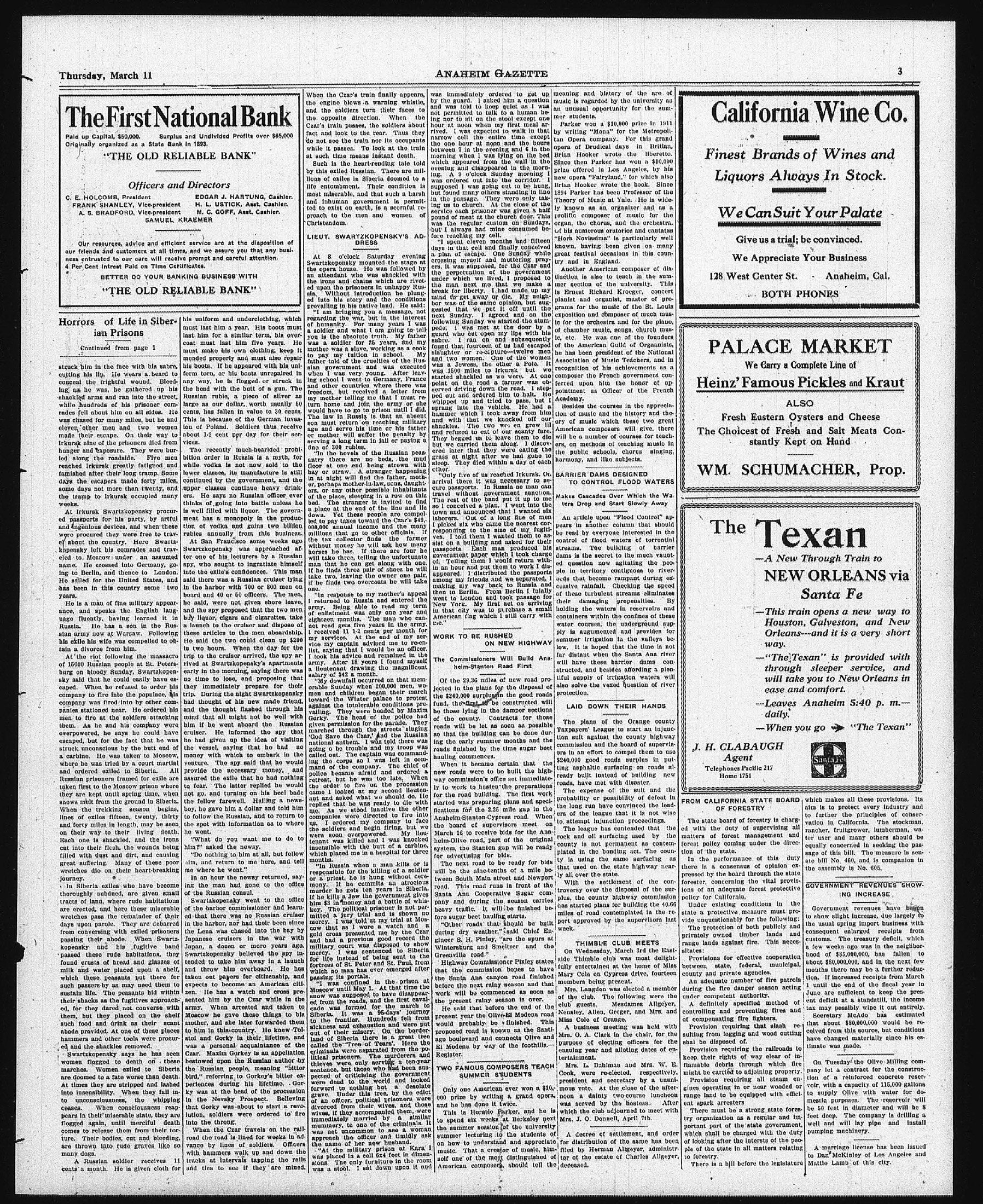
Searchable text
Thursday, March 11
The First National Bank
Paid up Capital, $50,000. Surplus and Undivided Profits over $65,000 Originally organized as a State Bank in 1893.
"The Old Reliable Bank"
Officers and Directors
C. E..HOLCOMB, President EDGAR J. HARTUNG, Cashier.
FRANK SHANLEY, Vice-president H. L. USTICK, Asst. Cashler.
A. S. BRADFORD, Vice-president M. C. GOFF, Asst. Cashler.
SAMUEL KRAEMER
Our resources, advice and efficient service are at the disposition of our fellows and customers at all times, and we assure you that any business entrusted to our care will receive prompt and careful attention.
4 Per Cent Interest Paid on Time Certificates.
BETTER DO YOUR BANKING BUSINESS WITH
"The Old Reliable Bank"
Horrors of Life in Siberian Prisons
Continued from page 1
struck him in the face with his sabre, cutting his lip. He wears a beard to conceal the frightful wound. Bleeding as he was, he gathered up his shackled arms and ran into the street, while hundreds of his prisoner comrades fell about him on all sides. He was chased for many miles, but he and eleven other men and two women made their escape. On their way to Irkursk nine of the prisoners died from his uniform and underclothing, which must last him a year. His boots must last him for a similar term, his overcoat must last him five years. He must make his own clothing, keep it mended properly and must also repair his boots. If he appeared with his uniform torn, or his boots unrepaired in any way, he is flogged or struck in the head with the butt of a gun. The Russian ruble, a piece of silver as large as our dollar, worth usually 50 cents, has fallen in value to 30 cents. This is because of the German invasion of Poland. Soldiers thus receive about 1-2 cent per day for their services.
When the Czar's train the engine blows ashore and the soldiers try the opposite direction, Czar's train passes, fact and look to the do not see the train while it passes. Then at such time means Such is the heart by this exiled Russian lions of exiles in Slife entombment. Most miserable, and and inhuman government to exist on earth proach to the men Christendom.
LIEUT. SWARTZK DREW
At 8 o'clock Swartzkopensky moved the opera house. He an attendant who the irons and chalked upon the prisoner slaa. Without intruded into his story he prevailing in his nat "I am bringing you regarding the war, of humanity. For a soldier and what you is the absolute was a soldier for mother was a slave to pay my tuition father told of the cussian government when I was very young school I went to and other countries freedom, but received my mother telling me turn home and join would have to go to The law in Russia son must return on age and serve his or mother will suffer serving a long term fine of 300 rubles.
struck him in the face with his sabre, cutting his lip. He wears a beard to conceal the frightful wound. Bleeding as he was, he gathered up his shackled arms and ran into the street, while hundreds of his prisoner comrades fell about him on all sides. He was chased for many miles, but he and eleven other men and two women made their escape. On their way to Irkursk nine of the prisoners died from hunger and exposure. They were buried along the roadside. Five men reached Irkursk greatly fatigued and famished after their long tramp. Some days the escapers made forty miles, some days not more than twenty, and the trump to Irkursk occupied many weeks.
At Irkursk Swartzkopensky procured passports for his party, by artful and ingenious devices, and when these were procured they were free to travel about the country. Here Swartzkopensky left his comrades and traveled to Moscow under an assumed name. He crossed into Germany, going to Berlin, and thence to London. He sailed for the United States, and has been in this country some two years.
He is a man of fine military appearance, and speaks the English language fluently, having learned it in Russia. He has a son in the Russian army now at Warsaw. Following his exile his wife was compelled to obtain a divorce from him.
At the riot following the massacre of 15000 Russian people at St. Petersburg on bloody Sunday, Swartzkopensky said that he could easily have escaped. When he refused to order his company to fire into the populace, his company was fired into by other companies stationed near. He ordered his men to fire at the soldiers attacking them. As he and his company were overpowered, he says he could have escaped, but for the fact that he was struck unconscious by the butt end of a carbine. He was taken to Moscow, where he was tried by a court martial and ordered exiled to Siberia. All Russian prisoners framed for exile are taken first to the Moscow prison where they are kept until spring time, when snows melt from the ground in Siberia. When the trekking season begins, lines of exiles fifteen, twenty, thirty and forty miles in length, may be seen on their way to their living death. Each one is shackled, and the irons cut into their flesh, the wounds being mended properly and must also repair his boots. If he appeared with his uniform torn or, his boots unrepaired in any way, he is flogged or struck in the head with the butt of a gun. The Russian ruble, a piece of silver as large as our dollar, worth usually 50 cents, has fallen in value to 30 cents. This is because of the German invasion of Poland. Soldiers thus receive about 1-2 cent per day for their services.
The recently much-hearlded prohibition order in Russia is a myth, for while vodka is not now sold to the lower classes, its manufacture is still continued by the government, and the upper classes continue heavy drinkers. He says no Russian officer ever thinks of going into battle unless he is well filled with liquor. The government has a monopoly in the production of vodka and gains two billion rubles annually from this business.
At San Francisco some weeks ago Swartzkopensky was approached after one of his lecturers by a Russian spy, who sought to ingratiate himself into the exile's confidences. This man said there was a Russian cruiser lying in the harbor with 700 or 800 men on board and 40 or 50 officers. The men, he said, were not given shore leave, and the spy proposed that the two men buy liquor, cigars and cigarettes, take a launch to the cruiser and dispose of these articles to the men aboardship. He said the two could clean up $200 in two hours. When the day for the trip to the cruiser arrived, the spy arrived at Swartzkopensky's apartments early in the morning, saying there was no time to lose, and proposing that they immediately prepare for their trip. During the night Swartzkopensky had thought of his new made friend, and the thought flashed through his mind that all might not be well with him if he went aboard the Russian cruiser. He informed the spy that he had given up the idea of visiting the vessel, saying that he had no money with which to embark in the venture. The spy said that he would provide the necessary money, and assured the exile that he had nothing to fear. The latter replied he would not go, and turning on his heel bade the fellow farewell. Hailing a newsboy, he gave him a dollar and told him to follow the Russian, and to return to the spot with information as to where he went.
“What do you want me to do to him?” asked the newsy.
In the hovels of entry there are no floor at one end and hay or straw. A man in an night will finish, perhaps mother-in-law, or any other part of the place, sleeps bed. The stranger places at the end down. Yet these led to pay taxes to 000,000 annual income millions that go to the tax collector without money he has. If he will take three tellers man that he can give if he finds three take two leaves to if he finds two over one.
“In response to I returned to Russia army. Being able of enlistment was eighteen months. Not read gets five I received 11-2-copy my services. At I vice my captain ask list, saying that I I took his advice army. After 18 year a leutenant drawn salary of $42 a month.”
“My downfall occurred Sunday when men and children toward the Winter against the intolerable vailing. They were Gorky. The head given permission for marched through ‘God Save the Czar’ national anthem. He going o be trouble called out. The cavalry the corps so mand of the company police became affronted, but he wrote the order to fire came I looked at ant and asked what replied that he was me. As we stood companies were done us. I ordered my soldiers and he were soon overpoisonent was killed insanable with them.”
In Siberia exiles who have become thoroughly subdued, are given small tracts of land, where rude habitations are erected, and here these miserable wretches pass the remainder of their days upon parole. They are debarred from conversing with exiled prisoners passing their abode. When Swartzkopensky and his fugitive band passed these rude habitations, they found crusts of bread and glasses of milk and water placed upon a shelf, which these peasants put there for such passers-by as may need them to sustain life. The peasants hid within their shacks as the fugitives approached, for they dared not converse with them, but they placed on the shelf such food and drink as their scant abode provided. At one of these places hammers and other tools were procured and the shackles removed.
Swartzkopensky says he has seen women flogged to death on these marches. Women exiled to Siberia are doomed to a fate worse than death. At times they are stripped and lashed into insensibility. When they fall into unconsciousness, the whipping ceases. When consciousness reappears in their miserable state, they are flogged again, until merciful death comes to release them from their torture. Their bodies, cut and bleeding, are thrown into rude graves like so many dogs.
A Russian soldier receives 11 cents a month. He is given cloth for money with which to enmark in the venture. The spy said that he would provide the necessary money, and assured the exile that he had nothing to fear. The latter replied he would not go, and turning on his heel bade the fellow farewell. Hailing a newsboy, he gave him a dollar and told him to follow the Russian, and to return to the spot with information as to where he went.
"What do you want me to do to him?" asked the newsy.
"Do nothing to him at all, but follow him, and return to me here, and tell me where he went."
In an hour the newsy returned, saying the man had gone to the office of the Russian consul.
Swartzkopensky went to the office of the harbor commissioner and learned that there was no Russian cruiser in the harbor, nor had their been since the Lena was chased into the bay by Japanese cruisers in the war with Japan, a dozen or more years ago. Swartzkopensky believed the spy intended to take him away in a launch and throw him overboard. He has taken out papers for citizenship, and expects to become an American citizen. He has a watch and cross presented him by the Czar while in the army. When arrested and taken to Moscow he gave those things to his mother, and she later forwarded them to him in this country. He knew Tolstol and Gorky in their lifetime, and was a personal acquaintance of the Czar. Maxim Gorkey is an appellation bestowed upon the Russian author by the Russian people, meaning "bitter bird," referring to Gorkey's bitter experiences during his lifetime. Gorky was at the head of the procession in the Newsky Prospect. Believing that Gorky was about to start a revolution, soldiers were ordered to fire into the throng.
When the Czar travels on the railroad the road is lined for weeks in advance by lines of soldiers. Officers with hammers walk up and down the tracks at intervals tapping the rails and ties to see if they are mined.
In Russia when responsible for the or a priest, he is mony. If he commits murder he gets to if he kills a Jew him $3 in money key. The politicalmitted a jury tries mercy. I was told cow that as I was gold cross present and had a previous military court was mercy. I was so far life instead of fortress of St. Peter which no man has passing its portals.
"I was confined Moscow until May snow was supposed from the roads, cade was formed Siberia. It was to the frontier, sickness and exhaust out of their miserland of Siberia called the Tree of criminals were sent litalical prisoners. Thieves were only sentence, but those pected of criticism were dead to the forward nothin grave. Under this of an officer, poli divorced from the wives, if they acco immediately marryummery, to one was not uncommonly approach the officiate name of her."At the militar was placed in a colons. The only was a stool.
When the Czar's train finally appears, the engine blows a warning whistle, and the soldiers turn their faces to the opposite direction. When the Czar's train passes, the soldiers about fact and look to the rear. Thus they do not see the train nor its occupants while it passes. To look at the train at such time means instant death.
Such is the heart-rending tale told by this exiled Russian. There are millions of exiles in Siberia doomed to a life entombment. Their condition is most miserable, and that such a harsh and inhuman government is permitted to exist on earth, is a scornful reproach to the men and women of Christendom.
LIEUT. SWARTZKOPENSKY'S ADDRESS
At 8 o'clock Saturday evening Swartzkopensky mounted the stage at the opera house. He was followed by an attendant who was shackled with the irons and chains which are riveted upon the prisoners in unhappy Russia. Without introduction he plunged into his story and the conditions prevailing in his native land. He said: "I am bringing you a message, not regarding the war, but in the interest of humanity. For many years I was a soldier and what I am going to tell you is the absolute truth. My father was a soldier for 25 years, and my mother was a slave, working as a cook to pay my tuition in school. My father told of the cruelties of the Russian government and was executed when I was very young. After leaving school I went to Germany, France and other countries where there was freedom, but received a letter from my mother telling me that I must return home and join the army or she would have to go to prison until I did. The law in Russia is that an absent son must return on reaching military age and serve his time or his father or mother will suffer the penalty by serving a long term in jail or paying a fine of 300 rubles.
was immediately ordered to get up by the guard. I asked him a question and was told to keep quiet as I was not permitted to talk to a human being nor to sit on the stool except one hour at noon when my first meal arrived. I was expected to walk in that narrow cell the entire time except the one hour at noon and the hours between 7 in the evening and 6 in the morning when I was lying on the bed which appeared from the wall in the evening and disappeared in the morning. A 9 o'clock Sunday morning I was ordered out into the corridor. I supposed I was going out to be hung, but found many others standing in line in the passage. They were only taking us to church. At the close of the service each prisoner was given a half pound of meat at the church door. This was the regular custom on Sundays, but I always had mine consumed before reaching my cell.
"I spent eleven months and fifteen days in that cell and finally conceived a plan of escape. One Sunday while crossing myself and muttering prayers, it was supposed, for the Czar and the perpetuation of the government under which we lived, I proposed to the man next me that we make a break for liberty, I had made up my mind to get away or die. My neighbor was of the same opinion, but suggested that we put it off until the next Sunday. I agreed and on the following Sunday we started the stampede. I was met at the door by a guard who cut open my lips with his sabre. I ran on and subsequently found that fourteen of us had escaped slaughter or re-capture—twelve men and two women. One of the women was a Jewess, the other a Pole. It was 1500 miles to Irkursk but we started shackled as we were. At one point on the road a farmer was observed driving down the road. I stepped out and ordered him to halt. He whipped up and tried to pass, but I sprang into the vehicle. He had a hammer which I took away from him and with that we knocked off our shackles. The two men en grew ill and refused to eat of our scanty fare. They begged us to leave them to die but we carried them along. I discovered and history of the area of music is regarded by the university as an unusual opportunity for the summer students.
Parker won a $10,000 prize in 1911 by writing "Mona" for the Metropolitan Opera company. For this grand opera of Drudical days in Britian, Brian Hooker wrote the libretto. Since then Parker has won a $10,000 prize offered in Los Angeles, by his new opera "Fairyland," for which also Brian Hooker wrote the book. Since 1894 Parker has been Professor of the Theory of Music at Yale. He is widely known as an organizer and as a prolific composer of music for the organ, the chorus, and the orchestra of his numerous oratorios and cantatas "Hora Novissima" is particularly well known, having been given on many great festival occasions in this country and in England.
Another American composer of distinction is also to teach in the summer section of the university. This is Ernest Richard Kroeger, concert pianist and organist, master of programs for the music of the St. Louis exposition and composer of much music for the orchestra and for the piano, of chamber music, songs, church music, etc. He was one of the founders of the American Guild of Organists, he has been president of the National Association of Music Teachers, and in recognition of his achievements as a composer the French government conferred upon him the honor of appointment as Officer of the French Academy.
Besides courses in the appreciation of music and the history and theory of music which these two great American composers will give, there will be a number of courses for teachers, on methods of teaching music in
to pay my tuition in school. My father told of the cruelties of the Russian government and was executed when I was very young. After leaving school I went to Germany, France and other countries where there was freedom, but received a letter from my mother telling me that I must return home and join the army or she would have to go to prison until I did. The law in Russia is that an absent son must return on reaching military age and serve his time or his father or mother will suffer the penalty by serving a long term in jail or paying a fine of 300 rubles.
"In the hovels of the Russian peasant there are no beds, the mud floor at one and being strewn with hay or straw. A stranger happening in at night will find the father, mother, perhaps mother-in-law, sons, daughters, or any other possible inhabitants of the place, sleeping in a row on this bed. The stranger is invited to find a place at the end of the line and lie down. Yet these people are compelled to pay taxes toward the Czar's $49,000,000 annual income and the many millions that go to other officials. If the tax collector finds the farmer without money he will ask how many horses he has. If there are four he will take three, telling the unfortunate man that he can get along with one. If he finds three pair of shoes he will take two, leaving the owner one pair, if he finds two overcats he will take one.
"In response to my mother's appeal I returned to Russia and entered the army. Being able to read my term of enlistment was only one year and eighteen months. The man who cannot read gets five years in the army. I received 11-12 cents per month for my services. At the end of my service my captain advised me to re-enlist, saying that I would be an officer. I took his advice and remained in the army. After 18 years I found myself a leutenant drawing the magnificent salary of $42 a month.
"My downfall occurred on that memorable Sunday when 200,000 men, women and children began their march toward the Winter palace to protest against the intolerable conditions prevailing. They were headed by Maxim Gorky. The head of the police had given permission for the parade. They marched through the streets singing 'God Save the Czar,' and the Russian national anthem. I was told there was going o be trouble and my troop was called out. The captain was commanding the corps so I was left in command of the company. The chlid of police became afraid and ordered a retreat, but he was too late. When the order to fire on the procession came I looked at my second leutenant and asked what we should do. He replied that he was ready to die with me. As we stood inactive the other companies were directed to fire into us. I ordered my company to face the soldiers and begin firing, but we were soon overpowered. My lieutenant was killed and I was knocked insane with the butt of a carbine.
My father told of the cruelties of the Russian government and was executed when I was very young. After leaving school I went to Germany, France and other countries where there was freedom, but received a letter from my mother telling me that I must return home and join the army or she would have to go to prison until I did. The law in Russia is that an absent son must return on reaching military age and serve his time or his father or mother will suffer the penalty by serving a long term in jail or paying a fine of 300 rubles.
"In the hovels of the Russian peasant there are no beds, the mud floor at one and being strewn with hay or straw. A stranger happening in at night will find the father, mother, perhaps mother-in-law, sons, daughters, or any other possible inhabitants of the place, sleeping in a row on this bed. The stranger is invited to find a place at the end of the line and lie down. Yet these people are compelled to pay taxes toward the Czar's $49,000,000 annual income and the many millions that go to other officials. If the tax collector finds the farmer without money he will ask how many horses he has. If there are four he will take three, telling the unfortunate man that he can get along with one. If he finds three pair of shoes he will take two, leaving the owner one pair, if he finds two overcats he will take one.
"In response to my mother's appeal I returned to Russia and entered the army. Being able to read my term of enlistment was only one year and eighteen months. The man who cannot read gets five years in the army. I received 11-12 cents per month for my services. At the end of my service my captain advised me to re-enlist, saying that I would be an officer. I took his advice and remained in the army. After 18 years I found myself a leutenant drawing the magnificent salary of $42 a month."
"My downfall occurred on that memorable Sunday when 200,000 men, women and children began their march toward the Winter palace to protest against the intolerable conditions prevailing. They were headed by Maxim Gorky. The head of the police had given permission for the parade. They marched through the streets singing 'God Save the Czar,' and the Russian national anthem. I was told there was going o be trouble and my troop was called out. The captain was commanding the corps so I was left in command of the company. The chlid of police became afraid and ordered a retreat, but he was too late. When the order to fire on the procession came I looked at my second leutenant and asked what we should do. He replied that he was ready to die with me. As we stood inactive the other companies were directed to fire into us. I ordered my company to face the soldiers and begin firing, but we were soon overpowered. My lieutenant was killed and I was knocked insane with the butt of a carbine."
One of the women was a Jewess, the other a Pole. It was 1500 miles to Irkursk but we started shackled as we wore. At one point on the road a farmer observed driving down the road. I stepped out and ordered him to halt. He whipped up and tried to pass, but I sprang into the vehicle. He had a hammer which I took away from him and with that we knocked off our shackles. The two men grew ill and refused to eat of our scanty fare. They begged us to leave them to die but we carried them along. I discovered later that they were eating the grass at night after we had gone to sleep. They died within a day of each other.
"Only five of us reached Irkursk. On arrival there it was necessary to secure passports. In Russia no man can travel without government sanction. The rest of the band put it up to me so I conceived a plan. I went into the town and announced that I wanted six laborers. Out of a long line of men I picked six who came nearest corresponding to the size of my fugitives. I told them I wanted them to assist on a building and asked for their passports. Each man produced his government paper which I took charge of. Telling them I would return within an hour and put them to work I disappeared. I distributed the passports among my friends and we separated, I making my way back to Russia and then to Berlin. From Berlin I finally went to London and took passage for New York. My first act on arriving in that city was to purchase a small American flag which I still carry with me."
WORK TO BE RUSHED ON NEW HIGHWAY
The Commissioners Will Build Anaheim-Stanton Road First
Of the 29.36 miles of new road projected in the plans for the disposal of the $240,000 surplus in the good roads fund, the first to be constructed will be those lying in the damper sections of the county. Contracts for those roads will be let as soon as possible so that the building can be done during the early summer months and the roads finished by the time sugar beet hauling commences.
When it became certain that the new roads were to be built highway commission's office set immediately to work to hasten the preparations for the road building. The first work started was preparing plans and specifications for the 2.25 mile gap in the Anaheim-Stanton-Cypress road. When the board of supervisors meet on March 16 to receive bids for the Anaheim-Olive road, part of the original system, the Stanton gap will be ready
An article upon "Flood Control" appears in another column that should be read by everyone interested in the control of flood waters of torrential streams.
The building of barrier dams is the secret to the much vaunted question now agitating the people in territory contiguous to rivers that become rampart during excessive rainfall. Checking the speed of these turbulent streams eliminates their damaging propenalties.
By holding waters in reservoirs and containers within the confines of these water courses, the underground supply is augmented and provides for summer irrigation in the valleys below.
It is hoped that the time is not far distant when the Santa Ana river will have those barrier dams constructed, and besides affording a plentiful supply of irrigation waters will also solve the vexed question of river protection.
LAID DOWN THEIR HANDS
The plans of Orange county Taxpayers' League to start an injunction suit against the county highway commission and the board of supervisors in an effort to compel them to use $240,000 good roads surplus in putting asphaltic surfacing on roads already built instead of building new roads, have met with disaster.
The expense of the suit and the probability or possibility of defeat in long run have convinced the leaders of the league that it is not wise to attempt injunction proceedings.
The league has contended that rock and oil surfacing used by the county is not permanent as contemplated in the heading set. The count
In Russia when a man kills or is responsible for the killing of a soldier or a priest, he is hung without ceremony. If he commits an atrocious murder he gets ten years in Siberia. If he kills a Jew the government gives him $3 in money and a bottle of whiskey. The political prisoner is not permitted a jury trial and is shown no mercy. I was told at my trial at Moscow that as I wore a watch and a gold cross presented me by the Czar and had a previous good record the military court was disposed to show mercy. I was sentenced to Siberia for life instead of being sent to the fortress of St. Peter and St. Paul, from which no man has ever emerged after passing its portals.
"I was confined in the prison at Moscow until May 1. At that time the snow was supposed to have disappeared from the roads, and the first cavalcade was formed for the march to Siberia. It was a 95-day journey to the frontier. Hundreds fell from slickness and exhaustion and were put out of their misery. On the borderland of Siberia there is a great tree called the "Tree of Tears." Here the criminals were separated from the political prisoners. The murders and thieves were only serving a ten-year sentence, but those who had been suspected of criticising the government were dead to the world and looked forward to nothing but a desolate grave. Under this tree, by the edict of an officer, political prisoners were divorced from their wives, and those wives, if they accompanied them, were immediately married by a similar mummy, to one of the criminals. It was not uncommon to see a woman approach the officer and timidly ask the name of her new husband.
"At the military prison at Kara I was placed in a cell 6x4 feet in dimensions. The only furniture in the room was a stool. I sat down upon it and
When it became certain that the new roads were to be built the highway commission's office set immediately to work to hasten the preparations for the road building. The first work started was preparing plans and specifications for the 2.25 mile gap in the Anaheim-Stanton-Cypress road. When the board of supervisors meet on March 16 to receive bids for the Anaheim-Olive road, part of the original system, the Stanton gap will be ready for advertising for bids.
The next road to be ready for bids will be the nine-tenths of a mile between South Main street and Newport road. This road runs in front of the Santa Ana Cooperative Sugar company and during the season carries heavy traffic. It will be finished before sugar beet hauling starts.
"Other roads that should be built during dry weather," said Chief Engineer S. H. Finley, "are the spurs at Winterburg and Smeltzer and the Greenville road."
Highway Commissioner Pixley states that the commission hopes to have the Santa Ana canyon road finished before the next rainy season and that work will be commenced as soon as the present rainy season is over.
He said that before the end of the present year the Olive-El Modena road would probably be finished. This proposed road is known as the Santiago boulevard and connects Olive and El Modena by way of the foothills—Register.
TWO FAMOUS COMPOSERS TEACH SUMMER STUDENTS
Only one American ever won a $10,000 prize by writing a grand opera, and he has done it twice.
This is Horatio Parker, and he is to spend six weeks at Berkeley next summer lecturing to the students of how to understand and appreciate music. That a creator of music, himself one of the most distinguished of American composers, should tell the $240,000 good roads surplus in putting asphaltic surfacing on roads already built instead of building new roads, have met with disaster.
The expense of the suit and the probability or possibility of defeat in the long run have convinced the leaders of the league that it is not wise to attempt injunction proceedings.
The league has contended that the rock and oil surfacing used by the county is not permanent as contemplated in the bonding act. The country is using on the state highway nearly all over the state.
With the settlement of controversy over the disposal of the surplus, the county highway commission has started plans for building the 40.66 miles of road contemplated in the report approved by the supervisors last week.
THIMBLE CLUB MEETS
On Wednesday, March 3rd the Eastside Thimble club was most delightfully entertained at the home of Miss Mary Cole on Cypress drive, fourteen members being present.
Mrs. Langdon was elected a member of the club. The following were the club guests: Mesdames Allgeyer, Nensley, Allen, Greger, and Mrs. and Miss Cole of Orange.
A business meeting was held with Mrs. O. A. Clark in the chair, for the purpose of electing officers for the ensuing year and allotting dates of entertainment.
Mrs. L. Dahlman and Mrs. W. E. Cook, were re-elected, respectively, president and secretary by an unanimous vote. At the close of the afternoon a dainty two-course luncheon was served by the hostess. After which the club adjourned to meet with Mrs. J. O. Donnell, April 7th.
A decree of settlement, and order for distribution of the same has been filed by Herman Allgeyer, administrator of the estate of Charles Allgeyer, deceased.
California Wine Co.
Finest Brands of Wines and
Liquors Always In Stock.
We Can Suit Your Palate
Give us a trial; be convinced.
We Appreciate Your Business
128 West Center St. Anaheim, Cal.
BOTH PHONES
PALACE MARKET
We Carry a Complete Line of
Heinz’ Famous Pickles and Kraut
ALSO
Fresh Eastern Oysters and Cheese
The Choicest of Fresh and Salt Meats Constantly Kept on Hand
We Carry a Complete Line of
Heinz' Famous Pickles and Kraut
ALSO
Fresh Eastern Oysters and Cheese
The Choicest of Fresh and Salt Meats Constantly Kept on Hand
WM. SCHUMACHER, Prop.
The Texan
—A New Through Train to
NEW ORLEANS via
Santa Fe
—This train opens a new way to Houston, Galveston, and New Orleans—and it is a very short way.
—“The Texan” is provided with through sleeper service, and will take you to New Orleans in ease and comfort.
—Leaves Anaheim 5:40 p.m.—daily.
—When you go → “The Texan”
J. H. CLABAUGH
Agent
Telephones Pacific 217
Home 1751
FROM CALIFORNIA STATE BOARD OF FORESTRY
The state board of forestry is charged with the duty of supervising all matters of forest management and forest policy coming under the direction of the state which makes all these provisions. Its aim is to protect every industry and to further the principles of conservation in California. The stockman, rancher, fruitgrower, lumberman, water user and many others should be equally concerned in seeking the pas-
FROM CALIFORNIA STATE BOARD OF FORESTRY
The state board of forestry is charged with the duty of supervising all matters of forest management and forest policy coming under the direction of the state.
In the performance of this duty there is a consensus of opinion expressed by the board through the state forester, concerning the vital provisions of an adequate forest protective policy for California.
Under existing conditions in the state a protective measure must provide unquestionably for the following:
The protection of both publicly and privately owned timber lands and range lands against fire. This necessitates:
Provisions for effective cooperation between state, federal, municipal, county and private agencies.
An adequate number of fire patrols during the fire danger season acting under competent authority.
A definitely specified method of controlling and preventing fires and of compensating fire fighters.
Provision requiring that slash resulting from logging and wood cutting shall be disposed of.
Provision requiring the railroads to keep their rights of way clear of inflamable debris through which fire might be carried to adjoining property.
Provision requiring all steam engines operating in or near wooded or range land to be equipped with efficient spark arresters.
There must be a strong state forestry organization as a regular and important part of the state government, which shall be charged with the duty of looking after the interests of the people of the state in all matters relating to forestry.
There is a bill before the legislature which makes all these provisions. Its aim is to protect every industry and to further the principles of conservation in California. The stockman, rancher, fruitgrower, lumberman, water user and many others should be equally concerned in seeking the passage of this bill. The measure is senate bill No. 460, and is companion in the assembly is No. 605.
GOVERNMENT REVENUES SHOWING INCREASE
Government revenues have begun to show slight increase, due largely to the usual spring import business with consequent enlarged receipts from customs. The treasury deficit, which a few weeks ago was in the neighborhood of $85,000,000, has fallen to about $80,000,000, and in the next few months there may be a further reduction. If increased receipts from March 1 until the end of the fiscal year in June are sufficient to keep the present deficit at a standstill, the income tax may possibly wipe it out entirely.
Secretary McAdo has estimated that about $80,000,000 would be received from this source, but conditions have changed materially since his estimate was made.
On Tuesday the Olive Milling company let a contract for the construction of a reinforced concrete reservoir, with a capacity of 115,000 gallons to supply Olive with water for domestic purposes. The reservoir will be 50 feet in diameter and will be 8 feet deep. The company is drilling a well and will lay pipe and install pumping machinery.
A marriage license has been issued to Dan McKinley of Los Angeles and Mattie Lamb of this city.