anaheim-gazette 1915-03-04
Scanned page
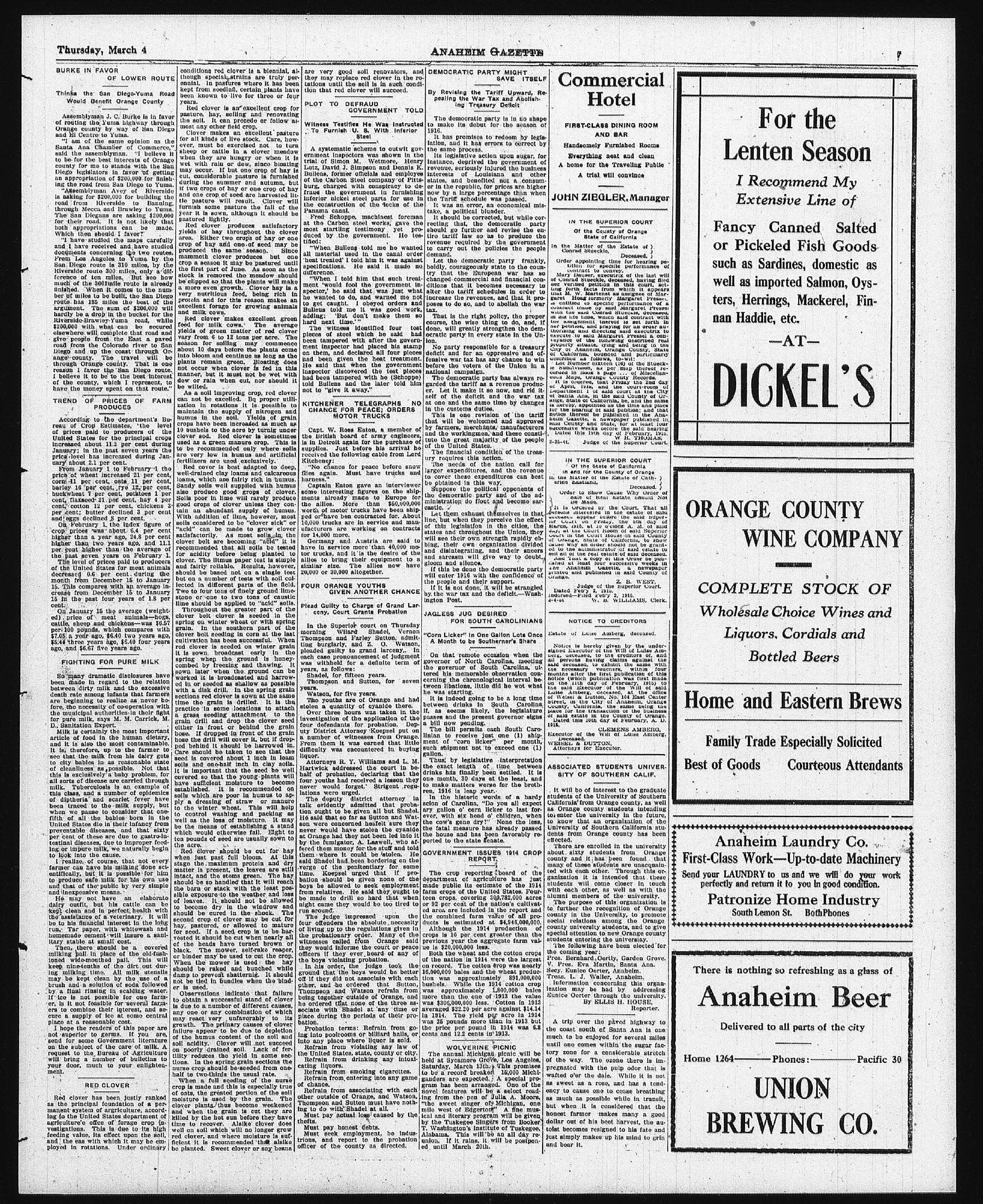
Searchable text
BURKE IN FAVOR
OF LOWER ROUTE
Thinks the San Diego-Yuma Road Would Benefit Orange County
Assemblyman J. C. Burke is in favor of routing the Yuma highway through Orange county by way of San Diego and El Centro to Yuma.
"I am of the same opinion as the Santa Ana Chamber of Commerce," said the assemblyman. "I believe it to be for the best interests of Orange county for me to stand with the San Diego legislators in favor of getting an appropriation of $200,000 for finishing the road from San Diego to Yuma.
"Assemblyman Avey of Riverside is asking for $200,000 for building the road from Riverside to Banning, through Mecca and Brawley to Yuma. The San Diegans are asking $200,000 for their road. It is not likely that both appropriations can be made. Which then should I favor?
"I have studied the maps carefully and I have received and have studied documents concerning the two routes. From Los Angeles to Yuma by the San Diego route is 310 miles, by the Riverside route 300 miles, only a difference of ten miles. But see how much of the 300 mile route is already finished. When it comes to the number of miles to be built, the San Diego route has 185 miles the best of the argument. The sum of $200,000 will hardly be a drop in the bucket for the Riverside-Brawley-Yuma road, while $200,000 with what can be secured elsewhere will complete that road and give people from the East a paved road from the Colorado river to San Diego and up the coast through Orange county. The travel will be through Orange county. That is one reason I favor the San Diego route. I believe it to be to the best interest of the county, which I represent, to have the money spent on that route."
TREND OF PRICES OF FARM PRODUCES
According to the department's Bureau of Crop Estimates, 'the level of prices paid to producers of the United States for the principal crops increased about 11:2 per cent during recent years.' Red clover is a biennial, although special strains are truly perennial. In pastures where it has been kept from seed inflorescence, certain plants have been known to live for three or four years.
Red clover is an excellent crop for pasture, hay, soiling and renovating the soil. It can precede or follow almost any other field crop.
Clover makes an excellent pasture for all kinds of live stock. Care, however, must be exercised not to turn sheep or cattle in a clover meadow when they are hungry or when it is wet with rain or dew, since bloating may occur. If but one crop of hay is cut, considerable pasture is furnished during the summer and autumn, but if two crops of hay or one crop of seed are harvested little pasture will result. Clover will furnish some pasture the fall of the year it is sown, although it should be pastured lightly.
Red clover produces satisfactory yields of hay throughout the clover area. Either two crops of hay or one crop of hay and one of seed may be produced the same season. Since mammoth clover produces but one crop a season it may be pastured until the first part of June. As soon as the stock is removed the meadow should be clipped so that the plants will make a more even growth. Clover hay is a very nutritious feed, being rich in protein and for this reason makes an excellent forage for growing animals and milk cows.
Red clover makes excellent green feed for milk cows. The average yields of green matter of red clover vary from 6 to 12 tons per acre. The season for soaking may commence about 10 days before the plants come into bloom and continue as long as the plants remain green. Bloating does not occur when clover is fed in this manner, but it must not be wet with dew or rain when cut, nor should it be wilted.
As a soil improving crop, red clover cannot be exciled. Bq proper utilization in rotations it is possible to maintain the supply of nitrogen and humus in the soil. Yields of grain crops have been increased as much as 10 bushels to the acre by turning under clover sod. Red clover is sometimes used as a green manure crop. This is to be recommended only where soils are very good soils they may replace reintroduction that red clover.
PLOT TO DEFRA GOVEE
Witness Testifies Hear To Furnish U. S. Steel
A systematic scheme trial of Simon M., Lutz, David J. Simpa Bullens, former officer of the Carbon Steel burg, charged with fraud the government inferior nickel steel the construction of Panama canal.
Fred Schoppe, mast at the Carbon steel most startling tests duced by the governor:
"When Bulleng to all material used in heat treated' I told his specifications. He difference.
"When I told him ment 'would fool thyspector,' he said that he wanted to do, and to get caught. I owe Bullens told me it adding: 'But don't hard next time.'"
The witness identifies pieces of steel which been tampered with ment inspector had done on them, and declared had been given thye He said that when inspector discovered had been tampered with told Bulleng and that not to "give it away."
KITCHENER TELL CHANCE FOR PEACE MOTOR T
Capt. W. Ross Earl the British board of is in Detroit again for supplies. Just before
TREND OF PRICES OF FARM PRODUCES
According to the department's Bureau of Crop Estimates, the level of prices paid to producers of the United States for the principal crops increased about 11.2 per cent during January; in the past seven years the price level has increased during January about 2.1 per cent.
From January 1 to February 1 the price of wheat increased 21 per cent, corn 41 per cent, oats 11 per cent, barley 16 per cent, rye 12 per cent, buckwheat 7 per cent, potatoes 1 per cent, flaxseed 21 per cent, hay 4 per cent, cotton 12 per cent, chickens 3 per cent; butter declined 3 per cent and eggs declined 8 per cent.
On February 1 the index figure of crop prices was about 6.4 per cent higher than a year ago, 24.8 per cent higher than two years ago, and 11.1 per cent higher than the average of the past seven years on February 1.
The level of prices paid to producers of the United States for meat animals decreased 0.6 per cent during the month from December 15 to January 15. This compares with an average increase from December 15 to January 15 in the past four years of 1.8 per cent.
On January 15 the average (weighted) price of meat animals—hogs, cattle, sheep and chickens—was $6.57 per 100 pounds, which compares with $7.05 a year ago, $6.40 two years ago, $5.44 three years ago, $6.40 four years ago, and $6.67 five years ago.
FIGHTING FOR PURE MILK
So many dramatic disclosures have been made in regard to the relation between dirty milk and the excessive death rate among infants that farmers are beginning to realize as never before, the necessity of co-operation with the municipal authorities in their fight for pure milk, says M. M. Carrick, M. D., Sanitation Expert.
Milk is certainly the most important article of food in the human dietary, and it is also the most contaminable. It is, therefore, up to the farmer to see that the milk from his dairy gets to city babies in as reasonable state of cleanliness as possible. Not that this is exclusively a baby problem, for all sorts of disease are carried through milk. Tuberculosis is an example of this class, and a number of epidemics of diptheria and scarlet fever have been traced to the milk supply, but when we pause to consider that one-fifth of all the babies born in the United States die in their infancy from preventable diseases, and that sixty percent of these are due to gastro-intestinal diseases, due to improper feeding or impure milk, we naturally begin into bloom and continue as long as the plants remain green. Bloating does not occur when clover is fed in this manner, but it must not be wet with dew or rain when cut, nor should it be wilted.
As a soil improving crop, red clover can not be exciled. Bq proper utilization in rotations it is possible to maintain the supply of nitrogen and humus in the soil. Yields of grain crops have been increased as much as 10 bushels to the acre by turning under clover sod. Red clover is sometimes used as a green manure crop. This is to be recommended only where soils are very low in humus and artificial fertilizers are used exclusively.
Red cover is best adapted to deep, well-drained clay loams and calcareous loams, which are fairly rich in humus. Sandy soils well supplied with humus also produce good crops of clover. Soils poor in lime will rarely produce good crops of clover unless they contain an abundant supply of humus. With addition of lime, however, most soils considered to be "clover slick" or "acid" can be made to grow clover satisfactorily. As most soils in the clover belt are becoming "acid" it is recommended that all soils be tested for acidity before being planted to clover. The litmus paper test is simple and fairly reliable. Results, however, should be based not on a single test but on a number of tests with soil collected in different parts of the field. Two to four tons of finely ground limestone or one to two tons of caustic lime should be applied to "acid" soils.
Throughout the greater part of the clover belt clover is seeded in the spring on winter wheat or with spring grain. In the southern part of the clover belt seeding in corn at the last cultivation has been successful. When red clover is seeded on winter grain it is sown broadcast early in the spring when the ground is honey-combed by freezing and thawing. It sown later when the ground can be worked it is broadcasted and harrowed in or seeded as shallow as possible with a disk drill. In the spring grain sections red clover is sown at the same time the grain is drilled. It is the practice in some locations to attach a grass seeding attachment to the grain drill and drop the clover seed either in front or behind the grain base. If dropped in front of the grain base the drill will cover it, but if dropped behind it should be harrowed in. Care should be taken to see that the seed is covered about 1 inch in loam soils and one-half inch in clay soils. It is important that the seed be well covered so that the young plants will have sufficient moisture to become established. It is recommended on soils which are poor in humus to apply a dressing of straw or manure to the winter wheat. This will help to control washing and packing as well as the loss of moisture. It may be the means of establishing a stand which would otherwise fail. Eight to ten pounds of seed are usually sown to the acre.
Red clover should be cut for hay into bloom and continue as long as the plants remain green. Bloating does not occur when clover is fed in this manner, but it must not be wet with dew or rain when cut, nor should it be wilted.
As a soil improving crop, red clover can not be exciled. Bq proper utilization in rotations it is possible to maintain the supply of nitrogen and humus in the soil. Yields of grain crops have been increased as much as 10 bushels to the acre by turning under clover sod. Red clover is sometimes used as a green manure crop. This is to be recommended only where soils are very low in humus and artificial fertilizers are used exclusively.
Red cover is best adapted to deep, well-drained clay loams and calcareous loams, which are fairly rich in humus. Sandy soils well supplied with humus also produce good crops of clover. Soils poor in lime will rarely produce good crops of clover unless they contain an abundant supply of humus. With addition of lime, however, most soils considered to be "clover slick" or "acid" can be made to grow clover satisfactorly. As most soils in the clover belt are becoming "acid" it is recommended that all soils be tested for acidity before being planted to clover. The litmus paper test is simple and fairly reliable. Results, however, should be based not on a single test but on a number of tests with soil collected in different parts of the field. Two to four tons of finely ground limestone or one to two tons of caustic lime should be applied to "acid" soils.
Throughout the greater part of the clover belt clover is seeded in the spring on winter wheat or with spring grain. In the southern part of the clover belt seeding in corn at the last cultivation has been successful. When red clovers are seeded on winter grain it is sown broadcast early in the spring when the ground is honey-combed by freezing and thawing. It sown later when the ground can be worked it is broadcasted and harrowed in or seeded as shallow as possible with a disk drill. In the spring grain sections red clovers are sown at the same time the grain is drilled. It is important that the seed be well covered so that the young plants will have sufficient moisture to become established. It is recommended on soils which are poor in humus to apply a dressing of straw or manure to the winter wheat. This will help to control washing and packing as well as the loss of moisture. It may be the means of establishing a stand which would otherwise fail. Eight to ten pounds of seed are usually sown to the acre.
Red clovers should be cut for hay into bloom and continue as long as the plants remain green. Bloating does not occur when clovers are fed in this manner, but it must not be wet with dew or rain when cut, nor should it be wilted.
As a soil improving crop, red clovers can not be exciled. Bq proper utilization in rotations it is possible to maintain the supply of nitrogen and humus in the soil. Yields of grain crops have been increased as much as 10 bushels to the acre by turning under clover sod. Red clovers is sometimes used as a green manure crop. This is to be recommended only where soils are very low in humus and artificial fertilizers are used exclusively.
Red cover is best adapted to deep, well-drained clay loams and calcareous looms, which are fairly rich in humus. Sandy soils well supplied with humus also produce good crops of clover. Soils poor in lime will rarely produce good crops of clover unless they contain an abundant supply of humus. With addition of lime, however, most soils considered to be "clover slick" or "acid" can be made to grow clover satisfactorily. As most soils in the clover belt are becoming "acid" it is recommended that all soils be tested for acidity before being planted to clover. The litmus paper test is simple and fairly reliable. Results, however, should be based not on a single test but on a number of tests with soil collected in different parts of the field. Two to four tons of finely ground limestone or one to two tons of caustic lime should be applied to "acid" soils.
Throughout the greater part of the clover belt cloven is seeded in the spring on winter wheat or with spring grain. In the southern part of the cloven belt seeding in corn at the last cultivation has been successful. When red clovers are seeded on winter grain it is sown broadcast early in the spring when the ground is honey-combed by freezing and thawing. It sown later when the ground can be worked it is broadcasted and harrowed in or seeded as shallow as possible with a disk drill. In the spring grain sections red clovers are sown at the same time the grain is drilled. It is important that the seed be well covered so that the young plants will have sufficient moisture to become established. It is recommended on soils which are poor in humus to apply a dressing of straw or manure to the winter wheat. This will help to control washing and packing as well as the loss of moisture. It may be the means of establishing a stand which would otherwise fail. Eight to ten pounds of seed are usually sown to the acre.
Red clovers should be cut for hay into bloom and continue as long as the plants remain green. Bloating does not occur when clovers are fed in this manner, but it must not be wet with dew or rain when cut, nor should it be wilted.
As a soil improving crop, red clovers can not be exciled. Bq proper utilization in rotations it is possible to maintain the supply of nitrogen and humus in the soil. Yields of grain crops have been increased as much as 10 bushels to the acre by turning under clover sod. Red clovers is sometimes used as a green manure crop. This is to be recommended only where soils are very low in humus and artificial fertilizers are used exclusively.
Red cover is best adapted to deep, well-drained clay loams and calcareous looms, which are fairly rich in humus. Sandy soils well supplied with humus also produce good crops of clover. Soils poor in lime will rarely produce good crops of clover unless they contain an abundant supply of humus. With addition of lime, however, most soils considered to be "clower slick" or "acid" can be made to grow clovers satisfactorily. As most soils in the clov...
see that the milk from his dairy gets to city bables in as reasonable state of cleanliness as possible. Not that this is exclusively a baby problem, for all sorts of disease are carried through milk. Tuberculosis is an example of this class, and a number of epidemics of diptheria and scarlet fever have been traced to the milk supply, but when we pause to consider that one-fifth of all the babies born in the United States die in their infancy from preventable diseases, and that sixty per cent of these are due to gastro-intestinal diseases, due to improper feeding or impure milk, we naturally begin to look into the cause.
I realize, of course, that not every farmer can have his milking done scientifically, but it is possible for him to produce safe milk for his own use and that of the public by very simple and inexpensive means.
He may not have an elaborate dairy outfit, but his cattle can be kept clean and in perfect health with the assistance of a veterinary. It will be to his financial interest in the long run. Tar paper, with whitewash and homemade cement will insure a sanitary stable at small cost.
Then, there should be a covered milking ball in place of the old-fashioned wide-mouthed pail. This will keep nine-tenths of the dirt out during milking time. All milk utensils may be kept clean by the use of a brush and a solution of soda followed by a final rinsing in scalding water. If ice is not possible for one farmer, is it not feasible for several farmers to combine their interest, and secure a supply of ice at some central place at a reasonable cost.
I hope the readers of this paper are not superior to germs. If you are, send for some Government literature on the subject of the care of milk. A request to the Bureau of Agriculture will bring a number of bulletins to your door, much to your enlightenment.
RED CLOVER
Red clover has been justly ranked as the principal foundation of a permanent system of agriculture, according to the United States department of agriculture's office of forage crop investigations. This is due to its high feeding value, its effect upon the soil, and the ease with which it may be employed in rotations. Under ordinary seed is covered about 1 inch in loam soils and one-half inch in clay soils. It is important that the seed be well covered so that the young plants will have sufficient moisture to become established. It is recommended on soils which are poor in humus to apply a dressing of straw or manure to the winter wheat. This will help to control washing and packing as well as the loss of moisture. It may be the means of establishing a stand which would otherwise fail. Eight to ten pounds of seed are usually sown to the acre.
Red clover should be cut for hay when just past full bloom. At this stage the maximum protein and dry matter is present, the leaves are still intact, and the stems green. The hay should be so handled that it will reach the barn or stack with the least possible exposure to the weather and loss of leaves. It should not be allowed to become dry in the windrow and should be cured in the shock. The second crop of clover may be cut for hay, pastured, or allowed to mature for seed. If a seed crop is to be harvested it should be cut when nearly all of the heads have turned brown or black. The mower, self-rake reaper, or blinder may be used to cut the crop. When the mower is used the hay should be raked and bunched while damp to prevent shattering. It should not be tied in bundles when the binder is used.
Observations indicate that failure to obtain a successful stand of clover is due to a number of different causes, any one or any combination of which may react very unfavorably to its growth. The primary causes of clover failure appear to be due to depletion of the humus content of the soil and soil acidity. Clover will not succeed on poorly drained soil. Lack of fertility reduces the yield in some sections. In the spring-grain sections the nurse crop should be seeded from one half to two-thirds the usual rate.
When a full seeding of the nurse crop is made and this is especially true of oats, the greatest portion of the soil moisture is used by the grain. The clover plants thus become weakened and when the grain is cut they are killed by the hot sun before they have time to recover. Alsike clover does well on soil which will no longer grow red clover, and where moisture is sufficient it is recommended that alsike be planted. Sweet clover or soy beans
Attorneys R. Y. Wiltwick addressed half of probation, deferred four youths had receive never forgettions were urged.
The deputy district talk evidently admitted ought to be given He said that he far as son were concerned he never would have stayed at Orange had they not by the fumigator. A ferred them money for them where it could said Shadel had been verge of penitence time. Koepsel urged bation should be given boys allowed to stay from relatives. He sai made to drill so night came they would run around.
The judge impressed four offenders the age of living up to the regime the probationary order witnesses called from they would informe the officers if they ever, the boys violating proIn his order, the boy ground that the boys did if they did not assa other, and he ordered Thompson and Watts being together outside he ordered that none sociate with Shadel place during the perilion.
Probation terms: Being into poolrooms or into any place where Refrain from violating the United States statute Refrain from drinking liquors Refrain from smoking Refrain from entering chance.
Refrain from associote other outside Ofan Thompson and Sutton ing to do with Shadel Must pay actual loss thefts Must pay honest debt Must seek employ trious, and report to officer of the county
are very good soil renovators, and they may replace red clover in the rotations until the soil is in such condition that red clover will succeed.
PLOT TO DEFRAUD GOVERNMENT TOLD
Witness Testifies He Was Instructed To Furnish U. S. With Inferior Steel
A systematic scheme to outwit government inspectors was shown in the trial of Simon M. Wetmore, Henry Lutz, David J. Simpson and Dennis K. Bullens, former officials and employees of the Carbon Steel company of Pittsburg, charged with conspiracy to defraud the government in furnishing inferior nickel steel parts for use in the construction of the locks of the Panama canal.
Fred Schoppe, machinest foreman at the Carbon steel works, gave the most startling testimony yet produced by the government. He testified:
"When Bulleng told me he wanted all material used in the canal order 'heat treated' I told him it was against specifications. He said it made no difference.
'When I told him that such treatment 'would fool the government inspector,' he said that was just what he wanted to do, and warned me not to get caught. I obeyed orders and Bullens told me it was good work, adding: 'But don't make them so hard next time.'"
The witness identified four test pieces of steel which he said had been tampered with after the government inspector had placed his stamp on them, and declared all four pieces had been given the heat treatment. He said that when the government inspector discovered the test pieces had been tampered with he (Schoppe) told Bulleng and the later told him not to "give it away."
KITCHENER TELEGRAPHS NO CHANCE FOR PEACE; ORDERS MOTOR TRUCKS
Capt. W. Ross Eaton, a member of the British board of army engineers, is in Detroit again for the purchase of supplies. Just before his arrival he
DEMOCRATIC PARTY MIGHT SAVE ITSELF
By Revising the Tariff Upward, Repealing the War Tax and Abolishing Treasury Deficit
The democratic party is in no shape to make its debut for the season of 1916.
It has promises to redeem by legislation, and it has errors to correct by the same process.
Its legislative action upon sugar, for instance, deprived the government of revenue, seriously injured the business interests of Louisiana and other states, and benefited not a consumer in the republic, for prices are higher now by a large percentage than when the Tariff schedule was passed.
It was an error, an economical mistake, a political blunder.
It should be corrected, but while correcting that, the democratic party should go further and revise the entire tariff law so as to produce the revenue required by the government to carry out the policies the people demand.
Let the democratic party frankly, boldly, courageously state to the country that the European war has so changed commercial and financial conditions that it becomes necessary to alter the tariff schedules in order to increase the revenues, and that it proposes to do so, and to abolish the war tax.
That is the right policy, the proper course, the wise thing to do, and, if done, will greatly strengthen the democratic party in every state in the Union.
No party responsible for a treasury deficit and for an oppressive and offensive war tax has any chance to win before the voters of the Union in a national campaign.
The democratic party has always regarded the tariff as a revenue producer. Let it make it so now, and rid itself of the deficit and the war tax at one and the same time by changes in the customs duties.
This is one revision of the tariff that will be welcomed and approved by farmers, merchants, manufacturers and the workingmen, and these constitute the great majority of the people of the United States.
Commercial Hotel
FIRST-CLASS DINING ROOM AND BAR
Handsomely Furnished Rooms
Everything neat and clean
A home for the Travelling Public
A trial will convince
JOHN ZIEGLER, Manager
IN THE SUPERIOR COURT
Of the County of Orange State of California
In the Matter of the Estate of Conrad Stueckle,
Deceased.
Order appointing time for hearing petition for specific performance of contract to convey.
Mary Jager exonerated of the last will of Conrad Stueckle, deceased, having filed her verified petition in this court, setting forth facts from which it appears that M. W. Marteness as assigne of Margaret Hoag formerly Margaret Presser, entitled to her petition for a contract made by said Margaret Presser with said Conrad Stueckle, deceased, as sure time, when said contract with her assignment thereof is set forth in her petition and praying for an order authorizing and directing valid executory to execute to said Margaret Pressa a conveyance of the following described real property situate, lying and being in the City of Anaheim, Orange County, State of California, pursuant to particular described as follows: to-wit.
Lot Number sixteen (16) of the Stueckle Subdivision, as per map there recorded in Book a page ... Of Miscellaneous Maps, Orange County Records.
Is Courtesy of The End day of April, 1918, and the court-room of Department 1 of said court at the City of Santa Ana, in said County of Orange, State of California, be, and the same is surely appointed as the time and place for insurer and payee if notice thereof be published in the Anaheim Gazette, a newspaper published in said County and State, for at least four successive weeks before the said hearing Date this 24th day of February, 1918.
Judge of the Superior Court.
KITCHENER TELEGRAPHS NO CHANCE FOR PEACE; ORDERS MOTOR TRUCKS
Capt. W. Ross Eaton, a member of the British board of army engineers, is in Detroit again for the purchase of supplies. Just before his arrival he received the following cable from Lord Kitcheney:
"No chance for peace before snow flies again. Must have trucks and harness."
Captain Eaton gave an interviewer some interesting figures on the ships already made to Europe for the allies. More than $50,000,000 worth of motor trucks have been shipped or have been contracted for. About 10,000 trucks are in service and manufacturers are working on contracts for 14,000 more.
Germany and Austria are said to have in service more than 40,000 motor trucks, and it is the desire of the allies to bring their equipment to a similar size. The allies now have 20,000 or 30,000 altogether.
FOUR ORANGE YOUTHS GIVEN ANOTHER CHANCE
Plead Guilty to Charge of Grand Larceny, Court Grants Probation
In the Superior court on Thursday morning Wilard Shadel, Vernon Thompson and Farley Sutton, admitting burglary, and Z. O. Watson, pleaded guilty to grand larceny. In each case pronouncement of judgment was withheld for a definite term of years, as follows:
Shadel, for fifteen years.
Thompson and Sutton, for seven years.
Watson, for five years.
The youths are of Orange and had stolen a quantity of cyanide there.
Over three hours was taken in the investigation of the application of the four defendants for probation. Deputy District Attorney Koopsel put on a number of witnesses from Orange. From them it was earned that little difficulty was encountered in buying liquor.
Attorneys R. Y. Williams and L. M. Hartwick addressed the court in behalf of probation, declaring that the four youths had received a lesson they never would forget. Strigent regulations were urged.
The deputy district attorney in talk evidently admitted that probation ought to be given all but Shadel. He said that so far as Sutton and Watson were concerned haself sure they never would have stolen the cyanide at Orange had they not been led into it by the fumigator, A. Laawell, who offered them money for the stuff and told
JAGLESS JUG DESIRED FOR SOUTH CAROLINIANS
"Corn Licker" In One Gallon Lots Once A Month to be Southerner's Share
On that remote occasion when the governor of North Carolina, meeting the governor of South Carolina, uttered his memorable observation concerning the chronological interval between libations, little did he not what he was starting.
It is indeed going to be a long time between drinks in South Carolina if, as seems likely, the legislature passes and the present governor signs a bill now pending.
The bill permits each South Carolinian to receive just one (1) shipment of "corn licker" per month, such shipment to exceed one (1) gallon.
Thus, by legislative interpretation the exact length of time between drinks has finally been settled. It is one month, 30 days at the least, and to make matters worse for the brethren, 1916 is leap year.
In the historic words of a hardy action of Carolina, "Do you all expect arry gallon o' corn licker to last forever, with six head o' children, when the cow's gone dry?" None the less, the fatal measure has already passed the house and has been favorably reported to the state senate.
IN THE SUPERIOR COURT Of the State of California In and for the County of Orange in the matter of the Estate of Catherine Eastland
Deceased.
Order to Show Cause Why Order of Sale of Real Estate Should Not Be Made.
It is Ordeued by the Court. That all decrees interest in the estate of sale must be decreed by the Court on Friday, the ninth day of March, 1918, at 10 o'clock A.M. or said at the Court Room of Saul Superior Court in the Court House in said County Orange. Since a cause may not be granted to the administrator of said estate to sell all of the real estate of said deceased.
And that a copy of this Order be published is ideal for successive weeks in the Anaheim Gazette newspaper printed and published in said County of Orange.
Z. B. WEST,
Dated February 1918.
Indorsed—Filed July 2, 1918.
W. B. WILLIAMS, Clerk.
NOTICE TO CREDITORS
Estate of Luise Amberg, deceased.
Notice is hereby given by the undersigned Executor of the Will of Luise Amberg, deceased, to the creditors of, and all persons having claims against the necessary vouchers, within four months after the first publication of this notice (which publication was first made on the 17th day of February, 1915) to said Executor of the Will of Luise Amberg, deceased, at the office of Weiss & Dutton, No. 104 East Center Street, in the City of Ananime, Orange County, California, the same being the place for the transaction of the business of said estate in the City of Orange. Dated this 17th day of February, A.D. 1918.
CLEMENS AMBERG,
Executor of the Will of Luise Amberg, deceased,
WEISSEL & DUTTON,
Attorneys for Executor.
ASSOCIATED STUDENTS UNIVERSITY OF SOUTHERN CALIFIC.
It will be of interest to the graduate students of the University of Southern California from Orange county, as well as Orange county students intending to enter the university in the future, to know that an organization of the University of Southern California students from Orange county has been effected.
Attorneys R. Y. Williams and L. M. Hartwick addressed the court in behalf of probation, declaring that the four youths had received a lesson they never would forget. Strigent regulations were urged.
The deputy district attorney in talk evidently admitted that probation ought to be given all but Shadel. He said that so far as Sutton and Watson were concerned he felt sure they never would have stolen the cyanide at Orange had they not been led into it by the fumigator, A. Laawell, who offered them money for the stuff and told them where it could be stolen. He said Shadel had been bordering on the verge of the penitentiary for some time. Koepsel urged that if probation should be given none of the boys be allowed to seek employment from relatives. He said they ought to be made to drill so hard that when night came they would be too tired to run around.
The judge impressed upon the four offenders the absolute necessity of living up to the regulations given in the probationary order. Many of the witnesses called from Orange said they would informe the court or peace officers if they ever heard of any of the boys violating probation.
In his order, the judge took the ground that the boys would be better off if they did not associate with each other, and he ordered that Sutton, Thompson and Watson refrain from being together outside of Orange, and he ordered that none of the three associate with Shadel at any time or place during the periods of their probation.
Probation terms: Refrain from going into poolrooms or billiard halls, or into any place where liquor is sold.
Refrain from violating any law of the United States, state, county or city.
Refrain from drinking any intoxicating liquors.
Refrain from smoking cigarettes.
Refrain from entering into any game of chance.
Refrain from associating with each other outside of Orange, and Watson, Thompson and Sutton must have nothing to do with Shadel at all.
Must pay actual loss caused by the thefts.
Must pay honest debts.
Must seek employment, be industrious, and report to the probation officer of the county as directed.
Thus, by legislative interpretation the exact length of time between drinks has finally been settled. It is one month, 30 days at the least, and to make matters worse for the brethren, 1916 is leap year.
In the historic words of a hardy scion of Carrollin, "Do you all expect a gallon o' corn licker to last forever, with six head o' children, when the cow's gone dry?" None the less, the fatal measure already passed the house and has been favorably reported to the state senate.
GOVERNMENT ISSUES 1914 CROP REPORT.
The crop reporting board of the department of agriculture has just made public its estimate of the 1914 farm crops of the United States. Fourteen crops, covering 300,782,000 acres or 92 per cent of the nation's cultivated area are included in the report and the combined farm value of all products is estimated at $4,946,000,000.
Although the 1914 production of crops is 10 per cent greater than the previous year the aggregate farm value is $20,000,000 less.
Both the wheat and the cotton crops of the nation in 1914 were the largest on record. The cotton crop was nearly 16,000,000 bales and the wheat production was approximately 891,000,000 bushels. While the 1914 cotton crop was approximately 1,800,000 bales more than the one of 1913 the value was $306,000,000 less. Cotton in 1913 averaged $22.20 per acre against $14.14 in 1914. The yield per acre in 1914 was 25 pounds more than in 1913 but the price per pound in 1914 was 6.8 cents and 12.2 cents in 1913.
WOLVERINE PICNIC
The annual Michigan picnic will be held at Sycamore Grove, Los Angeles, Saturday, March 13th. This promises to be a record breaker. 16,000 Michiganders are expected. A special program has been arranged. One of the novel features will be a select reading from the pen of Julia A. Moors, "the sweet singer of Michigan, one mile west of Edgerton." A fine musical and literary program will be given by the Tuskegee Singers from Booker T. Washington's Institute of Tuskegee, Alabama. This will be an all day reunion. If it rains, it will be postponed until March 20th.
ASSOCIATED STUDENTS UNIVERSITY OF SOUTHERN CALIF.
It will be of interest to the graduate students of the University of Southern California from Orange county, as well as Orange county students intending to enter the university in the future, to know that an organization of the University of Southern California students from Orange county has been effected.
There are enrolled in the university about sixty students from Orange county and it has been found that many of these students are unacquainted with each other. Through this organization it is intended that these students will come closer in touch with each other, as well as with the alumni members of the university.
The purpose of this organization is to further the recognition of Orange county in the University, to promote social relations among the Orange county university students, and to give special attention to new Orange county students entering the university.
The following have been elected for the coming year:
Pres. Bernhard Oertly, Garden Grove.
V. Pres. Eva Martin, Santa Ana.
Secy. Eunice Oertler, Anahelm.
Treas. L. J. Waller, Anaheim.
Information concerning this organization may be had by addressing Eunice Oertler through the university.
By ELLIIS H. HOUSE,
Reporter.
A trip over the paved highway to the coast south of Santa Ana is one much to be enjoyed for several miles until one comes within the sugar factory zone for a considerable stretch of the way. The ozone there is impregnated with the pulp odor that is wafted o'er the dale. While it is not as sweet as a rose, and has a tendency to cause one to cease breathing as much as possible while in transit, but when it is considered that the honest farmer makes many a good dollar out of his beet harvest, the autolat becomes resigned to his fate and just simply makes up his mind to grin and bear it.
For the
Lenten Season
I Recommend My
Extensive Line of
Fancy Canned Salted
or Pickeled Fish Goods
such as Sardines, domestic as
well as imported Salmon, Oysters,
Herrings, Mackerel, Finnan Haddie, etc.
—AT—
DICKEL'S
DICKEL'S
ORANGE COUNTY
WINE COMPANY
COMPLETE STOCK OF
Wholesale Choice Wines and
Liquors, Cordials and
Bottled Beers
Home and Eastern Brews
Family Trade Especially Solicited
Best of Goods Courteous Attendants
Anaheim Laundry Co.
Best of Goods Courteous Attendants
Anaheim Laundry Co.
First-Class Work—Up-to-date Machinery
Send your LAUNDRY to us and we will do your work perfectly and return it to you in good condition.
Patronize Home Industry
South Lemon St. BothPhones
There is nothing so refreshing as a glass of
Anaheim Beer
Delivered to all parts of the city
Home 1264——Phones:——Pacific 30
UNION
BREWING CO.