anaheim-gazette 1915-03-04
Scanned page
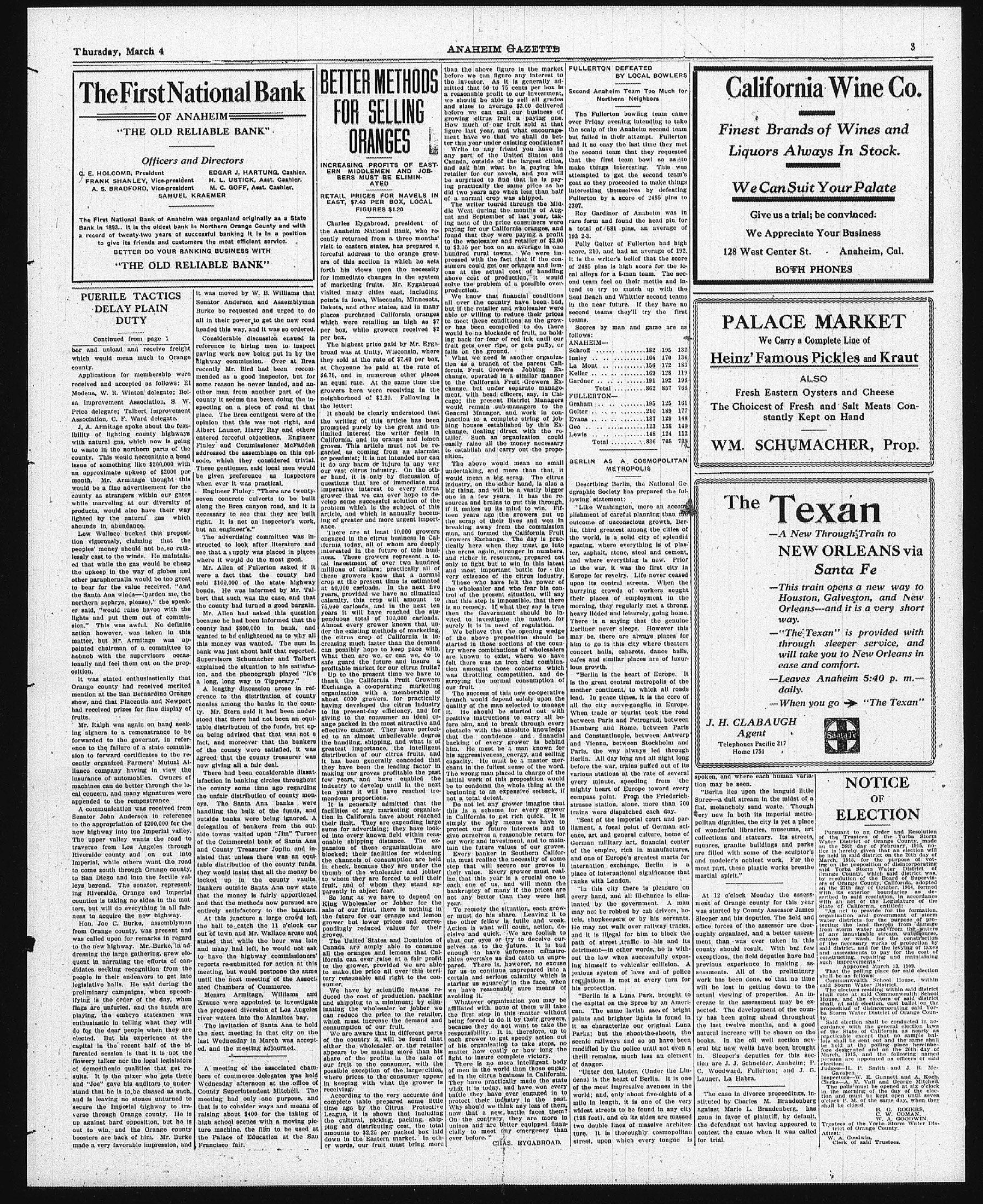
Searchable text
Thursday, March 4
The First National Bank
OF ANAHEIM
“THE OLD RELIABLE BANK”
Officers and Directors
C. E. HOLCOMB, President
FRANK SHANLEY, Vice-president
A. S. BRADFORD, Vice-president
SAMUEL KRAEMER
The First National Bank of Anaheim was organized originally as a State Bank in 1893.. It is the oldest bank in Northern Orange County and with a record of twenty-two years of successful banking it is in a position to give its friends and customers the most efficient service.
BETTER DO YOUR BANKING BUSINESS WITH
“THE OLD RELIABLE BANK”
PUERILE TACTICS
DELAY PLAIN DUTY
Continued from page 1
bor and unload and receive freight which would mean much to Orange county.
Applications for membership were received and accepted as follows: El Modena, W. R. Winton' delegate; Bolsa Improvement Association, S. W. Price delegate; Talbert Improvement Association, C. F. Ward delegate.
J. A. Armitage spoke about the feasibility of lighting county highways with natural gas, which now is going to create in the northern parts of the
It was moved by W. B. Williams that Senator Anderson and Assemblyman Burke be requested and urged to do all in their power to get the new road headed this way, and it was so ordered.
Considerable discussion ensured in reference to hiring men to inspect paving work now being put in by the highway commission. Over at Brea recently Mr. Bird had been recommended as a good inspector, but for some reason he never landed, and another man from another part of the county it seems has been doing the inspecting on a piece of road at that place. The Brea contingent were of the opinion that this was not right, and Albert Launer, Harry Ray and others entered forceful objections. Engineer Finley and Commissioner McFadden
BETTER FOR ORGANIZATION
INCREASING ENERGY MIDDLE BERS MULTIPLE RETAIL PRICES EAST, $7.40 FIGURE
Charles Eygert the Anaheim N.C. cently returned visit to eastern forceful addressers of this section forth his views for immediate marketing of marketing visited many points in Iowa, Dakota, and other places purchases which were re- per box, while per box.
The highest broad was at U.S. they sold at tha at Cheyenne b $6.75, and in an equal rate growers here neighborhood of the letter:
It should be the writing of prompted purely limited interest California, and groves. This
which would mean much to Orange county.
Applications for membership were received and accepted as follows: El Modena, W. R. Winton' delegate; Bolsa Improvement Association, S. W. Price delegate; Talbert Improvement Association, C. F. Ward delegate.
J. A. Armitage spoke about the feasibility of lighting county highways with natural gas, which now is going to waste in the northern parts of the county. This would necessitate a bond issue of something like $200,000 with an approximate upkeep of $2000 per month. Mr. Armitage thought this would be a fine advertisement for the county as strangers within our gates while marveling at our diversity of products, would also have their way lighted by the natural gas which abounds in abundance.
Low Wallace bucked this proposition vigorously, claiming that the peoples' money should not be so ruthlessly cast to the winds. He maintained that while the gas would be cheap the upkeep in the way of globes and other paraphernalia would be too great to bear for the value received. "And the Santa Ana winds—(pardon me, the northern zephrys, please)," the speaker said, "would raise havoc with the lights and put them out of commission." This was awful. No definite action however, was taken in this matter, but Mr. Armitage was appointed chairman of a committee to hobnob with the supervisors occasionally and feel them out on the proposition.
It was stated enthusiastically that Orange county had received merited mention at the San Bernardino Orange show, and that Placentia and Newport had received prizes for fine display of fruits.
Mr. Ralph was again on hand seeking signers to a remonstrance to be forwarded to the governor, in reference to the failure of a state commission to forward certificates to the recently organized Farmers' Mutual Alliance company having in view the insurance of automobiles. Owners of machines can do better through the local concern, and many signatures were appended to the remonstrance.
A communication was received from Senator John Anderson in reference to the appropriation of $200,000 for the new highway into tao Imperial valley. The upper valley wants the road to traverse from Los Angeles through which would mean much to Orange county.
Mr. Bird had been recommended as a good inspector, but for some reason he never landed, and another man from another part of the county it seems has been doing the inspecting on a piece of road at that place. The Brea contigent were of the opinion that this was not right, and Albert Launer, Harry Ray and others entered forceful objections. Engineer Finley and Commissioner McFadden addressed the assemblage on this episode, which they considered trivial. These gentlemen said local men would be given preference as inspectors when ever it was practical.
Engineer Finley: "There are twenty-seven concrete culverts to be built along the Brea canyon road, and it is necessary to see that they are built right. It is not an inspector's work, but an engineer's."
The advertising committee was instructed to look after literature and see that a supply was placed in places where it would do the most good.
Mr. Allen of Fullerton asked if it were a fact that the county had sold $100,000 of the state highway bonds. He was informed by Mr. Talbert that such was the case, and that the county had turned a good bargain.
Mr. Allen had asked this question because he had been informed that the county had $800,000 in bank, and wanted to be enlightened as to why all this money was wanted. The sum in bank was just about half that reported. Supervisors Schumacher and Talbert explained the situation to his satisfaction, and the phonograph played "It's a long, long way to Tipperary."
A lengthy discussion arose in reference to the distribution of county monies among the banks in the county. Mr. Stern said it had been understood that there had not been an equitable distribution of the funds, but upon being advised that that was not a fact, and moreover that the bankers of the county were satisfied, it was agreed that the county treasurer was now giving all a fair deal.
There had been considerable dissatisfaction in banking circles throughout the county some time ago regarding the unfair distribution of county monies. The Santa Ana banks were handling the bulk of the funds, and outside banks were being ignored. A delegation of bankers from the outside towns waited upon "Jim" Turner of the Commercial bank of Santa Ana and County Treasurer Joplin and in paving work now being put in by the highway commission. Over at Brea recently Mr. Bird had been recommended as a good inspector, but for some reason he never landed, and another man from another part of the county it seems has been doing the inspecting on a piece of road at that place. The Brea contigent were of the opinion that this was not right, and Albert Launer, Harry Ray and others entered forceful objections. Engineer Finley and Commissioner McFadden addressed the assemblage on this episode, which they considered trivial. These gentlemen said local men would be given preference as inspectors when ever it was practical.
Engineer Finley: "There are twenty-seven concrete culverts to be built along the Brea canyon road, and it is necessary to see that they are built right. It is not an inspector's work, but an engineer's."
The advertising committee was instructed to look after literature and see that a supply was placed in places where it would do the most good.
Mr. Allen of Fullerton asked if it were a fact that the county had sold $100,000 of the state highway bonds. He was informed by Mr. Talbert that such was the case, and that the county had turned a good bargain.
Mr. Allen had asked this question because he had been informed that the county had $800,000 in bank, and wanted to be enlightened as to why all this money was wanted. The sum in bank was just about half that reported. Supervisors Schumacher and Talbert explained the situation to his satisfaction, and the phonograph played "It's a long, long way to Tipperary."
There are engaged in their formation today, interested in their news. These general investments millions of dollars these growers crop at the price at 50,000 carlo years, provided calamity, this 75,000 carlo years it will penduous total Almost every year derider the existing citrus crops creasing much can possibly be What then are safe guard their profitable market Up to the point thank the Capital Exchange, a co-organization with 6000 grilling developing its present giving to the range packed in effective manner ad an aim at making our greet few years, and industry to deiten ten years it mendous property It is general facilities of administration in California their limit. This sums for advertised into every possible shipping pansion of th
A communication was received from Senator John Anderson in reference to the appropriation of $200,000 for the new highway into Tacoma Imperial valley. The upper valley wants the road to traverse from Los Angeles through Riverside county and on out into Imperial, while others want the road to come south through Orange county, to San Diego and into the fertile valleys beyond. The senator, representing Riverside, Orange and Imperial counties is taking no sides in the matters, but will do everything in all fairness to acquire the new highway.
Hon. Joe C. Burke, assemblyman from Orange county, was present and was called upon for remarks in regard to the new highway. Mr. Burke, in addressing the large gathering, grew eloquent in narrating the efforts of candidates seeking recognition from the people in their endeavors to get into legislative halls. He said during the preliminary campaign, when speechifying is the order of the day, when flags are unfurled, and the bands are playing, the embryo statesmen wax enthusiastic in telling what they will do for the dear people when they are elected. But his experience at the capital in the recent half of the bifurcated session is that it is not the flowery talker nor the local legislators of demosthenic qualities that get results. It is the mixer who gets there and "Joe" gave his auditors to understand that he is to be classed as such, and is leaving no stones unturned to secure the Imperial highway to traverse through Orange county. He is up against hard opposition, but he is out to win, and the Orange county boosters are back of him. Mr. Burke made a very favorable impression, and agreed that the county treasurer was now giving all a fair deal.
There had been considerable dissatisfaction in banking circles throughout the county some time ago regarding the unfair distribution of county money. The Santa Ana banks were handling the bulk of the funds, and outside banks were being ignored. A delegation of bankers from the outside towns waited upon "Jim" Turner of the Commercial bank of Santa Ana and County Treasurer Joplin and insisted that unless there was an equitable distribution of the county funds, they would insist that all the money be locked up in the county vaults. Bankers outside Santa Ana now state that the money is fairly apportioned and that the methods now pursued are entirely satisfactory to the bankers.
At this juncture a large crowd left the hall to catch the 11 o'clock car out of town and Mr. Wallace arose and stated that while the hour was late and many had left, he would not ask to have the highway commissioners' reports re-submitted for action at this meeting, but would postpone the same until the next meeting of the Associated Chambers of Commerce.
Messrs Armitage, Williams and Krause were appointed to investigate the proposed diversion of Los Angeles river waters into the Alamitos bay.
The invitation of Santa Ana to hold the next meeting in that city on the last Wednesday in March was accepted, and the meeting adjourned.
A meeting of the associated chambers of commerce delegates was held Wednesday afternoon at the office of County Superintendent Mitchell. The meeting had only one purpose, and that is to consider ways and means of raising about $400 for the taking of high school scenes with a moving picture machine, the film to be used at the Palace of Education at the San Francisco fair.
It is general facilities of administration in California their limit. The sums for advertisement into every available shipment pansion of the blocked; their channels or in check, because thumb of the fruit, and they parently in aba.
So long as King Wholesale sale of our fraternity for grower but low pondingly reduces groves.
The United States Canada are all all the orange ifornia can owe to the grower to make, the property reasonable sumer.
We have beenuced the cost and shipping by imiting the way we can reduce which must include consumption.
We are aware of the country either where appears to be share of our fruit to possible except where prices are in keeping with receiving.
According to complete table time ago by League, it is the cultural pling and dismount amounts to $5 down in the other words, our
BETTER METHODS FOR SELLING ORANGES
INCREASING PROFITS OF EASTERN MIDDLEMEN AND JOB-BERS MUST BE ELIMINATED
RETAIL PRICES FOR NAVELS IN EAST, $7.40 PER BOX, LOCAL FIGURES $1.20
Charles Eygabroad, president of the Anaheim National Bank, who recently returned from a three months' visit to eastern states, has prepared a forceful address to the orange growers of this section in which he sets forth his views upon the necessity for immediate changes in the system of marketing fruits. Mr. Eygabroad visited many cities east, including points in Iowa, Wisconsin, Minnesota, Dakota, and other states, and in many places purchased California oranges which were retailing as high as $7 per box, while growers received $2 per box.
The highest price paid by Mr. Eygabroad was at Unity, Wisconsin, where they sold at the rate of $7.40 per box, at Cheyenne he paid at the rate of $6.75, and in numerous other places an equal rate. At the same time the growers here were receiving in the neighborhood of $1.20. Following is the letter:
It should be clearly understood that the writing of this article has been prompted purely by the great and unlimited interest the writer feels in California, and its orange and lemon groves. This article must not be relied upon before we can figure any interest to the investor. As it is generally admitted that 50 to 75 cents per box is a reasonable profit to our investment, we should be able to sell all grades and sizes to average $3.00 delivered before we can call our business of growing citrus fruit a paying one. How much of our fruit sold at that figure last year, and what encouragement have we that we shall do better this year under existing conditions?
Write to any friend you have in any part of the United States and Canada, outside of the largest cities, and ask him what he is paying his retailer for our navels, and you will be surprised to find that he is paying practically the same price as he did two years ago when less than half of a normal crop was shipped.
The writer toured through the Middle West during the months of August and September of last year, taking note of the price consumers were paying for our California oranges, and found that they were paying a profit to the wholesaler and retailer of $2.00 to $3.00 per box on an average in one hundred rural towns. We were impressed with the fact that if the consumers could get our oranges and lemons at the actual cost of handling above cost of production, it would solve the problem of a possible overproduction.
We know that financial conditions all over the country have been bad, but if the retailer and wholesaler were able or willing to reduce their prices to meet these conditions as the grower has been compelled to do, there would be no blockade of fruit, no holding back for fear of red ink until our fruit gets over ripe, or gets puffy, or falls on the ground.
What we need is another organization as a branch of the parent California Fruit Growers Jobbing Exchange, operated in a similar manner to the California Fruit Growers Exchange, but under separate management, with head officers, say, in Chicago; the present District Managers would remain sub-managers to the General Manager, and work in conjunction to a complete string of jobing houses established by this Exchange, dealing direct with the retailer. Such an organization could easily raise all the money necessary
FULLERTON DEFEATED BY LOCAL BOWLERS
Second Anaheim Team Too Much for Northern Neighbors
The Fullerton bowling team came over Friday evening intending to take the scalp of the Anaheim second team but failed in their attempt. Fullerton had it so easy the last time they met the second team that they requested that the first team bowl so as to make things interesting. This was attempted to get the second team's goat so they proceeded to make things interesting themselves by defeating Fullerton by a score of 2485 pins to 2307.
Roy Gardiner of Anaheim was in rare form and found the head pin for a total of 581 pins, an average of 193 2-3.
Polly Golter of Fullerton had high score, 210, and had an average of 192. It is the writer's belief that the score of 2485 pins is high score for the local alleys for a 5-man team. The second team feel on their mettle and intend to try to match up with the Seal Beach and Whittier second teams in the near future. If they have no second teams they'll try the first teams.
Scores by man and game are as follows:
ANAHEIM—
Schroff ... 182 195 132
Insley ... 164 170 134
La Mont ... 156 172 183
Keller ... 169 128 119
Gardner ... 191 192 198
Total ... 862 857 766
FULLERTON—
Graham ... 195 125 161
Golter ... 210 189 177
Evans ... 187 129 148
Geo ... 123 138 140
Lewis ... 148 124 113
Total ... 836 705 789
It should be clearly understood that the writing of this article has been prompted purely by the great and unlimited interest the writer feels in California, and its orange and lemon groves. This article must not be regarded as coming from an alarmist or pessimist; it is not intended nor can it do any harm or injure in any way our vast citrus industry. On the other hand, it is only by discussion of cuesions that are of immediate and imperative interest to every citrus grower that we can ever hope to develop some successful solution of the problem which is the subject of this article, and which is annually becoming of greater and more urgent importance.
There are at least 10,000 growers engaged in the citrus business in California today, all of whom are deeply interested in the future of this business. These growers represent a total investment of over two hundred millions of dollars; practically all of these growers know that a normal crop at the present time is estimated at 50,000 carloads. In the next five years, provided we have no climatical calamity, this crop will amount to 75,000 carloads, and in the next ten years it will have reached the stupendous total of 100,000 carloads. Almost every grower knows that under the existing methods of marketing, the citrus crop of California is increasing much faster than the demand can possibly keep pace with. What then are we, or can we, do to safe guard the future and insure a profitable market for our citrus fruits?
Up to the present time we have to thank the California Fruit Growers Exchange, a co-operating marketing organization with a membership of about 6000 growers, for practically having developed the citrus industry to its present-day efficiency, and for giving to the consumer an ideal orange packed in the most attractive and effective manner. They have perfected an almost unbelievable degree of handling, shipping, and what is of greatest importance, the intelligent distribution of our citrus fruits, and it has been generally conceded that they have been the leading factor in making our groves profitable the past few years, and have enabled the industry to develop until in the next ten years it will have reached tremendous proportions.
It is generally admitted that the facilities of any marketing organization in California have about reached their limit. They are expending large sums for advertising; they have looked into every known field within reasonable shipping distance. The expansion of these organizations are they sold at the rate of $7.40 per box, at Cheyenne he paid at the rate of $6.75, and in numerous other places an equal rate. At the same time the growers here were receiving in the neighborhood of $1.20. Following is the letter:
It should be clearly understood that the writing of this article has been prompted purely by the great and unlimited interest the writer feels in California, and its orange and lemon groves. This article must not be regarded as coming from an alarmist or pessimist; it is not intended nor can it do any harm or injure in any way our vast citrus industry. On the other hand, it is only by discussion of cuesions that are of immediate and imperative interest to every citrus grower that we can ever hope to develop some successful solution of the problem which is the subject of this article, and which is annually becoming of greater and more urgent importance.
There are at least 10,000 growers engaged in the citrus business in California today, all of whom are deeply interested in the future of this business. These growers represent a total investment of over two hundred millions of dollars; practically all of these growers know that a normal crop at the present time is estimated at 50,000 carloads. In the next five years, provided we have no climatical calamity, this crop will amount to 75,000 carloads, and in the next ten years it will have reached the stupendous total of 100,000 carloads. Almost every grower knows that under the existing methods of marketing, the citrus crop of California is increasing much faster than the demand can possibly keep pace with. What then are we, or can we, do to safe guard the future and insure a profitable market for our citrus fruits?
Up to the present time we have to thank the California Fruit Growers Exchange, a co-operating marketing organization with a membership of about 6000 growers, for practically having developed the citrus industry to its present-day efficiency, and for giving to the consumer an ideal orange packed in the most attractive and effective manner. They have perfected an almost unbelievable degree of handling, shipping, and what is of greatest importance, the intelligent distribution of our citrus fruits, and it has been generally conceded that they have been the leading factor in making our groves profitable the past few years, and have enabled the industry to develop until in the next ten years it will have reached tremendous proportions.
It is generally admitted that the facilities of any marketing organization in California have about reached their limit. They are expending large sums for advertising; they have looked into every known field within reasonable shipping distance. The expansion of these organizations are they sold at the rate of $7.40 per box, at Cheyenne he paid at the rate of $6.75, and in numerous other places an equal rate. At the same time the growers here were receiving in the neighborhood of $1.20. Following is the letter:
It should be clearly understood that the writing of this article has been prompted purely by the great and unlimited interest the writer feels in California, and its orange and lemon groves. This article must not be regarded as coming from an alarmist or pessimist; it is not intended nor can it do any harm or injure in any way our vast citrus industry. On the other hand, it is only by discussion of cuesions that are of immediate and imperative interest to every citrus grower that we can ever hope to develop some successful solution of the problem which is the subject of this article, and which is annually becoming of greater and more urgent importance.
There are at least 10,000 growers engaged in the citrus business in California today, all of whom are deeply interested in the future of this business. These growers represent a total investment of over two hundred millions of dollars; practically all of these growers know that a normal crop at the present time is estimated at 50,000 carloads. In the next five years, provided we have no climatical calamity, this crop will amount to 75,000 carloads, and in the next ten years it will have reached the stupendous total of 100,000 carloads. Almost every grower knows that under the existing methods of marketing, the citrus crop of California is increasing much faster than the demand can possibly keep pace with. What then are we, or can we, do to safe guard the future and insure a profitable market for our citrus fruits?
Up to the present time we have to thank the California Fruit Growers Exchange, a co-operating marketing organization with a membership of about 6000 growers, for practically having developed the citrus industry to its present-day efficiency, and for giving to the consumer an ideal orange packed in the most attractive and effective manner. They have perfected an almost unbelievable degree of handling, shipping, and what is of greatest importance, the intelligent distribution of our citrus fruits, and it has been generally conceded that they have been the leading factor in making our groves profitable the past few years, and have enabled the industry to develop until in the next ten years it will have reached tremendous proportions.
It is generally admitted that the facilities of any marketing organization in California have about reached their limit. They are expending large sums for advertising; they have looked into every known field within reasonable shipping distance. The expansion of these organizations are they sold at the rate of $7.40 per box, at Cheyenne he paid at the rate of $6.75, and in numerous other places an equal rate. At the same time the growers here were receiving in the neighborhood of $1.20. Following is the letter:
It should be clearly understood that the writing of this article has been prompted purely by the great and unlimited interestthe writer feels in California,and its orange and lemon groves. This article must not be regarded as coming from an alarmist or pessimist; it is not intended nor can it do any harm or injure in any way our vast citrus industry. On the other hand, it is only by discussion of cuesions that are of immediate and imperative interest to every citrus grower that we can ever hope to develop some successful solutionofthe problem which isthe subjectofthisarticle,andwhichisannuallybecomingofgreaterandmoreurgentimportance.
There are at least 10,000 growers engaged in the citrus business in California today, all of whom are deeply interested inthe futureofthisarticle,andwhichisannuallybecomingofgreaterandmoreurgentimportance.
These growers represent a total investment of over two hundred millions of dollars; practically all of these growers know that a normal crop atthepresenttimeisestimatedat50,000carloads,andinthenexttenyearsthewillhavereachedthestupenduoustotalof100,000carloads.Almosteverygrownerknowsthattheyhavebeentheleadingfactorinmakingourgrovesprofitablethepastfewyears,andhaveenabledtheindustrytodevelopuntilinthenexttenyearsthewillhavereachedthestupenduoustotalof100,000carloads.Almosteverygrownerknowsthattheyhavebeentheleadingfactorinmakingourgrovesprofitablethepastfewyears,andhaveenabledtheindustrytodevelopuntilinthenexttenyearsthewillhavereachedthestupenduoustotalof100,000carloads.Almosteverygrownerknowsthattheyhavebeentheleadingfactorinmakingourgrovesprofitablethepastfewyears,andhaveenabledtheindustrytodevelopuntilinthenexttenyearsthewillhavereachedthestupenduoustotalof100,
It has been generally conceded that they have been the leading factor in making our groves profitable the past few years, and have enabled the industry to develop until in the next ten years it will have reached tremendous proportions.
It is generally admitted that the facilities of any marketing organization in California have about reached their limit. They are expanding large sums for advertising; they have looked into every known field within reasonable shipping distance. The expansion of these organizations are blocked; their facilities for widening the channels of consumption are held in check, because they are under the thumb of the wholesaler and jobber to whom they are forced to sell their fruit, and of whom they stand apparently in object fear.
So long as we have to depend on King Wholesaler or Jobber for the sale of our fruit, there is nothing in the future for our orange and lemon grower but lower prices and correspondingly reduced values for their groves.
The United States and Dominion of Canada are amply able to consume all the oranges and lemons that California can over raise at a fair profit to the grower, provided we are able to make the price all over this territory reasonable and right to the consumer.
We have by scientific means reduced the cost of production, packing and shipping to a minimum; by eliminating the wholesaler or jobber we can reduce the price to the retailer, which must increase the demand and consumption of our fruit.
We are aware that in different parts of the country it will be found that either the wholesaler or the retailer appears to be making more than his share of the profits in the sale of our fruit to the consumer, with the possible exception of the larger cities, where prices to the consumer appear in keeping with what the grower is receiving.
According to the very accurate and complete table prepared some little time ago by the Citrus Protective League, it is shown that including the cultural, picking, packing, shipping and distributing cost, the total amounts to $2.25 per packed box laid down in the Eastern market. In other words, our fruit must bring more aggressiveness, energy, and acting capacity. He must be a master merchant in the fullest sense of the word. The wrong man placed in charge of the initial work of this proposition would be to condemn the whole thing at the beginning to an expensive setback, if not a total defeat.
Do not let any grower imagine that this is a scheme for every grower in California to get rich quick. It is simply the only means we have to protect our future interests and to give ourselves a reasonable return for our work and investment, and to maintain the future values of our groves.
Every banker in Southern California must realize the necessity of some step that will secure our groves in their value. Every grower must realize that this year is a crucial one to each one of us, and will mean the bankruptcy of many if the prices are not any better than they were last year.
To remedy the situation, each grower must do his share. Leaving it to the other fellow is futile and weak. Action is what will count, action, decisive and quick. We are foolish to shut our eyes or try to deceive ourselves as to the future. It is bad enough to have unforeseen catastrophes overtake us and catch us unprepared. There is, however, no excuse for us to continue unprepared into a certain and serious calamity which is staring us squarely in the face, when we have reasonably sure means of avoiding it.
Whatever organization you may be affiliated with, none of them will take the first step in this matter without being forced to do it by their growers, because they do not want to take the responsibility. It is therefore, up to each grower to get speedy action out of his organization to take steps, no matter how costly or how long the fight to insure complete victory.
There is no more intelligent body of men in the world than those engaged in the citrus business in California. They have practically made the state what it is today, and have won every battle they have ever engaged in to protect their industry in the past. Why should we think any less of them, now that a new battle faces them? On the contrary, they are more in unison and are better equipped financially to meet any emergency than ever before.
CHAS. EYGABROAD.
"In this city there is pleasure on every hand, and all ill-chance is eliminated by the government. A man may not be robbed by cab drivers, hotels, shopkeepers or by his servants. He may not walk over railway tracks, and it is illegal for him to block the path of street traffic to his and its detriment—in other words, he is without the law when successfully exposing himself to vehicular collision. A jealous system of laws and of police regulations is met at every turn for his protection."
"Berlin is a Luna Park, brought to the capital on the Spree by an American. The same lavish use of bright paints and brighter lights is found in it as characterize our original Luna Parks; but the shoot-the-shoots, the scenic railways and so on have been modified by the police until not even a thrill remains, much less an element of danger."
"Unter den Linden (Under the Lindens) is the heart of Berlin. It is one of the most impressive avenues in the world; and only about five-eighths of a mile in length, it is one of the very widest streets to be found in any city (198 feet), and on its sides are massed two double lines of massive architecture. It is thoroughly cosmopolitan street, upon which every tongue is..."
DEFEATED
BY LOCAL BOWLERS
Team Too Much for
Near Neighbors
California Wine Co.
Finest Brands of Wines and
Liquors Always In Stock.
We Can Suit Your Palate
Give us a trial; be convinced:
We Appreciate Your Business
128 West Center St. - Anaheim, Cal.
BOTH PHONES
PALACE MARKET
We Carry a Complete Line of
Heinz’ Famous Pickles and Kraut
ALSO
Fresh Eastern Oysters and Cheese
The Choicest of Fresh and Salt Meats Constantly Kept on Hand
WM. SCHUMACHER. Prop.
Heinz' Famous Pickles and Kraut
ALSO
Fresh Eastern Oysters and Cheese
The Choicest of Fresh and Salt Meats Constantly Kept on Hand
WM. SCHUMACHER, Prop.
The Texan
—A New Through Train to NEW ORLEANS via Santa Fe
—This train opens a new way to Houston, Galveston, and New Orleans—and it is a very short way.
—"The Texan" is provided with through sleeper service, and will take you to New Orleans in ease and comfort.
—Leaves Anaheim 5:40 p.m.—daily.
—When you go → "The Texan"
J. H. CLABAUGH Agent
Telephones Pacific 217
Home 1751
NOTICE OF ELECTION
Pursuant to an Order and Resolution of the Trustees of the Yorba Storm Water District of Orange County, made on the 26th day of February, 1913, merely given that an election will
NOTICE OF ELECTION
Pursuant to an Order and Resolution of the Trustees of the Yorba Storm Water District of Orange County, made on the 26th day of February, 1915, notice hereby given that an election will hold in said district on the 20th day of March, 1915, for the purpose of voting on the proposition of disincorporating said Yorba Storm Water District of Orange County, which shall district be, by resolution of the Board of Supervisors of Orange County; California, adopted on the 27th day of October, 1914, formed with its exterior boundaries as described in said resolution, in accordance with an act of the Legislature of the State of California, entitled:
An act to provide for the formation, organization and government of storm water districts for the purpose of protecting the land therein from damage from storm water and from sample waters of any innavigable stream, watercourse, canyon or wash, for the construction of the necessary works of protection by said district, and for the levying of taxes and assessments to pay for the cost of constructing, repairing and maintaining such improvements.
Approved March 13, 1909.
That the polling place for said election shall be as follows:
Commonwealth School House, within said Storm Water District.
The electors residing within said district shall vote at said Commonwealth School House, and the electors of said district shall, at said election, cast ballot on the proposition of disincorporating said Yorba Storm Water District of Orange County.
Said election shall be conducted in accordance with the general election laws of the State of California as nearly as possible before acceptance by sample buildings shall be sent out and the same shall be held at the polling place hereinafter designated and on the 20th day of March, 1915, and the following named persons are appointed as officers of said election:
Judges—H. P. Smith and J. R. McGavalen.
Inspectors—W. E. Gunnett and A. Koch.
Clerks—A. V. Val and George Mitchell.
The poll must be opened at six o'clock in the morning of the day of the election and must be kept open until seven o'clock P.M. of the same day, when they shall be closed.
R. G. ROGERS,
C. W. COMAN,
W. A. GOODWIN.
Trustees of the Yorba Storm Water District of Orange County.
Attest:
W. A. Goodwin,
Clerk of said Trustees.