anaheim-gazette 1915-02-11
Scanned page
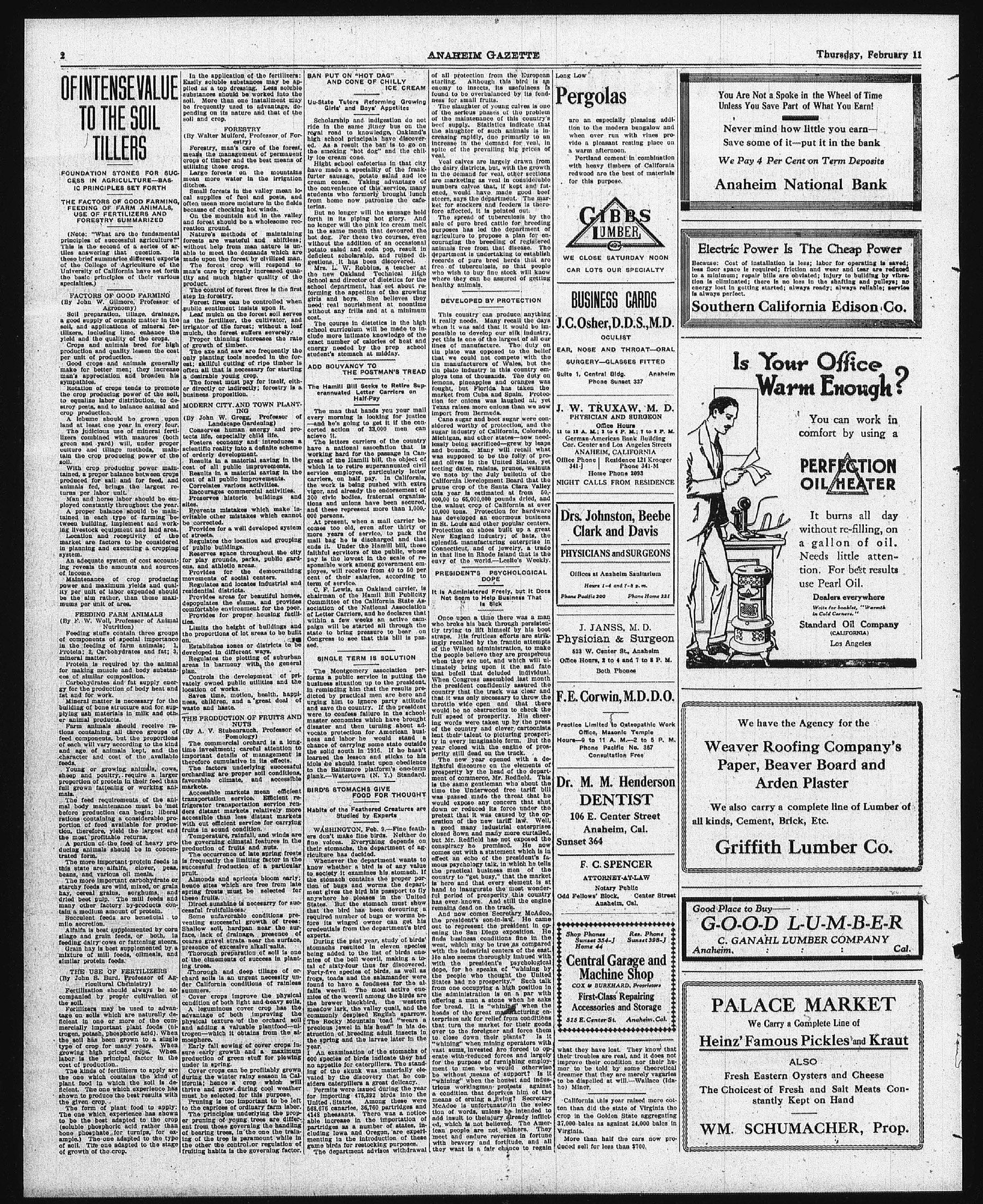
Searchable text
OF INTENSE VALUE TO THE SOIL TILLERS
FOUNDATION STONES FOR SUCCESS IN AGRICULTURE—BASIC PRINCIPLES SET FORTH
THE FACTORS OF GOOD FARMING, FEEDING OF FARM ANIMALS, USE OF FERTILIZERS AND FORESTRY SUMMARIZED
(Note: "What are the fundamental principles of successful agriculture?" This is the second of a series of articles answering that question. In these brief summaries different experts of the College of Agriculture of the University of California have set forth the basic principles of their various specialties.)
FACTORS OF GOOD FARMING (By John W. Gilmore, Professor of Agronomy)
Soil preparation, tillage, drainage, a good supply of organic matter in the soil, and applications of mineral fertilizers, including lime, enhance the yield and the quality of the crops.
Crops and animals bred for high production and quality lessen the cost per unit of production.
Good crops and animals generally make for better men; they increase man's appreciation and broaden his sympathies.
Rotation of crops tends to promote the crop producing power of the soil, to equalize labor distribution, to destroy pests, and to balance animal and crop production.
A lebume should be grown upon land at least one year in every four.
The judicious use of mineral fertilizers combined with manures (both green and yard) will, under proper culture and tillage methods, male.
In the application of the fertilizers: Easily soluble substances may be applied as a top dressing. Less soluble substances should be worked into the soil. More than one installment may be frequently used to advantage, depending on its nature and that of the soil and crop.
FORESTRY (By Walter Mulford, Professor of Forestry)
Forestry, man's care of the forest, means the management of permanent crops of timber and the best means of utilizing those crops.
Large forests on the mountains mean water in the irrigation ditches.
Small forests in the valley mean local supplies of fuel and posts, and often mean more moisture in the fields because of checking hot winds.
On the mountain and in the valley and forest should be a wholesome recreation ground.
Nature's methods of maintaining forests are wasteful and shifftless; without help from man nature is unable to meet the demands which are made upon the forest by civilized man.
The forest crop will respond to man's care by greatly increased quantity and much higher quality of the product.
The control of forest fires is the first step in forestry.
Forest fires can be controlled when public sentiment insists upon it.
Leaf mulch on the forest soil serves as the fertilizer, the cultivator, and irrigator of the forest; without a leaf mulch, the forest suffers severely.
Proper thinning increases the rate of growth of timber.
The axe and saw are frequently the only planting tools needed in the forest; skillful cutting of ripe timber is often all that is necessary for starting a desirable young crop.
The forest must pay for itself, either directly or indirectly; forestry is a business proposition.
MODERN CITY. AND TOWN PLANTING (By John W. Gregg, Professor of Landscape Gardening)
Conserves human energy and protects life, especially child life.
Fosters economy and introduces a scientific reality into a definite scheme.
BAN PUT ON "HOUSE AND CONE"
Uu-State Tutors For Girls' And Boys'
Scholarship and ride in the same royal road to know high school principled. As a result thie smoking "hotly ice cream cones."
Hight school cafés have made a speck further sausage, pot cream cones. Talk the convenience of students who form from home now perierls.
But no longer will forth in its piping no longer will the plant in the same mouth hot dog. For these without the addition potato salad and a deficient scholarships, it has been Mrs. L. W. Robthe new Oakland School and director school department, forming the appetite girls and boys. need real nourishment without any frills coat.
The course in diary school curriculum will include more intimate exact number of calories energy needed by student's stomach.
ADD BOUVANCY THE POINT
The Harmill Bill Seerannuated Lettle Half
per unit of production.
Good crops and animals generally make for better men; they increase man's appreciation and broaden his sympathies.
Rotation of crops tends to promote the crop producing power of the soil, to equalize labor distribution, to destroy pests, and to balance animal and crop production.
A lebume should be grown upon land at least one year in every four.
The judicious use of mineral fertilizers combined with manures (both green and yard) will under proper culture and tillage methods, maintain the crop producing power of the soil.
With crop producing power maintained, a proper balance between crops produced for sail and for feed, and animals fed, brings the largest returns per labor unit.
Man and horse labor should be employed constantly throughout the year.
A proper balance should be maintained in each type of farming between building, implement and working livestock equipment and land area.
Location and receptivity of the market are factors to be considered in planning and executing a cropping system.
An adequate system of cost accounting reveals the amounts and sources of income.
Maintenance of crop producing power and maximum yields and quality per unit of labor expended should be the aim rather than these maximums per unit of area.
FEEDING FARM ANIMALS
(By F. W. Woll, Professor of Animal Nutrition)
Feeding stuffs contain three groups of components of special importance in the feeding of farm animals; 1. Protein; 2. Carbohydrates and fat; 3. mineral matter.
Protein is required by the animal for making muscle and body substances of similar composition.
Carbohydrates and fat supply energy for the production of body heat and fat and for work.
Mineral matter is necessary for the building of bone structure and for supplying ash materials in milk and other animal products.
Farm animals should receive raions containing all three groups of feed components, but the proportions of each will vary according to the kind and age of animals kept, and the character and cost of the available feeds.
Young or growing animals, cows, sheep and poultry, require a larger proportion of protein in their feed than full grown fattening or working animals.
The feed requirements of the animal body maintenance must be met before production can begin; liberal rations containing a considerable proportion of feed available for production, therefore, yield the largest and the most profitable returns.
A portion of the feed of heavy producing animals should be in concern only planting tools needed in the forest; skillful cutting of ripe timber is often all that is necessary for starting a desirable young crop.
The forest must pay for itself, either directly or indirectly; forestry is a business proposition.
MODERN CITY AND TOWN PLANTING
(By John W. Gregg, Professor of Landscape Gardening)
Conserves human energy and protects life, especially child life.
Fosters economy and introduces a scientific reality into a definite scheme of orderly development.
Results in a material saving in the cost of all public improvements.
Results in a material saving in the cost of all public improvements.
Correlates various activities.
Encourages commercial activities.
Preserves historic buildings and sites.
Prevents mistakes which make inevitable other mistakes which cannot be corrected.
Provides for a well developed system of streets.
Regulates the location and grouping of public buildings.
Reserves space throughout the city for play grounds, parks, public gardens, and athletic areas.
Provides for the democratizing movements of social centers.
Regulates and locates industrial and residential districts.
Provides areas for beautiful homes, depopulates the slums, and provides comfortable environment for the poor.
Provides for proper housing facilities.
Limits the height of buildings and the proportions of lot areas to be built on.
Establishes zones or districts to be developed in different ways.
Regulates the plotting of suburban areas in harmony with the general plan.
Controls the development of privately owned public utilities and the location of works.
Saves time, motion, health, happiness, children, and a great deal of waste and haste.
THE PRODUCTION OF FRUITS AND NUTS
(By A. V. Stubenrauch, Professor of Pomology)
The commercial orchard is a long-time investment; careful attention to important details of management is therefore cumulative in its effects.
The factors underlying successful orcharding are proper soil conditions, favorable climate, and accessible markets.
Accessible markets mean efficient transportation service. Efficient refrigerator transportation service renders distant markets relatively more accessible than less distant markets with out efficient service for carrying fruits in sound condition.
Temperature, rainfall, and winds are the governing climatic features in the production of fruits and nuts.
Young or growing animals, cows, sheep and poultry, require a larger proportion of protein in their feed than full grown fattening or working animals.
The feed requirements of the animal body maintenance must be met before production can begin; liberal rations containing a considerable proportion of feed available for production, therefore, yield the largest and the most profitable returns.
A portion of the feed of heavy producing animals should be in concentrated form.
The more important protein feeds in this state are alfalfa, clover, peas, beans, and various oil meals.
The more important carbohydrate or starchy feeds are wild, mixed, or grain hay, cereal grains, sorghums, and dried beet pulp. The mill feeds and many other factory by-products contain a medium amount of protein.
Succulent feeds are beneficial to mile secretion.
Alfalfa is best supplemented by corn silage and grain feeds, or both, in feeding dairy cows or fattening steers.
Grain hay is best supplemented by a mixture of mill feeds, oilmeals, and similar protein feeds.
THE USE OF FERTILIZERS (By John S. Burd, Professor of Agricultural Chemistry)
Fertilization should always be accompanied by proper cultivation of the soil.
Fertilizers may be used to advantage on soils which are naturally deficient in one or more of the commercially important plant foods (nitrogen, potash, phosphoric acid). When the soil has been grown to a single type of crop for many years. When growing high priced crops. When labor is the principal factor in the cost of production.
The kinds of fertilizers to apply are the one which contains the kind of plant food in which the soil is deficient. The one which experience has shown to produce the best results with the given crop.
The form of plant food to apply: The one which experience has shown to be the best adapted to the crop (soluble phosphoric acid rather than bone phosphate for turnips, for example.) The one adapted to the type of soil. The one adapted to the stage of growth of the crop.
THE USE OF EFFECTIVE MANAGEMENT IN THE IMPORTANT DETAILS OF MANAGEMENT IS therefore cumulative in its effects.
The factors underlying successful orchardering are proper soil conditions, favorable climate, and accessible markets.
Accessible markets mean efficient transportation service. Efficient refrigerator transportation service renders distant markets relatively more accessible than less distant markets with out efficient service for carrying fruits in sound condition.
Temperature, rainfall, and winds are the governing climatic features in the production of fruits and nuts.
The occurrence of late spring frosts is frequently the limiting factor in the successful production of a particular fruit.
Almonds and apricots bloom early; hence sites which are free from late spring frosts must be selected for these fruits.
Direct sunshine is necessary for successful fruitfulness.
Some unfavorable conditions preventing successful growth of trees: Shallow soil, hardpan near the surface, lack of drainage, presence of coarse gravel strata near the surface, presence of excessive alkali salts.
Thorough preparation of soil is one of the elixments of success in planting trees.
Thorough and deep tillage of orchard soils is an urgent necessity under California conditions of rainless summers.
Cover crops improve the physical condition of both light and heavy soils.
A leguminous cover crop has the advantage of both improving the physical texture of the orchard soil and adding a valuable plantfood—nitrogen—which it obtains from the atmosphere.
Early fall sowing of cover crops insure early growth and a maximum production of green stuff for plowing under in spring.
Cover crops can be profitably grown during the winter rainy season in California; hence a crop which will thrive and grow during cool weather must be selected for this purpose.
Pruning is too important to be left to the caprices of ordinary farm labor.
The principles underlying the proper pruning of young trees are different from those governing the handling of bearing trees. In the one training of the tree is paramount while in the other the control or regulation of fruiting habits is the governing factor.
ANAHEIM GAZETTE
BAN PUT ON "HOT DAG"
AND CONE OF CHILLY
ICE CREAM
Uu-State Tutors Reforming Growing Girls' and Boys' Appetites
Scholarship and indigestion do not ride in the same jitney bus on the royal road to knowledge, Oakland's high school principals have discovered. As a result the ban is to go on the smoking "hot dog" and the chilly ice cream cone.
High school cafeterias in that city have made a speciality of the frank-furter sausage, potato salad and ice cream cones. Taking advantage of the convenience of this service, many students who formerly brought lunch from home now patronize the cafeterias.
But no longer will the sausage hold forth in its piping hot glory. And no longer will the pink ice cream melt in the same mouth that devoured the hot dog. For these two courses, even without the addition of an occasional potato salad and soda pop, result in deficient scholarship, and ruined digestions, it has been discovered.
Mrs. L. W. Robbins, a teacher at the new Oakland Technical High School and director of dietetics for the school department, has set about reforming the appetites of the growing girls and boys. She beloves they need real nourishment at noontime without any frills and at a minimum cost.
The course in dietetics in the high school curriculum will be made to include more intimate knowledge of the exact number of calories of heat and energy needed by the prep school student's stomach at midday.
ADD BOUYANCY TO THE POSTMAN'S TREAD
The Hamill Bill Seeks to Retire Superannuated Letter Carriers on Half-Pay
The man that hands you your mail every morning is looking for Justice—and he's going to get it if the concerted action of 33,000 men can accele it.
The letters carriers of the country have a national association that is of all protection from the European starling. Although this bird is an enemy to insects, its usefulness is found to be overbalanced by its fondness for small fruits.
The slaughter of young calves is one of the serious phases of the problem of the maintenance of this country's beef supply. Statistics indicate that the slaughter of such animals is increasing rapidly, due primarily to an increase in the demand for veal, in spite of the prevailing big prices of veal.
Veal calves are largely drawn from the dairy districts, but, with the growth in the demand for veal, other sections are marketing as veal in considerable numbers calves that, if kept and fattened, would have made good beef steers, says the department. The market for stockers and feeders is therefore affected, it is pointed out.
The spread of tuberculosis by the sale of pure bred cattle for breeding purposes has led the department of agriculture to propose a plan for encouraging the breeding of registered animals free from that disease. The department is undertaking to establish records of pure bred hords that are free of tuberculosis, so that people who wish to buy fine stock will know where they can be assured of getting healthy animals.
DEVELOPED BY PROTECTION
This country can produce anything it really needs. Many recall the days when it was said that it would be impossible to develop our silk industry, yet this is one of the largest of all our lines of manufacture. The duty on tin plate was opposed to the belief that we could not compete with the tin manufacturers of Wales, but the tin plate industry in this country employs tens of thousands. The duty on lemons, pineapples and oranges was fought, but Florida has taken the market from Cuba and Spain. Protection for onions was laughed at, yet Texas raises more onions than we now import from Bermuda.
Cane sugar and beet sugar were considered worthy of protection, and the sugar industry of California, Colorado, Michigan, and other states—now needlessly being sacrificed—grew by leaps what...
ADD BOUYANCY TO THE POSTMAN'S TREAD
The Hamill Bill Seeks to Retire Superannuated Letter Carriers on Half-Pay
The man that hands you your mail every morning is looking for Justice—and he's going to get it if the concerted action of 33,000 men can accele it.
The letters carriers of the country have a national association that is working hard for the passage in Congress of the Hamill bill, the object of which is to retire superannuated civil service employees, particularly letter carriers, on half pay. In California, the work is being pushed with extra vigor, and already the endorsement of 200 civic bodies, fraternal organizations and unions have been secured, and these represent more than 1,000,000 persons.
At present, when a mail carrier becomes too old, even after thirty or more years of service, to pack the mail bag he is discharged and that ends it. Under the Hamill bill, these faithful servitors of the public, whose pay is the lowest in the scale of responsible work among government employees, will receive from 40 to 50 per cent of their salaries, according to term of service.
C. F. Lewis, an Oakland carrier, is chairman of the Hamill Bill Publicity Committee of the California State Association of Letter Carriers, and he declares that within a few weeks an active campaign will be started all through the state to bring pressure to bear on Congress to see that this bill is passed.
SINGLE TERM IS SOLUTION
The Montgomery association performs a public service in putting the business situation up to the president, in reminding him that the results predicted by practical men are here and urging him to ignore party attitude and save the country. If the president were to confess failure in the schoolmaster economics which have brought disaster and then turning about advocate protection for American business and labor he would stand a chance of carrying some state outside the solid south in 1916. If he hasn't learned the lesson and sticks to his idols he should insist upon obedience to the Baltimore platform's one-term plank.—Watertown (N. Y.) Standard.
BIRD'S STOMACHS GIVE FOOD FOR THOUGHT
Habits of the Feathered Creatures are Studied by Experts
WASHINGTON, Feb. 9.—Fine feathers don't make fine birds. Neither do fine voices. Everything depends on their stomachs, the department of agriculture.
Cane sugar and beet sugar were considered worthy of protection, and the sugar industry of California, Colorado, Michigan, and other states—now lessly being sacrificed—grew by leaps and bounds. Many will recall what was supposed to be the folly of pro- and olives in the United States, yet testing dates, rains, prunes, walnuts we note by the July bulletin of the California Development Board that the prune crop of the Santa Clara Valley this year is estimated at from 50,000,000 to 65,000,000 pounds dried, and the walnut crop of California at over 10,000 tons. Protection for hardware has developed an enormous business in St. Louis and other popular centers. Protection on shoes built up a great New England industry; of hats, the splendid manufacturing enterprise in Connecticut, and of jewelry, a trade in that line in Rhode Island that is the envy of the world.—Leslie's Weekly.
PRESIDENT'S PSYCHOLOGICAL DOPE
It is Administered Freely, but it Does Not Seem to Help Business That Is Slick
Once upon a time there was a man who broke his back through persistently trying to lift himself by his boot straps. His fruitful efforts are strikingly recalled by the frantic attempts of the Wilson administration, to make the people believe they are prosperous when they are not, and which will ultimately bring upon it the sad fate that befell that deluded individual. When Congress assembled last month the president confidently assured the country that the track was clear and that it was only necessary to throw the throttle wide open and that there would be no obstruction to check the full speed of prosperity. His cheering words were taken up by the press of the country and clever cartoonists lent their talent to picturing prosperity in every imaginable form. But the year closed with the engine of prosperity still dead on the track.
The new year opened with a delightful discourse on the elements of prosperity by the head of the department of commerce, Mr. Redfield. This is the same gentleman who about time the Underwood free tariff bill was passed made the threat that he would expose any concern that shut down or reduced its force under the pretext that it was caused by the operation of the new tariff law. Well, a good many industrial enterprises closed down and many more curtailed, but Mr. Redfield has not exposed the conspiracy he promised. He now student at industry.
ADD BOUYANCY TO THE POSTMAN'S TREAD
The Hamill Bill Seeks to Retire Superannuated Letter Carriers on Half-Pay
The man that hands you your mall every morning is looking for Justice—and he's going to get it if the concerted action of 33,000 men can accele it.
The letters carriers of the country have a national association that is working hard for the passage in Congress of the Hamill bill, the object of which is to retire superannuated civil service employees, particularly letter carriers, on half pay. In California, the work is being pushed with extra vigor, and already the endorsement of 200 civic bodies, fraternal organizations and unions have been secured, and these represent more than 1,000,000 persons.
At present, when a mail carrier becomes too old, even after thirty or more years of service, to pack the mail bag he is discharged and that ends it. Under the Hamill bill, these faithful servitors of the public, whose pay is the lowest in the scale of responsible work among government employees, will receive from 40 to 50 per cent of their salaries, according to term of service.
C. F. Lewis, an Oakland carrier, is chairman of the Hamill Bill Publicity Committee of the California State Association of Letter Carriers, and he declares that within a few weeks an active campaign will be started all through the state to bring pressure to bear on Congress to see that this bill is passed.
SINGLE TERM IS SOLUTION
The Montgomery association performs a public service in putting the business situation up to the president, in reminding him that the results predicted by practical men are here and urging him to ignore party attitude and save the country. If the president were to confess failure in the schoolmaster economics which have brought disaster and then turning about advocate protection for American business and labor he would stand a chance of carrying some state outside the solid south in 1916. If he hasn't learned the lesson and sticks to his idols he should insist upon obedience to the Baltimore platform's one-term plank.—Watertown (N. Y.) Standard.
BIRD'S STOMACHS GIVE FOOD FOR THOUGHT
Habits of the Feathered Creatures are Studled by Experts
WASHINGTON, Feb. 9.—Fine feathers don't make fine birds. Neither do fine voices. Everything depends on their stomachs, the department of agriculture.
Cane sugar and beet sugar were considered worthy of protection, and the sugar industry of California, Colorado, Michigan, and other states—now lessly being sacrificed—grew by leaps and bounds. Many will recall what was supposed to be the folly of pro- and olives in the United States, yet testing dates, rains, prunes, walnuts we note by the July bulletin of the California Development Board that the prune crop of the Santa Clara Valley this year is estimated at from 50,000,000 to 65,000,000 pounds dried, and the walnut crop of California at over 10,000 tons. Protection for hardware has developed an enormous business in St. Louis and other popular centers. Protection on shoes built up a great New England industry; of hats, the splendid manufacturing enterprise in Connecticut, and of jewelry, a trade in that line in Rhode Island that is the envy of the world.—Leslie's Weekly.
PRESIDENT'S PSYCHOLOGICAL DOPE
It is Administered Freely, but it Does Not Seem to Help Business That Is Slick
Once upon a time there was a man who broke his back through persistently trying to lift himself by his boot straps. His fruitful efforts are strikingly recalled by the frantic attempts of the Wilson administration, to make the people believe they are prosperous when they are not, and which will ultimately bring upon it the sad fate that befell that deluded individual. When Congress assembled last month the president confidently assured the country that the track was clear and that it was only necessary to throw the throttle wide open and that there would be no obstruction to check the full speed of prosperity. His cheering words were taken up by the press of the country and clever cartoonists lent their talent to picturing prosperity in every imaginable form. But the year closed with the engine of prosperity still dead on the track.
The new year opened with a delightful discourse on the elements of prosperity by the head of the department of commerce, Mr. Redfield. This is the same gentleman who about time The Underwood free tariff bill was passed made the threat that he would expose any concern that shut down or reduced its force under the pretext that it was caused by the operation of the new tariff law. Well,a good many industrial enterprises closed down and many more curtailed,but Mr.Redfield has not exposedthe conspiracyhepromised.HewnowstudentatindustryatmuseumatstudiomuseumatstudiomuseumatstudiomuseumatstudiomuseumatstudiomuseumatstudiomuseumatstudiomuseumatstudiomuseumatstudiomuseumatstudiomuseumatstudiomuseumatstudiomuseumatstudiomuseumatstudiomuseumatstudiomuseumatstudiomuseumatstudiomuseumatstudiomuseumatstudiomuseumatstudiomuseumatstudiomuseumatstudiomuseumatstudiomuseumatstudiomuseumatstudiomuseumatstudiomuseumatstudiomuseumatstudiomuseumatstudiomuseumatstudiomuseumatstudiomuseumatstudiomuseumatstudiomuseumatstudiomuseumatstudiomuseumatstudiomuseumatstudiomuseumatstudiomuseumatstudiomuseumatstudiomuseumatstudiomuseumatstudiomuseumatstudiomuseumatstudiomuseumatstudiomuseumatstudiomuseumatstudiomuseumatstudiomuseumatstudiomuseumatstudiomuseumatstudiomuseumatstudiomuseumatstudiomuseumatstudiomuseumatstudiomuseumatstudioimmunumumumumumumumumumumumumumumumumumumumumumumumumumumumumumumumumumumumumumumumumumumumumumumumumumumumumumumumumumumumumumumumumumumumumumumumumumumumimumUMUMUMUMUMUMUMUMUMUMUMUMUMUMUMUMUMUMUMUMUMUMUMUMUMUMUMUMUMUMUMUMUMUMUMUMUMUMUMUMUMUMUMUMUMUMUMUMUMUMUMUMUMUMUMUMUMUMUMUMUMUMUMUMUMUMUMUMUMUMUMUMUMUMUMUMUMUMUmUmUmUmUmUmUmUmUmUmUmUmUmUmUmUmUmUmUmUmUmUmUmUmUmUmUmUmUmUmUmUmUmUmUmUmUmUmUmUmUmUmUmUmUmUmUmUmUmUmUmUmUmUmUmUmUm Um Um Um Um Um Um Um Um Um Um Um Um Um Um Um Um Um Um Um Um Um Um Um Um Um Um Um Um Um Um Um Um Um Um Um Um Um Um Um Um Um Um Um Um Um Um Um Um Um Um Um Um Um Um Um Um Um Um Um Um Om um um um um um um um um um um um um um um um um um um um um um um um um um um um um um um um um um um um um um um um um um um um um um um um um um um um um um um um um um um um um um um um um um um um um um um um um um um um um um um um um um um um om ums ums ums ums ums ums ums ums ums ums ums ums ums ums ums ums ums ums ums ums ums ums ums ums ums ums ums ums ums ums ums ums ums ums ums ums ums ums ums ums ums ums ums ums ums ums ums ums UMS UMS UMS UMS UMS UMS UMS UMS UMS UMS UMS UMS UMS UMS UMS UMS UMS UMS UMS UMS UMS UMS UMS UMS UMS UMS UMS UMS UMS UMS UMS UMS UMS UMS UMS UMS UMS UMS UMS UMS UMS UMS UMS UMS UMS UMS UMS UMS UMSU MSU MSU MSU MSU MSU MSU MSU MSU MSU MSU MSU MSU MSU MSU MSU MSU MSU MSU MSU MSU MSU MSU MSU MSU MSU MSU MSU MSU MSU MSU MSU MSU MSU MSU MSU MSU MSU MSU MSU MSU MSU MSU MSU MSU MSU MSU MSU MSU MSU MSSU MSSU MSSU MSSU MSSU MSSU MSSU MSSU MSSU MSSU MSSU MSSU MSSU MSSU MSSU MSSU MSSU MSSU MSSU MSSU MSSU MSSU MSSU MSSU MSSU MSSU MSSU MSSU MSSU MSSU MSSU MSSU MSSUS MSSUS MSSUS MSSUS MSSUS MSSUS MSSUS MSSUS MSSUS MSSUS MSSUS MSSUS MSSUS MSSUS MSSUS MSSUS MSSUS MSSUS MSSUS MSSUS MSSUS MSSUS MSSUS MSSUS MSSUS MSSUS MSSUS MSSUS MSSUS MSSUS MSSUS MSSUS MSSUsMssusMssusMssusMssusMssusMssusMssusMssusMssusMssusMssusMssusMssusMssusMssusMssusMssusMssusMssusMssusMssusMssusMssusMssusMssusMssusMssusMssusMssusMssusMssusMssusMssusMsSUsMsSUsMsSUsMsSUsMsSUsMsSUsMsSUsMsSUsMsSUsMsSUsMsSUsMsSUsMsSUsMsSUsMsSUsMsSUsMsSUsMsSUsMsSUsMsSUsMsSUsMsSUsMsSUsMsSUsMsSUsMsSUsMsSUsMsSUsMsSUsMsSUsMsSUsMsSUsMsSUs MsSUsMsSUsMsSUsMsSUsMsSUsMsSUsMsSUsMsSUsMsSUsMsSUsMsSUsMsSUsMsSUsMsSUsMsSUsMsSUsMsSUsMsSUsMsSUsMsSUsMsSUsMsSUsMsSUsMsSUsMsSUsMsSUsMsSUs MsSUs MsSUs MsSUs MsSUs MsSUs MsSUs MsSUs MsSUs MsSUs MsSUs MsSUs MsSUtils MsSUtils MsSUtils MsSUtils MsSUtils MsSUtils MsSUtils MsSUtils MsSUtils MsSUtils MsSUtils MsSUtils MsSUtils MsSUtils MsSUtils MsSUtils MsSUtils MsSUtils MsSUtils MsSUtils MsSUtils MsSUtils MsSUtils MsSUtils Ms SUtils Ms SUtils Ms SUtils Ms SUtils Ms SUtils Ms SUtils Ms Sutils Ms Sutils Ms Sutils Ms Sutils Ms Sutils Ms Sutils Ms Sutils Ms Sutils Ms Sutils Ms Sutils Ms Sutils Ms Sutils Ms Sutils Ms Sutils Ms Sutils Ms Sutils Ms Sutils Ms S.utils.Ms S.utils.Ms S.utils.Ms S.utils.Ms S.utils.Ms S.utils.Ms S.utils.Ms S.utils.Ms S.utils.Ms S.utils.Ms S.utils.Ms S.utils.Ms S.utils.Ms S.utils.Ms S.utils.Ms S.utils.Ms S.utils.Ms S.utils.Ms S.utils.Ms S.utils.Ms S.utils.Ms S.utils.Ms S.utils.Ms S.utils.Ms S.utils.Ms.S.utils.Ms.S.utils.Ms.S.utils.Ms.S.utils.Ms.S.utils.Ms.S.utils.Ms.S.utils.Ms.S.utils.Ms.S.utils.Ms.S.utils.Ms.S.utils.Ms.S.utils.Ms.S.utils.Ms.S.utils.Ms.S.utils.Ms.S.utils.Ms.S.utils.Ms.S.utils.Ms.S.utils.Ms.S.utils.Ms.S.utils.Ms.S.utils.Ms.S.utils.Ms.S.utils.Ms.S.Uts.Ms.S.Uts.Ms.S.Uts.Ms.S.Uts.Ms.S.Uts.Ms.S.Uts.Ms.S.Uts.Ms.S.Uts.Ms.S.Uts.Ms.S.Uts.Ms.S.Uts.Ms.S.Uts.Ms.S.Uts.Ms.S.Uts.Ms.S.Uts.Ms.S.Uts.Ms.S.Uts.Ms.S.Uts.Mm.s.Uts.Mm.s.Uts.Мм.s.Uts.Мм.s.Uts.Мм.s.Uts.Мм.s.Uts.Мм.s.Uts.Мм.s.Uts.Мм.s.Uts.Мм.s.Uts.Мм.s.Uts.Мм.s.Uts.Мм.s.Uts.Мм.s.Uts.Мм.s.Uts.Мм.s.Uts.Мм.s.Uts.Мм.s.Uts.Мм.s.Uts.Мм.s.Uts.Мм.s.Uts.Мм.s.Uts.Мm.s.Uts.Мm.s.Uts.Мm.s.Uts.Мm.s.Uts.Мm.s.Uts.Мm.s.Uts.Мm.s.Uts.Мm.s.Uts.Мm.s.Uts.Мm.s.Uts.Мm.s.Uts.Мm.s.Uts.Мm.s.Uts.Мm.s.Uts.Мm.s.Uts.Мm.s.Uts.Мm.s.Uts.Мm.s.Units.ПОЛЕТЫ.ПОЛЕТЫ.ПОЛЕТЫ.ПОЛЕТЫ.ПОЛЕТЫ.ПОЛЕТЫ.ПОЛЕТЫ.ПОЛЕТЫ.ПОЛЕТЫ.ПОЛЕТЫ.ПОЛЕТЫ.ПОЛЕТЫ.ПОЛЕТЫ.ПОЛЕТЫ.ПОЛЕТЫ.ПОЛЕТЫ.ПОЛЕТЫ.ПОЛЕТЫ.ПОЛЕТЫ.ПОЛЕТЫ.ПОЛЕТЫ.ПОЛЕТЫ.ПОЛЕТЫ.ПОЛЕТЫ.ПОЛЕТЫ.ПОЛЕТЫ.ПОЛЕТЫ.ПОЛЕТЫ.ПОЛЕТЫ.ПОЛЕТЫ.ПОЛЕТЕПОЛЕТЕПОЛеТЕПоплелепплелеппппппппппппппппппппппппппппппппппппппппппппппппппппппппппппппппппппп п п п п п п п п п п п п п п п п п п п п п п п п п п п п п п п п п п п п п п п п п п p p p p p p p p p p p p p p p p p p p p p p p p p p p p p p p p p p p p p p p p p p p p p p p p p p p p p p p p p p p p p p p p p p p p p p p p p p p p p p p p p p p p p p p p p p p p p p pp pp pp pp pp pp pp pp pp pp pp pp pp pp pp pp pp pp pp pp pp pp pp pp pp pp pp pp pp pp pp pp pp pp pp pp pp pp pp pp pp pp pp pp pp pp pp pp pp pp pp pp pp pp pp pp pp pp pp pp pp pp pp pp pp pp pp pp pp pp pp pp pp pp pp pp pp pp pp pp pp pp pp pppppppppppppppppppppppppppppppppppppppppppppppppppppppppppppppppppppppppppppppppppppppppppppppppppppppppppppppppppppppppppppppppppppppppppppppppppppppppppppPPPPPPPPPPPPPPPPPPPPPPPPPPPPPPPPPPPPPPPPPPPPPPPPPPPPPPPPPPPPPPPPPPPPPPPPPPPPPPPPPPPPPPPPPPPPPPPPPPPPPPPPPPPPPPPPPPPPPPPPPPPPPPPPPPPPPPPPPPPPPPPPPPPPPPPPPPPPPPPPPPPPPPPPPPPPPPPPPPPPPPPPPPPPPPPPPPPPPPPPPPPPPPPPPPPPPPPPPPPPPPPPPPPPPPPPPPPPPPPPPPPPPPPPPPPPPPPPPPPPPPPPPPPPPPPPPPPPPPPPPPPPPPPPPPPPPPPPPPPPPPPPPPPPPPPPPPPPPPPPPPPPPPPPPPPPPPPPPPPPPPPPFFFFFFFFFFFFFFFFFFFFFFFFFFFFFFFFFFFFFFFFFFFFFFFFFFFFFFFFFFFFFFFFFFFFFFFFFFFFFFFFFFFFFFFFFFFFFFFFFFFFFFFFFFFFFFFFFFFFFFFFFFFFFFFFFFFFFFFFFFFFFFFFFFFFFFFFFFFFFFFFFFFFFFFFFFFFFFFFFFFFFFFFFFFFFFFFFFFFFFFFFFFFFFFFFFFFFFFFFFFFFFFFFFFFFFFFFFFFFFFFFFFFFFFFFFFFFFFFFFFFFFFFFFFFFFFFFFFFFFFFFFFFFFFFFFFFFFFFFFFFFFFFFFFFFFFFFFFFFFFFFFFFFFFFFFFFFFFFFFFFFFFFFFFFFFFFFFFFFFFFFFFFFFFFFFFFFFFFFFFFFFFFFFFFFFFFFFFFFFFFFFFFFFFFFFFFFFFFFFFFFFFFFFFFFFFFFFFFFFFFFFFFFFFFFFFFFFFFFFFFFFFFFFFFFFFFFFFFFFFFFFFFFFFFFFFFFFFFFFFFFFFFFFFFFFFFFFFFFFFFFFFFFFFFFFFFFFFFFFFFFFFFFFFFFFFFFFFFFFFFFFFFFFFFFFFFFFFFFFFFFFFFFFFFFFFFFFFFFFFFFFFFFFFFFFFFFFFFFFFFFFFFFFFFFFFFFFFFFFFFFFFFFFFFFFFFFFFFFFFFFFFFFFFFFFFFFFFFFFFFFFFFFFFFFFFFFFFFFFFFFFFFFFFFFFFFFFFFFFFFFFFFFFFFFFFFFFFFFFFFFFFFFFFFFFFFFFFFFFffffffffffffffffffffffffffffffffffffffffffffffffffffffffffffffffffffffffffffffffffffffffffffffffffffffffffffffffffffffffffffffffffffffffffffffffffffffffffffffffffffffffffffffffffffffffffffffffffffffffffffffffffffffffffffffffffffffffffffffffffffffffffffffffffffffffffffffffffffffffffffffffffffffffffffffffffffffffffffffffffffffffffffffffffffffffffffffffffffffffffffffffffffffffffffffffffffffffffffffffffffffffffffffffffffffffffffffffffffffffffffffffffffffffffffffffffffffffffffffffffffffffffffffffffffffffffffffffffffffffffffffffffffffffffffffffffffffffffffffffffffffffffffffffffffffffffffffffffffffffffffffffffffffffffffffffffffffffffffffffff嘿嘿嘿嘿嘿嘿嘿嘿嘿嘿嘿嘿嘿嘿嘿嘿嘿嘿嘿嘿嘿嘿嘿嘿嘿嘿嘿嘿嘿嘿嘿嘿嘿嘿嘿嘿嘿嘿嘿嘿嘿嘿嘿嘿嘿嘿嘿嘿嘿嘿嘿嘿嘿嘿嘿嘿嘿嘿嘿嘿嘿嘿嘿黧黧黧黧黧黧黧黧黧黧黧黧黧黧黧黧黧黧黧黧黧黧黧黧黧黧黧黧黧黧黧黧黙黙黙黙黙黙黙黙黙黙黙黙黙黙黙黙黙黙黙黙黙黙黙黙黙黙黙黙黙黙黙黙黙黙黙黙黙黙黙黙黙黙黙黙黙黃黍黍黍黍黍黍黍黍黍黍黍黍黍黍黍黍黍黍黍黍黍黍黍黍黍黍黍黄妹黄妹黄妹黄妹黄妹黄妹黄妹黄妹黄妹黄妹妹黄妹妹黄妹妹黄妹妹黄妹妹黄妹妹黄妹妹黄妹妹黄妹妹黄妹妹黄妹妹黄妹妹黄妹妹黄妹妹黄妹妹黄妹妹黄妹妹黄妹妹黄妹妹黄妹妹黄妹妹黄妹妹黄妹妹黄妹妹黄妹妹黄妹妹黄妹妹黄妹妹黄妹妹黄妹妹黄妹妹黄妹妹黄妹妹黄妹妹黄妹妹黄妹妹黄妹妹黄妹妹黄妹妹黄妹妹黄妹妹黄妹妹黄妹妹黄妹妹黄妹妹黄妹妹黄妹妹黄妹妹黄妹妹黄妹妹黄色妹妹黄色妹妹黄色妹妹黄色妹妹黄色妹妹黄色妹妹黄色妹妹黄色妹妹黄色妹妹黄色妹妹黄色妹妹黄色妹妹黄色妹妹黄色妹妹黄色妹妹黄色妹妹黄色妹妹黄色妹妹黄色妹妹黄色妹妹黄色妹妹黄色妹妹黄色妹妹黄色妹妹黄色妹妹黄色妹妹黄色妹妹黄色妹妹黄色妹妹黄色妹妹黄色妹妹黄色妹妹黄色妹妹黄色妹妹黄色妹妹黄色妹妹黄色姊妹黄色姊妹黄色姊妹黄色姊妹黄色姊妹黄色姊妹黄色姊妹黄色姊妹黄色姊妹黄色姊妹黄色姊妹黄色姊妹黄色姊妹黄色姊妹黄色姊妹黄色姊妹黄色姊妹黄色姊妹黄色姊妹黄色姊妹黄色姊妹黄色姊妹黄色姊妹黄色姊妹黄色姊妹黄色姉妹黄色姉妹黄色姉妹黄色姉妹黄色姉妹黄色姉妹黄色姉妹黄色姉妹黄色姉妹黄色姉妹黄色姉妹黄色姉妹黄色姉妹黄色姉妹黄色姉妹黄色姉妹黄色姉妹黄色姉妹黄色姉妹黄色姉妹女性女性女性女性女性女性女性女性女性女性女性女性女性女性女性女性女性女性女性女性女性女性女性女性女性女性女性女性女性女性女性女性女性女性女性女性女性女性女性女性女性女性女性女性女性女性女性女性女性女性女性女性女性女性女性女性女性女性女性女性女性 female female female female female female female female female female female female female female female female female female female female female female female female female female female female female female female female female female female female female female female female female female female female female female female female female female female female female female female female female female female female female female female female female female female female female female female female female female female female female女女女女女女女女女女女女女女女女女女女女女女女女女女女女女女女女女女女女女女女女女女女女女女女女女女女女女女女女女女女女女女女女女女女女女女女女女女
learned the lesson and sticks to his idols he should insist upon obedience to the Baltimore platform's one-term plank.—Watertown (N. Y.) Standard.
BIRD'S STOMACHS GIVE FOOD FOR THOUGHT
Habits of the Feathered Creatures are Studled by Experts
WASHINGTON, Feb. 9.—Fine feathers don't make fine birds. Neither do fine voices. Everything depends on their stomachs, the department of agriculture has decided.
Whenever the department wants to know whether a bird is of any value to society it examines his stomach. If the stomach contains the proper portion of bugs and worms the department gives the bird his passport to fly anywhere he pleases in the United States. But the stomach must show that the bird has been devouring a required number of bugs or worms before its winged owner can get his credentials from the department's bird experts.
During the past year, study of birds' stomachs resulted in eleven species being added to the list of birds enemies of the boll weevil, making a total of sixty-four thus far discovered. Forty-five species of birds, as well as frogs, toads and the salamander were found to have a fondness for the alfalfa weevil. The most active enemies of the weevil among the birds are the brewer blackbird, the western meadow lark, the valley quail, and the commonly despised English sparrow. The Rocky Mountain toad "wears a precious jewel in his head" in his destruction of breeding adult insects in the spring and the larvae later in the year.
An examination of the stomachs of 600 species of birds indicate they had no appetite for caterpillars. The standing of the skunk was materially elevated by the discovery that he considers caterpillars a great delicacy.
Permits were issued during the year for importing 475,382 birds into the United States. Among these were 568,676 canaries, 36,760 partridges and 4148 pheasants. There was a noticeable increase in the importation of partridges as a number of states, including Iowa and Oregon, are experimenting in the introduction of these game birds for restocking purposes.
The department advises withdrawal.
The new year opened with a delightful discourse on the elements of prosperity by the head of the department of commerce, Mr. Redfield. This is the same gentleman who about the time the Underwood free tariff bill was passed made the threat that he would expose any concern that shut down or reduced its force under the pretext that it was caused by the operation of the new tariff law. Well, a good many industrial enterprises closed down and many more curtailed, but Mr. Redfield has not exposed the conspiracy he promised. He now comes out with a statement which is in effect an echo of the president's famous psychology talk, in which he tells the practical business men of the country to "get busy," that the market is here and that every element is at hand to inaugurate the most wonderful period of prosperity this country has ever known. And still the engine remains dead on the track.
And now comes Secretary McAdoo, the president's son-in-law. He came out to represent the president in opening the San Diego exposition. He finds business conditions fine in the west, which may be true as compared with the industrial centers of the east. He also seems thoroughly limbued with with the president's psychological dope, for he speaks of "whining by the States had no prosperity." Such talk from one occupying a high position in the administration is on a par with offering a man a stone when he asks for bread. It is "whining" when the heads of the great manufacturing enterprises ask for relief from conditions that turn the market for their goods over to the foreigner and force them to close down their plants? Is it "whining" when mining operators with vast sums, invested are forced to operate with-reduced forces and largely for the purpose of furnishing employment to men who would otherwise be without means of support? Is it "whining" when the honest and industrious workingman protests against a condition that deprives him of the means of erning a living? Secretary McAdoo is unfortunate in the selection of words, unless he intended to add insult to their injury already inflicted, which is not believed. The American people are not whiners. They meet and endure reverence in fortune with bravery and fortitude, and all they want is a fair chance to regain what they have lost. They know that their troubles are real, and it does not improve their condition nor their humor to be told by some theoretical dreamer that they are merely vagaries to be dispelled at will.—Wallace (Idaho) Miner.
California this year raised more cotton than did the state of Virginia the crop in the Golden State aggregating 37,000 bales as against 24,000 bales in Virginia.
More than half the cars now produced sell for less than $700.
Thursday, February 11
You Are Not a Spoke in the Wheel of Time
Unless You Save Part of What You Earn!
Never mind how little you earn—
Save some of it—put it in the bank
We Pay 4 Per Cent on Term Deposits
Anaheim National Bank
Electric Power Is The Cheap Power
Because: Cost of installation is less; labor for operating is saved;
less floor space is required; friction and wear and tear are reduced
to a minimum; repair bills are obviated; injury to building by vibration is eliminated; there is no loss in the shafting and pulleys; no
energy lost in getting started; always ready; always reliable; service
is always perfect.
Southern California Edison Co.
Is Your Office Warm Enough?
You can work in comfort by using a
Is Your Office Warm Enough?
You can work in comfort by using a
PERFECTION
OIL HEATER
It burns all day without re-filling, on a gallon of oil. Needs little attention. For best results use Pearl Oil.
Dealers everywhere
Write for booklet, "Warmth in Cold Corners."
Standard Oil Company
(CALIFORNIA)
Los Angeles
We have the Agency for the
Weaver Roofing Company's
Paper, Beaver Board and
Arden Plaster
We also carry a complete line of Lumber of all kinds, Cement, Brick, Etc.
Griffith Lumber Co.
Paper, Beaver Board and
Arden Plaster
We also carry a complete line of Lumber of
all kinds, Cement, Brick, Etc.
Griffith Lumber Co.
Good Place to Buy—
G-O-O-D L-U-M-B-E-R
C. GANAHL LUMBER COMPANY
Anaheim, Cal.
PALACE MARKET
We Carry a Complete Line of
Heinz' Famous Pickles and Kraut
ALSO
Fresh Eastern Oysters and Cheese
The Choicest of Fresh and Salt Meats Constantly Kept on Hand
WM. SCHUMACHER, Prop.