anaheim-gazette 1915-01-14
Scanned page
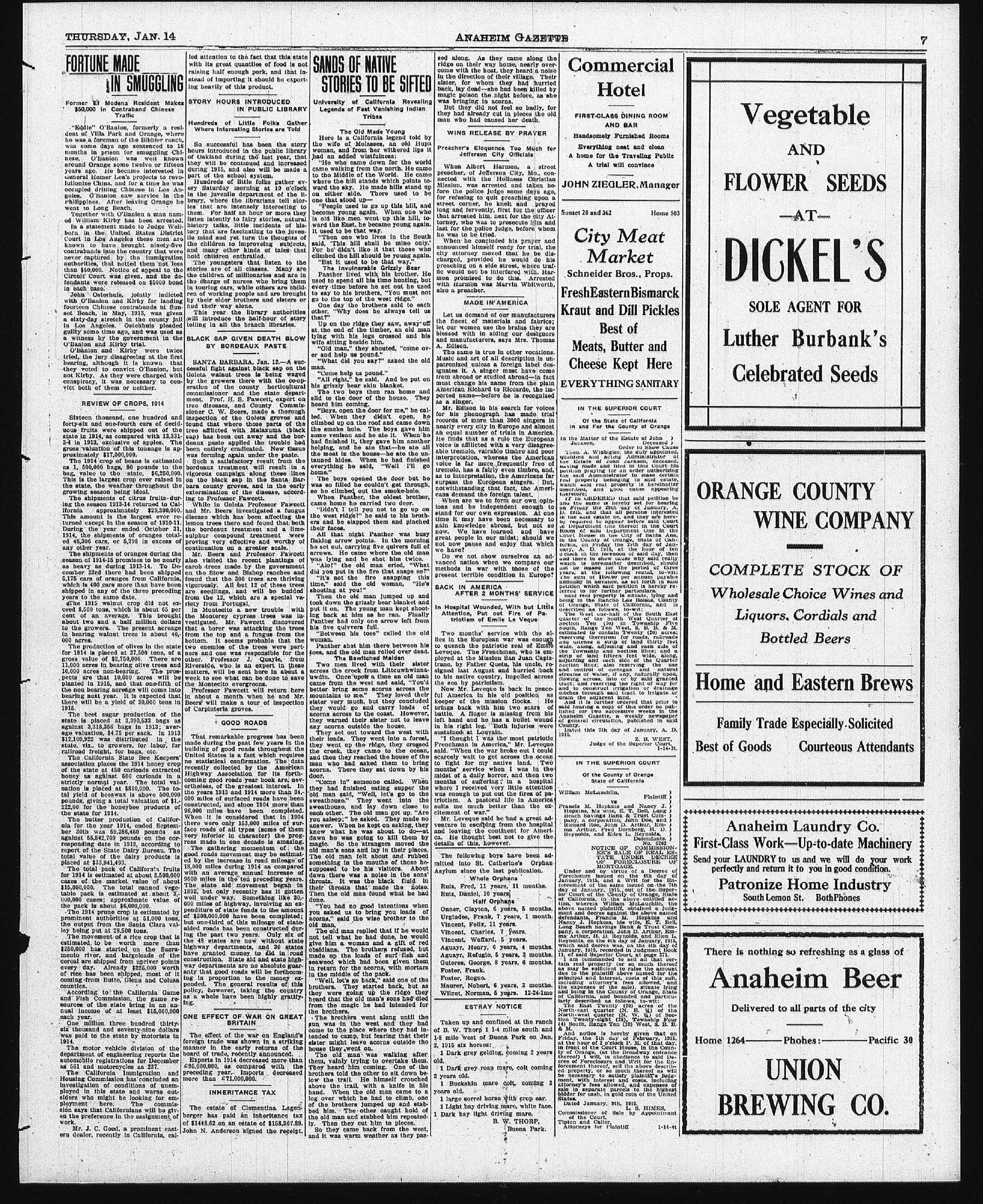
Searchable text
FORTUNE MADE IN SMUGGLING
Former El Modena Resident Makes $50,000 in Contraband Chinese Traffic
"Eddie" O'Banlon, formerly a resident of Villa Park and Orange, where he was a foreman of the Bibbier ranch, was some days ago sentenced to 18 months in prison for smuggling Chinese. O'Banlon was well known around Orange some twelve or fifteen years ago. He became interested in general Homer Lea's projects to revolutionize China, and for a time he was occupied drilling Chinese in Los Angeles. O'Banlon saw service in the Philippines. After leaving Orange he went to Long Beach.
Together with O'Banlon a man named William Kirby has been arrested. In a statement made to Judge Wellborn in the United States District Court in Los Angeles these men are known to have brought ninety-five contrabands into the country that were never captured by the immigration authorities, that netted them not less than $50,000. Notice of appeal to the Circuit Court was given, and the defendants were released on $5000 bond in each case.
John Osterhuis, jointly indicted with O'Banlon and Kirby for landing fourteen Chinese contrabands at Sunset Beach, in May, 1913, was given a sixty-day stretch in the county jail in Los Angeles. Ostehuhls pleaded guilty some time ago, and was used as a witness by the government in the O'Banlon and Kirby trial.
O'Banlon and Kirby were twice tried, the jury disagreeing at the first hearing, although it is known that they voted to convict O'Banlon, but not Kirby. As they were charged with conspiracy, it was necessary to convict both of them or neither.
REVIEW OF CROPS, 1914
Sixteen thousand, one hundred and forty-six and one-fourth cars of deciduous fruits were shipped out of the state in 1914, as compared with 13,331-3-4 in 1913, exclusive of apples. The gross valuation of this tonnage is an led attention to the fact that this state with its great quantities of food is not raising half enough pork, and that instead of importing it should be exporting heavily of this product.
STORY HOURS INTRODUCED IN PUBLIC LIBRARY
Hundreds of Little Folks Gather Where Interesting Stories are Told
So successful has been the story hours introduced in the public library of Oakland during the last year, that they will be continued and increased during 1915, and also will be made a part of the school system.
Hundreds of little folks gather every Saturday morning at 10 o'clock in the juvenile department of the library, where the librarians tell stories that are intensely interesting to them. For half an hour or more they listen intently to fairy stories, natural history talks, little incidents of history that are fascinating to the juvenile mind and yet turn the thoughts of the children to improving subjects, and many other kinds of tales that hold children enthralled.
The youngsters that listen to the stories are of all classes. Many are the children of millionaries and are in the charge of nurses who bring them in touring cars, while others are children of working people and are brought by their older brothers and sisters or nud their way alone.
This year the library authorities will introduce the half-hour of story telling in all the branch libraries.
BLACK SAP GIVEN DEATH BLOW BY BORDEAUX PASTE
SANTA BARBARA, Jan. 12.—A successful fight against black sap on the Goleta walnut trees is being waged by the growers there with the cooperation of the county horticultural commissioner and the state department. Prof. H. S. Fawcett, expert on tree diseases, and County Commissioner C. W. Beers, made a thorough inspection of the Goleta groves and found that where those parts of the tree afflicted with Malaxuma (black sap) has been cut away and the bordaux paste applied the trouble had been entirely graded. New tissue
SANDS OF STORIES
University of California Legends of Fashion
The Old Man
Here is a Californian wife of Mollus woman, and from him had an added wife.
He who came came walking from to the Middle of the hill ward the sky. He on either side.
One that stood up.
People used to become young age is old like men wield the East; he used to be that.
Then one who said, This hill sigh For he didn't like climbed the hill sigh But it used to The Invulnerable Panther lived we used to spend all our every time before to say to his broth go to the top of the other, "Why does that?"
Up on the ridge at the end of the lying with his lee wife sitting beside Old man," they er and help us po What did you man.
Come help us p All right," he his grizzly bear s The two boys slid to the door o heard him coming Boys, open ther led. When they climbed up on the smoke hole, some venom and had finished it, he
REVIEW OF CROPS, 1914
Sixteen thousand, one hundred and forty-six and one-fourth bags of deciduous fruits were shipped out of the state in 1914, as compared with 13,331-34 in 1913, exclusive of apples. The gross valuation of this tonnage is approximately $17,000,000.
The 1914 crop of beans is estimated as 1,500,000 bags, 80 pounds to the bag, value to the state, $6,250,000. This is the largest crop ever raised in the state, the weather throughout the growing season being ideal.
The shipments of citrus fruits during the season 1913-14 returned to California approximately $29,300,000. This amount is the largest ever returned except in the season of 1910-11. During the year ended October 31, 1914, the shipments of oranges totaled 45,306 cars, or 5,798 in excess of any other year.
The shipments of oranges during the season of 1914-15 promises to be nearly as heavy as during 1913-14. To December 23rd there had been shipped 5,175 cars of oranges from California, which is 400 cars more than have been shipped in any of the three preceding years to the same date.
The 1915 walnut crop did not exceed 8,500 tons, which is about 65 percent of an average. This brought about two and a half million dollars to the growers. The present acreage in bearing walnut trees is about 40,000 acres.
The production of olives in the state for 1914 is placed at 27,500 tons, of a gross value of $2,750,000. There are 11,000 acres in bearing olive trees and 10,000 acres non-bearing. The prospects are that 10,000 acres will be planted in 1915, and that one-fifth of the non-bearing acreage will come into bearing next year. It is expected that there will be a yield of 30,000 tons in 1915.
The beet sugar production of the state is placed at 3,390,533 bags against 3,318,356 bags in 1913; average valuation, $4.75 per sack. In 1913 $12,100,922 was distributed in the state, viz., to growers, for labor, for railroad freight, for bags, etc.
The California State Bee Keepers' association places the 1914 honey crop of the state at 450 carloads extracted honey as against 500 carloads in a strictly normal year. The total valuation is placed at $810,000. The total yield of beeswax is above 500,000 pounds, giving a total valuation of $1,222,00 for the honeybee products of the state for 1914.
The butter production of California for the year 1914, ended September 30th was 59,286,460 pounds as against 55,542,709 pounds on the corresponding date in 1913, according to report of the State Dairy Bureau.
SANTA BARBARA, Jan. 12.—A successful fight against black sap on the Goleta walnut trees is being waged by the growers there with the co-operation of the county horticultural commissioner and the state department. Prof. H. S. Fawcett, expert on tree diseases, and County Commissioner C. W. Beers, made a thorough inspection of the Goleta groves and found that where those parts of the tree afflicted with Malaxuma (black sap) has been cut away and the bordeaux paste applied the trouble had been entirely eradicated. New tissue was forming again under the paste.
Such a satisfactory result from the bordeaux treatment will result in a vigorous campaign along these lines on the black sap in the Santa Barbara county groves, and in the early extermination of the disease, according to Professor Fawcett.
While in Goleta Professor Fawcett and Mr. Beers investigated a fungus disease which has been affecting the lemon trees there and found that both the bordeaux treatment and a lime-sulphur compound treatment were proving very effective and worthy of continuation on a greater scale.
Mr. Beers and Professor Fawcett also visited the recent plantings of carob trees made by the government on the Stow and Bishop ranches and found that the 300 trees are thriving vigorously. All but 12 of these trees are seedlings, and will be budded from the 12, which are a special variety from Portugal.
In Montecito a new trouble with the Monterey cypress trees was investigated. Mr. Fawcett discovered that a borer was attacking the trees from the top and a fungus from the bottom. It seems probable that the two enemies of the trees were partners and one was responsible for the other. Professor J. Quayle, from Riverside, who is an expert in these matters, will be sent here in about a week to see what can be done to save the Montecito evergreens.
Professor Fawcett will return here in about a month when he and Mr. Beers will make a tour of inspection of Carpinteria groves.
GOOD ROADS
That remarkable progress has been made during the past few years in the building of good roads throughout the United States is a fact which requires no statistical confirmation. The data recently collected by the American Highway Association for its forthcoming good roads year book are, nevertheless, of the greatest interest. In the years 1913 and 1914 more than 34,000 miles of surfaced roads have been constructed, and since 1904 more than 96,000 miles have been completed. When it is considered that in 1904 there were only 153,000 miles of surface roads of all types (some of them very inferior in character) the progress made in one decade is amazing.
The gathering momentum of the
"What did you man."
"Come help us put him down on his grizzly bear skin."
"The two boys open their ear and help us put him down on his grizzly bear skin."
"Boys open their ear and help us put him down on his grizzly bear skin."
"When they climbed up on the smoke hole some venison and had finished it, helping and he sat in the meat in the tanned hides." Were everything he said home."
"The boys opened was so filled he could so he climbed out."
When Panther came home he caressed "Didn't I tell you the west ridge?" He rans and he slapped their faces.
All that night flaking arrow point he set out carrying arrows. He came was lying and he Alo!" The old did you put in them "It's not the first time," said the watcher at you!
Then the old man took down the grizzly put on it. The young back at him Panther had only his five quilvers "Between his woman."
Panther shot him goes,and the old man
The Bewite Two men lived across the creek from uwdin. Once upon came from the wet better bring some mountains to me." Sister very much they would go and acorns across to they warned their any acorns outside.
They set out to their loads. They went up on the creek they came and then they reached man who had acorns. There she door.
"Come in" some they had finished old man said "Woosehouse." The sweathouse,and each other.The one you saleep;"he as answer. When he knew what he waded he was gone magic. So she old man's sons and
The California State Bee Keeper's association places the 1914 honey crop of the state at 450 carloads extracted honey as against 500 carloads in a strictly normal year. The total valuation is placed at $810,000. The total yield of beeswax is above 500,000 pounds, giving a total valuation of $1,222,000 for the honeybee products of the state for 1914.
The butter production of California for the year 1914, ended September 30th was 59,286,460 pounds as against 55,542,709 pounds on the corresponding date in 1913, according to report of the State Dairy Bureau. The total value of the dairy products is placed at $33,941,493.
The total pack of California fruits for 1914 is estimated at about 5,500,000 cases of the market value of about $15,000,000. The total canned vegetable pack is estimated at about 3,000,000 cases; approximate value of the pack is about $6,000,000.
The 1914 prune crop is estimated by prominent authorities at 51,000 tons, the output from the Santa Clara valley being put at 28,500 tons.
The movement of a rice crop that is estimated to be worth more than $250,000 has started on the Sacramento river, and bargeloads of the cereal are shipped from upriver points every day. Already $225,000 worth of rice has been shipped, most of it coming from Butte, Glenn and Colusa counties.
According to the California Game and Fish Commission, the game resources of the state bring in an annual income of at least $15,000,000 each year.
One million three hundred thirty-six thousand and seventy-nine dollars was paid to the state by motorists in 1914.
The motor vehicle division of the department of engineering reports the automobile registrations for December as 561 and motorcycles as 237.
The California Immigration and Housing Commission has concluded an investigation of conditions of unemployed in this state and warns outsiders who might be looking for employment here. The commission says that Californians will be given the preference in the assignment of work.
Mr. J. C. Good, a prominent eastern dealer, recently in California, called
ONE EFFECT OF WAR ON GREAT BRITAIN
The effect of the war on England's foreign trade was shown in a striking manner in the early returns of the board of trade, recently announced.
Exports in 1914 decreased more than £95,000,000, as compared with the preceding year. Imports decreased more than £71,000,000.
INHERITANCE TAX
The estate of Clementina Lagenberger has paid an inheritance tax of $1448.62 on an estate of $158,267.89. John N. Anderson signed the receipt.
SANDS OF NATIVE STORIES TO BE SIFTED
University of California Revealing Legends of Fast Vanishing Indian Tribes
The Old Made Young
Here is a California legend told by the wife of Molasses, an old Hupa woman, and from her withered lips it had an added wistfulness;
"He who came down for the world came walking from the north. He came to the Middle of the World. He came where the hill stands which points toward the sky. He made hills stand up on either side. There used to be one that stood up—
"People used to go up this hill, and become young again. When one who is old like men went up this hill, toward the East, he became young again. It used to be that way.
"Then one who lives in the South said, 'This hill shall be mine only.' For he didn't like it that those who climbed the hill should be young again.
'But it used to be that way.'
The Invaluable Grizzly Bear Panther lived with his brother. He used to spend all his time hunting, but every time before he set out he used to say to his brothers, "You must not go to the top of the west ridge."
One day the brothers said to each other, "Why does he always tell us that?"
Up on the ridge they saw, away off at the end of the timber, an old man lying with his legs crossed and his wife sitting beside him.
"Old man," they shouted, "come over and help us pound."
"What did you say?" asked the old man.
"Come help us pound."
"All right," he said. And he put on his grizzly bear skin blanket.
The two boys then ran home and slid to the door of the house. They heard him coming.
"Boys, open the door for me," he called. When they didn't open, he climbed up on the roof and came down the smoke hole. The boys gave him some venison and he ate it. When he had finished it, they gave him another helping, and he ate that—he ate all sed along. As they came along the ridge on their way home, nearly overcome with the heat, they heard a noise in the direction of their village. Their sister, for whom they had hurried back, lay dead—she had been killed by magic poison the night before, as she was bringing in acorns.
But they did not feel so badly, for they had already cut in pieces the old man who had caused her death.
WINS RELEASE BY PRAYER
Preacher's Eloquence Too Much for Jefferson City Officials
When Albert Harmon, a street preacher, of Jefferson City, Mo., connected with the Hollowell Christian Mission, was arrested and taken before the police judge some days ago, for refusing to quit preaching upon a street corner, he knelt and prayed long and fervently, first for the officer that arrested him, next for the city Attorney, who was to presecute him and last for the police Judge, before whom he was to be tried.
When he concluded his prayer and announced himself ready for trial, the city attorney moved that he be discharged, provided he would do his preaching on a side street, where traffic would not be interfered with. Harmon promised to do this. Arrested with Harmon was Marvin Whitworth, also a preacher.
MADE IN AMERICA
Let us demand of our manufacturers the finest of materials and fabrics; let our women use the brains they are blessed with in aiding our designers and manufacturers, says Mrs. Thomas A. Edison.
The same is true in other vocations. Music and art of all description is unpatronized unless a foreign label designates it. A singer must have come from abroad or studied abroad—in fact must change his name from the plain American Richard to Riccardo, the imported name—before he is recognized as a singer.
Mr. Edison in his search for voices for his phonograph has made trial records of more than 3000 singers in nearly every city in Europe and almost an equal number of trials in America. He finds that as a rule the European voice is affiliated with a very disagreeable state.
IN THE SUPERIOR COURT
Of the State of California in and For the County of Orange
In the Matter of the Estate of John Jackson, Deceased
Order to Show Cause
"What did you say?" asked the old man.
"Come help us pound."
"All right," he said. And he put on his grizzly bear skin blanket.
The two boys then ran home and sled to the door of the house. They heard him coming.
"Boys, open the door for me," he called. When they didn't open, he climbed up on the roof and came down the smoke hole. The boys gave him some venison and he ate it. When he had finished it, they gave him another helping, and he ate that—he ate all the meat in the house—the he ate the untanned hides. When he had finished everything he said, "Well I'll go home."
The boys opened the door but he was so filled he couldn't get through, so he climbed out the smoke-hole.
When Panther, the oldest brother, came home he carried two deer.
"Didn't I tell you not to go up on the west ridge?" he said to his brothers and he slapped them and pinched their faces.
All that night Panther was busy flinking arrow points. In the morning he set out, carrying five quivers full of arrows. He came where the old man was lying and he shot him twice.
"Alo!" the old man cried. "What did you put in the fire that snaps so?"
"It's not the fire snapping this time," said the old woman, "He's shooting at you!"
Then the old man jumped up and took down the grizzly bear blanket and put it on. The young man kept shooting back at him as he ran. Finally Panther had only one arrow left from his five quivers full.
"Between his toes" called the old woman.
Panther shot him there between his knees, and the old man rolled over dead.
The Bewitched Malden
Two men lived with their sister across the creek from Littteuwhinnawdn. Once upon a time an old man came from the west and said, "You'd better bring some acorns across the mountains to me." They loved their sister very much, but they concluded they would go and carry loads of acorns across to the coast. However, they warned their sister not to leave any acorns outside the house.
They set out toward the west with their loads. They went into a forest, they went up the ridge, they croged the creek, they came to the ocean, and then they reached the house of the man who had asked them to bring acorns. There they sat down by his door.
"Come in" someone called. When they had finished eating supper the old man said, "Well, let's go to the sweathouse." They went into the sweathouse, and lay down close to each other. The old man got up. "Are you saleep; he asked. He made no answer. When he kept on asking, they knew what he was about to do—at dawn he was going to kill them by magic. So the strangers moved the old man's sons and lay in their places.
Music and art of all description is unpatronized unless a foreign label designates it. A singer must have come from abroad or studied abroad—in fact must change his name from the plain American Richard to Riccardo, the imported name—before he is recognized as a singer.
Mr. Edison in his search for voices for his phonograph has made trial records of more than 3000 singers in nearly every city in Europe and almost an equal number of trials in America.
He finds that as a rule the European voice is afflicted with a very disagreeable tremolo, valuable timbre and poor interpretation, whereas the American voice is far more frequently free of tremolo, has a fairly timbre, and, as to interpretation, the Americans far surpass the European singers. But, withoutstanding that fact, the Americans demand the foreign talent.
When are we to form our own opinions and be independent enough to stand for our own expression. At one time it may have been necessary to gain knowledge abroad, but not so now. We have learned and have great people in our midst; should we not now pause and enjoy that which we have?
Do we not show ourselves an advanced nation when we compare our methods in war with those of the present terrible condition in Europe?
BACK IN AMERICA
AFTER 2 MONTHS' SERVICE
In Hospital Wounded, With but Little Attention, Put out Fire of Patrolism of Emile Le Veque
Two months' service with the allies in the European war was enough to quench the patriotic zeal of Emile Leveque. The Frenchman, who is employed at the Mission San Juan Capitrano, by Father Quotu, his uncle, resigned last August and hurried back to his native country, impelled across the sea by patrolism.
Now Mr. Leveque is back in peaceful America in his old position as keeper of the mission flocks. He brings back with him two scars of battle. A finger is missing from his left hand and he has a bullet wound in his right leg. Both injuries were sustained at Louyain.
"I thought I was the most patriotic Frenchman in America," Mr. Leveque said. "When the war broke out I could scarcely wait to get across the ocean to fight for my native land. Two months' service when I was in the midst of a daily horror, and then two months of suffering; in a hospital where I received very little attention was enough to put out the fires of patriotism. A pastoral life in America suits me much better than the excitement of war."
Mr. Leveque said he had a great adventure in escaping from the hospital and leaving the continent for America. He thought best not to give details of this, however.
IN THE SUPERIOR COURT
Of the State of California
In and For the County of Orange
In the Matter of the Estate of John Jackson,
Order to Show Cause
Tieco A. Winbigler, the duly appointed quantifier said acting Administrator of state law of California because having made and filed in this Court his petition praying for an order authorizing the said Administrator to lease certain real property belonging to said estate, which said real property is hereafter questioned, and good cause appearing foreseeable;
IF IS ORDERED that said petition be and same is hereby set for hearing on Friday the 29th day of January, A.D. 18th, until the judge informs said estate be, and they are hereby required to appear before said Court in Department One thereof in the Court room of said Department One in the Court House of City Santa Ana, in County of State of California, on Friday the 29th day of January, A.D. 1915, at the hour of ten oclock in the afternoon of said day, then and there to show cause why said reality should be leased for the period of three years, at the following rental, to-wait: the sum of $100.00 per annum payable annually in advance, as set forth in said petition which said petition is hereby referred to being in the Rancho Las Bolsas, County of Orange, State of California, and is described as follows, to wit:
We have been told by South East quarter of the South West Quarter of section Ten (10) in Township Five south, Island Ten West, S.B.B & M estimated to contain Twenty (20) acres; reserving therefrom for roads, railroads and other land for wide along, adjoining and each side of the Township and Section lines; and a strip of land fifteen feet wide, along, adjoining and each side of the Quarter line; living within control of canegrass and natural streams of water; if any naturally upon flowing across, into or by said granted tract; and reserving the right of way and to construct irrigation or drainage using tributary water or irrigate or drain the adjacent land.
And it is further ordered that prior to said hearing a copy of this order be published for two successive weeks in the Annual Gazette a weekly newspaper of general circulation, published in said County.
Dated this 27th day of January, A.D. 1916.
Z. B. WEST,
Judge of the Superior Court,
1-14-3t.
IN THE SUPERIOR COURT
Of the County of Orange
State of California
William McLauchlin,
Plaintiff
Francis M. Hopkins and Nancy J.
Hopkins, his wife E.T. Bell, Long Beach Savings Bank & Trust Company,
a corporation John Doe,
and Richard Arthur, John D. Arthur,
Emma Arthur, Fred Dornberg, H.D.
Ikeynolds, and Elena L. Reynolds,
Defendants.
No. 6263
NOTICE OF COMMISSION
and then they reached the house of the man who had asked them to bring acorns. There they sat down by his door.
"Come in" someone called. When they had finished eating supper the old man said, "Well, let's go to the sweathouse." They went into the sweathouse, and lay down close to each other. The old man got up. "Are you asleep?" he asked. He made no answer. When he kept on asking, they knew what he was about to do—at dawn he was going to kill them by magic. So the strangers moved the old man's sons and lay in their places. The old man felt about and rubbed something in the mouths of those he supposed to be his visitors. About dawn there was a noise in the sons' throats. It was the black fluid in their throats that made the noise. Then the old man found what he had done.
"You had no good intentions when you asked us to bring you loads of acorns," said the wise brother to the old man.
The old man replied that if he would not tell what he had done, he would give him a woman and a gift of red obsidians. The brothers refused, but made up the loads of surf fish and seaweed which had been given them in return for the acorns, with mortars in the middle of the pack.
"Well, let's go back," said one of the brothers. They started back, but as they were going up the ridge they heard that the old man's sons had died from the magic he had intended for the brothers.
The brothers went along until the sun was in the west and they had come to the place where they had intended to camp, but fearing that their sister might leave acorns outside the house they went on.
The old man was walking after them, valently trying to overtake them. They heard him coming. One of the brothers told the other to sit down below the trail. He himself crouched above the trail, with a knife in his hand. When the old man came to a log over which he had to climb, one of the brothers jumped up and stabbed him. The other caught hold of the old man and stabbed him repeatedly. Then they cut him to pieces.
So they came back from the west, and it was warm weather as they pas-
ESTRAY NOTICE
Taken up and confined at the ranch of B. W. Thorp 1 1-4 miles south and 1-8 mile west of Buena Park on Jan. 2, 1915 six horses:
1 Dark grey golding, coming 2 years old.
1 Dark grey roan mare, colt coming 2 years old.
1 Buckskin mare colt, coming 2 years old.
1 large sorrel horse with crop ear.
1 Light bay driving mare, white face.
1 Dark bay light driving mare.
B. W. THORP,
Buena Park.
IN THE SUPERIOR COURT
Of the County of Orange
State of California
William McLaughlin,
Plaintiff
Francis M. Hopkins, and Nancy J.
Hopkins, Savings Bank & Trust Company,
a corporation, John Doe, and
Kirchard Roe, John D. Arthur, Emma
Arthur, Fred Dernold, H. D.
Ieynolds, and Elen L. Reynolds.
Delaware.
No. 6262
NOTICE OF COMMISSIONER'S SALE OF REAL ESTATE UNDER DECREE GAS FOR CLOSURE OF MORTGAGE
Under and by virtue of a Decree of Foreclosure issued on the 4th day of January, 1915, and a Writ for the Enforcement of the same issued on the 7th day of January, 1915, and of the Superior Court of the County of Orange, State of California, in the above entitled action wherein William McLaughlin, above named plaintiff, obtained a judgment and decree against the above named defendant Frances M. Hopkins and Nancy J. Hopkins, his wife, E. T. Bell, Long Beach Savings Bank & Trust Company, a corporation, John D. Arthur, Emma Arthur, H. D. Reynolds, and Ellen L. Reynolds, which said decree was on the 4th day of January, 1915, recorded in Judgment Book 11, of said Superior Court, at page 271.
I am commanded to sell all that certain real property (or so much thereof due to the plaintiff above named for the principal and interest, costs of this suit, including attorney's fees allowed, and the expenses of the sale), situate lying and being in the County of Orange, State of California, in particular as follows: to-wit:
The East Twenty (20) acres of the North-east quarter (N.E.) % of the North-west quarter (N.W.) % of Section Twenty-eight (28). Township Four South Range Ten (10) West, S.B.B.M.
And notice is hereby given that on Friday, the 5th day of February, 1915, at hour of 2 o'clock P.M., M. of that day, in front of the Court House in the County of Orange (at Broadway entrance thereof) I will, in obedience to Decree of Foreclosure and Writ for the Enforcement thereof, sell the above described property, or so much thereof as will have necessary to satisfy plaintiff with interest, costs including attorney's fees allowed, and expenses of sale in separate parcels to the highest blddder for cash, in gold coin of the United States.
Dated January, 9th, 1915,
L.S.HIMES,
Commissioner of Sale by Appointment of the Court.
Tipton and Callor,
Attorneys for Plaintiff
1-14-4t
Vegetable
AND
FLOWER SEEDS
—AT—
DICKEL'S
SOLE AGENT FOR
Luther Burbank's
Celebrated Seeds
KEPT HERE
ING SANITARY
ERIOR COURT
of California
County of Orange
Celebrated Seeds
ORANGE COUNTY
WINE COMPANY
COMPLETE STOCK OF
Wholesale Choice Wines and
Liquors, Cordials and
Bottled Beers
Home and Eastern Brews
Family Trade Especially. Solicited
Best of Goods Courteous Attendants
Anaheim Laundry Co.
First-Class Work—Up-to-date Machinery
Anaheim Laundry Co.
First-Class Work—Up-to-date Machinery
Send your LAUNDRY to us and we will do your work perfectly and return it to you in good condition.
Patronize Home Industry
South Lemon St. BothPhones
There is nothing so refreshing as a glass of Anaheim Beer
Delivered to all parts of the city
Home 1264——Phohes: Pacific 30
UNION BREWING CO.