anaheim-gazette 1915-01-14
Scanned page
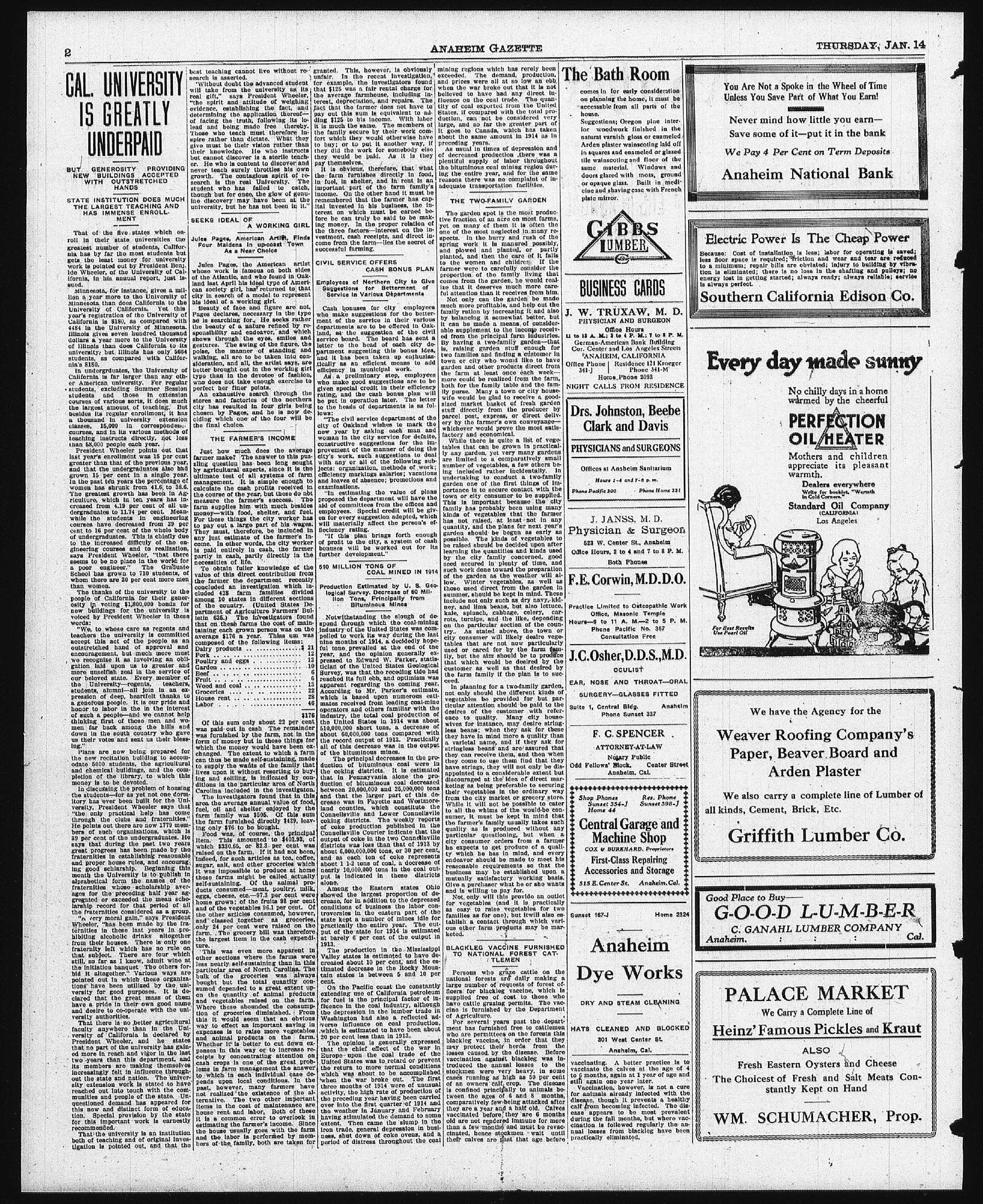
Searchable text
CAL. UNIVERSITY IS GREATLY UNDERPAID
BUT GENEROSITY PROVIDING NEW BUILDINGS ACCEPTED WITH OUTSTRETCHED HANDS
STATE INSTITUTION DOES MUCH THE LARGEST TEACHING AND HAS IMMENSE ENROLLMENT
That of the five states which enroll in their state universities the greatest number of students, California has by far the most students but gets the least money for university work is pointed out by President Benj. Ide Wheeler, of the University of California, in his annual report, just issued.
Minnesota, for instance, gives a million a year more to the University of Minnesota than does California to the University of California. Yet this year's registration of the University of California is 8180, as compared with 4484 in the University of Minnesota. Illinois gives seven hundred thousand dollars a year more to the University of Illinois than does California to its university, but Illinois has only 5664 students, as compared with California's 8180.
In undergraduates, the University of California is far larger than any other American university. For regular students, excluding Summer Session students and those in extension courses of various sorts, it does much the largest amount of teaching. But besides its regular enrollment, it has a thousand in university extension classes, 15,000 in correspondence courses, and in its various methods of teaching instructs directly, not less than 58,000 people each year.
best teaching cannot live without research is asserted.
"Without doubt the advanced student will take from the university as its real gift," says President Wheeler, "the spirit and attitude of weighing evidence, establishing the fact, and determining the application thereof—of facing the truth, following its lead and being made free thereby. Those who teach must therefore inspire rather than dictate. What they give must be their vision rather than their knowledge. He who instructs but cannot discover is a sterile teacher. He who is content to discover and never teach surely throttles his own growth. The contagious spirit of research is the real University. The student who has failed to catch, though but for once, the glow of genuine discovery may have been at the university, but he has not been in it."
SEEKS IDEAL OF A WORKING GIRL
Jules Pages, American Artist, Finds Four Maidens in up-coast Town As a Near Choice
Jules Pages, the American artist whose work is famous on both sides of the Atlantic, and who found in Oakland last April his ideal type of American society girl, has returned to that city in search of a model to represent his ideal of a working girl.
Beauty of face and figure are not, Pages declares, necessary in the type he is searching for. He seeks rather the beauty of a nature refined by responsibility and endeavor, and which shows through the eyes, smiles and gestures. The swing of the figure, the polise, the manner of standing and walking, all are to be taken into consideration, and all, the artist says, are better brought out in the working girl type than in the devotee of fashion, who does not take enough exercise to perfect her finer points.
An exhaustive search through the stores and factories of the northern city has resulted in four girls being chosen by Pages, and he is now deciding which one of the four will be the final choice.
THE FARMER'S INCOME
granted. This, he unfairly. In the case for example, that $125 was a tax on the average farmer's interest, depreciation fact that the farmer pay out this summer $125 to his family secure fort which they will to buy; or to put them did the work they would be paid themselves.
It is obvious, the farm furnishes in fuel, in shelter important part of income. On the record remembered that ital invested in its terrestre on which fore he can truly ing money. In the three factors vestment, cash come from the successful farming.
CIVIL SERVICE
Employees of New Suggestions Service in Va.
Cash bonuses who make good given special rating, and the letter to the pariment suggests and it has been technically as an efficientity in me.
As a preliminary who make good given special rating, and the be put in operation to the heads of low:
"The civil service city of Oakland new year by a woman in the constructive su..."
In undergraduates, the University of California is far larger than any other American university. For regular students, excluding Summer Session students and those in extension courses of various sorts, it does much the largest amount of teaching. But besides its regular enrollment, it has a thousand in university extension classes, 15,000 in correspondence courses, and in its various methods of teaching instructs directly, not less than 58,000 people each year.
President Wheeler points out that last year's enrollment was 15 per cent greater than that of the previous year, and that the undergraduates also had grown 15 per cent in a single year. In the past ten years the percentage of women has shrunk from 41.6 to 38.6. The greatest growth has been in Agriculture, which in ten years has increased from 4.19 per cent of all undergraduates to 11.74 per cent. Meanwhile the students in engineering courses have decreased from 29 per cent to 16 per cent of the whole body of undergraduates. This is chiefly due to the increased difficulty of the engineering courses and to realization says President Wheeler, "that there seems to be no place in the world for a poor engineer." The Graduate School has grown to 710 students, of whom there are 30 per cent more men than women.
The thanks of the university to the people of California for their generosity in voting $1,800,000 bonds for new buildings for the university is voiced by President Wheeler in these words:
"We, to whose care as regents and teachers the university is committed accept this act of the people as an outstretched hand of approval and encouragement, but much more must we recognize it as involving an obligation laid upon us to greater and more unselfish zeal in the service of our beloved state. Every member of the University—regents, teachers, students, alumni—all join in an expression of deep, heartfelt thanks to a generous people. It is our pride and honor to labor in the interest of such a people—and we cannot help thinking first of those men and women far back among the hills and down in the south country who gave us their votes and sent us their blessing."
Plans are now being prepared for the new recitation building to accommodate 5000 students, the agricultural and chemical buildings, and the completion of the library, to which this money is to be devoted.
In discussing the problem of housing the students—for as yet not one dormitory has ever been built for the University, President Wheeler says that "the only practical help has come through the clubs and fraternities." He points out there are now 1779 members of such organizations, which is 29 per cent of the undergraduates. He says that during the past two years great progress has been made by the walking, all are to be taken into consideration, and all, the artist says, are better brought out in the working girl type than in the devotee of fashion, who does not take enough exercise to perfect her finer points.
An exhaustive search through the stores and factories of the northern city has resulted in four girls being chosen by Pages, and he is now deciding which one of the four will be the final choice.
THE FARMER'S INCOME
Just how much does the average farmer make? The answer to this puzzling question has been long sought by agricultural experts, since it is the ultimate test of all systems of farm management. It is simple enough to calculate the cash profits received in the course of the year, but those do not measure the farmer's success. The farm supplies him with much besides money—with food, shelter, and fuel. For these things the city worker has to pay out a large part of his wages. They must, therefore, be included in any just estimate of the farmer's income. In other words, the city worker is paid entirely in cash, the farmer partly in cash, partly directly in the necessities of life.
To obtain fuller knowledge of the value of this direct contribution from the farmer the department recently concluded an investigation which included 438 farm families divided among 10 states in different sections of the country. (United States Department of Agriculture Farmers' Bulletin 635.) The investigators found that on these farms the cost of maintaining each grown person was on the average $176 a year. This um was composed of the following items: Dairy products . . . $21 Pork . . . 12 Poultry and eggs . . . 12 Garden . . . 10 Beef . . . 6 Fruit . . . 6 Wood and coal . . . 13 Groceries . . . 22 House rent . . . 28 Labor . . . 46
$176 Of this sum only about 22 per cent was paid out in cash. The remainder was furnished by the farm, not in the form of money but in those things for which the money would have been exchanged. The extent to which a farm can thus be made self-sustaining, made to supply the wants of the family that lives upon it without resorting to buying and selling, is indicated by conditions in the particular area of North Carolina included in the investigation.
The investigators found that in this area the average annual value of food, fuel, oil and shelter enjoyed by the farm family was $505. Of this sum the farm furnished directly $429, leaving only $76 to be bought.
Food was, of course, the principal item. This amounted to $401.93, or $330.65, or $22.3 per cent was better brought out in the working girl type than in the devotee of fashion, who does not take enough exercise to perfect her finer points.
"The civil service city of Oakland new year by a woman in the constructive support of the city's work, such with any or all objects: organization efficiency market and leaves of ab examinations."
"In estimation proposed the decision of committee employees. Spend en for every sugary material will materially affect efficiency rating."
"If this plan of profit to the bonuses will be further developed."
Notwithstands spond through industry of the polled to work nine months off ful tone prevail year, and then pressed to Edwin tielian of U.S. Survey, was reached its full apparent regard. According to which is based mates received operators and co-industry, the United States 510,000,000 show about 60,000,000 record output all of this depletion.
The principally duction of bitte coking distillat that. In Penna duction of bitte between 20,000, and that I crease was in land counties. Connellville area coking districts of coke produce Connellville C output of coke districts was lea
the new recitation building to accommodate 5000 students, the agricultural and chemical buildings, and the completion of the library, to which this money is to be devoted.
In discussing the problem of housing the students—for as yet not one dormitory has ever been built for the University, President Wheeler says that "the only practical help has come through the clubs and fraternities." He points out there are now 1779 members of such organizations, which is 29 per cent of the undergraduates. He says that during the past two years great progress has been made by the fraternities in establishing reasonable and proper house rules, and encouraging good scholarship. Beginning this month the University is to publish in alphabetic form the names of the fraternities whose scholarship averages for the preceding half year aggregated or exceeded the mean scholarship record for that period of all the fraternities considered as a group. "A very moral gain," says President Wheeler, "has been made by the fraternities in these last years in prohibiting alcoholic drinks altogether from their houses. There is only one fraternity left which has no rule on that subject. There are four which still, so far as I know, admit wine at the initiation banquet. The others forbid it altogether." Various ways are pointed out in which these organizations have been utilized by the university for good purposes. It is declared that the great mass of them have a pride in their own good name and desire to co-operate with the university authorities.
That there is no better agricultural faculty anywhere than in the University of California is declared by President Wheeler, and he states that no part of the university has gained more in reach and vigor in the last two years than this department, and its members are making themselves increasingly felt in influence throughout the state and nation. The university extension work is stated to have reached out into touch with the communities and people of the state. Unquestioned demand has appeared for this new and distinct form of education. Special provision by the state for this important work is earnestly recommended.
That the university is an institution both of teaching and of original investigation is pointed out, and that the principal duction of bitts the coking district that in Pennsylvania duction of bitts between 20,000 and that in land counties, Connellville district of coke products Connellville output of coke districts was less about 6,000,000, and as each tion about 1 1/2 ton nearly 10,000,000 put is indicated alone.
Among the students showed the latest crease, for in conditions of bitt troversies in the state kept a nut practically thou put of the state at barely 6 per cent.
The product Valley states increased about a timed decrease in states is 2 percent.
On the Pacific extending use for fuel is the fluence in the depression Washington has severe influence which is estimated 20 per cent less.
The opinion that the chief Europe-upon United States will return to which was abolished when the war three months after activity, the high preceding over into the weather having stimulated extent. Then from trade, geness, shut down period of distress.
ANAHEIM GAZETTE
granted. This, however, is obviously unfair. In the recent investigation, for example, the investigators found that $125 was a fair rental charge for the average farmhouse, including interest, depreciation, and repairs. The fact that the farmer does not have to pay out this sum is equivalent to adding $125 to his income. With labor it is much the same. The members of the family secure by their work comfort which they would otherwise have to buy; or to put it another way, if they did the work for somebody else they would be paid. As it is they pay themselves.
It is obvious, therefore, that what the farm furnishes directly in food, in fuel, in shelter, and in rent is an important part of the farm family's income. On the other hand it must be remembered that the farmer has capital invested in his business, the interest on which must be earned before he can truly be said to making money. In the proper relation of the three factors—interest on the investment, cash receipts, and direct income from the farm—lies the secret of successful farming.
CIVIL SERVICE OFFERS
CASH BONUS PLAN
Employees of Northern City to Give Suggestions for Betterment of Service in Various Departments
Cash bonuses for city employees who make suggestions for the betterment of the service in their various departments are to be offered in Oakland, at the suggestion of the civil service board. The board has sent a letter to the head of each city department suggesting this bonus idea, and it has been taken up enthusiastically as an efficient means to add efficiency in municipal work.
As a preliminary step, employees who make good suggestions are to be given special credit in their efficiency rating, and the cash bonus plan will be put in operation later. The letter to the heads of departments is as follows:
"The civil service department of the city of Oakland wishes to mark the new year by asking each man and woman in the city service for definite, constructive suggestions for the improvement of their manner of doing mining regions which has rarely been exceeded. The demand, production, and prices were all at so low an obb when the war broke out that it is not believed to have had any direct influence on the coal trade. The quantity of coal exported from the United States, if compared with the total production, cannot be considered very large, and so far the greater part of it goes to Canada, which has taken about the same amount in 1914 as in preceding years.
As usual in times of depression and of decreased production, there was a plentiful supply of labor throughout the bituminous coal mining region during the entire year, and for the same reasons there was no complaint of inadequate transportation facilities.
THE TWO-FAMILY GARDEN
The garden spot is the most productive fraction of an acre on most farms, yet on many of them it is often one of the most neglected in many respects. In the hurry and rush of the spring work it is manured possibly, and plowed and planted, or partly planted, and then the care of it falls to the women and children. If the farmer were to carefully consider the proportion of the family living that comes from the garden, he would realize that it deserves much more careful attention than it receives from him.
Not only can the garden be made much more profitable, and help out the family ration by increasing it also by balancing it somewhat better, but it can be made a means of considerable supplement to the incompetence from the principal farm industries. By having a two-family garden—that is, raising garden stuff enough for two families and finding a customer in town or city who would like to have garden and other products direct from the farm at least once each week—more could be realized from the farm, both for the family table and the family purse. Many a town or city housewife would be glad to receive a good-sized market basket of fresh garden stuff directly from the producer by parcel post, express, or direct delivery by the farmer's own conveyance—whichever would prove the most satisfactory and economical.
While there is quite a list of vegetables that can be grown in practical mines here is obviously unfair. In the recent investigation for example, the investigators found that $125 was a fair rental charge for the average farmhouse, including interest, depreciation, and repairs. The fact that the farmer does not have to pay out this sum is equivalent to adding $125 to his income. With labor it is much the same. The members of the family secure by their work comfort which they would otherwise have to buy; or to put it another way, if they did the work for somebody else they would be paid. As it is they pay themselves.
It is obvious, therefore, that what the farm furnishes directly in food, in fuel, in shelter, and in rent is an important part of the farm family's income. On the other hand it must be remembered that the farmer has capital invested in his business, the interest on which must be earned before he can truly be said to making money. In the proper relation of the three factors—interest on the investment, cash receipts, and direct income from the farm—lies the secret of successful farming.
CIVIL SERVICE OFFERS
CASH BONUS PLAN
Employees of Northern City to Give Suggestions for Betterment of Service in Various Departments
Cash bonuses for city employees who make suggestions for the betterment of the service in their various departments are to be offered in Oakland, at the suggestion of the civil service board. The board has sent a letter to the head of each city department suggesting this bonus idea, and it has been taken up enthusiastically as an efficient means to add efficiency in municipal work.
As a preliminary step, employees who make good suggestions are to be given special credit in their efficiency rating, and the cash bonus plan will be put in operation later. The letter to the heads of departments is as follows:
"The civil service department of the city of Oakland wishes to mark the new year by asking each man and woman in the city service for definite, constructive suggestions for the improvement of their mines here is obviously unfair. In the recent investigation for example, the investigators found that $125 was a fair rental charge for the average farmhouse, including interest, depreciation, and repairs. The fact that the farmer does not have to pay out this sum is equivalent to adding $125 to his income. With labor it is much the same. The members of the family secure by their work comfort which they would otherwise have to buy; or to put it another way, if they did the work for somebody else they would be paid. As it is they pay themselves."
It is obvious, therefore, that what the farm furnishes directly in food, in fuel, in shelter, and in rent is an important part of the farm family's income. On the other hand it must be remembered that the farmer has capital invested in his business, the interest on which must be earned before he can truly be said to making money. In the proper relation of the three factors—interest on the investment, cash receipts, and direct income from the farm—lies the secret of successful farming.
CIVIL SERVICE OFFERS
CASH BONUS PLAN
Employees of Northern City to Give Suggestions for Betterment of Service in Various Departments
Cash bonuses for city employees who make suggestions for the betterment of the service in their various departments are to be offered in Oakland, at the suggestion of the civil service board. The board has sent a letter to the head of each city department suggesting this bonus idea, and it has been taken up enthusiastically as an efficient means to add efficiency in municipal work.
As a preliminary step, employees who make good suggestions are to be given special credit in their efficiency rating, and the cash bonus plan will be put in operation later. The letter to the heads of departments is as follows:
"The civil service department of the city of Oakland wishes to mark the new year by asking each man and woman in the city service for definite, constructive suggestions for the improvement of their mines here is obviously unfair. In the recent investigation for example, the investigators found that $125 was a fair rental charge for the average farmhouse, including interest, depreciation, and repairs. The fact that the farmer does not have to pay out this sum is equivalent to adding $125 to his income. With labor it is much the same. The members of the family secure by their work comfort which they would otherwise have to buy; or to put it another way, if they did the work for somebody else they would be paid. As it is they pay themselves."
It is obvious, therefore, that whatthe farm furnishes directlyin food.in fuel.in shelter.in rentis an important partofthe farmfamily'sincome.Ontheotherhanditmustberememberthatthefarmerhascapitalinvestedinhimbusiness,theinterestonwhichmustbeearnedbeforehecantrulybesaidtomakemoney.Intheproperrelationofthethreefactors-interestontheinvestment,cashreceipts,anddirectincomefromthefarm-liesthesecretofsuccessfulfarming."
and it has been taken up enthusiastically as an efficient means to add efficiency in municipal work.
As a preliminary step, employees who make good suggestions are to be given special credit in their efficiency rating, and the cash bonus plan will be put in operation later. The letter to the heads of departments is as follows:
"The civil service department of the city of Oakland wishes to mark the new year by asking each man and woman in the city service for definite, constructive suggestions for the improvement of the manner of doing the city's work, such suggestions to deal with any or all of the following subjects: organization, methods of work; efficiency markings salaries; vacations and leaves of absence; promotions and examinations.
"In estimating the value of plans proposed the department will have the aid of committees from the offices and employees. Special credit will be given for every suggestion adopted, which will materially affect the person's efficiency rating.
"If this plan brings forth enough of profit to the city, a system of cash bonuses will be worked out for its further development."
510 MILLION TONS OF COAL MINED IN 1914
Production Estimated by U. S. Geological Survey. Decrease of 60 Million Tons, Principally from Bituminous Mines.
Notwithstanding the slough of despond through which the coal-mining industry of the United States was compelled to work its way during the last nine months of 1914, a decidedly hopeful tone prevailed at the end of the year, and the opinion generally expressed to Edward W. Parker, statistician of the United States Geological Survey, was that the recording tide had reached its full ebb, and optimism was apparent regarding the coming year. According to Mr. Parker's estimate, which is based upon numerous estimates received from leading coal-mine operators and others familiar with the industry, the total coal production of the United States in 1914 was about 510,000,000 short tons, a decrease of about 60,000,000 tons compared with the record output of 1913. Practically all of this decrease was in the output of the bituminous mines.
The principal decreases in the production of bituminous coal were in the coking districts. It is estimated that in Pennsylvania alone the production of bituminous coal decreased between 20,000,000 and 25,000,000 tons and that the larger part of this decrease was in Fayette and Westmoreland counties, which constitute the Connellville and Lower Connellville coking districts. The weekly reports of coke production published in the Connellville Courier indicate that the output of coke in the two Connellville districts was less than that of 1913 by about 6,000,000 tons or 30 per cent.
While there is quite a list of vegetables that can be grown in practically any garden, yet very many gardens are limited to a comparatively small number of vegetables, a few others being included rather incidentally. In undertaking to conduct a two-family garden one of the first things of importance is to secure contact with the town or city consumer to be supplied. This is important because the city family has probably been using many kinds of vegetables that the farmer has not raised, at least-not in any quantity, and the plans for next year's garden should be begun as early as possible. The kinds of vegetables to be raised should be decided upon after learning the quantities and kinds used by the city family concerned, good seed secured in plenty of time, and such work done toward the preparation of the garden as the weather will allow. Winter vegetables, as well as those used direct from the garden in summer, should be kept in mind. These include not only such as dry navy, kidney, and lima beans, but also lettuce, kale, spinach, cabbage, celery, carrots, turnips, and like, depending on the particular section of the country.. As stated above, the town or city consumer will likely desire vegetables that are not now particularly used or cared for by the farm family, but the aim should be to produce that which would be desired by the customer as well as that desired by the farm family if the plan is to succeed.
In planning for a two-family garden, not only should the different kinds of vegetables be provided for but particular attention should be paid to the desires of the customer with reference to quality. Many city housewives for instance may desire stringless beans; when they ask for these they have in mind more a quality than a varietal name, and if they ask for stringless beans and are assured that they can receive them, and then when they come to use them find that they have strings, they will not only be disappointed to a considerable extent but discouraged at the idea of direct marketing as being preferable to securing their vegetables in the ordinary way from the city market or grocery store. While it will not be possible to cater to all the whims of the would-be consumer, it must be kept in mind that the farmer's family usually takes such quality as is produced without any particular questioning, but when a city consumer orders from a farmer he expects to get produce of a qualifi-
The principal decreases in the production of bituminous coal were in the coking districts. It is estimated that in Pennsylvania alone the production of bituminous coal decreased between 20,000,000 and 25,000,000 tons and that the larger part of this decrease was in Fayette and Westmoreland counties, which constitute the Connellsville and Lower Connellsville coking districts. The weekly reports of coke production published in the Connellsville Courrier indicate that the output of coke in the two Connellsville districts was less than that of 1913 by about 6,000,000,000 tons, or 30 per cent, and as each ton of coke represents about 1-2 tons of coal, a decrease of nearly 10,000,000 tons in the coal output is indicated in these districts alone.
Among the Eastern states Ohio showed the largest proportion of decrease, for in addition to the depressed conditions of business the labor controversies in the eastern part of the state kept a number of mines idle for practically the entire year. The output of the state for 1914 is estimated at barely 6 per cent of the output in 1913.
The production in the Mississippi Valley states is estimated to have decreased about 10 per cent, and the estimated decrease in the Rocky Mountain states is between 5 and 10 per cent.
On the Pacific coast the constantly extending use of California petroleum for fuel is the principal factor of influence in the coal industry, although the depression in the lumber trade in Washington had also a reflected adverse influence on coal production, which is estimated to have been about 20 per cent less than in 1913.
The opinion is generally expressed that the chief effect of the war in Europe upon the coal trade of the United States was to retard or prevent the return to more normal conditions which was about to be accomplished when the war broke out. The first three months of 1914 were of unusual activity, the high rate of production of the preceding year having been carried over into the first quarter of 1914 and the weather in January and February having stimulated the demand to some extent. Then came the slump in the iron trade, general depression in business, shut down of coke ovens, and a period of distress throughout the coal
They can receive them, and they will not only be disappointed to a considerable extent but discouraged at the idea of direct marketing as being preferable to securing their vegetables in the ordinary way from the city market or grocery store. While it will not be possible to cater to all the whims of the would-be consumer, it must be kept in mind that the farmer's family usually takes such quality as is produced without any particular questioning, but when a city consumer orders from a farmer he expects to get produce of a quality which he has in mind, and every endeavor should be made to meet his reasonable requirements so that the business may be established upon a mutually satisfactory working basis. Give a purchaser what he or she wants and is willing to pay for.
Not only will this provide an outlet for vegetables (and it is practically as easy to raise vegetables for two families as for one), but it will also establish a contact through which various other farm products may be marketed.
BLACKLEG VACCINE FURNISHED TO NATIONAL FOREST CATTLEMEN
Persons who graze cattle on the national forests are daily making a large number of requests of forest officers for blackleg vaccine, which is supplied free of cost to those who have cattle grazing permits. The vaccine is furnished by the Department of Agriculture.
For several years past the department has furnished free to cattlemen who are permittees on the forests this blackleg vaccine, in order that they may protect their hords from the losses caused by the disease. Before vaccination against blackleg was introduced the annual losses to the stockmen were very heavy, in some cases running as high as 50 per cent of an owner's calf crop. The disease is confined principally to animals between the ages of 6 and 8 months, comparatively few being attacked after they are a year and a half old. Calves vaccinated before they are 6 months old are not rendered immune for more than a few months and must be revaccinated, hence stockmen wait until their calves are past that age before
Vaccination, however, is not a cure for animals already infected with the disease, though it prevents a healthy calf from becoming infected. The disease appears to be most prevalent during the fall months, but where vaccination is followed regularly the annual losses from blackleg have been practically eliminated.
THURSDAY; JAN. 14
You Are Not a Spoke in the Wheel of Time
Unless You Save Part of What You Earn!
Never mind how little you earn—
Save some of it—put it in the bank
We Pay 4 Per Cent on Term Deposits
Anaheim National Bank
Electric Power Is The Cheap Power
Because: Cost of Installation is less; labor for operating is saved;
less floor space is required; friction and wear and tear are reduced
to a minimum; repair bills are obviated; injury to building by vibration is eliminated; there is no loss in the shafting and pulleys; no
energy lost in getting started; always ready; always reliable; service
is always perfect.
Southern California Edison Co.
Every day made sunny
No chilly days in a home
warmed by the cheerful
PERFECTION
OIL HEATER
Every day made sunny
No chilly days in a home warmed by the cheerful PERFECTION OIL HEATER
Mothers and children appreciate its pleasant warmth.
Dealers everywhere
Write for booklet, "Warmth in Cold Corners."
Standard Oil Company (CALIFORNIA)
Los Angeles
We have the Agency for the Weaver Roofing Company's Paper, Beaver Board and Arden Plaster
We also carry a complete line of Lumber of all kinds, Cement, Brick, Etc.
Griffith Lumber Co.
PAPER, BEAVER BOARD and Arden Plaster
We also carry a complete line of Lumber of all kinds, Cement, Brick, Etc.
Griffith Lumber Co.
GOOD PLACE TO BUY—G-O-O-D L-U-M-B-E-R
C. GANAHL LUMBER COMPANY
Anaheim, Cal.
PALACE MARKET
We Carry a Complete Line of Heinz' Famous Pickles and Kraut
ALSO
Fresh Eastern Oysters and Cheese
The Choicest of Fresh and Salt Meats Constantly Kept on Hand
WM. SCHUMACHER, Prop.