anaheim-gazette 1915-01-07
Scanned page
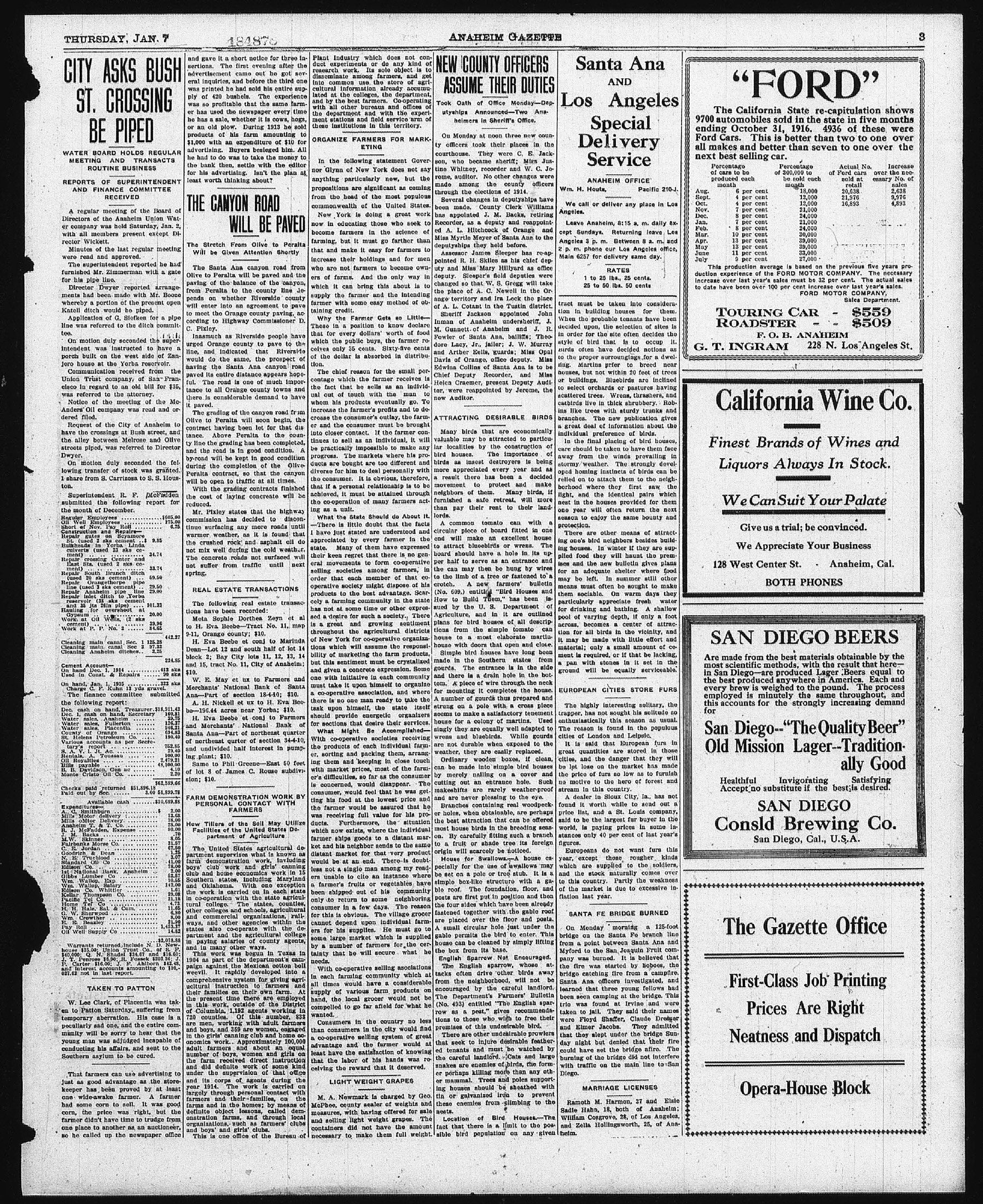
Searchable text
CITY ASKS BUSH ST. CROSSING BE PIPED
WATER BOARD HOLDS REGULAR MEETING AND TRANSACTS ROUTINE BUSINESS
REPORTS OF SUPERINTENDENT AND FINANCE COMMITTEE RECEIVED
A regular meeting of the Board of Directors of the Anaheim Union Water company was held Saturday, Jan. 2, with all members present except Director Wickett.
Minutes of the last regular meeting were read and approved.
The superintendent reported he had furnished Mr. Zimmerman with a gate for his pipe line.
Director Dwyer reported arrangements had been made with Mr. Booze whereby a portion of the present open Katell ditch would be piped.
Application of G. Sieken for a pipe line was referred to the ditch committee.
On motion duly seconded the superintendent was instructed to have a porch built on the west side of Zanfero house at the Yorba reservoir.
Communication received from the Union Trust company, of San Francisco in regard to an old bill for $35, was referred to the attorney.
Notice of the meeting of the McAnders Oil company was read and ordered filed.
Request of the City of Anaheim to have the crossings at Bush street, and the alley between Melrose and Olive streets pined, was referred to Director and gave it a short notice for three insertions. The first evening after the advertisement came out he got several inquiries, and before the third one was printed he had sold his entire supply of 420 bushels. The experience was so profitable that the same farmer has used the newspaper every time he has a sale, whether it is cows, hogs, or an old plow. During 1913 he sold products of his farm amounting to $1,000 with an expenditure of $10 for advertising. Buyers besieged him. All he had to do was to take the money to the bank then, settle with the editor for his advertising. Isn't the plan at least worth thinking about?
THE CANYON ROAD WILL BE PAVED
The Stretch From Olive to Peralta Will be Given Attention Shortly
The Santa Ana canyon road from Olive to Peralta will be paved and two paving of the balance of the canyon, from Peralta to the county line depends on whether Riverside county will enter into an agreement to pave to meet the Orange county paving, according to Highway Commissioner D. C. Pixley.
Innsamth as Riverside people have urged Orange county to pave to the line, and indicated that Riverside would do the same, the prospect of having the Santa Ana canyon road paved its entire distance appears hopeful. The road is one of much importance to all Orange county towns and there is considerable demand to have it paved.
The grading of the canyon road from Olive to Peralta will soon begin, the contract having been let for that distance. Above Peralta to the county line the grading has been completed,
Plant Industry will duct experiments research work. Disseminate among cultural information lated at the college and by the best faculty with all other department ment stations and these institutions.
ORGANIZE FARM ETC.
In the following nor Glynn of New anything particular propositions are sent from the head of commonwealth of New York is now in educating become farmers farming, but it must that and make it increase their hoof who are not farmers of farms. And which it can bring supply the farmer farmer with some talning credit.
Why the Farm Those in a position that for every dollar which the public receives only 35 cents of the dollar is a tion.
The chief reason contage which the fact that he usual out of touch whom his product increase the farmer crease the consumer and the consumer into closer contact tinues to sell as he practically imp
porch built on the west side of Zanjo house at the Yorba reservoir.
Communication received from the Union Trust company, of San Francisco in regard to an old bill for $35, was referred to the attorney.
Notice of the meeting of the McAnders Oil company was read and ordered filled.
Request of the City of Anaheim to have the crossings at Bush street, and the alley between Melrose and Olive streets piped, was referred to Director Dwyer.
On motion duly seconded the following transfer of stock was granted. 1 share from S. Carrizosa to S. S. Houston.
Superintendent R. F. McFadden submitted the following report for the month of December.
Regular Employees ... $605.00
Oil Well Employees ... 175.00
Short of Nov. Pay Roll ... 6.25
Construction and Repairs—Repair gates on Scyamore St. (used 2 sks cement) ... $9.85
Bulkheads Yorba, Linda culverts (used 23 sks cement) ... $34.74
Repair crossing Center and East Sts. (used 2 sks cement) ... $33.74
Repair South Branch ditch (used 20 sks cement) ... $59.50
Repair Orangethorpe pipe line (used 3 sks cement) ... $29.50
Repair Anaheim pipe lines
Repair Ink ditch to Yorba reservoir (38 sks cement and 35 jts 26in pipe) ... 101.33
Hauling for overshoot at Gypum ... 20.00
Work at Oil Wells (2 sks cement) ... 39.96
Work at P. P. No. 2 ... 84.65
Cleaning main canal Sec. 1 125.28
Cleaning main canal Sec. 2 97.32
Cleaning Anaheim ditches... 2.25
Cement Account—Ov hand Decl. I, 1914 ... 413 sks
Used in Const. & Repairs ... 90 sks
On hand, Jan. I, 1915 ... 323 sks
Charge C. P. Kuhn 13 yds gravel.
The finance committee submitted the following report:
Dec. cash on hand, Treasurer: $18,911.43
Dec. 1, cash on hand, Secretary: 160.81
Water sales, Anaheim: 29.75
Water sales, Pullerton: 126.37
Water sales, Placentia: 96.21
County Jurisdiction: 694.32
St. Helens Petroleum Co.: 190.40
Various accounts as per Secretary's report: 752.85
S.A.V.I.Jt.Ac: 25.40
Rentals, A.Toussau: 160.00
Oil Royalties: 2,479.21
Bills payable: 48,100.00
B.B.Davidson, Gen ac: 4.10
Monte Cristo Oil Co.: 2.20
Checks paid returned: $51,896.18
Paid out by Sec.: 3.60 $51,897.78
Available cash: $10,693.88
Expenditures—A.G.Smithburn: $2.00
Mills Motor delivery: 13.68
Mills oMotor Delivery: 18.00
Anahelm T. & T.Co.: 28.00
R.J.Mcadden, Expense: 80.00
J.M.Race: 7.00
M.W.Skinner: 8.05
Fairbanks Morse Co.: 31.57
C.E.Jordan: 67.50
would do the same, the prospect of having the Santa Ana canyon road paved its entire distance appears hopeful.
The road is one of much importance to all Orange county towns and there is considerable demand to have it paved.
The grading of the canyon road from Olive to Peralta will soon begin, the contract having been let for that distance.
Above Peralta to the county line the grading has been completed, and the road is in good condition.
A by-road will be kept in good condition during the completion of the Olive Peralta contract, so that the canyon will be open to traffic at all times.
With the grading contracts finished the cost of laying concrete will be reduced.
Mr.Pixley states that the highway commission has decided to discontinue surfacing any more roads until warmer weather, as it is found that the crushed rock and asphalt oil do not mix well during the cold weather.
The concrete roads not surfaced will not suffer from traffic until next spring.
REAL ESTATE TRANSACTIONS
The following real estate transactions have been recorded:
Meta Sophie Dorthea Zeyn et al to H.Eva Beebe—Tract No. 11, map 9-11, Orange county; $10.
H.Eva Beebe et conj to Marinda Dean—Lot 12 and south half of lot 14 block 2; Bay City lots 11, 12, 13, 14 and 15, tract No. 11, City of Anaheim; $10.
W.E.May et ux to Farmers and Merchants' National Bank of Santa Ana—Part of section 18-440; $10.
A.H.Nickell et ux to H.Eva Beebe—196.44 acres near Yorba; $10.
H.Eva Beebe et conj to Farmers and Merchants' National Bank of Santa Ana—Part of northeast quarter of northeast quarter of section 34-4-10, and undived half interest in pumping plant; $10.
Same to Phil Greene—East 50 feet of lot 8 of James C.Rouse subdivision; $10.
FARM DEMONSTRATION WORK BY PERSONAL CONTACT WITH FARMERS
How Tillers of the Soil May Utilize Facilities of the United States Department of Agriculture
The United States agricultural de
Warrants returned include N. D. Newhouse $25.00; Union Trust Co., of S. F. $40.00; Q. N. Shadel $34.67 and $16.60; J. T. Penrose $6.90; R. Fossek $202.36; J. P. Carter $18.00; J. F. Ahlborn $12.45; and internal accounts amounting to $10,-027.62 not in last report.
TAKEN TO PATTON
W. Lee Clark, of Placentia was taken to Patton Saturday, suffering from temporary aberration. His case is a peculiarly sad one, and the entire community will be sorry to hear that the young man was adjudged incapable of conducting his affairs, and sent to the Southern asylum to be cured.
That farmers can use advertising to just as good advantage as the store-keeper has been proved by at least one wide-awake farmer. A farmer had some corn to sell. It was good corn, the price was right, but the farmer didn't have time to trudge from one place to another as an auctioneer, so he called up the newspaper office.
FARM DEMONSTRATION WORK BY PERSONAL CONTACT WITH FARMERS
How Tillers of the Soil May Utilize Facilities of the United States Department of Agriculture
The United States agricultural department supervises what is known as farm demonstration work, involving boys' club work and girls' canning club and home economics work in 15 Southern states, including Maryland and Oklahoma. With one exception the work is carried on in each state in co-operation with the state agricultural college. The states, counties, other colleges and schools, agricultural and commercial organizations, railways, and other agencies within the states also co-operate with the department and the agricultural college in paying salaries of county agents, and in many other ways.
This work was begun in Texas in 1904 as part of the department's campaign against the Mexican cotton boll weevil. It rapidly developed into a comprehensive system for giving agricultural instruction to farmers and their families on their own farm. At the present time there are employed in this work, outside of the District of Columbia, 1,192 agents working in 720 counties. Of this number, 833 are men, working with adult farmers and boys, and 359 are women, engaged in the girls' canning club and home economics work. Approximately 100,000 adult farmers and about an equal number of boys, women and girls on the farm received direct instruction and did definite work of some kind under the supervision of that office and its corps of agents during the year 1914. The work is carried on largely through personal contact with farmers and their families, on the farms and in the homes; by means of definite object lessons, called demonstration farms, and through local organizations, such as farmers' clubs and boys' and girls' clubs.
This is one office of the Bureau of
Same to Phil Greene—East 50 feet of lot 8 of James C. Rouse subdivision; $10.
Consumers in than consumers in a co-operative self-measurement, with hand, the local gregped to go far wanted.
LIGHT WEET
M. A. Newmark McPhee, county measures, with hand and selling light containers did necessary to make
ANAHEIM GAZETTE
Plant Industry which does not conduct experiments or do any kind of research work. Its sole object is to disseminate among farmers, and get into common use the store of agricultural information already accumulated at the colleges, the department, and by the best farmers. Co-operating with all other bureaus and offices of the department and with the experiment stations and field service arm of these institutions in this territory.
ORGANIZE FARMERS FOR MARKETING
In the following statement Governor Glynn of New York does not say anything particularly new, but the propositions are significant as coming from the head of the most populous commonwealth of the United States.
New York is doing a great work now in educating those who seek to become farmers in the science of farming, but it must go farther than that and make it easy for farmers to increase their holdings and for men who are not farmers to become owners of farms. And the only way in which it can bring this about is to supply the farmer and the intending farmer with some easy method of obtaining credit.
Why the Farmer Gets so Little—Those in a position to know declare that for every dollars' worth of food which the public buys, the farmer receives only 35 cents. Sixty-five cents of the dollar is absorbed in distribution.
The chief reason for the small percentage which the farmer receives is the fact that he sells as an individual out of touch with the man to whom his products eventually go. To increase the farmer's profits and to decrease the consumer's outlay, the farmer and the consumer must be brought into closer contact. If the farmer continues to sell as an individual, it will be practically impossible to make any
NEW COUNTY OFFICERS ASSUME THEIR DUTIES
Took Oath of Office Monday—Deputyships Announced—Two Anaheimmers in Sheriff's Office.
On Monday at noon three new county officers took their places in the courthouse. They were C. E. Jackson, who became sheriff; Miss Justine Whitney, recorder and W. C. Jerome, auditor. No other changes were made among the county officers through the elections of 1914.
Several changes in deputyships have been made. County Clerk Williams has appointed J. M. Backs, retiring Recorder, as a deputy and reappointed A. L. Hitchcock of Orange and Miss Myrtle Meyer of Santa Ana to the deputyships they held before.
Assessor James Sleeper has re-appointed R. H. Skiles as his chief deputy and Miss Mary Hillyard as office deputy. Sleeper's field deputies were changed so that W. S. Gregg will take the place of A. C. Newell in the Orange territory and Ira Leck the place of A. L. Cotant in the Tustin district.
Sheriff Jackson appointed John Inman of Anaheim undersheriff, J. M. Gunnett of Anaheim and J. R. Fowler of Santa Ana, bailiffs; Theodore Lacy, Jr., Jallor; J. W. Murray and Arther Eells, guards; Miss Opal Davis of Orange, office deputy. Miss Edwina Collins of Santa Ana is to be Chief Deputy Recorder, and Miss Helen Craemer, present Deputy Auditor, were reappointed by Jerome, the new Auditor.
ATTRACTING DESIRABLE BIRDS
Many birds that are economically valuable may be attracted to particular localities by the construction of trees.
Santa Ana AND Los Angeles Special Delivery Service
ANAHEIM OFFICE
Wm. H. Houts, Pacific 210-J.
We call or deliver any place in Los Angeles.
Leave Anaheim, 8:15 a.m. daily except Sundays. Returning leave Los Angeles 3 p.m. Between 8 a.m. and 2 p.m. phone our Los Angeles office, Main 6257 for delivery same day.
RATES
1 to 25 lbs., 25 cents.
25 to 50 lbs., 50 cents
tract must be taken into consideration in building houses for them. When the probable tenants have been decided upon, the selection of sites is in order for the site often decides the style of bird that is to occupit it. Birds often have decided notions as to the proper surroundings for a dwelling. Martins prefer to breed near houses, but not within 20 feet of trees or buildings. Bluebirds are inclined to select orchards or pastures having scattered trees. Wrens, thrashers, and catbirds live in thick shrubbery. Robins like trees with sturdy trunks and branches. The new publication gives a great deal of information about the individual preference of birds.
In the final placing of bird houses, care should be taken to have them face
The chief reason for the small percentage which the farmer receives is the fact that he sells as an individual out of touch with the man to whom his products eventually go. To increase the farmer's profits and to decrease the consumer's outlay, the farmer and the consumer must be brought into closer contact. If the farmer continues to sell as an individual, it will be practically impossible to make any progress. The markets where his products are bought are too different and diverse for him to deal personally with the consumer. It is obvious, therefore, that if a personal relationship is to be achieved, it must be attained through the co-operation of many farmers acting as a unit.
What the State Should do About it—There is little doubt that the facts I have just stated are understood and appreciated by every farmer in the state. Many of them have expressed their keen regret that there is no general movements to form co-operative selling societies among farmers, in order that each member of that cooperative society might dispose of his products to the best advantage. Scarcely a farming community in the state has not at some time or other expressed a desire for such a society. There is a great and growing sentiment throughout the agricultural districts of New York for co-operative organizations which will assume the responsibility of marketing the farm products, but this sentiment must be crystallized and given a concrete expression. Some one with initiative in each community must take it upon himself to organize a co-operative association, and where there is no one man ready to take the task upon himself, the state itself should provide energetic organizers for sections that desire their services.
What Might Be Accomplished—With co-operative societies receiving the products of each individual farmer, sorting and packing them, arranging them and keeping in close touch with market prices, most of the farmer's difficulties, so far as the consumer is concerned, would disappear. The consumer, would feel that he was getting his food at the lowest price and the farmer would be assured that he was receiving full value for his products. Furthermore, the situation which now exists, where the individual farmer ships goods to a distant market and his neighbor sends to the same Davis of Orange, office deputy. Miss Edwina Collins of Santa Ana is to be Chief Deputy Recorder, and Miss Helen Craemer, present Deputy Auditor, were reappointed by Jerome, the new Auditor.
ATTRACTING DESIRABLE BIRDS
Many birds that are economically valuable may be attracted to particular localities by the construction of bird houses. The importance of birds as insect destroyers is being more appreciated every year and as a result there has been a decided movement to protect and make neighbors of them. Many birds, if furnished a safe retreat, will more than pay their rent to their landlords.
A common tomato can with a circular piece of board fitted in one end will make an excellent house to attract blueebirds or wrens. The board should have a hole in its upper half to serve as an entrance and the can may then be hung wires to the limb of a tree or fastened to a crotch. A new farmers' bulletin (No. 609.) entitles "Bird Houses and How to Build Them," has been issued by the U.S. Department of Agriculture, and in it are outlined plans for bird houses of all descriptions from the simple tomato can house to a most elaborate martin-house with doors that open and close.
Simple bird houses have long been made in the Southern states from gourds. The entrance is in the side and there is a drain hole in the bottom. A piece of wire through the neck for mounting it completes the house. A number of gourds thus prepared and strung on a pole with a cross piece seems to make a satisfactory tenement house for a colony of martins. Used singly they are equally well adapted to wrens and blueebirds. While gourds are not durable when exposed to the weather, they are easily replaced.
Ordinary wooden boxes, if clean, can be made into simple bird houses by merely nailing on a cover and cutting out an entrance hole. Such makeshifts are rarely weather-proof and are never pleasing to the eye.
Branches containing real woodpecker holes, when obtainable, are perhaps the best attraction that can be offered most house birds in the breeding season. By carefully fitting such a branch to a fruit or shade tree its foreign origin will surely be noticed.
In the final placing of bird houses, care should be taken to have them face away from the winds prevailing in stormy weather. The strongly developed homing instincts of birds can be relied on to attach them to the neighborhood where they first saw the light, and the identical pairs which nest in the houses provided for them one year will often return the next season to enjoy the same bounty and protection.
There are other means of attracting one's bird neighbors besides building houses. In winter if they are supplied food they will haunt the premises and the new bulletin gives plans for an adequate shelter where food may be left. In summer still other means must often be sought to make them sociable. On warm days they particularly appreciate fresh water for drinking and bathing. A shallow pool of varying depth, if only a foot across, becomes a center of attraction for all birds in the vicinity, and it may be made with little effort and material; only a small amount of cement is required, or if that be lacking, a pan with stones in it set in the ground will be equally serviceable.
EUROPEAN CITIES STORE FURS
The highly interesting solitary, the trapper, has not sought his solitude so enthusiastically this season as usual. The reason is found in the populous cities of London and Leipside.
It is said that European furs in great quantities are stored in those cities, and the danger that they will be let lose on the market has made the price of furs so low as to furnish no motive to the hero of forest and stream in this country.
A dealer in Sloux City, In., has not found it worth while to send out a price list, and a St. Louis company, said to be the largest fur buyer in the world, is paying prices in some instances only 40 per cent of last year's figures.
Europeans do not want furs this
them and keeping in close touch with market prices, most of the farmer's difficulties, so far as the consumer is concerned, would disappear. The consumer, would feel that he was getting his food at the lowest price and the farmer would be assured that he was receiving full value for his products. Furthermore, the situation which now exists, where the individual farmer ships goods to a distant market and his neighbor sends to the same distant market for that very product would be at an end. There is doubtless not a single man among my readers unable to cite an instance where a farmer's fruits or vegetables have been shipped out of his community only to return to some neighboring consumer in a few days. The reason for this is obvious. The village grocer cannot depend upon individual farmers for his supplies. He must go to some large market which is supplied by a number of farmers for the certainty that he will secure what he needs.
With co-operative selling associations in each farming community which at all times would have a considerable supply of various farm products on hand, the local grocer would not be compelled to go far afield for what he wanted.
Consumers in the country no less than consumers in the city would find a co-operative selling system of great advantage and the farmer would at least have the satisfaction of knowing that the labor of his hands was receiving the reward that it deserved.
LIGHT WEIGHT GRAPES
M. A. Newmark is charged by Geo. McPhee, county sealer of weights and measures, with having offered for sale and selling light weight grapes. The containers did not have the amount necessary to make them full weight.
Ordinary wooden boxes, if clean, can be made into simple bird houses by merely nailing on a cover and cutting out an entrance hole. Such makeshifts are rarely weather-proof and are never pleasing to the eye.
Branches containing real woodpecker holes, when obtainable, are perhaps the best attraction that can be offered most house birds in the breeding season. By carefully fitting such a branch to a fruit or shade tree its foreign origin will scarcely be noticed.
House for Swallows. A house especially for the use of swallows may be set on a pole or tree stub. It is a simple box-like structure with a gate roof. The foundation, floor, and posts are first put in position and then the four sides which have been already fastened together with the gable roof are placed over the floor and posts. A small circular hole just under the gable permits the bird to enter. This house can be cleaned by simply lifting the box from its base.
English Sparrow Not Encouraged.
The English sparrow, whose attacks often drive other birds away from the neighborhood, will not be encouraged by the careful landlord. The Department's Farmers' Bulletin (No. 493) entitled "The English sparrow as a peat," gives recommendations to those who wish to free their premises of this undesirable bird.
There are other undesirable prowlers that seek to injure desirable feathered tenants and must be watched by the careful landlord. Cats and large snakes are enemies of birds, the former perhaps killing more than any other mammal. Trees and poles supporting houses should be sheathed with tin or galvanized iron to prevent these enemies from climbing to the neats.
Location of Bird Houses. The fact that there is a limit to the possible bird population on any given cities, and the danger that they will be let lose on the market has made the price of furs so low as to furnish no motive to the hero of forest and stream in this country.
A dealer in Sloux City, Ia., has not found it worth while to send out a price list, and to a St. Louis company, said to be the largest fur buyer in the world, is paying prices in some instances only 40 per cent of last year's figures.
Europeans do not want furs this year, except those rougher kinds which are supplied to the soldiers, and the stock naturally comes over to this country. Partly the weakness of the market is due to excessive inflation last year.
SANTA FE BRIDGE BURNED
On Monday morning a 125-foot bridge on the Santa Fe branch line from a point between Santa Ana and Myford to the San Joaquin Fruit company was burned. It is believed that the fire was started by hoboes, the bridge catching fire from a campfire. Santa Ana officers investigated, and learned that three young fellows had been seen camping at the bridge. This trio was found at Irvine and were taken to jail. They said their names were Floyd Shaffer, Claude Dreger and Elmer Jacobs. They admitted that they slept under the bridge Sunday night but denied that their fire could have set the bridge affire. The burning of the bridge did not interfere with traffic on the main line to San Diego.
MARRIAGE LICENSES
Ramoth M. Harmon, 27 and Elsie Sadle Hahn, 18, both of Anaheim; William Cosgrove, 28, of Los Angeles; and Zella Hollingsworth, 25, of Anaheim.
"FORD"
The California State re-capitulation shows 9700 automobiles sold in the state in five months ending October 31, 1916. 4936 of these were Ford Cars. This is better than two to one over all makes and better than seven to one over the next best selling car.
Percentage of cars to be produced each month
Aug. 6 per cent
Sept. 4 per cent
Oct. 4 per cent
Nov. 7 per cent
Dec. 8 per cent
Jan. 7 per cent
Feb. 8 per cent
Mar. 10 per cent
Apr. 13 per cent
May 13 per cent
June 11 per cent
July 9 per cent
Percentage of 300,000 to be sold each month
18,000
12,000
12,000
21,000
24,000
21,000
24,000
30,000
39,000
39,000
33,000
27,000
Actual No. of Ford cars sold at retail
20,638
21,976
16,893
4,893
Increase over the necessary No. of sales
2,638
9,976
4,893
This production average is based on the previous five years production experience of the FORD MOTOR COMPANY. The necessary increase over last year's sales must be 32 per cent. The actual sales to date have been over 100 per cent increase over last year's sales.
FORD MOTOR COMPANY,
Sales Department.
TOURING CAR - $559
ROADSTER - $509
F. O. B. ANAHEIM
G. T. INGRAM 228 N. Los Angeles St.
California Wine Co.
Finest Brands of Wines and
California Wine Co.
Finest Brands of Wines and
Liquors Always In Stock.
We Can Suit Your Palate
Give us a trial; be convinced.
We Appreciate Your Business
128 West Center St. Anaheim, Cal.
BOTH PHONES
SAN DIEGO BEERS
Are made from the best materials obtainable by the most scientific methods, with the result that here—in San Diego—are produced Lager. Beers equal to the best produced anywhere in America. Each and every brew is weighed to the pound. The process employed is minutely the same throughout, and this accounts for the strongly increasing demand for
San Diego--"The Quality Beer"
Old Mission Lager--Traditionally Good
Healthful Invigorating Satisfying
Accept no substitute if the best is desired.
SAN DIEGO
Consld Brewing Co.
San Diego, Cal., U.S.A.
ally Good
Healthful Invigorating Satisfying
Accept no substitute if the best is desired.
SAN DIEGO
Consld Brewing Co.
San Diego, Cal., U.S.A.
The Gazette Office
First-Class Job Printing
Prices Are Right
Neatness and Dispatch
Opera-House Block