anaheim-gazette 1914-12-31
Scanned page
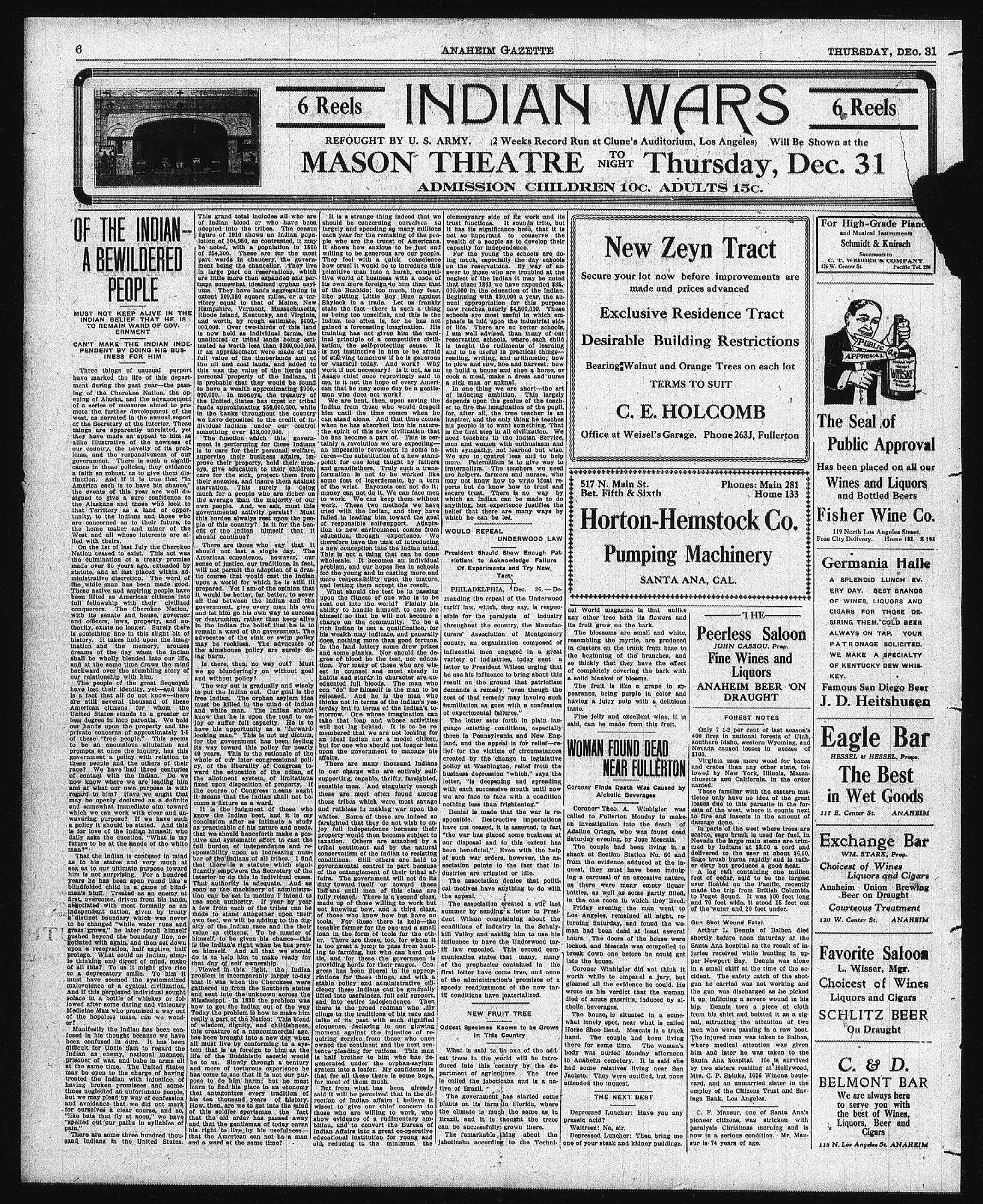
Searchable text
OF THE INDIAN -- A BEWILDERED PEOPLE
MUST NOT KEEP ALIVE IN THE INDIAN BELIEF THAT HE IS TO REMAIN WARD OF GOV-ERNMENT
CAN'T MAKE THE INDIAN INDEPENDENT BY DOING HIS BUSINESS FOR HIM
Three things of unusual purport have marked the life of this department during the past year—the passing of the Cherokee Nation, the opening of Alaska, and the advancement of a series of measures aimed to promote the further development of the west, as narrated in the annual report of the Secretary of the Interior. These things are apparently unrelated, yet they have made an appeal to him as alike illustrative of the nowness of our country, the novelty of its pro-
This grand total includes all who are of Indian blood or who have been adopted into the tribes. The census figure of 1910 shows an Indian population of 304,950, as contrasted, it may be noted, with a population in 1860 of 254,300. These are for the most part wards in chancery, the government being the chancellor. They live in large part on reservations, which are little more than expanded and perhaps somewhat idealized orphan asylums. They have lands aggregating in extent 109,150 square miles, or a territory equal to that of Maine, New Hampshire, Vermont, Massachusetts, Rhode Island, Kentucky, and Virginia, and worth, by rough estimate, $600,000,000. Over two-thirds of this land is now held as individual farms, the unallotted or tribal lands being estimated as worth less than $200,000,000. If an appraisement were made of the full value of the timberlands and of the oil and coal lands, and added to this was the value of the herds and personal property of the Indians, it is probable that they would be found to have a wealth approximating $900,000,000. In moneys, the treasury of the United States has trust or tribal funds approximating $50,000,000, while in the banks throughout the country we have deposited to the credit of individual Indians under our control something over $18,000,000.
The function which this government is performing for these Indians it is a strange should be contem- largely and spare each year for people who are th- It shows how they feel with primitive man- itive world of its own more f- of the Bushide like pitting L Shylock in a state the fact- as being too u Indian too often gained a force training has no final principle in- the se- is not instinct of starving tom or wasteful to work if not need Asage chief or me, is it not that he can that he ma-man who does- We are bent Indian from the him until he can stand alone when he has all the spirit of the he has become tainly a revolu-
Three things of unusual purport have marked the life of this department during the past year—the passing of the Cherokee Nation, the opening of Alaska, and the advancement of a series of measures aimed to promote the further development of the west, as narrated in the annual report of the Secretary of the Interior. These things are apparently unrelated, yet they have made an appeal to him as alike illustrative of the nowness of our country, the novelty of its problems, and the responsiveness of our government. There is such a significance in these policies, they evidence a faith so robust, as to give them distinction. And if it is true that "in America each is to have his chance," the events of this year are well designed to give a sure confidence to the Alaskans and those who look to that Territory as a land of opportunity, to the Indians and those who are concerned as to their future, to the home maker and miner of the West and all whose interests are allied with theirs.
On the last of last July the Cherokee Nation ceased to exist. This act was the culmination of a treaty promise made over 80 years ago, extended by statute, and at last placed within administrative discretion. The word of the white man has been made good. These native and aspiring people have been lifted as American citizens into full fellowship with their civilized conquerors. The Cherokee Nation, with its senate and house, governor and officers, laws, property, authority, exists no longer. Surely there is something fine in this slight bit of history. It takes hold upon the imagination and the memory, arouses dreams of the day when the Indian shall be wholly blended into our life, and at the same time draws the mind backward over the stumbling story of our relationship with him.
The people of the great Sequoyah have lost their identity, yet—and this is a fact that all do not know—there are still several thousand of these American citizens for whom the United States stands to a greater or less degree in loco parens. We hold our hands upon the property and the private concerns of approximately 1-5 of these "free people." This seems to be an anomalous situation and prompts at once the inquiry, has this government a policy with relation to these people and the others of their race? We have had three centuries of contact with the Indian. Do we now know where we are leading him and at what our own purpose is with regard to him? Have we aught that may be openly declared as a definite and somewhat immediate aim toward which we can work with clear and unwavering purpose? If we have such a policy it should be stated. And this is for love of the Indian himself, who daily asks the question, "What is my future to be at the hands of the white man."
full value of the timberlands and of the oil and coal lands, and added to this was the value of the herds and personal property of the Indians, it is probable that they would be found to have a wealth approximating $900,000,000. In moneys, the treasury of the United States has trust or tribal funds approximating $600,000,000, while in the banks throughout the country we have deposited to the credit of individual Indians under our control something over $180,000,000.
The function which this government is performing for these Indians is to care for their personal welfare, supervise their business affairs, improve their property, hold their money, give education to their children, care for the sick, protect them from their enemies, and insure them against starvation. This surely is doing much for a people who are richer on the average than the majority of our own people. And, we ask, must this governmental activity persist? Must this burden always rest upon the people of this country? Is it for the benefit of the Indian himself that it should continue?
There are those who say that it should not last a single day. The American conscience, however, our sense of justice, our traditions, in fact, will not permit the adoption of a drastic course that would cast the Indian upon a world for which he is still ill prepared. Yet I am of the opinion that it would be better, far better, to sever all ties between the Indian and the government, give every man his own and let him go his own way to success or destruction, rather than keep alive in the Indian the belief that he is to remain a ward of the government. The advocates of the sink or swim policy may be reckless. The advocates of the almshouse policy are surely doing harm.
Is there then, no way out? Must we go blunderingly on without goal and without policy?
The way out is gradually and wisely to put the Indian out. Our goal is the free Indian. The orphan asylum idea must be killed in the mind of Indian and white man. The Indian should know that he is upon the road to enjoy or suffer full capacity. He is to have his opportunity as a "forward-looking man." This is not my dictum, for the government has been feeling its way toward this policy for nearly 40 years. This is the rationale of the whole of our later congressional policy, of the liberality of Congress toward the education of the Indian, of the allotment system, of limitations fixed upon disposition of property. If the course of Congress means ought it means that the Indian shall not become a fixture as a ward.
It is the judgment of those who know the Indian beat, and it is my conclusion after as intimate a study as practicable of his nature and needs, that we should henceforth make a positive and systematic effort to cast the full burden of independence and re-
of starving tomato or wasteful tomato work if not need Asage chief one; me is it not that can that he man who does.
We are bent Indian from him until he can stand alone when he has all the spirit of the he has become tainly a revoluion an impossible picture—the subse point for one and grandfather formation is not some feat of life of the wrist. I money can not work. These tried with them failed in leading responsibility to new en education, through therefore have a new concept. This is not a wholesale. It problem, and oor for the young a more responsible and letting them.
What should upon the fitness sent out into its ability to handle himself so that charge on that rich Indian is in his wealth may does nothing upon the gover affairs.
There are men in our charge supporting capa sensible men. These are most those tribes who and ruthless in whites. Some are farsighted that joy full indepen d property would be taxation. Other tribal sentiment
government a policy with relation to these people and the others of their race? We have had three centuries of contact with the Indian. Do we now know where we are leading him and at what our own purpose is with regard to him? Have we aught that may be openly declared as a definite and somewhat immediate aim toward which we can work with clear and unwavering purpose? If we have such a policy it should be stated. And this is for love of the Indian himself, who daily asks the question, "What is my future to be at the hands of the white man?"
That the Indian is confused in mind as to his status and very much at sea as to our ultimate purpose toward him is not surprising. For a hundred years he has been spun round like a blindfolded child in a game of blindman's bluff. Treated as an enemy at first, overcome, driven from his lands, negotiated with most formally as an independent nation, given by treaty a distinct boundary which was never to be changed "while water runs and grass grows," he later found himself pushed beyond the boundary line, negotiated with again, and then set down upon a reservation, half captive, half protege. What could an Indian, simple thinking and direct of mind, make of all this? To us it might give rise to a deprecatory smile. To him it must have seemed the systematized malevolence of a cynical civilization. And if this perplexed individual sought solace in a bottle of whiskey or followed after some daring and visionary Medicine Man who promised a way out of the hopeless maze, can we wonder?
Manifestly the Indian has been confused in his thought because we have been confused in ours. It has been difficult for Uncle Sam to regard the Indian as enemy, national monce, prisoner of war, and babe in arms all at the same time. The United States may be open to the charge of having treated the Indian with injustice, of having broken promises and sometimes neglected an unfortunate people, but we may plead by way of confession and avoidance that we did not mark for ourselves a clear course, and so, "like bats that fly at noon," we have "spelled out our paths in syllables of pain."
There are some three hundred thousand Indians in the United States.
It is the judgment of those who know the Indian best, and it is my conclusion after as intimate a study as practicable of his nature and needs, that we should henceforth make a positive and systematic effort to cast the full burden of independence and responsibility upon an increasing number of the Indians of all tribes. I find that there is a statute which significantly empowers the Secretary of the Interior to do this in Individual cases. That authority is adequate. And as soon as the machinery of administration can be set in motion I intend to use such authority. If year by year a few from each of the tribes can be made to stand altogether upon their own feet, we will be adding to the dignity of the Indian race and the value as citizens. To be master of himself, to be given his chance—this is the Indian's right when he has proven himself. And all that we should do is to help him to make ready for that day of self ownership.
Viewed in this light, the Indian problem is incomparably larger to-day that it was when the Cherokees were gathered up from the Southern states and sent into the unknown across the Mississippi. In 1830 the problem was how to get the Indian out of the way Today the problem is how to make him really a part of the Nation: This blend of wisdom, dignity, and childishness, this creature of a noncommercial age, has been brought into a new day when all must live by conforming to a system that is as foreign to him as the life of the Buddhist ascetic would be to us. Slowly through a century and more of tortuous experience he has come to see that it is not our purpose to do him harm; but he must learn to find his place in an economy that antagonizes every tradition of his ten thousand years of history. How, then, are we to get into the mind of this soldier sportman the fact that the old order has passed away and that the gentleman of today earns his right to live, by his usefulness—that the American can not be a man and a ward at the same time?
There are many in our charge supporting capita sensible men. These are most those tribes who ruthless in whites. Some are farraught that they joy full independence property would taxation. Other tribal sentiment conservatism of conditions. Still governmental control of the entangled fairs. The governmental control of the entangled fairs. The governmental control of the entangled fairs.
But from what said it will be persecution of Indians wisest to give out those who are wise show evidence of bitten, and to co-Indian Affairs into educational institute old, reducing to
6 Reels INDIAN WEST
REFOUGHT BY U. S. ARMY. (2 Weeks Record Run at Clune's Auditorium,
MASON THEATRE TO NIGHT ADMISSION CHILDREN 10c. ADU
New Zey
Secure your lot now before
made and pric
Exclusive Res
Desirable Buildi
Bearing Walnut and Ora
TERMS T
C. E. HO
Office at Weisel's Garage
It is a strange thing indeed that we should be concerning ourselves so largely and spending so many millions each year for the remaking of the people who are the trust of Americans. It shows how anxious to be just and willing to be generous are our people. They feel with a quick conscience how cruel it would be to introduce this primitive man into a harsh, competitive world of business with a code of its own more foreign to him than that of the Bushide; too much, they fear, like putting Little Boy Blue against Shylock in a trade. Let us frankly state the fact—there is such a thing as being too unselfish, and this is the Indian too often is, for he has not gained a forecasting imagination. His training has not given him the cardinal principle of a competitive civilization, the self-protecting sense. It is not instinctive in him to be afraid of starving tomorrow if he is generous or wasteful today. And work? Why work if not necessary? Is it not, as an Asage chief once reprovingly said to me, is it not the hope of every American that he may some day be a gentleman who does not work?
We are bent, then, upon saving the Indian from those who would despoil him until the time comes when he can stand alone. And that time comes when he has absorbed into his nature the spirit of this new civilization that he has become a part of. This is certainly a revolution we are expecting—
and of added to words and Indians, it be found ing $900-maasury of tribal country of init control of starving tomorrow if he is generous or wasteful today. And work? Why work if not necessary? Is it not, as an Asago chief once reprovingly said to me, is it not the hope of every American that he may some day be a gentleman who does not work?
We are bent, then, upon saving the Indian from those who would despoil him until the time comes when he can stand alone. And that time comes when he has absorbed into his nature the spirit of this new civilization that he has become a part of. This is certainly a revolution we are expecting—an impossible revoluelt in some natures—the substitution of a new standpoint for one long taught by fathers and grandfathers. Truly such a transformation is not to be worked like some feat of legerdemain, by a turn of the wrist. Bayonets can not do it; money can not do it. We can face men to work. We can keep them without work. These two methods we have tried with the Indian, and they have failed in leading him toward the goal of responsible self-support. Adaptation to new environment comes from education, through experience. We therefore have the task of introducing a new conception into the Indian mind. This is not a thing that can be done wholesale. It becomes an individual problem, and our hopes lies in schools for the young and in casting more and more responsibility upon the mature, and letting them accept the result.
What should the test be in passing upon the fitness of one who is to be sent out into the world? Plainly his ability to handle himself, to care for himself so that he will not become a charge on the community. To be a rich Indian is not a qualification, for his wealth may indicate, and generally does, nothing more than good fortune. In the land lottery some drew prizes and some planks. Nor should the degree of blood be the test, nor education. For many of those who are wise in counsel and most steady in habits and sturdy in character are uneducated full bloods. The man who con "do" himself is the man to be released. And he is the man who thinks not in terms of the Indian's yesterday but in terms of the Indian's tomorrow. One whose imagination can take that leap and whose activities will not lag behind. It is to be remembered that we are not looking for an ideal Indian nor a model citizen, but for one who should not longer lean upon the government to manage his affairs.
There are many thousand Indians in our charge who are entirely self-supporting, capable, thrifty, farsighted, sensible men. And singularly enough these are most often found among those tribes which were most savage and ruthless in making war upon the whites. Some of these are indeed so farraight that they do not wish to enjoy full independence because their property would then become subject to taxation. Others are attached by a tribal sentiment and by the natural reading, writing, and arithmetic; how to plow and sow, hoe and harvest; how to build a house and shoe a horse, or cook a meal, make a dress and nurse a sick man or animal.
In one thing we are short—the art of inducing ambition. This largely depends upon the genius of the teacher to fire the imagination of the pupil, for, after all, the true teacher is an insplorer, and the only thing he teaches his people is to want something. That is the first step in all civilization. We need teachers in the Indian Service, men and women with enthusiasm and with sympathy, not learned but wise. We are to control less and to help more. Paternalism is to give way to fraternialism. The teachers we need are helpers, farmers and nurses, who may not know how to write ideal reports but do know how to trust and secure trust. There is no way by which an Indian can be made to do anything, but experience justifies the belief that there are many ways by which he can be led.
WOULD REPEAL
UNDERWOOD LAW
President Should Show Enough Patriotism to Acknowledge Failure Of Experiments and Try New Tact.
PHILADELPHIA, Dec. 26. — Demanding the repeal of the Underwood tariff law, which they say, is responsible for the paralysis of industry throughout the country, the Manufacturers' Association of Montgomery county, an organization composed of influential men engaged in a great variety of industries, today sent a letter to President Wilson urging that he use his influence to bring about this result on the ground that patriotism demands a remedy, "even though the cost of that remedy may involve such brumilation as goes with a confession of experimental failures."
The letter sets forth in plain language existing conditions, especially those in Pennsylvania and New England, and the appeal is for relief for the victims of circumstances created by the change in legislative policy at Washington, relief from the business depression "which," says the letter, "is deepening and spreading with each successive month until now we are face to face with a condition nothing less than frightening."
Denial is made that the war is responsible. Destructive importations have not ceased, it is asserted, in fact "the war has placed its business at our disposal and to this extent has been beneficial." Even with the help
cal World magazine is that unlike any other tree both its flowers and its fruit grow on the bark.
The blossoms are small and white, resembling myrtle, are produced in clusters on the trunk from base to the beginning of the branches, and so thickly that they have the effect of completely covering the bark with a solid blanket of blooms.
The fruit is like a grape in appearance, being purple in color and having a juicy pulp with a delicious taste.
Fine jelly and excellent wine, it is said, can be made from this fruit.
WOMAN FOUND DEAD NEAR FULLERTON
Coroner Finds Death Was Caused by Alchelic Beverages
Coroner Theo. A. Winbigler was called to Fullerton Monday to make an investigation into the death of Adalline Ortega, who was found dead Saturday evening, by Jose Moscais.
The couple had been living in a
near fullerton
Coroner Finds Death Was Caused by Alcoholic Beverages
Coroner Theo. A. Winbigler was called to Fullerton Monday to make an investigation into the death of Adaline Ortega, who was found dead Saturday evening, by Jose Mescalis.
The couple had been living in a shack at Section Station No. 50 and from the evidence adduced at the inquest, they must have been indulging a carousel of an excessive nature, as there were many empty liquor bottles, as well as some partly filled, in the one room in which they lived.
Friday evening the man went to Los Angeles, remained all night, returning Saturday, and found the woman had been dead at least several hours. The doors of the house were locked, and Mescalis was compelled to break down one before he could get into the house.
Coroner Winbigler did not think it worthwhile to emploi a jury, but gleaned all the evidence he could. He wrote as his verdict that the woman died of acute gastritis, induced by alcoholic beverages.
The house is situated in a somewhat lonely spot, near what is called Horse Shoe Bend. Mescalis is a track hand. The couple had been living there for some time. The woman's body was buried Monday afternoon in Anaheim cemetery. It is said she had some relatives living near San Jacinto. They were notified, but none attended the inquest.
THE NEXT BEST
Depressed Luncher: Have you any prussic acid?
Waitress: No, sir.
Depressed Luncher: Then bring me one of your steak and kidney puddings.
THURSDAY, DEC. 31
WARS 6 Reels
June's Auditorium, Los Angeles) Will Be Shown at the
NIGHT Thursday, Dec. 31
10c. ADULTS 15c.
New Zeyn Tract
your lot now before improvements are made and prices advanced
exclusive Residence Tract
able Building Restrictions
Walnut and Orange Trees on each lot
TERMS TO SUIT
C. E. HOLCOMB
t Weisel's Garage. Phone 263J, Fullerton
For High-Grade Piano and Musical Instruments
Schmidt & Knirsch
Successors to
C. T. WEIBER & COMPANY
128 W. Center St. Pacific Tel. 229
The Seal of Public Approval
Walnut and Orange Trees on each lot
TERMS TO SUIT
C. E. HOLCOMB
at Weisel's Garage. Phone 263J, Fullerton
Main St.
Phones: Main 281
th & Sixth Home 133
Arton-Hemstock Co.
umping Machinery
SANTA ANA, CAL.
THE
Peerless Saloon
JOHN CASSOU. Prop.
Fine Wines and Liquors
ANAHEIM BEER ON DRAUGHT
FOREST NOTES
Only 7 1-2 per cent of last season's 400 fires in national forests of Utah,
southern Idaho, western Wyoming, and Nevada caused losses in excess of $100.
Virginia uses more wood for boxes and crates than any other state, followed by New York, Illinois, Massachusetts and California, in the order named.
Those familiar with the eastern mistletoe only have no idea of the great losses due to this parasite in the forests of the west, where it counts next to fire and insects in the amount of damage done.
In parts of the west where trees are scarce, sage brush is used for fuel. In Nevada the large main stems are trimmed by Indians at $3.00 a cord and
The Seal of Public Approval
Has been placed on all our Wines and Liquors and Bottled Beers
Fisher Wine Co.
119 North Los Angeles Street.
Free City Delivery. Home 161. S 195
Germania Halle
A splendid LUNCH EVEERY DAY. BEST BRANDS OF WINES, LIQUORS AND CIGARS FOR THQSE DE-SIRING THEM. COLD BEER ALWAYS ON TAP. YOUR PATRONAGE SOLICITED. WE MAKE A SPECIALTY OF KENTUCKY DEW WHISKEY.
Famous San Diego Beer
J. D. Heitshusen
Eagle Bar
HESSEL & HESSEL, Props.
The Best in Wet Goods
117 E. Center St. ANAHEIM
Exchange Bar
DEATH Was Caused by
Beverages
A. A. Winbigler was
Monday to make
into the death of
who was found dead
by Jose Mescalis.
He had been living in a
Station No. 50 and
ace adduced at the instist have been indulgof an excessive nature,
many empty liquor
as some partly filled,
in which they lived.
The man went to
remained all night, redy, and found the wodead at least several
worses of the house were
Mescalis was compelled to
before he could get
igler did not think it
empanel a jury, but
evidence he could. He
dict that the woman
histritis, induced by alsituated in a somenear what is called
Mescalis is a track
people had been living
time. The woman's
Monday afternoon
retory. It is said she
lives living near San
were notified, but none
quest.
NEXT BEST
Teacher: Have you any
air.
Teacher: Then bring me
and kidney puddings.
Virginia uses more wood for boxes
and crates than any other state, folowed by New York, Illinois, Massachusetts and California, in the order
named.
Those familiar with the eastern mistletoe only have no idea of the great
loases due to this parasite in the forests of the west, where it counts next
to fire and insects in the amount of
damage done.
In parts of the west where trees are
scarce, sage brush is used for fuel. In
Nevada the large main stems are trimmed by Indians at $3.00 a cord and
delivered to the user at about $6.50.
Sage brush burns rapidly and is rather
dirty but produces a good heat.
A log raft containing one million
feet of cedar, said to be the largest
ever floated on the Pacific, recently
made the trip from British Columbia
to Puget Sound. It was 100 feet long
and 70 feet wide, it stood 15 feet out
of the water and 20 feet under.
Gun Shot Wound Fatal.
Arthur L. Dennis of Balboa died shortly before noon Saturday at the Santa Ana hospital as the result of injuries received while hunting in upper Newport Bay. Dennis was alone in a small skiff at the time of the accident. The safety catch of the shot-gun he carried was not working and the gun was discharged as he picked it up, inflicting a severe wound in his hip. Dennis tore a piece of cloth from his shirt and holsted it as a signal, attracting the attention of two men who were passing in a row boat. The injured man was taken to Balboa, where medical attention was given him and later he was taken to the Santa Ana hospital. He is survived by two sisters residing at Hollywood, Mrs. C. P. Spinks, 1626 Winona boulevard, and an unmarried sister in the employ of the Citizens Trust and Savings Bank, Los Angeles.
C. F. Mansur, one of Santa Ana's pioneer citizens, was stricken with paralysis Christmas morning and is now in a serious condition. Mr. Mausur is 74 years of age.
The Best
in Wet Goods
117 E. Center St. ANAHEIM
Exchange Bar
WM. STARK, Prop.
Choicest of Wines
Liquors and Cigars
Anaheim Union Brewing
Beer on Draught
Courteous Treatment
120 W. Center St. ANAHEIM
Favorite Saloon
L. Wisser, Mgr.
Choicest of Wines
Liquors and Cigars
SCHLITZ BEER On Draught
C. & D.
BELMONT BAR
We are always here to serve you with the best of Wines,
Liquors, Beer and Cigars
115 N. Los Angeles St. ANAHEIM