anaheim-gazette 1914-11-19
Scanned page
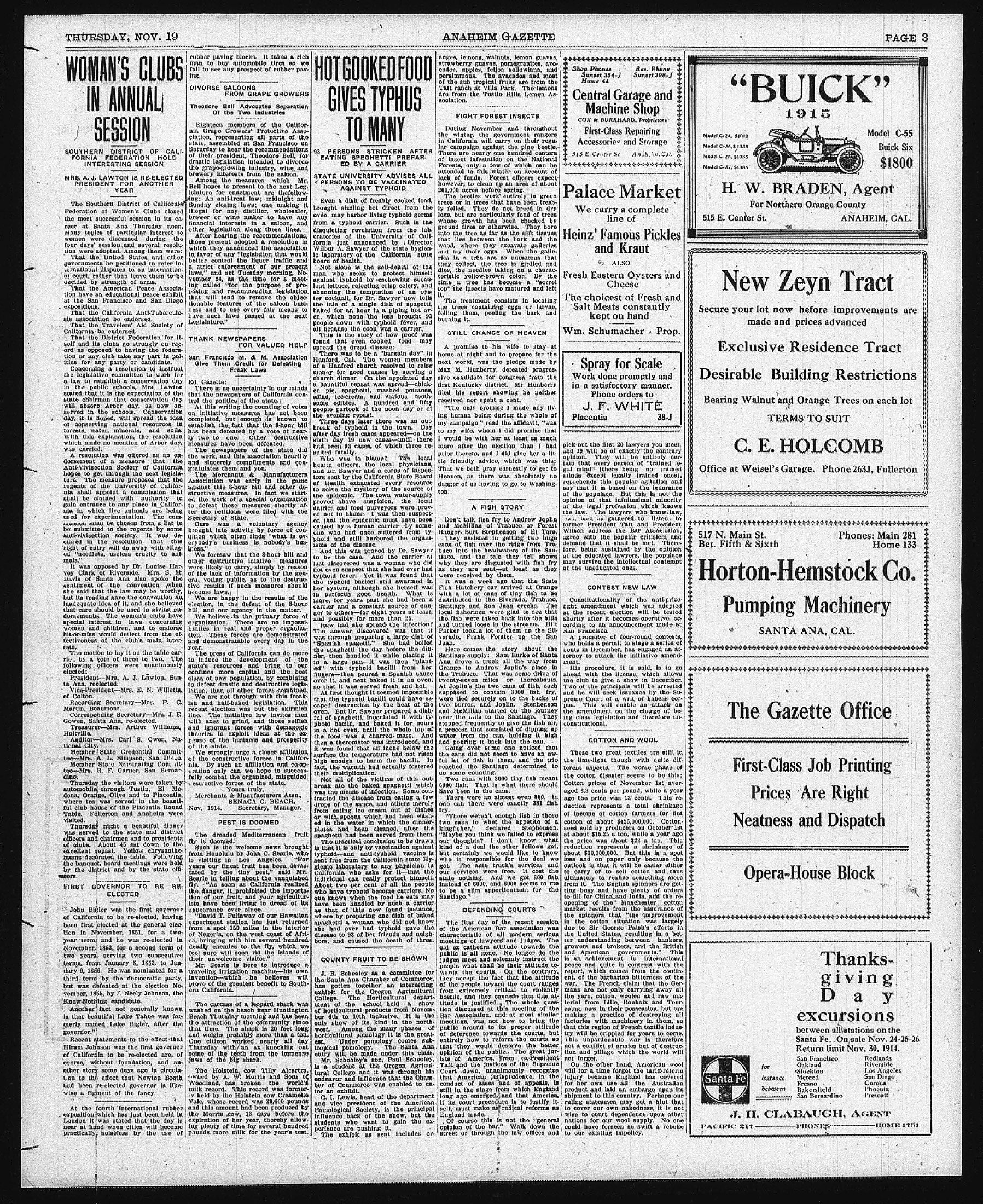
Searchable text
WOMAN'S CLUBS IN ANNUAL SESSION
SOUTHERN DISTRICT OF CALIFORNIA FEDERATION HOLD INTERESTING SESSION
MRS. A. J. LAWTON IS RE-ELECTED PRESIDENT FOR ANOTHER YEAR
The Southern District of California Federation of Women's Clubs closed the most successful session in its career at Santa Ana Thursday noon. Many topics of particular interest to women were discussed during the four days' session and several resolution were adopted. Among them were:
That the United States and other governments be petitioned to refer international disputes to an international court, rather than leave them to be decided by strength of arms.
That the American Peace Association have an educational peace exhibit at the San Francisco and San Diego expositions.
That the California Anti-Tuberculosis association be endorsed.
That the Travelers' Aid Society of California be endorsed.
That the District Federation for itself and its clubs go strongly on record as opposed to having the federation or any club take any part in politics for any party or candidate.
Concerning a resolution to instruct the legislative committee to work for a law to establish a conservation day in the public schools, Mrs. Lawton stated that it is the expectation of the state chairman that conservation day will absorb Arbor day, as now observed in the schools.
Conservation day, it is hoped, will spread the idea of conserving national resources in forests, water, minerals, and soils. With this explanation, the resolution which made no mention of Arbor day, was carried rubber paving blocks. It takes a rich man to buy automobile tires so we fail to see any prospect of rubber paving.
DIVORSE SALOONS FROM GRAPE GROWERS
Theodore Bell Advocates Separation Of the Two Industries
Eighteen members of the California Grape Growers' Protective Association, representing all parts of the state, assembled at San Francisco on Saturday to hear the recommendations of their president, Theodore Bell, for drastic legislation intended to divorce the grape-growing industry, wine, and brewery interests from the saloon.
Among the measures which Mr. Bell hopes to present to the next Legislature for enactment are the following:
An anti-treat law; midnight and Sunday closing laws; one making illegal for any distiller, wholesaler, brewer or wine maker to have any financial interests in a saloon, and other legislation along these lines.
After hearing the recommendations, those present adopted a resolution in which they announced the association in favor of any "legislation that would better control the liquor traffic and a strict enforcement of our present laws," and set Tuesday morning, November 24, as the time for a meeting called "for the purpose of proposing and recommending legislation that will tend to remove the objectiveable features of the saloon business and to use every fair means to have such laws passed at the next Legislature."
THANK NEWSPAPERS FOR VALUED HELP
San Francisco M. & M. Association Give Them Credit for Defeating Freak Laws
Ed. Gazette:
There is no uncertainty in our minds that the newspapers of California control the politics of the state.
At this writing the counting of votes on initiative measures has not been completed, but enough is known to establish the fact that the 8-hour bill has been defeated by a vote of nearly two to one. Other destructive measures have been defeated.
HOT GOODS TO THE
93 PERSONS EATING SPECIAL EDIT BY
STATE UNIVERSITY PERSONS TO AGAINST
Even a dish of brought sizzling oven may harbor from a typhoid or disquieting oratories of the form just announce Wilbur A. Sawyer ic laboratory of the board of health.
Not alone is this man who seeks a lent lettuce, rejects shunning the ter cocktail, for he the tale of a sin baked for an hour en, which none people down with all because the co.
This is the story found that even spread the dread.
There was to be Hanford, Cal., Tofa of a Hanford church money for good church dinner.
A bountiful repas en pie, spaghetti saffl, ice-cream, some edibles.
A people partook of the evening repas.
Three days later break of typhoid after day fresh cab sixth day 19 new had been 93 cases.
Concerning a resolution to instruct the legislative committee to work for a law to establish a conservation day in the public schools, Mrs. Lawton stated that it is the expectation of the state chairman that conservation day will absorb Arbor day, as now observed in the schools. Conservation day, it is hoped, will spread the idea of conserving national resources in forests, water, minerals, and soils. With this explanation, the resolution which made no mention of Arbor day, was carried.
A resolution was offered as an endorsement of a measure that the Anti-Vivisection Society of California hopes to get through the next legislature. The measure proposes that the regents of the University of California shall appoint a commission that shall be clothed with authority to gain entrance to any place in California in which live animals are being used for experimentation. The commission shall be chosen from a list to be submitted to the regents by some anti-vivisection society. It was declared in the resolution that this right of entry will do away with alleged "needless, useless cruelty to animals."
It was opposed by Dr. Louise Harvey Clark of Riverside, Mrs. S. M. Davis of Santa Ana also spoke the sentiment of the convention when she said that the law may be worthy, but its reading gave the convention an inadequate idea of it, and she believed that care should be used in giving endorsements. The women's clubs have special interest in laws concerning women and children, and to endorse hit-or-miss would detract from the effectiveness of the club's main interests.
The motion to lay it on the table carried by a vote of three to two. The following officers were unanimously elected:
President—Mrs. A. J. Lawton, Santa Ana, reelected.
Vice-President—Mrs. E. N. Willetts, of Colton.
Recording Secretary—Mrs. F. C. Martin, Beaumont.
Corresponding Secretary—Mrs. J. E. Gowen, Santa Ana, re-elected.
Treasurer—Mrs. Arthur Williams, Holtville.
Auditor—Mrs. Carl S. Owen, National City.
Member State Credential Committee—Mrs. A. L. Simpson, San Diego.
Member State Recruiting Committee—Mrs. R. F. Garner, San Bernardino.
Thursday the visitors were taken by automobile through Tustin, El Modena, Orange, Olive and to Placentia, where tea was served in the beautiful club house of the Placentia Round Table. Fullerton and Anahiem were visited.
Thursday night a beautiful dinner was served to the state and district officers and chairmen and to presidents of clubs. About 45 sat down to the excellent reunion at Yellow chrysanthemum.
San Francisco M. & M. Association Give Them Credit for Defeating Freak Laws
Ed. Gazette:
There is no uncertainty in our minds that the newspapers of California control the politics of the state.
At this writing the counting of votes on initiative measures has not been completed, but enough is known to establish the fact that the 8-hour bill has been defeated by a vote of nearly two to one. Other destructive measures have been defeated.
The newspapers of the state did the work, and this association heartily and sincerely compliments and congratulates them and you.
The Merchants & Manufacturers Association was early in the game against this 8-hour bill and other destructive measures. In fact we started the work of a special organization to defeat these measures shortly after the petitions were filed with the Secretary of State.
Ours was a voluntary agency brought into activity by force of conviction which often finds "what is everybody's business is nobody's business."
We fore saw that the 8-hour bill and other destructive initiative measures were likely to carry, simply by reason of the lack of information by the general voting public, as to the destructive results if such measures should become laws.
We are happy in the results of the election, in the defeat of the 8-hour bill, and our agency in the matter.
We believe in the primary force of organization. There are no impossibilities in real and proper organization. These forces are demonstrated and demonstratable every day in the year.
The press of California can do more to induce the development of the state's resources and bring to our confines more capital and the best class of new population, by combining to defeat drastic and destructive legislation, than all other forces combined.
We are not through with this freakish and half-baked legislation. This recent election was but the skirmish line. The initiative law invites men with axes to grind, and those selfish and ignorant forces with demagogic theories to exploit ideas at the expense of the business and prosperity of the state.
We strongly urge a closer affiliation of the constructive forces in California. By such an affiliation and co-operation only we can hope to successfully combat the organized, misguided, destructive forces of the state.
Yours truly,
Merchants & Manufacturers Assn., SENACA C. BEACH,
Nov. 1914.
Secretary, Manager.
PEST IS DOOMED
The dreaded Mediterranean fruit fly is doomed.
Such is the welcome news brought there was to Hanford, Cal., that of a Hanford church money for good or church dinner.
O a bountiful repose en pile, spaghetti saffold, ice-cream, some edibles.
O people partook of the evening repair.
Three days later break of typhoid after day fresh caught sixth day 19 new had been 93 cases sufted fatally.
Who was to be health officers, tand Dr. Sawyer arts sent by the C.Of Health exhaust to solve mythe epidemic.
The proved above sardines and food led not to blame.
ed that the epidemic caused by a hump one who had one paundal and still still sams of the disease.
And this was put to be the case last discovered w not even suspect typhoid fever.
Yet the typhoid bacillus system, although perfectly good more, for years carrier and a courier to others—for and possibly for.
How had she go?
The answer disasmed with preper "Spanish spaghetti" therder, then handled in a large pan—and with typhoid fingers—then poured over it, and next so that it was seized.
At first thought that the typhoid bacillus destruction oven. But Dr. Sawful of spaghetti bacillus, and in a hot oven, was at then a thermometer it was found that surface the temp high enough to fact, the warmth their multiplication.
Not all of the break ate the bread was the means of tracted the disease drops of the sauces from eating ice or with spoons waved in the water plates had been spaghetti had been in the practical cisl that it is only h
Mrs. A. L. Simpson, San Diego
Member State: New York
Committee: Mrs. R. F. Garner, San Bernardino
Thursday the visitors were taken by automobile through Tustin, El Modena, Orange, Olive and to Placentia, where tea was served in the beautiful club house of the Placentia Round Table. Fullerton and Anaheim were visited.
Thursday night a beautiful dinner was served to the state and district officers and chairmen and to presidents of clubs. About 45 sat down to the excellent repast. Yellow chrysanthemums decorated the table. Following the banquet, board meetings were held by the district and by the state officers.
FIRST GOVERNOR TO BE RE-ELECTED
John Bigler was the first governor of California to be re-elected, having been first elected at the general election in November, 1851, for a two-year term; and he was re-elected in November, 1853, for a second term of two years, serving two consecutive terms, from January 8, 1852, to January 9, 1856. He was nominated for a third term by the democratic party, but was defeated at the election November, 1855, by J. Neely Johnson, the Know-Nothing candidate.
Another fact not generally known is that beautiful Lake Tahoe was formerly named Lake Bigler, after the governor."
Recent statements to the effect that Hiram Johnson was the first governor of California to be re-elected are, of course, without foundation, and another story some days ago in circulation to the effect that Newton Booth had been re-elected governor is likewise a figment of the fancy.
At the fourth international rubber exposition which has just been held in London it was stated that the day is near at hand when cities will become practically noiseless by the use of
PEST IS DOOMED
The dreaded Mediterranean fruit fly is doomed.
Such is the welcome news brought from Honolulu by John C. Searle, who is visiting in Los Angeles. "For years our finest fruit has been devastated by the tiny post," said Mr. Searle in telling about the vanquished fly. "As soon as California realized the danger, it prohibited the importation of our fruit, and your agriculturists have been living in dread of its appearance ever since.
"David T. Fullaway of our Hawaiian experiment station has just returned from a spot 150 miles in the interior of Negerla, on the west coast of Africa, bringing with him several hundred deadly enemies to the fly, which we feel sure will soon rid the islands of their unwelcome visitor."
Mr. Searle is here to introduce a traveling irrigation machine—his own invention—which he believes will prove of the greatest benefit to Southern California.
The carcass of a leopard shark was washed on the beach near Huntington Beach Thursday morning and has been the attraction of the community since that time. The shark is 20 feet long and weighs probably more than a ton. One citizen worked nearly all day Thursday with an ax knocking out some of the teeth from the immense jaws of the big shark.
The Holstein cow Tilly Alcartra, owned by A. W. Morris and Sons of Woodland, has broken the world's milk record. This record was formerly held by the Holstein cow Creamelle Vale, whose record was 29,600 pounds and this amount had been produced by the Morris cow, 13 days before the expiration of her year, thereby allowing plenty of time for several hundred pounds more milk for the year's test.
J. R. Schooloye, the Santa Ana College has gotten together exhibit for the College. The ment of the season of horticultural per cent 6th to 10th only show of its west. Among tropical pomology entry will be made.
Mr. Schooloye's is a student at natural College and endeavor and infiltration of Commerce an exhibit.
C. I. Lewis, head and vice president Pomological Society influence back on students who were perceive arepussthe exhibit
HOT GOOKED FOOD GIVES TYPHUS TO MANY
93 PERSONS STRICKEN AFTER EATING SPEGHETTI PREPARATED BY A CARRIER
STATE UNIVERSITY ADVISES ALL PERSONS TO BE VACCINATED AGAINST TYPHOID
Even a dish of freshly cooked food, brought sizzling hot direct from the oven, may harbor living typhoid germs from a typhoid carrier. Such is the disquieting revelation from the laboratories of the University of California just announced by Director Wilbur A. Sawyer of the state hygienic laboratory of the California state board of health.
Not alone is the self-denial of the man who seeks to protect himself against typhoid by eschewing succulent lettuce, rejecting crisp color, and shunning the temptation of an oyster cocktail, for Dr. Sawyer now tells the tale of a single dish of spaggett, baked for an hour in a piping hot oven, which none the less brought 93 people down with typhoid fever, and all because the cook was a carrier.
This is the story of how proof was found that even cooked food may spread the dread disease:
There was to be a "bargain day" in Hanford, Cal. The women members of a Hanford church resolved to raise money for good causes by serving a church dinner. On the appointed day a bountiful repast was spread—chicken pie, spaghetti, mashed potatoes, salad, ice cream, and various toothsome edibles. A hundred and fifty people partook of the noon day or of the evening repeat.
Three days later there was an outbreak of typhoid in the town. Day after day fresh cases appeared—on the sixth day 19 new cases—until there had been 93 cases, of which three re-
anges, lemons, walnuts, lemon guavas, strawberry guavas, pomegranites, avocados, apples, felloa sollowiana, and persimmons. The avacados and most of the sub tropical fruits are from the Taft ranch at Villa Park. The lemons are from the Tustin Hills Lemon Association.
FIGHT FOREST INSECTS
During November and throughout the winter, the government rangers in California will carry on their regular campaign against the pine beetle. There are nearly one hundred centers of insect infestation on the National Forests, only a few of which can be attended to this winter on account of lack of funds. Forest officers expect however, to clean up an area of about 200,000 acres before spring.
The beetles work entirely in green trees or in trees that have been freshly felled. They do not breed in dry logs, but are particularly fond of trees whose growth has been checked by ground fires or otherwise. They bore into the tree as far as the soft tissues that lies between the bark and the wood, where they excavate galleries and lay their eggs. When the galleries in a tree are so numerous that they collect, the tree is girdled and dies, the needles taking on a characteristic yellow-brown color. By the time a tree has become a "sorrel top" the insects have matured and left it.
The treatment consists in locating the trees containing eggs or larvae, felling them, peeling the bark and burning it.
STILL CHANCE OF HEAVEN
A promise to his wife to stay at home at night and to prepare for the next world, was the pledge made by Max M. Hunberry, defeated progressive candidate for congress from the first Kentucky district. Mr. Hunberry filed his report showing he neither received nor apented a cent.
"The only promise I made any living human being during the whole of my campaign," read the afilidavit, "was to my wife, whom I did promise that I would be with her at least as much more after the election than I had pick out the first 20 lawyers you meet."
There was to be a bargain day in Hanford, Cal. The women members of a Hanford church resolved to raise money for good causes by serving a church dinner. On the appointed day a bountiful repast was spread—chicken pie, spaghetti, mashed potatoes, saffron, ice cream, and various toothsome edibles. A hundred and fifty people partook of the noon day or of the evening repast.
Three days later there was an outbreak of typhoid in the town. Day after day fresh cases appeared—on the sixth day 19 new cases—until there had been 93 cases, of which three resulted fatally.
Who was to blame? The local health officers, the local physicians, and Dr. Sawyer and a corps of inspectors sent by the California State Board of Health exhausted every resource to solve the mystery of the source of the epidemic. The town water-supply proved above suspicion, the local dairies and food purveyors were proved not to blame. It was then suspected that the epidemic must have been caused by a human carrier—by someone who had once suffered from typhoid and still harbored the organisms of the disease.
And this was proved by Dr. Sawyer to be the case. And the carrier at last discovered was a woman who did not even suspect that she had ever had typhoid fever. Yet it was found that the typhoid bacillus still swarmed in her system, although she herself was in perfectly good health. What is more, for years past she had been a carrier and a constant source of danger to others—for eight years at least, and possibly for more than 25.
How had she spread the infection? The answer discovered was that it was through preparing a large dish of "Spanish spaghetti." She had boiled the spaghetti the day before the dinner, then handled it while placing it in a large pan—it was then "planted" with typhoid bacillus from her fingers—then poured a Spanish sauce over it, and next baked it in an oven, so that it was served fresh and hot.
At first thought it seemed impossible that the typhoid bacillus could have escaped destruction by the heat of the oven. But Dr. Sawyer prepared a dishful of spaghetti, inoculated it with typhoid bacillus, and baked it for hours in a hot oven, until the whole top of the food was a charred mass. And then a thermometer was introduced, and it was found that an inch below the surface the temperature had not risen high enough to harm the bacilli. In fact, the warmth had actually fostered their multiplication.
Not all of the victims of this outbreak ate the baked spaghetti which was the means of infection. Some contracted the disease from eating a few drops of the sauce, and others merely from eating ice cream out of dishes or with spoons which had been washed in the water in which the dinner plates had been cleaned, after the spaghetti had been served from them.
The practical conclusion to be drawn is that it is only by vaccination against
"The only promise I made any living human being during the whole of my campaign," read the affidavit, "was to my wife, whom I did promise that I would be with her at least as much more after the election than I had prior thereto, and I did give her a little friendly advice, which was this: That we both pray earnestly to get to Heaven, as there was absolutely no danger of us having to go to Washington."
A FISH STORY
Don't talk fish fry to Andrew Joplin and McMillan of Trabuco or Forest Ianger-Burt Stephenson of El Toro.
They assisted in getting two huge cans of fish over the ridge from Trabuco into the headwaters of the Santiago, and the tale they tell shows why they are disgusted with fish fry as they are sent—at least as they were received by them.
It was a week ago that the State Fish Hatchery car arrived at Orange with a lot of cans of tiny fish to be distributed in the Silverado, Trabuco, Santiago and San Juan creeks. The local fishermen were glad to see that the fish were taken back into the hills and turned loose in the streams. Hilf Parker took a lot of them up the Silverado, Frank Forster up the San Juan.
Here comes the story about the Santiago supply: Sam Burke of Santa Ana drove a truck all the way from Orange to Andrew Joplin's place in Trabuco. That was some drive of twenty-seven miles or thereabouts. At Joplin's two cans of fish, each supposed to contain 3000 fish fry, were tied securely on to the backs of two burros, and Joplin, Stephenson and McMillan started on the journey over the trails to the Santiago. They stopped frequently to give the fish air, a process that consisted of dipping up water from the can, holding it high and pouring it back into the can.
Going over some one noticed that the cans did not seem to have an awful lot of fish in them, and the tril reached the Santiago determined to do some counting.
Two cans with 3000 tiny fish meant 6000 fish. That is what there should have been in the cans.
There were an almost even 800. In one can there were exactly 381 fish fry.
"There weren't enough fish in those two cans to whist the appetite of a kingfisher," declared Stephenson. "Maybe you think we failed to express our thoughts? I don't know what kind of a deal the other fellows got,
pick out the first 20 lawyers you meet, and 19 will be of exactly the contrary opinion. They will be entirely certain that every person of "trained legal mind" (there being no trained minds except legally trained ones), prerehends this popular agitation and say that it is based on the ignorance of the populace. But this is not the opinion of that infinitimal minority of the legal profession which knows the law. The lawyers who know law, mean as gathered to listen to former President Taft and President Wilson address the Bar Association, agree with the popular criticism and demand that it shall be met. Therefore, being sustained by the opinion of the educated lawyers, the populace may survive the intellectual contempt of the uneducated ones."
CONTEST NEW LAW
Constitutionality of the anti-prize-light amendment which was adopted at the recent election will be tested shortly after it becomes operative, according to an announcement made at San Francisco.
A promoter of four-round contests, who holds a permit to stage a series ofouts in December, has engaged an attorney to attack the initiative amendment.
His procedure, it is said, is to go ahead with the license, which allowsthe club to give a show in December. Two of the principals will be arrestedand he will seek issuance by the Supreme Court of a writ of habeas corpus. This will enable an attack onthe amendment on the charge of being class legislation and therefore unconstitutional.
COTTON AND WOOL
These two great textiles are still in the lime-light though with quite different aspects. The worse phase ofthe cotton disaster seems to be this: Cotton prices of November 1st averaged 6.3 cents per pound, while a year ago the price was 13 cents. This reduction represents a total shrinkageof income of cotton farmers for lint cotton of about $425,000,000. Cottonseed sold by producers on October list at about $15.25 a ton, while a year agothe price was about $22 a ton. This reduction represents a shrinkage of
Not all of the victims of this outbreak ate the baked spaghetti which was the means of infection. Some contracted the disease from eating a few drops of the sauce, and others merely from eating ice cream out of dishes or with spoons which had been washed in the water in which the dinner plates had been cleaned, after the spaghetti had been served from them.
The practical conclusion to be drawn is that it is only by vaccination against typhoid and anti-typhoid vaccine is sent free from the California state Hygienic laboratory to any physician in California who asks for it—that the individual can really protect himself. About two per cent of all the people who have typhoid become carriers. No one knows when the food he eats may have been handled by such a carrier as that of this new found instance, where by preparing one dish of baked spaghetti a woman who did not know she had ever had typhoid gave the disease to 93 of her friends and neighbors, and caused the death of three.
COUNTY FRUIT TO BE SHOWN
J. R. Schooloy as a committee for the Santa Ana Chamber of Commerce, has gotten together an interesting exhibit for the Oregon Agricultural College. The Horticultural department of the school held a show of horticultural products from November 6th to 10th inclusive. It is the only show of its kind in the northwest. Among the many phases of horticultural pomology it is the greatest. Under pomology comes sub-tropical pomology. The Santa Ana entry will be made under this class.
Mr. Schooloy's son, Paul Schooloy, is a student at the Oregon Agricultural College and it was through his endeavor and influence that the Chamber of Commerce was enabled to enter an exhibit.
C. I. Lewis, head of the department and vice president of the American Pomological Society, is the principal influence back of the show, but the students who want to gain the experience are pushing it.
The exhibit as sent includes or
The first day of the recent session of the American Bar association was characteristic of all modern serious meetings of lawyers and judges. The old ext cathedra attitude towards the public is all gone. No longer do the judges meet and solemnly instruct the people what shall be their attitude towards the courts. On the contrary, they accept the fact that the attitude of the people toward the court ranges from extremely critical to violently hostile, and they concede that this attitude is justified. The whole question discussed at this meeting of the Bar Association, and at most similar meetings, was not how to bring the public around to its proper attitude of deference towards the courts, but entirely how to reform the courts so that they would deserve the better opinion of the public. The great jurists of America, from ex-President Taft and the justices of the Supreme Court down, unanimously recognize that American jurisprudence, in the conduct of cases and of appeals, is still in the stage from which England long ago emerged, and that America, if its court procedure is to justify itself, must make as radical reforms as England made.
Of course this is not the "general opinion of the bar." Walk down the street or through the law offices and lime-light though with quite different aspects. The worse phase of the cotton disaster seems to be this: Cotton prices of November 1st averaged 6.3 cents per pound, while a year ago the price was 13 cents. This reduction represents a total shrinkage of income of cotton farmers for lint cotton of about $425,000,000. Cottonseed sold by producers on October 1st at about $15.25 a ton, while a year ago the price was $22 a ton. This reduction represents a shrinkage of about $30,000,000. But this is a spot loss and on paper only because the outlook is that it will be easier either to carry or to sell cotton and thus ultimately to realize something more from it. The English spinners are getting busy and have plenty of orders to fill for China and India, and the opening of the Manchester cotton market results from the assurance of the spinners that "the improvement in the cotton situation was largely due to Sir George Palish's efforts in the United States, resulting in a better understanding between bankers, growers and brokers, and the British and American governments."
This is an achievement in international peace and quite in contrast with the report, which comes from the continent, of the barbarian bitterness of the war. The French claim that the Germans are not only carrying away all the yarn, cotton, woolen and raw material from Lille, Roubaix and Tourcoing, now in their possession, but are making a practice of destroying all factories with machinery in them, so that this region of French textile industry will be crippled for years to come. This unpardonable war is therefore not a conflict of armies but of destruction and pillage which the world will not forget.
On the other hand, American wool will for a time forget the tariff-reform injury because England has covered for her own use all the Australian product and laid an embargo upon its shipment to this country. Perhaps our ruling statesmen may get a hint that to cover our own nakedness, it is not wise to court dependence upon other nations for our wool supply. No one could have foreseen so swift a rebuke to our existing impolicy.
"BUICK"
1915
Model C-24, $1010
Model C-36, $1335
Model C-25, $1085
Model C-37, $1385
Model G-55
Buick Six
$1800
H. W. BRADEN, Agent
For Northern Orange County
515 E. Center St.
ANAHEIM, CAL.
New Zeyn Tract
Secure your lot now before improvements are made and prices advanced
Exclusive Residence Tract
Desirable Building Restrictions
Bearing Walnut and Orange Trees on each lot
TERMS TO SUIT
C. E. HOLCOMB
Desirable Building Restrictions
Bearing Walnut and Orange Trees on each lot
TERMS TO SUIT
C. E. HOLCOMB
Office at Weisel’s Garage. Phone 263J, Fullerton
517 N. Main St.
Bet. Fifth & Sixth
Phones: Main 281
Home 133
Horton-Hemstock Co.
Pumping Machinery
SANTA ANA, CAL.
The Gazette Office
First-Class Job Printing
Prices Are Right
Neatness and Dispatch
First-Class Job Printing
Prices Are Right
Neatness and Dispatch
Opera-House Block
Thanksgiving Day excursions
between all stations on the Santa Fe... On sale Nov. 24-25-26
Return limit Nov. 30, 1914.
for instance between
San Francisco Redlands
Oakland Riverside
Stockton Los Angeles
Merced San Diego
Fresno Corona
Bakersfield Phoenix
San Bernardino Prescott
J. H. CLABAUGH, AGENT
PACIFIC 217 PHONES HOME 1751