anaheim-gazette 1914-11-19
Scanned page
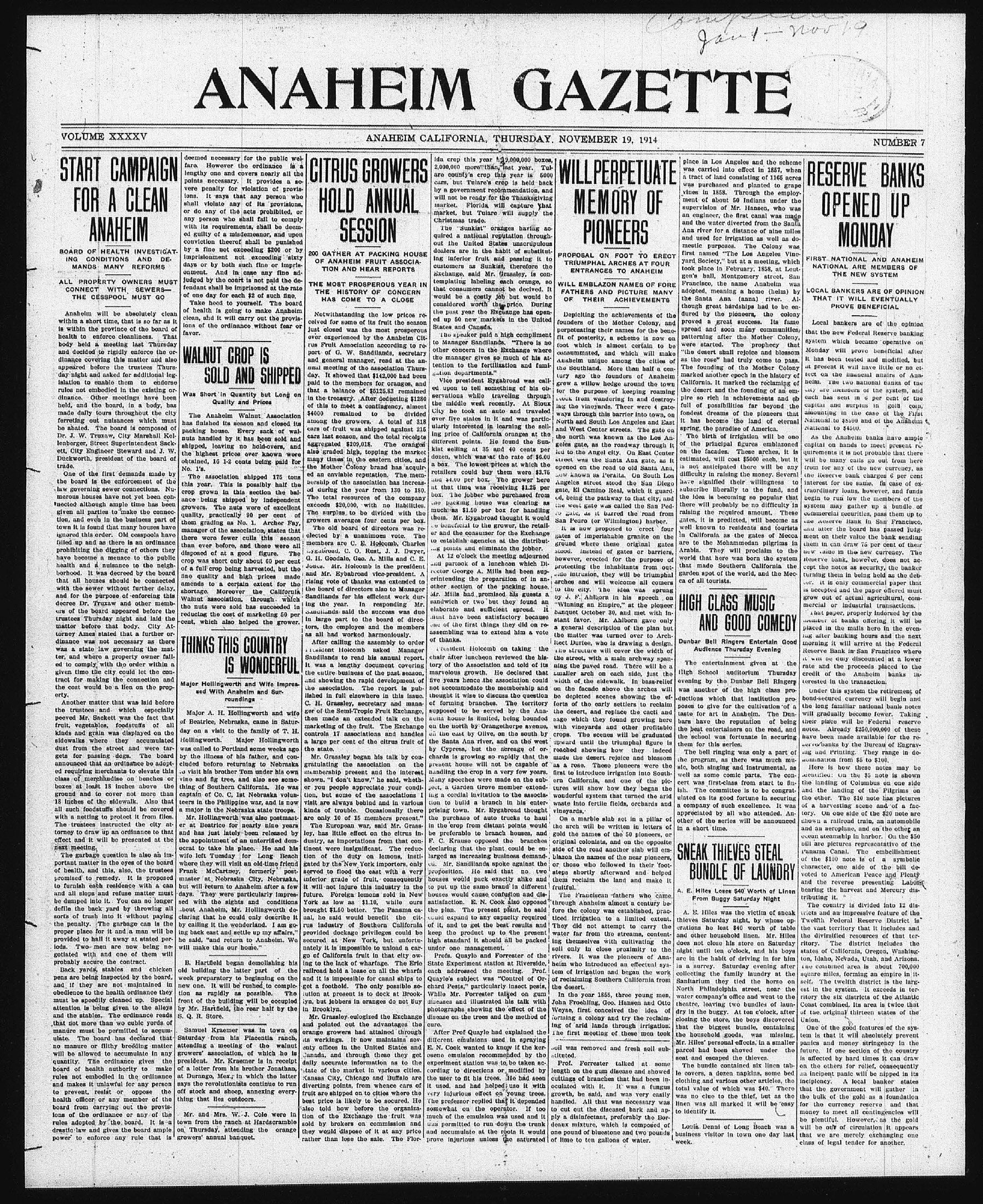
Searchable text
START CAMPAIGN FOR A CLEAN ANAHEIM
BOARD OF HEALTH INVESTIGATING CONDITIONS AND DEMANDS MANY REFORMS
ALL PROPERTY OWNERS MUST CONNECT WITH SEWERS—THE CESSPOOL MUST GO
Anaheim will be absolutely clean within a short time, that is so far as it is within the province of the board of health to enforce cleanliness. That body held a meeting last Thursday and decided to rigidly enforce the ordinance covering this matter and also appeared before the trustees Thursday night and asked for additional legislation to enable them to endorse rules not embodied in the existing ordinance. Other meetings have been held, and the board, in a body, has made daily tours throughout the city ferreting out nuisances which must be abated. The board is composed of Dr. J. W. Truxaw, City Marshall Kellenberger, Street Superintendent Sack-deemed necessary for the public welfare. However the ordinance is a lengthy one and covers nearly all the points necessary. It provides a severe penalty for violation of provisions. It says that any person who shall violate any of its provisions, or do any of the acts prohibited, or any person who shall fail to comply with its requirements, shall be deemed guilty of a misdemeanor, and upon conviction theerof shall be punished by a fine not exceeding $200 or by imprisonment not exceeding sixty days or by both such fine or imprisonment. And in case any fine adjudged by the court is not paid the defendant shall be imprisoned at the rate of one day for each $2 of such fine.
Take heed to yourself. The board of health is going to make Anaheim clean, and it will carry out the provisions of the ordinance without fear or favor.
WALNUT GROP IS SOLD AND SHIPPED
Was Short in Quantity but Long on Quality and Prices
The Anaheim Walnut Association has finished its season and closed its packing house. Every sack of walnuts handled by it has been sold and shipped, leaving no hold-overs, and
One of the first demands made by the board is the enforcement of the law governing sewer connections. Numerous houses have not yet been connected although ample time has been given all parties to make the connection, and even in the business part of town it is found that many houses have ignored this order. Old cesspools have failed up and as there is an ordinance prohibiting the digging of others they have become a menace to the public health and a nuisance to the neighborhood. It was decreed by the board that all houses should be connected with the sewer without further delay, and for the purpose of enforcing this decree Dr. Truxaw and other members of the board appeared before the trustees Thursday night and laid the matter before that body. City Attorney Ames stated that a further ordinance was not necessary as there was a state law governing the matter, and where a property owner failed to comply with the order within a given time the city could let the contract for making the connection and the cost would be a lien on the property.
Another matter that was laid before the trustees and which especially peeved Mr. Sackett was the fact that fruit, vegetables, foodstuffs of all kinds and grain was displayed on the sidewalks where they accumulated dust from the street and were targets for passing dogs. The board announced that an ordinance be adopted requiring merchants to elevate this class of merchandise on benches or boxes at least 18 inches above the ground and to cover not more than 18 inches of the sidewalk. Also that all such foodstuffs should be covered with a netting to protect it from files. The trustees instructed the city attorney to draw up an ordinance to that effect and it will be presented at the next meeting.
WALNUT GROP IS SOLD AND SHIPPED
Was Short in Quantity but Long on Quality and Prices
The Anaheim Walnut Association has finished its season and closed its packing house. Every sack of walnuts handled by it has been sold and shipped, leaving no hold-overs, and the highest prices over known were obtained, 16 1-2 cents being paid for No. 1's.
The association shipped 175 tons this year. This is possibly half the crop grown in this section the balance being shipped by independent growers. The nuts were of excellent quality, practically 90 per cent of them grading as No. 1. Archer Fay, manager of the association, states that there were fewer culls this season than ever before, and these were all disposed of at a good figure. The crop was short only about 60 per cent of a full crop being harvested, but the fine quality and high prices made amends to a certain extent for the shortage. Moreover the California Walnut association, through which the nuts were sold has succeeded in reducing the cost of marketing 50 per cent, which also helped the grower.
THINKS THIS COUNTRY IS WONDERFUL
Major Hollingworth and Wife Impressed With Anaheim and Surroundings
Major A. H. Hollingworth and wife of Beatrice, Nebraska, came in Saturday on a visit to the family of T. H. Hollingworth.
Major Hollingworth was called to Portland some weeks ago by the illness of his father, and concluded before returning to Nebraska to visit his brother Tom under his own vine and fig tree, and also see something of Southern California. He was captain of Co. C, 1st Nebraska volunteers in the Philippine war, and is now a major in the Nebraska state troops.
Mr. Hollingworth was also postmaster at Beatrice for nearly nine years and has just lately been released by the appointment of an uninterrified democrat to take his place. He and his general management team met on day. It showed that paid to the member that a balance of $4000 remained among the growers cars of fruit was sold cars last season, and aggregated $209,010 also graded high, many times in the Mother Colony.
The old board elected by a unanimous members are C. E., Lygabroad, C. O., G. H. Goodale, Geo., Jones, Mr. Holcombe and Mr. Eybabroad rising vote of thank the board of directors Sandilands for his ingoring the year. In Sandilands said they in large part to their employees as all had worked after calling the President Holcomb Sandilands to read it. It was a lengthy one of the entire business and showing the rapid association. Titled in full elsewhere C. H. Grassley, secretary of the Semi-Tropical marketing of the fruit controls 17 associates a large per cent of the state.
Mr. Grassley began gratulating the membership present shown: "I don't know or you people apportion, but some of them visit are always behinds kinds of trouble." Only are only 10 of 15 ripe.
The European waiver has little effect dutry, as important tinent were insignificant
The garbage question is also an important matter in the eyes of the board of health, and this, also, the trustees promised to remedy. It is proposed to furnish each residence with a can and all slops and refuse matter must be dumped into it. You can no longer defile the back yard by throwing all sorts of trash into it without paying the penalty. The garbage can is the proper place for it and a man will be provided to hall it away at stated periods. Two men are now being negotiated with and one of them will probably secure the contract.
Back yards, stables and chicken pens are being inspected by the board, and if they are not majtainted in obedience to the health ordinance they must be speedily cleaned up. Special attention is being given to the alleys and the stables. The ordinance reads that not more than two cubic yards of manure must be permitted to accumulate. The board has declared that no manure or filthy breeding matter will be allowed to accumulate in any quantity. The ordinance gives the board of health authority to make rules not embodied in the ordinance and makes it unlawful for any person to prevent, resist or oppose the health officer or any member of the board from carrying out the provisions of the ordinance or any of the rules adopted by the board. It is a drastic law and gives the board ample power to enforce any rule that is
B. Hartfield began demolishing his old building the latter part of the week preparatory to beginning on the new one. It will be rushed to completion as rapidly as possible. The front of the building will be occupied by Mr. Hartfield, the rear half by the S. Q. R. Store.
Samuel Kraemer was in town on Saturday from his Placentia ranch, attending a meeting of the walnut growers' association, of which he is president. Mr. Kraemer is in receipt of a letter from his brother Jonathan, at Durango, Mex., in which the latter says the revolutionists continue to run off stock and sheep, annexing everything that lies outdoors.
Mr. and Mrs. W. J. Cole were in town from the ranch at Hardscramble on Thursday, attending the orange growers' annual banquet.
Mr. Grassley began gratifying the asses membership present shown. "I don't know or you people appreciation, but some visit are always behind kinds of trouble." C are only 10 of 15 m.
The European wayley, has little effect dutry, as importation tinent were insignification of the duty gated by the New York served to flood the inferior grade of fire it will not injure the future. Foreign lem York as low as $1 brought $1.50 better,nal, he said would rus industry of So provided dockage procured at New Yonately it is impossibility go of California fruiting to the lack of wh railroad hold a lease and it is impossible get a foothold. The auction at present is slyn, but jobbers in on in Brooklyn.
Mr. Grassley eulogized and pointed out the orange growers had its workings. It notenty offices in the U Canada, and through daily accurate informa state of the market Kansas City, Chicago diverting points, from fruit are shipped on the best price is likely t also told how beforeion of the Exchange sold by brokers on they would dispose o rather than lose th
ANAHEIM GAZETE
ANAHEIM CALIFORNIA, THURSDAY, NOVEMBER 19, 1914
CITRUS GROWERS HOLD ANNUAL SESSION
200 GATHER AT PACKING HOUSE OF ANAHEIM FRUIT ASSOCIATION AND HEAR REPORTS
THE MOST PROSPEROUS YEAR IN THE HISTORY OF CONCERN HAS COME TO A CLOSE
Notwithstanding the low prices received for some of its fruit the season just closed was the most prosperous ever experienced by the Anaheim Citrus Fruit Association according to report of G. W. Sandilands, secretary and general manager, read at the annual meeting of the association Thursday. It showed that $142,000 had been paid to the members for oranges, and that a balance of $6125.83 remained in the treasury. After deducting $1280 of this to meet a contingency, almost $4000 remained to be divided among the growers. A total of 318 cars of fruit was shipped against 215 cars last season, and the total receipts aggregated $209,018. The orange crop this year has 19,000,000 boxes, 2,000,000 more than last year. Tulare county's crop this year is 5000 cars, but Tulare's crop is held back by a government recommendation, and will not be ready for the Thanksgiving market. Florida will capture that market, but Tulare will supply the Christmas trade.
The "Sunkist" oranges having acquired a national reputation throughout the United States unscrubulous dealers are in the habit of substituting inferior fruit and passing it to customers as Sunkist, therefore the Exchange, said Mr. Grassley, is contemplating labeling each orange, so that consumers cannot be deceived. It would be a costly job but would be considered worth the price. During the past year the Excange has opened up 50 new markets in the United States and Canada.
The speaker paid a high compliment to Manager Sandilands. "There is no other concern in the Exchange where the manager gives so much of his attention to the fertilization and fumigation departments."
Vice president Eygabroad was called upon to tell something of his observations while traveling through the middle west recently. At Sioux City he took an auto and traveled over five states in it and was particularly interested in learning the selling price of California oranges at the different points. He found the Sun-cles selling at 35 and 40 cents per daa crop this year.
WILL PERPETUATE MEMORY OF PIONEERS
PROPOSAL ON FOOT TO ERECT TRIUMPHAL ARCHES AT FOUR ENTRANCES TO ANAHEIM
WILL EMBLAZON NAMES OF FORE FATHERS AND PICTURE MANY OF THEIR ACHIEVEMENTS
Depicting the achievements of the founders of the Mother Colony, and perpetuating their names for the benefit of posterity, a scheme is now on foot which is almost certain to be consummated, and which will make Anaheim unique among the cities of the Southland. More than half a century ago the founders of Anaheim grew a willow hedge around the town for the purpose of keeping roaming stock from wandering in and destroying the vineyards. There were 4 gateways through this barrier into town, on North and South Los Angeles and East and West Center streets. The gate on the north was known as the Los Angeles gate, as the roadway through it.
The old board of directors was re-elected by a unanimous vote. The members are C. E. Holcob, Charles Eygabroad, C. O. Rust, J. J. Dwyer, G. H. Goodale, Geo. A. Mills and C. E. Jones. Mr. Holcob is the president and Mr. Eybabroad vice-president. A rising vote of thanks was extended to the board of directors also to Manager Sandilands for his efficient work during the year. In responding Mr. Sandilands said the success was due in large part to the board of directors, the employees and the members as all had worked harmoniously.
After calling the assembly to order President Holcob asked Manager Sandilands to read his annual report. It was a lengthy document covering the entire business of the past season, and showing the rapid development of the association. The report is published in full elsewhere in this issue. C. H. Grassley, secretary and manager of the Semi-Tropic Fruit Exchange, then made an extended talk on the marketing of the fruit. The Exchange controls 17 associations and handles a large per cent of the citrus fruit of the state.
Mr. Grassley began his talk by congratulating the association on the membership present and the interest shown. "I don't know," he said, whether you people appreciate your condition, but some of the associations I visit are always behind and in various kinds of trouble. Occasionally there are only 10 of 15 members present."
The European war, said Mr. Grassley, has little effect on the citrus industry, as importations from that continent were insignificant. The reduc-
the manager gives so much of his attention to the fertilization and fumigation departments."
Vice president Eygabroad was called upon to tell something of his observations while traveling through the middle west recently. At Sioux City he took an auto and traveled over five states in it and was particularly interested in learning the selling price of California oranges at the different points. He found the Sunlist selling at 35 and 40 cents per dozen, which was at the rate of $6.00 a box. The lowest prices at which retailers could buy them were $3.75 and $4.00 per box. The grower here at that time was receiving $1.25 per box. The jobber who purchased from the packing house was clearing as much as $1.50 per box for handling them. Mr. Eygabroad thought it would be beneficial to the grower, the retailer and the consumer for the Exchange to establish agencies at the distributing points and eliminate the jobber.
At 12 o'clock the meeting adjourned and partook of a luncheon which Director George A. Mills had been superintending the preparation of in another section of the packing house. Mr. Mills had promised his guests a sandwich or two but they found an elaborate and sufficient spread. It must have been satisfactory because one of the first things they did on reassembling was to extend him a vote of thanks.
President Holcomb on taking the chair after luncheon reviewed the history of the Association and told of its marvelous growth. He declared that five years hence the association could not accommodate the membership and thought it wise to discuss the question of forming branches.
The territory supposed to be served by the Anaheim house is limited, being bounded on the north by Orangethorpe avenue, on the east by Olive, on the south by the Santa Ana river, and on the west by Cypress, but the acreage of orchards is growing so rapidly that the present house will not be capable of handling the crop in a very few years.Many speeches were made on the subject, a Garden Grove member extending a cordial invitation to the association to build a branch in his enterprising town. Mr. Eygabroad thought the purchase of auto trucks to haul in the crop from distant points would be preferable to branch houses, and F. C. Krause opposed the branches declaring that the plant could be en-
Anaheim unique among the cities of the Southland. More than half a century ago the founders of Anaheim grew a willow hedge around the town for the purpose of keeping roaming stock from wandering in and destroying the vineyards. Theer were 4 gateways through this barrier into town, on North and South Los Angeles and East and West Center streets. The gate on the north was known as the Los Angeles gate, as the roadway through it led to the Angel city. On East Center street was the Santa Ana gate, as it opened on the road to old Santa Ana, now known as Peralta. On South Los Angeles street stood the San Diego gate, El Camino Real, which it guarded, being the pathway to that city, and the west gate was called the San Pedigo gate, as barred the road from San Pedro (or Wilmington) harbor.
It is now proposed to erect four gates of imperishable granite on the ground where these original gates stood. Instead of gates or barriers, however, erected for the purpose of protecting the inhabitants from outside intrusion, they will be triumphal arches and will welcome all comers to the city. The idea was sprung by J. F. Abhlorn in his speech on "Winning an Empire," at the plague banquet October 30, and met with instant favor. Mr Abhlorn gave only a general description of the plan but the matter was turned over to Architect Durtee, who is drawing a design.
The structure will cover the width of the street, with a main archway spanning the paved road. There will be a smaller arch on each side, just the width of the sidewalk. In bass-relief on the facade above the arches will be depicted scenes showing efforts of the early settlers to reclaim the desert, and replace the cacti and sage which they found growing here with vineyards and other profitable crops. The scenes will be graduated upward until the triumphal figure is reached showing how they indeed made the desert rejoice and blossom as a rose.
These pioneers were the first to introduce irrigation into Southern California, and one of the pictures will show how they began the wonderful system that turned the arid waste into fertile fields, orchards and vineyards.
On a marble slab set in a pillar of the arch will be written in letters of gold the names of the 50 pioneers, or original colonists, and on the opposite side of the road another slab will em-
Mr. Grassley began his talk by congratulating the association on the membership present and the interest shown. "I don't know," he said, whether or people appreciate your condition, but some of the associations I visit are always behind and in various kinds of trouble. Occasionally there are only 10 of 15 members present.
The European war, said Mr. Grassley, has little effect on the citrus industry, as importations from that continent were insignificant. The reduction of the duty on lemons, instituted by the New York importers, only served to flood the east with a very inferior grade of fruit, consequently it will not injure this industry in the future. Foreign lemons sold in New York as low as $1.10, while ours brought $1.50 better. The Panama canal, he said would benefit the citrus industry of Southern California provided dockage privileges could be secured at New York, but unfortunately it is impossible to unload a cargo of California fruit in that city owing to the lack of wharfage. The Erie railroad hold a lease on all the wharfs and it is impossible for canal ships to get a foothold. The only possible solution at present is to dock at Brooklyn, but jobbers in oranges do not buy in Brooklyn.
Mr. Grassley eulogized the Exchange and pointed out the advantages the orange growers had attained through its workings. It now maintains seventy offices in the United States and Canada, and through these they get daily accurate information as to the state of the market in various cities. Kansas City, Chicago and Buffalo are diverting points, from whence cars of fruit are shipped on to cities where the best price is likely to be secured. He also told how before the organization of the Exchange the fruit was sold by brokers on commission and they would dispose of it at any price rather than lose the sale. The Flor-
Mr. Grassley is growing so rapidly that the present house will not be capable of handling the crop in a very few years. Many speeches were made on the subject, a Garden Grove member extending a cordial invitation to the association to build a branch in his enterprising town. Mr. Eygabroad thought the purchase of auto trucks to haul in the crop from distant points would be preferable to branch houses, and F.C.Krause opposed the branches declaring that the plant could be enlarged as increasing business demand. Mr.Sandilanda spoke against the proposition. He said that no two houses would pack exactly alike and to put up the same brand in different houses would cause confusion and dissatisfaction. E.N.Cook also opposed the plan. The present plant, he said could expand to any capacity required of it, and to get the best results and keep the product up to the present high standard it should all be packed under one management.
Prof. Quayle and Forrester of the State Experiment station at Riverside, each addressed the meeting. Prof. Quayle's subject was "Control of Orchard Pests," particularly insect pests, While Mr. Forrester talked on gum diseases and illustrated his talk with photographs showing the effect of the disease on the trees and the method of cure.
After Prof Quayle had explained the different emulsions used in spraying E.N.Cook wanted to know if the kerosene emulsion recommended by the experiment station was to be taken according to directions or modified by the user to fit his trees. He had seen it used, and had helped use it with very injurious effect on young trees. The professor replied that it depended somewhat on the operator. If too much of the emulsion was used and it was permitted to run down the trunk and accumulate at the roots it would prove injurious unless the saturated soil was removed and fresh soil substituted.
Prof. Forrester talked at some length on the gum disease and showed cuttings of branches that had been inoculated with it. It was a fungus growth, he said, and was very easily handled. All that was necessary was to cut out the diseased bark and apply a disinfectant, preferably the Bordeaux mixture, which is composed of one pound of bluestone and two pounds of lime to ten gallons of water.
MAR 19, 1914
ZETTE
PERPETUATE HISTORY OF BEERS
FOOT TO ERECT MACHES AT FOUR TO ANAHEIM
NAMES OF FORE PICTURE MANY ACHIEVEMENTS
achievements of the Mother Colony, and names for the bene-scheme is now on most certain to be which will make among the cities of more than half a cen-nders of Anaheim are around the town of keeping roaming in and destroy-thee were 4 gate-carrier into town, on Los Angeles and East streets. The gate on own as the Los An-roadway through it place in Los Angeles and the scheme was carried into effect in 1857, when a tract of land consisting of 1165 acres was purchased and planted to grape vines in 1858. Through the employ-ment of about 50 Indians under the supervision of Mr. Hansen, who was an engineer, the first canal was made and the water diverted from the Santa Ana river for a distance of nine miles and used for irrigation as well as domestic purposes. The Colony was first named "The Los Angeles Vineyard Society," but at a meeting, which took place in February, 1858, at Leutgen's hall, Montgomery street, San Francisco, the name Anaheim was adopted, meaning a home (helm) by the Santa Ana (anna) river. Although great hardships had to be endured by the pioneers, the colony proved a great success. Its fame spread and soon many communities, patterning after the Mother Colony, were started. The prophecy that "the desert shall rejoice and blossom as the rose" had truly come to pass. The founding of the Mother Colony marked another epoch in the history of California. It marked the reclamation of the desert and the founding of an empire so rich in achievements and full of possibilities far beyond the fondest dreams of the pioneers that it has become the land of eternal spring, the paradise of America.
The birth of irrigation will be one of the principal figures emblazoned
RESERVE BANKS OPENED UP MONDAY
FIRST NATIONAL AND ANAHEIM NATIONAL ARE MEMBERS OF THE NEW SYSTEM
LOCAL BANKERS ARE OF OPINION THAT IT WILL EVENTUALLY PROVE BENEFICIAL
Local bankers are of the opinion that the new Federal Reserve banking system which became operative on Monday will prove beneficial after it has been tested and modified, but at present it will have little or no effect on the financial affairs of Anaheim. The two national banks of the city are members of the system, and each has sent in 6 per cent of the capital and surplus in gold coin, amounting in the case of the First National to $8000 and of the Anaheim National to $4500.
As the Anaheim banks have ample capital on hands to meet present re-
which will make among the cities of more than half a centurys of Anaheim around the town of keeping roaming in and destroying. Thee were 4 gate-carrier into town, on Los Angeles and East streets. The gate on town as the Los An-roadway through it. On East Center Santa Ana gate, as it to old Santa Ana, on South Los God the San Diego real, which it guarded to that city, and called the San Ped-ered the road from (ningham) harbor. To erect four mole granite on the original gates or barriers, for the purpose of inhabitants from out-which will be triumphal welcome all comers idea was sprung on his speech on "at the ploiseer and met with In-ablorn gave only one of the plan but turned over to Arch-drawing a design, cover the width of main archway span-There will be a rich side, just the bulk. In bass-reliefie the arches will showing the effettlers to reclaim face the cacti and ground growing here other profitable will be graduated triumphal figure is how they indeed voice and blossom pioneers were the migration into South-one of the plea they began the that turned the arid fields, orchards and set in a pillar of letters in letters of the 50 pioneers, or and on the opposite other slab will em-
as the rose" had truly come to pass. The founding of the Mother Colony marked another epoch in the history of California. It marked the reclaiming of the desert and the founding of an empire so rich in achievements and so full of possibilities far beyond the fondest dreams of the pioneers that it has become the land of eternal spring, the paradise of America.
The birth of irrigation will be one of the principal figures emblazoned on the facades. These arches, it is estimated, will cost $5000 each, but it is not anticipated there will be any difficulty in raising the money. Several have signified their willingness to subscribe liberally to the fund, and the idea is becoming so popular that there will probably be no difficulty in raising the required amount. These gates, it is predicted, will become as well known to residents and tourists in California as the gates of Mecca are to the Mohammedan pilgrims in Arabia. They will proclaim to the world that here was born the system that made Southern California the garden spot of the world, and the Mecca of all tourists.
HIGH CLASS MUSIC AND GOOD COMEDY
Dunbar Bell Ringers Entertain Good Audience Thursday Evening
The entertainment given at the high School auditorium Thursday evening by the Dunbar Bell Ringers was another of the high class productions which that institution proposes to give for the cultivation of a taste for art in Anaheim. The Dunbars have the reputation of being the best entertainers on the road, and the school was fortunate in securing them for this series.
The bell ringing was only a part of the program, as there was much music, both singing and instrumental, as well as some comic parts. The concert was first-class from start to finish. The committee is to be congratulated on its good fortune in securing a company of such excellence. It was appreciated by all who attended. Another of the series will be announced in a short time.
SNEAK THUNES STEAL
It has been tested and modified, but at present it will have little or no effect on the financial annals of Anaheim. The two national banks of the city are members of the system, and each has sent in 6 per cent of the capital and surplus in gold coin, amounting in the case of the First National to $8000 and of the Andheim National to $4500.
As the Anaheim banks have ample capital on hands to meet present requirements it is not probable that there will be many calls go out from here from for any of the new currency, as the reserve bank charges 6 per cent interest for the same. In case of extraordinary loans, however, funds begin to run low the members of the system may gather up a bundle of commercial securities, pass them up to one Reserve Bank in San Francisco, and after the board has passed judgment on their value the bank sending them in can draw 75 per cent of their new value in the new currency. The reserve bank, however, does not accept the notes as security, the bank turning them in being held as the debtor. It is only commercial paper that is accepted and the paper offered must grow out of actual agricultural, commercial or industrial transactions.
That paper, properly indorsed by the member of banks offering it will be placed in the mails here in the evening after banking hours and the next morning it will arrive at the Federal Reserve Bank in San Francisco where it will be duly discounted at a lower rate and the proceeds placed to the credit of the Anaheim banks interested in the transaction.
Under this system the retirement of bond-secured currency will begin and the long familiar national banks notes will gradually become fewer. Taking their place will be Federal reserve notes. Already $250,000,000 of these have been made available for the reserve/banks by the Bureau of Engraving and Printing. They range in denomination from $5 to $100.
Here is how these notes may be identified: On the $5 note is shown the landing of Columbus on one side and the landing of the Pilgrims on the other. The $10 note has pictures of a harvesting scene and of a factory. On one side of the $20 note are shown a railroad train, an automobile and an aeroplane, and on the other an ocean steamship in harbor. On the $50 bill are pictures representative of the tuna name Canal. The embellishment
the program, as there was much music, both singing and instrumental, as well as some comic parts. The concert was first-class from start to finish. The committee is to be congratulated on its good fortune in securing a company of such excellence. It was appreciated by all who attended. Another of the series will be announced in a short time.
SNEAK THIEVES STEAL BUNDLE OF LAUNDRY
A. E. Hiles Loses $40 Worth of Linen From Buggy Saturday Night
A. E. Hiles was the victim of sneak thieves Saturday night, by whose operations he lost $40 worth of table and other household linen. Mr. Hiles does not close his store on Saturday night until ten o'clock, and his boys are in the habit of driving in for him in a surrey. Saturday evening after collecting the family laundry at the Sanitarium they tied the horse on North Philadelphia street, near the water company's office and went to the theatre, leaving two bundles of laundry in the buggy. At ten o'clock, after closing the store, the boys discovered that the biggest bundle, containing the household goods, was missing. Mr. Hiles' personal effects, in a smaller parcel had been shoved under the seat and escaped the thieves.
The bundle contained six linen tables covers, a dozen napkins, some bed clothing and various other articles, the total value of which was $40. There was no clue to the thief, but as the linen was all marked it will be easy to identify it.
Louis Denni of Long Beach was a business visitor in town one day last week.
Here is how these notes may be identified: On the $5 note is shown the landing of Columbus on one side and the landing of the Pilgrims on the other. The $10 note has pictures of a harvesting scene and of a factory. On one side of the $20 note are shown a railroad train, an automobile and an aeroplane, and on the other an ocean steamship in harbor. On the $50 bill are pictures representative of the Panama Canal. The embellishment of the $100 note is of a symbolic character, one side of the bill devoted to American Peace and Plenty and the reverse presenting Labor bearing the harvest and Mercury distributing it.
The country is divided into 12 districts and an impressive feature of the Twelfth Federal Reserve District is the vast territory that it includes and the divisified resources of that territory. The district includes the states of California, Oregon, Washington, Idaho, Nevada, Utah, and Arizona. One combined area is about 700,000 square miles, forming an empire in itself. The twelfth district is the largest in the system. It exceeds in territory the six districts of the Atlantic Coast combined. Its area is twice that of the original thirteen states of the Union.
One of the good features of the system is that it will absolutely prevent panics and money stringency in the future. If one section of the country is affected by hard times it can draw on the others for relief, consequently an incipient panic will be nipped in its incapability. A local banker states that the government will gather in the bulk of the gold as a foundation for the currency reserve and that money to meet all contingencies will be plentiful. However, as the gold will be out of circulation it appears that we are merely exchanging one class of legal tender for another.