anaheim-gazette 1914-10-29
Scanned page
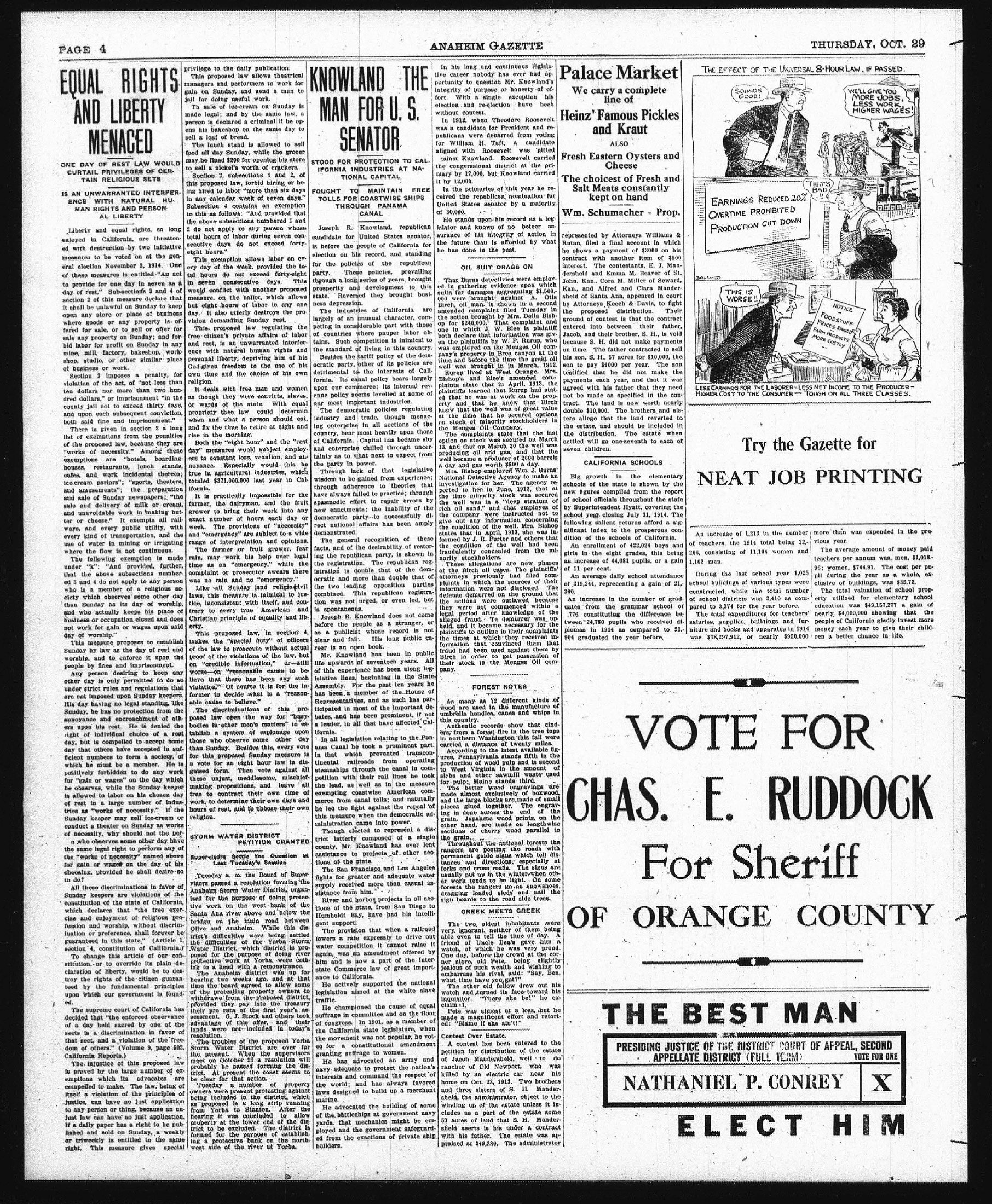
Searchable text
EQUAL RIGHTS AND LIBERTY MENACED
ONE DAY OF REST LAW WOULD CURTAIL PRIVILEGES OF CERTAIN RELIGIOUS SETS
IS AN UNWARRANTED INTERFENCE WITH NATURAL HUMAN RIGHTS AND PERSONAL LIBERTY
Liberty and equal rights, so long enjoyed in California, are threatened with destruction by two initiative measures to be voted on at the general election November 3, 1914. One of these measures is entitled "An act to provide for one day in seven as a day of rest." Sub-sections 3 and 4 of section 2 of this measure declare that it shall be unlawful on Sunday to keep open any store or place of business where goods or any property is offered for sale, or to sell or offer for sale any property on Sunday; and forbid labor for profit on Sunday in any mine, mill, factory, bakeshop, workshop, studio, or other similar place of business or work.
Section 3 imposes a penalty, for violation of the act, of "not less than ten dollars nor more than two hundred dollars," or imprisonment "in the county jail not to exceed thirty days, and upon each subsequent conviction, both said fine and imprisonment."
There is given in section 2 a long list of exemptions from the penalties of the proposed law, because they are privilege to the daily publication.
This proposed law allows theatrical managers and performers to work for gain on Sunday, and send a man to jail for doing useful work.
The sale of ice-cream on Sunday is made legal; and by the same law, a person is declared a criminal if he opens his bakeshop on the same day to sell a loaf of bread.
The lunch stand is allowed to sell food all day Sunday, while the grocer may be fined $200 for opening his store to sell a nickel's worth of crackers.
Section 2, subsections 1 and 2, of this proposed law, forbid hiring or being hired to labor "more than six days in any calendar week of seven days." Subsection 4 contains an exemption to this as follows: "And provided that the above subsections numbered 1 and 2 do not apply to any person whose total hours of labor during seven consecutive days do not exceed forty-eight hours."
This exemption allows labor on every day of the week, provided the total hours do not exceed forty-eight in seven consecutive days. This would conflict with another proposed measure, on the ballot, which allows but eight hours of labor in any one day. It also utterly destroys the provision demanding Sunday rest.
This proposed law regulating the free citizen's private affairs of labor and rest, is an unwarranted interference with natural human rights and personal liberty, depriving him of his God-given freedom to the use of his own time and the choice of his own religion.
It deals with free men and women as though they were convicts, slaves, or wards of the state. With equal propriety the law could determine when and what a person should eat, and fix the time to retire at night and rise in the morning.
Both the "eight hour" and the "rest hour" measures would subject employ
Section 3 imposes a penalty, for violation of the act, of "not less than ten dollars nor more than two hundred dollars," or imprisonment "in the county jail not to exceed thirty days, and upon each subsequent conviction, both said fine and imprisonment."
There is given in section 2 a long list of exemptions from the penalties of the proposed law, because they are "works of necessity." Among these exemptions are "hotels, boarding-houses, restaurants, lunch stands, cafes, and work incidental thereto; ice-cream parlors"; "sports, theaters, and amusements"; the preparation and sale of Sunday newspapers; "the sale and delivery of milk or cream, and unavoidable work in making butter or cheese." It exempts all railways, and every public utility, with every kind of transportation, and the use of water in mining or irrigating where the flow is not continuous.
The following exemption is made under "k": "And provided, further, that the above subsections numbered 3 and 4 do not apply to any person who is a member of a religious society which observes some other day than Sunday as its day of worship, and who actually keeps his place of business or occupation closed and does not work for gain or wages upon said day of worship."
This measure proposes to establish Sunday by law as the day of rest and worship, and to enforce it upon the people by fines and imprisonment.
Any person desiring to keep any other day is only permitted to do so under strict rules and regulations that are not imposed upon Sunday keeper. His day having no legal standing, like Sunday, he has no protection from the annoyance and encroachment of others upon his rest. He is denied the right of individual choice of a rest day, but is compelled to accept some day that others have accepted in sufficient numbers to form a society, of which he must be a member. He is positively forbidden to do any work for "gain or wages" on the day which he observes, while the Sunday keeper is allowed to labor on his chosen day of rest in a large number of industries as "works of necessity." If the Sunday keeper may sell ice-cream or conduct a theater on Sunday as works of necessity, why should not the per-who observes some other day have the same legal right to perform any of personal liberty, depriving him of his God-given freedom to the use of his own time and the choice of his own religion.
It deals with free men and women as though they were convicts, slaves, or wards of the state. With equal propriety the law could determine when and what a person should eat, and fix the time to retire at night and rise in the morning.
Both the "eight hour" and the "rest day" measures would subject employers to constant loss, vexation, and annoyance. Especially would this be true in agricultural industries, which totaled $371,000,000 last year in California.
It is practically impossible for the farmer, the dairyman, and the fruit grower to bring their work into any exact number of hours each day or week. The provisions of "necessity" and "emergency" are subject to a wide range of interpretation and opinions.
The farmer or fruit grower, fear rain, may work his help over legal time as an "emergency," while the complaint or prosecutor swears there was no rain and no "emergency."
Like all Sunday land religio-civil laws, this measure is inimical to justice, inconsistent with itself, and contrary to every true American and Christian principle of equality and liberty.
This proposed law, in section 4, makes the "special duty" of officers of the law to prosecute without actual proof of the violations of the law, but on "credible information," or—still worse—on "reasonable cause to believe that there has been any such violation." Of course it is for the informer to decide what is a "reasonable cause to believe."
The discriminations of this proposed law open the way for "busy-bodies in other men's matters" to establish a system of esplonage upon those who observe some other day than Sunday. Besides this, every vote for this proposed Sunday measure is a vote for an eight hour law in disguised form. Then vote against all these unjust, meddlesome, mischief-making propositions, and leave all free to contract their own time of work, to determine their own days and hours of rest, and to choose their own religion.
Besides the tariffocratic party, other detrimental to the fornia. Its canal upon our commerce enue policy seems our most important.
The democratic industry and training enterprise in country, bear most of California. Cap and enterprise chanty as to what the party in power through lack of wisdom to be gained through adherence have always failed spasmodic effort new enactments; democratic party direct national affairs demonstrated.
The general refracts, and of the doing the republican registration. Istration is double ocratic and moreover the two leading combined. This intention was not urge is spontaneous.
Joseph R. Knowl before the people as a publicist ww clear and fair. reer is an open b Mr. Knowlland life upwards of six of this experience isislative lines, beg Assembly. For this has been a memb Representatives, adicipated in most bates, and has been a leader, in all tha ifornia.
In all legislation ama Canal he took in that which i tinental railroad steamships through petition with their lead, as well exempting coastwise merce from canal he led the fight she this measure when ministration came.
Though elected trict latterly con county, Mr. Knowl
STORM WATER DISTRICT
PETITION GRANTED
Supervisors Settle the Question at Last Tuesday's Session
Tuesday a.m. the Board of Supervisors passed a resolution forming the Anaheim Storm Water District, organized for the purpose of doing protective work on the west bank of the Santa Ana river above and below the bridge on the main road between Olive and Anaheim. While this district's difficulties were being settled the difficulties of the Yorba Storm Water District, which district is proposed for the purpose of doing river protective work at Yorba, were coming to a head with a remonstrance.
The Anaheim district was up for hearing two weeks ago, and at that time the board agreed to allow some of the protesting property owners to withdraw from the proposed district, provided they pay into the treasury their pro rata of the first year's assessment. G.J. Stock and others took advantage of this offer, and their lands were not included in today's resolution.
The troubles of the proposed Yorba Storm Water District are over for the present. When the supervisors meet on October 27 a resolution will probably be passed forming the district. At present the coast seems to be clear for that action.
Tuesday a number of property owners were present protesting against being included in the district, which as proposed is a long strip running from Yorba to Stanton. After the hearing it was concluded to allow property at the lower end of the district to be excluded. The district is formed for the purpose of establishing a protective bank on the northwest side of the river at Yorba.
Though elected district latterly com county, Mr. Know assistance to provisions of the state.
The San Francisco rights for greater supply received noistance from him.
River and harbours of the state Humboldt Bay, in gent support.
The provision lowers a rate ex water competition again, was an am him and is now state Commerce law to California.
He actively sued legislation aimed traffic.
He championed suffrage in community of congress. In I the California state movement waived for a constituting suffrage.
He has advocated navy adequate to interests and come the world; and laws designed to marine.
He advocated to of the battleships yards, that mech ployed and the geo ed from the exact builders.
KNOWLAND THE MAN FOR U.S. SENATOR
STOOD FOR PROTECTION TO CALIFORNIA INDUSTRIES AT NATIONAL CAPITAL
FOUGHT TO MAINTAIN FREE TOLLS FOR COASTWISE SHIPS THROUGH PANAMA CANAL
Joseph R. Knowland, republican candidate for United States senator, is before the people of California for election on his record, and standing for the policies of the republican party. These policies, prevailing through a long series of years, brought prosperity and development to this state. Reversed they brought business depression.
The industries of California are largely of an unusual character, competing in considerable part with those of countries where pauper labor obtains. Such competition is inimical to the standard of living in this country.
Besides the tariff policy of the democratic party, other of its policies are detrimental to the interests of California. Its canal policy bears largely upon our commerce; its internal revenue policy seems levelled at some of our most important industries.
The democratic policies regulating industry and trade, though menacing enterprise in all sections of the country, bear most heavily upon those of California. Capital has became shy and enterprise chilled through uncer-
In his long and continuous legislative career nobody has ever had opportunity to question Mr. Knowland's integrity of purpose or honesty of effort. With a single exception his election and re-election have been without contest.
In 1912, when Theodore Roosevelt was a candidate for President and republicans were debarred from voting for William H. Taft, a candidate aligned with Roosevelt was pitted against Knowland. Roosevelt carried the congerssional district at the primary by 17,000, but Knowland carried it by 12,000.
In the primaries of this year he received the republican nomination for United States senator by a majority of 30,000.
He stands upon his record as a legislator and known of no beteeer assurance of his integrity of action in the future than is afforded by what he has done in the past.
OIL SUIT DRAGS ON
That Burns detectives were employed in gathering evidence upon which suits for damages aggregating $1,500,000 were brought against A. Otis Birch, oil man. Is shown in a second amended complaint filed Tuesday in the action brought by Mrs. Della Bishop for $240,000. That complaint and one in which J. W. Blee is plaintiff both declare that information was given the plaintiffs by W. F. Rurup, who was employed on the Menges Oil company’s property in Brea canyon at the time and before the time the great oil well was brought in in March, 1912.
Rurup lived at West Orange. Mrs. Bishop’s and Blee’s amended complaints state that in April, 1913, the plaintiffs learned that Rurup had stated that he was at work on the property and that he knew that Birch knew that the well was of great value at the time that he secured options on stock of minority stockholders in the Menges Oil Company.
The complaints state that the last option on stock was secured on March 13, and that on March 20 the well was represented by Attorneys Williams & Rutan, filed a final account in which he shows a payment of $3000 on his contract with another item of $500 interest. The contestants, E. J. Mandersheld and Emma M. Beaver of St. John, Kan., Cora M. Miller of Seward, Kan., and Alfred and Clara Mander-sheid of Santa Ana, appeared in court by Attorneys Keech & Davis, to fight the proposed distribution. Their ground of contest is that the contract entered into between their father, Jacob, and their brother, S. H., is void because S. H. did not make payments on time. The father contracted to sell his son, S. H., 57 acres for $10,000, the son to pay $1000 per year. The son testified that he did not make the payments each year, and that it was agreed with his father that they need not be made as specified in the contract. The land is now worth nearly double $10,000. The brothers and sisters allege that the land reverted to the estate, and should be included in the distribution. The estate when settled will go one-seventh to each of seven children.
Besides the tariff policy of the democratic party, other of its policies are detrimental to the interests of California. Its canal policy bears largely upon our commerce; its internal revenue policy seems levelled at some of our most important industries.
The democratic policies regulating industry and trade, though menacing enterprise in all sections of the country, bear most heavily upon those of California. Capital has became shy and enterprise chilled through uncertainty as to what next to expect from the party in power.
Through lack of that legislative wisdom to be gained from experience; through adherence to theories that have always failed to practice; through spasmodic effort to repair errors by new enactments; the inability of the democratic party to successfully direct national affairs has been amply demonstrated.
The general recognition of these facts, and of the desirability of restoring the republican party, is shown in the registration. The republican registration is double that of the democratic and more than double that of the two leading opposition parties combined. This republican registration was not urged, or even led, but is spontaneous.
Joseph R. Knowland does not come before the people as a stranger, or as a publicist whose record is not clear and fair. His long public career is an open book.
Mr. Knowland has been in public life upwards of seventeen years. All of this experience has been along legislative lines, beginning in the State Assembly. For the past ten years he has been a member of the House of Representatives, and as such has participated in most of the important debates, and has been prominent, if not a leader, in all that have affected California.
In all legislation relating to the Panama Canal he took a prominent part in that which prevented transcontinental railroads from operating steamships through the canal in competition with their rail lines he took the lead, as well as in the measure exempting coastwise American commerce from canal tolls; and naturally he led the fight against the repeal of this measure when the democratic administration came into power.
Though elected to represent a district latterly composed of a single county, Mr. Knowland has ever lent his property in Brea canyon at the time and before the time the great oil well was brought in in March, 1912.
Rurup lived at West Orange. Mrs. Bishop's and Blee's amended complaints state that in April, 1913, the plaintiffs learned that Rurup had stated that he was at work on the property and that he knew that Birch knew that the well was of great value at the time that he secured options on stock of minority stockholders in the Menges Oil Company.
The complaints state that the last option on stock was secured on March 13, and that on March 20 the well was producing oil and gas, and that the well became a producer of 2600 barrels a day and gas worth $500 a day.
Mrs. Bishop employed Wm. J. Burns' National Detective Agency to make an investigation for her. The agency reported to her in June, 1912, that at the time minority stock was secured the well was in a "deep stratum of rich oil sand," and that employees of the company were instructed not to give out any information concerning the condition of the well. Mrs. Bishop states that in April, 1913, she was informed by J. R. Porter and others that the condition of the well had been fraudulently concealed from the minority stockholders.
These allegations are new phases of the Birch oil cases. The plaintiffs attorneys previously had filed complaints in which the sources of their information were not disclosed. The defense demurred on the ground that the actions were outlawed because they were not commenced within a legal period after knowledge of the alleged fraud. Te demurrer was upheld, and it became necessary for the plaintiffs to outline in their complaints the times at which they received information that convinced them that fraud had been used against them by Birch in order to get possession of their stock in the Menges Oil company.
FOREST NOTES
As many as 72 different kinds of wood are used in the manufacture of umbrella handles, canes and whips in this country.
Authentic records show that cinders, from a forest fire in the tree tops in northern Washington this fall were carried a distance of twenty miles.
According to the latest available figures, Pennsylvania stands fifth in the production of wood pulp and is second to West Virginia in the amount of slabs and other sawmill waste used for pulp; Maine stands third.
The better wood engravings are made almost exclusively of boxwood, and the large blocks are made of small pieces glued together. The engraving is done across the end of the grain. Japanese wood prints, on the other hand, are made on lengthwise sections of cherry wood parallel to the grain.
Throughout the national forests the rangers are posting the roads with his son, S. H., 57 acres for $10,000, the son to pay $1000 per year. The son testified that he did not make the payments each year, and that it was agreed with his father that they need not be made as specified in the contract. The land is now worth nearly double $10,000. The brothers and sisters allege that the land reverted to the estate, and should be included in the distribution. The estate when settled will go one-seventh to each of seven children.
CALIFORNIA SCHOOLS
Big growth in the elementary schools of the state is shown by the new figures compiled from the report of school officials throughout the state by Superintendent Hyatt, covering the school year closing July 31, 1914. The following salient returns afford a significant index to the prosperous condition of the schools of California.
An enrollment of 422,024 boys and girls in the eight grades, this being an increase of 44,081 pupils, or a gain of 11 per cent.
An average daily school attendance of 319,244, reprecenting a gain of 21,-360.
An increase in the number of graduates from the grammar school of 777 constituting the difference between 24,780 pupils who received diplomas in 1914 as compared to 21,-904 graduated the year before.
tinental railroads from operating steamships through the canal in competition with their rail lines he took the lead, as well as in the measure exempting coastwise American commerce from canal tolls; and naturally he led the fight against the repeal of this measure when the democratic administration came into power.
Though elected to represent a district latterly composed of a single county, Mr. Knowland has ever lent assistance to projects of other sections of the state.
The San Francisco and Los Angeles fights for greater and adequate water supply received more than casual assistance from him.
River and harbor projects in all sections of the state, from San Diego to Humboldt Bay, have had his intelligent support.
The provision that when a railroad lowers a rate expressly to drive out water competition it cannot raise it again, was an amendment offered by him and is now a part of the Interstate Commerce law of great importance to California.
He actively supported the national legislation aimed at the white slave traffic.
He championed the cause of equal suffrage in committee and on the floor of congress. In 1901, as a member of the California state legislature, when the movement was not popular, he voted for a constitutional amendment granting suffrage to women.
He has advocated an army and navy adequate to protect the nation's interests and command the respect of the world; and has always favored laws designed to build up a merchant marine.
He advocated the building of some of the battleships at government navy yards, that mechanics might be employed and the government safeguarded from the exactions of private ship builders.
Pennsylvania stands fifth in the production of wood pulp and is second to West Virginia in the amount of slabs and other sawmill waste used for pulp; Maine stands third.
The better wood engravings are made almost exclusively of boxwood, and the large blocks are made of small pieces glued together. The engraving is done across-the-end of the grain. Japanese wood prints, on the other hand, are made on lengthwise sections of cherry wood parallel to the grain.
Throughout the national forests the rangers are posting the roads with permanent guide signs which tell distances and directions, especially at forks and cross roads. The signs are usually put up in the winter-when other work tends to be light. On some forests the rangers go on snowshoes, dragging loaded sleds and nail the sign boards to the road side trees.
GREEK MEETS GREEK
The two oldest inhabitants were very ignorant, neither of them being able even to tell the time of day. A friend of Uncle Ben's gave him a watch, of which he was very proud. One day, before the crowd at the corner store, old Pete, being slightly jealous of such wealth and wishing to embarrass his rival, said: "Say, Ben, what time have you got?"
The other old fellow drew out his watch and turned its face toward his inquisitor. "There she be!" he exclaimed.
Pete was almost at a loss, but he made a magnificent effort and retorted: "Blame if she ain't!"
Contest Over Estate.
A contest has been entered to the petition for distribution of the estate of Jacob Mandersheld, well to do rancher of Old Newport, who was killed by an electric car near his home on Oct. 23, 1913. Two brothers and three sisters of S. H. Mandersheld, the administrator, object to the winding up of the estate unless it includes as a part of the estate some 57 acres of land that S. H. Mandersheld asserts is his under a contract with his father. The estate was appraised at $49,380. The administrator
THURSDAY, OCT. 29
THE EFFECT OF THE UNIVERSAL 8-HOUR LAW, IF PASSED.
SOUNDS GOOD!
WE'LL GIVE YOU MORE JOBS,
LESS WORK,
HIGHER WAGES!
EARNINGS REDUCED 20%
OVERTIME PROHIBITED
PRODUCTION CUT DOWN
THAT'S BAD !!
THIS IS WORSE !!
NOTICE
FOODSTUFF
PRICES RAISED
FARM PRODUCTS
MORE COSTLY
LESS EARNINGS FOR THE LABORER - LESS NET INCOME TO THE PRODUCER -
HIGHER COST TO THE CONSUMER — TOUGH ON ALL THREE CLASSES.
Try the Gazette for
NEAT JOB PRINTING
An increase of 1,213 in the number
of teachers, the 1914 total being 12,
266, consisting of 11,104 women and
1,162 men.
During the last school year 1,025
school buildings of various types were
constructed, while the total number
of school districts was 3,410 as compared to 3,374 for the year before.
The total expenditures for teachers' salaries, supplies, buildings and furniture and books and apparatus in 1914 was $18,297,912, or nearly $950,000 more than was expended in the previous year.
The average amount of money paid
teachers per annum was, men, $1,018.96; women, $744.91. The cost per pupil during the year as a whole, exclusive of buildings, was $35.72.
The total valuation of school property utilized for elementary school education was $49,157,277 a gain of nearly $4,000,000 showing that the people of California gladly invest more money each year to give their children a better chance in life.
VOTE FOR
AS. E. RUDDOCK
AS. E. RUDDOCK
For Sheriff
ORANGE COUNTY
HE BEST MAN
RESIDING JUSTICE OF THE DISTRICT COURT OF APPEAL, SECOND
APPELLATE DISTRICT (FULL TERM)
VOTE FOR ONE
NATHANIEL P. CONREY X
ELECT HIM