anaheim-gazette 1914-10-15
Scanned page
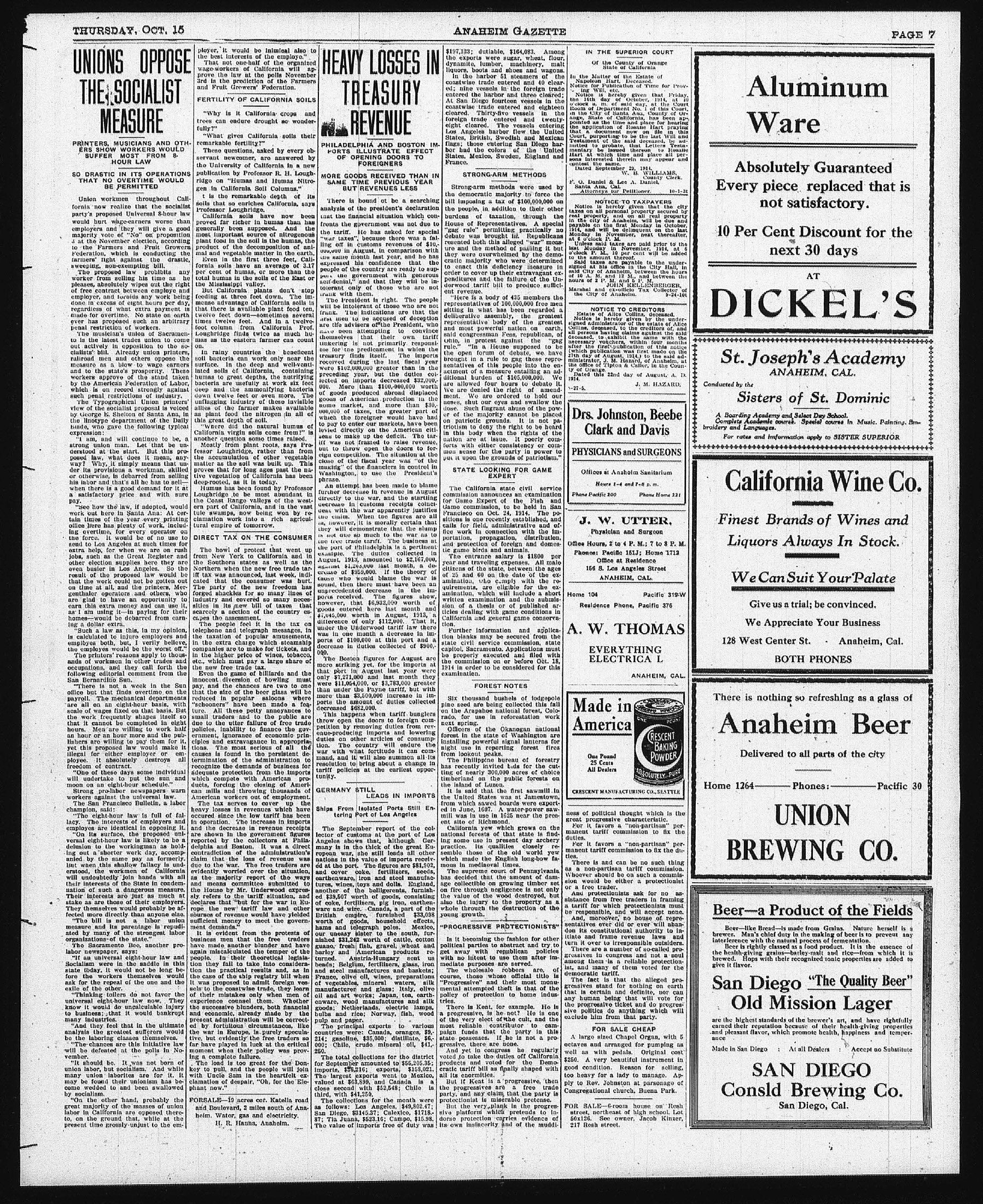
Searchable text
UNIONS OPPOSE THE SOCIALIST MEASURE
PRINTERS, MUSICIANS AND OTHER SHOW WORKERS WOULD SUFFER MOST FROM 8-HOUR LAW
SO DRASTIC IN ITS OPERATIONS THAT NO OVERTIME WOULD BE PERMITTED
Union workmen throughout California now realize that the socialist party's proposed Universal 8-hour law would hurt wage earners worse than employers and they will give a good majority vote of "No" on proposition 3 at the November election, according to the Farmers and Fruit Growers Federation, which is conducting the farmers' fight against the drastic, sweeping, non-exempting bill.
The proposed law prohibits any worker from selling his time as he pleases, absolutely wipes out the right of free contract between employee and employer, and forbids any work being done in excess of eight hours per day, regardless of what extra payment is made for overtime. No state on earth ever has proposed such an arbitrary penal restriction of workers.
The musician's union of Sacramento is the latest trades union to come out actively in opposition to the socialists' bill. Already union printers, railroad men and others oppose the measure as a blow to wage earners and to the state's prosperity. These workers approve of the stand taken by the American Federation of Labor, which is on record strongly against such penal restrictions of industry.
The Typographical Union printers' view of the socialist proposal is voiced by George E. Sholton of Santa Ana, in the linotype department of the Daily Bunge, who gave the following typical expression:
"I am, and will continue to be, a strong union man. Let that be unployer, it would be inimical also to the best interests of the employe."
That not one-half of the organized wage-workers of California will approve the law at the polls November 3rd is the prediction of the Farmers and Fruit Growers' Federation.
FERTILITY OF CALIFORNIA SOILS
"Why is it California crops and trees can endure drought so wonderfully?"
"What gives California soils their remarkable fertility?"
These questions, asked by every observant newcomer, are answered by the University of California in a new publication by Professor R. H. Loughridge on "Humas and Humas Nitrogen in California Soil Columns."
It is the remarkable depth of its soils that so enriches California, says Professor Loughridge.
California soils have now been proved far richer in humus than has generally been supposed. And the most important source of nitrogenous plant food in the soil is the humus, the product of the decomposition of animal and vegetable matter in the earth.
Even in the first three feet, California soils have an average of 3.17 per cent of humus, or more than the total humus in the soils of the East or the Mississippi valley.
But California plants don't stop feeding at three feet down. The immense advantage of California soils is that there is available plant food ten, twelve feet down—sometimes several times twelve feet. And in a twelve-foot column from California Prof. Loughridge finds twice as much humus as the eastern farmer can count on.
In rainy countries the beneficent soil bacteria can work only near the surface. In the deep and well-ventilated soils of California, containing humus to great depths, the nutrifying bacteria are usefully at work six feet deep and the ammonifying bacteria down twelve feet or even more. The unflagging industry of these invisible allies of the farmer makes available as plant food the nitrogen in all of this great depth of soil.
"Where did the natural humus of California virgin soils come from?" is another question some times raised.
Mostly from plant roots, says ProPHILADELPHIA PORTS ILLINOIS OF OPEN FOR MORE GOODS SAME TIME BUT RE
railroad men and others oppose the measure as a blow to wage earners and to the state's prosperity. These workers approve of the stand taken by the American Federation of Labor, which is on record strongly against such penal restrictions of industry.
The Typographical Union printers' view of the socialist proposal is voiced by George E. Sholton of Santa Ana, in the linotype department of the Daily trade, who gave the following typical expression:
"I am, and will continue to be, a strong union man. Let that be understood at the start. But this proposed law, what does it mean, anyway? Why, it simply means that under its provisions a workman, skilled or otherwise, is debarred from selling his labor and that's all he has to sell—when there is a good demand for it at a satisfactory price and with sure pay.
"See how the law, if adopted, would work out here in Santa Ana: At certain times of the year every printing office here has plenty of work, including overtime, for every operator on the force. It would be of no use to send to Los Angeles at such times for extra help, for when we are on rush jobs, such as the Great Register and other election supplies here they are even busier in Los Angeles. So the result of the proposed law would be that the work could not be gotten out on time at all, and the printers, Mergenthaler operators and others, who are glad to have an opportunity to earn this extra money and can use it, as I am using it—in paying for their homes—would be debarred from earning a dollar extra.
"Such a law as this, in my opinion, is calculated to injure employers and employees both, but I verily believe, the employees would be the worst off."
The printers' reasons apply to thousands of workmen in other trades and occupations, and they call forth the following editorial comment from the San Bernardino Sun.
"There is not a week in the Sun office but that finds overtime on the payroll. The mechanical departments are all on an eight-hour basis, with scale of wages fixed on that basis. But the work frequently shapes itself so that it cannot be completed in eight hours. Men are willing to work half an hour or an hour more and the publishers are willing to pay them for it, yet this proposed law would make it illegal for either employer or employee. It absolutely destroys all freedom of contract.
"One of these days some individual will undertake to put the sun and moon on an eight-hour schedule."
Strong pro-labor newspapers warn workers against the universal law.
The San Francisco Bulletin, a labor champion, said:
"The eight-hour law is full of fallacy. The interests of employers and employees are identical in opposing it.
"On its surface, the proposed universal eight-hour law is likely to be a delusion to the workingman as hold-railroad men and others oppose the measure as a blow to wage earners and to the state's prosperity. These workers approve of the stand taken by the American Federation of Labor, which is on record strongly against such penal restrictions of industry.
The Typographical Union printers' view of the socialist proposal is voiced by George E. Sholton of Santa Ana, in the linotype department of the Daily trade, who gave the following typical expression:
"I am, and will continue to be, a strong union man. Let that be understood at the start. But this proposed law, what does it mean, anyway? Why, it simply means that under its provisions a workman, skilled or otherwise, is debarred from selling his labor and that's all he has to sell—when there is a good demand for it at a satisfactory price and with sure pay.
"See how the law, if adopted, would work out here in Santa Ana: At certain times of the year every printing office here has plenty of work, including overtime, for every operator on the force. It would be of no use to send to Los Angeles at such times for extra help, for when we are on rush jobs, such as the Great Register and other election supplies here they are even busier in Los Angeles. So the result of the proposed law would be that the work could not be gotten out on time at all, and the printers, Mergenthaler operators and others, who are glad to have an opportunity to earn this extra money and can use it, as I am using it—in paying for their homes—would be debarred from earning a dollar extra.
"Such a law as this, in my opinion, is calculated to injure employers and employees both, but I verily believe, the employees would be the worst off."
The printers' reasons apply to thousands of workmen in other trades and occupations, and they call forth the following editorial comment from the San Bernardino Sun.
"There is not a week in the Sun office but that finds overtime on the payroll. The mechanical departments are all on an eight-hour basis, with scale of wages fixed on that basis. But the work frequently shapes itself so that it cannot be completed in eight hours. Men are willing to work half an hour or an hour more and the publishers are willing to pay them for it, yet this proposed law would make it illegal for either employer or employee. It absolutely destroys all freedom of contract.
"One of these days some individual will undertake to put the sun and moon on an eight-hour schedule."
Strong pro-labor newspapers warn workers against the universal law.
The San Francisco Bulletin, a labor champion, said:
"The eight-hour law is full of fallacy. The interests of employers and employees are identical in opposing it.
"On its surface, the proposed universal eight-hour law is likely to be a delusion to the workingman as hold-railroad men and others oppose the measure as a blow to wage earners and to the state's prosperity. These workers approve of the stand taken by the American Federation of Labor, which is on record strongly against such penal restrictions of industry.
The Typographical Union printers' view of the socialist proposal is voiced by George E. Sholton of Santa Ana, in the linotype department of the Daily trade, who gave the following typical expression:
"I am, and will continue to be, a strong union man. Let that be understood at the start. But this proposed law, what does it mean, anyway? Why, it simply means that under its provisions a workman, skilled or otherwise, is debarred from selling his labor and that's all he has to sell—when there is a good demand for it at a satisfactory price and with sure pay.
"See how the law, if adopted, would work out here in Santa Ana: At certain times of the year every printing office here has plenty of work, including overtime, for every operator on the force. It would be of no use to send to Los Angeles at such times for extra help, for when we are on rush jobs, such as the Great Register and other election supplies here they are even busier in Los Angeles. So the result of the proposed law would be that the work could not be gotten out on time at all, and the printers, Mergenthaler operators and others, who are glad to have an opportunity to earn this extra money and can use it, as I am using it—in paying for their homes—would be debarred from earning a dollar extra.
"Such a law as this, in my opinion, is calculated to injure employers and employees both, but I verily believe, the employees would be the worst off."
The printers' reasons apply to thousands of workmen in other trades and occupations, and they call forth the following editorial comment from the San Bernardino Sun.
"There is not a week in the Sun office but that finds overtime on the payroll. The mechanical departments are all on an eight-hour basis, with scale of wages fixed on that basis. But the work frequently shapes itself so that it cannot be completed in eight hours. Men are willing to work half an hour or an hour more and the publishers are willing to pay them for it, yet this proposed law would make it illegal for either employer or employee. It absolutely destroys all freedom of contract.
"One of these days some individual will undertake to put the sun and moon on an eight-hour schedule."
Strong pro-labor newspapers warn workers against the universal law.
The San Francisco Bulletin, a labor champion, said:
"The eight-hour law is full of fallacy. The interests of employers and employees are identical in opposing it.
"On its surface, the proposed universal eight-hour law is likely to be a delusion to the workingman as hold-railroad men and others oppose the measure as a blow to wage earners and to the state's prosperity. These workers approve of the stand taken by the American Federation of Labor, which is on record strongly against such penal restrictions of industry.
The Typographical Union printers' view of the socialist proposal is voiced by George E. Sholton of Santa Ana, in the linotype department of the Daily trade, who gave the following typical expression:
"I am, and will continue to be, a strong union man. Let that be understood at the start. But this proposed law, what does it mean, anyway? Why, it simply means that under its provisions a workman, skilled or otherwise, is debarred from selling his labor and that's all he has to sell—when there is a good demand for it at a satisfactory price and with sure pay.
"See how the law, if adopted, would work out here in Santa Ana: At certain times of the year every printing office here has plenty of work, including overtime for every operator on the force. It would be of no use to send to Los Angeles at such times for extra help, for when we are on rush jobs, such as the Great Register and other election supplies here they are even busier in Los Angeles. So the result of the proposed law would be that the work could not be gotten out on time at all, and the printers, Mergenthaler operators and others who are glad to have an opportunity to earn this extra money and can use it, as I am using it—in paying for their homes—would be debarred from earning a dollar extra.
"Such a law as this, in my opinion, is calculated to injure employers and employees both,但我不会因为这些原因而放弃我的工作。我会继续努力,争取在未来几年中取得更多的成功。
"Strong pro-labor newspapers warn workers against the universal law."
The San Francisco Bulletin, a labor champion,
said:
"The eight-hour law is full of fallacy. The interests of employers and employees are identical in opposing it.
"On its surface,the proposed universal eight-hour law is likely to be a delusion to the workingman as hold-railroad men和others oppose的 measure as a blow to wage earners和tothestate's prosperity."
The Typographical Union printers' view of the socialist proposal is voiced by George E. Sholton of Santa Ana,in the linotype department of the Daily trade,who gave the following typical expression:
"I am,and will continue to be,a strong union man. Let that be understood at the start. But this proposed law,what does it mean,anyway?Why,it simply means that under its provisions a workman,skilled or otherwise,is debarred from selling his labor和that all he has to sell—when there is a good demand for它at a satisfactory priceandwithsurepay."
The printers' reasons apply to thousands of workmen in other trades and occupations,and they call forth the following editorial comment from the San Bernardino Sun.
"There is not a week in the Sun office but that finds overtime on the payroll.The mechanical departments are all on an eight-hour basis,with scale of wages fixed on that basis.Buttheworkfrequentlyshapesitselfsothatitcannotbecompletedineighthours.Menarewillingtoworkhalfanhororanhourmoreandthepublishersarewillingtowayfortheityetthisproposedlawwouldmakeitillegalforeitheremployeroremployee.Itsabsolutelydestroysallfreedomofcontract."
"The oneofthesedayssomeindividualwillundertaketoputthesunandmoononaneight-hourschedule."
Strong pro-labor newspapers warn workers against the universal law.
The San Francisco Bulletin,a labor champion,
said:
"The八小时lawisfulloffallacy.Theinterestsofemployersandemployeesareidenticalinopposingit."
The Typographical Union printers' view of the socialist proposal is voiced by George E. Sholton of Santa Ana,in the linotype department of the Daily trade,who gave the following typical expression:
"I am,and will continue to be,a strong union man.Let that be understood atthestart.Butthisproposedlawwhatdoesitmean,anyway?"
It absolutely destroys all freedom of contract.
"One of these days some individual will undertake to put the sun and moon on an eight-hour schedule."
Strong pro-labor newspapers warn workers against the universal law.
The San Francisco Bulletin, a labor champion, said:
"The eight-hour law is full of fallacy. The interests of employers and employees are identical in opposing it.
"On its surface, the proposed universal eight-hour law is likely to be a delusion to the workingman as holding out a shorter work day, accompanied by the same pay as formerly. But when this shallow fallacy is understood, the workmen of California will undoubtedly join hands with all their interests of the State in condemnation of such a dangerous measure. Their interests are just as much at stake as are those of their employers. They themselves would probably be affected more directly than anyone else."
"The bill is not a labor union measure and its parentage is repudiated by many of the strongest labor organizations of the state."
The Sacramento Bee, another pro-labor newspaper, says:
"If an universal eight-hour law and Socialism were in the saddle in this state today, it would not be long before the workers themselves would ask for the repeal of the one and the exile of the other.
"Thinking tollers do not favor the universal eight-hour law now. They know it would do uncalculable injury to business; that it would bankrupt many industries."
"And they feel that in the ultimate analysis the greatest sufferers would be the laboring classes themselves."
"The chances are this initiative law will be defeated at the polls in November."
"It should be. It was not born of union labor, but socialism. And while many union laborites are for it, it may be found their unionism has become wedded to and been swallowed by socialism.
"On the other hand, probably the great majority of the masses of union labor in California are opposed thereto, on the ground that, while at the present time grossly unjust to the em-
FORSALE—19 acres cor. Katella road and Boulevard, 2 miles south of Anaheim. Water, gas and electricity.
H. R. Hanna, Anaheim."
HEAVY LOSSES IN TREASURY REVENUE
PHILADELPHIA AND BOSTON IMPORTS ILLUSTRATE EFFECT OF OPENING DOORS TO FOREIGNERS
MORE GOODS RECEIVED THAN IN SAME TIME PREVIOUS YEAR BUT REVENUES LESS
There is bound to be a searching analysis of the president's declaration that the financial situation which confronts the government was not due to the tariff. He has asked for special "war taxes", because there was a falling in customs revenues of $10,000,000 in August, in comparison with one month last year, and he has expressed his confidence that the people of the country are ready to support the government with generous self-denial," and that they will be tolerant only of those who are not trunk with them.
The President is right. The people will be intolerant of those who are not frank. The indications are that the aristocrats are the advisers of the President, who have been attempting to convince themselves that their own tariff unkering is not primarily responsible for the predicament in which the treasury finds itself. The imports received during the last fiscal year were $102,000,000 greater than in the preceding year, but the duties collected on imports decreased $32,000,000. More than $100,000,000 worth of goods produced abroad displaced goods of American production in the home market, and more than $30,000,000 of taxes, the greater part of which the foreigner would have had to pay to enter our markets, have been levied directly on the American citizens to make up the deficit. The tariff was not framed to raise revenue, but to throw open the doors for $197,133; dutiable, $164,083. Among the exports were sugar, wheat, flour, dynamite, lumber, machinery, malt liquors, boots and shoes and wagons.
In the harbor 51 steamers of the coastwise trade entered and 40 cleared; nine vessels in the foreign trade entered the harbor and three cleared; At San Diego fourteen vessels in the coastwise trade entered and eighteen cleared. Thirty-five vessels in the foreign trade entered and twenty-eight cleared. The vessels entering Los Angeles harbor flew the United States, British, Swedish and Mexican flags; those entering San Diego harbor had the colors of the United States, Mexico, Sweden, England and France.
STRONG-ARM METHODS
Strong-arm methods were used by the democratic majority to force the bill imposing a tax of $100,000,000 on the people, in addition to their other burdens of taxation, through the House of Representatives. A special "gag rule" permitting practically no debate was brought in. Republicans resented both this alleged "war" measure and the method of passing it but they were overwhelmed by the democratic majority who were determined to enact this deficiency measure in order to cover up their extravagant expenditures and the failure of the Underwood tariff bill to produce sufficient revenue.
"Here is a body of 435 members the representatives of 100,000,000 free men sitting in what has been regarded a deliberative assembly, the greatest representative body of the greatest and most powerful nation on earth, said congressman Fess, republican of Ohio, in protest against the "gag rule." "In a house supposed to be the open forum of debate, we have brought in a rule to gag these representatives of this people into the enactment of a measure entailing an additional burden of $105,000,000. We are allowed four hours to debate it. We are denied the right of amendment. We are ordered to hold our noses, shut our eyes and swallow the dose. Such flagrant abuse of the power of the majority cannot be placed on patriotic grounds. It is not patriotism to deny the right to be heard in this body when the rights of the nation are at issue. It poorly comforts with either consistency or comIN THE SUPERIOR COURT
Of the County of Orange State of California
In the Matter of the Estate of Napoleon Hart, Deceased.
Notice for Publication of Time for Providence is hereby given that Friday,
Notice is hereby given that Friday,
at 16 o'clock a.m., m. of said day, at the Court Room of Department No. 1 of this Court,
at the City of Santa Ana, County of Orlando,
State of California has been appointed as the time and place for hearing the application of Rosine Hart praying that a document now on file in this Court, purporting to be the last Will and Testament of the said deceased, be admitted to probate, that Letters Testamentary are issued thereon to Rosine Hart at which time and place all persons interested therein may appear and contest the same.
Dated September 29, 1914.
W. H. WILLIAMS,
County Clerk.
F. O. Daniel & Lee A. Daniel,
Santa Ana, Cal.
Attorneys for Pettitioner.
NOTICE TO TAXPAYERS
Notice is hereby given that the city taxes on all personal property secured by real property, and on all real property in the city of Anahiem, will be due and payment of the said taxes in October, 1914, and will be delimited for each Monday in November, next thereafter,
at 6 o'clock P.M.
Unless said taxes are paid prior to the best Monday in November, 1914, at 6 o'clock P.M., cent will be added to the amount thereof.
Said taxes are payable to the undersigned at his office in the City Hall, in said City of Anahiem, between the hours of 10 A.M. and 12 M., and between the hours of 2 P.M. and 4 P.M.
JOIN KELLENBERGER,
Marshal and ex-officio Tax Collector of the City of Anahiem.
NOTICE TO CREDITORS
Estate of Alice Collins, deceased.
Notice is hereby given by the undersigned administrator of the estate of Alice Collins, deceased, to the creditors of, and as persons having claims against the said deceased as necessary vouchers within four months after the first publication of this notice (which publication was first made on the 27th day of August, 1914) to the said administrator, J. M. Hazard, of Anahiem, at the office of Ripton & Callor, in the County of Orange.
Dated this 22nd day of August, A. D. 1914.
J. M. HAZARD,
Drs. Johnston, Beebe Clark and Davis
near the well-ventilated stratifying six feet bacteria are. The invisible available in all of musus of room" is raised. Days Prevail in vegetable p. This naissance has been professor dant in the west, the vast by reaigricultural SUMER event up and in the trade tariff, indisputable hurt. Dom has lines of necessities that country estax on pages, in elements, manship sets, and tobacco share of the must to one will be where a feaeces to multicare are trade the governic prin-propriasis will the present deiont to success for imports on Ameri-lands of payment, the have been imports receipts figures Phila-direct
GERMANY STILL LEADS IN IMPORTS
Ships From Isolated Ports Still Entering Port of Los Angeles
The September report of the collector of customs at the port of Los Angeles shows that, although Germany is in the thick of the great Eu-ness of political thought which is the great progressive characteristic.
For it favors a "non-partisan" permanent tariff commission to fix the duties.
For it favors a "non-partisan" permanent tariff commission to fix the du-
GERMANY STILL LEADS IN IMPORTS
Ships From Isolated Ports Still Entering Port of Los Angeles
The September report of the collector of customs at the port of Los Angeles shows that, although Germany is in the thick of the great European war, she still loads all other nations in the value of imports received at the port. The figures are $81,902 and cover coke, fertilizers, seeds, earthenware, iron and steel manufactures, wines, toys and dolls. England, another of the belligerents, furnished $35,507 worth of goods, consisting of coke, fertilizers, pig iron, earthenware and wire. Canada, a part of the British empire, furnished $33,098 worth of goods, household effects, hams and telegraph poles. Mexico, our uneasy alister to the south, furnished $31,242 worth of cattle, cotton guano, fresh fish, gravel, wheat and barley and American products returned. Austria-Hungary sent us beads; Belgium, fertilizers, glass, iron and steel manufactures and baskets; France, olive oil, wines, preparations of vegetables, mineral waters, silk manufacturer and glass; Italy, olive oil and art works; Japan, tea, earthware, wood manufactures and silk goods; Netherlands, electric lamps, bulbs and rice; Norway, fish, wood pulp and paper.
The principal exports to various countries were: Canada, oranges, $9.214; gasoline, $35,000; distillate, $6.000; Chile, crude mineral oil, $41.250.
The total collections for the district for September amounted to $55,205.35; imports, $36,216; exports, $158,021. The largest exports went to Mexico, valued at $65,899, and Canada is a close second with $52,548. Chile is third, with $41,250.
The collections for the month were as follows: Los Angeles, $49,802.47; San Diego, $314.37; Calexico, $171.87; Tia Juana, $523.16; Campo, $15.98. The value of imports free of duty was
The Philippine bureau of forestry has recently invited bids for the cutting of nearly 300,000 acres of choice timberland on the public forests on the island of Luzon.
It is said that the first sawmill in the United States was at Jamestown, from which sawdots were exported in June. 1607. A water-power sawmill was in use in 1625 near the present site of Richmond.
California yew which grows on the national forests of that state is finding some use in present day archery practice. Its qualities closely resemble those of the old world yew which made the English long-bow famous in mediaeval times.
The supreme court of Pennsylvania has decided that the amount of damage collectible on growing timber set on fire through negligence is not only the value of the wood destroyed, but also the injury to the property as a whole through the destruction of the young growth.
"PROGRESSIVE PROTECTIONISTS"
Is it becoming the fashion for other political parties to abstract and try to get away with republican policies with no intent to use them after immediate purposes are served.
The wholesale robbers are, of course, those whose official title is "Progressive" and their most monumental attempted theft is that of the policy of protection to home industries.
There is Kent, for example. He is a progressive, is he not? He is one of the very elect of the cult, and the most reliable contributor to campaign funds that the party in this state possesses. If he is not a progressive, there are none.
And yet in congress he regularly voted to take the duties off California products and voted for the Democratic tariff bill as finally shaped with all its enormities.
But if Kent is a progressive, then the progressives are a free trade party, and any claim that the party is protectionist is miserable pretense.
But the very plank in the progressive platform which pretends to indorse protection carries evidence of its own insincerity and of the muddi-
ness of political thought which is the great progressive characteristic.
For it favors a "non-partisan" permanent tariff commission to fix the duties.
For it favors a "non-partisan" permanent tariff commission to fix the duties.
There is and can be no such thing as a non-partisan tariff commission. Whoever should be on such a commission would be either a protectionist or a free trader.
And protectionists ask for no assistance from free traders in framing a tariff for which protectionists must be responsible, and will accept none.
And moreover, no house of representatives ever did or ever will abandon its constitutional authority to initiate and frame revenue laws and turn it over to irresponsible outsiders.
There are a number of so-called progressives in congress and not a soul among them is a reliable protectionist, and many of them voted for the democratic tariff.
The fact is that the alleged progressives stand for nothing on earth that is certain and definite, nor can any human being that will vote for the progressive ticket and do progressive politics do anything which will exclude him from that party.
FOR SALE CHEAP
A large sized Chapel Organ, with 5 octaves and arranged for pumping as well as with pedals. Original cost $250. A very beautiful instrument in good condition. Reason for selling too heavy for a lady to manage. Apply to Rev. Johnston at parsonage of Congregational church, Buena Park.
FOR SALE—G-room house on Resh street, northeast of high school. Lot 50x126. See owner, Jacob Kinzer, 217 Resh street.
SUPERIOR COURT
County of Orange
of California
of the Estate of
St. Deceased.
ocation of Time for Provence.
rely given that Friday,
of October, 1914, at 10
said day, at the Court
ment No. 1 of this Court,
Santa Ana, County of OrCalifornia, has been aptime and place for hearing
of Rosanne Hart praying
not now on file in this
going to be the last Will and
he said deceased, be addate, that Letters Testimed thereon to Rosaine
time and place all perthereln may appear and
e.
October 29, 1914.
W. B. WILLIAMS,
County Clerk.
Lee A. Daniel,
L.
Pettitioner.
10-1-31
TO TAXPAYERS
by given that the city
onal property secured by
and on all real property
naheim, will be due and
first Monday in October,
be delinquent on the last
member, next thereafter,
d.
xes are paid prior to the
November, 1914, at 6
per cent will be added
thereof.
payable to the underlice in the City Hall, in
naheim, between the hours
12 M. and between the
and 5 P.M.
IN KELLENBERGER,
officio Tax Collector of
naheim.
9-24-101
TO CREDITORS
ce Collins, deceased.
by given by the underrator of the estate of Alice
to the creditors of, and
claims against the said
with the same with the
terms, within four months.
publication of this notice
was first made on the
last, 1914.) to the said adhazard, of Annaheim, at
ton & Callor, in the Coundial day of August, A. D.
J. M. HAZARD,
nston, Beebe
and Davis
Aluminum
Ware
Absolutely Guaranteed
Every piece replaced that is not satisfactory.
10 Per Cent Discount for the next 30 days
AT
DICKEL'S
St. Joseph’s Academy
ANAHEIM, CAL.
Conducted by the
Sisters of St. Dominic
A Boarding Academy and Select Day School.
Complete Academic course. Special courses in Music, Painting, Embroidery and Languages.
For rates and information apply to SISTER SUPERIOR
St. Joseph's Academy
ANAHEIM, CAL.
Conducted by the
Sisters of St. Dominic
A Boarding Academy and Select Day School.
Complete Academic course. Special courses in Music, Painting, Embroidery and Languages.
For rates and information apply to SISTER SUPERIOR
California Wine Co.
Finest Brands of Wines and
Liquors Always In Stock.
We Can Suit Your Palate
Give us a trial; be convinced.
We Appreciate Your Business
128 West Center St. Anaheim, Cal.
BOTH PHONES
There is nothing so refreshing as a glass of
Anaheim Beer
Delivered to all parts of the city
Home 1264 Phones: Pacific 30
UNION
BREWING CO.
Home 1264——Phones:——Pacific 30
UNION
BREWING CO.
Beer—a Product of the Fields
Beer—like Bread—is made from Grains. Nature herself is a brewer. Man's chief duty in the making of beer is to prevent any interference with the natural process of fermentation.
Beer is rightly classed as a food product. It is the essence of the health-giving grains—barley-malt and rice—from which it is brewed. Hops with their recognized tonic properties are added to give it flavor.
San Diego "The Quality Beer"
Old Mission Lager
are the highest standards of the brewer's art, and have rightfully earned their reputation because of their health-giving properties and pleasant flavor, which promote health, happiness and temperance.
Made in San Diego : At all Dealers : Accept no Substitute
SAN DIEGO
Consld Brewing Co.
San Diego, Cal.