anaheim-gazette 1914-09-17
Scanned page
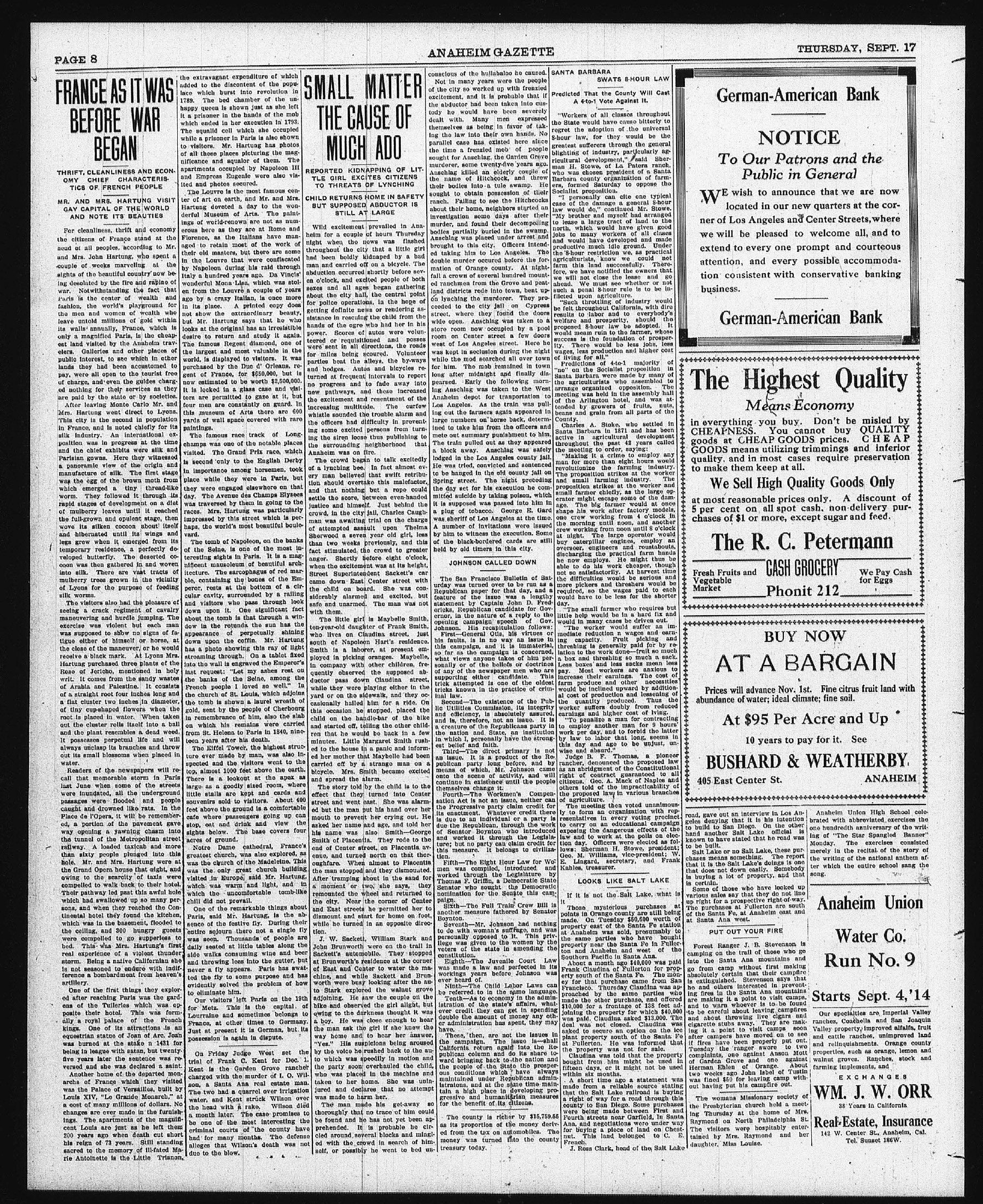
Searchable text
FRANCE AS IT WAS BEFORE WAR BEGAN
THRIFT, CLEANLINESS AND ECONOMY CHIEF CHARACTERISTICS OF FRENCH PEOPLE
MR. AND MRS. HARTUNG VISIT GAY CAPITAL OF THE WORLD AND NOTE ITS BEAUTIES
For cleanliness, thrift and economy the citizens of France stand at the head of all peoples, according to Mr. and Mrs. John Hartung, who spent a couple of weeks marveling at the sights of the beautiful country now being desolated by the fire and rapine of war. Notwithstanding the fact that Paris is the center of wealth and fashion, the world's playground for the men and women of wealth who leave untold millions of gold within its walls annually, France, which is only a magnified Paris, is the cheapest land visited by the Annaheim travelers. Galleries and other places of public interest, to see which in other lands they had been accustomed to pay, were all open to the tourist free of charge, and even the guides charged nothing for their services as they are paid by the state or by societies.
After leaving Monte Carlo Mr. and Mrs. Hartung went direct to Lyons. This city is the second in population in France, and is noted chiefly for its silk industry. An international exhibition was in progress at the time the extravagant expenditure of which added to the discontent of the populace which burst into revolution in 1789. The bed chamber of the unhappy queen is shown just as she left it a prisoner in the hands of the mob which ended in her execution in 1793. The squalfold cell which she occupied while a prisoner In Paris is also shown to visitors. Mr. Hartung has photos of all these places picturing the magnificence and squalor of them. The apartments occupied by Napoleon III and Empress Eugenie were also visited and photos secured.
The Louvre is the most famous center of art on earth, and Mr. and Mrs. Hartung devoted a day to the wonderful Museum of Arts. The paintings of world-renown are not as numerous here as they are at Rome and Florence, as the Italians have managed to retain most of the work of their old masters, but there are some in the Louvre that were confiscated by Napoleon during his raid through Italy a hundred years ago. Da Vinci's wonderful Mona-Lisa, which was stolen from the Louvre a couple of years ago by a crazy Italian, is once more in its place. A printed copy does not show the extraordinary beauty, but Mr. Hartung says that he looks at the original has an irresistible desire to return and study it again. The famous Regent diamond, one of the largest and most valuable in the world, is displayed to visitors. It was purchased by the Duc d'Orléans, regent of France, for $650,000, but is now estimated to be worth $2,500,000. It is locked in a glass case and visitors are permitted to gaze at it, but four men are constantly on guard. In this museum of Arts there are 600 yards of wall space covered with rare paintings.
The famous race track of Long-champs was one of the notable places Wild excitement helm for a couple night when the m throughout the city had been boldly man and carried off abduction occurred en o'clock, and exe sexes and all ages about the city hall for police operation getting definite newistance in rescuing hands of the ogre power. Scores of teered or requisitioned were sent in all days for miles being spartles beat the air and hedges. Auto turned at frequent no progress and new pathways, and the excitement and increasing multitude whistle sounded thru the officers had doing some excited ing the siren loosened the surrounding r
public interest, to see which in other lands they had been accustomed to pay, were all open to the tourist free of charge, and even the guildes charged nothing for their services as they are paid by the state or by societies.
After leaving Monte Carlo Mr. and Mrs. Hartung went direct to Lyons. This city is the second in population in France, and is noted chiefly for its silk industry. An international exposition was in progress at the time and the chief exhibits were silk and Parisian gowns. Here they witnessed a panoramic view of the origin and manufacture of silk. The first stage was the egg of the brown moth from which emerged a tiny thread-like worm. They followed it through its rapid stages of development on a diet of mulberry leaves until it reached the full-grown and opulent stage, then wove its silken cocoon about itself and hibernated until its wings and legs grow when it emerged from its temporary residence, a perfectly developed butterfly. The deserted cooon was then gathered in and woven into silk. There are vast tracts of mulberry trees grown in the vicinity of Lyons for the purpose of feeding silk worms.
The visitors also had the pleasure of seeing a crack regiment of cavalry maneuvering and hurdle jumping. The exercise was violent but each man was supposed to shuw no signs of fatigue either of himself or horse, at the close of the maneuver, or he would receive a black mark. At Lyons Mrs. Hartung purchased three plants of the Rose of Jericho, mentioned in holy writ. It comes from the sandy wastes of Arabia and Palestine. It consists of a straight root four inches long and a flat cluster two inches in diameter, of tiny cup-shaped flowers when the root is placed in water. When taken out the cluster rolls itself into a ball and the plant resembles a dead weed. It possesses perpetual life and will always uncleap its branches and throw out its small blossoms when placed in water.
Readers of the newspapers will recall that memorable storm in Paris last June when some of the streets were inundated, all the underground passages were flooded and people caught and drowned like rats. In the Place de l'Opera, it will be remembered, a portion of the pavement gave way opening a yawning chasm into the tunnel of the Metropolitan railway. A loaded taxicab and more world, is displayed to visitors. It was purchased by the Duc d'Orleans, regent of France, for $650,000, but is now estimated to be worth $2,500,000. It is locked in a glass case and visitors are permitted to gaze at it, but four men are constantly on guard. In this museum of Arts there are 600 yards of wall space covered with rare paintings.
The famous race track of Long-champs was one of the notable places visited. The Grand Prix race, which is second only to the English Derby in importance among horsesmen, took place while they were in Paris, but they were engaged elsewhere on that day. The Avenue des Champs Elysees was traversed by them in going to the races. Mrs. Hartung was particularly impressed by this street which is perhaps, the world's most beautiful boulevard.
The tomb of Napoleon, on the banks of the Seine, is one of the most interesting sights in Paris. It is a magnificent mausoleum of beautiful architecture. The sarcophagus of red marble, containing the bones of the Emperor, rests at the bottom of a circular cavity, surrounded by a railing and visitors who pass through look down upon it. One significant fact about the tomb is that through a window in the rotunda the sun has the appearance of perpetually shining down upon the coffin. Mr. Hartung has a photo showing this ray of light streaming through. On a tablet fixed into the wall is engraved the Emperor's last request: "Let my ashes rest on the banks of the Seine, among the French people I loved so well." In the church of St. Louis, which adjoins the tomb is shown a laurel wreath of gold, sent by the people of Cherbourg in remembrance of him, also the slab on which his remains were carried from St. Helena to Paris in 1840, nineteen years after his death.
The Elfel Tower, the highest structure ever made by man, was also inspected and the visitors went to the top, almost 1000 feet above the earth. There is a lookout at the apex as large as a goodly sized room, where little stalls are kept and cards and souvenirs sold to visitors. About 400 feet above the ground is a comfortable cafe where passengers going up can stop, eat and drink and view the sights below. The base covers four acres of ground.
Notre Dame cathedral, France's world, is displayed to visitors. It was purchased by the Duc d'Orleans, regent of France, for $650,000, but is now estimated to be worth $2,500,000. It is locked in a glass case and visitors are permitted to gaze at it, but four men are constantly on guard. In this museum of Arts there are 600 yards of wall space covered with rare paintings.
The famous race track of Long-champs was one of the notable places visited. The Grand Prix race, which is second only to the English Derby in importance among horsesmen, took place while they were in Paris, but they were engaged elsewhere on that day. The Avenue des Champs Elysees was traversed by them in going to the races. Mrs. Hartung was particularly impressed by this street which is perhaps, the world's most beautiful boulevard.
The tomb of Napoleon, on the banks of the Seine, is one of the most interesting sights in Paris. It is a magnificent mausoleum of beautiful architecture. The sarcophagus of red marble, containing the bones of the Emperor, rests at the bottom of a circular cavity, surrounded by a railing and visitors who pass through look down upon it. One significant fact about the tomb is that through a window in the rotunda the sun has the appearance of perpetually shining down upon the coffin. Mr. Hartung has a photo showing this ray of light streaming through. On a tablet fixed into the wall is engraved the Emperor's last request: "Let my ashes rest on the banks of the Seine, among the French people I loved so well." In the church of St. Louis, which adjoins the tomb is shown a laurel wreath of gold, sent by the people of Cherbourg in remembrance of him, also the slab on which his remains were carried from St. Helena to Paris in 1840, nineteen years after his death.
The Elfel Tower, the highest structure ever made by man, was also inspected and the visitors went to the top, almost 1000 feet above the earth. There is a lookout at the apex as large as a goodly sized room, where little stalls are kept and cards and souvenirs sold to visitors. About 400 feet above the ground is a comfortable cafe where passengers going up can stop, eat and drink and view the sights below. The base covers four acres of ground.
Notre Dame cathedral, France's world, is displayed to visitors. It was purchased by the Duc d'Orleans, regent of France, for $650,000, but is now estimated to be worth $2,500,000. It is locked in a glass case and visitors are permitted to gaze at it, but four men are constantly on guard. In this museum of Arts there are 600 yards of wall space covered with rare paintings.
The famous race track of Long-champs was one of the notable places visited. The Grand Prix race, which is second only to the English Derby in importance among horsesmen, took place while they were in Paris, but they were engaged elsewhere on that day. The Avenue des Champs Elysees was traversed by them in going to the races. Mrs. Hartung was particularly impressed by this street which is perhaps, the world's most beautiful boulevard.
The tomb of Napoleon, on the banks of the Seine, is one of the most interesting sights in Paris. It is a magnificent mausoleum of beautiful architecture. The sarcophagus of red marble, containing the bones of the Emperor, rests at the bottom of a circular cavity, surrounded by a railing and visitors who pass through look down upon it. One significant fact about the tomb is that through a window in the rotunda the sun has the appearance of perpetually shining down upon the coffin. Mr. Hartung has a photo showing this ray of light streaming through. On a tablet fixed into the wall is engraved the Emperor's last request: "Let my ashes rest on the banks of the Seine, among the French people I loved so well." In the church of St. Louis, which adjoins the tomb is shown a laurel wreath of gold, sent by the people of Cherbourg in remembrance of him, also the slab on which his remains were carried from St. Helena to Paris in 1840, nineteen years after his death.
The Elfel Tower, the highest structure ever made by man, was also inspected and the visitors went to the top, almost 1000 feet above the earth. There is a lookout at the apex as large as a goodly sized room, where little stalls are kept and cards and souvenirs sold to visitors. About 400 feet above the ground is a comfortable cafe where passengers going up can stop, eat and drink and view the sights below. The base covers four acres of ground.
Notre Dame cathedral, France's world, is displayed to visitors. It was purchased by the Duc d'Orleans, regent of France, for $650,000, but is now estimated to be worth $2,500,000. It is locked in a glass case and visitors are permitted to gaze at it, but four men are constantly on guard. In this museum of Arts there are 600 yards of wall space covered with rare paintings.
The famous race track of Long-champs was one of the notable places visited. The Grand Prix race, which is second only to the English Derby in importance among horsesmen, took place while they were in Paris, but they were engaged elsewhere on that day. The Avenue des Champs Elysees was traversed by them in going to the races. Mrs. Hartung was particularly impressed by this street which is perhaps, the world's most beautiful boulevard.
The tomb of Napoleon, on the banks of the Seine, is one of the most interesting sights in Paris. It is a magnificent mausoleum of beautiful architecture. The sarcophagus of red marble, containing the bones of the Emperor, rests at the bottom of a circular cavity, surrounded by a railing and visitors who pass through look down upon it. One significant fact about the tomb is that through a window in the rotunda the sun has the appearance of perpetually shining down upon the coffin. Mr. Hartung has a photo showing this ray of light streaming through. On a tablet fixed into the wall is engraved the Emperor's last request: "Let my ashes rest onthe banksoftheSeineamonghorsemen,toketheplacewhiletheywereinpariswherepereydovertaandjustnothingsettledthescorebejusticeandhimselfcrowd,inthecitymanwasawaitingoffattemptedassaultSherwoodaseveralthantwoweekspracticedstimulatedtheranger.shortlywhentheexcitementStreetSuperintendentcamedownEastchildsonbosidseriderablyalarmedsafeandunarmedwiththem.
The little girl ten-year-old daughter who lives on Clarence south of Napoleon Smith is a labor played in pickling in company with quietly observed ductor pass down while they were piled yard or on she sidason halted off; telen that he would minutes.Little MEdited tothehouseincedhermotherthancarriedoffbya bicycle.Mrs.Sm spreadandtheair
The story told effect that they fleet街和went past butthemanprounttopreventaskeredhnameandhisnamewasaSmithofPlacentilendofCenterstright
Readers of the newspapers will recall that memorable storm in Paris last June when some of the streets were inundated, all the underground passages were flooded and people caught and drowned like rats. In the Place de l'Opera, it will be remembered, a portion of the pavement gave way opening a yawning chasm into the tunnel of the Metropolitan street railway. A loaded taxi cab and more than sixty people plunged into this hole. Mr. and Mrs. Hartung were at the Grand Opera house that night, and owing to the scarcity of taxis were compelled to walk back to their hotel. Their pathway led past this awful hole which had swallowed up so many persons, and when they reached the Continental hotel they found the kitchen, which was in the basement, flooded to the ceiling, and 300 hungry guests were compelled to go supperless to bed. This was Mrs. Hartung's first real experience of a violent thunderstorm. Being a native Californian she is not seasoned to endure with indifference a bombardment from heaven's artillery.
One of the first things they explored after reaching Paris was the gardens of the Tulleries which was opposite their hotel. This was formally a royal palace of the French kings. One of its attractions is an equestrian statue of Joan of Arc. Joan was burned at the stake n 1431 for being in league with satan, but twenty-five years later the sentence was reversed and she was declared a saint.
Another home of the departed monarchs of France which they visited was the Palace of Versailles, built by Louis XIV, "Le Grande Monarch," at a cost of many millions of dollars. No changes are ever made in the furnishings. The apartments of the magnificent Louls are just as he left them 200 years ago when death cut short his reign of 73 years. Still standing sacred to the memory of ill-fated Marie Antolnette is the Little Trianon,
On Friday Judge West set the trial of Frank C. Kent for Dec. 1. Kent is the Garden Grove rancher charged with the murder of I. O. Wilson, a Santa Ana real estate man. The two had a quarrel over irrigation water, and Kent struck Wilson over the head with a rake. Wilson died a month later. The case promises to be one of the most interesting the criminal courts of the county have had for many months. The defense alleges that Wilson's death was not due to the blow.
The story told effect that they street and went ed but the man p mouth to prevent asked her name ad his name was a Smith of Placentil end of Center strenuo, and turned oughtfare. When the man stopped After tramping at a moment or two remounted the wi city. Near t and East streets dismount and sta while he turned adition.
J. W. Sackett, John Brunworth, Sackett's autom at Brunworth's re of East and Centhine, and whille worth were busy to Stark explore adjoining. He sa bike and observe owing to the dar a boy. He was the man ask tha way home and "Yes." His susp by the voice he r to which was sp e party soon c who was placed taken to her ho jured and decla was made to har
The man mad thoroughly that he be found and he prehended. It cled around seved with the cross self, or possibly
SMALL MATTER THE CAUSE OF MUCH ADO
REPORTED KIDNAPPING OF LITTLE GIRL EXCITES CITIZENS TO THREATS OF LYNCHING
CHILD RETURNS HOME IN SAFETY BUT SUPPOSED ABDUCTOR IS STILL AT LARGE
Wild excitement prevailed in Anaheim for a couple of hours Thursday night when the news was flashed throughout the city that a little girl had been boldly kidnapped by a bad man and carried off on a bicycle. The abduction occurred shortly before seven o'clock, and excited people of both sexes and all ages began gathering about the city hall, the central point for police operations, in the hope of getting definite news or rendering assistance in rescuing the child from the hands of the ogre who had her in his power. Scores of autos were volunteered or requisitioned and posses were sent in all directions, the roads for miles being scoured. Volunteer parties beat the alleys, the by-ways and hedges. Autos and bicycles returned at frequent intervals to report no progress and to fade away into new pathways, and these increased the excitement and resentment of the increasing multitude. The curfew whistle sounded the trouble alarm and the officers had difficulty in preventing some excited persons from turning the siren loose thus publishing to the surrounding neighborhood that conscious of the hullabaloo he caused.
Not in many years were the people of the city so worked up with frenzied excitement, and it is probable that if the abductor had been taken into custody he would have been severely dealt with. Many men expressed themselves as being in favor of taking the law into their own hands. No parallel case has existed here since the time a frenzied mob of people sought for Anschlag, the Garden Grove murderer, some twenty-five years ago. Anschlag killed an elderly couple of the name of Hitchcock, and threw their bodies into a tule swamp. He sought to obtain possession of their ranch. Falling to see the Hitchcocks about their home, neighbors started an investigation some days after their murder, and found their decomposing bodies partially buried in the swamp. Anschlag was placed under arrest and brought to this city. Officers intended taking him to Los Angeles. The double murder occurred before the formation of Orange county. At nightfall a crown of several hundred mounted ranchmen from the Grove and pentland districts rode into town, bent upon lynching the murderer. They proceeded to the city jail on Cypress street, where they found the doors wide open. Anschlag was taken to a store room now occupied by a pool room on Center street a few doors west of Los Angeles street. Here he was kept in seclusion during the night while the mod searched all over town for him. The mob remained in town long after midnight and finally disappeared. Early the following morning Anschlag was taken to the West Anaheim depot for transportation to Los Angeles. As the train was pulling out the farmers again appeared in large numbers on horse back, determined to take him from the officers and mete out summary punishment to him. The train pulled out as they appeared.
SANTA BARBARA
SWATS 8-HOUR LAW
Predicted That the County Will Cast A 4-to-1 Vote Against It.
"Workers of all classes throughout the State would have cause bitterly to regret the adoption of the universal 8-hour law, for they would be the greatest sufferers through the general blighting of industry, particularly agricultural development," said Sherman H. Stowe, of La Patera ranch, who was chosen president of a Santa Barbara county organization of farmers, formed Saturday to oppose the Socialist proposition.
"I personally cite one typical case of the damage a general 8-hour law would do," continued Mr. Stowe. "My brother and myself had arranged to lease a large tract of land to the north, which would have given good jobs to many workers of all classes and would have developed and made productive much idle ground. Under the 8-hour restriction we, as practical agriculturists, know we could not farm this land successfully. Therefore, we have notified the owners that we will not close the lease and go ahead. We must see whether or not such a penal 8-hour rule is to be inflicted upon agriculture."
"Such throttling of industry would be felt throughout California, with dire results to labor and to everybody's welfare and prosperity, should the proposed 8-hour law be adopted. It would mean ruin to the farmer, whose success is the foundation of prosperity. There would be less jobs, less wages, less production and higher cost of living for all."
Predictions of 4-to-1 majority of "no" on the Socialist proposition in Santa Barbara were made by many of the agriculturists who assembled to arrange organized opposition. The meeting was held in the assembly hall of the Arlington hotel, and was attended by growers of fruits, nuts, beans and grain from all parts of the County.
Charles A. Stoke, who settled in Santa Barbara in 1871 and has been active in agricultural development throughout the past 42 years called
for miles being secured, Volunteer parties beat the alleys, by-bay walks and hedges. Autos and bicycles returned at frequent intervals to report no progress and to fade away into new pathways, and these increased the excitement and resentment of the increasing multitude. The curfew whistle sounded the trouble alarm and the officers had difficulty in preventing some excited persons from turning the siren loose thus publishing to the surrounding neighborhood that Anaheim was on fire.
The crowd began to talk excitedly of a lynching bee. In fact almost every man believed that swift retribution should overtake this malefactor, and that nothing but a rope could settle the score, between even-handed justice and himself. Just behind the crowd, in the city jail, Charles Caughman was awaiting trial on the charge of attempted assault upon Thelma Sherwood a seven year old girl, less than two weeks previously, and this fact stimulated the crowd to greater anger. Shortly before eight o'clock, when the excitement was at its height, Street Superintendent Sackett's car came down East Center street with the child on board. She was considerably alarmed and excited, but safe and unarmed. The man was not with them.
The little girl is Maybelle Smith, ten-year-old daughter of Frank Smith, who lives on Claudia street, just south of Napoleon Hart's residence. Smith is a laborer, at present employed in pickling oranges. Maybelle, in company with other children, frequently observed the supposed abductor pass down Claudia street, while they were playing either in the yard or on the sidewalk, and they occasionally hailed him for a ride. On this occasion he stopped, placed the child on the handle-bar of the bike and started off, telling the other children that he would be back in a few minutes. Little Margaret Smith rushed to the house in a panic and informed her mother that Maybelle had been carried off by a strange man on a bicycle. Mrs. Smith became excited and spread the alarm.
The story told by the child is to the effect that they turned into Center street and went east. She was alarmed but the man put his hand over her mouth to prevent her crying out. He asked her name and age, and told her his name was also Smith—George Smith of Placentia. They rode to the end of Center street, on Placentia availance.
The San Francisco Bulletin of Saturday was turned over to be run as a Republican paper for that day, and a feature of the issue was a lengthy statement by Captain John D. Fredericks, Republican candidate for Governor, in the nature of a reply to the opening campaign speech of Gov. Johnson. His recapitulation follows:
First—General Otis, his virtues or his faults, is in no way an issue in this campaign, and it is immaterial, so far as the campaign is concerned, what views anyone takes of him personally or of the bellows or doctrines of any of the newspaper men who are supporting either candidate. This trick attempted is one of the oldest tricks known in the practice of criminal law.
Second—The existence of the Public Utilities Commission, its integrity and efficiency, is absolutely assured, and is therefore, not an issue. It is a creature of the Republicans party in the nation and State, an institution in which I personally have the strongest belief and faith.
Third—The direct primary is not an issue. It is a product of the Republican party long before, and by means of which, Mr. Johnson came onto the scene of activity, and will continue in existence until the people themselves change it.
Fourth—The Workmen's Compensation Act is not an issue, neither can the Progressive party claim credit for its enactment. Whatever credit there is due to an individual or a party is due the Republican, through the work of Senator Boynton who introduced and worked it through the Legislature; but no party can claim credit for this measure. It belongs to civilization while the mod searched all over town for him. The mob remained in town long after midnight and finally disappeared. Early the following morning Anschlag was taken to the West Anaheim depot for transportation to Los Angeles. As the train was pulling out the farmers again appeared in large numbers on horseback, determined to take him from the officers and mete out summary punishment to him. The train pulled out as they appeared a block away. Anschlag was safely lodged in the Los Angeles county jail. He was tried, convicted and sentenced to be hanged in the old county jail on Spring street. The night preceding the day set for his execution he committed suicide by taking poison, which it is supposed was passed into him in a plug of tobacco. George E. Gard was sheriff of Los Angeles at the time. A number of invitations were issued by him to witness the execution. Some of the black-bordered cards are still held by old timers in this city.
JOHNSON CALLED DOWN
The worker would suffer an immediate reduction in wages and earning capacity. Fruit picking and threshing is generally paid for by relation to the work done—fruit so much a box and threshing so much a sack. Less boxes and less sacks mean less pay. Most workers are anxious to increase their earnings. The cost of farm produce and other necessities would be inclined upward by additional cost of production and lessening of the quantity produced. Thus the worker suffers doubly from reduced earnings and higher cost of living.
To penalize a man for contracting to employ another man for 9 hours' work per day, and to forbid the latter by law to labor that long, seems in this day and age to be unjust, unwise and absurd."
Judge B. F. Thomas, a pioneer rancher, denounced the proposed law as an abridgment of the Constitutional right of contract guaranteed to all citizens. Geo. A. Mack of Naples and others told of the impracticability of the proposed law in various branches of agriculture.
The meeting then voted unanimously to form an organization with representatives in every voting precinct to carry on an educational campaign exposing the dangerous effects of the law and to work at the polls on election day. Officers were elected as follows: Sherman H. Stowe, president...
her mother that Maybellie had been carried off by a strange man on a bicycle. Mrs. Smith became excited and spread the alarm.
The story told by the child is to the effect that they turned into Center street and went east. She was alarmed but the man put his hand over her mouth to prevent her crying out. He asked her name and age, and told her his name was also Smith—George Smith of Placentia. They rode to the end of Center street, on Placentia avenue, and turned north on that thoroughfare. When almost to Placentia the man stopped and they dismouted. After tramping about in the sand for a moment or two, she says, they remounted the wheel and returned to the city. Near the corner of Center and East streets he permitted her to dismount and start for home on foot, while he turned in an opposite direction.
J. W. Sackett, William Stark and John Brunworth were on the trail in Sackett's automobile. They stopped at Brunworth's residence at the corner of East and Center to water the machine, and while Sackett and Brunworth were busy looking after the auto-Stark explored the walnut grove adjoining. He saw the couple on the bike and observed the girl alight, but owing to the darkness thought it was a boy. He was close enough to hear the man ask the girl if she knew the way home and to hear her answer, "Yes." His suspicions being aroused by the voice he rushed back to the auto which was speedily in motion and the party soon overhaulied the child, who was placed in the machine and taken to her home. She was uninjured and declares that no attempt was made to harm her.
The man made his get-away so thoroughly that no trace of him could be found and he has not yet been apprehended. It is probable he circled around several blocks and mingled with the crowd in search of himself, or possibly he went to bed unan issue. It is a product of the Re-publican party long before, and by means of which, Mr. Johnson came onto the scene of activity, and will continue in existence until the people themselves change it.
Fourth—The Workmen's Compensation Act is not an issue, neither can the Progressive party claim credit for its enactment. Whatever credit there is due to an individual or a party is due the Republican, through the work of Senator Boynton who introduced and worked it through the Legislature; but no party can claim credit for this measure. It belongs to civilization.
Fifth—The Elght Hour Law for Women was compiled, introduced and worked through the Legislature by Thomas F. Griffin, a Democratic State Senator who sought the Democratic nomination for the Senate this campaign.
Sixth—The Full Train Crew Bill is another measure fathered by Senator Boynton.
Seventh—Mr. Johnson had nothing to do with woman's suffrage, and was personally opposed to it. This privilege was given to the women by the voters of the state in amending the constitution.
Eighth—The Juvenile Court Law was made a law and perfected in its workings years before Johnson was ever heard of.
Ninth—The Child Labor Laws can be referred to in the same language.
Tenth—As to economy in the administration of the state's affairs, whatever credit they can get in spending double the amount of money any other administration has spent, they may have.
These, then, are not the issues in the campaign. The issue is—shall California return again into the Republican column and do its share toward bringing back to the nation and the people of the State the prosperous conditions which have always maintained under Republican administrations, and at the same time maintain a high place in developing progressive and humanitarian measures for the benefit of its citizens.
The county is richer by $15,759.55 as its proportion of the money derived from the tax on automobiles. The money was turned into the county treasury today.
J. Ross Clark, head of the Salt Lake Judge B. F. Thomas, a pioneer rancher, denounced the proposed law as an abridgment of the Constitutional right of contract guaranteed to all citizens. Geo. A. Mack of Naples and others told of the impracticability of the proposed law in various branches of agriculture.
The meeting then voted unanimously to form an organization with representatives in every voting precinct to carry on an educational campaign exposing the dangerous effects of the law and to work at the polls on election day. Officers were elected as follows: Sherman H. Stowe, president; Geo. M. Williams, vice-president; W. E. Lingard, secretary, and Frank Kahles, treasurer.
LOOKS LIKE SALT LAKE
If it is not the Salt Lake, what is it?
Those mysterious purchases at points in Orange county are still being made. On Tuesday $50,600 worth of property east of the Santa Fe station at Anaheim was sold, presumably to the same parties who have bought property near the Santa Fe in Fullerton and Anaheim and west of the Southern Pacific in Santa Ana.
About a month ago $40,000 was paid Frank Claudina of Fullerton for property south of the Santa Fe. The money for that purchase came from San Francisco. Thursday Claudina was approached by the same parties who made the other purchase, and offered $10,000 for a frontage of 138 feet joining the property for which $40,000 was paid. Claudina asked $13,000. The deal was not closed. Claudina was asked to secure an option on the ice plant property south of the Santa Fe at Fullerton. He was informed that the property was not for sale.
Claudina was told that the property bought from him might be used in fifteen days, or it might not be used within six months.
A short time ago a statement was made from a reliable source stating that the Salt Lake railroad is buying a right of way for a road through this county to San Diego. Some purchases were being made between First and Fourth streets near Garfield, In Santa Ana, and negotiations were under way for buying a piece of land on Chestnut. This land belonged to C. E. French.
J. Ross Clark, head of the Salt Lake
German-American Bank
NOTICE
To Our Patrons and the Public in General
WE wish to announce that we are now located in our new quarters at the corner of Los Angeles and Center Streets, where we will be pleased to welcome all, and to extend to every one prompt and courteous attention, and every possible accommodation consistent with conservative banking business.
German-American Bank
The Highest Quality
Means Economy
in everything you buy. Don't be misled by CHEAPNESS. You cannot buy QUALITY goods at CHEAP GOODS prices. CHEAP GOODS means utilizing trimmings and inferior
The Highest Quality
Means Economy
in everything you buy. Don't be misled by CHEAPNESS. You cannot buy QUALITY goods at CHEAP GOODS prices. CHEAP GOODS means utilizing trimmings and inferior quality, and in most cases require preservation to make them keep at all.
We Sell High Quality Goods Only
at most reasonable prices only. A discount of 5 per cent on all spot cash, non-delivery purchases of $1 or more, except sugar and feed.
The R. C. Petermann
Fresh Fruits and Vegetable Market
CASH GROCERY
Phonit 212
BUY NOW
AT A BARGAIN
Prices will advance Nov. 1st. Fine citrus fruit land with abundance of water; ideal climate; fine soil.
At $95 Per Acre and Up
10 years to pay for it. See
BUSHARD & WEATHERBY
405 East Center St.
ANAHEIM
Anaheim Union High School celebrated with abbreviated exercises the one hundredth anniversary of the writing of "The Star Spangled Banner" Monday. The exercises consisted merely in the recital of the story of
BUSHARD & WEATHERBY
405 East Center St.
ANAHEIM
road, gave out an interview in Los Angeles denying that it is his intention to build to San Diego. On the other hand another Salt Lake official is known to have stated that he road was to be built.
Salt Lake or no Salt Lake, these purchases means something. The report that it is the Salt Lake's doings is one that does not down easily. Somebody is buying a lot of property, and that is certain.
Some of those who have looked up various sales say that they do not line up right for a prospective right-of-way. The purchases at Fullerton are south of the Santa Fe, at Anaheim east and at Santa Ana west.
PUT OUT YOUR FIRE
Forest Ranger J. B. Stevenson is camping on the trail of those who go into the Santa Ana mountains and go from camp without first making absolutely certain that their campfire is extinguished. Stevenson says that he and others interested in preventing fires in the Santa Ana mountains are making it a point to visit camps, and to warn whoever is to be found to be careful about leaving campfires and about throwing live cigars and cigarette stubs away. They are making it a point to visit camps soon after campers have moved on to see if fires have been properly put out. Tuesday the ranger swore to two complaints, one against Anson Mott of Garden Grove and one against Herman Ehlen of Orange. About two weeks ago John Isbel of Tustin was fined $50 for leaving camp without putting his campfire out.
The womans Missionary society of the Presbyterian church held a meeting Thursday at the home of Mrs. Raymond on North Philadelphia St. The visitors were hospitably entertained by Mrs. Raymond and her daughter, Miss Louise.
Anaheim Union High School celebrated with abbreviated exercises the one hundredth anniversary of the writing of "The Star Spangled Banner" Monday. The exercises consisted merely in the recital of the story of the writing of the national anthem after which the entire school sang the song.
Anaheim Union Water Co.
Run No. 9
Starts Sept. 4,'14
Our specialties are Imperial Valley ranches, Coasthella and San Joaquin Valley property, improved alfalfa, fruit and cattle ranches, unimproved land and relinquishments. Orange county properties, such as orange, lemon and walnut groves. Ranches, stock and farming implements, and
EXCHANGES
WM. J. W. ORR
38 Years in California
Real-Estate, Insurance
142 W. Center St., Anaheim, Cal.
Tel. Sunset 186W.