anaheim-gazette 1914-09-17
Scanned page
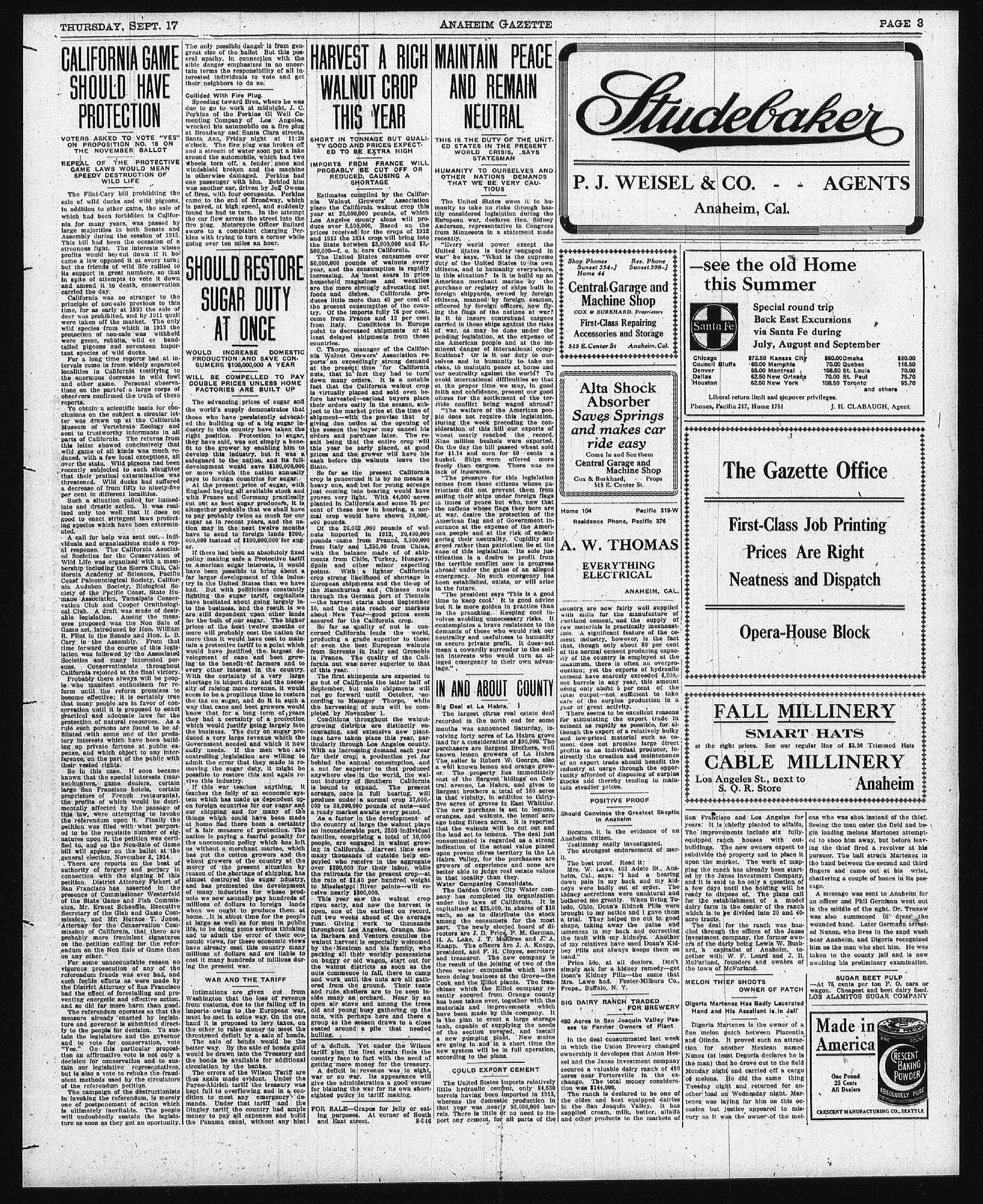
Searchable text
CALIFORNIA GAME SHOULD HAVE PROTECTION
VOTERS ASKED TO VOTE "YES" ON PROPOSITION NO. 18 ON THE NOVEMBER BALLOT
REPEAL OF THE PROTECTIVE GAME LAWS WOULD MEAN SPEEDY DESTRUCTION OF WILD LIFE
The Flint-Cary bill prohibiting the sale of wild ducks and wild pigeons, in addition to other game, the sale of which had been forbidden in California for many years, was passed by large majorities in both Senate and Assembly during the session of 1913. This bill had been the occasion of a strenuous fight. The interests whose profits would be cut down if it became a law opposed it at every turn; but the friends of wild life rallied to its support in great numbers, so that in spite of attempts to vote it down and amend it to death, conservation carried the day.
California was no stranger to the principle of non-sale previous to this time, for as early at 1893 the sale of deer was prohibited, and by 1911 quail were taken off the market. The only wild species from which in 1913 the protection of non-sale was withheld were geese, rabbits, wild or band-tailed pigeons and seventeen important species of wild ducks.
For a long time reports had at intervals come in from widely separated localities in California testifying to the enormous decrease in wild fowl and other game. Personal observations on the part of a large corps of observers confirmed the truth of these reports.
To obtain a scientific basis for conclusions on the subject a circular letter was drawn up at the California Museum of Vertebrate Zoology and sent to trustworthy informants in all parts of California. The returns from this letter showed conclusively that
The only possible danger is from greatest size of the ballot. But this poser apathy, in connection with the sible danger emphasizes in no uncertain terms the responsibility of all interested individuals to vote and get their neighbors to do so.
Collided With Fire Plug.
Speeding toward Brea, where he was due to go to work at midnight, J. C. Perkins of the Perkins Oil Well Company of Los Angeles, wrecked his automobile on a fire plug at Broadway and Santa Clara streets, Santa Ana, Friday night at 11:20 o'clock. The fire plug was broken off and a stream of water soon put a lake around the automobile, which had two wheels torn off, a feeder gone and windshield broken and the machine is otherwise damaged. Perkins had one passenger with him. Behind him was another car, driven by Jeff Owens of Brea, with four occupants. Perkins came to the end of Broadway, which is paved, at high speed, and suddenly found he had to turn. In the attempt the car flew across the street into the fire plug. Motorcycle Officer Ballard swore to a complaint charging Perkins with trying to turn a corner while going over ten miles an hour.
SHOULD RESTORE SUGAR DUTY AT ONCE
WOULD INCREASE DOMESTIC PRODUCTION AND SAVE CONSUMERS $100,000,000 A YEAR
WILL BE COMPELLED TO PAY DOUBLE PRICES UNLESS HOME FACTORIES ARE BUILT UP
The advancing prices of sugar and the world's supply demonstrates that those who have persistently advocated the building up of a big sugar industry in this country have taken the right position. Protection to sugar, they have said, was not simply a benefit to the grower by enabling him to
HARVEST WALNUT THIS
SHORT IN TONNEY GOOD AND ED TO BE
IMPORTS FROM PROBABLY BE REDUCED, SHOP
Estimates compelia Walnut Grove place the California year at 20,000,000 Los Angeles county duce over 8,500,000 prices received for and 1913 the 1914 the State between 500,000—f. o. b. ca.
The United States 50,000,000 pounds year, and the con increasing. As'm household magazine are the more strong foods and dishes duces little more o the present consumer try. Of the import come from France from Italy. Co point to decrease least delayed ship countries.
C. Thorpe, manila Walnut Grove ports an exceeding at the present time nuts, that in fact down many order fact that the Cali is virtually placed fore harvested—c their orders early ject to the market shipment—with giving due notice the season the bus orders and purch suit being that this year be
For a long time reports had at intervals come in from widely separated localities in California testifying to the enormous decrease in wild fowl and other game. Personal observations on the part of a large corps of observers confirmed the truth of these reports.
To obtain a scientific basis for conclusions on the subject a circular letter was drawn up at the California Museum of Vertebrate Zoology and sent to trustworthy informants in all parts of California. The returns from this letter showed conclusively that wild game of all kinds was much reduced, with a few local exceptions, all over the state. Wild pigeons had been recently subjected to such slaughter that their practical extermination was threatened. Wild ducks had suffered a decrease of from fifty to ninety-five per cent in different localities.
Such a situation called for immediate and drastic action. It was realized only too well that it does no good to enact stringent laws protecting species which have been exterminated.
A call for help was sent out. Individuals and organizations made a royal response. The California Association Societies for the Conservation of Wild Life was organized with a membership including the Sierra Club, California Academy of Sciences, Pacific Coast Paleontological Society, California Audubon Society, Biological Society of the Pacific Coast, State Human Association, Tamarisks Conservation Club and Cooper Ornithological Club. A draft was made of desirable legislation. Among the measures proposed was the Non Sale of Game act, introduced by Hon. William R. Flint in the Senate and Hon. L. B. Cary in the Assembly. From that time forward the course of this legislation was followed by the Associated Societies and many interested persons. Conservationists throughout California rejoiced at the final victory.
Probably there always will be people who manifest enthusiasm for reform until the reform promises to become effective; it is certainly true that many people are in favor of conservation until it is proposed to enact practical and adequate laws for the protection of natural resources. As a rule such persons are found to be affiliated with some one of the predatory interests which have been building up private fortune at public expense, and which object to any interference, on the part of the public with their vested rights.
So in this case. If soon became known that the special interests (market hunters, game dealers, certain large San Francisco hotels, certain proprietors of French restaurants), the profits of which would be detrimentally affected by the passage of this law, were attempting to invoke the referendum upon it. Finally the petition was filed with what purported to be the requisite number of signatures upon it, the petition was certified to, and so the Non-Sale of Game bill was approved on the ballot at the
PRODUCTION AND SAVE CONSUMERS $100,000,000 A YEAR
WILL BE COMPELLED TO PAY DOUBLE PRICES UNLESS HOME FACTORIES ARE BUILT UP
The advancing prices of sugar and the world’s supply demonstrates that those who have persistently advocated the building up of a big sugar industry in this country have taken the right position. Protection to sugar, they have said, was not simply a benefit to the grower by enabling him to develop this industry, but it was a safeguard to the nation, and its full-development would save $100,000,000 or more which the nation annually pays to foreign countries for sugar.
At the present price of sugar, with England buying all available stock and with France and Germany practically cut out as beet sugar producers, it is altogether probable that we shall have to pay probably twice as much for our sugar as in recent years, and the nation may in the next twelve months have to send to foreign lands $200,000,000 instead of $100,000,000 for sugar.
If there had been an absolutely fixed policy making a protective tariff to American sugar interests, it would have been possible to bring about a far larger development of this industry in the United States than we have had. But with politicians constantly fighting the sugar tariff, capitalists have hesitated about going largely into the business, and the result is we are still dependent upon other lands for bulk of our sugar. The higher prices of the next twelve months or more will probably cost the nation far more than it would have cost to maintain a protective tariff to a point which would have justified the largest development of cane and beet growing to the benefit of farmers and to every other interest in the country. With the certainty of a very large shortage in import duty and the necessity of raising more revenue, it would seem to be a propitious time to restore the tax on sugar, and do it in such a way that cane and beet growers would know that for a long term of years they had a certainity of a protection which would justify going largely into the business. The duty on sugar provide a very large revenue which the Government needed and which it now sudly needs. If the men who are controlling legislation are willing to admit the error that they made in removing the sugar duty, it might be possible to restore this and again revive this industry.
If this war teaches anything, it teaches the folly of an economic system which has made us dependent upon foreign countries for our sugar and our shipping and for many of the things which could have been made at home had there been a certainty of a fair measure of protection. The nation is paying a fearful penalty for the uneconomic policy which has left us without a merchant marine, which
So in this case. If soon became known that the special interests (market hunters, game dealers, certain large San Francisco hotels, certain proprietors of French restaurants), the profits of which would be detrimentally affected by the passage of this law, were attempting to invoke the referendum upon it. Finally the petition was filed with what purported to be the requisite number of signatures upon it, the petition was certified to, and so the Non-Sale of Game bill will appear on the ballot at the general election, November 8, 1914.
There are reports on the best of authority of forgery and perjury in connection with the signing of this petition. District Attorney Flickert of San Francisco has asserted in the presence of Commissioner Westerfield of the State Game and Fish Commission, Mr. Ernest Schneffle, Executive Secretary of the Gish and Game Commission, and Mr. Horace T. Jones, Attorney for the Conservation Commission of California, that there are probably more fraudulent signatures on the petition calling for the referendum on the Non Sale of Game than on any other.
For some unaccountable reason no vigorous prosecution of any of the referendum frauds was ever had, and such feeble efforts as were made by the District Attorney of San Francisco had the effect of forestalling and preventing energetic and effective action, and so did far more harm than good.
The referendum operates so that the measure already enacted by legislature and governor is submitted directly to the people for decision. To sustain the legislature and the governor and to vote for conservation, vote "Yes." On this particular proposition an affirmative vote is not only a decision for conservation and to sustain our legislative representatives, but is also a vote to rebuke the fraudulent methods used by the circulators of the referendum petition.
The campaign of the destructionists in invoking the referendum, is merely one of postponement of action which is ultimately inevitable. The people will undoubtedly sustain the legislature as soon as they get an opportunity.
WAR AND THE TARIFF
Intimations are given out from Washington that the loss of revenue from customs, due to the falling off in imports-owing to the European war, must be met in some way. On the one hand it is proposed to levy taxes, on the other to raise money to meet the threatened deficit by a sale of bonds.
The sale of bonds would be the better way. By the sale of bonds gold would be drawn into the Treasury and the bonds be available for additional circulation by the banks.
The errors of the Wilson Tariff are thus again made evident. Under the Payne-Aldrich tariff the treasury was kept full to overflowing and in a condition to meet any emergency demands. Under that tariff and the Dingley tariff the country had ample money to pay all expenses and build the Panama canal, without any hint controlling legislation are willing to admit the error that they made in removing the sugar duty, it might be possible to restore this and again revive this industry.
If this war teaches anything, it teaches the folly of an economic system which has made us dependent upon foreign countries for our sugar and our shipping and for many of the things which could have been made at home had there been a certainty of a fair measure of protection. The nation is paying a fearful penalty for the uneconomic policy which has left us without a merchant marine, which has put the cotton growers and the wheat growers of the country at the mercy of the present situation by reason of the shortage of shipping, has almost destroyed the sugar industry, and has presented the development of many industries for whose products we now annually pay hundreds of millions of dollars to foreign lands when we ought to produce them at home. It is about time for the people at large as well as for men in public life, to be doing some serious thinking and to admit the error of their economic views, for these economic views have already cost this country many millions of dollars and are liable to cost it many hundreds of millions during the present war.
This year saw ripen early, and in full two weeks after year. Giving work throughout Los Angeles Barbara and Walnut harvest is by the Mexican packing all their on buggy or old wagon distribution nuts commence to work until they ered from the gage and rude shellers side many an open air stove an old and young bus nuts, with perhaps group as the seas seated around a hullling.
of a deficit. Yet tariff plan the first country face to face getting more money.
A deficit in rewarm or no war; give the administration for blaming the wiser policy in FOR SALE—Graping purposes. and East street
HARVEST A RICH WALNUT CROP THIS YEAR
SHORT IN TONNAGE BUT QUALITY GOOD AND PRICES EXPECTED TO BE EXTRA HIGH
IMPORTS FROM FRANCE WILL PROBABLY BE CUT OFF OR REDUCED, CAUSING A SHORTAGE
Estimates compiled by the California Walnut Growers' Association place the California walnut crop this year at 20,000,000 pounds, of which Los Angeles county alone will produce over 8,500,000. Based on the prices received for the crops of 1912 and 1913 the 1814 crop will bring into the State between $3,000,000 and $3,500,000—f. o. b. cars California.
The United States consumes over 50,000,000 pounds of walnuts every year, and the consumption is rapidly increasing. As meat soars in price household magazines and weeklies are the more strongly advocating nut foods and dishes. California produces little more than 40 per cent of the present consumption of the country. Of the imports fully 78 per cent come from France and 12 per cent from Italy. Conditions in Europe point to decreased shipments or at least delayed shipments from those countries.
C. Thorpe, manager of the California Walnut Growers' Association reports an exceedingly strong demand at the present time for California nuts, that in fact they had to turn down many orders. It is a notable fact that the California walnut crop is virtually placed and sold even before harvested—carload buyers place their orders early in the season, subject to the market price at the time of shipment—with the proviso that by giving due notice at the opening of the season the buyer may cancel his orders and purchase later. The result being that the entire crop will this year be early placed, at good
MAINTAIN PEACE AND REMAIN NEUTRAL
THIS IS THE DUTY OF THE UNITED STATES IN THE PRESENT WORLD CRISIS, SAYS STATESMAN
HUMANITY TO OURSELVES AND OTHER NATIONS DEMANDS THAT WE BE VERY CAUTIOUS
The United States owes it to humanity to take no risks through hastily considered legislation during the European war, declares Hon. Sidney Anderson, representative in Congress from Minnesota in a statement made recently.
"Every world power except the United States is today engaged in war" he says. "What is the supreme duty of the United States to its own citizens, and to humanity everywhere, in this situation? Is it to build up an American merchant marine by the purchase or registry of ships built in foreign shipyards, owned by foreign citizens, manned by foreign seamen, officered by foreign officers, now flying the flags of the nations at war? Is it to insure contraband cargoes carried in these ships against the risks of war, as may be done under the pending legislation, at the expense of the American people and at the imminent danger of international complications? Or is it our duty to ourselves and to humanity to take no risks, to maintain peace at home and our neutrality against the world? To avoid international difficulties so that at the proper time we may, in good faith and cohidence, present our good offices for the settlement of the terrible conflict being waged abroad?
"The welfare of the American people does not require this legislation. During the week preceding the consideration of this bill our exports of wheat nearly reached the record. Nine million bushels were exported. On the day the bill passed wheat sold."
So far as the present California crop is concerned it is by no means a heavy one, and but for young acreage just coming into bearing would have proven very light. With 44,000 acres planted in California and some 75 per cent of these now in bearing, a normal crop would have shown 30,000-40,000 pounds.
Of the 26,662,000 pounds of walnuts imported in 1913, 20,400,000 pounds came from France, 3,300,000 from Italy and 1,250,000 from China, with the balance made of shipments from Chile, Turkey, Hungary, Spain and other minor exporting points. With a lighter California crop strong likelihood of shortage in European shipments and the tie-up of the Manchurian and Chinese nuts through the German port of Tientain—the harvest starts of September 10, and the nuts reach our markets about New Year—good prices seem assured for the California crop.
So far as quality of nut is concerned California leads the world, producing a grade superior to those of even the best European walnuts from Sorrento in Italy and Grenoble in France. The quality of the California nut was never superior to that of this year.
The first shimpents are expected to go out of California the latter half of September, but main shipments will not go forward until October, according to Manager Thorpe, while the harvesting of nuts will be completed by November 1.
Conditions throughout the walnut-growing districts are distinctly encouraging, and extensive new plantings have taken place this year, particularly through Los Angeles county. With an increasing demand each year for their crop, a production yet far behind the annual consumption, and a nut for superior to that produced anywhere else in the world, the walnut industry of Southern California is bound to expand. The present acreage, once in full bearing, will produce under a normal crop 37,000-40,000 to 38,000,000 pounds of nuts—and a ready market awaits every pound.
As a factor in the development of the country at large the walnut plays no inconsiderable part, 2500 individual families, comprising a total of 10,000 people, are engaged in walnut growing in California. Harvest time sees alna Walnut Growers' Association reports an exceedingly strong demand at the present time for California nuts, that in fact they had to turn down many orders. It is a notable fact that the California walnut crop is virtually placed and sold even before harvested—carload buyers place their orders early in the season, subject to the market price at the time of shipment—with the proviso that by giving due notice at the opening of the season the buyer may cancel his orders and purchase later. The result being that the entire crop will this year be early placed, at good prices and the grower will have his cash before the walnuts leave the State.
So far as the present California crop is concerned it is by no means a heavy one, and but for young acreage just coming into bearing would have proven very light. With 44,000 acres planted in California and some 75 per cent of these now in bearing, a normal crop would have shown 30,000-40,000 pounds.
Of the 26,662,000 pounds of walnuts imported in 1913, 20,400,000 pounds came from France, 3,300,000 from Italy and 1,250,000 from China, with the balance made of shipments from Chile, Turkey, Hungary, Spain and other minor exporting points. With a lighter California crop strong likelihood of shortage in European shipments and the tie-up of the Manchurian and Chinese nuts through the German port of Tientain—the harvest starts of September 10, and the nuts reach our markets about New Year—good prices seem assured for the California crop.
So far as quality of nut is concerned California leads the world, producing a grade superior to those of even the best European walnuts from Sorrento in Italy and Grenoble in France. The quality of the California nut was never superior to that of this year.
The first shimpents are expected to go out of California the latter half of September, but main shipments will not go forward until October, according to Manager Thorpe, while the harvesting of nuts will be completed by November 1.
Conditions throughout the walnut-growing districts are distinctly encouraging, and extensive new plantings have taken place this year, particularly through Los Angeles county. With an increasing demand each year for their crop, a production yet far behind the annual consumption, and a nut for superior to that produced anywhere else in the world, the walnut industry of Southern California is bound to expand. The present acreage, once in full bearing, will produce under a normal crop 37,000-40,000 to 38,000,000 pounds of nuts—and a ready market awaits every pound.
As a factor in the development of the country at large the walnut plays no inconsiderable part, 2500 individual families, comprising a total of 10,000 people, are engaged in walnut growing in California. Harvest time sees alna Walnut Growers' Association reports an exceedingly strong demand at the present time for California nuts, that in fact they had to turn down many orders. It is a notable fact that the California walnut crop is virtually placed and sold even before harvested—carload buyers place their orders early in the season, subject to the market price at the time of shipment—with the proviso that by giving due notice at the opening of the season the buyer may cancel his orders and purchase later. The result being that the entire crop will this year be early placed, at good prices and the grower will have his cash before the walnuts leave the State.
So far as the present California crop is concerned it is by no means a heavy one, and but for young acreage just coming into bearing would have proven very light. With 44,000 acres planted in California and some 75 per cent of these now in bearing, a normal crop would have shown 30,000-40,000 pounds.
Of the 26,662,000 pounds of walnuts imported in 1913, 20,400,000 pounds came from France, 3,300,000 from Italy and 1,250,0...
for their crop a production yet far behind the annual consumption, and a nut for superior to that produced anywhere else in the world, the walnut industry of Southern California is bound to expand. The present acreage, once in full bearing, will produce under a normal crop 37,000,000 to 38,000,000 pounds of nuts—and a ready market awaits every pound.
As a factor in the development of the country at large the walnut plays no inconsiderable part, 2500 individual families, comprising a total of 10,000 people, are engaged in walnut growing in California. Harvest time sees many thousands of outside help employed who receive in the aggregate over $200,000 for their labor, while the railroads for the present crop—at the rate of $140 per hundred weight to Mississippi River points—will receive nearly $300,000.
This year saw the walnut crop ripen early, and now the harvest is open, one of the earliest on record, full two weeks ahead of the average year. Gliving work to thousands throughout Los Angeles, Orange, Santa Barbara and Ventura counties the walnut harvest is especially welcomed by the Mexican and his family, who packing all their worldly possessions on buggy or old wagon, start out for the walnut districts as soon as the nuts commence to fall, there to camp and work until the nuts are all gathered from the ground. Their tents and rude shelters are to be seen inside many orchard. Near by an open air stove and among the trees old and young busy gathering up the nuts, with perhaps here and there a group as the season draws to a close seated around a pile that needed hulling.
of a deficit. Yet under the Wilson tariff plan the first strain finds the country face to fact with the need of getting more money for the treasury.
A deficit in revenue was in sight, war or no war. Its appearance will give the administration a good excuse for blaming the war for its own short-sighted policy in tariff making.
FOR SALE—Grapes for jelly or eating purposes. At corner of South and East street.
The United States imports relatively little hydraulic cement, only 630 barrels having been imported in 1913, whereas the domestic production in that year was nearly 93,000,000 barrels. There is little or no need to import any cement, for all parts of the
POSITIVE PROOF
Should Convince the Greatest Skeptic In Anaheim
Because it is the evidence of an Anaheim citizen.
Testimony easily investigated.
The strongest endorsement of merit.
The best proof. Read it:
Mrs. W. Lawe, 403 Adele St., Anaheim, Cal., says: "I had a bearing down pain in my back and my kidneys were badly out of order. The kidney secretions were unnatural and bothered me greatly. When living Toledo, Ohio, Doan's Kidnek Pills were brought to my notice and I gave them a trial. They helped me out in good shape, taking away the pains and lameness in my back and correcting the fault with my kidneys. Another of my relatives have used Doan's Kidney Pills and always keeps them on hand."
Price 50c, at all dealers. Don't simply ask for a kidney remedy—get Doan's Kidney Pills—the same that Mrs. Lawe had. Foster-Milburn Co., Props., Buffalo, N.Y.
BIG DAIRY RANCH TRADED FOR BREWERY
480 Acres In San Joaquin Valley Passes to Former Owners of Plant
In the deal consummated last week in which the Union Brewery changed ownership it develops that Anton Hessel and the Janus Investment company secured a valuable dairy ranch of 480 acres near Portersville in the exchange. The total money consideration was $144,000.
The ranch is declared to be one of the oldest and best equipped dairies in the San Joaquin Valley. It has supplied cream, milk, butter, alfalfa and other products to the markets of
Studebaker
WEISEL & CO. - AGENTS
Anaheim, Cal.
—see the old Home this Summer
Special round trip
Back East Excursions
via Santa Fe during
July, August and September
Chicago $72.50 Kansas City $60.00Omaha $60.00
Council Bluffs 60.00 Memphis 70.00 Quebec 118.50
Denver 55.00 Montreal 108.50 St. Louis 70.00
Dallas 62.50 New Orleans 70.00 St. Paul 75.70
Houston 62.50 New York 108.50 Toronto 95.70
and others
Liberal return limit and stopover privileges.
Phones, Pacific 217, Home 1751 J. H. CLABAUGH, Agent.
The Gazette Office
First-Class Job Printing
Prices Are Right
Neatness and Dispatch
Opera-House Block
FALL MILLINERY
SMART HATS
at the right prices. See our regular line of $3.50 Trimmed Hats
CABLE MILLINERY
Los Angeles St., next to S. Q. R. Store Anaheim
San Francisco and Los Angeles for years. It is chiefly planted to alfalfa. The improvements include six fully-equipped ranch houses with outbuildings. The new owners expect to ones who was shot instead of the thief. Seeing the man enter the field and begin loading melons Martonez attempted to shoo him away, but before leaving the thief fired a revolver at his
San Francisco and Los Angeles for years. It is chiefly planted to alfalfa. The improvements include six fully-equipped ranch houses with outbuildings. The new owners expect to subdivide the property and to place it upon the market. The work of mapping the ranch has already been started by the Janss Investment Company, and it is said to be only a question of a few days until the holding will be ready to dispose of. The plans call for the establishment of a model dairy farm in the center of the ranch which is to be divided into 20 and 40-acre tracts.
The deal for the ranch was handled through the offices of the Janss Investment company, the former owner of the dairy being Lewis W. Bushard, a capitalist of Anaheim, together with W. F. Leard and J. B. McFarland, founders and owners of the town of McFarland.
MELON THIEF SHOOTS
OWNER OF PATCH
Digoria Martenez Has Badly Lacerated Hand and His Assailant Is in Jail
Digoria Martenez is the owner of a fine melon patch between Placentia and Olinda. It proved such an attraction for another Mexican named Nunoz (at least Degoria declares he is the man) that he drove out to the field Monday night and carried off a cargo of melons. He did the same thing Tuesday night and returned for another load on Wednesday night. Martenez was laying for him on this occasion but justice appeared to miscary as it was the owner of the melons who was shot instead of the thief. Seeing the man enter the field and begin loading melons Martenez attempted to shoo him away, but before leaving the thief fired a revolver at his pursuer. The ball struck Martenez in the hand between the second and third fingers and came out at his wrist, shattering a couple of bones in its passage.
A message was sent to Anaheim for an officer and Phil Germann went out in the middle of the night. Dr. Truxaw was also summoned to dress the wounded hand. Later Germann arrested Nunoz, who lives in the sand wash near Anaheim, and Digoria recognized him as the man who shot him. He was taken to the county jail and is now awaiting his preliminary examination.
SUGAR BEET PULP
—At 75 cents per ton F. O. cars or wagon. Cheapest and best dairy food. LOS ALAMITOS SUGAR COMPANY