anaheim-gazette 1914-09-10
Scanned page
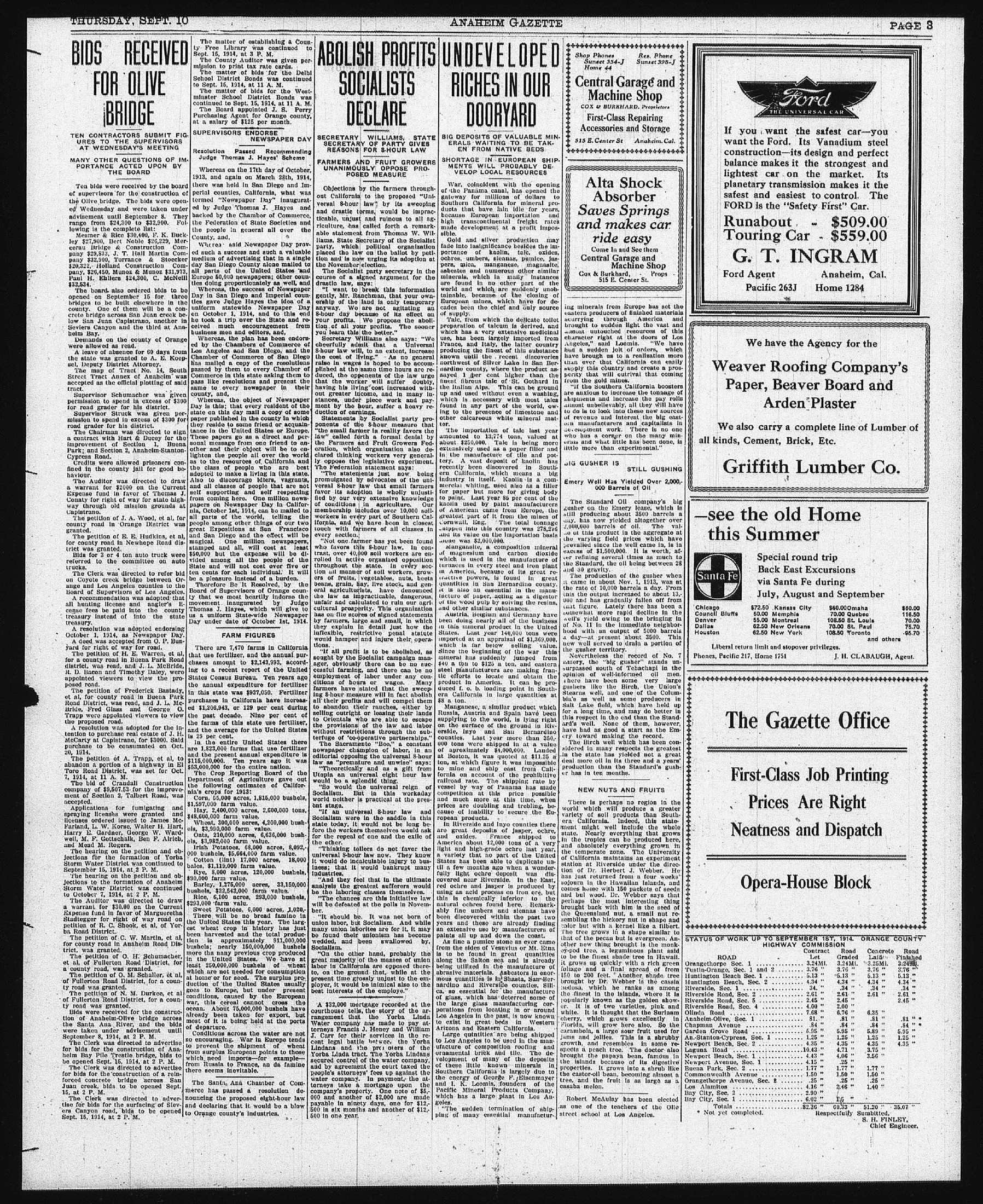
Searchable text
BIDS RECEIVED FOR OLIVE BRIDGE
TEN CONTRACTORS SUBMIT FIGURES TO THE SUPERVISORS AT WEDNESDAY'S MEETING
MANY OTHER QUESTIONS OF IMPORTANCE ACTED UPON BY THE BOARD
Ten bids were received by the board of supervisors for the construction of the Olive bridge. The bids were opened Wednesday and were taken under advisement until September 8. They range from $24,300 to $32,900. Following is the complete list:
Mesmer & Rice $30,400, F. K. Buckley $27,900, Bert Noble $26,229, Mercerau Bridge & Construction Company $29,833, J. T. Hall Martin Company $29,900, Torrance & Stoecker $20,322, Holland Construction Company, $26,450, Munoz & Munoz $31,973, Paul H. Ehlers $24,300, C. McNeill $22,534.
The board also ordered bids to be opened on September 15 for three bridges to be built elsewhere in the county. One of them will be a concrete bridge across San Juan creek below San Juan Capistrano, another in Seviera Canyon and the third at Anaheim Bay.
Demands on the county of Orange were allowed as read.
A leave of absence for 60 days from the state was granted to A. E. Koepsel, Deputy District Attorney.
The map of Tract No. 14, South Street Tract Annex of Anaheim was accepted as the official plotting of said tract.
Supervisor Schumacher was given permission to spend in excess of $300 for road grader for his district.
Supervisor Struck was given permission to spend in excess of $300 for road grader for his district.
The Chairman was directed to sign a contract with Hart & Ducey for the improvement of Section 1, Buena Vista.
The matter of establishing a County Free Library was continued to Sept. 15, 1914, at 3 P.M.
The County Auditor was given permission to print tax rate cards.
The matter of bids for the Delhi School District Bonds was continued to Sept. 15, 1914, at 11 A.M.
The matter of bids for the Westminster School District Bonds was continued to Sept. 15, 1914, at 11 A.M.
The Board appointed J. S. Perry Purchasing Agent for Orange county, at a salary of $125 per month.
SUPERVISORS ENDORSE NEWSPAPER DAY
Resolution Passed Recommending Judge Thomas J. Hayes' Scheme
Whereas on the 17th day of October, 1913, and again on March 28th, 1914, there was held in San Diego and Imperial counties, California, what was termed "Newspaper Day" inaugurated by Judge Thomas J. Hayes and backed by the Chamber of Commerce, the Federation of State Societies and the people in general all over the County, and,
Whereas said Newspaper Day provided such a success and such a valuable medium of advertising that in a single day San Diego County alone mailed to all parts of the United States and Europe 50,000 newspapers; other countries doing proportionately as well, and
Whereas, the success of Newspaper Day in San Diego and Imperial counties gave Judge Hayes the idea of a uniform statewide Newspaper Day on October 1, 1914, and to this end he took a trip over the State and received much encouragement from business men and editors, and,
Whereas, the plan has been endorsed by the Chambers of Commerce of Los Angeles and San Diego, and the Chamber of Commerce of San Diego has mailed a copy of the resolutions passed by them to every Chamber of Commerce in this state asking them to pass like resolutions and present the same to every newspaper in their county, and,
Whereas, the object of Newspaper Day is this; that every resident of the state on this day mail a copy of some paper published in the county in which they reside to some friend or acquaintance in the United States or Europe.
These papers go as a direct and personal message from one friend to another and their object will be to en-
ABOLISH SOCIAL DECISION
SECRETARY SECRETARY REASONS FARMERS AND UNANIMOUS POSED OBJECTIONS BY OUT California thru versal 8-hour law and drastic termicable, unjustifiable culture, has capable statement llams, State Secretary party, which placed the law limitation and is now the November election.
The Socialist leader course of a slight drastic law, says,
"I want to be gently, Mr. Randolph's assistant of the law anyway. We are an 8-hour day because your profits. Writen of all your own you learn this thing."
Secretary Will cheerfully admit 8-hour law will,
the cost of living raise in wages plished at the saiduced, the oppoet that the worker having his living out greater inconveniences under the hour duction of earning statements by portions of the "the small farmer law" called forth by Farmers and eration which
the state was granted to A. E. Koepsel, Deputy Attorney.
The map of Tract No. 14, South Street Tract Annex of Anaheim was accepted as the official plotting of said tract.
Supervisor Schumacher was given permission to spend in excess of $300 for road grader for his district.
Supervisor Struck was given permission to spend in excess of $300 for road grader for his district.
The Chairman was directed to sign a contract with Hart & Ducey for the improvement of Section 1, Buena Park; and Section 2, Anaheim-Stanton-Cypress Road.
Credits were allowed prisoners confined in the county jail for good behaviour.
The Auditor was directed to draw a warrant for $2000 on the Current Expense fund in favor of Thomas J. County for right of way for state highway through old mission grounds at Capistrano.
The petition of J. A. Wood, et al, for county road in Orange District was granted.
The petition of E. E. Hudkins, et al, for county road in Newhope Road district was granted.
Bids for 3 or 4 ton auto truck were referred to the committee on auto trucks.
The Clerk was directed to refer bid on Coyote creek bridge between Orange and Los Angeles counties to the Board of Supervisors of Los Angeles.
A recommendation was adopted that all hunting license and angler's license fees be paid into the county treasury instead of into the state treasury.
A resolution was adopted endorsing October 1, 1914, as newspaper Day.
A deed was accepted from O. P. Bunyard for right of way for road.
The petition of H. E. Warren, et al, for a county road in Buena Park Road district, was read, and J. L. McBride, K. D. Bacon and Timothy Daley, were appointed viewers to view the proposed road.
The petition of Frederick Bastady, et al, for county road in Buena Park Road District, was read, and J. L. McBride, Fred Glass and George O. Trapp were appointed viewers to view the proposed road.
A resolution was adopted for the intention to purchase real estate of J. H. McCarty at Capistrano, for $3000. Said purchase to be consumed on Oct. 20, 1914.
The petition of A. Trapp, et al, to abandon a portion of a highway in El Toro Road District, was set for Oct. 7, 1914, at 11 A.M.
The bid of Crandall Construction company of $9,507.53 for the improvement of Section 2, Talbert Road, was accepted.
Applications for fumigating and spraying licenses were granted and licenses ordered issued to James McFarland, L. W. Korse, Walter H. Hart, Harry E. Gardner, George W. Wardwell, M. F. Gutschalk, Ben F. Alrich, and Mead M. Rogers.
The hearing on the petition and objection is detailed below:
Chamber of Commerce of San Diego has mailed a copy of the resolutions passed by them to every Chamber of Commerce in this state asking them to pass like resolutions and present the same to every newspaper in their county, and,
Whereas, the object of Newspaper Day is this; that every resident of the state on this day mail a copy of some paper published in the county in which they reside to some friend or acquaintance in the United States or Europe.
These papers go as a direct and personal message from one friend to another and their object will be to enlighten the people all over the world as to the resources of California and the class of people who are best adopted to make a living in this state.
Also to discourage idlers, vagrants, and all classes of people that are not self supporting and self respecting from coming here. One million newspapers on Newspaper Day in California, October 1st, 1914, can be mailed to all parts of the world, telling the people among other things of our two great Expositions at San Francisco and San Diego and the effect will be magical. One million newspapers, stamped and all, will cost at least $50,000 but the expense will be divided among all the people of the State and will not cost over five or ten cents for each individual. It will be a pleasure instead of a burden.
Therefore Be It Resolved, by the Board of Supervisors of Orange country that we most heartily indorse the movement inaugurated by Judge Thomas J. Hayes, which will give us a uniform State-wide Newspaper Day under date of October 1st, 1914.
**FARM FIGURES**
There are 7,470 farms in California that use fertilizer, and the annual purchases amount to $2,143,993, according to a recent report of the United States Census Bureau. Ten years ago the annual expenditure for fertilizer in this state was $937,050. Fertilizer purchases in California have increased $1,206,943, or 129 per cent during the past decade. Nine per cent of the farms of this state use fertilizer, and the average for the United States is 29 per cent.
In the entire United States there are 1,823,000 farms that use fertilizer and the present annual expenditure is $115,000,000. Ten years ago it was $53,000,000 for the entire nation.
The Crop Reporting Board of the Department of Agriculture gave out the following estimates of California's crops for 1913:
Corn, 55,000 acres, 1,815,000 bushels,$1,597,000 farm value.
Hay, 2,400,000 acres, 2,600,000 tons,$48,600,000 farm value.
Wheat, 300,000 acres, 4,200,000 bushels,$3,990,000 farm value.
Oats, 210,000 acres, 6,636,000 bushels,$3,982,000 farm value.
Irish Potatoes, 68,000 acres,$8,922,
the cost of living raise in wages is plished at the seat ductioned at the seat opportune that the workers having his living out greater income stances under payment by the hour duction of earning
Statements byponents of the law "the small farmer law" called forth by the Farmers and eration which oel elared thinking wily oppose the law The Federation is
"The statement promulgated by versal 8-hour law favor its adoption filed by our very conditions in membership incl workers in every lifornia,and we touch with farmers every section."
Not one-farm who favors this treat over 40 thousand rolled in active throughout the nation all manner o尔 beans,grain,hayeral agriculturist law as impure unfair and calculus cultural prosperity has on file scores by farmers larger they explain in inflexible restricte ttergefuge of 'co-op'
The Sacrament newspaper champion editorial opposition law as "premature"
"Theoretically Utopia an univer sible would be a splendor"
So would th e Socialism But world neither is p but stage.
If an univers al Socialism were in state today it w ofore the workers to for the repeal of the other
"Thinking toller
The petition of A. Trapp, et al., to abandon a portion of a highway in El Toro Road District, was set for Oct. 7, 1914, at 11 A.M.
The bid of Crandall Construction company of $9,507.53 for the improvement of Section 2, Talbert Road, was accepted.
Applications for fumigating and spraying licenses were granted and licenses ordered issued to James McFarland, L. W. Korse, Walter H. Hart, Harry E. Gardner, George W. Wardwell, M. F. Gottschalk, Ben F. Alrich, and Mead M. Rogers.
The hearing on the petition and objections for the formation of Yorba Storm Water District was continued to September 15, 1914, at 2 P.M.
The hearing on the petition and objections to the formation of Anaheim Storm Water District was continued to October 7, 1914, at 2 P.M.
The Auditor was directed to draw a warrant for $30.00 on the Current Expense fund in favor of Margueretha Stadtgeger for right of way road on petition of R. C. Shook, et al., of Yorba Road District.
The petition of C. W. Martin, et al., for county road in Anaheim Road District, was granted.
The petition of O. H. Schumacher, et al., of Fullerton Road District, for a county road, was granted.
The petition of O. M. Schaller, et al., of Fullerton Road District, for a county road was granted.
The petition of N. M. Durkee, et al., of Fullerton Road District, for a county road was granted.
Bids were received for the construction of Anaheim-Olive bridge across the Santa Ana River, and the bids were taken under advisement until September 8, 1914, at 2 P.M.
The Clerk was directed to advertise for bids for the construction of Anaheim Bay Pile Trestle bridge, bids to be opened Sept. 15, 1914, at 2 P.M.
The Clerk was directed to advertise for bids for the construction of a reinforced concrete bridge across San Juan creek, bids to be opened Sept. 15, at 2 P.M.
The Clerk was directed to advertise for bids for the surfacing of Sleivers Canyon road, bids to be opened Sept. 15, 1914, at 2 P.M.
The Santa Ana Chamber of Commerce has passed a resolution denouncing the proposed eight-hour law and declaring that it would be a blow to Orange county's industries.
The Crop Reporting Board of the Department of Agriculture gave out the following estimates of California's crops for 1913:
Corn, 55,000 acres, 1,815,000 bushels, $1,597,000 farm value.
Hay, 2,400,000 acres, 2,600,000 tons, $48,600,000 farm value.
Wheat, 300,000 acres, 4,200,000 bushels, $3,990,000 farm value.
Oats, 210,000 acres, 6,636,000 bushels, $3,982,000 farm value.
Irish Potatoes, 68,000 acres, 8,092,000 bushels, $5,664,000 farm value.
Cotton (lint) 17,000 acres, 18,000 bales, $1,119,000 farm value.
Rye, 8,000 acres, 120,000 bushels, $90,000 farm value.
Barley, 1,275,000 acres, 33,150,000 bushels, $22,542,000 farm value.
Rice, 6,100 acres, 293,000 bushels, $293,000 farm value.
Sweet Potatoes, 6,000 acres, 1,020.
There will be no bread famine in the United States this year. The largest wheat crop in history has just been harvested and the total production is approximately 911,000,000 bushels; nearly 150,000,000 bushels more than any previous crop produced in the United States. We have at least 250,000,000 bushels of wheat which are not needed for consumption at home or for seed. The surplus production of the United States usually goes to Europe but under present conditions caused by the European war; this cereal cannot cross the ocean. About 75,000,000 bushels have already been taken for export but most of it is being held at the ports of departure.
Conditions across the water are not so encouraging. War in Europe tends to prevent the shipment of wheat from surplus European points to those which need imports—for example—from Russia to France; an da famine there seems inevitable.
The Santa Ana Chamber of Commerce has passed a resolution denouncing the proposed eight-hour law and declaring that it would be a blow to Orange county's industries.
The Court Reporting Board of the Department of Agriculture gave out the following estimates of California's crops for 1913:
Corn, 55,000 acres, 1,815,000 bushels,
$1,597,000 farm value.
Hay,
2,4...
ABOLISH PROFITS SOCIALISTS DECLARE
SECRETARY WILLIAMS, STATE SECRETARY OF PARTY GIVES REASONS FOR 8-HOUR LAW
FARMERS AND FRUIT GROWERS UNANIMOUSLY OPPOSE PROPOSED MEASURE
Objections by the farmers throughout California to the proposed "Universal 8-hour law" by its sweeping and drastic terms, would be impracticable, unjust and rulous to all agriculture, has called forth a remarkable statement from Thomas W. Williams, State Secretary of the Socialist party, which political organization placed the law on the ballot by petition and is now urging its adoption at the November election.
The Socialist party secretary in the course of a signed argument for the drastic law, says:
"I want to break this information gently, Mr. Ranchman, that your ownership of the land is only temporary anyway. We are not agitating an 8-hour day because of its effect on your profits. We propose the abolition of all your profits. The sooner you learn this the better."
Secretary Williams also says: "We cheerfully admit that a Universal 8-hour law will, to an extent, increase the cost of living." As no general raise in wages is hoped to be accomplished at the same time hours are reduced, the opponents of the law urge that the worker will suffer doubly, having his living cost increased without greater income, and in many instances, under piece work and payment by the hour, suffer a heavy reduction of earnings.
Statements by Socialist party proponents of the 8-hour measure that "the small farmer in reality favors the law" called forth a formal denial by the Farmers and Fruit Growers Federation, which organisation also do.
UNDEVELOPED RICHES IN OUR DOORYARD
BIG DEPOSITS OF VALUABLE MINERALS WAITING TO BE TAKEN FROM NATIVE BEDS
SHORTAGE IN EUROPEAN SHIPMENTS WILL PROBABLY DEVELOP LOCAL RESOURCES
War, coincident with the opening of the Panama canal, has opened the gateway for millions of dollars to Southern California for mineral products that have lain idle for years, because European importation and high transcontinental freight rates made development at a profit impossible.
Gold and silver production may fade into insignificance besides the importance of kaolin, talc, oxides, ochres, umbers, slennas, pumice, jaspers, mica, manganese, magnasite, asbestos and numerous other similar minerals, which in many instances are found in no other part of the world and which are suddenly unobtainable, because of the closing of European mines, which have for decades been the chief and only source of supply.
Talc, from which the delicate toilet preparation of talcum is derived, and which has a very extensive medicinal use, has been largely imported from France, and Italy, the latter country producing the finest of this substance known until the recent discoveries northwest of Silver Lake in San Bernardino county, where the product assayed 1 per cent higher than the finest fibrous talc of St. Gothard in the Italian Alps. This can be ground up and used without even a washing, which is necessary with most talces found in any part of the world, owing to the presence of limestone and other calcareous white mineral matter.
The importation of talc last year amounted to 13,747 tons, valued at about $250,000. Talc is being more extensively used as a paper filler and what little has been done is little more than experimental."
Diego solutions of the California and beat state, grants, are not expecting news-California called to the twounciisco will be papers, least be the difference of the orive or will then. The judge alive to paper 1914.
California pur-record-United states ago tillizer tiller increase during cent of tiller, States there tillizer is was there tiller, newspapers champion of labor, in an editorial opposing the universal 8-hour law as "premature and unwise" says:
"Theoretically and as a gift from Utopia an universal eight hour law would be a splendid thing."
So would the universal reign of Socialism. But in this workaday world neither is practical at the present stage.
If an universal 8-hour law and Socialism were in the saddle in this state today, it would not be long before the workers themselves would ask for the repeal of one and the exile of the other.
Thinking tollers do not favor the cost of living." As no general in wages is hoped to be accomplished at the same time hours are reduced, the opponents of the law urge that the worker will suffer doubly, having his living cost increased without greater income, and in many instances, under piece work and payment by the hour, suffer a heavy reduction of earnings.
Statements by Socialist party proponents of the 8-hour measure that "the small farmer in reality favors the law" called forth a formal denial by the Farmers and Fruit Growers Federation, which organization also declared thinking workers very generally oppose the legislative experiment. The Federation statement says:
"The statements just now, being promulgated by advocates of the universal 8-hour law that small farmers favor its adoption is wholly unjustified by our very extensive knowledge of conditions in agriculture. Our membership includes over 10,000 soilworkers in every part of Southern California, and we have been in closest touch with farmers of all classes in every section."
Not one farmer has yet been found who favors this 8-hour law. In contrast, over 40,000 soilworkers are enrolled in active organized opposition throughout the state. In every section all manner of soilworkers, growers of fruits, vegetables, nuts, beets beans, grain, hay, live stock, and general agricultural services, have demonized the law as impracticable, dangerous, unfair and calculated to ruin our agricultural prosperity. This organization has on file scores of signed statements by farmers, large and small, in which they explain in detail just how the inflexible, restrictive penal statute would hamper and injure their operations.
If all profit is to be abolished, as sought by the Socialist campaign manager, obviously there can be no successful farming, and there can be no employment of labor under any conditions of hours or wages. Many farmers have stated that the sweeping 8-hour measure will in fact abolish all their profits and will compel them to abandon their ranches, either by selling outright or leasing their lands to Orientalis who are able to escape the provisions of the law and labor without restrictions through the subterfuge of "co-operative partnerships."
The Sacramento "Bee," a constant newspaper champion of labor, in an editorial opposing the universal 8-hour law as "premature and unwise" says:
"Theoretically and as a gift from Utopia an universal eight hour law would be a splendid thing."
So would the universal reign of Socialism. But in this workaday world neither is practical at the present stage.
If an universal 8-hour law and Socialism were in the saddle in this state today, it would not be long before the workers themselves would ask for the repeal of one and the exile of the other.
Thinking tollers do not favor the cost of living."
Northwest discoveries northwest of Silver Lake in San Bernardino county, where the product assayed 1 per cent higher than the lowest fibrous talc of St. Gothard in the Italian Alps. This can be ground up and used without even a washing, which is necessary with most tails found in any part of the world, owing to the presence of limestone and other calcareous white mineral matter.
The importation of talc last year amounted to 13,774 tons, valued at about $250,000. Talc is being more extensively used as a paper filler and in the manufacture of tile and pottery. A vast deposit of kaolin has recently been discovered in Southern California, which means a big industry in itself. Kaolin is a commercial whiting, used also as a filler for paper but more for giving body paint. Last year 85 per cent of the kaolin used by paint manufacturers of American came from Europe, the greatest part of it from the mines of Cornwall, Eng. The total tonnage shipped into this country was 278,276 and its value on the importation basis alone was $2,000,000.
Manganite, a composition mineral of magnesium and carbon dioxide which is used in the manufacture of turbines in every steel and iron plant in America, because of its great reactive powers, is found in great quantities in San Bernardino county. It is also an essential in the manufacture of paper, acting as a digestor of the wood pulp by solving the resins, and other similar substances.
Austria, Belgium and Germany have been doing nearly all of the business in this mineral product in the United States. Last year 140,000 tons were imported at an appraisal of $1,369,000 which is far below selling value. Since the beginning of the war this mineral has suddenly jumped from $40 a ton to $125 a ton, and eastern steel manufacturers are making fran-tle efforts to locate and obtain the product in America. It can be produced f.o.b. loading point in Southern California in large quantities at $8 a ton.
Manganese, a similar product which Russia, Austria and Spain have been supplying to the world, is lying right on the surface of the ground in Riverside, Inyo and San Bernardino counties. Last year more than 350,000 tons were shipped in at a value of approximately $4,000,000. Landed at Boston, it was quoted at $11.25 a ton, at which figure it was impossible to mine and ship east from California on account of the prohibitive railroad rate. The shipping rate by vessel by way of Panama has made competition at this price possible and much more at this time, when prices are doubling and trebling, because of inability to secure the European products.
In Riverside and Inyo counties there are great deposits of jasper, ochre, and oxides. France shipped to America about 12,000 tons of a very light and high grade ochre last year.
There is perhaps no region in the world which will produce a greater variety of soil products than Southern California. Indeed, this statement might well include the whole state. Nearly everything that grows in the tropics can be produced here, and absolutely everything grown in
editorial opposing the universal 8-hour law as "premature and unwise" says:
"Theoretically and as a gift from Utopia an universal eight hour law would be a splendid thing."
"So would the universal reign of Socialism. But in this workaday world neither is practical at the present stage."
"If an universal 8-hour law and Socialism were in the saddle in this state today, it would not be long before the workers themselves would ask for the repeal of one and the exile of the other."
"Thinking tollers do not favor the universal 8-hour law now. They know it would do incalculable injury to business; that it would bankrupt many industries."
"And they feel that in the ultimate analysis the greatest sufferers would be the laboring classes themselves."
"The chances are this initiative law will be defeated at the polls in November."
"It should be. It was not born of union labor, but Socialism. And while many union laborers are for it, it may be found their unionism has become wedded, and been swallowed by, Socialism."
"On the other hand, probably the great majority of the masses of union labor in California are opposed there to, on the ground that, while at the present time grossly unjust to the employer, it would be intimical also to the best interests of the employee."
A $32,000 mortgage recorded at the courthouse tells the story of the arrangement that the Yorba Linda Water company now made to pay attorneys Francis J. Heney and William J. Carr for their services in the recent legal battle between the Yorba Lindans and the pro-oters of the Yorba Linda tract. The Yorba Lindans secured control of the water company, and by agreement the court taxed the people's attorneys' fees up against the water company. In payment, the attorneys take a mortgage upon the company's property. One note of $5,000 and another of $2,000 are made payable in ninety days, one for $12,500 in six months and another of $12,500 in one year.
At Boston, it was quoted at $11.25 a ton, at which figure it was impossible to mine and ship east from California on account of the prohibitive railroad rate. The shipping rate by vessel by way of Panama has made competition at this price possible and much more at this time, when prices are doubling and trebling, because of inability to secure the European products.
In Riverside and Inyo counties there are great deposits of jasper, ochre, and oxides. France shipped to America about 12,000 tons of a very light and high-grade ochre last year, a variety that no part of the United States has been able to duplicate until a few months ago when a wonderfully light ochre deposit was discovered near Riverside. In the East, red ochre and jasper is produced by using an acid process on iron ore, but this is chemically inferior to the natural ochres found here. Remarkably fine umbers and slennas have been discovered within the past two years and these are already finding an extensive use by manufacturers of paints all up and down the coast.
As fine a pumice stone as ever came from the sides of Vasuvius or Mt. Etna is to be found in great quantities along the Salton sea and is already being utilized in the manufacture of abrasive materials. Asbestos in enormous quantities is in Shasta, San Bernardino and Riverside counties, Silica, so essential for the manufacture of glass, which has deterred some of the large glass manufacturing corporations from locating in or around Los Angeles in the past, is now known to exist in great beds in Western Arizona and Eastern California.
Large quantities are being shipped to Los Angeles to be used in the manufacture of composition roofing and ornamental brick and tile. The development of many of the deposits of these little known minerals in Southern California is largely due to the energy of George F. Eisenmayer and I. K. Loomis, founders of the Pacific Mineral Products Company, which has a large plant in Los Angeles.
"The sudden termination of shipping of many essential manufactures"
There is perhaps no region in the world which will produce a greater variety of soil products than Southern California. Indeed, this statement might well include the whole state. Nearly everything that grows in the tropics can be produced here, and absolutely everything grown in the temperate zone. The University of California maintains an experiment station at Riverside under the direction of Dr. Herbert J. Webber. He has just returned from a four weeks' sojourn in the Hawaiian islands, and comes home with 150 packets of seeds and bul wood. Dr. Webber says that perhaps the most interesting thing brought back with him is the seed of the Queensland nut, a small nut resembling the hickory nut in shape and color but with a kernel like a filbert. The tree grows in a shape similar to that of the pecan but is evergreen. Another new thing brought is the monkey-pod tree, a leguminous plant said to be the finest shade tree in Hawaii. It grows up quickly with a rich green foliage and a final spread of from 150 to 200 feet. Another shade tree brought by Dr. Webber is the casala nodosa, which he ranks as among the finest in the islands, where it is popularly known as the golden shower. It is of two varieties, pink and white. It is thought that the Surinam cherry, which grows excellently in Florida, will grow here also. So the carambola, a large sour fruit used for jams and jellies. This is a shrubby growth, and resembles in some respects a peach tree. The doctor also brought the papaya bean, famous in the islands because of its digestive properties. It grows into a shrub like the castor-oil bean, becoming almost a tree, and the fruit is as large as a casaba melon.
Robert McAulay has been elected as one of the teachers of the Olle street school at Los Angeles.
Garage and
Mine Shop
Mass Repairing
Sites and Storage
St Anaheim Cal.
Shock
orber
Springs
makes car
easy
and See them
Garage and
Machine Shop
hard, Props
Center St.
Europe has set the
of finished materials
through America and
can light the vast and
resources of this
at the doors of Los
Looms. "We have
bit of orders, which
to a realization more
California can easily
carry and create a prooutrival that coming
from California boosters
increase the tonnage of
increase the pay rolls
only, all they will have
into these new sources
interest the big easters and capitalists in
k. There is no one
on the many mintle has been done, is experimental."
Ford
THE UNIVERSAL CAR
If you want the safest car—you want the Ford. Its Vanadium steel construction—its design and perfect balance makes it the strongest and lightest car on the market. Its planetary transmission makes it the safest and easiest to control. The FORD is the "Safety First" Car.
Runabout - $509.00
Touring Car - $559.00
G. T. INGRAM
Ford Agent Anaheim, Cal.
Pacific 263J Home 1284
We have the Agency for the
Weaver Roofing Company's
Paper, Beaver Board and
Arden Plaster
We also carry a complete line of Lumber of all kinds, Cement, Brick, Etc.
Weaver Roofing Company’s
Paper, Beaver Board and
Arden Plaster
We also carry a complete line of Lumber of
all kinds, Cement, Brick, Etc.
Griffith Lumber Co.
—see the old Home
this Summer
Special round trip
Back East Excursions
via Santa Fe during
July, August and September
Chicago $72.50 Kansas City $80.00Omaha $60.00
Council Bluffs 60.00 Memphis 70.00 Quebec 116.50
Denver 55.00 Montreal 108.50 St. Louis 70.00
Dallas 62.50 New Orleans 70.00 St. Paul 75.70
Houston 62.50 New York 108.50 Toronto 95.70
and others
Liberal return limit and stopover privileges.
Phones, Pacific 217, Home 1751 J. H. CLABAUGH, Agent.
The Gazette Office
First-Class Job Printing
Prices Are Right
Neatness and Dispatch
First-Class Job Printing
Prices Are Right
Neatness and Dispatch
Opera-House Block
STATUS OF WORK UP TO SEPTEMBER 1ST, 1914. ORANGE COUNTY
HIGHWAY COMMISSION
ROAD Contract Road Concrete Road
Let Graded Laid Finished
Orangethorpe Sec. 1 3.24MI 3.24MI 3.25MI 3.24MI
Tustin-Orange, Sec. 1 and 2 3.76 " 3.76 " 3.76 " 3.76 "
Huntington Beach Sec. 1 5.13 " 5.13 " 5.13 " 5.13 "
Huntington Beach, Sec. 2 4.34 " 4.34 " 4.34 " 4.34 "
Riverside, Sec. 1 34." 34." 34." 34."
Riverside Road, Sec. 2 2.61 " 2.61 " 2.61 " 2.61 "
Riverside Road, Sec. 5 2.45 " 2.45 " 2.45 "
Riverside Road, Sec. 4 4.00 " 2.00 ""
Olinda Road 7.68 " 6.76 " 6.35 "
Anaheim-Olive, Sec. 1 81." .81" .81" .81"
Chapman Avenue .84 " .84 " .84 " .84 "
Garden Grove Road 5.95 " 5.95 " 5.89 " 5.95 "
An-Stanton-Cypress, Sec. 1 1.25 " 1.25 " 1.25 " 1.25 "
Newport Beach, Sec. 2 4.35 " 4.35 " 4.35 "
Laguna Road 10.43 " 4.71 " 3.75 "
Newport Beach, Sec. 1 4.43 " 4.06 " 3.56 "
Newport Avenue, Sec. 1 4.15 " .25 "
Buena Park, Sec. 2 1.77 " 1.77 " 1.77 "
Commonwealth Avenue 1.50 " 1.50 " 1.50 "
Orangethorpe Avenue, Sec. 2 .25 ".25 ".25 "
Los Alamitos 4.16 " 2.46 " 1.40 "
Bay City, Sec. 2 .290 "
Bay City, Sec. 1 .602 "
Totals .....82.36" .....60.33" .....51.20" .....35.07"
* Not yet completed.
Respectfully Sumbitted,
S.H.FINLEY,
Chief Engineer.