anaheim-gazette 1914-09-03
Scanned page
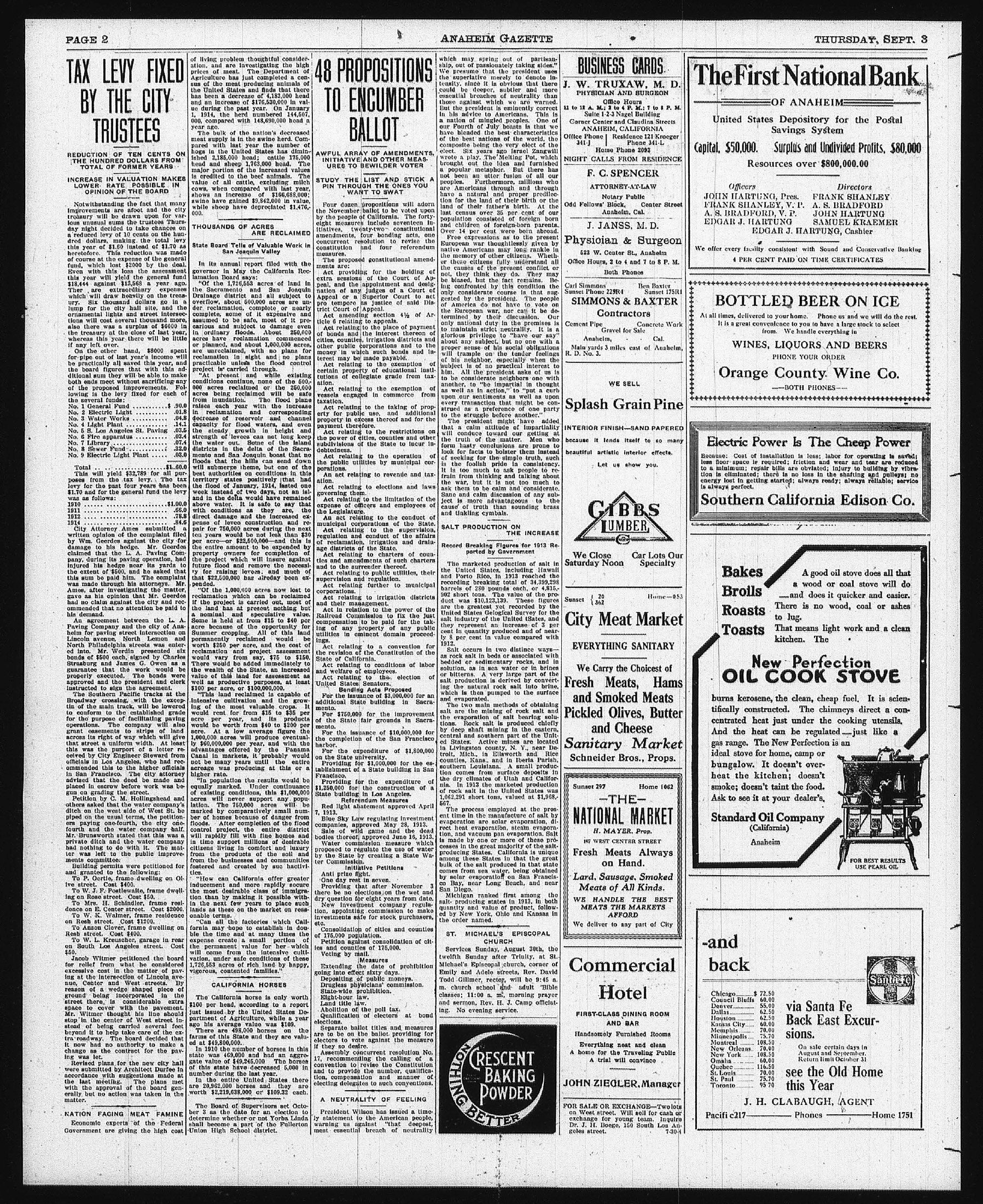
Searchable text
TAX LEVY FIXED BY THE CITY TRUSTEES
REDUCTION OF TEN CENTS ON THE HUNDRED DOLLARS FROM TOTAL OF FORMER YEARS
INCREASE IN VALUATION MAKES LOWER RATE POSSIBLE IN OPINION OF THE BOARD
Notwithstanding the fact that many improvements are afoot and the city treasury will be drawn upon for various unusual sums the trustees Thursday night decided to take chances on a reduced levy of 10 cents on the hundred dollars, making the total levy this year of $1.60 instead of $1.70 as heretofore. This reduction was made of course at the expense of the general fund, which lost $2000 by the deal. Even with this loss the assessment this year will yield the general fund $18,444 against $13,568 a year ago. There are extraordinary expenses which will draw heavily on the treasury. Six thousand dollars go in a lump for the city hall site, and the ornamental lights and street intersections will cost several thousand more, also there was a surplus of $6000 in the treasury at the close of last year, whereas this year there will be little if any left over.
On the other hand, $8000 spent for pipe out of last year's income will be practically all saved this year, and the board figures that with this additional sum they will be able to make both ends meet without sacrificing any of the proposed improvements. Following is the levy fixed for each of the several funds:
No. 1 General Fund . . . $90.0
No. 2 Electric Light . . . 01.8
No. 3 Water Works . . . 04.8
No. 4 Light Plant . . . 14.1
No. 5 S. Los Angeles St. Pavling . . 03.5
No. 6 Fire apparatus . . . 03.4
No. 7 Library . . . 07.4
No. 8 Shower Fund . . . 32.0
of living problem thoughtful consideration, and are investigating the high prices of meat. The Department of Agriculture has just completed a census of the meat producing animals of the United States and finds that there has been a decrease of 4,183,000 head and an increase of $176,530,000 in value during the past year. On January 1, 1914, the herd numbered 144,507,000, compared with 148,690,000 head a year ago.
The bulk of the nation's decreased meat supply is in the swine herd. Compared with last year the number of hogs in the United States has diminished 2,185,000 head; cattle 175,000 head and sheep 1,763,000 head. The major portion of the increased values is credited to the beef animals. The value of all cattle, excluding milch cows, when compared with last year, shows an increase of $166,688,000; swine have gained $9,842,000 in value, while sheep have depreciated $1,476,000.
THOUSANDS OF ACRES ARE RECLAIMED
State Board Tells of Valuable Work in San Joaquin Valley
In its annual report filed with the governor in May the California Reclamation Board says:
"Of the 1,726,553 acres of land in the Sacramento and San Joaquin Drainage district and all subject to overflow, about 500,000 acres are under reclamation, complete or nearly complete, some of it expensive and assumed to be safe, most of it precarious and subject to damage even in ordinary floods. About 250,000 acres have reclamation commenced or planned, and about 1,000,000 acres, are unreclaimed, with no plans for reclamation in sight and no plans practicable unless the flood control project is carried through.
"At present and while existing conditions continue, none of the 500-000 acres reclaimed or the 250,000 acres being reclaimed will be safe from inundation. The flood plane raises each year with the increase in reclamation and corresponding decrease of reservoir and channel capacity for flood waters, and even the steady growth in height and strength of levees can not long keep the water out. Some of the island districts in the delta of the Sacra-
for pipe out of last year's income will be practically all saved this year, and the board figures that with this additional sum they will be able to make both ends meet without sacrificing any of the proposed improvements. Following is the levy fixed for each of the several funds:
No. 1 General Fund ... $90.0
No. 2 Electric Light ... $0.18
No. 3 Water Works ... $0.48
No. 4 Light Plant ... $14.1
No. 5 S. Los Angeles St. Paving ... $0.35
No. 6 Fire apparatus ... $0.34
No. 7 Library ... $0.74
No. 8 Sewer Fund ... $32.0
No. 9 Electric Light Plant ... $0.30
Total ... $1,60.0
This will yield $32,789 for all purposes from the tax levy. The tax levy for the past four years has been $1.70 and for the general fund the levy was as follows:
1910 ... $1,00.0
1911 ... $60.0
1912 ... $78.8
1914 ... $84.6
City Attorney Ames submitted a written opinion of the complaint filed by Wm. Geerdes against the city for damage to his hedge. Mr. Geerdes claimed that the L.A.Paving Company, during its paving operation, had injured his hedge near its yards to the extent of $500, and he asked that this sum be paid him. The complaint was made through his attorneys, Mr. Ames, after investigating the matter, gave as his opinion that Mr. Geerdes had no claim against the city and recommended that no attention be paid to his demand.
An agreement between the L.A.Paving Company and the city of Anaheim for paving street intersection on Lincoln avenue, North Lemon and North Philadelphia streets was entered into. Mr.Werdin presented six bonds of $500 each, signed by Charles Strasburg and James G.Owen as a guarantee that the work would be properly executed. The bonds were approved and the president and clerk instructed to sign the agreement.
The Southern Pacific tracks at the Broadway crossing, with the exception of the main track, will be lowered to conform to the established grade for the purpose of facilitating paving operations. The company will also grant easements to strips of land across its right of way which will give that street a uniform width. At least this was the purport of a letter received by City Engineer Steward from officials in Los Angeles, who had recommended this to the higher officials in San Francisco. The city attorney advised that the deed be made and placed in escrow before work was begun on grading the street.
Petition by C.M.Hollingshead and others asked that the water company's ditch on the west side of West St. be piped on the usual terms, the petitioners paying one-fourth, the city one-fourth and the water company half. Mr.Brunsworth stated that this was a private ditch and the water company had nothing to do with it. The mat-
reclamation in sight and no plans practicable unless the flood control project is carried through.
At present and while existing conditions continue, none of the 500,000 acres reclaimed or the 250,000 acres being reclaimed will be safe from inundation. The flood plane rails each year with the increase in reclamation and corresponding decrease of reservoir and channel capacity for flood waters, and even the steady growth in height and strength of levees can not long keep the water out. Some of the island districts in the delta of the Sacramento and San Joaquin boast that no floods that the hills can send down will submerge theme, but one of the best authorities on conditions in this territory states positively that had the flood of January, 1914, lasted one week instead of two days, not an island in the delta would have remained above water. It is safe to say that with conditions as they are, the direct damage and the increased expense of levee construction and repair for 750,000 acres during the next ten years would be not less than $30 per acre—or $22,500,000—and this is the entire amount to be expended by property owners for completion of the project which will insure against future flood and remove the necessary for raising levees, and much of that $22,500,000 has already been expended.
Of the 1,000,000 acres now lost to reclamation which can be reclaimed if the project is carried out, most of the land has at present nothing but a nominal and speculative value. Some is held at from $15 to $40 per acre because of the opportunity for Summer cropping. All of this land permanently reclaimed would be worth $250 per acre, and the cost of reclamation and project assessment would vary from say, $75 to $150. There would be added immediately to the wealth of the State, an increased value of this land for assessment as well as productive purposes, at least $100 per acre, or $100,000,000.
"This land reclaimed is capable of intensive cultivation and the growing of the most valuable crops. It would rent for from $15 to $35 per acre per year, and its products would be worth from $40 to $200 per acre. At a low average figure the 1,000,000 acres will produce eventually $60,000,000 per year, and with the advantages offered by the Panama Canal in markets, it probably would not be many years until the entire acreage was producing at this or a higher rate.
"In population the results would be equally marked. Under continuance of existing conditions, this $1,000,000 acres will never support any population. The 750,000 acres will be marked by comparatively small number of homes because of danger from floods. After completion of the flood control project, the entire district will rapidly fill with fine homes and in time support millions of desirable citizens living in comfort and luxury
For the issuance additional Statemento.
For $750,000 of the State faction.
For the issuance the completion of harbor.
For the expiration of the State univ.
Providing for a tablishment of an Francisco.
Providing for $1,250,000 for this State building in Reference.
Red light abutting 7,1913.
Blue Sky Law companies, approve Sale of wild bodies thereof; apply Water commissory proposed to regu-
NATION FACING MEAT FAMINE
Economic experts of the Federal Government are giving the high cost
Petition by C. M. Hollingshead and others asked that the water company's ditch on the west side of West St. be piped on the usual terms, the petitioners paying one-fourth, the city one-fourth and the water company half. Mr. Brunsworth stated that this was a private ditch and the water company had nothing to do with it. The matter was left to the public improvements committee.
Building permits were petitioned for and granted to the following:
To P. Oertle, frame dwelling on Olive street. Cost $400.
To W. J. F. Postlewaite, frame dwelling on Rose street. Cost $50.
To Mrs. H. Schindler, frame residence on E. Center street. Cost $2000.
To W. K. Walmer, frame residence on Resh street. Cost $1200.
To Anson Clever, frame dwelling on Resh street. Cost $400.
To W. L. Kreuscher, garage in rear on South Los Angeles street. Cost $50.
Jacob Witter petitioned the board for relief from what he considered excessive cost in the matter of paving at the intersection of Lincoln avenue, Center and West streets. By reason of a wedge shaped piece of ground being incorporated in the street there is considerable extra space to cover with the pavement. Mr. Witter thought his line should stop in the center of West street instead of being carried several feet beyond it to help take care of the extra roadway. The board decided that it now had no authority to make a change as the contract for the paving was let.
Revised plans for the new city hall were submitted by Architect Durfee in accordance with suggestions made at the last meeting. The plans met with the approval of the board generally but no action was taken in the matter.
CALIFORNIA HORSES
The California horse is only worth $100 per head, according to a report just issued by the United States Department of Agriculture, while a year ago his average value was $109.
There are 498,000 horses on the farms of this State and they are valued at $49,800,000.
In 1910 the number of horses in this state was 469,000 and had an aggregate value of $49,245,000. The horses of this state have decreased 5,000 in number during the last year.
In the entire United States there are 20,962,000 horses and they are worth $2,219,638,000 or $109.32 each.
The Board of Supervisors set October 3 as the date for an election to determine whether or not Yorba Linda shall become a part of the Fullerton Union High School district.
In population the results would be equally marked. Under continuance of existing conditions, this $1,000,000 acres will never support any population. The 750,000 acres will be marked by comparatively small number of homes because of danger from floods. After completion of the flood control project, the entire district will rapidly fill with fine homes and in time support millions of desirable citizens living in comfort and luxury from the products of the soil and from the businesses and communities fostered and created by suc hactivities.
"How can California offer greater inducement and more rapidly secure the most desirable class of immigration than by making it possible within the next few years to place such lands as these on the market on reasonable terms."
"Can all the factories which California may hope to establish in double the time and at many times the expense create a small portion of the permanent value for her which will come from the intensive cultivation, under safe conditions of those 1,726,553 acres of rich land by happy, vigorous, contented families."
48 PROPOSITIONS TO ENCUMBER BALLOT
AWFUL ARRAY OF AMENDMENTS, INITIATIVE AND OTHER MEASURES TO BEWILDER VOTER
STUDY THE LIST AND STICK A PIN THROUGH THE ONES YOU WANT TO SWAT
Four dozen propositions will adorn the November ballot to be voted upon by the people of California. The forty-eight measures include seventeen initiatives, twenty-two constitutional amendments, four bonding acts, one concurrent resolution to revise the constitution and four referendum measures.
The proposed constitutional amendments are:
Act providing for the holding of extra sessions of the Court of Appeal, and the appointment and designation of any judges of a Court of Appeal or a Superior Court to act tempore as justice of said District Court of Appeal.
Act amending section 4½ of Article 6 relating to appeals.
Act relating to the place of payment of bonds and the interest thereon of cities, counties, irrigation districts and other public corporations and to the money in which such bonds and interest may be made payable.
Act relating to the exemption of certain property of educational institutions of collegiate grade from taxation.
Act relating to the exemption of vessels engaged in commerce from taxation.
Act relating to the taking of property for public use, and additional property in excess thereof and for the payment therefore.
Act relating to the restrictions on the power of cities, counties and other subdivisions of the State to incur in
which may spring out of partisan ship, out of passionately taking slides."
We presume that the president uses the superlative merely to denote intensity, since it is obvious that there could be deeper, subtler and more essential breaches of neutrality than those against which we are warned. But the president is eminently correct in his advice to Americans. This is a nation of misgled peoples. One of our Fourth of July boasts is that we have blended the best characteristics of the best nations of the world, the composite being the very elect of the elect. Six years ago Israel Zangwill wrote a play, The Melting Pot, which brought out the idea and furnished a popular metaphor. But there has not been an utter fusion of all our peoples. Furthermore, millions who are Americans through and through have a natural and proper predilection for the land of their birth or the land of their father's birth. At the last census over 35 per cent of our population consisted of foreign born and children of foreign-born parents. Over 14 per cent were born abroad.
Free expressions as to the present European war thoughtlessly given by native Americans may long rankle in the memory of other citizens. Whether these citizens fully understand all the causes of the present conflict or not, they think they do. They may be biased, but the fact remains. Being confronted by this condition the only considerate course is that suggested by the president. The people of America do not have to vote on the European war, nor can it be determined by their discussion. Our only national duty in the premises is to maintain strict neutrality. It is a glorious privilege to "have our say" about any subject, but no one with a proper sense of his social obligations will trample on the tender feelings of his neighbor, especially when the subject is of no practical interest to him. All the president asks of us is to be considerate neighbors one with another, to "be impartial in thought as well as in action," to "put a curb upon our sentiments as well as upon every transaction that might be construed as a preference of one party to the struggle before another."
The president might have added that a calm attitude of impartiality will conduce toward our getting at the truth of the matter. Men who form hasty conclusions are prone to...
existing the 600,
250,000 safe plane increase
responding channel and even
ug keep island Sacrathat no down of the in this
hat had
an isl-mained may that
the based exand re the next
man $30 this is added by
of against necessalsuch of een excost to claimed most of
but value.
440 per priority for its land
would entire or a
popu- will be num from the flood district areas and desirable luxury
Act relating to the exemption of educational institutions of collegiate grade from taxation.
Act relating to the exemption of vessels engaged in commerce from taxation.
Act relating to the taking of property for public use, and additional property in excess thereof and for the payment therefore.
Act relating to the restrictions on the power of cities, counties and other subdivisions of the State to incur indebtedness.
Act relating to the operation of the public utilities by municipal corporations.
An act relating to revenue and taxation.
Act relating to elections and laws governing them.
Act relating to the limitation of the expense of officers and employees of the Legislature.
An act relating to the conduct of municipal corporations of the State.
Act relating to the supervision, regulation and conduct of the affairs of reclamation, irrigation and drainage districts of the State.
Act relating to charters of counties and amendments of such charters and to the surrender therefor.
Act relating to public utilities, their supervision and regulation.
Act relating further to municipal corporations.
Act relating to irrigation districts and their management.
Act in relation to the power of the Railroad Commission to fix the just compensation to be paid for the taking of any property of any public utilities in eminent domain proceedings.
Act relating to a convention for the revision of the Constitution of the State of California.
Act relating to conditions of labor and welfare of employees.
Act relating to the election of United States Senators.
Bonding Acts Proposed
For the issuance of $3,000,000 for an additional State building in Sacramento.
For $750,000 for the improvement of the State fair grounds in Sacramento.
For the issuance of $10,000,000 for the completion of the San Francisco harbor.
For the expenditure of $1,800,000 on the state university.
Providing for $1,000,000 for the establishment of a State building in San Francisco.
Providing for the expenditure of $1,250,000 for the construction of a State building in Los Angeles.
Referendum Measures
Red light abatement approved April 7, 1913.
Blue Sky Law regulating investment companies, approved May 28, 1913.
Sale of wild game and the dead bodies thereof, approved June 16, 1913.
Water commission measure which proposed to regulate the use of water
will trample on the tender feelings of his neighbor, especially when the subject is of no practical interest to him. All the president asks of us is to be considerate neighbors one with another, to "be impartial in thought as well as in action," to "put a curb upon our sentiments as well as upon every transaction that might be construed as a preference of one party to the struggle before another."
The president might have added that a calm attitude of impartiality will conduce toward our getting at the truth of the matter. Men who form hasty conclusions are prone to look for facts to bolster them instead of seeking for the simple truth, such is the foolish pride in consistency. It is too much to ask people to refrain from thinking and talking about the war, but it is not too much to ask them to be calm and considerate. Sane and calm discussion of any subject is more advantageous to the cause of truth than sounding brass and tinkling cymbals.
SALT PRODUCTION ON THE INCREASE
Record Breaking Figures for 1913 Reported by Government
The marketed production of salt in the United States, including Hawaii and Porto Rico, in 1913 reached the recording breaking total of 34,399,298 barrels of 280 pounds each, or 4,815,902 short tons. The value of the product was $10,123,139. These figures are the greatest yet recorded by the United States Geological Survey for the salt industry of the United States, and they represent an increase of 3 per cent in quantity produced and of nearly 8 per cent in value compared with 1912.
Salt occurs in two distinct ways—as rock salt in beds or associated with bedded or sedimentary rocks, and in solution, as in sea water or in brines or bitterns. A very large part of the salt production is derived by converting the natural rock salt into brine, which is then pumped to the surface and evaporated.
The two main methods of obtaining salt are the mining of rock salt and the evaporation of salt bearing solutions. Rock salt is produced chiefly by deep shaft mining in the eastern, central and southern part of the United States. Active mines are located in Livingston county, N. Y., near Detroit, Mich., in Ellsworth and Rice counties, Kans., and in Iberia Parish, southern Louisiana. A small production comes from surface deposits in the dry climates of Utah and California. In 1913 the marketed production of rock salt in the United States was 1,062,291 short tons, valued at $1,968,567.
The process employed at the present time in the manufacture of salt by evaporation are solar evaporation, direct heat evaporation, steam evaporation, and vacuum pan evaporation. Salt is made by one or more of these processes in the great majority of the salt.
on the State university.
Providing for $1,000,000 for the establishment of a State building in San Francisco.
Providing for the expenditure of $1,250,000 for the construction of a State building in Los Angeles.
Referendum Measures
Red light abatement approved April 7, 1913.
Blue Sky Law regulating investment companies, approved May 28, 1913.
Sale of wild game and the dead bodies thereof approved June 16, 1913.
Water commission measure which proposed to regulate the use of water by the State by creating a State Water Commission.
Initiative Petitions
Anti prize fight.
One day rest in seven.
Providing that after November 3 there be no elections on the wet and dry question for eight years from date.
New investment company regulation, appointing commission to make investments safe for stock purchasers, etc.
Consolidation of cities and counties of 175,000 population.
Petition against consolidation of cities and counties of 175,000.
Voting by mail.
Measures
Extending the date of prohibition going into effect sixty days.
Depositizing of public moneys.
Drugless physicians' commission.
State-wide prohibition.
Eight-hour law.
Land title law.
Abolition of the poll tax.
Qualification of electors at bond elections.
Separate ballot titles and measures are to be on the ballot providing for electors to vote against the measure if they so desire.
Assembly concurrent resolution No. 17, recommending the calling of a convention to revise the Constitution and to provide the number, qualification, compensation and manner of electing delegates to such conventions.
A NEUTRALITY OF FEELING
President Wilson has issued a timely statement to the American people, warning us against "that deepest, most essential breach of neutrality
ST. MICHAEL'S EPISCOPAL CHURCH
Services Sunday, August 30th, the twelfth Sunday after Trinity, at St. Michael's Episcopal church, corner of Emily and Adela streets, Rev. David Todd Gillmer, rector, will be 9:45 a.m. church school and adult Bible classes; 11:00 a.m. morning prayer and sermon, Rev. H. J. Camp officiating. No evening service.
Commercial Hotel
FIRST-CLASS DINING ROOM AND BAR
Handsomely Furnished Rooms
Everything neat and clean
A home for the Traveling Public
A trial will convince
JOHN ZIEGLER, Manager
FOR SALE OR EXCHANGE—Two lots on West street. Will sell for cash or exchange for young team. Inquire Dr. J. H. Boege, 150 South Los Angeles street.
THURSDAY, SEPT. 3
The First National Bank
OF ANAHEIM
United States Depository for the Postal Savings System
Capital, $50,000. Surplus and Undivided Profits, $80,000
Resources over $800,000.00
Officers
JOHN HARTUNG, Pres.
FRANK SHANLEY
FRANK SHANLEY, V. P.
A. S. BRADFORD
A. S. BRADFORD, V. P.
JOHN HARTUNG
EDGAR J. HARTUNG
SAMUEL KRAEMER
EDGAR J. HARTUNG, Cashler
We offer every facility consistent with Sound and Conservative Banking
4 PER CENT PAID ON TIME CERTIFICATES
BOTTLED BEER ON ICE
At all times, delivered to your home. Phone us and we will do the rest.
It is a great convenience to you to have a large stock to select from. We handle everything in
WINES, LIQUORS AND BEERS
PHONE YOUR ORDER
Orange County Wine Co.
—BOTH PHONES—
Electric Power Is The Cheap Power
PHONE YOUR ORDER
Orange County Wine Co.
—BOTH PHONES—
Electric Power Is The Cheap Power
Because: Cost of installation is less; labor for operating is saved;
less floor space is required; friction and wear and tear are reduced
to a minimum; repair bills are obviated; injury to building by vibration is eliminated; there is no loss in the shafting and pulleys; no
energy lost in getting started; always ready; always reliable; service
is always perfect.
Southern California Edison Co.
Bakes
Broils
Roasts
Toasts
A good oil stove does all that
a wood or coal stove will do
—and does it quicker and easier.
There is no wood, coal or ashes
to lug.
That means light work and a clean
kitchen. The
New Perfection
OIL COOK STOVE
burns kerosene, the clean, cheap fuel. It is scientifically constructed. The chimneys direct a concentrated heat just under the cooking utensils.
And the heat can be regulated—just like a
gas range. The New Perfection is an
ideal stove for home, camp or
bungalow. It doesn't overheat the kitchen; doesn't
smoke; doesn't taint the food.
Ask to see it at your dealer's.
Standard Oil Company
(California)
Anaheim
- and back
Chicago ... $ 72.50
Council Bluffs 60.00
Denver ... 55.00
Dallas ... 62.50
Houston ... 62.50
Kansas City 60.00
Memphis 70.00
Minneapolis 75.70
Montreal 108.50
New Orleans 70.00
New York 108.50
Omaha 60.00
Quebec 116.50
St. Louis 70.00
St. Paul 75.70
Toronto 95.70
via Santa Fe Back East Excursions.
On sale certain days in August and September.
Return limit October 31
see the Old Home this Year
J. H. CLABAUGH, AGENT
Pacifi c217 Phones Home 1751