anaheim-gazette 1914-08-13
Scanned page
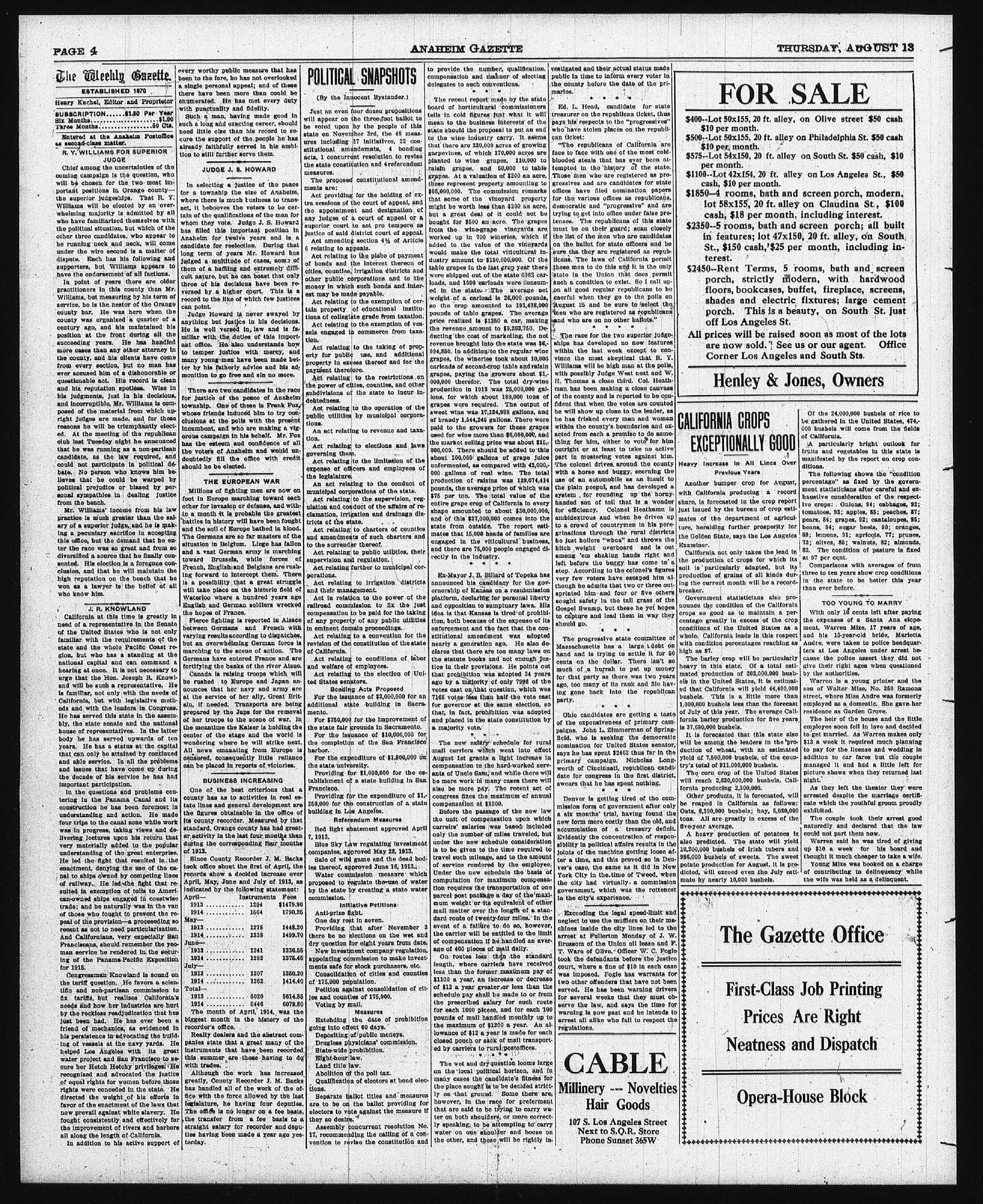
Searchable text
The Weekly Gazette
ESTABLISHED 1870
Henry Kuchel, Editor and Proprietor
SUBSCRIPTION... $1.50 Per Year
Six Months... $1.00
Three Months... $6.00
Entered at the Anaheim Postoffice as second-class matter.
R. Y. WILLIAMS FOR SUPERIOR JUDGE
Chief among the uncertainties of the coming campaign is the question, who will be chosen for the two most important positions in Orange county—the superior judgeships. That R. Y. Williams will be elected by an overwhelming majority is admitted by all who have familiarized themselves with the political situation, but which of the other three candidates, who appear to be running neck and neck, will come under the wire second is a matter of dispute. Each has his following and supporters, but Williams appears to have the endorsement of all factions.
In point of years there are older practitioners in this county than Mr. Williams, but measuring by his term of service, he is the nectar of the Orange county bar. He was here when the county was organized a quarter of a century ago, and his maintained his position at the front during all the succeeding years. He has handled more cases than any other attorney in the county, and his clients have come from every section, but no man has ever accused him of a dishonorable or questionable act. His record is clean and his reputation spotless. Wise in his judgments, just in his decisions, and incorruptible, Mr. Williams is composed of the material from which upright judges are made, and for those reasons he will be triumphantly elected. At the meeting of the republican club last Tuesday night he announced that he was running as a nonpartisan every worthy public measure that has been to the fore, he has not overlooked a single personal appeal; and of these there have been more than could be enumerated. He has met every duty with punctuality and fidelity.
Such a man, having made good in such a long and exacting career, should need little else than his record to secure the support of the people he has already faithfully served in his ambition to still further serve them.
JUDGE J. S. HOWARD
In selecting a justice of the peace for a township the size of Anaheim, where there is much business to transact, it behooves the voters to be certain of the qualifications of the man for whom they vote. Judge J. S. Howard has filled this important position in Anaheim for twelve years and is a candidate for reelection. During that long term of years Mr. Howard has judged a multitude of cases, some of them of a hailing and extremely difficult nature, but he can boast that only three of his decisions have been reversed by a higher court. This is a record to like of which few justices can point.
Judge Howard is never swayed by anything but justice in his decisions. He is well versed in law and is familiar with the duties of this important office. He also understands how to temper justice with mercy, and many young men have been made better by his fatherly advice and his admonition to go free and sin no more.
There are two candidates in the race for justice of the peace of Anaheim township. One of these is Frank Fox, whose friends induced him to try conclusions at the polls with the present incumbent, and who are making a vigorous campaign in his behalf. Mr. Fox has the esteem and confidence of all
the county, and his clients have come from every section, but no man has ever accused him of a dishonorable or questionable act. His record is clean and his reputation spotless. Wise in his judgments, just in his decisions, and incorruptible, Mr. Williams is composed of the material from which upright judges are made, and for those reasons he will be triumphantly elected. At the meeting of the republican club last Tuesday night he announced that he was running as a non-partisan candidate, as the law required, and could not participate in political debate. No person who knows him believes that he could be warped by political prejudice or blamed by personal sympathies in dealing justice from the bench.
Mr. Williams' income from his law practice is much greater than the salary of a superior judge, and he is making a pecuniary sacrifice in accepting this office, but the demand that he enter the race was so great and from so diversified a source that he finally consented. His election is a foregone conclusion, and that he will maintain the high reputation on the bench that he won as a lawyer is the belief of all who know him.
J. R. KNOWLAND
California at this time is greatly in need of a representative in the Senate of the United States who is not only familiar with the requirements of the state and the whole Pacific Coast region, but who has a standing at the national capital and can command a hearing at once. It is not necessary to urge that the Hon. Joseph R. Knowland will be such a representative. He is familiar, not only with the needs of California, but with legislative methods and with the leaders in Congress. He has served this state in the assembly, the state senate and the national house of representatives. In the latter body he has served upwards of ten years. He has a status at the capital that can only be attained by continued and able service. In all the problems and issues that have come up during the decade of his service he has had important participation.
In the questions and problems centering in the Panama Canal and its construction he has been foremost in understanding and action. He made four trips to the canal zone while work was in progress, taking views and delivering lectures upon his return that very materially added to the popular
THE EUROPEAN WAR
Millions of fighting men are now on foot in Europe marching toward each other for invasion or defense, and within a month it is probable the greatest battles in history will have been fought and the soil of Europe bathed in blood. The Germans are so far masters of the situation in Belgium. Liege has fallen and a vast German army is marching toward Brussels, while forces of French, English and Belgians are rushing forward to intercept them. There is a possibility that a great struggle will take place on the historic field of Waterloo where a hundred years ago English and German soldiers wrecked the hopes of France.
Fierce fighting is reported in Alsace between Germans and French with varying results according to dispatches, but an overwhelming German force is marching to the scene of action. The Germans have entered France and are fortifying the banks of the river Alsue. Canada is raising troops which will be rushed to Europe and Japan announces that her navy and army are at the service of her ally, Great Britain, if needed. Transports are being prepared by the Japs for the removal of her troops to the scene of war. In the meantime the Kaiser is holding the center of the stage and the world is wondering where he will strike next. All news emanating from Europe is censored, consequently little reliance can be placed in reports of victories.
BUSINESS INCREASING
One of the best criterions that a county has as to activities in real estate lines and general development are the figures obtainable in the office of its county recorder. Measured by that standard, Orange county has had greater activity in the last four months than during the corresponding four months of 1918.
There are two candidates in the race for justice of the peace of Anaheim township. One of these is Frank Fox, whose friends induced him to try conclusions at the polls with the present incumbent, and who are making a vigorous campaign in his behalf. Mr. Fox has the esteem and confidence of all the voters of Anaheim and would undoubtedly fill the office with credit should he be elected.
For the issuance of additional state benitoi.
For $750,000 for the state fair ground.
For the issuance of completion of harbor.
For the expenditure of state university.
Providing for $11 million tabulation of a state Francisco.
Providing for the 250,000 for the construction in Los Anos.
Referendum.
Red light abatem 7, 1913.
Blue Sky Law re-
In the questions and problems centering in the Panama Canal and its construction he has been foremost in understanding and action. He made four trips to the canal zone while work was in progress, taking views and delivering lectures upon his return that very materially added to the popular understanding of the great enterprise. He led the fight that resulted in exemption of tolls to American-owned ships engaged in coastwise trade; and he naturally was in the van of those who fought to prevent the repeal of the provision—a proceeding so recent as not to need particularization. And Californians, very especially San Franciscoans, should remember the yeoman service he rendered in the securing of the Panama-Pacific Exposition for 1915.
Congressman Knowland is sound on the tariff question. He favors a scientific and non-partisan commission to fix tariffs, but realizes California's needs and how her industries are hurt by the rockless readjudication that has just been had. He has ever been a friend of mechanics, as evidenced in his persistence in advocating the building of vessels at the navy yards. He helped Los Angeles with its great water project and San Francisco to secure her Hetch Hetchy privileges. He recognized and advocated the justice of equal rights for women before those rights were conceded in the state. He directed the weight of his efforts in favor of the enactment of the laws that now prevail against white slavery. He fought consistently and effectively for the improvement of rivers and harbors all along the length of California.
In addition to his active support of
BUSINESS INCREASING
One of the best criterions that a county has as to activities in real estate lines and general development are the figures obtainable in the office of its county recorder. Measured by that standard, Orange county has had greater activity in the last four months than during the corresponding four months of 1913.
Since County Recorder J. M. Backs took office about the first of April, the records show a decided increase over April, May, June and July of 1913, as indicated by the following statement:
April— Instruments Fees
1913 ... 1294 $1479.90
1914 ... 1564 1790.25
May—
1913 ... 1278 1448.20
1914 ... 1338 1499.70
June—
1913 ... 1241 1336.55
1914 ... 1282 1375.45
July—
1913 ... 1207 1350.20
1914 ... 1262 1414.40
Total—
1913 ... 5020 6614.85
1914 ... 5446 6079.80
The month of April, 1914, was the biggest month in the history of the recorder's office.
Reality dealers and the abstract companies state that a great many of the instruments that have been recorded this summer are those having to do with trades.
Although the work has increased greatly, County Recorder J. M. Backs has handled all of the work of the office with the force allowed by the last legislature, he having four deputies. The office is no longer on a fee basis, the transfer from a fee basis to a straight salary for recorder and deputies having been made a year ago yesterday.
For the expenditure the state university Providing for $125,000 tabulation of a state Francisco.
Providing for the 250,000 for the construction in Los Anos Referendum Red light abatem 7, 1913.
Blue Sky Law recompanies, approves Sale of wild games thereof, approved Water commissions proposed to regulate by the state by civil commission.
Initiative Anti-prize fight.
One day rest in a Providing that there be no electric dry question for elec New investment appointing commissions safe for stock Consolidation of 175,000 population Petition against jes and counties of Voting by mail.
Mea Extehding the going into effect 60 Depositizing of public Druggles physicist State-wide prohibition Eight-hour law Land title law Abolition of the Qualification of elections.
Separate ballot are to be on the electors to vote agile they so desire.
Assembly concurs 17, recommendingvention to revise
POLITICAL SNAPSHOTS
(By the Innocent Bystander.)
Just an even four dozen propositions will appear on the three-foot ballot to be voted upon by the people of this state on November 3rd, the 48 measures including 17 initiatives, 22 constitutional amendments, 4 bonding acts, 1 concurrent resolution to revise the state constitution and 4 referendum measures.
The proposed constitutional amendments are:
Act providing for the holding of extra sessions of the court of appeal, and the appointment and designation of any judges of a court of appeal or a superior court to act pro tempore as justice of said district court of appeal.
Act amending section 4½ of Article 6 relating to appeals.
Act relating to the place of payment of bonds and the interest thereon of cities, counties, irrigation districts and to the money in which such bonds and interest may be made payable.
Act relating to the exemption of certain property of educational institutions of collegiate grade from taxation.
Act relating to the exemption of vessels engaged in commerce from taxation.
Act relating to the taking of property for public use, and additional property in excess thereof and for the payment therefore.
Act relating to the restrictions on the power of cities, counties, and other subdivisions of the state to incur indebtedness.
Act relating to the operation of the public utilities by municipal corporations.
An act relating to revenue and taxation.
Act relating to elections and laws
to provide the number, qualification, compensation and manner of electing delegates to such conventions.
The recent report made by the state board of horticultural commissioners tells in cold figures just what it will mean to the business interests of the state should the proposal to put an end to the wine industry carry. It seems that there are 330,000 acres of growing garpivines, of which 170,000 acres are planted to wine grapes, 110,000 to raisin grapes, and 50,000 to table grapes. At a valuation of $200 an acre, these represent property amounting to $66,000,000. The commission remarks that some of the vineyard property might be worth less than $200 an acre, but a great deal of it could not be bought for $500 an acre. The grapes from the wine-grape vineyards are worked up in 700 wineries, which if added to the value of the vineyards would make the total viticultural industry amount to $150,000,000. Of the table grapes in the last grow year there were shipped out of the state 6363 carloads, and 1000 carloads were consumed in the state. The average net weight of a carload is 26,000 pounds, so the crop amounted to 191,438,000 pounds of table grapes. The average price realized is $1250 a car, making the revenue amount to $9,203,750. Deducting the cost of marketing, the net revenue brought into the state was $6,994,850. In addition to the regular wine grapes, the wineries took about 10,000 carloads of second-crop table and raisin grapes, paying the growers about $1,000,000 therefor. The total dry-wine production in 1913 was 25,000,000 gallons, for which about 180,000 tons of grapes were required. The output of sweet wine was 17,134,988 gallons, and of brandy 1,544,245 gallons. There were paid to the growers for these grapes used for wine more than $6,000,000, and the market selling price was about $15. There should be this type of investigation and their actual status made public in time to inform every voter in the county before the date of the primaries.
Ed. L. Head, candidate for state treasurer on the republican ticket, thus pays his respects to the "progressives" who have stolen places on the republican ticket:
"The republicans of California are face to face with one of the most cold-blooded steals that has ever been attempted in the history of the state. Those men who are registered as progressives and are candidates for state offices have filed nomination papers for the various offices as republicans, democratic and "progressive" and are trying to get into office under false pretenses. The republicans of this state must be on their guard; scan closely the list of the men who are candidates on the ballot for state officers and be sure that they are registered as republicans. The laws of California permit these men to do this and it is only state in the Union that does permit such a condition to exist. So I call upon all good regular republicans to be caerful when they go to the polls on August 25 and be sure to select the men who are registered as republicans and who are on no other ballots."
The race for the two superior judgements has developed no new features within the last week except to convince the most skeptical that R. Y. Williams will be high man at the polls, with possibly Judge West next W. H. Thomas a close third. Col. Heathman has been making a close canvass of the county and is reported to be confident that when the votes are counted he will show up close to the leader, as he has frisked every man and woman within the county's boundaries and exacted from each a promise to do something for him either to vote for him outright or at least to take no active
For public use and additional property in excess thereof and for the payment therefore.
Act relating to the restrictions on the power of cities, counties, and other subdivisions of the state to incur indebtedness.
Act relating to the operation of the public utilities by municipal corporations.
An act relating to revenue and taxation.
Act relating to elections and laws governing them.
Act relating to the limitation of the expense of officers and employees of the legislature.
An act relating to the conduct of municipal corporations of the state.
Act relating to the supervision, regulation and conduct of the affairs of reclamation, irrigation and drainage districts of the state.
Act relating to charters of counties and amendments of such charters and to the surrender thereof.
Act relating to public utilities, their supervision and regulation.
Act relating further to municipal corporations.
Act relating to irrigation districts and their management.
Act in relation to the power of the railroad commission to fix the just compensation to be paid for the taking of any property of any public utilities in eminent domain proceedings.
Act relating to a convention for the revision of the constitution of the state of California.
Act relating to conditions of labor and welfare of employees.
Act relating to the election of United States senators.
Bonding Acts Proposed
For the issuance of $3,000,000 for an additional state building in Sacramento.
For $750,000 for the improvement of the state fair grounds in Sacramento.
For the issuance of $10,000,000 for the completion of the San Francisco harbor.
For the expenditure of $1,800,000 on the state university.
Providing for $1,000,000 for the establishment of a state building in San Francisco.
Providing for the expenditure of $1,250,000 for the construction of a state building in Los Angeles.
Referendum Measures
Red light abatement approved April 7, 1913.
Blue Sky Law regulating investment securities approved May 28, 1913.
grapes, the wineries took about 10,000 carloads of second-crop table and raisin grapes, paying the growers about $1,000,000 therefor. The total dry-wine production in 1913 was 25,000,000 gallons, for which about 180,000 tons of grapes were required. The output of sweet wine was 17,134,988 gallons, and brandy 1,544,245 gallons. There were paid to the growers for these grapes used for wine more than $6,000,000, and the market selling price was about $15,000,000. There should be added to this about 100,000 gallons of grape juice unfermented, as compared with 42,000,000 gallons of real wine. The total production of raisins was 129,074,414 pounds, the average price of which was $75 per ton. The total value of the entire grape crop of California in every shape amounted to about $30,000,000, and of this $27,000,000 comes into the state from outside. The report estimates that 15,000 heads of families are engaged in the viticultural business, and there are 75,000 people engaged directly in the industry.
Ex-Mayor J. B. Billard of Topeka has announced his candidacy for the governorship of Kansas on a resubmission platform, declaring for personal liberty and opposition to sumptuary laws. His idea is that Kansas is tired of prohibition, both because of the expense of its enforcement and the fact that the constitutional amendment was adopted nearly a generation ago. He also declares that there are too many laws on the statute books and not enough justice in their provisions. He points out that prohibition was adopted 34 years ago by a majority of only 7998 of the votes cast on that question, which was 7168 votes less than half the vote cast for governor at the same election, so that, in fact, prohibition was adopted and placed in the state constitution by a majority vote.
The new salary schedule for rural mail carriers which went into effect August 1st grants a light increase in compensation to the hard-worked servants of Uncle Sam; and while there will be more work in many cases there will also be more pay. The recent act of congress fixes the maximum annual compensation at $1200.
Before the passage of the new law the unit of compensation upon which carrels' salaries was based included only the number of miles traveled, but under the new schedule consideration is to be given to the time required to
vince most skeptical that R. Y. Williams will be high man at the polls, with possibly Judge West next and W. H. Thomas a close third. Col. Heathman has been making a close canvass of the county and is reported to be confident that when the votes are counted he will show up close to the leader, as he has frisked every man and woman within the county's boundaries and expected from each a promise to do something for him either to vote for him outright or at least to take no active part in mustering votes against him. The colonel drives around the county with a horse and buggy, scoring the use of an automobile as an insult to the plain peepul, and has developed a system for rounding up the horny-handed son of toll that is a wonder for efficiency. Colonel Heatham is ambidextrous and when he drives up to a crowd of countrymen in his peregrinations through the rural districts he just hollers "whoa" and throws the hitch weight overboard and is out among 'em shaking hands right and left before the buggy has come to a stop. According to the colonel's figures very few voters have escaped him although he admits that two or three outsprinted him and four or five others sought safety in the tall grass of the Gospel Swamp, but these he yet hopes to capture and lead them in way they should go.
The progressive state committee of Massachusetts has a large debt on hand and is trying to settle it for 50 cents on the dollar. There isn't so much of a hurrah to put up money for that party as there was two years ago, too many of its rank and file having gone back into the republican party.
Ohio candidates are getting a taste of the expensiveness of primary campaigns, John L. Zimmerman of Springfield, who is seeking the democratic nomination for United States senator, says he has spent $2463 thus far in the primary campaign. Nicholas Longworth of Cincinnati, republican candidate for congress in the first district, swears that he has spent nothing.
Denver is getting tired of the commission form of government after only a six months' trial, having found the new form more costly than the old, and accumulation of a treasury deficit. Evidently the concentration of responsibility in political affair results in the victory machine leaving little room for public use and additional property in excess thereof and for the payment therefore.
Act relating to the restrictions on the power of cities, counties,and other subdivisions of the state to incur indebtedness.
Act relating to the operation of the public utilities by municipal corporations.
An act relating to revenue and taxation.
Act relating to elections and laws governing them.
Act relating to the limitation of the expense of officers and employees of the legislature.
An act relating to conduct of municipal corporations of the state.
Act relating to the supervision,regulationandconductionoftheaffairsofreclamation,irrigationanddrainagedistrictsofthestate.
Act relatingtochartersofcountiesandamendmentsofsuchchartersandtothesurrenderthereof.
Act relatingtopublicutilities,theirsupervisionandregulation.
Act relatingfurthertowmunicipalcorporations.
Act relatingtoirrigationdistrictsandtheirmanagement.
Actinrelationtopoweroftherailroadcommissiontofixjustcompensationtobepaidforthetakingofanypropertyofanypublicutilitiesineminentdomainproceedings.
Act relatingtoa ConventionfortherevisionoftheconstitutionofthestateofCalifornia.
Act relatingtoconditionsoflaborandwelfareofemployees.
Act relatingtotheelectionofUnitedStatessenators.
BondingActionsProposed
Fortheissuanceof$3,ooo,millionforanadditionalstatebuildinginSacramento.
For$750,ooofortheimprovementofthestatefairgroundsinSacramento.
Fortheissuanceof$10,ooo,millionforthecompletionofthesSanFranciscoharbor.
Fortheexpenditureof$1,ooo,milliononthestateuniversity.
Providingfor$1,ooo,millionfortheestablishmentofastatebuildinginSanFrancisco.
Providingfortheexpenditureof$1,-25o,millionfortheconstructionofastatebuildinginLosAngeles.
ReferendumMeasures
RedlightabatementapprovedApril7,1913。
BlueSkyLawregulatingInvestmentsecuritiesapprovedMay28,1913。
For the expenditure of $1,800,000 on the state university.
Providing for $1,000,000 for the establishment of a state building in San Francisco.
Providing for the expenditure of $1,250,000 for the construction of a state building in Los Angeles.
Referendum Measures
Red light abatement approved April 7, 1913.
Blue Sky Law regulating investment companies, approved May 28, 1913.
Sale of wild game and the dead bodies thereof, approved June 16, 1913.
Water commission measure which proposed to regulate the use of water by the state by creating a state water commission.
Initiative Petitions
Anti-prize fight.
One day rest in seven.
Providing that after November 3 there be no elections on the wet and dry question for eight years from date.
New investment company regulation appointing commission to make investments safe for stock purchasers, etc.
Consolidation of cities and counties of 175,000 population.
Petition against consolidation of cities and counties of 175,000.
Voting by mail.
Measures
Extehding the date of prohibition going into effect 60 days.
Depositing of public moneys.
Drugless physicians' commission.
State-wide prohibition.
Eight-hour law.
Land title law.
Abolition of the poll tax.
Qualification of electors at bond elections.
Separate ballot titles and measures are to be on the ballot providing for electors to vote against the measure if they so desire.
Assembly concurrent resolution No. 17, recommending the calling of a convention to revise the constitution and
August last grants a light increase in compensation to the hard-worked servants of Uncle Sam, and while there will be more work in many cases there will also be more pay. The recent act of congress fixes the maximum of annual compensation at $1200.
Before the passage of the new law the unit of compensation upon which carreirs' salaries was based included only the number of miles traveled, but under the new schedule consideration is to be given to the time required to travel such mileage, and to the amount of service rendered by the employee. Under the new schedule the basis of computation for maximum compensation requires the transportation of one parcel post package a day of the maximum weight or its equivalent of other mail matter over the length of a standard route of twenty-four miles. In the event of a failure to do so, however, the carrier will be entitled to the limit of compensation if he handled an average of 400 pieces of mail daily.
On routes less than the standard length, where carriers have received less than the former maximum pay of $1100 a year, an increase or decrease of $12 a year greater or less than the schedule pay shall be made to or from the prescribed salary for such route for each 1000 pieces, and for each 100 pounds of mail handled monthly up to the maximum of $1200 a year. An allowance of $12 a year is made for each closed pouch or sack of mail transported by carriers to rural post offices.
The wet and dry question looms large on the local political horizon, and in many cases the candidate's fitness for the place sought is to be decided strictly on that ground. Some there are, however, in the race for preferment that are said to be trying to carry water on both shoulders, or more correctly speaking, to be attempting to carry water on one shoulder and booze on the other, and these will be rigidly in-
Denver is getting tired of the commission form of government after only a six months' trial, having found the new form more costly than the old, and accumulation of a treasury deficit. Evidently the concentration of responsibility in political affairs results in the joints of the machine getting loose after a time, and this proved so in Denver's case, the same as it did in New York City in the time of Tweed, when the city had virtually a commission government, which was the rottenest in the city's experience.
Exceeding the speed limit and neglect to use the mufflers on their machines inside the city lines led to the arrest at Fullerton Monday of J. W. Brussom of the Union oil lease and F. T. Ware of Olive. Officer W. C. Fogle took the defendants before the justice court, where a fine of $10 in each case was imposed. Fogle has warrants for two other offenders that have not been served. He has been warning drivers for several weeks that they must observe the law, and says the time for warning is now past and he intends to arrest all alike who fail to respect the regulations.
CABLE Millinery --- Novelties Hair Goods
107 S. Los Angeles Street Next to S.Q.R. Store Phone Sunset 365W
FOR SALE
$400--Lot 50x155, 20 ft. alley, on Olive street $50 cash
$10 per month.
$500--Lot 50x155, 20 ft. alley on Philadelphia St. $50 cash
$10 per month.
$575--Lot 54x150, 20 ft. alley on South St. $50 cash, $10
per month.
$1100--Lot 42x154, 20 ft. alley on Los Angeles St., $50
cash, $10 per month.
$1850--4 rooms, bath and screen porch, modern,
lot 58x155, 20 ft. alley on Claudina St., $100
cash, $18 per month, including interest.
$2350--5 rooms, bath and screen porch; all built
in features; lot 47x150, 20 ft. alley, on South
St., $150 cash,'$25 per month, including interest.
$2450--Rent Terms, 5 rooms, bath and screen
porch, strictly modern, with hardwood floors,
bookcases, buffet, fireplace, screens,
shades and electric fixtures; large cement
porch. This is a beauty, on South St. just
off Los Angeles St.
All prices will be raised soon as most of the lots
are now sold." See us or our agent. Office
Corner Los Angeles and South Sts.
Henley & Jones, Owners
CALIFORNIA CROPS
EXCEPTIONALLY GOOD
Of the 24,000,000 bushels of rice to
be gathered in the United States, 474,
000 bushels will come from the fields
of California.
A particularly bright outlook for
CALIFORNIA CROPS EXCEPTIONALLY GOOD
Heavy Increase in All Lines Over Previous Years
Another bumper crop for August, with California producing a record share, is forecasted in the crop report just issued by the bureau of crop estimates of the department of agriculture, heralding further prosperity for the Golden State, says the Los Angeles Examiner.
Government statisticians also pronounce the condition of the California crops so good as to maintain a percentage greatly in excess of the crop conditions of the United States as a whole. California leads in this respect with condition percentages reaching as high as 97.
The barley crop will be particularly heavy in this state. Of a total estimated production of 203,000,000 bushels in the United States, it is estimated that California will yield 44,400,000 bushels. This is a little more than 1,000,000 bushels less than the forecast of July of this year. The average California barley production for five years is 37,690,000 bushels.
It is forecasted that this state also will be among the leaders in the production of wheat, with an estimated yield of 7,500,000 bushels, of the country's total of 911,000,000 bushels.
The corn crop of the United States will reach 2,630,000,000 bushels, California producing 2,300,000.
Other products, it is forecasted, will be reaped in California as follows: Oats, 8,390,000 bushels; hay, 5,080,000 tons. All are greatly in excess of the five-year average.
A heavy production of potatoes is also predicted. The state will yield 10,200,000 bushels of Irish tubers andOf the 24,000,000 bushels of rice to be gathered in the United States, 474,000 bushels will come from the fields of California.
A particularly bright outlook for fruits and vegetables in this state is manifested by the report on crop conditions.
The following shows the "condition percentage" as fixed by the government statisticians after careful and exhaustive consideration of the respective crops: Onions, 94; cabbages, 92; tomatoes, 93; apples, 85; peaches, 87; pears, 84; grapes, 92; cantaloupes, 95; beans, 94; sugar beets, 90; oranges, 88; lemons, 91; apricots, 77; prunes, 73; olives, 85; walnuts, 82; almonds, 83. The condition of pasture is fixed at 97 per cent.
Comparisons with averages of from three to ten years show crop conditions in the state to be better this year than ever before.
TOO YOUNG TO MARRY
With only 10 cents left after paying the expenses of a Santa Ana elopement, Warren Mize, 17 years of age, and his 15-year-old bride, Marietta Andre, were taken to police headquarters at Los Angeles under arrest because the police assert they did not give their right ages when questioned by the authorities.
Warren is a young printer and the son of Walter Mize. No. 350 Ramona street, where Miss Andre was formerly employed as a domestic. She gave her residence as Garden Grove.
The heir of the house and the little employee soon fell in love and decided to get married. As Warren makes only $13 a week it required much planning to pay for the license and wedding in addition to car fares but the couple managed it and had a little left for picture shows when they returned last night.
As they left the theater they were arrested despite the marriage certificate which the youthful groom proudly exhibited.
The couple took their arrest good naturedly and declared that the law could not part them now.
Warren said he was tired of giving $10 a week for his board and
The Gazette Office
First-Class Job Printing
Prices Are Right
Neatness and Dispatch
Opera-House Block