anaheim-gazette 1914-08-13
Scanned page
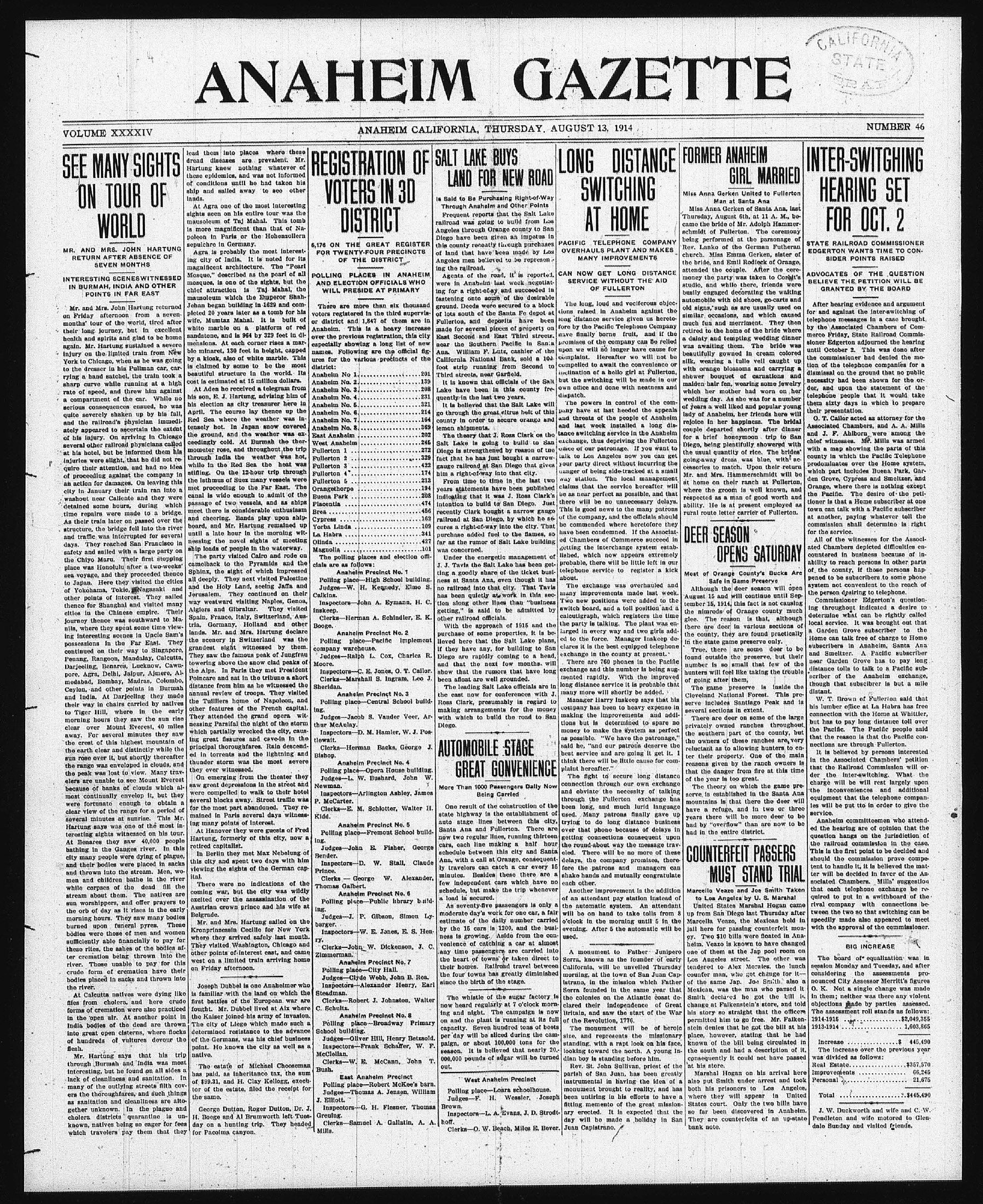
Searchable text
SEE MANY SIGHTS ON TOUR OF WORLD
MR. AND MRS. JOHN HARTUNG RETURN AFTER ABSENCE OF SEVEN MONTHS
INTERESTING SCENES WITNESSED IN BURMAH, INDIA AND OTHER POINTS IN FAR EAST
Mr. and Mrs. John Hartung returned on Friday afternoon from a seven-months' tour of the world, tired after their long journey, but in excellent health and spirits and glad to be home again. Mr. Hartung sustained a severe injury on the limited train from New York to Chicago, when as he was going to the dresser in his Pullman car, carrying a hand satchel, the train took a sharp curve while running at a high rate of speed, and threw him against a compartment of the car. While no serious consequences ensued, he was quite severely shaken up by his fall, and the railroad's physician immediately appeared to ascertain the extent of his injury. On arriving in Chicago several other railroad physicians called lead them into places where these dread diseases are prevalent. Mr. Hartung knew nothing whatever of these epidemics, and was not informed of conditions until he had taken his ship and sailed away to see other lands.
At Agra one of the most interesting sights seen on his entire tour was the mausoleum of Taj Mahal. This tomb is more magnificent than that of Napoleon in Paris or the Hohenzollern sepulchre in Germany.
Agra is probably the most interesting city of India. It is noted for its magnificent architecture. The "Pearl Mosque," described as the pearl of all mosques, is one of the sights, but the chief attraction is Taj Mahal, the mausoleum which the Emperor Shah-Jehan began building in 1629 and completed 20 years later as a tomb for his wife, Mumtaz Mahal. It is built of white marble on a platform of red sandstone, and is 964 by 329 feet in dimensions. At each corner rises a marble minaret, 130 feet in height, capped by a kiosk, also of white marble. This is claimed by some to be the most beautiful structure in the world. Its cost is estimated at 15 million dollars.
At Aden he received a telegram from his son, E. J. Hartung, advising him of his election as city treasurer here in April. The course lay thence up the Red Sea where the weather was intensely hot. In Japan snow covered the ground, and the weather was exceedingly cold. At Burmah the thermometer rose and throughout the trin...
York to Chicago, when as he was going to the dresser in his Pullman car, carrying a hand satchel, the train took a sharp curve while running at a high rate of speed, and threw him against a compartment of the car. While no serious consequences ensued, he was quite severely shaken up by his fall, and the railroad's physician immediately appeared to ascertain the extent of his injury. On arriving in Chicago several other railroad physicians called at his hotel, but be informed them his injuries were slight, that he did not require their attention, and had no idea of proceeding against the company in an action for damages. On leaving this city in January their train ran into a washout near Caliente and they were detained some hours, during which time repairs were made to a bridge. As their train later on passed over the structure, the bridge fell into the river and traffic was interrupted for several days. They reached San Francisco in safety and sailed with a large party on the Chiyo Maru. Their first stopping place was Honolulu after a two-weeks' sea voyage, and they proceeded thence to Japan. Here they visited the cities of Yokohama, Tokio, Nagasaki and other points of interest. They sailed thence for Shanghai and visited many cities in the Chinese empire. Their journey thence was southward to Manila, where they spent some time viewing interesting scenes in Uncle Sam's possessions in the Far East. They continued on their way to Singapore, Penang, Rangoon, Mandalay, Calcutta, Darjeeling, Benares, Lucknow, Cawnpore, Agra, Delhi, Jaipur, Ajmere, Almedabad, Bombay, Madras, Colombo, Ceylon, and other points in Burmah and India. At Darjeeling they made their way in chairs carried by natives to Tiger Hill, where in the early morning hours they saw the sun rise clear over Mount Everest, 40 miles away. For several minutes they saw the crest of this highest mountain of the earth clear and distinctly while the sun rose over it, but shortly thereafter the range was enveloped in clouds, and the peak was lost to view. Many travelers are unable to see Mount Everest because of banks of clouds which almost continually envelop it, but they were fortunate enough to obtain a clear view of the range for a period of several minutes at sunrise. This Mr. Hartung says was one of the most interesting sights witnessed on his tour. At Benares they saw 40,000 people bathing in the Ganges river. In this by a klosk, also of white marble. This is claimed by some to be the most beautiful structure in the world. Its cost is estimated at 15 million dollars.
At Aden he received a telegram from his son, E. J. Hartung, advising him of his election as city treasurer here in April. The course lay thence up the Red Sea where the weather was intensely hot. In Japan snow covered the ground, and the weather was exceedingly cold. At Burmah the thermometer rose, and throughout the trip through India the weather was hot, while in the Red Sea the heat was stifling. On the 12-hour trip through the Isthmus of Suez many vessels were met proceeding to the Far East. The canal is wide enough to admit of the passage of two vessels, and as ships meet there is considerable enthusiasm and cheering. Bands play upon shipboard, and Mr. Hartung remained up until a late hour in the morning witnessing the novel sights of meeting ship loads of people in the waterway.
The party visited Cairo and rode on camelback to the Pyramids and the Sphinx, the sight of which impressed all deeply. They next visited Palestine and the Holy Land, seeing Jaffa and Jerusalem. They continued on their way westward visiting Naples, Genoa, Algiers and Gibraltar. They visited Spain, France, Italy, Switzerland, Austria, Germany, Holland and other lands. Mr. and Mrs. Hartung declare the scenery in Switzerland was the grandest sight witnessed by them. They saw the famous peak of Jungfrau towering above the snow clad peaks of the Alps. In Paris they met President Policare and sat in the tribune a short distance from him as he witnessed the annual review of troops. They visited the Tuilliers home of Napoleon, and other features of the French capital. They attended the grand opera witnessing Parsifal the night of the storm which partially wrecked the city, causing great fissures and cave-in in the principal thoroughfares. Rain descended in torrents and the lightning and thunder storm was the most severe they ever witnessed.
On emerging from the theater they saw great depressions in the street and were compelled to walk to their hotel several blocks away. Street traffic was for the most part abandoned. They remained in Paris several days witnessing many points of interest.
At Hanover they were guests of Fred Hartung, formerly of this city, now a retired capitalist.
Anaheim No 1...
Anaheim No 2...
Anaheim No 3...
Anaheim No 4...
Anaheim No 5...
Anaheim No 6...
Anaheim No 7...
Anaheim No 8...
East Anaheim...
West Anaheim...
Fullerton 1...
Fullerton 2...
Fullerton 3...
Fullerton 4*...
Fullerton 5...
Orangethorpe...
Buena Park...
Placentla...
Brea...
Cypress...
Yorba Linda...
La Habra...
Olinda...
Magnolia...
sun rose over it, but shortly thereafter the range was enveloped in clouds, and the peak was lost to view. Many travelers are unable to see Mount Everest because of banks of clouds which almost continually envelop it, but they were fortunate enough to obtain a clear view of the range for a period of several minutes at sunrise. This Mr. Hartung says was one of the most interesting sights witnessed on his tour. At Benares they saw 40,000 people bathing in the Ganges river. In this city many people were dying of plague, and their bodies were placed in sacks and thrown into the stream. Men, women and children bathe in the river while corpses of the dead fill the stream about them. The natives are sun worshippers, and offer prayers to the orb of day as it rises in the early morning hours. They saw many bodies burned upon funeral pyres. These bodies were those of men and women sufficiently able financially to pay for these rites, the ashes of the bodies after cremation being thrown into the river. Those unable to pay for this crude form of cremation have their bodies placed in sacks and thrown into the river.
At Calcutta natives were dying like flies from cholera, and here crude forms of cremation were also practiced in the open air. At another point in India bodies of the dead are thrown into great open clisterns, where flocks of hundreds of vultures devour the flesh.
Mr. Hartung says that his trip through Burmah and India was most interesting, but he found on all sides a lack of cleanliness and sanitation. In many of the outlying streets filth covers the thoroughfares, and such things as sanitation and cleanliness are altogether unknown. In the plague and cholera districts quarantine is unknown, natives being so eager for fees which travelers pay them that they
Joseph Dubbel is one Anahelmer who is familiar with the land on which the first battles of the European war are fought. Mr. Dubbel lived at Alx where the Kaiser joined his army of invasion. The city of Liege which made such a determined resistance to the advance of the Germans, was his chief business point. He knows the city as well as a native.
The estate of Michael Chooseman has paid, as inheritance tax, the sum of $99.31, and H. Clay Kellogg, executor of the estate, filed the receipt for the same.
George Dutton, Roger Dutton, Dr. J. H. Boege and Al Brumworth left Tuesday on a hunting trip. They headed for Pacolima canyon.
AHEIM GAZET
ANAHEIM CALIFORNIA, THURSDAY, AUGUST 13, 1914
REGISTRATION OF VOTERS IN 3D DISTRICT
6,176 ON THE GREAT REGISTER FOR TWENTY-FOUR PRECINCTS OF THE DISTRICT
POLLING PLACES IN ANAHEIM AND ELECTION OFFICIALS WHO WILL PRESIDE AT PRIMARY
There are more than six thousand voters registered in the third supervisory district and 1,847 of them are in Anaheim. This is a heavy increase over the previous registration, this city especially showing a long list of new names. Following are the official figures for the various precincts of the district:
Anaheim No. 1...201
Anaheim No. 2...139
Anaheim No. 3...208
Anaheim No. 4...231
Anaheim No. 5...321
Anaheim No. 6...214
Anaheim No. 7...164
Anaheim No. 8...369
East Anaheim...202
West Anaheim...245
SALT LAKE BUYS LAND FOR NEW ROAD
Is Said to Be Purchasing Right-of-Way Through Anaheim and Other Points
Frequent reports that the Salt Lake railroad was going to build from Los Angeles through Orange county to San Diego have been given an impetus in this county recently through purchases of land that have been made by Los Angeles men believed to be representing the railroad.
Agents of the road, it is reported, were in Anaheim last week negotiating for a right-of-way and succeeded in fastening onto some of the desirable ground. Deeds were secured to a block lots south of the Santa Fe depot at Fullerton, and deposits have been made for several pieces of property on East Second and East Third streets, near the Southern Pacific in Santa Ana. William F. Lutz, cashier of the California National Bank, sold a 100-foot strip running from Second to Third streets, near Garfield.
It is known that officials of the Salt Lake have been in this county frequently in the last two years.
It is believed that the Salt Lake will go through the great citrus belt of this county in order to secure orange and lemon shipments.
The theory that J. Ross Clark on the Salt Lake is going to build to San Francisco exchange, thus depriving the Fullerton office of our patronage. If you want to
LONG DISTANCE SWITCHING AT HOME
PACIFIC TELEPHONE COMPANY OVERHAULS PLANT AND MAKES MANY IMPROVEMENTS
CAN NOW GET LONG DISTANCE SERVICE WITHOUT THE AID OF FULLERTON
The long, loud and vociferous objections raised in Anaheim against the long distance service given us heretofore by the Pacific Telephone Company have finally borne fruit, and if the promises of the company can be relied upon we will no longer have cause for complaint. Hereafter we will not be compelled to await the convenience or inclination of a hello girl at Fullerton, but the switching will be made in our own office and done with neatness and dispatch.
The powers in control of the company have at last heeded the appeals and threats of the people of Anaheim and last week installed a long distance switching service in the Anaheim exchange, thus depriving the Fullerton office of our patronage. If you want to
This is the first page of a newspaper article. It includes several columns with headings and subheadings, followed by paragraphs of text.
The first column has a heading "URES FOR THE VARIOUS PRECINCTS OF THE DISTRICT:" followed by a list of names: Anaheim No. 1, Anaheim No. 2, etc., until Anaheim No. 5.
The second column has a heading "Polling places and election officials are as follows:" followed by a list of names: Anaheim Precinct No. 1, Polling place—High School building, Judges—W. H. Kennedy, Elmo S. Calkins, Inspectors—John A. Eymann, H. C. Inskip, Clerks—Herman A. Schindler, E. K. Booge, Anaheim Precinct No. 2, Polling place—Pacific Implement company warehouse, Judges—Ralph L. Cox, Charles R. Moore, Inspectors—C. E. Jones, O. T. Callor, Clerks—Marshall S. Ingram, Leo J. Sheridan, Anaheim Precinct No. 3, Polling place—Central School building, Judges—Jacob S. Vander Veer, Arthur McAulay, Inspectors—D. M. Hamler, W. J. Postlewait, Clerks—Herman Backs, George J. Bishop, Anaheim Precinct No. 4, Polling place—Opera House building, Judges—L. W. Bushard, John W. Newman, Inspectors—Arlington Ashley, James P. McCarter, Clerks—E. M. Schlotter, Walter H. Kidd, Anaheim Precinct No. 5, Polling place—Fremont School building, Judges—John E. Fisher, George California National Bank, sold a 10-foot strip running from Second to Third streets, near Garfield.
It is known that officials of the Salt Lake have been in this county frequently in the last two years.
It is believed that the Salt Lake will go through the great citrus belt of this county in order to secure orange and lemon shipments.
The theory that J. Ross Clark on the Salt Lake is going to build to San Diego is strengthened by reason of the fact that he has just bought a narrow-gauge railroad at San Diego that gives him a right-of-way into that city.
From time to time in the last two years statements have been published indicating that it was J. Ross Clark's intention to build to San Diego. Just recently Clark bought a narrow gauge railroad at San Diego, by which he secures a right-of-way into the city. That purchase added fuel to the flames, so far as the rumor of Salt Lake building was concerned.
Under the energetic management of J. J. Tavis the Salt Lake has been getting a goodly share of the ticket business at Santa Ana, even though it has no railroad into that city. That Tavis has been quietly at work in this section along other lines than "business getting," is said to be admitted by other railroad officials.
With the approach of 1915 and the purchase of some properties, it is believed here that the Salt Lake plans, if they have any, for building to San Diego are rapidly coming to a head, and that the next few months will show that the rumors that have long been afloat are well grounded.
The leading Salt Lake officials are in the east now for conferences with J. Ross Clark, presumably in regard to making arrangements for the money with which to build the road to San Diego.
The exchange was overhauled and many improvements made last week. Two new positions were added to the switch board, and a toll position and a calcutgraph, which registers the time the party is talking. The plant was enlarged in every way and two girls added to the force. Manager Inskip declares it is the best equipped telephone exchange in the county at present.
There are 760 phones in the Pacific exchange and this number is being augmented rapidly. With the improved long distance service it is probable that many more will shortly be added.
Manager Harry Inskip says that his company has been to heavy expense in making the improvements and additions but is determined to spare no money to make the system as perfect as possible." We have the patronage," said he, "and our patrons deserve the best service and are going it get it. I think there will be little cause for complaint here."
The fight to secure long distance connection through our own exchange and obviate the necessity of talking through the Fullerton exchange has been long, and much lurid language used. Many patrons finally gave up trying to do long distance business over that phone because of delays in getting connections consequent upon the round-about way the message travelled on.
More Than 1000 Passengers Daily Now Being Carried
One result of the construction of the state highway is the establishment of auto stage lines between this city, Santa Ana and Fullerton. There are now two regular lines, running thirteen cars each line making a half hour journey for the various precincts of the district:
Anaheim No. 1...201
Anaheim No. 2...139
Anaheim No. 3...208
Anaheim No. 4...231
Anaheim No. 5...321
Anaheim No. 6...214
Anaheim No. 7...164
Anaheim No. 8...369
East Anaheim...202
West Anaheim...245
Fullerton 1...272
Fullerton 2...329
Fullerton 3...422
Fullerton 4*...174
Fullerton 5...213
Orangethorpe...194
Buena Park...208
Placentla...474
Brea...456
Cypress...162
Yorba Linda...109
La Habra...341
Olinda...427
Magnolia...101
The polling places and election officials are as follows:
Anaheim Precinct No. 1
Polling place—High School building.
Judges—W. H. Kennedy, Elmo S. Calkins.
Inspectors—John A. Eymann, H. C. Inskip.
Clerks—Herman A. Schindler, E. K. Booge.
Anaheim Precinct No. 2
Polling place—Pacific Implement company warehouse.
Judges—Ralph L. Cox, Charles R. Moore.
Inspectors—C. E. Jones, O. T. Callor.
Clerks—Marshall S. Ingram, Leo J. Sheridan.
Anaheim Precinct No. 3
Polling place—Central School building.
Judges—Jacob S.Vander Veer, Arthur McAulay.
Inspectors—D.M.Hamler.W.J.Postlewait.
Clerks-Herman Backs,George J.Bishop.
Anaheim Precinct No. 4
Polling place—Opera House building.
Judges-L.W.Bushard John W.Newman.
Inspectors-Arlington AshleyJames P.McCarter.
Clerks-E.M.SchlotterWalter H.Kidd.
Anaheim Precinct No. 5
Polling place-Fremont School building.
Judges-John E.FisherGeorge
Anaheim Precinct No. 4
Polling place—Opera House building.
Judges—L. W. Bushard, John W. Newman.
Inspectors—Arlington Ashley, James P. McCarter.
Clerks—E. M. Schlotter, Walter H. Kidd.
Anaheim Precinct No. 5
Polling place—Fremont School building.
Judges—John E. Fisher, George Bender.
Inspectors—D. W. Stall, Claude Prince.
Clerks — George W. Alexander, Thomas Galbert.
Anaheim Precinct No. 6
Polling place—Public library building.
Judges—J. P. Gibson, Simon Lybarger.
Inspectors—W. E. Jones, E. S. Henry.
Clerks—John W. Dickenson, J. C. Zimmerman.
Anaheim Precinct No. 7
Polling place—City Hall.
Judges—Clyde Webb, John B. Rea.
Inspectors—Alexander Henry, Earl Steadman.
Clerks—Robert J. Johnston, Walter C. Schultz.
Anaheim Precinct No. 8
Polling place—Broadway Primary School building.
Judges—Oliver Hill, Henry Bettsold.
Inspectors—Frank Schaffer, W. F. McClellan.
Clerks—W. E. McCann, John T. Bush.
East Anaheim Precinct
Polling place—Robert McKee's barn.
Judges—Thomas A. Jensen, William J. Ellott.
Inspectors—G. H. Flesner, Thomas Greuling.
Clerks—Samuel A. Gallatin, A. A. Mills.
More Than 1000 Passengers Daily Now Being Carried
One result of the construction of the state highway is the establishment of auto stage lines between this city, Santa Ana and Fullerton. There are now two regular lines, running thirteen cars, each line making a half hour schedule between this city and Santa Ana, with a call at Orange, consequently travelers can catch a car every 15 minutes. Besides these there are a few independent cars which have no schedule, but make the trip whenever a load is secured.
As seventy-five passengers is only a moderate day's work for one car, a fair estimate of the daily number carried by the 15 cars is 1200, and the business is growing. Aside from the convenience of catching a car at almost any time passengers are carried into the heart of towns or taken direct to their homes. Railroad travel between the four towns has greatly diminished since the birth of the stage.
The whistle of the sugar factory is now heard regularly at 7 o'clock morning and night. The campaign is now on and the plant is running at its full capacity. Seven hundred tons of beets per day will be sliced during the campaign, or about 100,000 tons for the season. It is believed that nearly 20,000,000 pounds of sugar will be turned out.
West Anaheim Precinct
Polling place—Loara schoolhouse.
Judges—F. H. Wessler, Joseph Brown.
Inspectors—L. A. Evans, J. D. Strodthoff.
Clerks—O. W. Beach, Miles E. Bever.
The fight to secure long distance connection through our own exchange and obviate the necessity of talking through the Fullerton exchange has been long, and much lurid language used. Many patrons finally gave up trying to do long distance business over that phone because of delays in getting connections consequent upon the round-about way the message traveled. There will be no more of these delays, the company promises, therefore the patrons and managers can shake hands and mutually congratulate each other.
Another improvement is the addition of an attendant pay station instead of the automatic system. An attendant will be on hand to take tolls from 8 o'clock in the morning until 5 in the evening. After 5 the automatic will be used.
A monument to Father Junipero Serra, known as the founder of early California, will be unveiled Thursday morning, at the town of San Juan Capistrano, in the mission which Father Serra founded in the same year that the colonies on the Atlantic coast declared their independence of Great Britain, and saw the start of the War of the Revolution, 1776.
The monument will be of heroic size, and represents the missionary standing, with a rapt look on his face, looking toward the north. A young Indian boy is standing before him.
Rev. St. John Sullivan, priest of the parish of San Juan, has been greatly instrumental in having the idea of a monument brought to reality, and has been untiring in his efforts to have a fitting memento of the great missionary erected. It is expected that the day will be made a holiday in San Juan Capistrano.
1914 NUMBER 46
DISTANCE CHING HOME
HONE COMPANY ANT AND MAKES PROVEMENTS
LONG DISTANCE HOUT THE AID LERTON
and vociferous objecnaheim against the price given us hereto-Telephone Company fruit, and if the company can be relied anger have cause for after we will not be the convenience or lo girl at Fullerton, will be made in our ve with neatness and control of the com-heeded the appeals people of Anaheim stalled a long dis-device in the Anaheim driving the Fullerton age. If you want to
FORMER ANAHEIM GIRL MARRIED
Miss Anna Gerken United to Fullerton Man at Santa Ana
Miss Anna Gerken of Santa Ana, last Thursday, August 6th, at 11 A.M., became the bride of Mr. Adolph Hammer-schmidt of Fullerton. The ceremony being performed at the parsonage of Rev. Lanko of the German Futheran church. Miss Emma Gerken, sister of the bride, and Emil Rodlock of Orange, attended the couple. After the ceremony the party was taken to Corinth's studio, and while there, friends were busily engaged decorating the waiting automobile with old shoes, go-carts and old signs,'such as are usually used on similar occasions, and which caused much fun and merriment. They then retired to the home of the bride where a dainty and tempting wedding dinner was awaiting them. The bride was beautifully gowned in cream colored silk, wearing a tulle veil caught up with orange blossoms and carrying a shower bouquet of carnations and malden hair fen, wearing some jewelry which her mother had worn on her wedding day. As she was for a number of years a well liked and popular young lady of Anaheim, her friends here will rejoice in her happiness. The bridal couple departed shortly after dinner for a brief honeymoon trip to San Diego, being plentifully showered with
INTER-SWITGHING HEARING SET FOR OCT. 2
STATE RAILROAD COMMISSIONER EDGERTON WANTS TIME TO CONSIDER POINTS RAISED
ADVOCATES OF THE QUESTION BELIEVE THE PETITION WILL BE GRANTED BY THE BOARD
After hearing evidence and argument for and against the inter-switching of telephone messages in a case brought by the Associated Chambers of Commerce Friday, State Railroad Commissioner Edgerton adjourned the hearing until October 2. This was done after the commissioner had denied the motion of the telephone companies for a dismissal on the ground that no public necessity had been shown for the order, and upon the statement of the telephone people that it would take them sixty days in which to prepare their presentation.
O. T. Callor acted as attorney for the Associated Chambers, and A. A. Mills and J. F. Ahiborn were among the chief witnesses. Mr. Mills was armed with a man showing the parts of this
DEER SEASON OPENS SATURDAY
Most of Orange County's Bucks Are Safe in Game Preserve
Although the deer season will open August 15 and will continue until September 15, 1914, this fact is not causing the nimrods of Orange county much glee. The reason is that, although there are deer in various sections of the county, they are found practically in the state game preserve only.
True, there are some deer to be found outside the preserve, but their number is so small that few of the hunters will feel like taking the trouble of going after them.
The game preserve is inside the Cleveland National Forest. This preserve includes Santiago Peak and is several sections in extent.
There are deer on some of the large privately owned ranches throughout the southern part of the county, but the owners of these ranches are very reluctant as to allowing hunters to enter their property. One of the main reasons given by the ranch owners is that the danger from fire at this time of the year is too great.
The theory on which the game preserve is established in the Santa Ana mountains is that there the deer will have a refuge, and in two or three years there will be more deer to be had by "overflow" than are now to be had in the entire district.
O. T. Callor acted as attorney for the Associated Chambers, and A. A. Mills and J. F. Alhborn were among the chief witnesses. Mr. Mills was armed with a map showing the parts of this county in which the Pacific Telephone predominates over the Home system, which part includes Buena Park, Garden Grove, Cypress and Smeltzer, and Orange, where there is nothing except the Pacific. The desire of the petitioner is that a Home subscriber at one town can talk with a Pacific subscriber at another, paying whatever toll the commission shall determine is right for the service.
All of the witnesses for the Associated Chambers depicted difficulties encountered in business because of inability to reach persons in other parts of the county, if those persons happened to be subscribers to some phone system not convenient to the reach of the person desiring to telephone.
Commissioner Edgerton's questioning throughout indicated a desire to determine what can be rightly called local service. It was brought out that a Garden Grove subscriber to the Home can talk free of charge to Home subscribers in Anaheim, Santa Ana and Smeltzer. A Pacific subscriber near Garden Grove has to pay long distance tolls to talk to a Pacific subscriber of the Anaheim exchange, though that subscriber is but a mile distant.
W. T. Brown of Fullerton said that his lumber office at La Habra has free connection with the Home at Whittier, but has to pay long distance toll over the Pacific. The Pacific people said that the reason is that the Pacific connections are through Fullerton.
It is believed by persons interested in the Associated Chambers' petition that the Railroad Commission will order the inter-switching. What the charge will be will rest largely upon the inconveniences and additional equipment that the telephone companies will be put tto in order to give the service.
Anaheim committeemen who attended the hearing are of opinion that the question hangs on the jurisdiction of the railroad commission in the case. This is the first point to be decided and
COUNTERFEIT PASSERS
MUST STAND TRIAL
Marcelilo Veazo and Joe Smith Taken to Los Angeles by U. S. Marshal
United States Marshal Hogan came up from San Diego last Thursday after Marcella Veazo, the Mexican held in jail here for passing counterfeit money. Two $10 bills were floated in Anaheim. Veazo is known to have changed one of them at the Jap pool room on Los Angeles street. The other was tendered to Alex Morales, the lunch counter man, who got change for it—of the same Jap. Joe Smith also a Mexican, was the man who passed it. Smith declared he got the bill it change at Falkenstein's store, and told his story so straight that the officers permitted him to go free. Mr. Falkenstein denies that he got the bill at his place, however, stating that he had known of the bill being circulated in the south and had a description of it, consequently it could not have passed at his store.
Marshal Hogan on his arrival here also put Smith under arrest and took both his prisoners to Los Angeles, where they will appear in United States court. Only the two bills have so far been discovered in Anaheim. They are counterfeits of an up-state bank note.
BIG INCREASE
The board of equalization was in session Monday and Tuesday, and after considering the assessments pronounced City Assessor Merritt's figures O.K. Not a single change was made in them; neither was there any violent objections made by parties assessed. The assessment roll stands as follows:
1914-1915 ... $2,049,355
1913-1914 ... 1,603,865
Increase ... $445,490
The increase over the previous year was divided as follows:
Real Estate ... $357,570
Improvements ... 66,245
Personal ... 21,675
Total ... $445,490
J. W. Duckworth and wife and C. W. Pendleton and wife motored to Glendale Sunday and visited friends.