anaheim-gazette 1914-07-16
Scanned page
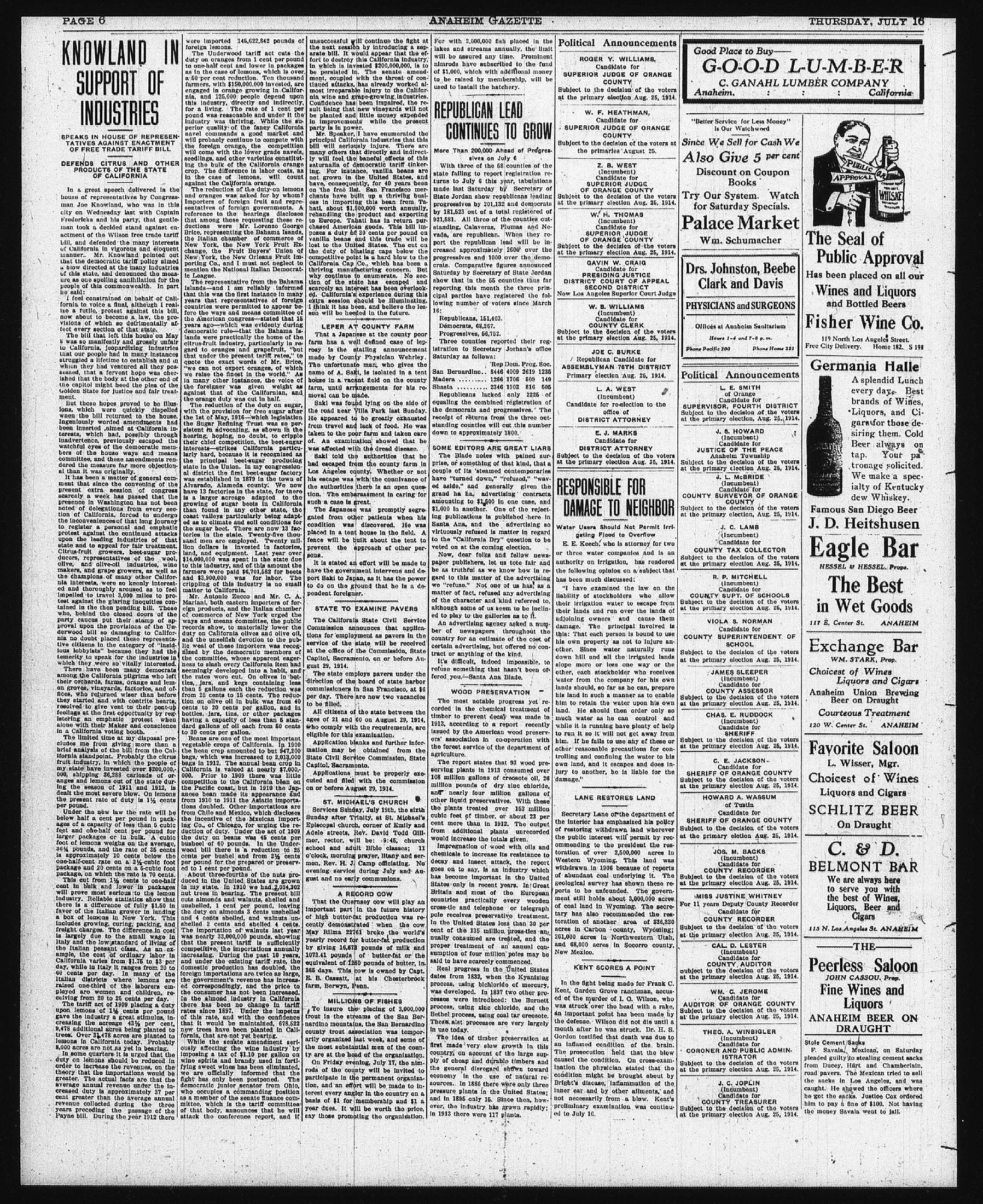
Searchable text
KNOWLAND IN SUPPORT OF INDUSTRIES
SPEAKS IN HOUSE OF REPRESENTATIVES AGAINST ENACTMENT OF FREE TRADE TARIFF BILL
DEFENDS CITRUS AND OTHER PRODUCTS OF THE STATE OF CALIFORNIA
In a great speech delivered in the house of representatives by Congressman Joe Knowland, who was in this city on Wednesday last with Captain Fredericks and his party, that gentleman took a decided stand against enactment of the Wilson free trade tariff bill, and defended the many interests of California in vigorous and eloquent manner. Mr. Knowland pointed out that the democratic tariff policy aimed a blow directed at the many industries of this state, and denounced the measure as one spelling annihilation for the people of this commonwealth. In part he said:
I feel constrained on behalf of California to voice a final, although I realize a futile, protest against this bill, now about to become a law, the provisions of which so detrimentally affect every section of that state.
The bill that left this house on May 8 was so manifestly and grossly unfair to California, jeopardizing industries that our people had in many instances struggled a lifetime to establish and in which they had ventured all they possessed, that the fervent hope was cherished that the body at the other end of the capital might heed the plea of the golden State for justice and fair treatment.
But those hopes proved to be illusions, which were quickly dispelled when the bill returned to the house. Ingeniously worded amendments had been inserted, aimed at California interests, which had, possibly through inadvertence, previously escaped the watchful eyes of the democratic memwere imported 145,622,342 pounds of foreign lemons.
The Underwood tariff act cuts the duty on oranges from 1 cent per pound to one-half cent and lower in packages as in the case of lemons, which is over a 50-per cent reduction. Ten thousand farmers, with $150,000,000 invested, are engaged in orange growing in California, and 125,000 people depend upon this industry directly and indirectly, for a living. The rate of 1 cent per pound was reasonable and under it the industry was thriving. While the superior quality of the fancy California navel commands a good market and will probably continue to compete with the foreign orange, the competition will come with the lower grade navels, seedlings, and other varieties constituting the bulk of the California orange crop. The difference in labor costs, as in the case of lemons, will count against the California orange.
The reduction of the duty-on lemons and oranges was asked for by whom? Importers of foreign fruit and representatives of foreign governments. A reference to the hearings discloses that among those requesting these reductions were Mr. Lorenzo George Brice, representing the Bahama Islands, the Italian chamber of commerce of New York, the New York Fruit Exchange, the Fruit Buyers' Union of New York, the New Orleans Fruit Importing Co., and I must not neglect to mention the National Italian Democratic League.
The representative from the Bahama Islands—and I am reliably informed that this was the first instance in many years that representatives of foreign countries were permitted to appear before the ways and means committee of the American congress—stated that 15 years ago—which was evident during democratic rule—that the Bahama Islands were practically the home of the citrus-fruit industry, particularly in regard to oranges and grapefruit, "but that under the present tariff rates," to quote the exact words of Mr. Brice, "we can not export oranges, of which we raise the finest in the world." As in many other instances, the voice of the foreigner was given weight as against that of the Californian, and the orange duty was cut in half.
The reduction of the duty on sugar, with the provision for free sugar after the latt of May, 1916—which legislation the Sugar Refining Trust was so persistent in advocating, as shown in the hearing, hoping, no doubt, to cripple their chief competition, the beet-sugar interest—strikes California particu-
unsuccessful will owe to the next session by arate bill. It would fort to destroy this in which is invested be persisted in. The ment, coupled with tinned attacks, has most irreparable loss in wine and grape. Confidence has been being that never be planted and little in improvements party is in power.
Mr. Speaker, I have principal California bill will seriously many others that deny will feel, the basal saturnalia of demography. For instances, not grown in the have, consequently on the free list. The chants have built it in hatl. about $1,500,000 rehandling the pro- to Europe. Tahali chased American g poses a duty of 30 vanilla beans and lost to the United States competitive point in California Cap Co. thriving manufacture why continue to exion of the state is scarcely an extra session show I think it has been son will be heeded.
LEPER AT CO
That a Japanese farm has a well d rosy is the statistic made by County B. The unfortunate name of A. Saki, in house in a vacant farm, until arranging moval can be made.
Saki was found lhe road near Villa He appeared to be from travel and lack taken to the poor foe. An examination was affected with th
that our people had in many instances struggled a lifetime to establish and in which they had ventured all they possessed, that the forwent hope was cherished that the body at the other end of the capitol might heed the plea of the golden State for justice and fair treatment.
But those hopes proved to be illusions, which were quickly dispelled when the bill returned to the house. Ingeniously worded amendments had been inserted, aimed at California interests, which had, possibly through inadvertence, previously escaped the watchful eyes of the democratic members of the house ways and means committee, and these amendments rendered the measure far more objectional than it was originally.
It has been a matter of general comment that since the convening of the present extra session of congress scarcely a week has passed that the presence in Washington has not been noted of delegations from every section of California, forced to undergo the inconveniences of that long journey to register a personal and emphatic protest against the continued attacks upon the leading industries of that state and to appeal for fair treatment. Citrus-fruit growers, beet-sugar producers, representatives of the wool, olive, and olive oil industries, wine makers, and grape growers, as well as the champions of many other California interests, were so keenly interested and thoroughly aroused as to feel impelled to travel 3,000 miles to protest against the glaring inequities contained in the then pending bill. Those who, behind the closed doors of the party caucus put their stamp of approval upon the provisions of the Underwood bill so damaging to California no doubt placed these representative citizens in the category of "insidious lobbyists" because they had the temerity to speak for the industries in which they were so vitally interested.
There have been many democrats among the California pilgrims who left their orchards, farms, orange and lemon groves, vineyards, factories, and offices, who returned wiser than before they started and with contrite hearts, resolved to give vent to their pent-up feelings at the first opportunity by registering an emphatic protest when alone with their Maker and conscience in a California voting booth.
The limited time at my disposal precludes me from giving more than a brief analysis of the bill from the California standpoint. Probably the citrus fruit industry, in which the people of my state have invested over $200,000,000, shipping 36,288 carloads of oranges and lemons out of the state during the season of 1911 and 1912, is dealt the most severe blow. On lemons the present rate of duty is 1½ cents per pound.
Under the new law the rate will be below half a cent per pound in packages of a capacity of less than 5 cubic feet and one-half cent per pound for larger packages or in bulk. A cubic foot of lemons weighs on the average 36½ pounds, and the rate of 35 cents that under the present tariff rates," to quote the exact words of Mr. Bricse, "we can not export oranges, of which we raise the finest in the world." As in many other instances, the voice of the foreigner was given weight as against that of the Californian, and the orange duty was cut in half.
The reduction of the duty on sugar, with the provision for free sugar after the 1st of May, 1916—which legislation the Sugar Refining Trust was so persistent in advocating, as shown in the hearing, hoping, no doubt, to cripple their chief competition, the beet-sugar interests—strikes California particularly hard, because it is recognized as the principal beet-sugar producing state in the Union. In my congressional district the first beet-sugar factory was established in 1879 in the town of Alvarado, Alameda county. We now have 13 factors in the state, for there is a larger acreage adapted to the growing of sugar beets in California than found in any other state, the coast valleys particularly being adapted as to climate and soil conditions for the sugar beet. There are now 13 factors in the state. Twenty-five thousand men are employed. Twenty million dollars is invested in factories, land, and equipment. Last year over $14,000,000 was spent in the state due to this industry, and of this amount the farmers were paid $6,701,582 for beets and $3,900,000 was for labor. The crippling of this industry is no small matter to California.
Mr. Antonio Zucco and Mr. C. A. Mariani, both eastern importers of foreign products, and the Italian chamber of commerce of New York urged the ways and means committee, the public records show, to materially lower the duty on California olives and olive oil, and the unselfish devotion to the public weal of these importers was recognized by the democratic members of the committee, whose apparent eagerness to slash every California item had seemingly developed into a habit, and the rates were cut. On olives in bottles, jars, and kegs containing less than 5 gallons each each reduction was from 25 cents to 15 cents. The reduction on olive oil in bulk was from 40 cents to 20 cents per gallon, and in bottles, jars, tins, or other packages having a capacity of less than 5 standard gallons of oil each from 50 cents to 30 cents per gallon.
Beans are one of the most important vegetable crops of California. In 1900 the bean crop amounted to but 947,200 bags, which was increased to 2,013,000 bags in 1912. The annual bean crop in California is valued at nearly $7,000,-000. Prior to 1909 there was little competition to the California bean on the Pacific coast, but in 1910 the Japanese bean made its appearance and from 1910 to 1911 the Aslatic importations doubled. Other importations are from Chile and Mexico, which discloses the incentive of the Mexican Importing Co., of Chicago, for urging the reduction of duty. Under the act of 1909 the duty on beans was 45 cents per bushelheel of 60 pounds. In the Underwood bill there is a reduction to 25
Saki was found by the road near Villa He appeared to be from travel and taken to the poor fathom. An examination was affected with Saki told the aides had escaped from Los Angeles county his escape was with the authorities there. The embarassment such a case is great.
The Japanese was gated from other condition was dipped in a tent hose will be built prevent the apprehension.
It is stated an effuse have the government port Saki to Japan; do on on the ground pendent foregner.
STATE TO EXAMINE
The California State Commission announces for employment service of the state at the office of the Capitol, Sacramento gust 29,1914.
The state employ direction of the board commissioners in Santa per day. There are too be filled.
All citizens of the ages of 21 and 60 who comply with this eligible for this exam.
Application blankation may be on State Civil Service Capitol, Sacramento.
Applications must be ceded and filed with on or before August.
Under the new law the rate will be below half a cent per pound in packages of a capacity of less than 5 cubic feet and one-half cent per pound for larger packages or in bulk. A cubic foot of lemons weighs on the average, 36½ pounds, and the rate of 35 cents is approximately 10 cents below the one-half-cent rate on a 2½-cubic foot package and 20 cents on a 5-cubic foot package, on which the rate is 70 cents.
This cut from 1½ cents to one-half cent in bulk and lower in packages will prove most serious to the lemon industry. Reliable statistics show that there is a difference of fully $1.50 in favor of the Italian grower in landing a box of lemons in New York. This includes growing, curing, packing, and freight charges. The difference in cost is largely due to the small wage in Italy and the low standard of living of the Italian peasant class. As an example, the cost of ordinary labor in California varies from $1.75 to $3 per day, while in Italy it ranges from 20 to 60 cents per day. In many of the Italian districts where lemons are raised one-third of the laborers employed are women and children, receiving from 20 to 25 cents per day.
The tariff act of 1909 placing a duty upon lemons of 1½ cents per pound gave the industry a great stimulus, increasing the acreage 43½ per cent, 9,478 additional acres being planted to trees. Over 31,478 acres are planted to lemons in California today. Probably 8,000 acres are not yet in bearing.
In some quarters it is urged that the duty on lemons should be reduced in order to increase the revenues, on the theory that the importations would be greater. The actual facts are that the average annual revenue under the increased duty is approximately 37 per cent greater than the average annual revenue collected during the three years preceding the passage of the Payne bill. During the year 1912 there
Probably the citrus fruit industry, in which the people of my state have invested over $200,000, shipping 36,288 carloads of oranges and lemons out of the state during the season of 1911 and 1912, is dealt the most severe blow. On lemons the present rate of duty is 1½ cents per pound.
Under the new law the rate will be below half a cent per pound in packages of a capacity of less than 5 cubic feet and one-half cent per pound for larger packages or in bulk. A cubic foot of lemons weighs on the average, 36½ pounds, and the rate of 35 cents is approximately 10 cents below the one-half-cent rate on a 2½-cubic foot package and 20 cents on a 5-cubic foot package, on which the rate is 70 cents.
This cut from 1½ cents to one-half cent in bulk and lower in packages will prove most serious to the lemon industry. Reliable statistics show that there is a difference of fully $1.50 in favor of the Italian grower in landing a box of lemons in New York. This includes growing, curing, packing, and freight charges. The difference in cost is largely due to the small wage in Italy and the low standard of living of the Italian peasant class. As an example, the cost of ordinary labor in California varies from $1.75 to $3 per day, while in Italy it ranges from 20 to 60 cents per day. In many of the Italian districts where lemons are raised one-third of the laborers employed are women and children, receiving from 20 to 25 cents per day.
The tariff act of 1909 placing a duty upon lemons of 1½ cents per pound gave the industry a great stimulus, increasing the acreage 43½ per cent, 9,478 additional acres being planted to trees. Over 31,478 acres are planted to lemons in California today. Probably 8,000 acres are not yet in bearing.
While the senate amendment seriously affecting the wine industry by imposing a tax of $1.10 per gallon on wine spirits and brandy used in fortifying sweet wines has been eliminated, we are officially informed that the fight has only been postponed. The democratic junior senator from Ohio, who occupies a commanding position as a member of the senate finance committee, which is the tariff committee of that body, announces that he will attack the conference report, and if
ANAHEIM GAZETTE
unsuccessful will continue the fight at the next session by introducing a separate bill. It would appear that the effort to destroy this California industry, in which is invested $200,000,000, is to be persisted in. The senate amendment, coupled with the threat of continued attacks, has already worked almost irreparable injury to the California wine and grape-growing industries. Confidence has been impaired, the result being that new vineyards will not be planted and little money expended in improvements while the present party is in power.
Mr. Speaker, I have enumerated the principal California industries that this bill will seriously injure. There are many others that directly and indirectly will feel the baneful effects of this saturnalia of democratic tariff tinkering. For instance, vanilla beans are not grown in the United States, and have, consequently, for 40 years been on the free list. San Francisco merchants have built up a thriving business in importing this bean from Tahiti, about $1,500,000 worth annually, rehandling the product and exporting to Europe. Tahiti has in return purchased American goods. This bill imposes a duty of 30 cents per pound on vanilla beans and this trade will be lost to the United States. The cut on the duty of blasting caps below the competitive point is a hard blow to the California Cap Co., which has been a thriving manufacturing concern. But why continue to enumerate. No section of the state has escaped and scarcely an interest has been overlooked. California's experience during this extra session should be illuminating. I think it has been, and believe the lesson will be heeded in the future.
LEPER AT COUNTY FARM
That a Japanese at the county poor farm has a well defined case of leprosy is the statistic announcement made by County Physician Wohlreyl. The unfortunate man, who gives the name of A. Saki, is isolated in a tent house in a vacant field on the county farm, until arrangements for his removal can be made.
Sakki was found lying on the side of the road near Villa Park last Sunday. He appeared to be greatly exhausted from travel and lack of food. He was taken to the poor farm and taken care of. An examination showed that he was affected with the dread disease.
For with 3,000,000 fish placed in the lakes and streams annually, the limit will be assured any time. Prominent nimrods have subscribed to the fund of $1,000, which with additional money to be raised by membership, will be used to install the hatchery.
REPUBLICAN LEAD CONTINUES TO GROW
More Than 200,000 Ahead of Progresses on July 6
With three of the 68 counties of the state falling to report registration returns to July 6 this year, tabulations made last Saturday by Secretary of State Jordan show republicans leading progressives by 201,132 and democrats by 181,523 out of a total registered of 921,581. All three of the counties outstanding, Calaveras, Plumas and Nevada, are republican. When they report the republican lead will be increased approximately 2600 over the progressives and 1000 over the democrats. Comparative figures announced Saturday by Secretary of State Jordan show that in the 55 counties thus far reporting this month the three principal parties have registered the following number of voters since March 16:
Republicans, 151,403.
Democrats, 68,267.
Progressives, 56,752.
Three counties reported their registration to Secretary Jorhan's office Saturday as follows:
Rep Dom. Prog. Soc.
San Bernardino... 8446 4009 2619 1235
Madera ... 1266 1706 509 149
Shasta ... 2346 1902 816 505
Republicans lacked only 2225 of equaling the combined registration of the democrats and progressives. The receipt of returns from the three outstanding counties will cut this number down to approximately 1800.
Political Announcements
ROGER Y. WILLIAMS,
Candidate for
SUPERIOR JUDGE OF ORANGE
COUNTY
Subject to the decision of the voters at the primary election Aug. 25, 1914.
W. F. HEATHMAN,
Candidate for
SUPERIOR JUDGE OF ORANGE
COUNTY
Subject to the decision of the voters at the primaries August 25.
Z. B. WEST
(Incumbent)
Candidate for
SUPERIOR JUDGE
OF ORANGE COUNTY
Subject to the decision of the voters at the primary election Aug. 25, 1914.
W. H. THOMAS
(Incumbent)
Candidate for
SUPERIOR JUDGE
OF ORANGE COUNTY
Subject to the decision of the voters at the primary election Aug. 25, 1914.
GAVIN W. CRAIG
Candidate for
PRESIDING JUSTICE
DISTRICT COURT OF APPEAL
SECOND DISTRICT
Now Los Angeles Superior Court Judge
W. B. WILLIAMS
(Incumbent)
Candidate for
COUNTY CLERK
Subject to the decision of the voters at the primary election Aug. 25, 1914.
JOE C. BURKE
Republican Candidate for ASSEMBLYMAN 76TH DISTRICT Primary election Aug. 25, 1914.
L. A. WEST
(Incumbent)
Candidate for re-election to the office of DISTRICT ATTORNEY
E. J. MARKS
Candidate for DISTRICT ATTORNEY
made by County Physician Wehrloy.
The unfortunate man, who gives the name of A. Saki, is isolated in a tent house in a vacant field on the county farm, until arrangements for his removal can be made.
Saki was found lying on the side of the road near Villa Park last Sunday. He appeared to be greatly exhausted from travel and lack of food. He was taken to the poor farm and taken care of. An examination showed that he was affected with the dread disease.
Saki told the authorities that he had escaped from the county farm in Los Angeles county. Whether or not his escape was with the connivance of the authorities there is an open question. The embarrassment in caring for such a case is great.
The Japanese was promptly segregated from other patients when his condition was discovered. He was placed in a tent house in the field. A fence will be built about the tent to prevent the approach of other persons.
It is stated an effort will be made to have the government intervene and deport Saki to Japan, as it has the power to do on the ground that he is a dependent foreigner.
STATE TO EXAMINE PAVERS
The California State Civil Service Commission announces that applications for employment as pavers in the service of the state will be received at the office of the Commission, State Capitol, Sacramento, on or before August 29, 1914.
The state employs pavers under the direction of the board of state harbor commissioners in San Francisco, at $6 per day. There are now two vacancies to be filled.
All citizens of the state between the ages of 21 and 60 on August 29, 1914, who comply with the requirements, are eligible for this examination.
Application blanks and further information may be obtained from the State Civil Service Commission, State Capitol, Sacramento.
Applications must be properly executed and filed with the commission on or before August 29, 1914.
ST. MICHAEL'S CHURCH
Services Sunday, July 19th, the sixth Sunday after Trinity, at St. Michael's Episcopal church, corner of Emily and Adela streets, Rev. David Todd Gillmor, rector, will be: 9:45, church school and adult Bible classes; 11
Saturday as follows:
Rep Dom. Prog. Soc.
San Bernardino...8446 4009 2619 1235
Madera ...1266 1706 509 149
Shasta ...2346 1902 816 505
Republicans lacked only 2225 of equaling the combined registration of the democrats and progressives. The receipt of returns from the three outstanding counties will cut this number down to approximately 1800.
SOME EDITORS ARE GREAT LIARS
The Blade notes with pained surprise, or something of that kind, that a couple of its 'steamed contemporaries have "turned down," "refused," "waved aside," and generally given the grand ha ha, advertising contracts amounting to $1,500 in one case, and $1,000 in another. One of the rejecting publications is published here in Santa Ana, and the advertising so virtuously refused is matter in regard to the "California Dry" question to be voted on at the coming election.
New, dear folks and fellow newspaper publishers, let us tote fair and be as truthful as we know how in regard to this matter of the advertising we "refuse." Not one of us has, as a matter of fact, refused any advertising of the character and kind referred to, although some of us seem to be inclined to play to the galleries as to it.
An advertising agency asked a number of newspapers throughout the country for an estimate of the cost of certain advertising, but offered no contract or anything of the kind.
It's difficult, indeed impossible, to refuse something that hasn't been offered you.—Santa Ana Blade.
WOOD PRESERVATION
The most notable progress yet recorded in the chemical treatment of timber to prevent decay was made in 1913, according to a report recently issued by the American wood preservers' association in co-operation with the forest service of the department of agriculture.
The report states that 93 wood preserving plants in 1913 consumed over 108 million gallons of creosote oil, 26 million pounds of dry zinc chloride, and nearly four million gallons of other liquid preservatives. With these plants treated over 163 million cubic feet of timber, or about 23 percent more than in 1912. The output from additional plants unrecorded would increase the totals given.
Impregnation of wood with oils and
Republican Candidate for ASSEMBLYMAN 76TH DISTRICT Primary election Aug. 25, 1914.
L. A. WEST (Incumbent)
Candidate for re-election to the office of DISTRICT ATTORNEY
E. J. MARKS
Candidate for DISTRICT ATTORNEY
Subject to the decision of the voters at the primary election Aug. 25, 1914.
RESPONSIBLE FOR DAMAGE TO NEIGHBOR
Water Users Should Not Permit Irrigating Flood to Overflow
E. E. Keech, who is attorney for two or three water companies and is an authority on irrigation, has rendered the following opinion on a subject that has been much discussed:
"I have examined the law on the liability of stockholders who allow their irrigation water to escape from their lands and run over the lands of adjoining owners and cause them damage. The principal involved is this: That each person is bound to use his own property as not to injure another. Since water naturally runs down hill and all the irrigated lands slope more or less one way or the other, each stockholder who receives water from the company for his own lands should, so far as he can, prepare his land in such a manner as to enable him to retain the water upon his own land. He should then order only so much water as he can control and while it is running have plenty of help to run it so it will not get away from him. If he fails to use any of these or other reasonable precautions for controlling and confining the water to his own land, and it escapes and does injury to another, he is liable for the damage."
LANE RESTORES LAND
Secretary Lane of the department of the interior has emphasized his policy of restoring withdrawn land wherever the public interest will permit by recommending to the president the res
ST. MICHAEL'S CHURCH
Services Sunday, July 19th, at St. Michael's Episcopal church, corner of Emily and Adele streets, Rev. David Todd Gillmore, rector, will be: 9:45, church school and adult Bible classes; 11 o'clock, morning prayer, litany and sermon, Rev. H. J. Camp officiating. No evening service during July and August and no early communions.
A RECORD COW
That the Guernsey cow will play an important part in the future history of high butter-fat production was recently demonstrated when the cow May Rilma 22761 broke the world's yearly record for butter-fat production by giving 16,873 pounds of milk and 1073.41 pounds of butter-fat or the equivalent of 1280 pounds of butter, in 365 days. This cow is owned by Capt. E. B. Cassatt, at his Chesterbrook farm, Berwyn, Penn.
MILLIONS OF FISHES
To insure the placing of 3,000,000 trout in the streams of the San Bernardino mountains, the San Bernardino county trout association was temporarily organized last week, and some of the most substantial men of the county are at the head of the organization.
On Friday evening, July 17, the nimrods of the county will be invited to participate in the permanent organization, and an effort will be made to interest every angler in the country on a basis of $1 for membership and $1 a year dues. It will be worth the price, say those promoting the organization.
The report states that 93 wood preserving plants in 1913 consumed over 108 million gallons of creosote oil, 26 million pounds of dry zinc chloride, and nearly four million gallons of other liquid preservatives. With these plants treated over 163 million cubic feet of timber, or about 23 per cent more than in 1912. The output from additional plants unrecorded would increase the totals given.
Imprognation of wood with oils and chemicals to increase its resistance to decay and insect attack, the report goes on to say, is an industry which has become important in the United States only in recent years. In Great Britain and most of the European countries practically every wooden cross-tie and telephone or telegraph pole receives preservative treatment. In the United States less than 30 percent of the 135 million cross-ties annually consumed are treated, and the proper treatment of an annual consumption of four million poles may be said to have scarcely commenced.
Real progress in the United States dates from 1832, when the Kyanizing process, using bichloride of mercury, was developed. In 1837 two other processes were introduced: the Burnett process, using zinc chloride, and the Bethel process, using coal tar creosote. These all processes are very largely in use today.
The idea of timber preservation at first made very slow growth in this country, on account of the large supply of cheap and durable timbers and the general disregard shown toward economy in the use of natural resources. In 1885 there were only three pressure plants in the United States; and in 1895 only 15. Since then, however, the industry has grown rapidly; in 1913 there were 117 plants.
LANE RESTORES LAND
Secretary Lane of the department of the interior has emphasized his policy of restoring withdrawn land wherever the public interest will permit by recommending to the president the restoration of over 2,500,000 acres in Western Wyoming. This land was withdrawn in 1906 because of reports of abundant coal underlying it. The geological survey has shown these reports to be unfounded. The government still holds about 3,000,000 acres of coal land in Wyoming. The secretary has also recommended the restoration of another area of 336,330 acres in Carbon county, Wyoming; 261,000 acres in Northwestern Utah; and 68,800 acres in Socorro county, New Mexico.
KENT SCORES A POINT
In the fight being made for Frank C. Kent, Garden Grove ranchman, accused of the murder of I. O. Wilson, who was struck over the head with a rake, an important point has been made by the defense. Wilson did not die until a month after he was struck. Dr. H. S. Gordon testified that death was due to an inflamed condition of the brain. The prosecution held that the blow caused the condition. On cross-examination the physician stated that the condition might be brought about by Bright's disease, inflammation of the inner ear and by other ailments; and not necessarily from a blow. Kent's preliminary examination was continued to July 16.
THURSDAY, JULY 16
Good Place to Buy—
G-O-O-D L-U-M-B-E-R
C. GANAHL LUMBER COMPANY
Anaheim, California
"Better Service for Less Money"
Is Our Watchword
Since We Sell for Cash We Also Give 5 per cent Discount on Coupon Books
Try Our System. Watch for Saturday Specials.
Palace Market
Wm. Schumacher
Drs. Johnston, Beebe Clark and Davis
PHYSICIANS and SURGEONS
Offices at Anaheim Sanitarium
Hours 1-4 and 7-8 p.m.
Phone Pacific 200 Phone Home 221
Political Announcements
L. E. SMITH
of Orange
Candidate for SUPERVISOR, FOURTH DISTRICT
Subject to the decision of the voters at the primary election, Aug. 25, 1914.
J. & HOWARD
(Incumbent)
Candidate for
The Seal of Public Approval
Has been placed on all our Wines and Liquors and Bottled Beers
Fisher Wine Co.
119 North Los Angeles Street.
Free City Delivery. Home 182. S 198
Germania Halle
A splendid Lunch every day. Best brands of Wines,
Liquors, and Cigars for those desiring them. Cold Beer always on
Political Announcements
L. E. SMITH
of Orange
Candidate for
SUPERVISOR, FOURTH DISTRICT
Subject to the decision of the voters at the primary election, Aug. 25, 1914.
J. B. HOWARD
(Incumbent)
Candidate for
JUSTICE OF THE PEACE
Annaheim Township
Subject to the decision of the voters at the primary election Aug. 25, 1914.
J. L. McBRIDE
(Incumbent)
Candidate for
COUNTY SURVEYOR OF ORANGE COUNTY
Subject to the decision of the voters at the primary election, Aug. 25, 1914.
J. C. LAMB
(Incumbent)
Candidate for
COUNTY TAX COLLECTOR
Subject to the decision of the voters at the primary election Aug. 25, 1914.
R. P. MITCHELL
(Incumbent)
Candidate for
COUNTY SUPT. OF SCHOOLS
Subject to the decision of the voters at the primary election Aug. 25, 1914.
VIOLA S. NORMAN
Candidate for
COUNTY SUPERINTENDENT OF SCHOOL
Subject to the decision of the voters at the primary election Aug. 25, 1914.
JAMES SLEEPER
(Incumbent)
Candidate for
COUNTY ASSESSOR
Subject to the decision of the voters at the primary election Aug. 25, 1914.
CHAS. E. RUDDOCK
(Incumbent)
Candidate for
SHERIFF
Subject to the decision of the voters at the primary election Aug. 25, 1914.
C. E. JACKSON
Candidate for
SHERIFF OF ORANGE COUNTY
Subject to the decision of the voters at the primary election Aug. 25, 1914.
HOWARD A. WASSUM
of Tuxtla
Candidate for
SHERIFF OF ORANGE COUNTY
Subject to the decision of the voters at the primary election Aug. 25, 1914.
Germania Halle
A splendid Lunch every day. Best brands of Wines,
Liquors, and Cigars for those desiring them. Cold Beer always on tap. Your patronage solicited.
We make a specialty of Kentucky dew Whiskey.
Famous San Diego Beer
J. D. Heitshusen
Eagle Bar
HESSEL & HESSEL. Props.
The Best in Wet Goods
117 E. Center St. ANAHEIM
Exchange Bar
WM. STARK, Prop.
Choicest of Wines
Liquors and Cigars
Annaheim Union Brewing
Beer on Draught
Courteous Treatment
120 W. Center St. ANAHEIM
Favorite Saloon
L. Wisser, Mgr.
Choicest of Wines
Liquors and Cigars
SCHLITZ BEER On Draught
C. E. JACKSON
Candidate for
SHERIFF OF ORANGE COUNTY
Subject to the decision of the voters at the primary election Aug. 25, 1914.
HOWARD A. WASSUM
of Tustin
Candidate for
SHERIFF OF ORANGE COUNTY
Subject to the decision of the voters at the primary election Aug. 25, 1914.
JOS. M. BACKS
(Incumbent)
Candidate for
COUNTY RECORDER
Subject to the decision of the voters at the primary election Aug. 25, 1914.
MISS JUSTINE WHITNEY
For 11 years Deputy County Recorder
Candidate for
COUNTY RECORDER
Subject to the decision of the voters at the primary election Aug. 25, 1914.
CAL D. LESTER
(Incumbent)
Candidate for
COUNTY AUDITOR
Subject to the decision of the voters at the primary election Aug. 25, 1914.
WM. C. JEROME
Candidate for
AUDITOR OF ORANGE COUNTY
Subject to the decision of the voters at the primary election Aug. 25, 1914.
THEO. A. WINBIGLER
(Incumbent)
Candidate for
CORONER AND PUBLIC ADMINISTRATOR
Subject to the decision of the voters at the primary election Aug. 25, 1914.
J. C. JOPLIN
(Incumbent)
Candidate for
COUNTY TREASURER
Subject to the decision of the voters at the primary election Aug. 25, 1914.
L. Wisser, Mgr.
Choicest of Wines
Liquors and Cigars
SCHLITZ BEER On Draught
C. & D.
BELMONT BAR
We are always here to serve you with the best of Wines,
Liquors, Beer and Cigars
115 N. Los Angeles St. ANAHEIM
THE Peerless Saloon
JOHN CASSOU, Prop.
Fine Wines and Liquors
ANAHEIM BEER ON DRAUGHT
Stole Cement Sacks
F. Savala, Mexican, on Saturday pleaded guilty to stealing cement sacks from Ducey, Hart and Chamberlain, road pavers. The Mexican tried to sell the sacks in Los Angeles, and was caught. He showed the officers where he got the sacks. Justice Cox ordered him to pay a fine of $100. Not having the money Savala went to jail.