anaheim-gazette 1914-07-09
Scanned page
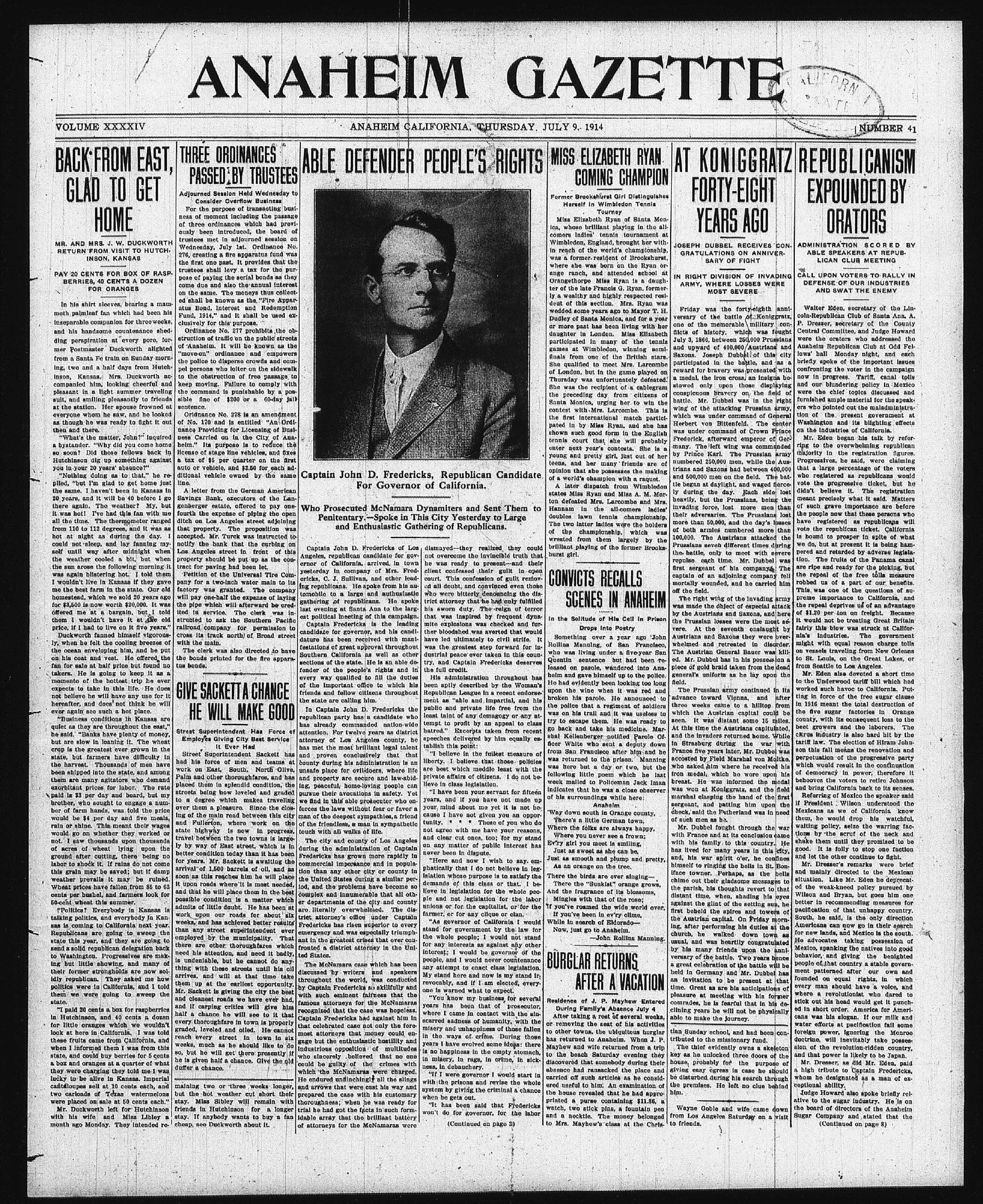
Searchable text
BACK FROM EAST,
GLAD TO GET
HOME
MR. AND MRS. J. W. DUCKWORTH
RETURN FROM VISIT TO HUTCHINSON, KANSAS
PAY 20 CENTS FOR BOX OF RASP-BERRIES, 40 CENTS A DOZEN FOR ORANGES
In his shirt sleeves, bearing a mammoth palmleaf fan which had been his inseparable companion for three weeks, and his handsome countenance shedding perspiration at every pore, former Postmaster Duckworth alighted from a Santa Fe train on Sunday morning, two and a half days from Hutchinson, Kansas. Mrs. Duckworth accompanied him, looking cheerful and pleasant in a light summer traveling suit, and smiling pleasantly to friends at the station. Her spouse frowned at everyone whom he saw, and he looked as though he was ready to fight it out then and there.
"What's the matter, John?" inquired by astander. "Why did you come home"
THREE ORDINANCES PASSED BY TRUSTEES
Adjourned Session Held Wednesday to Consider Overflow Business
For the purpose of transacting business of moment including the passage of three ordinances which had previously been introduced, the board of trustees met in adjourned session on Wednesday, July 1st. Ordinance No. 276, creating a fire apparatus fund was the first one past. It provides that the trustees shall levy a tax for the purpose of paying the serial bonds as they come due and also the annual interest on the same. The monies thus collected shall be known as the "Fire Apparatus Bond, Interest and Redemption Fund, 1914," and it shall be used exclusively for this purpose.
Ordinance No. 277 prohibits the obstruction of traffic on the public streets of Anaheim. It will be known as the "move-on" ordinance and empowers the police to disperse crowds and compel persons who loiter on the sidewalk to the obstruction of free passage to keep moving. Failure to comply with the command is punishable by a possible fine of $200 or a 60-day jail sentence.
Ordinance No. 278 is an amendment of No. 170 and is entitled "An Ordinance Providing for Licensing of Business Carried on in the City of Anaheim." Its purpose is to reduce the
from a Santa Fe train on Sunday morning, two and a half days from Hutchinson, Kansas. Mrs. Duckworth accompanied him, looking cheerful and pleasant in a light summer travelling suit, and smiling pleasantly to friends at the station. Her spouse frowned at everyone whom he saw, and he looked as though he was ready to fight it out then and there.
"What's the matter, John?" inquired a bystander. "Why did you come home so soon? Did those fellows back in Hutchinson dig up something against you in your 20 years' absence?"
"Nothing doing as to that," he replied, "but I'm glad to get home just the same. I haven't been in Kansas in 20 years, and it will be 40 before I go there again. The weather? My, but it was hot! I've had this fan with me all the time. The thermometer ranged from 110 to 112 degrees, and it was as hot at night as during the day. I could not sleep, and lay fanning myself until way after midnight when the weather cooled a bit, but when the sun arose the following morning it was again blistering hot. I told them I wouldn't live in Kansas if they gave me the best farm in the state. Our old homestead, which we sold 20 years ago for $3,500 is now worth $20,000. It was offered me at a bargain, but I told them I wouldn't have it at the old price, if I had to live on it five years."
Duckworth fanned himself vigorously, when he felt the cooling breezes of the ocean enveloping him, and he put on his coat and vest. He offered the fan for sale at half price but found no takers. He is going to keep it as a momento of the hottest trip he ever expects to take in this life. He does not believe he will have any use for it hereafter, and does not think he will ever again see such a hot place.
"Business conditions in Kansas are quiet as they are throughout the east," he said. "Banks have plenty of money, but are slow in loaning it. The wheat crop is the greatest ever grown in the state, but farmers have difficulty in the harvest. Thousands of men have been shipped into the state, and among them are many agitators who demand exorbitant prices for labor. The rate paid is $3 per day and board, but my brother, who sought to engage a number of farm hands, was told the price would be $4 per day and five meals, rain or shine. This meant their wages would go on whether they worked or not. I saw thousands upon thousands of acres of wheat lying upon the
GIVE SACKETT A CHANGE HE WILL MAKE GOOD
Street Superintendent Has Force of Employees Giving City Best Service It Ever Had
Street Superintendent Sackett has had his force of men and teams at work on East, South, North Olive, Palm and other thoroughfares, and has placed them in splendid condition, the streets being how leveled and graded to a degree which makes traveling over them a pleasure. Since the closing of the main road between this city and Fullerton, where work on the state highway is now in progress, travel between the two towns is largely by way of East street, which is in
the police to disperse crowds and compel persons who loiter on the sidewalk to the obstruction of free passage to keep moving. Failure to comply with the command is punishable by a possible fine of $200 or a 60-day jail sentence.
Ordnance No. 278 is an amendment of No. 170 and is entitled "An Ordnance Providing for Licensing of Business Carried on in the City of Anaheim." Its purpose is to reduce the license of stage line vehicles, and fixes a tax of $5 per quarter on the first auto or vehicle, and $2.50 for each additional vehicle owned by the same line.
A letter from the German American Savings Bank, executors of the Langenberger estate, offered to pay one-fourth the expense of ploping the open ditch on Los Angeles street adjoining that property. The proposition was accepted. Mr. Turck was instructed to notify the bank that the curbing on Los Angeles street in front of this property should be put up as the contract for paving had been let.
Petition of the Universal Tire Company for a two-inch water main to its factory was granted. The company will pay one-half the expense of laying the pipe which will afterward be credited in service. The clerk was instructed to ask the Southern Pacific railroad company for permission to cross its track north/of Broad street with the main.
The clerk was also directed to have the bonds printed for the fire apparatus bonds.
Captain John D. P. Angeles, republican citizen of California, yesterday in company ericks, C. J. Sullivan, ing republicans. He sat tomobile to a large gathering of republics last evening at Santa Clara east political meeting.
Captain Frederickks candidate for governor dature has been reelections of great applies Southern California sections of the state. fender of the people every way qualified t o of the important offiends and fellow citie the state are calling b
In Captain John D. republican party has already comman attention. For twelve attorney of Los Angles met the most briliand and proven conclusi county during his admin unsafe place for evil and property are secu ing, peaceful, home-lo purae their avocation we find in this able pr forces the laws without man of the deepest sym of the friendless, a ma touch with all walks o
The city and county during the administra
state, but farmers have difficulty in the harvest. Thousands of men have been shipped into the state, and among them are many agitators who demand exorbitant prices for labor. The rate paid is $3 per day and board, but my brother, who sought to engage a number of farm hands, was told the price would be $4 per day and five meals, rain or shine. This meant their wages would go on whether they worked or not. I saw thousands upon thousands of acres of wheat lying upon the ground after cutting, there being no labor to shock it. If rains do not come this grain may be saved; but if damp weather prevails it may be ruined. Wheat prices have fallen from 85 to 63 cents per bushel, and farmers look for 50-cent wheat this summer.
"Politics? Everybody in Kansas is talking politics, and everybody in Kansas is coming to California next year. Republicans are going to sweep the state this year, and they are going to send a solid republican delegation back to Washington. Progressives are making but little showing, and many of their former strongholds are now solidly republican. They asked me how politics were in California, and I told them we were going to sweep the state.
"I paid 20 cents a box for raspberries in Hutchinson, and 40 cents a dozen for little oranges which we wouldn't look at here in California. I was told these fruits came from California, and when I informed them I was from this state, and could buy berries for 5 cents a box and oranges at a quarter of what they were charging they told me I was lucky to be alive in Kansas. Imperial cantaloupes sell at 10 cents each, and two carloads of Texas watermelons were placed on sale at 50 cents each."
Mr. Duckworth left for Hutchinson with his wife and Miss Libley a month ago Monday. They intended remaining two or three weeks longer, but the hot weather cut short their stay. Miss Sibley will remain with friends in Hutchinson for a longer stay. If anybody wants to buy a fan cheap, see Duckworth about it.
The city and county during the administrations Fredericks has grown commercial importance than any other city in the United States during the problems complex and innumerable departments of the are literally overwhelmed triet attorney's office Fredericks has risen as emergency and was cast in the greatest crisis fronted a district attended States.
The McNamara case discussed by writers throughout the world, by Captain Fredericks with such eminent famous attorneys for recognized that the captain Fredericks had that celebrated case most attorneys but the enthusiastic industrious opposition who sincerely believed could be guilty of the which the McNamara He endured unfinishing and arrows that were prepared the case with thoroughness; when he trial he had got the fiscidable array that the of attorneys for the M
ANAHEIM GAZETTE
ANAHEIM CALIFORNIA, THURSDAY, JULY 9., 1914
ABLE DEFENDER PEOPLE'S RIGHTS
MISS ELIZABETH RYAN
COMING CHAMPION
Former Brookhurst Girl Distinguishes
Herself in Wimbledon Tennis
Tourney
Miss Elizabeth Ryan of Santa Monica, whose brilliant playing in the all-comers ladies' tennis tournament at Wimbledon, England, brought her within reach of the world's championships, was a former-resident of Brookhurst, where she was born on the Ryan orange ranch, and attended school at Orangethorpe Miss Ryan is a daughter of the late Francis G. Ryan, formerly a wealthy and highly respected resident of this section. Mrs. Ryan was wedded some years ago to Mayor T. H. Dudley of Santa Monica, and for a year or more past has been living with her daughter in London. Miss Elizabeth participated in many of the tennis games at Wimbledon, winning semifinals from one of the British stars. She qualified to meet Mrs. Larcombe of London, but in the game played on Thursday was unfortunately defeated. She was the recipient of a cablegram the preceding day from citizens of Santa Monica, urging her to win the contest with Mrs. Larcombe. This is the first international match participated in by Miss Ryan, and she has shown such good form in the English tennis court that she will probably enter next year's contests. She is a
Captain John D. Fredericks, Republican Candidate For Governor of California.
Who Prosecuted McNamara Dynamiters and Sent Them to Penitentary:—Spoke in This City Yesterday to Large and Enthusiastic Gathering of Republicans.
Captain John D. Fredericks of Los Angeles, republican candidate for governor of California, arrived in town yesterday in company of Mrs. Fredericks, C. J. Sullivan, and other leading republicans. He spoke from his automobile to a large and enthusiastic gathering of republicans. He spoke last evening at Santa Ana to the largest political meeting of this campaign.
Captain Fredericks is the leading candidate for governor, and his candidature has been received with manifestations of great approval throughout Southern California as well as other sections of the state. He is an able defender of the people's rights and in every way qualified to fill the duties of the important office to which his friends and fellow citizens throughout the state are calling him.
In Captain John D. Fredericks the republican party has a candidate who has already commanded nation-wide attention. For twelve years as district attorney of Los Angeles county, he has met the most brilliant legal talent and proven conclusively that that county during his administration is an unsafe place for evildoers, where life and property are secure and law-abiding, peaceful, home-loving people can pursue their avocations in safety. Yet we find in this able prosecutor who enforces the laws without fear or favor a man of the deepest sympathies, a friend of the friendless, a man in sympathetic touch with all walks of life.
The city and county of Los Angeles during the administration of Captain
dismayed—they realized they could not overcome the invincible truth that he was ready to present—and their client confessed their guilt in open court. This confession of guilt removed all doubt, and convinced even those who were bitterly denouncing the district attorney that he had only fulfilled his sworn duty. The reign of terror that was inspired by frequent dynamite explosions was checked and further bloodshed was averted that would have led ultimately to civil strife. It was the greatest step forward for industrial peace ever taken in this country, and Captain Fredericks deserves the full credit.
His administration throughout has been aptly described by the Woman's Republican League in a recent endorsement as "table and impartial, and his public and private life free from the least taint of any demagogy or any attempt to profit by an appeal to class hatred." Excerpts taken from recent speeches delivered by him equally establish this point:
"I believe in the fullest measure of liberty. I believe that those policies are best which medleast with the private affairs of citizens. I do not believe in class legislation.
"I have been your servant for fifteen years, and if you have not made up your mind about me yet it is not because I have not given you an opportunity. **** Those of you who do not agree with me have your reasons, and clear cut ones, too; for my stand on any matter of public interest has finals from one of the British stars. She qualified to meet Mrs. Larcombe of London, but in the game played on Thursday was unfortunately defeated. She was the recipient of a cablegram the preceding day from citizens of Santa Monica, urging her to win the contest with Mrs. Larcombe. This is the first international match participated in by Miss Ryan, and she has shown such good form in the English tennis court that she will probably enter next year's contests. She is a young and pretty girl, just out of her teens, and her many friends are of opinion that she possesses the making of a world's champion with a request.
A later dispatch from Wimbledon states Miss Ryan and Miss A. M. Morton defeated Mrs. Larcombe and Mrs. Hannan in the all-comers ladies' doubles lawn tennis championship. The two latter ladies were the holders of the championship, which was wrested from them largely by the brilliant playing of the former Brookhurst girl.
CONVICTS RECALLS SCENES IN ANAHEIM
In the Solitude of His Cell in Prison Drops Into Postry
Something over a year ago John Rollins Manning, of San Francisco, who was living under a five-year San Quentin sentence but had been released on parole, wandered into Anaheim and gave himself up to the police. He had evidently been looking too long upon the wine when it was red and broken his parole. He announced to the police that a regiment of soldiers was on his trail and it was useless to try to escape them. He was ready to go back and take his medicine. Marshal Kellenberger notified Parole Officer White who sent a deputy down from San Francisco after him and he was returned to the prison. Manning was here but a day or two, but the following little poem which he last week mailed to Policeman Jack Iman indicates that he was a close observer of his surroundings while here:
Anaheim
"Way down south in Orange county,
There's a little German town,
Where the folks are always happy,
Where you never see a frown;
Every girl you meet is smiling."
Just as sweet as she can be
and proven conclusively that this county during his administration is an unsafe place for evil-doers, where life and property are secure and law-abiding, peaceful, home-loving people can pursue their avocations in safety. Yet we find in this able prosecutor who enforces the laws without fear or favor a man of the deepest sympathies, a friend of the friendless, a man in sympathetic touch with all walks of life.
The city and county of Los Angeles during the administration of Captain Fredericks has grown more rapidly in commercial importance and in population than any other city or county in the United States during a similar period, and the problems have become so complex and innumerable that all other departments of the city and county are literally overwhelmed. The district attorney's office under Captain Fredericks has risen superior to every emergency and was especially triumphant in the greatest crises that ever confronted a district attorney in the United States.
The McNamara case which has been discussed by writers and speakers throughout the world, was conducted by Captain Fredericks so skillfully and with such eminent fairness that the famous attorneys for the McNamaras recognized that the case was hopeless. Captain Fredericks had against him in that celebrated case not only the foremost attorneys that money could engage but the enthusiastic hostility and industrious opposition of multitudes who sincerely believed that no one could be guilty of the crimes with which the McNamaras were charged. He endured unfinchingly all the silings and arrows that were cast his way and prepared the case with his customary thoroughness; when he was ready for trial he had got the facts in such formidable array that the brilliant battery of attorneys for the McNamaras were
A court has issued a measure of liberty. I believe that those policies are best which meddle least with the private affairs of citizens. I do not believe in class legislation.
"I have been your servant for fifteen years, and if you have not made up your mind about me yet it is not because I have not given you an opportunity. * * * Those of you who do not agree with me have your reasons, and clear cut ones, too; for my stand on any matter of public interest has never been in dispute.
"Here and now I wish to say emphatically that I do not believe in legislation whose purpose is to satisfy the demands of this class or that. I believe in legislation for the whole people and not legislation for the labor unions or for the capitalist, or for the farmer, or for any clique or clan.
"As governor of California I would stand for government by the law for the whole people; I would not stand for any interests as against any other interest; I would be governor of the people, and I would never countenance any attempt to enact class legislation. My stand here and now is my stand irrevocably, and if I am elected, everyone is warned what to expect.
"You know my business, for several years has been that of prosecutor, where I came in contact with the sinscarred sadness of humanity, with the misery and unhappiness of those fallen in the ways of crime. During those years I have evolved some ideas: there is no happiness in the empty stomach, in misery, in rags, in crime, in sickness, in debauchery.
"If I were governor I would start in with the prisons and revise the whole system by giving the criminal a chance when he gets out.
"It has been said that Fredericks won't do for governor, for the labor
(Continued on page 3)
Residence of J. P. Mayhew Entered During Family's Absence July 4
After taking a rest of several weeks, or removing the seat of his activities to other towns, the ubiquitous hurglar has returned to Anaheim. When J. P. Mayhew and wife returned from a trip to the beach Saturday evening they discovered that somebody during their absence had ransacked the place and carried off such articles as he considered useful to him. An examination of the house revealed that he had appropriated a purse containing $11.86, a watch, two stick pins, a fountain pen and a necktie. The money belonged to Mrs. Mayhew's class at the Chris-
AT KONIGGRATZ
FORTY-EIGHT
YEARS AGO
JOSEPH DUBBEL RECEIVES CONGRATULATIONS ON ANNIVERSARY OF FIGHT
IN RIGHT DIVISION OF INVADING ARMY, WHERE LOSSES WERE MOST SEVERE
Friday was the forty-eighth anniversary of the battle of Koniggratz, one of the memorable military conflicts of history, which was fought July 3, 1866, between 250,000 Prussians and upward of 400,000 Austrians and Saxons. Joseph Dubbel of this city participated in the battle, and as a reward for bravery was presented with a medal, the iron cross, an insignia bestowed only upon those displaying conspicuous bravery on the field of battle. Mr. Dubbel was in the right wing of the attacking Prussian army, which was under command of General Herbert von Bittenfeld. The center was under command of Crown Prince Frederick, afterward emperor of Germany. The left wing was commanded
REPUBLICANISM EXPOUNDED BY ORATORS
ADMINISTRATION SCORED BY ABLE SPEAKERS AT REPUBLICAN CLUB MEETING
CALL UPON VOTERS TO RALLY IN DEFENSE OF OUR INDUSTRIES AND SWAT THE ENEMY
Walter Eden, secretary of the Lincoln-Republican Club of Santa Ana, A. P. Dresser, secretary of the County Central Committee, and Judge Howard were the orators who addressed the Anaheim Republican Club at Odd Fellows' hall Monday night, and each briefly spoke of the important issues confronting the voter in the campaign now in progress. Tariff, canal tolls and our blundering policy in Mexico were the chief topics discussed and furnished ample material for the speakers who pointed out the maladministration of the present government at Washington and its blighting effects on the industries of California.
Mr. Eden began his talk by referring to the overwhelming republican
The British stars. Mrs. Larcombe game played on continually defeated of a cablegram from citizens of her to win the combe. This is a match participant, and she has in the English will probably tests. She is a just out of her friends are ofresses the making with a request. From Wimbledon Miss A. M. Morcombe and Mrs. comers ladies' championship, were the holders up, which was largely by the former Brooks.
Cell in Prison Postry
year ago John San Francisco a five-year San had been reordered into Ana-up to the police, looking too long it was red and announced to moment of soldiers it was useless to he was ready to medicine. Married Parole Of a deputy down after him and he Manning two, but the which he last man Jack Iman a close observer here: orange county, man town, always happy; a frown; smiling, can he
The Prussian army continued in its advance toward Vienna, and after three weeks came to a hilltop from which the Austrian capital could be seen. It was distant some 15 miles. At this time the Austrians capitulated, and the invaders returned home. While in Strasburg during the war with France five years later, Mr. Dubbel was accosted by Field Marshal von Moltke, who asked him where he received his iron medal, which he wore upon his breast. He was informed the medal was won at Koniggratz, and the field marshal clasping the hand of the first sergeant, and patting him upon the check, said the Fatherland was in need of such men as he.
Mr. Dubbel fought through the war with France and at its conclusion came with his family to this country. He has lived for many years in this city.
Joseph Dubbel of this city participated in the battle, and as a reward for bravery was presented with a medal, the iron cross, an insigna bestowed only upon those displaying conspicuous bravery on the field of battle. Mr. Dubbel was in the right wing of the attacking Prussian army, which was under command of General Herbert von Blittenfeld. The center was under command of Crown Prince Frederick, afterward emperor of Germany. The left wing was commanded by Prince Karl. The Prussian army numbered 250,000 men, while the Austrians and Saxons had between 400,000 and 500,000 men on the field. The battle began at daylight, and waged fiercely during the day. Each side lost heavily, but the Prussians, being invading force, lost more men than their adversaries. The Prussians lost more than 50,000, and the day's losses of both armies numbered more than 100,000. The Austrians attacked the Prussians seven different times during the battle, only to meet with severe repulse each time. Mr. Dubbel was first sergeant of his company. The captain of an adjoining company fell mortally wounded, and he carried him off the field.
The right wing of the invading army was made the object of especial attack by the Austrians and Saxons, and here the Prussian losses were the most severe. At the seventh onslaught by Austrians and Saxons they were overwhelmed and retreated in disorder. The Austrian General Bauer was killed. Mr. Dubbel has in his possession a piece of gold braid taken from the dead general's uniform as he lay upon the field.
The Prussian army continued in its advance toward Vienna, and after three weeks came to a hilltop from which the Austrian capital could be seen. It was distant some 15 miles. At this time the Austrians capitulated, and the invaders returned home. While in Strasburg during the war with France five years later, Mr. Dubbel was accosted by Field Marshal von Moltke, who asked him where he received his iron medal, which he wore upon his breast. He was informed the medal was won at Koniggratz, and the field marshal clasping the hand of the first sergeant, and patting him upon the check, said the Fatherland was in need of such men as he.
Mr. Dubbel fought through the war with France and at its conclusion came with his family to this country. He has lived for many years in this city.
Joseph Dubbel of this city participated in the battle, and as a reward for bravery was presented with a medal, the iron cross, an insigna bestowed only upon those displaying conspicuous bravery on the field of battle. Mr. Dubbel was in the right wing of the attacking Prussian army, which was under command of General Herbert von Blittenfeld. The center was under command of Crown Prince Frederick, afterward emperor of Germany. The left wing was commanded by Prince Karl. The Prussian army numbered 250,000 men, while the Austrians and Saxons had between 400,000 and 500,000 men on the field. The battle began at daylight, and waged fiercely during the day. Each side lost heavily, but the Prussians, being invading force, lost more men than their adversaries. The Prussians lost more than 50,000, and the day's losses of both armies numbered more than 100,000. The Austrians attacked the Prussians seven different times during the battle, only to meet with severe repulse each time. Mr. Dubbel was first sergeant of his company. The captain of an adjoining company fell mortally wounded, and he carried him off the field.
The right wing of the invading army was made the object of especial attack by the Austrians and Saxons, and here the Prussian losses were the most severe. At the seventh onslaught by Austrians and Saxons they were overwhelming and retreated in disorder. The Austrian General Bauer was killed. Mr. Dubbel has in his possession a piece of gold braid taken from the dead general's uniform as he lay upon the field.
The Prussian army continued in its advance toward Vienna, and after three weeks came to a hilltop from which the Austrian capital could be seen. It was distant some 15 miles. At this time the Austrians capitulated, and the invaders returned home. While in Strasburg during the war with France five years later, Mr. Dubbel was accosted by Field Marshal von Moltke, who asked him where he received his iron medal, which he wore upon his breast. He was informed the medal was won at Koniggratz, and the field marshal clasping the hand of the first sergeant, and patting him upon the check, said the Fatherland was in need of such men as he.
Mr. Dubbel fought through the war with France and at its conclusion came with his family to this country. He has lived for many years in this city.
Joseph Dubbel of this city participated in the battle, and as a reward for bravery was presented with a medal, the iron cross, an insigna bestowed only upon those displaying conspicuous bravery on the field of battle. Mr. Dubbel was in the right wing of the attacking Prussian army, which was under command of General Herbert von Blittenfeld. The center was under command of Crown Prince Frederick, afterward emperor of Germany. The left wing was commanded by Prince Karl. The Prussian army numbered 250,000 men, while the Austrians and Saxons had between 400,000 and 500,000 men on the field. The battle began at daylight, and waged fiercely during the day. Each side lost heavily, but the Prussians, being invading force, lost more men than their adversaries. The Prussians lost more than 50,000, and the day's losses of both armies numbered more than 100,000. The Austrians attacked the Prussians seven different times during the battle, only to meet with severe repulse each time. Mr. Dubbel was first sergeant of his company. The captain of an adjoining company fell mortally wounded, and he carried him off the field.
The right wing of the invading army was made the object of especial attack by the Austrians and Saxons, and here the Prussian losses were the most severe. At the seventh onslaught by Austrians and Saxons they were overwhelming and retreated in disorder. The Austrian General Bauer was killed. Mr. Dubbel has in his possession a piece of gold braid taken from the dead general's uniform as he lay upon the field.
The Prussian army continued in its advance toward Vienna, and after three weeks came to a hilltop from which the Austrian capital could be seen. It was distant some 15 miles. At this time the Austrians capitulated, and the invaders returned home. While in Strasburg during the war with France five years later, Mr. Dubbel was accosted by Field Marshal von Moltke, who asked him where he received his iron medal, which he wore upon his breast. He was informed the medal was won at Koniggratz, and the field marshal clasping the hand of the first sergeant, and patting him upon the check, said the Fatherland was in need of such men as he.
Mr. Dubbel fought through the war with France and at its conclusion came with his family to this country. He has lived for many years in this city.
Joseph Dubbel of this city participated in the battle, and as a reward for bravery was presented with a medal, the iron cross, an insigna bestowed only upon those displaying conspicuous bravery on the field of battle. Mr. Dubbel was in the right wing of the attacking Prussian army, which was under command of General Herbert von Blittenfeld. The center was under command of Crown Prince Frederick, afterward emperor of Germany. The left wing was commanded by Prince Karl. The Prussian army numbered 250,000 men, while the Austrians and Saxons had between 400,000 and 500,000 men on the field. The battle began at daylight, and waged fiercely during the day. Each side lost heavily, but the Prussians, being invading force, lost more men than their adversaries. The Prussians lost more than 50,000, and the day's losses of both armies numbered more than 100,000. The Austrians attacked the Prussians seven different times during the battle only to meet with severe repulse each time. Mr. Dubbel was first sergeant of his company. The captain of an adjoining company fell mortally wounded, and he carried him off the field.
The right wing of the invading army was made the object of especial attack by the Austrians and Saxons, and here the Prussian losses werethe most severe.Atthe seventh onslaughtby AustriansandSaxonstheywereoverlovedandretreatedindisorder.TheAustrianGeneralBauerwaskilled.Mr.Dubbelhasinhispossessionapieceofgoldbraidtakenfromthedeadgeneralsuniformashelayupofthefield.
The Prussian army continued in its advance toward Vienna,andafterthreeweeks cametoahilltopfromwhichtheAustriancapitalcouldbeseenItwasdistantsome15miles.AtthistimetheAustrianscapitulated,andtheinvadersreturnedhome.WlethinStrasburgduringthewarwithFrancefiveyearslater,Mr.DubbelwasaccostedbyFieldMarshalvonMoltkewhoaskedhimwherehereceivedhisironmedalwhichheworeuponthisbreast.HewisinformedthemedalwonatKoniggratz,andthefieldmarshalcraspingthehandofthefirstsergeant,andpattinghimuponthecheck,saidtheFatherlandwasinneedofsuchmenashes.
Mr.EdenalsodevotedashorttimetotheUnderwoodtariffbillwhichhadworkedsuchhavoctoCalifornia.Puttinginforceofthefreesugarclausein1916meantthetotaldestructionofthefivesugarfactoriesInOrangecountywithitsconsequentlosstothebeetgrowersandthelaborers.Thecitrusindustryisalsohardhitbythetarifflaw.TheelectionofHiramJohnsonthisfallmeanstherenovationandperpetuationoftheprogressivepartychouldresultinthecontinuationofdemocracyinpower,theoretivethevotersto retireJohnsonandbringCaliforniabacktoitsenses.
ReferringofMexicothespeakersaidifPresidentWilsonunderstoodtheMexicansasweofCaliforniaknowthehe woulddrophiswatchfulwaitingpolicy,selzewildarisingfacionsbythescruffoftheneckandshake them until they promised tobegood.itisfollytostoponefaction
Manning for two, but the which he last man Jack Iman a close observer here:
Orange county, man town, always happy, a frown; smiling, can be, bump and pretty, tree.
Over singing—orange grows, its blossoms, the rose; wide world over, cry clime, Colorado—helm.
Kollins Manning.
Dayhaw Entered essence July 4 of several weeks, of his activities aquitous hurglar him. When J. P. turned from a trip by evening they body during their place and as he consid- examination of it he had appro-ning $11.86, a fountain pen money belonged us at the Chris-
accosted by Field Marshal von Moltke, who asked him where he received his iron medal, which he wore upon his breast. He was informed the medal was won at Koniggratz, and the field marshal clasping the hand of the first sergeant, and patting him upon the check, said the Fatherland was in need of such men as he.
Mr. Dubbel fought through the war with France and at its conclusion came with his family to this country. He has lived for many years in this city, and, his war spirit o'er, he confines himself to ringing the bells in St. Boniface towner. Perhaps, as the bells chime out their gladsome messages to the parish, his thoughts revert to that distant time, when, shading his eyes against the glint of the setting sun, he first beheld the spires and towers of the Austrian capital. On Friday morning, after performing his duties at the church, he walked down town as usual, and was heartily congratulated by his many friends upon the anniversary of the battle. Two years hence a great celebration of the battle will be held in Germany and Mr. Dubbel has an invitation to be present at that time. Great as are his anticipations of pleasure at meeting with his former comrades, he is fearful that in his declining years he will not be physically able to make the journey.
Wayne Goble and wife came down from Los Angeles Saturday on a visit to friends.
The thief evidently owns a skeleton key as he unlocked three doors of the house, probably for the purpose of giving easy egress in case he should be disturbed during his search through the premises. He left no clue behind him.
Wayne Goble and wife came down from Los Angeles Saturday on a visit to friends.
perpetuation of the progressive party which would result in the continuation of democracy in power, therefore it behooves the voters to retire Johnson and bring California back to its senses.
Referring of Mexico the speaker said if President Wilson understood the Mexicans as we of California know them, he would drop his watchful, waiting policy, seize the warring factions by the scruf of the neck and shake them until they promised to be good. It is folly to stop one faction and let the other continue to fight.
Mr. Dresser's remarks were brief and mainly directed to the Mexican situation. Like Mr. Eden he deprecated the weak-kneed policy pursued by Wilson and Bryan, but goes him one better in recommending measures for pacification of that unhappy country. South, he said, is the only direction Americans can now go in their search for new lands, and Mexico is the south. He advocates taking possession of Mexico, spanking the natives into good behavior, and giving the benighted people of that country a stable government patterned after our own and founded on equal rights, in which every man should have a voice, and where a revolutionist who dared to stick out his head would get it punched in short order. America for Americans was his slogan. If our milk and water efforts at pacification fall some foreign power, ignoring the Monroe doctrine, will inevitably take possession of the revolution-ridden country, and that power is likely to be Japan.
Mr. Dresser, as did Mr. Eden, paid a high tribute to Captain Fredericks, whom he designated as a man of exceptional ability.
Judge Howard also spoke briefly relative to the sugar industry. He is on the board of directors of the Anaheim Sugar Company and stated that the (Continued on page 8)