anaheim-gazette 1914-07-02
Scanned page
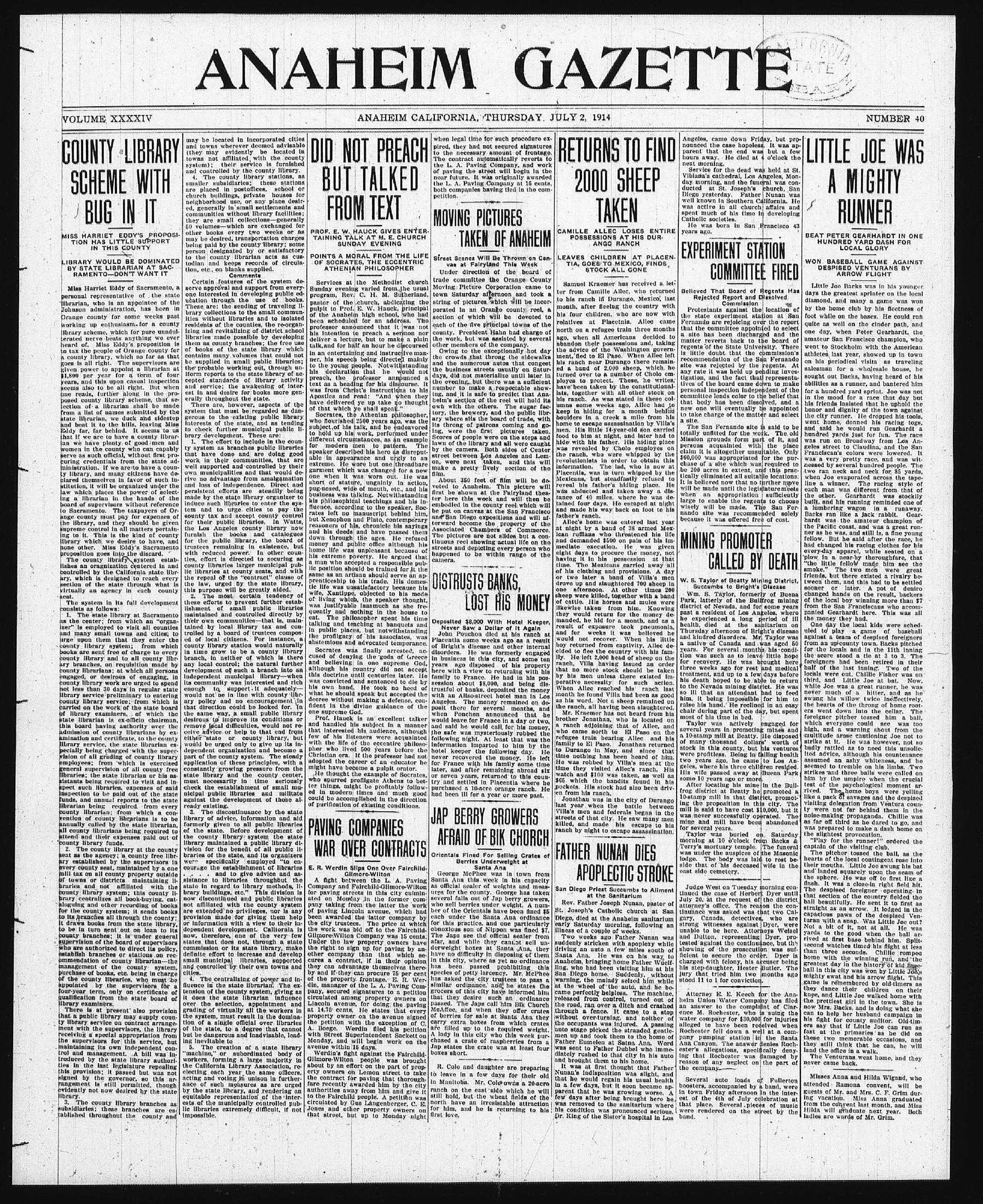
Searchable text
COUNTY LIBRARY SCHEME WITH BUG IN IT
MISS HARRIET EDDY'S PROPOSITION HAS LITTLE SUPPORT IN THIS COUNTY
LIBRARY WOULD BE DOMINATED BY STATE LIBRARIAN AT SACRAMENTO—DON'T WANT IT
Miss Harriet Eddy of Sacramento, a personal representative of the state librarian, who is an appointee of the Johnson administration, has been in Orange county for some weeks past working up enthusiasm for a county library scheme, which for pure unadulterated nerve beats anything we ever heard of. Miss Eddy's proposition is to tax the people of Orange county for a county library, which so far as that goes is all right. The supervisors are given power to appoint a librarian at $1,800 per year for a term of four years, and this upon casual inspection seems also to be all right. But when one reads further along in the proposed county library scheme, that selection of a librarian shall be made from a list of names submitted by the state librarian, we duck and sidestep and beat it to the hills, leaving Miss Eddy far, far behind. It seems to us that if we are to have a county librarian we have plenty of good men and women in the county who can capably may be located in incorporated cities and towns wherever deemed advisable (they may evidently be located in towns not affiliated with the county system); their service is furnished and controlled by the county library.
4. The county library stations, as smaller subsidiaries; these stations are placed in postoffices, school or church buildings, private houses for neighborhood use, or any place desired, generally in small settlements and communities without library facilities; they are small collections—generally 50 volumes—which are exchanged for other books every two weeks or as may be desired, transportation charges being paid by the county library; some person designated by or satisfactory to the county librarian acts as custodian and keeps records of circulation, etc., on blanks supplied.
Comments
Certain features of the system deserve approval and support from everyone interested in developing public education through the use of books. These are: the sending of traveling library collections to the small communities without libraries and to isolated residents of the counties, the re-organizing and revitalizing of district school libraries made possible by developing them as county branches; the free use of books of the state library which contains many volumes that could not be supplied in small public libraries; the probable working out, through uniform reports to the state library of accepted standards of library activity and service; the awakening of interest in and desire for books more generally throughout the state.
There are, however, aspects of the system that must be regarded as dangerous to the existing public library interests of the state, and as tending to check further municipal public library development. These are:
1. The effort to include in the county system as branches public libraries
DID NOT BUT THE FROM
PROF. E. W. HAU TAINING TALK TO SUNDAY
POINTS A MORAL OF SOCRATES, ATHENIAN P
Services at the Sunday evening vow program, Rev. C. pastor of the churp pulpit to Prof. E. of the Anaheim high school been scheduled for professor announcing his intention to deliver a lecture, talk,and for half an hour in an entertaining ner. his speech be to the young people his declaration tha preach, the proft text as a heading was from Christ's Apostles and read have delivered ye o that which ye socrates, the At who flourished 2500 subject.of his talk, to hold up his work different circumstances for modern men
a county library, which so far as that goes is all right. The supervisors are given power to appoint a librarian at $1,800 per year for a term of four years, and this upon casual inspection seems also to be all right. But when one reads, further along in the proposed county library scheme, that selection of a librarian shall be made from a list of names submitted by the state librarian, we duck and sidestep and beat it to the hills, leaving Miss Eddy far, far behind. It seems to us that if we are to have a county librarian we have plenty of good men and women in the county who can capably serve as such official, without first procuring credentials from the state administration. If we are to have a county library, and many citizens have declared themselves in favor of such institution, it will be organized under the law which places the power of selecting a librarian in the hands of the board of supervisors without reference to Sacramento. The taxpayers of Orange county must pay for expenses of the library, and they should be given supreme control in all matters pertaining to it. This is the kind of county library which we desire to have, and none other. Miss Eddy's Sacramento proposition goes into the discard.
The county library system establishes an oragnization centered in and controlled by the California state library, which is designed to reach every section of the state through what is virtually an agency in each county seat.
The system in its full development consists as follows:
1. The state library at Sacramento as the center; from which an "organizer" is employed to visit all counties and many small towns and cities; to urge upon them that they enter the county library system; from which books are sent free of charge to every county library and to all county libraries, on requisition made by county librarians; at which all persons engaged, or desirous of engaging, in county library work are urged to spend not less than 30 days in regular state library service preliminary to entering county library service; from which is carried on the work of the state board of library examiners, of which the state librarian is ex-officio chairman, this board having authority over the admission of county librarians by examination and certificate, to the county library service, the state librarian especially being charged with the supervision of all grading of county library employees; from which is exercised general supervision of all county free libraries; the state librarian or his assistants being required to visit and inspect such libraries, expenses of said inspection to be paid out of the state funds, and annual reports to the state librarian being required, from every county librarian; from which a convention of county librarians is to be annually called by the state librarian, all county librarians being required to attend and their expenses paid out of county library funds.
2. The county library at the county contains many volumes that could not be supplied in small public libraries; the probable working out, through uniform reports to the state library of accepted standards of library activity and service; the awakening of interest in and desire for books more generally throughout the state.
There are, however, aspects of the system that must be regarded as dangerous to the existing public library interests of the state, and as tending to check further municipal public library development. These are:
1. The effort to include in the country system as branches public libraries that have done and are doing good work in their communities, that are well supported and controlled by their own municipalities and that would derive no advantage from amalgamation and loss of independence. Direct and persistent efforts are steadily being made by the state library organizer to induce such libraries to enter the system and to urge cities to pay the county tax and accept county control for their public libraries. In Watts, the Los Angeles county library now furnish the books and catalogues for the public library, the board of trustees remaining in existence, but with reduced power. In other counties, effort is directed to securing as county libraries larger municipal public libraries at county seats, and with the repeal of the "contract" clause of the law, urged by the state library, this purpose will be greatly aided.
2. The most certain tendency of these efforts to prevent further establishment of small public libraries maintained and controlled directly by their own communities—that is, maintained by local library tax and controlled by a board of trustees composed of local citizens. For instance, a county library station would naturally in time grow to be a county library branch, in neither of which is there any local control; the natural further development of such a branch into an independent municipal library—when its community was interested and rich enough to support it adequately—would not be in line with county library policy and no encouragement in that direction could be looked for. In the same way, a small public library desirable to improve its conditions or remove local difficulties, would not receive advice or help to that end from either state or county library, but would be urged only to give up its independent organization and become a part of the county system. The steady application of these principles, with a constantly growing pressure from the state library and the county center, must necessarily in time seriously check the establishment of small municipal public libraries and militate against the development of those already existing.
3. The discontinuance by the state library of advice, information and aid formerly given to all public libraries of the state. Before development of the county library system the state library maintained a public library division for the benefit of all public it...
vision of all grading of county library employees; from which is exercised general supervision of all county free libraries; the state librarian or his assistants being required to visit and inspect such libraries, expenses of said inspection to be paid out of the state funds, and annual reports to the state librarian being required, from every county librarian; from which a convention of county librarians is to be annually called by the state librarian, all county librarians being required to attend and their expenses paid out of county library funds.
2. The county library at the county seat as the agency; a county free library established by the supervisors in every county seat, maintained by a one mill tax on all county property outside of towns or districts maintaining libraries and not affiliated with the county library system; this county library centralizes all book-buying, cataloguing and other recording of books for the county system; it sends books to its branches all through the county; it draws books from the state library, to be in turn sent out on loan to its county branches; it is under general supervision of the board of supervisors who are authorized to direct its policy, establish branches or stations on recommendation of county librarian—the management of the county system, purchase of books, etc., being in charge of the county libraries, who must be appointed by the supervisors for a four-year term, only on certificate of qualification from the state board of library examiners.
There is at present also provision that a public library may supply county library service on contract arrangement with the supervisors, the library receiving a special appropriation from the supervisors for this service, but maintaining its own independent control and management. A bill was introduced by the state library authorities in the last legislature repealing this provision; it passed but was not signed by the governor, so this arrangement is still permitted, though evidently not now desired by the state library.
3. The county library branches as subsidiaries; these branches are established throughout the county and part of the county system. The steady application of these principles, with a constantly growing pressure from the state library and the county center, must necessarily in time seriously check the establishment of small municipal public libraries and militate against the development of those already existing.
3. The discontinuance by the state library of advice, information and aid formerly given to all public libraries of the state. Before development of the county library system the state library maintained a public library division for the benefit of all public libraries of the state, and its organizers were specifically employed "to encourage the establishment of libraries ... and to give advice and assistance to libraries throughout the state in regard to library methods, library buildings, etc." This division is now discontinued and public libraries not affiliated with the county system are extended no privileges, nor is any provision made for giving them help or information with a view to their independent development. California is now, therefore, one of the very few states that does not, through a state commission or its state library, make definite effort to increase and develop small municipal libraries, supported and controlled by their own towns and cities.
4. The centralizing of power and influence in the state librarian. The extension of the county system, giving as it does the state librarian influence over the selection, appointment and grading of virtually all the workers in the system, must result in the domination of a single official over libraries of the state, to a degree that cannot but be dangerous and inadvisable, leading inevitable to
5. The creation of a state library "machine," or subordinated body of workers, forming a large majority in the California Library Association, relecting each year the same officers, acting and voting in unison in furtherance of such measures as are urged by the state library, and rendering an equitable representation of the interests of municipally controlled public libraries extremely difficult, if not impossible.
AHEIM GAZETE
ANAHEIM CALIFORNIA, THURSDAY. JULY 2, 1914
DID NOT PREACH BUT TALKED FROM TEXT
PROF. E. W. HAUCK GIVES ENTERTAINING TALK AT M. E. CHURCH SUNDAY EVENING
POINTS A MORAL FROM THE LIFE OF SOCRATES, THE ECCENTRIC ATHENIAN PHILOSOPHER
Services at the Methodist church Sunday evening varied from the usual program, Rev. C. H. M. Sutherland, pastor of the church, abdicating the pulpit to Prof. E. W. Hauck, principal of the Anaheim high school, who had been scheduled for an address. The professor announced that it was not his intention to preach a sermon nor deliver a lecture, but to make a plain talk, and for half an hour he discoursed in an entertaining and instructive manner, his speech being directed mainly to the young people. Notwithstanding his declaration that he would not preach, the professor announced a text as a heading for his discourse. It was from Christ's instructions to his Apostles and read: "And when they have delivered ye up take go thought of that which ye shall speak."
Socrates, the Athenian philosopher, who flourished 2500 years ago, was the subject, of his talk, and he endeavored to hold up his work, performed under different circumstances, as an example for modern men to pattern.
when legal time for such procedure expired, they had not secured signatures to the necessary amount of frontage. The contract automatically reverts to the L. A. Paving Company, and work of paving the street will begin in the near future. It was originally awarded the L. A. Paving Company at 15 cents, both companies having tied in the competition.
MOVING PICTURES TAKEN OF ANAHEIM
Street Scenes Will Be Thrown on Canvas at Fairland This Week
Under direction of the board of trade committee the Orange County Moving Picture Corporation came to town Saturday afternoon and took a string of pictures which will be incorporated in an Orange county reel, a section of which will be devoted to each of the five principal towns of the county. President Hahn had charge of the work, but was assisted by several other members of the company.
Owing to the exceptionally hot day the crowds that throng the sidewalks and the numerous autos that congest the business streets usually on Saturday, did not materialize until later in the evening, but there was a sufficient number to make a respectable showing, and it is safe to predict that Anaheim's section of the reel will hold its own with the others. The sugar factory, the brewery, and the public library where sits the board of trade, with its throng of patrons coming and going, were the first pictures taken. Scores of people were on the steps and lawn of the library and all were caught by the camera. Both sides of Canvas.
RETURNS TO FIND 2000 SHEEP TAKEN
CAMILLE ALLEC LOSES ENTIRE POSSESSIONS AT HIS DURANGO RANCH
LEAVES CHILDREN AT PLACENTIA, GOES TO MEXICO, FINDS STOCK ALL GONE
Samuel Kraemer has received a letter from Camille Allec, who returned to his ranch in Durango, Mexico, last month, after fleeing the country with his four children, who are now with relatives at Placentia. Allec came north on a refuge train three months ago, when all Americans decided to abandon their possessions and, taking the advice of the Washington government, fled to El Paso. When Allec left his ranch near Durango there remained a band of 2,000 sheep, which he turned over to a number of Cholo employees to protect. These he writes, have been taken by the constitutionalists, together with all other stock on his ranch. As was stated in these columns some weeks ago, Allec had to keep in hiding for a month behind boulders in a creek a mile from his home to escape assassination by Villa's men. His little 14-year-old son carried food to him at night, and later had to hide with his father. His hiding place was revealed by Cholo employees on
Socrates, the Athenian philosopher, who flourished 2500 years ago, was the subject of his talk, and he endeavored to hold up his work, performed under different circumstances, as an example for modern men to pattern. The speaker described his hero as disreputable in appearance and urgly to an extreme. He wore but one threadbare garment which was changed for a new one when it was worn out. He was short of stature, ungainly in action, pug-nosed, wide of mouth, etc., and his business was talking. Notwithstanding his philosophical teachings and his influence, according to the speaker, Socrates left no manuscript behind him, but Xenophon and Plato, contemporary reasoners of his, chronicle his sayings and his deeds, and have passed them down through the ages. He refused money and public office although his home life was unpleasant because of its extreme poverty. He argued that a man who accepted a responsible public position should be trained for it the same as an artisan should serve an apprenticeship to his trade. His domestic life was unsatisfactory because his wife, Xantiphe, objected to his mode of living which, the speaker thought, was justifiable inasmuch as she frequently and nothing in the house to eat. The philosopher spent his time talking and teaching at banquets and in public places, but notwithstanding the profligacy of his associates, was abstemious and advocated temperance.
Socrates was finally arrested, accused of denying the gods of Greece and believing in one supreme God, although his country did not accept this doctrine until centuries later. He was convicted and sentenced to die by his own hand. He took no heed of what he should speak but accepted the decree without making a defense, confident in the divine guidance of the one supreme God.
Prof. Hauck is an excellent talker and handled his subject in a manner that interested his audience, although few of his listeners were acquainted with the life of the eccentric philosopher who lived 500 years before the Christian era. If the professor had not adopted the career of an educator he might have become a pulpit orator.
He thought the example of Socrates, who spurred profligate Athens to better things, might be profitably followed in modern times and much good could be accomplished in the direction of purification of existing conditions.
PAVING COMPANIES
WAR OVER CONTRACTS
JAP BERRY GROWERS
AFRAID OF BIK CHORCH
The crowds that throng the sidewalks and the numerous autos that congest the business streets usually on Saturday, did not materialize until later in the evening, but there was a sufficient number to make a respectable showing, and it is safe to predict that Anhelm's section of the reel will hold its own with the others. The sugar factory, the brewery, and the public library where sits the board of trade, with its throng of patrons coming and going, were the first pictures taken. Scores of people were on the steps and lawn of the library and all were caught by the camera. Both sides of Center street between Los Angeles and Lemon, were next taken, and this will make a pretty lively section of the film.
About 350 feet of film will be devoted to Anaheim. This picture will first be shown at the Fairyland theater here this week and will then be embodied in the county reel which will be put on canvas at the San Francisco and San Diego expositions and will afterward become the property of the Associated Chambers of Commerce. The pictures are not slides but a continuous reel showing actual life on the streets and depicting every person who happened to be within range of the camera.
DISTRUSTS BANKS,
LOST HIS MONEY
Deposited $8,000 With Hotel Keeper,
Never Saw a Dollar of It Again
John Pouchon died at his ranch at Placentia some weeks ago as a result of Bright's disease and other internal disorders. He was formerly engaged in business in this city, and some ten years ago disposed of his property here with a view to returning with his family to France. He had in his possession about $8,000, and being disrestful of banks, deposited the money with an Alliso-street hotel man in Los Angeles. The money remained on deposit there for several months, and when Pouchon announced that he would leave for France in a day or two, and said he would call for his money, the safe was mysteriously robbed the following night. At least that was the information imparted to him by the hotel keeper the following day. He never recovered the money. He left for France with his family some time later, and after remaining abroad six or seven years, returned to this country and settled in Placentia where he purchased a 10-acre orange ranch. He had been ill for a year or more past.
Mr. Kraeme has not heard from his brother Jonathan, who is located on a ranch adjoining that of Allec, and who came north to El Paso on the refugee train bearing Allec and his family to El Paso. Jonathan returned to Durango in May, and since that time nothing has been heard of him. He was robbed by Villa's men at the time they visited Allec's ranch. His watch and $100 was taken, as well as $65 which the bandits found in his pockets. His stock had also been driven from his ranch.
Jonathan was in the city of Durango last year when the battle between Villa's men and federals began in the streets of that city. He saw many men killed, and made his escape to his ranch by night to escape assassination.
PAVING COMPANIES WAR OVER CONTRACTS
E. R. Werdin Slips One Over Fairchild-Gilmore-Wilton
A fight between the L. A. Paving Company and Fairchild-Gilmore-Wilton for paving streets in this city culminated on Monday in the former company taking from the latter the work of paving Lincoln avenue, which had been awarded the latter company by the city trustees. The price at which the work was bid off to the Fairchild-Gilmore-Wilton Company was 15 cents. Under the law property owners have the right to sign up for paving by another company than that which secures a contract. If in their opinion they can advantage themselves thereby and if they can procure 75 per cent of the property frontage. E. R. Werdin, manager of the L. A. Paving Company, secured signatures to a petition circulated among property owners on Lincoln avenue, for doing the paving at 14.75 cents. He states that every property owner on the avenue signed the petition with the exception of C. A. Boege. Werdin filed his petition with Street Superintendent Sackett on Monday, and will begin work on the avenue within 15 days.
Werdin's fight against the Fairchild-Gilmore-Wilton people was brought about by an effort on the part of property owners on Lemon street to take the contract for paving that thoroughfare recently awarded him by the city authorities away from him and give it to the Fairchild people. A petition was circulated by Gus Langenberger, C. E. Jones and other property owners on that street, but up to Monday night never recovered the money. He left for France with his family some time later, and after remaining abroad six or seven years, returned to this country and settled in Placentia where he purchased a 10-acre orange ranch. He had been ill for a year or more past.
JAP BERRY GROWERS AFRAID OF BIK CHORCH
Orientals Fined For Selling Crates of Berries Underweight at Santa Ana
George McPhee was in town from Santa Ana this week in his capacity as official sealer of weights and measures for the county. George has taken several falls out of Jap berry growers, who sell berries under weight. A number of the Orientals have been fined $5 each under the Santa Ana ordinance for this practice, and one particularly obnoxious son of Nippon was fined $7.
The Japs see the official sealer from afar, and while they cannot sell underweight boxes at Santa Ana, they have no difficulty in disposing of them in this city, where as yet no ordinance has been passed prohibiting this species of petty larcency. Mr. McPhee has asked the city trustees to pass a similar ordinance, and he states the grocers of this city have informed him that they desire such an ordinance passed. The Japs call him Blk Chorch McAfee, and when they offer crates of berries for sale at Santa Ana they carry extra boxes from which crates are filled up to the required weight. A lady in this city who this week purchased a crate of raspberries from a Jap states the crate was at least four boxes short.
R. Colo and daughter are preparing to leave in a few days for their old in Manitoba. Mr. Colo owns a 20-acre ranch on the east side which he will still hold, but the wheat fields of the north have an irresistable attraction for him, and he is returning to his first love.
FATHER NUNAN DIES APOPLECTIC STROKE
San Diego Priest Succumbs to Allment at the Sanitarium
Rev. Father Joseph Nunan, pastor of St. Joseph's Catholic church at San Diego, died at the Anaheim sanitarium early Saturday morning, following an illness of a couple of weeks.
Two weeks ago Father Nunan was suddenly stricken with apoplexy while driving an auto a few miles south of Santa Ana. He was on his way to Anaheim, bringing home Father Wuelfling, who had been visiting him at his San Diego home. Suddenly, without warning, the malady seized him while at the wheel of the auto, and he became perfectly helpless. The machine released from control, turned out of the road, ran over a ditch and crashed through a fence. It came to a stop without over-turning, and neither of the occupants was injured. A passing auto stage picked the stranded gentleman up and took them to the home of Father Eumelen at Satna Ana. Word was sent to Father Dubbel who immediately rushed to that city in his auto and brought them to his home.
It was at first thought that Father Nunan's indisposition was slight, and that he would regain his usual health in a few days, but it soon became apparent that he was growing worse. A few days after being brought here he was removed to the sanitarium where his condition was pronounced serious. Dr. King of the Sister's hospital in Los Angeles boosted in esthetic that were banded.
G TO FIND SHEEP KEN
LOSES ENTIRE AT HIS DURRANCH
EN AT PLACEN-MEXICO, FINDS LL GONE
has received a letter, who returned rango, Mexico, last week the country with who are now with Austria. Allec came train three months Americans decided to sessions and, taking Washington governor. When Allec left rango there remain 0 sheep, which he number of Cholo em. These, he writes, the constitutional all other stock on stated in these col- ago, Allec had to a month behind a mile from his assassination by Villa's year-old son carried it, and later had to His hiding place cholo employees on Angeles, came down Friday, but pronounced the case hopeless. It was apparent that the end was but a few hours away. He died at 4 o'clock the next morning.
Service for the dead was held at St. Vibiana's cathedral, Los Angeles, Monday morning, and the funeral was conducted at St. Joseph's church, San Diego yesterday. Father Nunan was well known in Southern California. He was active in all church affairs and spent much of his time in developing Catholic societies.
He was born in San Francisco 43 years ago.
EXPERIMENT STATION COMMITTEE FIRED
Believed That Board of Regents Has Rejected Report and Dissolved Commission
Protestants against the location of the state experiment station at San Fernando are rejoicing over the report that the committee appointed to select a site has been discharged and the matter reverts back to the board of regents of the State University. There is little doubt that the commission's recommendation of the San Fernando site was rejected by the regents. At any rate it was held up pending investigation, and the fact that representatives of the board came down to make personal inspection independent of the committee lends color to the belief that that body has been dissolved, and a new one will eventually be appointed to take charge of the matter and select a site.
The San Fernando site is said to be totally unfitted for the work. The old Mission grounds form part of it, and persons acquainted with the place
LITTLE JOE WAS A MIGHTY RUNNER
BEAT PETER GEARHARDT IN ONE HUNDRED YARD DASH FOR LOCAL GLORY
WON BASEBALL GAME AGAINST DESPISED VENTURANS BY ARROW FLIGHT
Little Joe Backs was in his younger days the greatest sprinter on the local diamond, and many a game was won by the home club by his fleetness of foot while on the bases. He could run quite as well on the cinder path, and one day, when Peter Geearhardt, the amateur San Francisco champion, who went to Stockholm with the American athletes last year, showed up in town on his periodical visits as traveling salesman for a wholesale house, he sought out Backs, having heard of his abilities as a runner, and bantered him for a hundred yard sprint. Joe was not in the mood for a race that day but his friends insisted that he uphold the honor and dignity of the town against the city runner. He dropped his tools, went home, donned his racing togs, and said he would run Geearhardt a hundred yards just for fun. The race was run on Broadway from Los Angeles street to Claudina, and the San
When Allec left the lango there remained 100 sheep, which he numbered of Cholo emm. These, he writes, are the constitutional all other stock on estated in these colloago, Allec had to take a mile from his assassination by Villa's year-old son carried out, and later had to His hiding place where Cholo employees on were whipped by the order to obtain this head, who is now at turn whipped by the officially refused to hiding place. He taken away a dis-where he was de-feeced escaped at night back on foot to his hand of Villa's men entered 700 sheep in other times 200 together with a band mules and mules were him. Knowing for the money de-mailed a month, and as a took pneumonia, was believed he When his little captivity, Allec countryside with his fami-sad of sheep on the issued an order should be taken there existed im-fer such action. And his ranch last had been as good sheep remained on been slaughtered. Not heard from his who is located on that of Allec, and El Paso on the King Allec and his Jonathan returned, and since that been heard of him. Villa's men at the Allec's ranch. His taken, as well as adults found in his had also been driv-
the city of Durango battle between ferals began in the He saw many men his escape to his escape assassination.
The San Fernando site is said to be totally unfitted for the work. The old Mission grounds form part of it, and persons acquainted with the place claim it altogether unsuitable. Only $60,000 was appropriated for the purchase of a site which was required to be 200 acres in extent, and this practically eliminated all suitable locations. It is believed now that no further move will be made until the legislature meets when an appropriation sufficiently large to enable the regents to choose wisely will be made. The San Fernando site was recommended solely because it was offered free of cost.
MINING PROMOTER CALLED BY DEATH
W. S. Taylor of Beatty Mining District, Succumbs to Bright's Disease
Wm. S. Taylor, formerly of Buena Park, latterly of the Bulffrog mining district of Nevada, and for some years past a resident of Los Angeles, where he experienced a long period of ill health, died at the sanitarium on Thursday afternoon of Bright's disease and kindred disorders. Mr Taylor was a native of Canada and was aged 50 years. For several months his condition was such as to leave little hope for recovery. He was brought here three weeks ago for rest and medical treatment, and up to a few days before his death hoped to be able to return to the Nevada mining district. He was so ill that an attendant had to feed him, it being impossible for him to raise his hand. He reclined in an easy chair during part of the day, but spent most of his time in bed.
Taylor was actively engaged for several years in promoting mines and a 10-stamp mill at Beatty. He disposed of many thousand dollars' worth of stock in this county, but his ventures were profitless. Being in failing health two years ago, he came to Los Angeles, where his three children resided. His wife passed away at Buena Park some 10 years ago or more.
After locating his mine in the Bullfrog district at Beatty he promoted a 10-stamp mill in that district, promoting the proposition in this city. The mill is said to have cost $10,000, but it was never successfully operated. The mine and mill have been abandoned for several years.
Taylor was buried on Saturday morning at 10 o'clock from Backs & Terry's mortuary temple. The funeral athlete last year, showed up in town on his periodical visits as traveling salesman for a wholesale house, he sought out Backs, having heard of his abilities as a runner, and bantered him for a hundred yard sprint. Joe was not in the mood for a race that day but his friends insisted that he uphold the honor and dignity of the town against the city runner. He dropped his tools, went home, donned his racing togs, and said he would run Gearhardt a hundred yards just for fun. The race was run on Broadway from Los Angeles street to Claudina, and the San Franciscan's colors were lowered. It was a very pretty race, and was witnessed by several hundred people. The two ran neck and neck for 85 yards, when Joe evaporated across the tape-line a winner. The racing style of each man was different from that of the other. Gearhardt was stockily built, and his running reminded one of a limbering wagon in a runaway. Backs ran like a Jack rabbit. Gearhardt was the amateur champion of the Pacific coast, and was a great runner as he was, and still is, a fine young fellow. But he said after the race, he had changed his racing clothes for his every-day apparel, while seated on a plow in a near-by thoroughfare, that "the little fellow" made him see the smoke." The two men were great friends, but there existed a rivalry between them, and this had to be settled sooner or later. A pot of deniro changed hands on the result, backers of the local boy winning more than $7 from the San Franciscan who accompanied Gearhardt here. This was all the money they had.
One day the local kids were scheduled to play a game of baseball against a team of despised foreigners from an up-county town. Backs pitched for the locals and in the 11th innning the score stood a tie at 3 to 3. The foreigners had been retired in their half of the last innning. Two of the locals were out. Chille Fisher was on third, and Little Joe at bat. Now, while Joe was a great runner, he was never much of a hitter, and as he swung his willow twice ineffectively, the hearts of the throng of home rooters went down into the cellar. The foreigner pitcher tossed him a ball, which everyone could see was too high, and a warning shout from the multitude arose cautioning Joe not to strike at it. He was however, not so badly rattled as to need this unsolicited advice, although his countenance assumed an ashy whiteness, and he seemed to tremble on his limbs. Two strikes and three balls were called on him by the umpire when the crucial test of the psychological moment arrived. The home boys were yelling like a pack of savages and the despised visiting delegation from Ventura county were not far behind them in the noise-making propaganda. Chille was as far off third as he dared to go, and was prepared to make a dash home on the slightest provocation.
"Play for the runner!" ordered the captain of the visiting club.
been heard of him. Villa's men at the Allec's ranch. His taken, as well as adits found in his had also been drivthe city of Durango battle between erals began in the He saw many men his escape to his escape assassination.
After locating his mine in the Bullfrog district at Beatty he promoted a 10-stamp mill in that district, promoting the proposition in this city. The mill is said to have cost $10,000, but it was never successfully operated. The mine and mill have been abandoned for several years.
Taylor was buried on Saturday morning at 10 o'clock from Backs & Terry's mortuary temple. The funeral was under the auspices of the Masonic lodge. The body was laid to rest beside that of his deceased wife in the east side cemetery.
Judge West on Tuesday morning continued the case of Herbert Dyer until July 20, at the request of the district attorney's office. The reason the continuance was asked was that two Calgary, Canada, detectives, who are strong witnesses against Dyer, were unable to be here. Attorneys Welsel and Dutton, representing Dyer, protested against the continuance, but the showing of the prosecution was sufficient to secure the order. Dyer is charged with felony, his accuser being his step-daughter, Hester Butler. The jury that tried him two months ago stood 11 to 1 for conviction.
Attorney E. E. Keech for the Anaheim Union Water Company has filed an answer to the complaint of Clarence M. Rochester, who is suing the water company for $30,000 for injuries alleged to have been received when Rochester fell down a well at a company pumping station in the Santa Ana Canyon. The answer denies Rochester's allegations, specifically denying that Rochester was damaged by reason of any neglect on the part of the company.
Several auto loads of Fullerton boosters, accompanied by a band, were in Friday afternoon in the interest of the 4th of July celebration at that place. Several pieces of music were rendered on the street by the band.
Misses Anna and Hilda Wigand, who attended Ramona convent, will be guests of Mr. and Mrs. C. F. Grim during vacation. Miss Anna graduated from the convent last month, and Miss Hilda will graduate next year. Both ladles are wards of Mr. Grim.