anaheim-gazette 1914-06-04
Scanned page
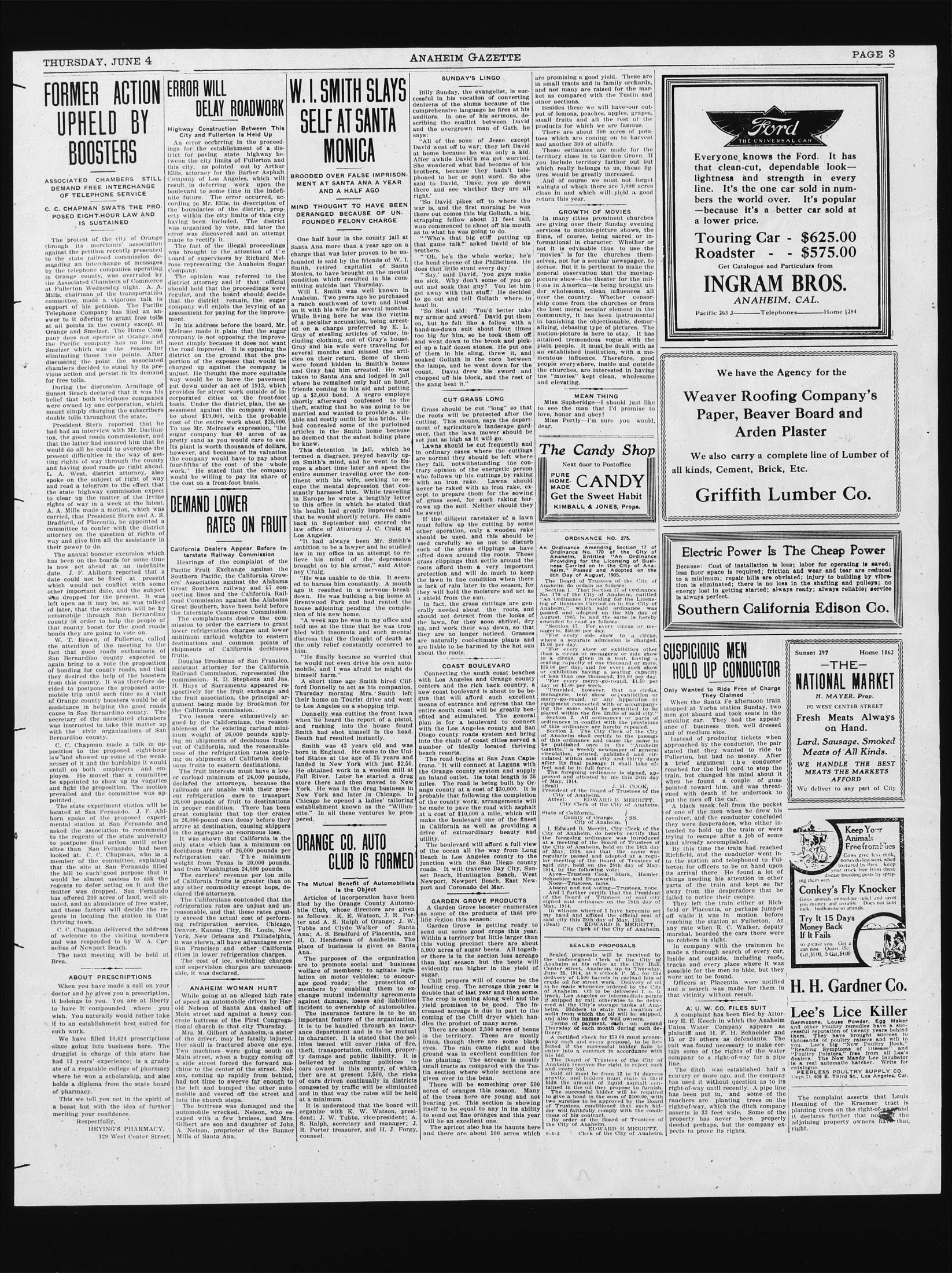
Searchable text
FORMER ACTION UPHELD BY BOOSTERS
ASSOCIATED CHAMBERS STILL DEMAND FREE INTERCHANGE OF TELEPHONE SERVICE
C. C. CHAPMAN SWATS THE PROPOSED EIGHT-HOUR LAW AND IS SUSTAINED
The protest of the city of Orange through its merchants' association against the petition recently presented to the state railroad commission demanding an interchange of messages by the telephone companies operating in Orange county, was overruled by the Associated Chambers of Commerce at Fullerton Wednesday night. A. A. Mills, chairman of the transportation committee, made a vigorous talk in support of his petition. The Pacific Telephone Company has filed an answer to it offering to grant free tolls at all points in the county except at Orange and Smelzer. The Home Company does not operate at Orange and the Pacific company has no line at Smelzer which was the reason for eliminating those two points. After discussing the point the associated chambers decided to stand by its previous action and persist in its demand for free tolls.
During the discussion Armitage of Sunset Beach declared that it was his belief that both telephone companies were owned by one corporation, which meant simply charging the subscribers double tolls throughout the state.
President Stern reported that he had had an interview with Mr. Darlington, the good roads commissioner, and that the latter had assured him that he would do all he could to overcome the present difficulties in the way of getting rights of way through the county and having good roads go right ahead.
ERROR WILL DELAY ROADWORK
Highway Construction Between This City and Fullerton Is Held Up
An error occurrring in the proceedings for the establishment of a district for paving state highway between the city limits of Fullerton and this city, as pointed out by Arthur Ellis, attorney for the Barber Asphalt Company of Los Angeles, which will result in deferring work upon the boulevard to some time in the indefinite future. The error occurred, according to Mr. Ellis, in description of the boundaries of the district, property within the city limits of this city having been included. The district was organized by vote, and later the error was discovered and an attempt made to rectify it.
The fact of the illegal proceedings was brought to the attention of the board of supervisors by Richard Melrose representing the Anaheim Sugar Company.
The opinion was referred to the district attorney and if that official should hold that the proceedings were regular, and the board should decide that the district remain, the sugar company will enjoin the levying of an assessment for paying for the improvement.
In his address before the board, Mr. Melrose made it plain that the sugar company is not opposing the improvement simply because it does not want the road improved. It is opposing the district on the ground that the proportion of the expense that would be charged up against the company is unjust. He thought the more equitable way would be to have the pavement put down under an act of 1913, which provides for street work outside of incorporated cities on the front-foot basis. Under the district plan, the assessment against the company would be about $19,000, with the probable cost of the entire work about $25,000.
To use Mr. Melrose's expression, "the sugar company has 40 acres of as pretty sand as you would care to see. Its plant is worth thousands of dollars, however, and because of its valuation the company would have to pay about four-fifths of the cost of the whole work." He stated that the company...
During the discussion Armitage of Sunset Beach declared that it was his belief that both telephone companies were owned by one corporation, which meant simply charging the subscribers double tolls throughout the state.
President Stern reported that he had had an interview with Mr. Darlington, the good roads commissioner, and that the latter had assured him that he would do all he could to overcome the present difficulties in the way of getting rights of way through the county and having good roads go right ahead. L. A. West, district attorney, also spoke on the subject of right of way and read a telegram to the effect that the state highway commission expect to clear up the matter of the Irvine rights of way in a week at the latest. A. A. Mills made a motion, which was carried, that President Stern and A. S. Bradford, of Placentia, be appointed a committee to confer with the district attorney on the question of rights of way and give him all the assistance in their power to do.
The annual booster excursion which has been on the boards for some time is now set ahead at an indefinite date. J. F. Ahlborn reported that a date could not be fixed at present which would not conflict with some other important date, and the subject was dropped for the present. It was left open as it may be, as was talked of later, that the excursion will be by automobile through San Bernardino county in order to help the people of that county boost for the good roads bonds they are going to vote on.
W. T. Brown, of Fullerton, called the attention of the meeting to the fact that good roads enthusiasts of San Bernardino county expected to again bring to a vote the proposition of bonding for county roads, and that they desired the help of the boosters from this county. It was therefore decided to postpone the proposed automobile trip until such time as a visit of Orange county boosters would be of assistance in helping the good roads cause in San Bernardino county. The secretary of the associated chambers was instructed to take this matter up with the civic organizations of San Bernardino county.
C. C. Chapman made a talk in opposition to the proposed eight-hour law and showed up some of the weaknesses of it and the hardships it would entail on both employers and employees. He moved that a committee be appointed to show up its vagaries and fight the proposition. The motion prevailed and the committee was appointed.
The state experiment station will be located at San Fernando. J. F. Ahlborn spoke of the proposed experimental station at San Fernando and asked the association to recommend to the regents of the state university to postpone final action until other sites than San Fernando had been looked at. C. C. Chapman, who is a member of the committee, explained that the site at San Fernando filled the bill to such good purpose that it would be almost useless to ask the regents to defer acting on it and the matter was dropped. San Fernando has offered 200 acres of land, well sit-
DEMAND LOWER RATES ON FRUIT
California Dealers Appear Before Interstate Railway Commission
Hearings of the complaint of the Pacific Fruit Exchange against the Southern Pacific, the California Growers' Association against the Alabama Great Southern railway and 57 connecting lines and the California Railroad Commission against the Alabama Great Southern, have been held before the Interstate Commerce Commission.
The complainants desire the commission to order the carriers to grant lower refrigeration charges and lower minimum carload weights to eastern destinations and common points of shipments of California deciduous fruits.
Douglas Brookman of San Fransico, assistant attorney for the California Railroad Commission, represented the commission. R. D. Stephens and Jas. H. Hays of Sacramento appeared respectively for the fruit exchange and the fruit association, the principal argument being made by Brookman for the California commission.
Two issues were exhaustively argued by the Californians, the reasonableness of the existing carload minimum weight of 26,000 pounds applying on shipments of deciduous fruits out of California, and the reasonableness of the refrigeration rates applying on shipments of California deciduous fruits to eastern destinations.
The fruit interests must have a lower carload minimum of 24,000 pounds, declared the attorneys, because the railroads are unable with their present refrigeration cars to transport 26,000 pounds of fruit to destinations in proper condition. There has been great complaint that top tier crates in 26,000-pound cars decay before they arrive at destination, causing shippers in the aggregate an enormous loss.
It was shown that California is the only state which has a minimum on deciduous fruits of 26,000 pounds per refrigeration car. The minimum weight from Texas is 20,000 pounds, and from Washington 24,000 pounds.
The carriers' revenue per ton mile of California fruits is greater than on any other commodity except hops, declared the attorneys.
He thought the more equitable way would be to have the pavement put down under an act of 1913, which provides for street work outside of incorporated cities on the front-foot basis. Under the district, plan, the assessment against the company would be about $19,000, with the probable cost of the entire work about $25,000.
To use Mr. Melrose's expression, "the sugar company has 40 acres of as pretty sand as you would care to see. Its plant is worth thousands of dollars, however, and because of its valuation the company would have to pay about four-fifths of the cost of the whole work." He stated that the company would be willing to pay its share of the cost on a front-foot basis.
This detention in termed a disgrace, placed on Smith's mind, and rope a short time later entire summer travelent with his wife cape the mental depastantly harassed him in Europe he wrote to this office in which his health had great that he would shortly back in September law office of Attorney Los Angeles.
"It had always ambition to be a law law in my office in lieve his mind or brought on by his aney Craig.
"He was unable to ed to harass him co-ago it resulted in down. He was build Brentwood Park and house adjoining pertion of his new home.
"A week ago he w told me at the time bled with insomnia distress that the tha only relief consim him.
"He finally became he would not even d mobile, and I was a himself harm."
A short time ago ford Donnelly to act Thursday morning their home on Tourto Los Angeles on a Donnelly was cut when he heard there and rushing into Smith had shot his Death had resulted Smith was 43 y born in England. He ted States at the al landed in New York He obtained work in Fall River. Later store there and tha York. He was in tha New York and lat Chicago he opened establishment know ette." In all these pered.
The state experiment station will be located at San Fernando. J. F. Ahlborn spoke of the proposed experimental station at San Fernando and asked the association to recommend to the regents of the state university to postpone final action until other sites than San Fernando had been looked at. C. C. Chapman, who is a member of the committee, explained that the site at San Fernando filled the bill to such good purpose that it would be almost useless to ask the regents to defer acting on it and the matter was dropped. San Fernando has offered 200 acres of land, well situated, and an abundance of free water, and these factors will decide the regents in locating the station in that thriving town.
C. C. Chapman delivered the address of welcome to the visiting members and was responded to by W. A. Cornelius of Newport Beach.
The next meeting will be held at Brea.
ABOUT PRESCRIPTIONS
When you have made a call on your doctor and he gives you a prescription, it belongs to you. You are at liberty to have it compounded where you wish. You naturally would rather take it to an establishment best suited for such work.
We have filled 10,424 prescriptions since going into business here. The druggist in charge of this store has had 11 years' experience; is a graduate of a reputable college of pharmacy where he won a scholarship, and also holds a diploma from the state board of pharmacy.
This we tell you not in the spirit of a boast but with the idea of further meriting your confidence.
Respectfully,
HEYING'S PHARMACY,
129 West Center Street.
ANAHEIM WOMAN HURT
While going at an alleged high rate of speed an automobile driven by Harold Nelson of Santa Ana dashed off Main street and against a heavy concrete buttress of the First Congregational church in that city Thursday.
Mrs. M. Gilbert of Anaheim, a sister of the driver, may be fatally injured. Her skull is fractured above one eye. Two machines were going south on Main street, when a buggy coming off a side street forced the forward machine to the center of the street. Nelson, coming up rapidly from behind, had not time to swerve far enough to the left and bumped the other automobile and veered off the street and into the church steps.
The buttress was damaged and the automobile wrecked. Nelson, who escaped with a few bruises, and Mrs. Gilbert are son and daughter of John A. Nelson, proprietor of the Banner Mills of Santa Ana.
Chicago he opened his establishment known as "Estelle." In all these peresed.
Articles of incorporation filed by the Orangeville Club, whose owner as follows: K. E. Terer and A. S. Ralph Tubbs and Clyde Ana; A. S. Bradford H. O. Henderson place of business Ana.
The purposes of are to promote safety welfare of members on motor vehicle good roads; members by ena change mutual incidences to owners.
The insurance for important feature It is to be handledance department and in character. It isicies issued will theft, transportation damage and put believed by conf cars owned in ther are at present of cars driven congested by traffi and in that way tha at a minimum.
It is understood to organize with K. Dent; J. W. Tubba S. Ralph, secretary R. Porter treasurer counsel.
W.I. SMITH SLAYS SELF AT SANTA MONICA
BROODED OVER FALSE IMPRISONMENT AT SANTA ANA A YEAR AND A HALF AGO
MIND THOUGHT TO HAVE BEEN DERANGED BECAUSE OF UNFOUNDED FELONY CHARGE
One half hour in the county jail at Santa Ana more than a year ago on a charge that was later proven to be unfounded is said by the friends of W. I. Smith, retired capitalist of Santa Monica, to have brought on the mental condition which resulted in his committing suicide last Thursday.
Will I. Smith was well known in Anaheim. Two years ago he purchased a ranch southwest of town and lived on it with his wife for several months. While living here he was the victim of a peculiar accusation, being arrested on a charge preferred by E. L. Gray of stealing articles of value, including clothing, out of Gray's house. Gray and his wife were traveling for several months and missed the articles on their return. Some of them were found hidden in Smith's house and Gray had him arrested. He was taken to Santa Ana and lodged in jail where he remained only half an hour, friends coming to his aid and putting up a $3,000 bond. A negro employ shortly afterward confessed to the theft, stating that he was going to be married and wanted to provide a suitable and costly outfit for his bride. He had concealed some of the purloined articles in the Smith home because he deemed that the safest hiding place he knew.
This detention in jail, which he termed a disgrace, preyed heavily upon Smith's mind, and he went to Europe a short time later and spent the entire summer traveling over the con-
SUNDAY'S LINGO
Billy Sunday, the evangelist, is successful in his vocation of converting denizens of the slums because of the comprehensive language he fires at his auditors. In one of his sermons, describing the conflict between David and the overgrown man of Gath, he says:
"All of the sons of Jesse except David went off to war; they left David at home because he was only a kid. After awhile David's ma got worried. She wondered what had become of his brothers, because they hadn't telephoned to her or sent word. So she said to David, 'Dave, you go down there and see whether they are all right.'"
"So David pikes off to where the war is, and the first morning he was there out comes this big Goliath, a big, strapping fellow about 11 feet tall, who commenced to shoot off his mouth as to what he was going to do.
'Who's that big stiff putting up that game talk?' asked David of his brothers.
'Oh, he's the whole works; he's the head cheese of the Philistines. He does that little stunt every day.'
"Say,' said David, 'you guys make me sick. Why don't some of you go out and soak that guy? You let him get away with that stuff.' He decided to go out and tell Goliath where to head in.
'So Saul said: 'You'd better take my armor and sword.' David put them on, but he felt like a fellow with a hand-me-down suit about four times too big for him, so he took them off and went down to the brook and picked up a half dozen stones. He put one of them in his sling, threw it, and soaked Goliath in the coco between the lamps, and he went down for the count. David drew his sword and chopped off his block, and the rest of the gang beat it.'"
CUT GRASS LONG
Grass should be cut "long" so that the roots will be protected after the cutting. This means, says the department of agriculture's landscape gardener, that the lawn mower should be set just as high as it will go.
Lawns should be cut frequently and in ordinary cases where the cuttings are normal they should be left where they fall, notwithstanding the contrary opinion of the energetic person are promising a good yield. These are in small tracts and in family orchards, and not many are raised for the market as compared with the Tustin and other sections.
Besides these we will have our output of lemons, peaches, apples, grapes, small fruits and all the rest of the products for which we are famous.
There are about 300 acres of potatoes which are coming on to harvest and another 300 of alfalfa.
These estimates are made for the territory close in to Garden Grove. If you include territory farther out but which really belongs to us, these figures would be greatly increased.
And of course we must not forget walnuts of which there are 1,000 acres close in and which will yield a good return this year.
GROWTH OF MOVIES
In many cities prominent churches are giving over their Sunday evening services to motion-picture shows, the films, of course, being sacred or informational in character. Whether or not it is advisable thus to use the "movies" is for the churches themselves, not for a secular newspaper, to decrue. But it is pertinent to make the general observation that the moving-picture show—the theater for the millions in America—is being brought under wholesome, clean influences all over the country. Whether censorship come from the churches or from the best moral secular element in the community, it has been instrumental in banishing the objectionable, demoralizing, debasing type of pictures. The motion-picture is here to stay. It has attained tremendous vogue with the plain people. It must be dealt with as an established institution, with a momentous influence. Therefore, good people everywhere, inside and outside the churches, are interested in having the "movies" kept clean, wholesome and elevating.
MEAN THING
Miss Supheridge—I should just like to see the man that I'd promise to love, honor and obey!
Miss Pertly—I'm sure you would, dear.
taken to Santa Ana and lodged in jail where he remained only half an hour, friends coming to his aid and putting up a $3,000 bond. A negro employee shortly afterward confessed to the theft, stating that he was going to be married and wanted to provide a suitable and costly outfit for his bride. He had concealed some of the purloined articles in the Smith home because he deemed that the safest hiding place he knew.
This detention in jail, which he termed a disgrace, preyed heavily upon Smith's mind, and he went to Europe a short time later and spent the entire summer traveling over the continent with his wife, seeking to escape the mental depression that constantly harassed him. While traveling in Europe he wrote a lengthly letter to this office in which he stated that his health had greatly improved and that he would shortly return. He came back in September and entered the law office of Attorney J. C. Craig at Los Angeles.
"It had always been Mr. Smith's ambition to be a lawyer and he studied law in my office in an attempt to relieve his mind of the depression brought on by his arrest," said Attorney Craig.
"He was unable to do this. It seemed to harass him constantly. A month ago it resulted in a nervous breakdown. He was building a big home at Brentwood Park and had rented the house adjoining pending the completion of his new home.
"A week ago he was in my office and told me at the time that he was troubled with insomnia and such mental distress that the thought of death as the only relief constantly occurred to him.
"He finally became so worried that he would not even drive his own automobile, and I was afraid he might do himself harm."
A short time ago Smith hired Clifford Donnelly to act as his companion. Thursday morning Mrs. Smith left their home on Tourist drive and went to Los Angeles on a shopping trip.
Donnelly was cutting the front lawn when he heard the report of a pistol, and rushing into the house found Smith had shot himself in the head. Death had resulted instantly.
Smith was 43 years old and was born in England. He came to the United States at the age of 25 years and landed in New York with just $2.50. He obtained work in a woolen mill at Fall River. Later he started a drug store there and then moved to New York. He was in the drug business in New York and later in Chicago. In Chicago he opened a ladies' tailoring establishment known as the "Willunette." In all these ventures he prospered.
ORANGE CO. AUTO CLUB IS FORMED
The Mutual Benefit of Automobilists is the Object
Articles of incorporation have been
CUT GRASS LONG
Grass should be cut "long" so that the roots will be protected after the cutting. This means, says the department of agriculture's landscape gardener, that the lawn mower should be set just as high as it will go.
Lawn should be cut frequently and in ordinary cases where the cuttings are normal they should be left where they fall, notwithstanding the contrary opinion of the energetic person who follows up his cuttings by raking with an iron rake. Lawns should never be raked with an iron rake, except to prepare them for the sowing of grass seed, for such raking harrows up the soil. Neither should they be swept.
If the diligent caretaker of a lawn must follow up the cutting by some other operation, only a wooden rake should be used, and this should be used carefully so as not to disturb such of the grass clippings as have sifted down around the roots. These grass clippings that settle around the roots afford them a very important protection and will do much to keep the lawn in fine condition when there is lack of rain later in the season, for they will hold the moisture and act as a shield from the sun.
In fact, the grass cuttings are generally needed about the roots, and should not detract from the looks of the lawn, for they soon shrivel, dry up, and work their way down, so that they are no longer noticed. Grasses are naturally cool-climate plants and are liable to be harmed by the hot sun about the roots.
COAST BOULEVARD
Connecting the south coast beaches with Los Angeles and Orange county centers and the rich back country, a new coast boulevard is about to be begun that will afford such excellent means of entrance and egress that the entire south coast will be greatly benefited and stimulated. The general plan is for a boulevard to connect with the Los Angeles county and San Diego county roads system and bring into the chain of coast cities served a number of ideally located thriving beach resorts.
The road begins at San Juan Capistrano. It will connect at Laguna with the Orange county system and supply an inland outlet. Its total length is 35 miles. The road is being built by Orange county at a cost of $30,000. It is probable that following the completion of the county work, arrangements will be made to pave the road with asphalt at a cost of $10,000 a mile, which will make the boulevard one of the finest in California as well as providing a drive of extraordinary beauty and utility.
The boulevard will afford a full view of the ocean all the way from Long Beach in Los Angeles county to the junction with the San Diego county roads. It will traverse Bay City, Sunset Beach, Huntington Beach, West Newport, Newport Beach, East Newport and Coronado del Mar.
MEAN THING
Miss Supheridge—I should just like to see the man that I'd promise to love, honor and obey!
Miss Pertly—I'm sure you would, dear.
The Candy Shop
Next door to Postoffice
PURE HOME MADE
Get the Sweet Habit
KIMBALL & JONES, Props.
ORDINANCE NO. 275.
An Ordinance Amending Section 17 of Ordinance No. 170 of the City of Anaheim, Entitled "An Ordinance Providing for the Licensing of Business Carried on in the City of Anaheim," Passed and Adopted on the 8th Day of August, 1905.
The Board of Trustees of the City of Anaheim do ordain as follows:
Section 1. That Section 17 of Ordinance No. 170 of the City of Anaheim, entitled "An Ordinance Providing for the Licensing of Business Carried on in the City of Anaheim," which said ordinance was passed and adopted on the 8th day of August, 1905, be and the same is hereby amended to read as follows:
Section 17. For every circus or menagerie; $50.00 per day.
For every side show to a circus, where a separate admission is charged, $5.00 per day.
For every show or exhibition other than a circus or menagerie or side show to a circus, given in a tent, having a seating capacity of one thousand or more, $25.00 per day, and for every such show or exhibition having a seating capacity of less than one thousand, $10.00 per day.
For every merry-go-round, $1.50 per day or $7.00 per week.
Provided, however, that no circus, menagerie, tent show or exhibition or merry-go-round, or any apparatus or equipment connected with or accompanying the same shall be permitted to be placed within the fire limits of said city.
Section 2. All ordinances or parts of ordinances in conflict with the provisions of this ordinance are hereby repealed.
Section 3. The City Clerk of the City of Anaheim shall certify to the passage of this ordinance and cause the same to be published once in the "Anaheim Gazette," a weekly newspaper of general circulation, printed, published and circulated within said city and thirty days after its final passage it shall take effect and be in full force.
The foregoing ordinance is signed, approved and attested by me this 28th day of May, 1914.
(Seal)
J. H. COOK,
President of the Board of Trustees of the City of Anaheim.
Attest:
EDWARD B. MERRITT,
City Clerk of the City of Anaheim.
State of California.
County of Orange.
City of Anaheim.
I. Edward B. Merritt, City Clerk of the City of Anaheim, do hereby certify that the foregoing ordinance was introduced at a meeting of the Board of Trustees of the City of Anaheim, held on the 14th day of May, 1914, and that the same was regularly passed and adopted at a regular meeting of the Board of Trustees of said city, held on the 28th day of May, 1914, by the following vote:
Ayes—Trustees Cook, Stark, Hamler, Schneider and Brunworth.
Noes—Trustees none.
Absent and not voting—Trustees none.
And I further certify that the President of the Board of Trustees of said city
ORANGE CO. AUTO CLUB IS FORMED
The Mutual Benefit of Automobilists Is the Object
Articles of incorporation have been filed by the Orange County Automobile Club, whose directors are given as follows: K. E. Watson, J. R. Porter and A. S. Ralph of Orange; J. W. Tubbs and Clyde Walker of Santa Ana; A. S. Bradford of Placentia, and H. O. Henderson of Anaheim. The place of business is given as Santa Ana.
The purposes of the organization are to promote social and business welfare of members; to agitate legislation on motor vehicles; to encourage good roads; the protection of members by enabling them to exchange mutual indemnity agreements against damage, losses and liabilities incident to ownership of automobiles.
The insurance feature is to be an important feature of the organization. It is to be handled through an insurance department and is to be mutual in character. It is stated that the policies issued will cover risks of fire, theft, transportation, collision, property damage and public liability. It is believed by confining politices to cars owned in this county, of which there are at present 2,500, the risks of cars driven continually in districts congested by traffic will be eliminated and in that way the rates will be held at a minimum.
It is understood that the board will organize with K. W. Watson, president; J. W. Tubbs, vice-president; A. S. Ralph, secretary and manager; J. R. Porter treasurer, and H. J. Forgy, counsel.
GARDEN GROVE PRODUCTS
A Garden Grove booster enumerates as some of the products of that prolific region this season:
Garden Grove is getting ready to send out some good crops this year. Within a territory but little larger than this voting precinct there are about 5,000 acres of sugar beets. All together there is in the section less acreage than last season but the beets will evidently run higher in the yield of sugar.
Chill peppers will of course be the leading crop. The acreage this year is double that of last year and then some. The crop is coming along well and the yield promises to be good. The increased acreage is due in part to the coming of the Chill dryer which handles the product of many acres.
There are about 2,500 acres of beans in the territory. These are mostly limas, though there are some black eyes. The rain came right and the ground was in excellent condition for the planting. The acreage is mostly small tracts as compared with the Tustin section where whole sections are given over to the bean.
There will be something over 500 acres of oranges this season. Many of the trees here are young and not bearing yet. This section is showing itself to be equal to any in its ability to send out fine oranges and this year will be an excellent one.
The apricot also has its haunts here and there are about 100 acres which of the county work, arrangements will be made to pave the road with asphalt at a cost of $10,000 a mile, which will make the boulevard one of the finest in California as well as providing a drive of extraordinary beauty and utility.
The boulevard will afford a full view of the ocean all the way from Long Beach in Los Angeles county to the junction with the San Diego county roads. It will traverse Bay City, Sunset Beach, Huntington Beach, West Newport, Newport Beach, East Newport and Coronado del Mar.
SEALED PROPOSALS
Sealed proposals will be received by the undersigned Clerk of the City of Anaheim at his office at the City Hall, Center street, Anaheim, up to Thursday, June 25, 1914, at 8 o'clock P.M., for the delivery of 1,500 barrels in carload lots of crude oil for street work. Delivery of oil to be made whenever ordered by the City of Anaheim. Oil to be delivered f.o.b.track, Los Angeles or intermediate points if shipped by rail, otherwise to be delivered at the City's storage tanks at Anaheim. Bidders to state the location of wells from which the oil will be shipped, and also the names of well owners.
Terms of payment, cash on second Thursday of each month during such delivery.
A certified check for $50.00 must accompany each and every proposal, to be forfeited if the successful bidder fails to enter into a contract in accordance with his bid.
The Board of Trustees of the City of Anaheim reserves the right to reject each and every bid.
Said oil must be from 12 to 14 degrees gravity, and bidders must state in their bids the amount of liquid asphalt contained in the oil they propose to furnish.
The successful bidder will be required to give a bond in the sum of $500.00, with two sureties to be approved by the Board of Trustees, conditioned that such bidder will faithfully comply with the conditions of his contract.
By order of the Board of Trustees of the City of Anaheim.
EDWARD B. MERRITT,
Clerk of the City of Anaheim.
Ford
THE UNIVERSAL CAR
Everyone knows the Ford. It has that clean-cut, dependable look—lightness and strength in every line. It's the one car sold in numbers the world over. It's popular—because it's a better car sold at a lower price.
Touring Car - $625.00
Roadster - - $575.00
Get Catalogue and Particulars from INGRAM BROS.
ANAHEIM, CAL.
Pacific 263 J Telephones Home 1284
We have the Agency for the Weaver Roofing Company's Paper, Beaver Board and Arden Plaster
We also carry a complete line of Lumber of all kinds, Cement, Brick, Etc.
Weaver Roofing Company’s Paper, Beaver Board and Arden Plaster
We also carry a complete line of Lumber of all kinds, Cement, Brick, Etc.
Griffith Lumber Co.
Electric Power Is The Cheap Power
Because: Cost of installation is less; labor for operating is saved; less floor space is required; friction and wear and tear are reduced to a minimum; repair bills are obviated; injury to building by vibration is eliminated; there is no loss in the shafting and pulleys; no energy lost in getting started; always ready; always reliable; service is always perfect.
Southern California Edison Co.
SUSPICIOUS MEN HOLD UP CONDUCTOR
Only Wanted to Ride Free of Charge They Claimed
When the Santa Fe afternoon train stopped at Yorba station Sunday, two men got aboard and took seats in the smoking car. They had the appearance of business men, well dressed and of medium size.
Instead of producing tickets when approached by the conductor, the pair stated that they wanted to ride to Fullerton, but had no money. After a brief argument the conductor reached for the bell cord to stop the train, but changed his mind about it when he found a couple of guns pointed toward him, and was threatened with death if he undertook to put the men off the car.
A black mask fell from the pocket of one of the men when he drew his revolver, and the conductor concluded they were desperate, who either intended to hold up the train or were trying to escape after a job of some kind already accomplished.
By this time the train had reached Richfield, and the conductor went into the station and telephoned to Fullerton for officers to be on hand upon its arrival there. He found a lot of things needing his attention in other parts of the train and kept so far away from the desperadoes that he failed to notice their escape.
A black mask fell from the pocket of one of the men when he drew his revolver, and the conductor concluded they were desperadoes, who either intended to hold up the train or were trying to escape after a job of some kind already accomplished.
By this time the train had reached Richfield, and the conductor went into the station and telephoned to Fullerton for officers to be on hand upon its arrival there. He found a lot of things needing his attention in other parts of the train and kept so far away from the desperadoes that he failed to notice their escape.
They left the train either at Richfield or Placentia, or perhaps jumped off while it was in motion before reaching the station at Fullerton. At any rate when R. C. Walker, deputy marshal, boarded the cars there were no robbers in sight.
In company with the trainmen he made a thorough search of every car, inside and outside, including roofs, trucks and every place where it was possible for the men to hide, but they were not to be found.
Officers at Placentia were notified and a search was made for them in that vicinity without result.
A. U. W. CO. FILES SUIT
A complaint has been filed by Attorney E. E. Keech in which the Anaheim Union Water Company appears as plaintiff and H. F. H. Schneider and 15 or 20 others as defendants. The suit was found necessary to make certain some of the rights of the water company to a right-of-way for a pipe line.
The ditch was established half a century or more ago, and the company has used it without question as to its right-of-way until recently. A pipe line has been put in, and some of the ranchers are planting trees on the right-of-way, which the ditch company asserts is 33 feet wide. Some of the property has never been properly deeded perhaps, but the company expects to prove its rights.
The complaint asserts that Louis Henning of the Kraemer tract is planting trees on the right-of-way, and it declares further that none of the adjoining property owners have that right.