anaheim-gazette 1914-05-14
Scanned page
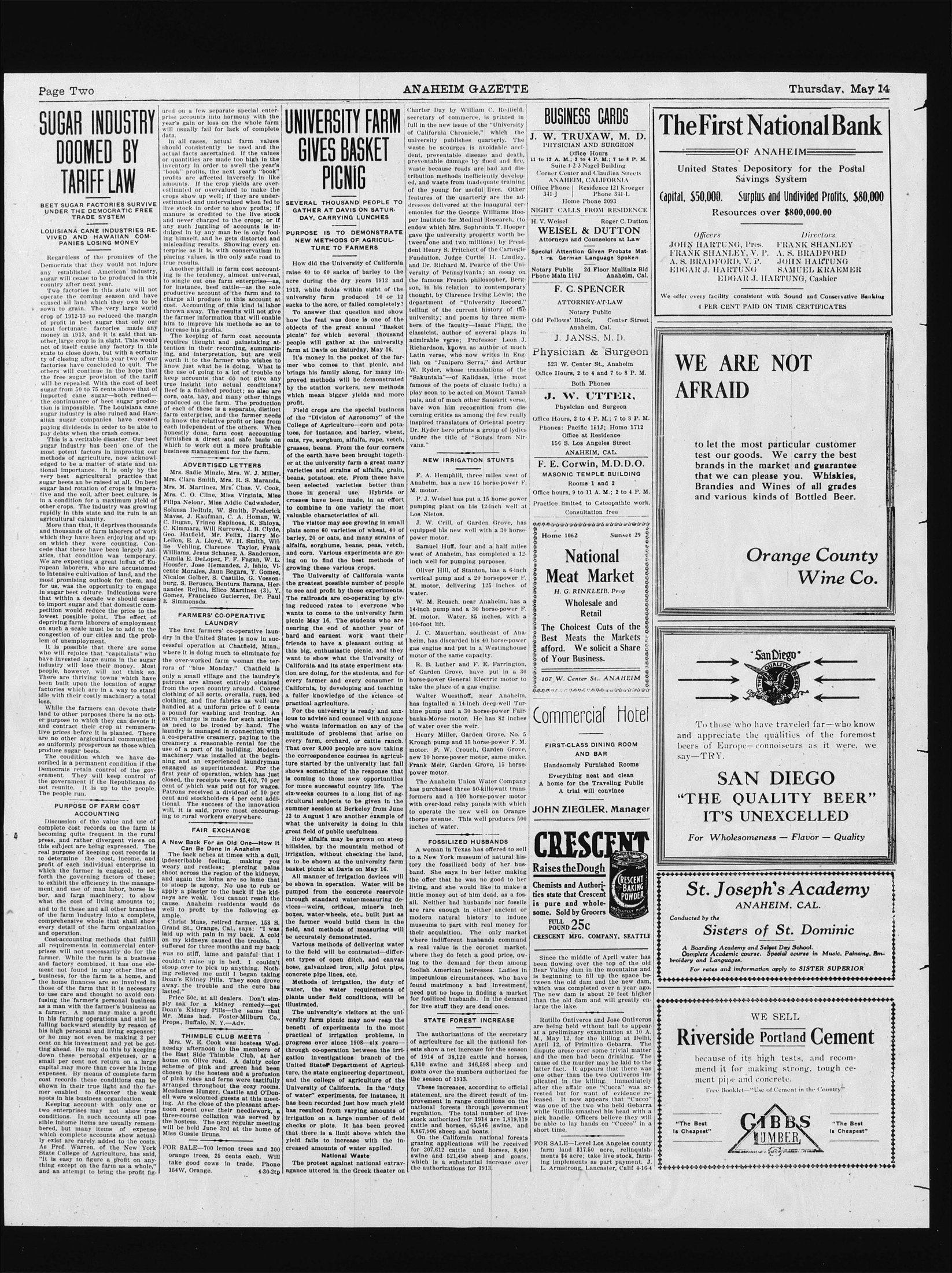
Searchable text
SUGAR INDUSTRY DOOMED BY TARIFF LAW
BEET SUGAR FACTORIES SURVIVE UNDER THE DEMOCRATIC FREE TRADE SYSTEM
LOUISIANA CANE INDUSTRIES REVIVED AND HAWAIIAN COMPANIES LOSING MONEY
Regardless of the promises of the Democrats that they would not injure any established American industry, sugar will cease to be produced in this country after next year.
Two factories in this state will not operate the coming season and have caused all land which they own to be sown to grain. The very large world crop of 1912-13 so reduced the margin of profit in beet sugar that only our most fortunate factories made any money in 1913, and it is said that another large crop is in sight. This would not of itself cause any factory in this state to close down, but with a certainty of closing after this year two of our factories have concluded to quit. The others will continue in the hope that the free sugar provision of the tariff will be repealed. With the cost of beet sugar from 50 to 75 cents above that of imported cane sugar—both refined—the continuance of beet sugar production is impossible. The Louisiana cane sugar industry is also ruined and Hawaiian sugar companies have ceased paying dividends in order to be able to pay debts when the crash comes.
This is a veritable disaster. Our beet sugar industry has been one of the most potent factors in improving our methods of agriculture, now acknowledged to be a matter of state and national importance. It is only by theured on a few separate special enterprise accounts into harmony with the year's gain or loss on the whole farm will usually fail for lack of complete data.
In all cases, actual farm values should consistently be used and the actual facts ascertained. If the values or quantities are made too high in the inventory in order to swell the year's "book" profits, the next year's "book" profits are affected inversely in like amounts. If the crop yields are overestimated or overvalued to make the crops show up well; if they are underestimated and undervalued when fed to live stock in order to show profits; if manure is credited to the live stock and never charged to the crops; or if any such juggling of accounts is indulged in by any man he is only fooling himself, and he gets distorted and misleading results. Showing every enterprise as it is, with conservatism in placing values, is the only safe road to true results.
Another pitfall in farm cost accounting is the tendency, almost universal, to single out one farm enterprise—as, for instance, beef cattle—as the sole productive account of the farm and to charge all produce to this account at cost. Accounting of this kind is labor thrown away. The results will not give the farmer information that will enable him to improve his methods so as to increase his profits.
The keeping of farm cost accounts requires thought and painstaking attention in their recording, summarizing, and interpretation, but are well worth it to the farmer who wishes to know just what he is doing. What is the use of going to a lot of trouble to keep accounts that do not give any true insight into actual conditions? Beef is a finished product; so also are corn, oats, hay, and many other things produced on the farm. The production of each of these is a separate, distinct farm enterprise, and the farmer needs to know the relative profit or loss from each independent of the others. When honestly done, farm cost accounting furnishes a direct and safe basis on which to work out a more profitable business management for the farm.
ADVERTISED LETTERS
Mrs. Sadie Minzie, Mrs. W. J. Miller.
the free sugar provision of the tariff will be repealed. With the cost of beet sugar from 50 to 75 cents above that of imported cane sugar—both refined—the continuance of beet sugar production is impossible. The Louisiana cane sugar industry is also ruined and Hawaiian sugar companies have ceased paying dividends in order to be able to pay debts when the crash comes.
This is a veritable disaster. Our beet sugar industry has been one of the most potent factors in improving our methods of agriculture, now acknowledged to be a matter of state and national importance. It is only by the very best agricultural practice that sugar beets can be raised at all. On beet sugar land rotation of crops is imperative and the soil, after beet culture, is in a condition for a maximum yield of other crops. The industry was growing rapidly in this state and its ruin is an agricultural calamity.
More than that, it deprives thousands and thousands of farm laborers of work which they have been enjoying and upon which they were counting. Concede that these have been largely Asiatics, that condition was temporary. We are expecting a great influx of European laborers, who are accustomed to intensive cultivation of land, and the most promising outlook for them, and for us, was the opportunity to engage in sugar beet culture. Indications were that within a decade we should cease to import sugar and that domestic competition would reduce the price to the lowest possible point. The effect of depriving farm laborers of employment on such a scale must be to add to the congestion of our cities and the problem of unemployment.
It is possible that there are some who will rejoice that "capitalists" who have invested large sums in the sugar industry will lose their money. Most people, however, will not think so. There are thriving towns which have been built upon the location of sugar factories which are in a way to stand idle with their costly machinery a total loss.
While the farmers can devote their land to other purposes there is no other purpose to which they can devote it and contract their crop at remunerative prices before it is planted. There are no other agricultural communities so uniformly prosperous as those which produce sugar beets.
The condition which we have described is a permanent condition if the Democrats retain control of the government. They will keep control of the government if the Republicans do not reunite. It is up to the people. The people run.
PURPOSE OF FARM COST ACCOUNTING
Discussion of the value and use of complete cost records on the farm is becoming quite frequent in the rural press, and rather divergent views on this subject are being expressed. The real purpose of keeping cost records is to determine the cost, income, and profit of each individual enterprise in which the farmer is engaged; to set forth the governing factors of these; to exhibit the efficiency in the management and use of man labor, horse labor, and farm machinery; to show keep accounts that do not give any true insight into actual conditions? Beef is a finished product; so also are corn, oats, hay, and many other things produced on the farm. The production of each of these is a separate, distinct farm enterprise, and the farmer needs to know the relative profit or loss from each independent of the others. When honestly done, farm cost accounting furnishes a direct and safe basis on which to work out a more profitable business management for the farm.
ADVERTISED LETTERS
Mrs. Sadie Minzie, Mrs. W. J. Miller, Mrs. Clara Smith, Mrs. R. S. Maranda, Mrs. M. Martinez, Mrs. Chas. V. Cook, Mrs. C. O. Cline, Miss Virginia, Miss Filipa Nelonr, Miss Addie Cadwaleder, Solausa DeRuiz, W. Smith, Frederick Mavss, J. Kaufman, C. A. Homan, W. C. Dugan, Yrlneo Espinosa, K. Shloya, C. Kimmara, Will Rurrows, J. B. Clyde, Geo. Hatfield, Mr. Felix, Harry McLellon, E. A. Lloyd, W. H. Smith, Willie Vehling, Clarence Taylor, Frank Williams, Jesus Schanez, A. Sanderson, Camila E. DeLopez, F. F. Fagan, W. L. Hoosfer, Jose Hemandez, J. Ishio, Vicente Morales, Jaun Begars, Y. Gomez, Nicalos Golber, S. Castillo, G. Vossenburg, S. Berusco, Bentura Barana, Hernandes Rejina, Elico Martinez (3), Y. Gomez, Francisco Gutierrez, Dr. Paul E Simmonsds.
FARMERS' CO-OPERATIVE LAUNDRY
The first farmers' co-operative laundry in the United States is now in successful operation at Chatfield, Minn., where it is doing much to eliminate for the over-worked farm woman the terrors of "blue Monday." Chatfield is only a small village and the laundry's patrons are almost entirely obtained from the open country around Coarse clothing of all sorts, overalls, rugs, bed clothing, and fine fabrics as well are handled at a uniform price of 5 cents a pound for washing and ironing. An extra charge is made for such articles as need to be ironed by hand. The laundry is managed in connection with a co-operative creamery, paying to the creamy a reasonable rental for the use of a part of its building. Modern machinery was installed at the beginning and an experienced laundryman engaged as superintendent. For the first year of operation, which has just closed, the receipts were $5,403,70 per cent of which was paid out for wages. Patrons received a dividend of 10 per cent and stockholders 6 per cent additional. The success of the innovation will, it is said, prove most encouraging to rural workers everywhere.
FAIR EXCHANGE
A New Back For an Old One—How It Can Be Done In Anaheim
The back aches at times with a dull, indescribable feeling, making you weary and restless; piercing pains shoot across the region of the kidneys, and again the loins are so lame that to stoop is agony. No use to rub or apply a plaster to the back if the kidneys are weak. You cannot reach the brings his family members by the station worker which mean bigger y profit.
Field crops are the result of the "Division of Agriculture," for instance, and oats, rye, sorghum, alfalfa grasses, beans. From time of earth have been erased at the university farm varieties and strains of beans, potatoes etc. He been selected varieties those in general use crosses have been made to combine in one valuable characteristic.
The visitor may see glads some 60 varieties barley, 20 or oats, and alfalfa sorghums, beans and corn. Various experiments on to find the browning these various glads.
The University of California is the greatest possible number to see and profit by them. The railroads are co-operating reduced rates to want to come to the picnic May 16. The stems nearing the end of a hard and earnest work friends to have a pleaser this big enthusiastic want to show what the California and its state tion are doing; for the every farmer and even California, by developing a fuller knowledge of practical agriculture.
For the university is lous to advise and count who wants information multitude of problems every farm, orchard; That over 8,000 people receive correspondence course started by the university shows something of this coming to those new for more successful courses six-weeks courses in a cultural subjects to summer session at Berkeley 22 to August 1 are another what the university in great field of public use.
How alfalfa may be hillsides, by the mountain irrigation without cheat is to be shown at the basket picnic at Davis.
All manner of irrigation be shown in operation pumped from the through standard water
PURPOSE OF FARM COST ACCOUNTING
Discussion of the value and use of complete cost records on the farm is becoming quite frequent in the rural press, and rather divergent views on this subject are being expressed. The real purpose of keeping cost records is to determine the cost, income, and profit of each individual enterprise in which the farmer is engaged; to set forth the governing factors of these; to exhibit the efficiency in the management and use of man labor, horse labor, and farm machinery; to show what the cost of living amounts to; and to fit these and all other branches of the farm industry into a complete, comprehensive whole that shall show every detail of the farm organization and operation.
Cost-accounting methods that fulfill all requirements in commercial enterprises will not necessarily do for the farmer. While the farm is a business and factory combined, it has one element not found in any other line of business, for the farm is a home, and the home finances are so involved in those of the farm that it is necessary to use care and thought to avoid confusing the farmer's personal business as a man with the farmer's business as a farmer. A man may make a profit in his farming operations and still be falling backward steadily by reason of his high personal and living expenses; or he may not even be making 2 per cent on his investment and yet be getting ahead. He may do this by keeping down these personal expenses, or a small per cent net return on a large capital may more than cover his living expenses. By means of complete farm cost records these conditions can be shown in their true light and the farmer enabled to discover the weak spots in his business organization.
Keeping account with only one or two enterprises may not show true conditions. In such accounts all possible income items are usually remembered, but many items of expense which complete accounts show actually exist are rarely added to the costs. As Prof. Warren, of the New York State College of Agriculture, has said, "It is easy to figure a profit on anything except on the farm as a whole," and an attempt to bring the profit fig-
FAIR EXCHANGE
A New Back For an Old One—How It Can Be Done in Anaheim
The back aches at times with a dull, indescribable feeling, making you weary and restless; piercing pains shoot across the region of the kidneys, and again the loins are so lame that to stoop is agony. No use to rub or apply a plaster to the back if the kidneys are weak. You cannot reach the cause. Anahelm residents would do well to profit by the following example.
Christ Maas, retired farmer, 158 S. Grand St., Orange, Cal., says: "I was laid up with pain in my back. A cold on my kidneys caused the trouble. I suffered for three months and my back was so stiff, lame and painful that I couldn't raise up in bed. I couldn't stoop over to pick up anything. Nothing relieved me until I began taking Doan's Kidney Pills. They soon drove away the trouble and the cure has lasted."
Price 50c, at all dealers. Don't simply ask for a kidney remedy—get Doan's Kidney Pills—the same that Mr. Maas had. Foster-Milburn Co., Props., Buffalo, N. Y.—Adv.
THIMBLE CLUB MEETS
Mrs. W. E. Cook was hostess Wednesday afternoon to the members of the East Side Thimble Club, at her home on Olive road. A dainty color scheme of pink and green had been chosen by the hostess and a profusion of pink roses and ferns were tastfully arranged throughout the cozy rooms. Mesdames Hunger, Castile and O'Donell were welcomed guests at this meeting. At the close of the pleasant afternoon spent over their needlework, a three-course collation was served by the hostess. The next regular meeting will be held June 3rd at the home of Miss Gussie Bruns.
FOR SALE—700 lemon trees and 300 orange trees, 25 cents each. Will take good cows in trade. Phone 154W, Orange.
4-30-2tp
UNIVERSITY FARM GIVES BASKET PICNIG
SEVERAL THOUSAND PEOPLE TO GATHER AT DAVIS ON SATURDAY, CARRYING LUNCHES
PURPOSE IS TO DEMONSTRATE NEW METHODS OF AGRICULTURE TO FARMERS
How did the University of California raise 40 to 60 sacks of barley to the acre during the dry years 1912 and 1913, while fields within sight of the university farm produced 10 or 12 sacks to the acre, or failed completely?
To answer that question and show how the feat was done is one of the objects of the great annual "Basket picnic" for which several thousand people will gather at the university farm at Davis on Saturday, May 16.
It's money in the pocket of the farmer who comes to that picnic, and brings his family along, for many improved methods will be demonstrated by the station workers, new methods which mean bigger yields and more profit.
Field crops are the special business of the "Division of Agronomy" of the College of Agriculture—corn and potatoes, for instance, and barley, wheat, oats, rye, sorghum, alfalfa, rape, vetch, grasses, beans. From the four corners of the earth have been brought together at the university farm a great many varieties and strains of alfalfa, grain,
Charter Day by William C. Redfield, secretary of commerce, is printed in full in the new issue of the "University of California Chronicle," which the university publishes quarterly. The waste he scourges is avoidable accident, preventable disease and death, preventable damage by flood and fire, waste because roads are bad and distribution methods inefficiently developed, and waste from inadequate training of the young for useful lives. Other features of the quarterly are the addresses delivered at the inaugural ceremonies for the George Williams Hooper Institute for Medical Research, (to endow which Mrs. Sophronia T. Hooper gave the university property worth between one and two millions) by President Henry S. Pritchett of the Carnegie Foundation, Judge Curtis H. Lindley, and Dr. Richard M. Pearce of the University of Pennsylvania; an essay on the famous French philosopher, Bergson, in his relation to contemporary thought, by Clarence Irving Lewis; the department of "University Record," telling of the current history of the university; and poems by three members of the faculty—Isaac Flagg, the classicist, author of several plays in admirable verse; Professor Leon J. Richardson, known as author of much Latin verse, who now writes in English on "Junipero Serra," and Arthur W. Ryder, whose translations of the "Sakuntala"—of Kalidasa, (the most famous of the poets of classic India) a play soon to be acted on Mount Tamalpais, and of much other Sanskrit verse, have won him recognition from discerning critics as among the few really inspired translators of Oriental poetry. Dr. Ryder here prints a group of lydics under the title of "Songs from Nirvana."
NEW IRRIGATION STUNTS
proved methods will be demonstrated by the station workers, new methods which mean bigger yields and more profit.
Field crops are the special business of the "Division of Agronomy" of the College of Agriculture—corn and potatoes, for instance, and barley, wheat, oats, rye, sorghum, alfalfa, rape, vetch, grasses, beans. From the four corners of the earth have been brought together at the university farm a great many varieties and strains of alfalfa, grain, beans, potatoes, etc. From these have been selected varieties better than those in general use. Hybrids or crosses have been made, in an effort to combine in one variety the most valuable characteristics of all.
The visitor may see growing in small plats some 60 varieties of wheat, 40 of barley, 20 or oats, and many strains of alfalfa, sorghums, beans, peas, vetch, and corn. Various experiments are going on to find the best methods of growing these various crops.
The University of California wants the greatest possible number of people to see and profit by these experiments. The railroads are co-operating by giving reduced rates to everyone who wants to come to the university farm picnic May 16. The students who are nearing the end of another year of hard and earnest work want their friends to have a pleasant outing at this big, enthusiastic picnic, and they want to show what the University of California and its state experiment station are doing, for the students, and for every farmer and every consumer in California, by developing and teaching a fuller knowledge of the science of practical agriculture.
For the university is ready and anxious to advise and counsel with anyone who wants information on any of the multitude of problems that arise on every farm, orchard, or cattle ranch. That over 8,000 people are now taking the correspondence courses in agriculture started by the university last fall shows something of the response that is coming to those new opportunities for more successful country life. The six-weeks courses in a long list of agricultural subjects to be given in the summer session at Berkeley from June 22 to August 1 are another example of what the university is doing in this great field of public usefulness.
How alfalfa may be grown on steep hillsides, by the mountain method of irrigation, without checking the land, is to be shown at the university farm basket picnic at Davis on May 16.
All manner of irrigation devices will be shown in operation. Water will be pumped from the concrete reservoir through standard water-measuring de
"Sakuntala"—of Kalidasa, (the most famous of the poets of classic India) a play soon to be acted on Mount Tamalpais, and of much other Sanskrit verse, have won him recognition from discerning critics as among the few really inspired translators of Oriental poetry. Dr. Ryder here prints a group of lydics under the title of "Songs from Nirvana."
NEW IRRIGATION STUNTS
F. A. Hemphill, three miles west of Anaheim, has a new 15 horse-power F. M. motor.
P. J. Weisel has put a 15 horse-power pumping plant on his 12-inch well at Los Nietos.
J. W. Crill, of Garden Grove, has equipped his new well with a 30 horse-power motor.
Samuel Huff, four and a half miles west of Anaheim, has completed a 12-inch well for pumping purposes.
Oliver Hill, of Stanton, has a 6-inch vertical pump and a 20 horsepower F. M. motor, delivering 125 inches of water.
W. M. Reusch, near Anaheim, has a 14-inch pump and a 30 horse-power F. M. motor. Water, 85 inches, with a 100-foot lift.
J. C. Mauerhan, southeast of Anaheim, has discarded his 40 horse-power gas engine and put in a Westinghouse motor of the same capacity.
R. B. Luther and F. E. Farrington, of Garden Grove, have put in a 30 horse-power General Electric motor to take the place of a gas engine.
Walter Wuesthoff, near Anaheim, has installed a 14-inch deep-well Turbine pump and a 30 horse-power Fairbanks-Morse motor. He has 82 inches of water over the weir.
Henry Miller, Garden Grove, No. 5 Krough pump and 15 horse-power F. M. motor. F. W. Crouch, Garden Grove, new 10 horse-power motor, same make. Frank Meir, Garden Grove, 15 horse-power motor.
The Anaheim Union Water Company has purchased three 50-killowatt transformers and a 100 horse-power motor with over-load relay panels with which to operate the new well on Orange-thorpe avenue. This well produces 500 inches of water.
FOSSILIZED HUSBANDS
A woman in Texas has offered to sell to a New York museum of natural history the fossilized body of her husband. She says in her letter making the offer that he was no good to her living, and she would like to make a little money out of him dead, as a fos-
cultural subjects to be given in the summer session at Berkeley from June 22 to August 1 are another example of what the university is doing in this great field of public usefulness.
How alfalfa may be grown on steep hillsides, by the mountain method of irrigation, without checking the land, is to be shown at the university farm basket picnic at Davis on May 16.
All manner of irrigation devices will be shown in operation. Water will be pumped from the concrete reservoir through standard water-measuring devices—weirs, orifices, miner's inch boxes, water-wheels, etc., built just as the farmer would build them in the field, and methods of measuring will be accurately demonstrated.
Various methods of delivering water to the field will be contrasted—different types of open ditch, and canvas hose, galvanized iron, slip joint pipe, concrete pipe lines, etc.
Methods of irrigation, the duty of water, the water requirements of plants under field conditions, will be illustrated.
The university's visitors at the university farm picnic may now reap the benefit of experiments in the most practical of irrigation problems, in progress ever since 1908—six years—through co-operation between the irrigation investigations branch of the United States Department of Agriculture, the state engineering department, and the college of agriculture of the University of California. In the "duty of water" experiments, for instance, it has been recorded just how much yield has resulted from varying amounts of irrigation on a large number of field checks or plots. It has been proved that there is a limit above which the yield falls to increase with the increased amounts of water applied.
National Waste
The protest against national extravagance uttered in the Greek theater on
FOSSILIZED HUSBANDS
A woman in Texas has offered to sell to a New York museum of natural history the fossilized body of her husband. She says in her letter making the offer that he was no good to her living, and she would like to make a little money out of him dead, as a fossil. Neither bad husbands nor fossils are rare enough in either ancient or modern natural history to induce museums to part with real money for their acquisition. The only market where indifferent husbands command a real value is the coronet market, where they do fetch a good price, owing to the demand for them among foolish American heiresses. Ladies in impecunious circumstances, who have found matrimony a bad investment, need put no hope in finding a market for fossilized husbands. In the demand for live stuff they are dead ones.
STATE FOREST INCREASE
The authorizations of the secretary of agriculture for all the national forests show a net increase for the season of 1914 of 38,120 cattle and horses, 6,110 swine and 346,598 sheep and goats over the numbers authorized for the season of 1913.
These increases, according to official statement, are the direct result of improvement in range conditions on the national forests through government regulation. The total number of livestock authorized for 1914 are 1,819,119 cattle and horses, 65,546 swine, and 8,867,906 sheep and boats.
On the California national forests grazing applications will be received for 207,612 cattle and horses, 8,490 swine and 521,490 sheep and goats, which is a substantial increase over the authorizations for 1913.
Since the middle of April water has been flowing over the top of the old Bear Valley dam in the mountains and is beginning to fill up the space between the old dam and the new dam, which was completed over a year ago. The new dam is about 20 feet higher than the old dam and will greatly enlarge the lake.
Rutillo Ontiveros and Jose Ontiveros are being held without bail to appear at a preliminary examination at 10 A.M., May 12, for the killing at Delhi, April 12, of Primitivo Gebarra. The dispute arose over some trivial matter and the men had been drinking. The cause of the murder may be laid to the latter fact. It appears that there was one other than the two Ontiveros implicated in the killing. Immediately after the affair one "Cucca" was arrested but for want of evidence released. It now appears that "Cucco" was one of the two who held Gebarra while Rutillo smashed his head with a pick handle. Officers believe they will be able to lay hands on "Cucco" in a short time.
FOR SALE—Level Los Angeles county farm land $17.50 acre; relinquishments $4 acre; take live stock; farming implements as part payment. J. L. Armstrong, Lancaster, Calif 4-16-4
Thursday, May 14
The First National Bank
OF ANAHEIM
United States Depository for the Postal Savings System
Capital, $50,000. Surplus and Undivided Profits, $80,000
Resources over $800,000.00
Officers
JOHN HARTUNG, Pres.
FRANK SHANLEY
FRANK SHANLEY, V. P.
A. S. BRADFORD
A. S. BRADFORD, V. P.
EDGAR J. HARTUNG
SAMUEL KRAEMER
EDGAR J. HARTUNG, Cashier
We offer every facility consistent with Sound and Conservative Banking
4 PER CENT PAID ON TIME CERTIFICATES
WE ARE NOT AFRAID
to let the most particular customer test our goods. We carry the best brands in the market and guarantee that we can please you.
AFRAID
to let the most particular customer test our goods. We carry the best brands in the market and guarantee that we can please you. Whiskies, Brandies and Wines of all grades and various kinds of Bottled Beer.
Orange County
Wine Co.
To those who have traveled far—who know and appreciate the qualities of the foremost beers of Europe—connoiseurs as it were, we say—TRY.
SAN DIEGO
"THE QUALITY BEER"
IT'S UNEXCELLED
For Wholesomeness — Flavor — Quality
St. Joseph's Academy
THE QUALITY BEER
IT'S UNEXCELLED
For Wholesomeness — Flavor — Quality
St. Joseph’s Academy
ANAHEIM, CAL.
Conducted by the
Sisters of St. Dominic
A Boarding Academy and Select Day School.
Complete Academic course. Special course in Music, Painting, Embroidery and Languages.
For rates and information apply to SISTER SUPERIOR
WE SELL
Riverside Portland Cement
because of its high tests, and recommend it for making strong, tough cement pipe and concrete.
Free Booklet—“Use of Cement in the Country”
“The Best Is Cheapeast”
“The Best Is Cheapeast”