anaheim-gazette 1914-04-23
Scanned page
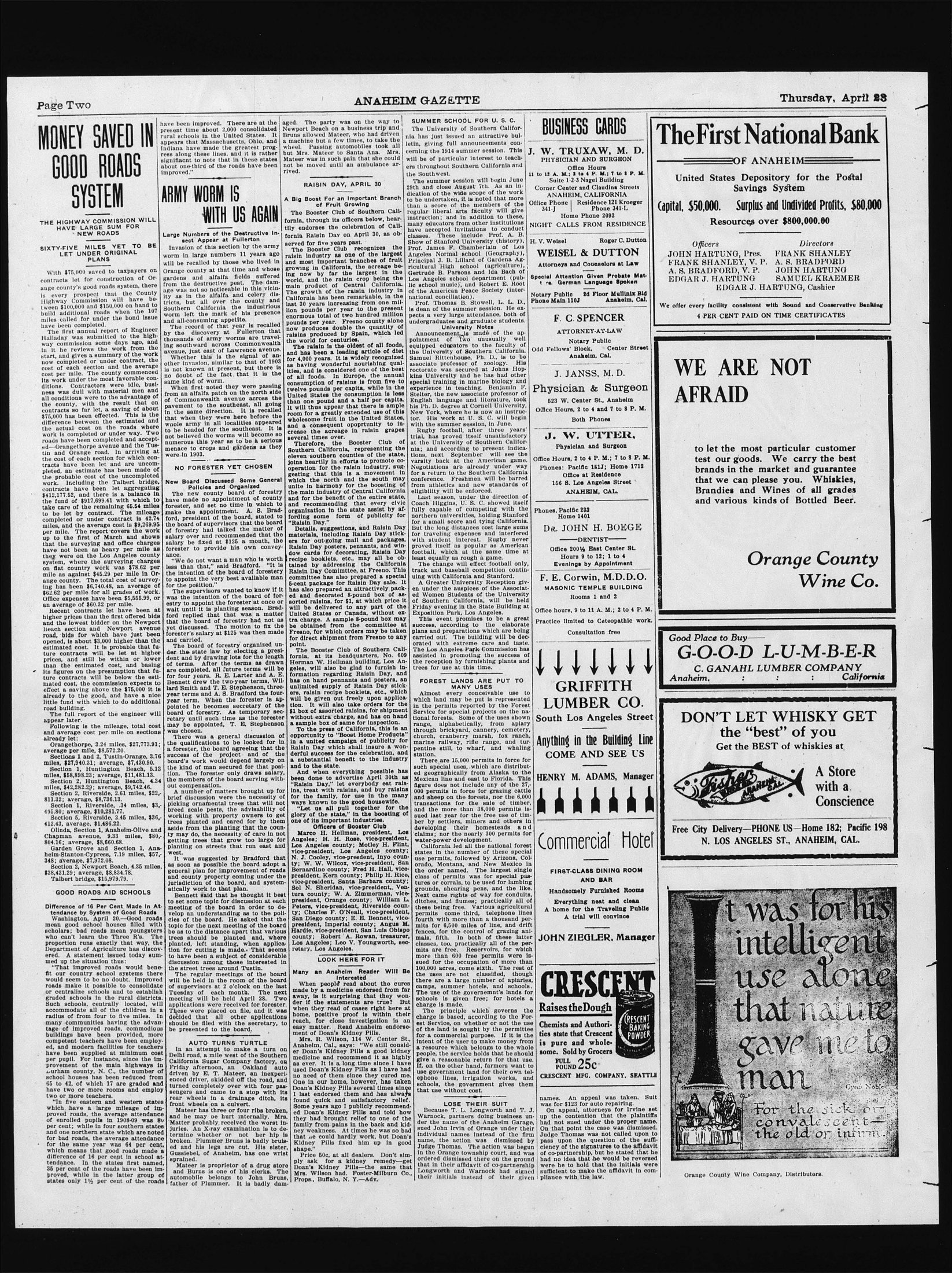
Searchable text
MONEY SAVED IN GOOD ROADS SYSTEM
THE HIGHWAY COMMISSION WILL HAVE LARGE SUM FOR NEW ROADS
Sixty-five miles yet to be let under original plans
With $75,000 saved to taxpayers on contracts let for construction of Orange county's good roads system, there is every prospect that the County Highway Commission will have between $100,000 and $150,000 on hand to build additional roads when the 107 miles called for under the bond issue have been completed.
The first annual report of Engineer Halladay was submitted to the highway commission some days ago, and in it he reviews the work from the start, and gives a summary of the work now completed or under contract, the cost of each section and the average cost per mile. The county commenced its work under the most favorable conditions. Contractors were idle, business was dull with material men and all conditions were to the advantage of the county, with the result that on contracts so far let, a saving of about $75,000 has been effected. This is the difference between the estimated and the actual cost on the roads where work is completed or under way. Two roads have been completed and accepted—Orangethorpe avenue and the Tustin and Orange road. In arriving at the cost of each section for which contracts have been let and are uncompleted, an estimate has been made of have been improved. There are at the present time about 2,000 consolidated rural schools in the United States. It appears that Massachusetts, Ohio, and Indiana have made the greatest progress along these lines, and it is rather significant to note that in these states about one-third of the roads have been improved."
ARMY WORM IS WITH US AGAIN
Large Numbers of the Destructive Insect Appear at Fullerton
Invasion of this section by the army worm in large numbers 11 years ago will be recalled by those who lived in Orange county at that time and whose gardens and alfalfa fields suffered from the destructive pest. The damage was not so noticeable in this vicinity as in the alfalfa and celery districts, but all over the county and Southern California the industrious worm left the mark of his presence and all-consuming appetite.
The record of that year is recalled by the discovery at Fullerton that thousands of army worms are traveling southward across Commonwealth avenue, just east of Lawrence avenue.
Whether this is the signal of another invasion, similar to that of 1903 is not known at present, but there is no doubt of the fact that it is the same kind of worm.
When first noted they were passing from an alfalfa patch on the north side of Commonwealth avenue across the pavement to the southeast, all going in the same direction. It is recalled that when they were here before the whole army in all localities appeared to be headed for the southeast. It is not believed the worms will become so numerous this year as to be a serious menace to crops and gardens as they were in 1903.
NO FORESTER YET CHOSEN
its work under the most favorable conditions. Contractors were idle, business was dull with material men and all conditions were to the advantage of the county, with the result that on contracts so far let, a saving of about $75,000 has been effected. This is the difference between the estimated and the actual cost on the roads where work is completed or under way. Two roads have been completed and accepted—Orangethorpe avenue and the Tustin and Orange road. In arriving at the cost of each section for which contracts have been let and are uncompleted, an estimate has been made of the probable cost of the uncompleted work. Including the Talbert bridge, contracts have been let aggregating $412,177.52, and there is a balance in the fund of $917,699.41 with which to take care of the remaining 65.54 miles to be let by contract. The mileage completed or under contract is 42.74 miles, and the average cost is $9,269.95 per mile. The report covers the work up to the first of March and shows that the surveying and office charges have not been as heavy per mile as they were on the Los Angeles county system, where the surveying charges on flat country work was $78.62 per mile as against $45.29 per mile in Orange county. The total cost of surveying has been $6,740.48, an average of $62.62 per mile for all grades of work. Office expenses have been $5,555.99, or an average of $60.32 per mile.
Recent contracts let have been at higher prices than the first offered bids and the lowest bidder on the Newport Beach section and Newport avenue road, bids for which have just been opened, is about $3,000 higher than the estimated cost. It is probable that future contracts will be let at higher prices, and still be within or lower than the estimated cost, and basing its figures on the presumption that future contracts will be below the estimated cost, the commission expects to effect a saving above the $75,000 it is already to the good, and have a nice little fund with which to do additional road building.
The full report of the engineer will appear later.
Following is the mileage, total cost and average cost per mile on sections already let:
Orangethorpe, 3.24 miles, $27,773.91; average per mile, $8,572.20.
Sections 1 and 2, Tustin-Orange, 3.76 miles, $27,940.31; average, $7,430.90.
Section 1, Huntington Beach, 5.13 miles, $58,898.23; average, $11,481.13.
Section 2, Huntington Beach, 4.34 miles, $42,282.29; average, $9,742.46.
Section 2, Riverside, 2.61 miles, $22,-811.32; average, $8,736.13.
Section 1, Riverside, .34 miles, $3,-495.80; average, $10,281.77.
Section 5, Riverside, 2.45 miles, $36,-412.43; average, $1,486.22.
Olinda, Section 1, Anaheim-Olive and Chapman avenue, 9.33 miles, $80,-804.16; average, $8,660.68.
Garden Grove and Section 1, Anaheim-Stanton-Cypress, 7.19 miles, $57,-348; average, $7,972.08.
Section 2, Newport Beach, 4.35 miles, $38,431.29; average, $8,834.78.
Talbert bridge, $15,979.79.
NO FORESTER YET CHOSEN
New Board Discussed Some General Policies and Organized
The new county board of forestry have made no appointment of county forester, and set no time in which to make the appointment. A. S. Bradford, president of the board, stated to the board of supervisors that the board of forestry had talked the matter of salary over and recommended that the salary be fixed at $125 a month, the forester to provide his own conveyance.
"We do not want a man who is worth less than that," said Bradford. "It is the intention of the board of forestry to appoint the very best available man for the position."
The supervisors wanted to know if it was the intention of the board of forestry to appoint the forester at once or wait until it is planting season. Bradford replied that that was a matter that the board of forestry had not as yet discussed. The motion to fix the forester's salary at $125 was then made and carried.
The board of forestry organized under the state law by electing a president and by drawing lots for the length of terms. After the terms as drawn are completed, all future terms will be for four years. R.E.Larter and A.E.Bennett drew the two-year terms, Willard Smith and T.E.Stephenson, three-year terms and A.S.Bradford the four-year term. When the forester is appointed he becomes secretary of the board of forestry. As temporary secretary until such time as the forester may be appointed, T.E.Stephenson was chosen.
There was a general discussion of the qualifications to be looked for in aforester, the board agreeing that the success of the project and of the board's work would depend largely on the kind of man secured for that position. The forester only draws salary, the members of the board serving without compensation.
A number of matters brought up for brief discussion were the necessity of picking ornamental trees that will not breed scale pests, the advisability of working with property owners to get trees planted and cared for by them aside from the planting that the county may do, the necessity of care in not getting trees that grow too large for planting on streets that run east and west.
It was suggested by Bradford that as soon as possible the board adopt a general plan for improvement of roads and county property coming under the jurisdiction of the board, and systematically work to that plan.
Bennett said that he thought it best no doubt of the fact that it is the same kind of worm.
When first noted they were passing from an alfalfa patch on the north side of Commonwealth avenue across the pavement to the southeast, all going in the same direction. It is recalled that when they were here before the whole army in all localities appeared to be headed for the southeast. It is not believed the worms will become so numerous this year as to be a serious menace to crops and gardens as they were in 1903.
Therefore, the Booster Southern California, no eleven southern counties joins heartily in effort operation for the raisin gesting that this is which the north and unite in harmony for main industry of Canaford and for the benefit of and recommending to organization in the storging some form "Raisin Day."
Details suggestions materials including Rers for out-going maale Raisin Day posters pee dow cards for decorate recipe booklets etc., tained by addressing Raisin Day Committee committee has also pre-5-cent package for Raishas also prepared an ed and decorated 8-piece sorted raisins, for $1,$ will be delivered to United States or Canada tra charge. A sample be obtained from Fresno for which order for direct shipment freight point.
The Booster Club of formia at its head尔 Herman W.Hellman geles will also be gla formation regarding has on hand pennant unlimited supply of Lers raisin recipe boo will be given out treation It will also tak$1 box of assorted raisins without extra charge,a sample box of same To the press of Cal opportunity to "Boost in a united campaign Raisin Day which sho derful success for tha a substantial benefi tand to the state.
And when everythi t been done to advertise "Raisin Day," let evens treat with raisins for the family,fur ways known to tha g "Let us all pull glory of the state," in one of its important In officers of Boor Marco H.Hellman Angeles; H.H.Ros Los Angeles county vice-president,Los N.J.Cooley,vice-pretty;W.W.Wilcox,vice-Bernardino county;B president,kern county vice-president,Santa Sol N.Sheridan,victoria tura county;W.A.$
GOOD ROADS AID SCHOOLS
Difference of 16 Per Cent Made In Attendance by System of Good Roads
Washington, April 20.—Good roads mean good school houses filled with scholars; bad roads mean youngsters who can't learn the Three R's. The proportion runs exactly that way, the Department of Agriculture has discovered. A statement issued today summed up the situation thus:
"That improved roads would benefit our country school systems there would seem to be no doubt. Improved roads make it possible to consolidate or centralize schools and to establish graded schools in the rural districts. Such schools, centrally located, will accommodate all of the children in a radius of four to five miles. In many communities having the advantage of improved roads, commodious buildings have been provided, more competent teachers have been employed, and modern facilities for teachers have been supplied at minimum cost per pupil. For instance, since the improvement of the main highways in Durham county, N. C., the number of school houses has been reduced from 65 to 42, of which 17 are graded and have two or more rooms and employ two or more teachers.
"In five eastern and western states which have a large mileage of improved roads, the average attendance of enrolled pupils in 1908-09 was 80 per cent; while in four southern states and one northern state which are noted for bad roads, the average attendance for the same year was 64 per cent, which means that good roads made a difference of 16 per cent in school attendance. In the states first named, 35 per cent of the roads have been improved, while in the latter group of states only 1½ per cent of the roads"
AUTO TURNS TURTLE
In an attempt to make a turn on Delhi road, a mile west of the Southern California Sugar Company factory, on Friday afternoon, an Oakland auto driven by E. T. Mateer, an inexperienced driver, skidded off the road, and turned completely over with four passengers and came to a stop with its rear wheels in a drainage ditch, its front wheels on a culvert.
Mateer has three or four ribs broken, and he may be hurt internally. Mrs. Matter probably received the worst injuries. An X-ray examination is to determine whether or not her hip is broken. Plummer Bruns is badly bruised and his legs are cut. His sister, Gussiebel, of Anaheim, has one wrist sprained.
Mateer is proprietor of a drug store and Burns is one of his clerks. The automobile belongs to John Bruns, father of Plummer. It is badly dam-
aged. The party was on the way to Newport Beach on a business trip and Bruns allowed Mateer, who had driven a machine but a few times, to take the wheel. Passing automobiles took all but Mrs. Mateer to Santa Ana. Mrs. Mateer was in such pain that she could not be moved until an ambulance arrived.
RAISIN DAY, APRIL 30
A Big Boost For an Important Branch of Fruit Growing
The Booster Club of Southern California, through its officers below, heartily endorses the celebration of California Raisin Day on April 30, as observed for five years past.
The Booster Club recognizes the raisin industry as one of the largest and most important branches of fruit growing in California, the acreage being now by far the largest in the world, and the raisin crop being the main product of Central California. The growth of the raisin industry in California has been remarkable, in the last 30 years increasing from one million pounds per year to the present enormous total of two hundred million pounds per year. Fresno county alone now produces double the quantity of raisins produced by Spain, which led the world for centuries.
The raisin is the oldest of all foods, and has been a leading article of diet for 4,000 years. It is widely recognized as having wonderful nourishing qualities, and is considered one of the best of all foods. In Europe, the annual consumption of raisins is from five to twelve pounds per capita, while in the United States the consumption is less than one pound and a half per capita. It will thus appear that there is ample room for a greatly extended use of this wholesome fruit in the United States, and a consequent opportunity to increase the acreage in raisin grapes several times over.
Therefore, the Booster Club of Southern California, representing the eleven southern counties of the state, joins heartily in efforts to promote cooperation for the raisin industry, suggesting that this is a movement in
SUMMER SCHOOL FOR U. S. C.
The University of Southern California has just issued an attractive bulletin, giving full announcements concerning the 1914 summer session. This will be of particular interest to teachers throughout Southern California and the Southwest.
The summer session will begin June 29th and close August 7th. As an indication of the wide scope of the work to be undertaken, it is noted that more than a score of the members of the regular liberal arts faculty will give instruction; and in addition to these, many educators from other institutions have accepted invitations to conduct classes. These include Prof. A. B. Show of Stanford University (history), Prof. James F. Chamberlain of Los Angeles Normal school (Geography), Principal J. B. Lillard of Gardena Agricultural High school (agriculture), Gertrude B. Parsons and Ida Bach of Los Angeles school department (public school music), and Robert E. Root of the American Peace Society (international conciliation).
Prof. Thomas B. Stowell, L. L. D., is dean of the summer session. He expects a very large attendance, both of undergraduates and graduate students.
University Notes
Announcement is made of the appointment of two unusually well equipped educators to the faculty of the University of Southern California. Samuel Rittenhouse, Ph. D., is to be associate professor of zoology. His roctorate was secured at Johns Hopkins University and he has had other special training in marine biology and experience in teaching. Benjamin F. Stelter, the new associate professor of English language and literature, took his Ph. D. degree at Cornell University, New York, where he is now an instructor. His work at U. S. C. will begin with the summer session, in June.
Rugby football, after three years' trial, has proved itself unsatisfactory at the University of Southern California; and according to present indications, next September will see the varsity back at the American game. Negotiations are already under way for a return to the Southern California
of all foods. In Europe, the annual consumption of raisins is from five to twelve pounds per capita, while in the United States the consumption is less than one pound and a half per capita. It will thus appear that there is ample room for a greatly extended use of this wholesome fruit in the United States, and a consequent opportunity to increase the acreage in raisin grapes several times over.
Therefore, the Booster Club of Southern California, representing the eleven southern counties of the state, joins heartily in efforts to promote cooperation for the raisin industry, suggesting that this is a movement in which the north and the south may unite in harmony for the boosting of the main industry of Central California and for the benefit of the entire state, and recommending that every civic organization in the state assist by affording some form of publicity for "Raisin Day."
Details, suggestions, and Raisin Day materials, including Raisin Day stickers for out-going mail and packages, Raisin Day posters, pennants, and window cards for decorating, Raisin Day recipe booklets, etc., may all be obtained by addressing the California Raisin Day Committee, at Fresno. This committee has also prepared a special 5-cent package for Raisin Day sale. It has also prepared an attractively packed and decorated 8-pound box of assorted raisins, for $1, at which price it will be delivered to any part of the United States or Canada, without extra charge. A sample 8-pound box may be obtained from the committee at Fresno, for which orders may be taken for direct shipment from Fresno to any point.
The Booster Club of Southern California, at its headquarters, No. 609 Herman W. Hellman building, Los Angeles, will also be glad to furnish information regarding Raisin Day, and has on hand pennants and posters, an unlimited supply of Raisin Day stickers, raisin recipe booklets, etc., which will be given out freely upon application. It will also take orders for the $1 box of assorted raisins, for shipment without extra charge, and has on hand a sample box of same for inspection.
To the press of California, this is an opportunity to "Boost Home Products" in a united campaign of publicity for Raisin Day which shall insure a wonderful success for the celebration, and a substantial benefit to the industry and to the state.
And when everything possible has been done to advertise April 30th as "Raisin Day," let everybody eat raisins, treat with raisins, and buy raisins for the family, for use in the many ways known to the good housewife.
"Let us all pull together for the glory of the state," in the boosting of one of its important industries.
Officers of Booster Club
Marco H. Hellman, president, Los Angeles; H. H. Rose, vice-president, Los Angeles county; Motley H. Flint, vice-president, Los Angeles county; N. J. Cooley, vice-president, Inyo county; W. W. Wilcox, vice-president, San Bernardino county; Fred H. Hall, vice-president, Kern county; Philip H. Rice, vice-president, Santa Barbara county; Sol N. Sheridan, vice-president., Ventura county; W. A. Zimmerman, vice-president Orange county; William L.
kings University and he has had other special training in marine biology and experience in teaching. Benjamin F. Stelter, the new associate professor of English language and literature, took his Ph.D. degree at Cornell University, New York, where he is now an instructor. His work at U. S. C. will begin with the summer session, in June.
Rugby football, after three years' trial, has proved itself unsatisfactory at the University of Southern California; and according to present indications, next September will see the varsity back at the American game. Negotiations are already under way for a return to the Southern California conference. Freshmen will be barred from athletics and new standards of eligibility will be enforced.
Last season, under the direction of Coach Higgins, U. S. C. showed itself fully capable of competing with the northern universities, holding Stanford for a small score and tying California. But the long distances cost large sums for traveling expenses and interfered with student interest. Rugby never proved itself as popular as American football, which at the same time at least equally as rough a game.
The change will effect football only, track and baseball competition continuing with California and Stanford.
A Greater University Reception given under the auspices of the Associated Women Students of the University of Southern California, will be held Friday evening in the State Building at Exposition Park, Los Angeles.
This event promises to be a great success, according to the elaborate plans and preparations which are being carried out. The building will be decorated with extreme care and taste. The Los Angeles Park Commission has assisted in promoting the success of the reception by furnishing plants and trees for use at this time.
FOREST LANDS ARE PUT TO MANY USES
Almost every conceivable use to which land may be put is represented in the permits reported by the Forest Service for special projects on the national forests. Some of the uses shown range, alphabetically, from apiary through brickyard, cannery, cemetery, church, cranberry marsh, fox ranch, marine railway, rifle range, and turpentine still, to wharf, and whaling station.
There are 15,000 permits in force for such special uses, which are distributed geographically from Alaska to the Mexican line and east to Florida. This figure does not include any of the 27,000 permits in force for grazing cattle and sheep on the forests, nor the 6,000 transactions for the sale of timber, and the more than 38,000 permits issued last year for the free use of timber by settlers, miners and others in developing their homesteads and claims; nor the nearly 300 permits for water-power development.
California led all the national forest states in the number of these special use permits, followed by Arizona, Colorado, Montana, and New Mexico in the order named. The largest single class of permits was for special pastures or corrals, to be used for lambing grounds, shearing pens, and the like. Next came rights of way for conduits...
"Let us all pull together for the glory of the state," in the boosting of one of its important industries.
Officers of Booster Club
Marco H. Hellman, president, Los Angeles; H. H. Rose, vice-president, Los Angeles county; Motley H. Flint, vice-president, Los Angeles county; N. J. Cooley, vice-president, Inyo county; W. W. Wilcox, vice-president, San Bernardino county; Fred H. Hall, vice-president, Kern county; Philip H. Rice, vice-president, Santa Barbara county; Sol N. Sheridan, vice-president, Ventura county; W. A. Zimmerman, vice-president, Orange county; William L. Peters, vice-president, Riverside county; Charles F. O'Neall, vice-president, San Diego county; E. E. Bennett, vice-president, Imperial county; Angus M. Hardie, vice-president, San Luis Obispo county; Robert A. Rowan, treasurer, Los Angeles; Leo V. Youngworth, secretary, Los Angeles.
LOOK HERE FOR IT
Many an Anaheim Reader Will Be Interested
When people read about the cures made by a medicine endorsed from far away, is it surprising that they wonder if the statements are true? But when they read of cases right here at home, positive proof is within their reach, for close investigation is an easy matter. Read Anaheim endorsement of Doan's Kidney Pills.
Mrs. R. Wilson, 114 W. Center St., Anaheim, Cal., says: "We still consider Doan's Kidney Pills a good kidney medicine and recommend it as highly as ever. It is a long time since I have used Doan's Kidney Pills as I have had no need of them since they cured me. One in our home, however, has taken Doan's Kidney Pills several times since I last endorsed them and has always found quick and satisfactory relief. Some years ago I publicly recommended Doan's Kidney Pills and told how they had brought relief to one of the family from pains in the back and kidney weakness. At times he was so bad that he could hardly work, but Doan's Kidney Pills fixed him up in good shape."
Price 50c, at all dealers. Don't simply ask for a kidney remedy—get Doan's Kidney Pills—the same that Mrs. Wilson had. Foster-Milburn Co., Props., Buffalo, N.Y.—Adv.
LOSE THEIR SUIT
Because T. L. Longworth and T. J. Warnock, partners doing business under the name of the Anaheim Garage, sued John Irvin of Orange under their individual names instead of the firm name, the action was dismissed by Judge Thomas. The action was begun in the Orange township court, and was ordered dismissed there on the ground that in their affidavit of co-partnership Longworth and Warnock had signed their initials instead of their given names. An appeal was taken. Suit was for $123 for auto repairing.
On appeal, attorneys for Irvine set up the contention that the plaintiffs had not sued under the proper name. On that point the case was dismissed. Judge Thomas was not called upon to pass upon the question of the sufficiency of the signatures to the affidavit of co-partnership, but he stated that he had no idea that he would be reversed were he to hold that the initials were sufficient to make the affidavit in compliance with the law.
Thursday, April 28
The First National Bank
OF ANAHEIM
United States Depository for the Postal Savings System
Capital, $50,000. Surplus and Undivided Profits, $80,000
Resources over $800,000.00
Officers
JOHN HARTUNG, Pres.
FRANK SHANLEY
FRANK SHANLEY, V. P.
A. S. BRADFORD
A. S. BRADFORD, V. P.
JOHN HARTUNG
EDGAR J. HARTUNG
SAMUEL KRAEMER
EDGAR J. HARTUNG, Cashier
We offer every facility consistent with Sound and Conservative Banking
4 PER CENT PAID ON TIME CERTIFICATES
WE ARE NOT AFRAID
to let the most particular customer test our goods. We carry the best brands in the market and guarantee
AFRAID
to let the most particular customer test our goods. We carry the best brands in the market and guarantee that we can please you. Whiskies, Brandies and Wines of all grades and various kinds of Bottled Beer.
Orange County
Wine Co.
Good Place to Buy—
G-O-O-D L-U-M-B-E-R
C. GANAHL LUMBER COMPANY
Anaheim. : : : California
DON'T LET WHISKY GET
the “best” of you
Get the BEST of whiskies at
A Store with a Conscience
Free City Delivery—PHONE US—Home 182; Pacific 198
N. LOS ANGELES ST., ANAHEIM, CAL.
It was for his intelligent use alone that nature gave me to man.
For the sick or convalescent—the old or infirm.
Orange County Wine Company, Distributors.