anaheim-gazette 1914-04-02
Scanned page
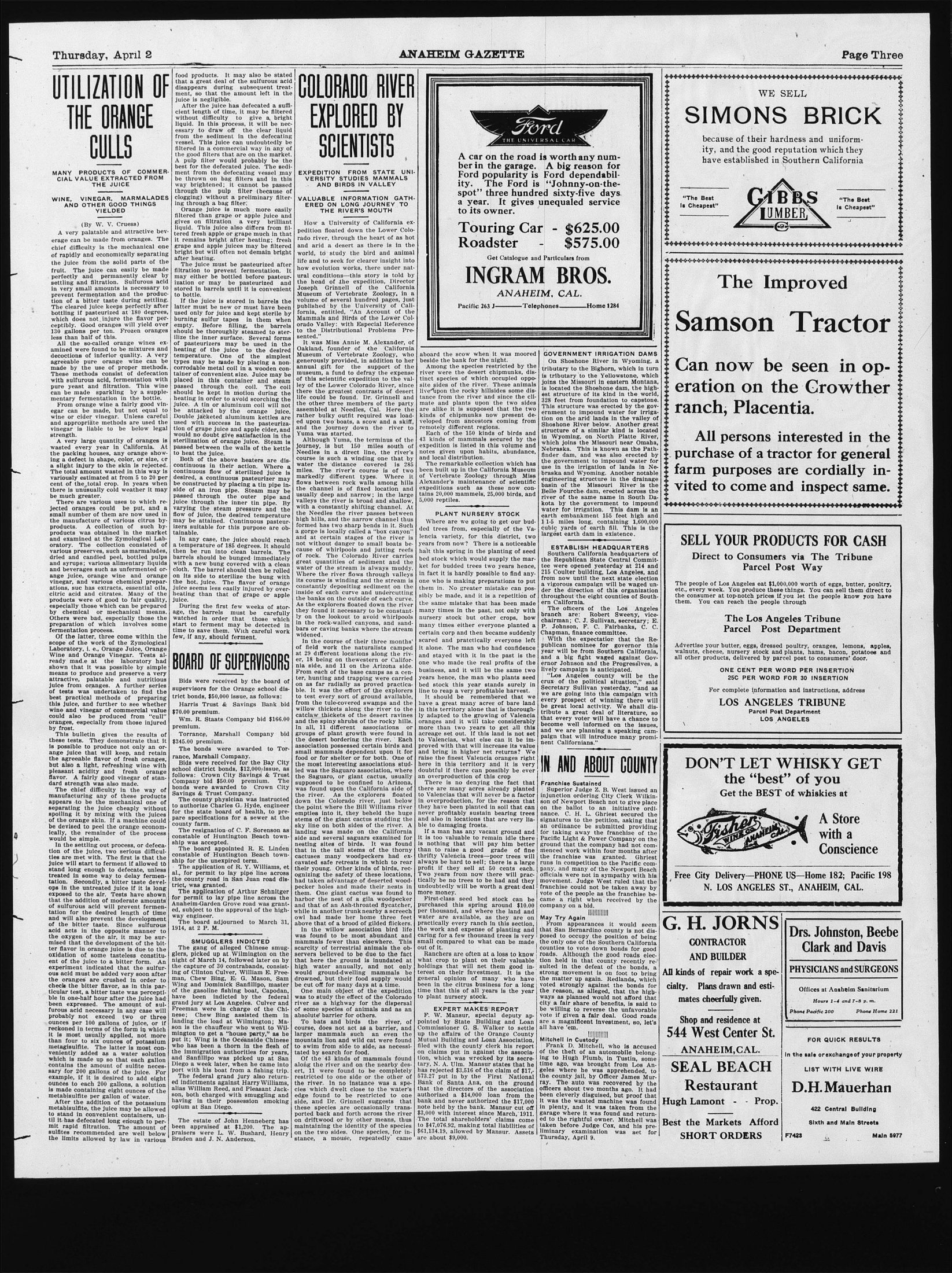
Searchable text
UTILIZATION OF THE ORANGE CULLS
MANY PRODUCTS OF COMMERCIAL VALUE EXTRACTED FROM THE JUICE
WINE, VINEGAR, MARMALADES AND OTHER GOOD THINGS YIELDED
(By W. V. Cruess)
A very palatable and attractive beverage can be made from oranges. The chief difficulty is the mechanical one of rapidly and economically separating the juice from the solid parts of the fruit. The juice can easily be made perfectly and permanently clear by settling and filtration. Sulfurous acid in very small amounts is necessary to prevent fermentation and the production of a bitter taste during settling. The cleared juice keeps perfectly after bottling if pasteurized at 180 degrees, which does not injure the flavor perceptibly. Good oranges will yield over 130 gallons per ton. Frozen oranges less than half of this.
All the so-called orange wines examined were found to be mixtures and decoctions of inferior quality. A very agreeable pure orange wine can be made by the use of proper methods. These methods consist of defecation with sulfurous acid, fermentation with pure yeast and filtration. This wine can be made sparkling by a supplementary fermentation in the bottle.
From orange wine a fairly good vinegar can be made, but not equal to wine or cider vinegar. Unless careful and appropriate methods are used the vinegar is liable to be below legal strength.
A very large quantity of oranges is wasted every year in California. At the packing houses, any orange showing a defect in shape, color, or size, or a slight injury to the skin is rejected. The total amount wasted in this way is food products. It may also be stated that a great deal of the sulfurous acid disappears during subsequent treatment, so that the amount left in the juice is negligible.
After the juice has defecated a sufficient length of time, it may be filtered without difficulty to give a bright liquid. In this process, it will be necessary to draw off the clear liquid from the sediment in the defecating vessel. This juice can undoubtedly be filtered in a commercial way in any of the good filters that are on the market. A pulp filter would probably be the best for the defecated juice. The sediment from the defecating vessel may be thrown on bag filters and in this way brightened; it cannot be passed through the pulp filter (because of clogging) without a preliminary filtering through a bag filter:
Orange juice is much more easily filtered than grape or apple juice and gives on filtration a very brilliant liquid. This juice also differs from filtered fresh apple or grape much in that it remains bright after heating; fresh grape and apple juices may be filtered bright but will often not remain bright after heating.
The juice must be pasteurized after filtration to prevent fermentation. It may either be bottled before pasteurization or may be pasteurized and stored in barrels until it is convenient to bottle.
If the juice is stored in barrels the latter must be new or must have been used only for juice and kept sterile by burning sulfur tapes in them when empty. Before filling, the barrels should be thoroughly steamed to sterilize the inner surface. Several forms of pasteurizers may be used in the heating of the juice to the desired temperature. One of the simplest types may be made by placing a non-corrodable metal coil in a wooden container of convenient size. Juice may be placed in this container and steam passed through the coil. The coil should be kept in motion during the heating in order to avoid scorching the juice. A tin or aluminum coil will not be attacked by the orange juice. Double jacketed aluminum kettles are used with success in the pasteurization of grape juice and apple cider, and would no doubt give satisfaction in the sterilization of orange juice. Steam is passed between the walls of the kettle to heat the juice.
Both of the above heaters are discontinuous in their action. Where a continuous flow of sterilized juice is
These methods consist of dehydration with sulfurous acid, fermentation with pure yeast and filtration. This wine can be made sparkling by a supplementary fermentation in the bottle.
From orange wine a fairly good vinegar can be made, but not equal to wine or cider vinegar. Unless careful and appropriate methods are used the vinegar is liable to be below legal strength.
A very large quantity of oranges is wasted every year in California. At the packing houses, any orange showing a defect in shape, color, or size, or a slight injury to the skin is rejected. The total amount wasted in this way is variously estimated at from 5 to 20 per cent of the total crop. In years when there is unusually cold weather it may be much greater.
There are various uses to which rejected oranges could be put, and a small number of them are now used in the manufacture of various citrus byproducts. A collection of such byproducts was obtained in the market and examined at the Zymological Laboratory. The collection consisted of various preserves, such as marmalades, dried and candied peel, bottled pulps and syrups; various alimentary liquids and beverages such as unfermented orange juice, orange wine and orange vinegar, and various chemical preparations, suc has extracts, essential oils, citric acid and citrates. Many of the products were of good quality, especially those which can be prepared by chemical or mechanical means. Others were bad, especially those the preparation of which involves some fermentation process.
Of the latter, three come within the scope of the work of the Zymological Laboratory, i.e., Orange Juice, Orange Wine and Orange Vinegar. Tests already made at the laboratory had shown that it was possible by simple means to produce and preserve a very attractive, palatable and nutritious juice from oranges. A further series of tests was undertaken to find the best practical methods of preparing this juice, and further to see whether wine and vinegar of commercial value could also be produced from "cull" oranges, especially from those injured by frost.
This bulletin gives the results of these tests. They demonstrate that it is possible to produce not only an orange juice that will keep, and retain the agreeable flavor of fresh oranges, but also a light, refreshing wine with pleasant acidity and fresh orange flavor. A fairly good vinegar of standard strength was also made.
The chief difficulty in the way of manufacturing any of these products appears to be the mechanical one of separating the juice cheaply without spoiling it by mixing with the juices of the orange skin. If a machine could be devised to peel the orange economically, the remainder of the process would be simple.
In the settling out process, or defecation of the juice, two serious difficulties are met with. The first is that the juice will start to ferment if allowed to stand long enough to defecate, unless treated in some way to delay fermentation. Secondly, a bitter taste develops in the untreated juice if it is long exposed to the air. Tests have shown that the addition of detergent with sulfurous acid, fermentation with pure yeast and filtration. This wine can be made sparkling by a supplementary fermentation in the bottle.
From orange wine a fairly good vinegar can be made, but not equal to wine or cider vinegar. Unless careful and appropriate methods are used the vinegar is liable to be below legal strength.
A very large quantity of oranges is wasted every year in California. At the packing houses, any orange showing a defect in shape, color, or size, or a slight injury to the skin is rejected. The total amount wasted in this way is variously estimated at from 5 to 20 per cent of the total crop. In years when there is unusually cold weather it may be much greater.
There are various uses to which rejected oranges could be put, and a small number of them are now used in the manufacture of various citrus byproducts. A collection of such byproducts was obtained in the market and examined at the Zymological Laboratory. The collection consisted of various preserves, such as marmaludes, dried and candied peel, bottled pulps and syrups; various alimentary liquids and beverages such as unfermented orange juice, orange wine and orange vinegar, and various chemical preparations, suc has extracts, essential oils, citric acid and citrates. Many of the products were of good quality, especially those which can be prepared by chemical or mechanical means. Others were bad, especially those the preparation of which involves some fermentation process.
Of the latter, three come within the scope of the work of the Zymological Laboratory, i.e., Orange Juice, Orange Wine and Orange Vinegar. Tests already made at the laboratory had shown that it was possible by simple means to produce and preserve a very attractive, palatable and nutritious juice from oranges. A further series of tests was undertaken to find the best practical methods of preparing this juice, and further to see whether wine and vinegar of commercial value could also be produced from "cull" oranges, especially from those injured by frost.
This bulletin gives the results of these tests. They demonstrate that it is possible to produce not only an orange juice that will keep, and retain the agreeable flavor of fresh oranges, but also a light, refreshing wine with pleasant acidity and fresh orange flavor. A fairly good vinegar of standard strength was also made.
The chief difficulty in the way of manufacturing any of these products appears to be the mechanical one of separating the juice cheaply without spoiling it by mixing with the juices of the orange skin. If a machine could be devised to peel the orange economically, the remainder of the process would be simple.
In the settling out process, or defecation of the juice, two serious difficulties are met with. The first is that the juice will start to ferment if allowed to stand long enough to defecate, unless treated in some way to delay fermentation. Secondly, a bitter taste develops in the untreated juice if it is long exposed to the air. Tests have shown that the addition of detergent with sulfurous acid, fermentation with pure yeast and filtration. This wine can be made sparkling by a supplementary fermentation in the bottle.
From orange wine a fairly good vinegar can be made, but not equal to wine or cider vinegar. Unless careful and appropriate methods are used the vinegar is liable to be below legal strength.
A very large quantity of oranges is wasted every year in California. At the packing houses, any orange showing a defect in shape, color, or size, or a slight injury to the skin is rejected. The total amount wasted in this way is variously estimated at from 5 to 20 per cent of the total crop. In years when there is unusually cold weather it may be much greater.
There are various uses to which rejected oranges could be put, and a small number of them are now used in the manufacture of various citrus byproducts. A collection of such byproducts was obtained in the market and examined at the Zymological Laboratory. The collection consisted of various preserves, such as marmaludes, dried and candied peel, bottled pulps and syrups; various alimentary liquids and beverages such as unfermented orange juice, orange wine and orange vinegar, and various chemical preparations, suc has extracts, essential oils, citric acid and citrates. Many of the products were of good quality, especially those which can be prepared by chemical or mechanical means. Others were bad, especially those the preparation of which involves some fermentation process.
Of the latter, three come within the scope of the work of the Zymological Laboratory, i.e., Orange Juice, Orange Wine and Orange Vinegar. Tests already made at the laboratory had shown that it was possible by simple means to produce and preserve a very attractive, palatable and nutritious juice from oranges. A further series of tests was undertaken to find the best practical methods of preparing this juice, and further to see whether wine and vinegar of commercial value could also be produced from "cull" oranges, especially from those injured by frost.
This bulletin gives the results of these tests. They demonstrate that it is possible to produce not only an orange juice that will keep, and retain the agreeable flavor of fresh oranges, but also a light, refreshing wine with pleasant acidity and fresh orange flavor. A fairly good vinegar of standard strength was also made.
The chief difficulty in the way of manufacturing any of these products appears to be the mechanical one of separating the juice cheaply without spoiling it by mixing with the juices of the orange skin. If a machine could be devised to peel the orange economically, the remainder of the process would be simple.
In the settling out process, or defecation of the juice, two serious difficulties are met with. The first is that the juice will start to ferment if allowed to stand long enough to defecate, unless treated in some way to delay fermentation. Secondly, a bitter taste develops in the untreated juice if it is long exposed to the air. Tests have shown that the addition of detergent with sulfurous acid, fermentation with pure yeast and filtration. This wine can be made sparkling by a supplementary fermentation in the bottle.
From orange wine a fairly good vinegar can be made, but not equal to wine or cider vinegar. Unless careful and appropriate methods are used the vinegar is liable to be below legal strength.
A very large quantity of oranges is wasted every year in California. At the packing houses, any orange showing a defect in shape, color, or size, or a slight injury to the skin is rejected. The total amount wasted in this way is variously estimated at from 5 to 20 per cent of the total crop. In years when there is unusually cold weather it may be much greater.
There are various uses to which rejected oranges could be put, and a small number of them are now used in the manufacture of various citrus byproducts. A collection of such byproducts was obtained in the market and examined at the Zymological Laboratory. The collection consisted of various preserves, such as marmaludes, dried and candied peel, bottled pulps and syrups; various alimentary liquids and beverages such as unfermented orange juice, orange wine and orange vinegar, and various chemical preparations, suc has extracts, essential oils, citric acid and citrates. Many of the products were of good quality, especially those which can be prepared by chemical or mechanical means. Others were bad, especially those the preparation of which involves some fermentation process.
Of the latter, three come within the scope of the work of the Zymological Laboratory, i.e., Orange Juice, Orange Wine and Orange Vinegar. Tests already made at the laboratory had shown that it was possible by simple means to produce and preserve a very attractive, palatable and nutritious juice from oranges. A further series of tests was undertaken to find the best practical methods of preparing this juice, and further to see whether wine and vinegar of commercial value could also be produced from "cull" oranges, especially from those injured by frost.
This bulletin gives the results of these tests. They demonstrate that it is possible to produce not only an orange juice that will keep, and retain the agreeable flavor of fresh oranges, but also a light,refreshing wine with pleasant acidity and fresh orange flavor. A fairly good vinegar of standard strength was also made.
The chief difficulty in the way of manufacturing any of these products appears to be the mechanical one of separating the juice cheaply without spoiling it by mixing with the juices of the orange skin. If a machine could be devised to peel the orange economically,the remainder of the process would be simple.
In the settling out process,or defecation of the juice,two serious difficulties are met with. The first is that the juice will start to ferment if allowed to stand long enough to defecate,unless treated in some way to delay fermentation。Secondly,a bitter taste develops in the untreated juice if it is long exposed to the air。Tests have shown that the addition of detergent with sulfurous acid,fermentation with pure yeast和filtration。This wine can be made sparkling by a supplementary fermentation in the bottle.
From orange wine a fairly good vinegar can be made,but not equal to wine或 cider vinegar。 Unless careful and appropriate methods are used,the vinegar is liable to be below legal strength.
A very large quantity of oranges is wasted every year in California。Atthe packing housesanyorange showinga defectinshapecolorandsizeofthejuicethatwillkeep,andretainstheagreeableflavoroffreshorangebutalsoalight,refreshingwinewithpleasantacidityandfreshorangeflavor.Afairlygoodvinegarofstandardstrengthwasalsomade.
The chief difficulty inthewayofmanufacturinganyoftheseproductsappearstobethemechanicaloneofseparatingthejuicecheaplywithoutspoilingitbymixingwiththejuicesoftheorangeskin.lifemethodtoreturnfermentmaybet detectedintimeofthebanksontheoutlet.Astheexplorerfloatfounditnecessarilyonthelookouttinetherock-walledbarsorcavingbankwidened.
Inthecourseofthefieldworkthemattain29differentlocations18beingonthenoriaside,and11oncromefoundasfarradiallyabble.itwastheefforttesteverysortoffromthetule-coverwillowthicketsalongcatclawthicketsofandandspinyshrubsinall11differentgroupsofplantgrowthedesertborderassociessmallmammalsdeposurefoodorforsherofthemostinterestingliedwastheSaguaro,theSaguaroor,gisussupposedtobewornfoundupthenriver.AsthedowntheColorado,thepointwheretherestemptiesintoit,thestemsofthegiantcoolskylineonbothsidelandingmadeasideandseveralsagnestingsitesofbirdinthatinthetailsteactusesmanywoodcavatedsaferetreatetheyounger.Otognizingthe safetyhad takenadvantagepeckerholesandmen them.One giantcanharborthenestofthejourneyoftheparkofthisuseumofscienceofthisuseumofscienceofthis museumofscienceofthis museumofscienceofthis museumofscienceofthis museumofscienceofthis museumofscienceofthis museumofscienceofthis museumofscienceofthis museumofscienceofthis museumofscienceofthis museumofscienceofthis museumofscienceofthis museumofscienceofthis museumofscienceofthis museumofscienceofthis museumofscienceofthis museumofscienceofthis museumofscienceofthis museumofscienceofthis museumofscienceofthis museumofscienceofthis museum.ofscience.ofthis museum.ofscience.ofthis museum.ofscience.ofthis museum.ofscience.ofthis museum.ofscience.ofthis museum.ofscience.ofthis museum.ofscience.ofthis museum.ofscience.ofthis museum.ofscience.ofthis museum.ofscience.ofthis museum.ofscience.ofthis museum.ofscience.ofthis museum.ofscience.ofthis museum.ofscience.ofthis museum.ofscience.ofthis museum.ofscience.ofthis museum.ofscience.ofthis.museum.ofscience.ofthis museum.ofscience.ofthis museum.ofscience.ofthis museum.ofscience.ofthis museum.ofscience.ofthis museum.ofscience.ofthis museum.ofscience.ofthis museum.ofscience.ofthis museum.ofscience.ofthis museum.ofscience.ofthis museum.ofscience.ofthis museum.ofscience.ofthis museum.ofscience.ofthis museum.ofscience.ofthis museum.ofscience.ofthis museum.ofscience.ofthis.museum.of.science_ofthis.museum_of.science_ofthis.museum_of.science_ofthis.museum_of.science_ofthis.museum_of.science_ofthis.museum_of.since_ofthis.museum_of.since_ofthis.museum_of.since_ofthis.museum_of.since_ofthis.museum_of.since_ofthis.museum_of.since_ofthis.museum_of.since_ofthis.museum_of.since_ofthis.museum_of.since_ofthis.museum_of.since_ofthis.museum_of.since_ofthis.museum_of.since_ofthis.museum_of.since_ofthis.museum_of.since_ofthis.museum_OF.Since_OF.Since_OF.Since_OF.Since_OF.Since_OF.Since_OF.Since_OF.Since_OF.Since_OF.Since_OF.Since_OF.Since_OF.Since_OF.Since_OF.Since_OF.Since_OF.Since_OF.Since_OF.Since_OF.Since_OF.Since_OF.Since_OF.Since_OF.Since_OF.Since_OF.Since_OF.Since_OF.Since_OF.Since_OF.Since_OF.Since_OF.Since_OF.Since_OF.Since_OF.Since_OF.Since_OF.Since_OF.Since_OF.Since_OF.Since_OF.Since_OF.Since_OF.Since_OF.Since_OF.Since_OF.Since_OF.Since_OF.Since_OF.SinceOF.SinceOF.SinceOF.SinceOF.SinceOF.SinceOF.SinceOF.SinceOF.SinceOF.SinceOF.SinceOF.SinceOF.SinceOF.SinceOF.SinceOF.SinceOF.SinceOF.SinceOF.SinceOF.SinceOF.SinceOF.SinceOF.SinceOF.SinceOF.SinceOF.SinceOF.SinceOF.SinceOF.SinceOF.SinceOF.SinceOF,SenseOfSenseOfSenseOfSenseOfSenseOfSenseOfSenseOfSenseOfSenseOfSenseOfSenseOfSenseOfSenseOfSenseOfSenseOfSenseOfSenseOfSenseOfSenseOfSenseOfSenseOfSenseOfSenseOfSenseOfSenseOfSenseOfSenseOfSenseOfSenseOfSenseOfSenseOfSenseOfSenseOfSenseOfSenseOfSenseOfSenseOfSenseOfSenseOfSenseOfSenseOfSenseOfSenseOfSenseOfSenseOfSenseOfSenseOfSenseOfSenseOfSenseOfSENSE OF SENSE OF SENSE OF SENSE OF SENSE OF SENSE OF SENSE OF SENSE OF SENSE OF SENSE OF SENSE OF SENSE OF SENSE OF SENSE OF SENSE OF SENSE OF SENSE OF SENSE OF SENSE OF SENSE OF SENSE OF SENSE OF SENSE OF SENSE OF SENSE OF SENSE OF SENSE OF SENSE OF SENSE OF SENSE OF SENSE OF SENSE Of SENSE Of SENSE Of SENSE Of SENSE Of SENSE Of SENSE Of SENSE Of SENSE Of SENSE Of SENSE Of SENSE Of SENSE Of SENSE Of SENSE Of SENSE Of SENSE Of SENSE Of SENSE Of SENSE Of SENSE Of SENSE Of SENSE Of SENSE Of SENSE Of SENSE Of SENSE Of SENSE Of SENSERESESESESESESESESESESESESESESESESESESESESESESESESESESESESESESESESESESESESESESESESESESESESESESESESESESESESESESESESESESESESESESESE SE SE SE SE SE SE SE SE SE SE SE SE SE SE SE SE SE SE SE SE SE SE SE SE SE SE SE SE SE SE SE SE SE SE SE SE SE SE SE SE SE SE SE SE SE SE SE SE SE SE SE SE SE SE SE Se Se Se Se Se Se Se Se Se Se Se Se Se Se Se Se Se Se Se Se Se Se Se Se Se Se Se Se Se Se Se Se Se Se Se Se Se Se Se Se Se Se Se Se Se Se Se Se Se Se Se Se Se Se Se Se Se Se Se Se Se Se Se Se Se Se Se Se Se Se Se SeSeSeSeSeSeSeSeSeSeSeSeSeSeSeSeSeSeSeSeSeSeSeSeSeSeSeSeSeSeSeSeSeSeSeSeSeSeSeSeSeSeSeSeSeSeSeSeSeSeSeSeSeSeSeSeSeSeSeSeSeSeSeSeSeSeSeSeSeSeSeSeSeSe se se se se se se se se se se se se se se se se se se se se se se se se se se se se se se se se se se se se se se se se se se se se se se se se se se se se se se se se se se se se se se se se se se se se se se se se se se se sese sese sese sese sese sese sese sese sese sese sese sese sese sese sese sese sese sese sese sese sese sese sese sese sese sese sese sese sese sese sese sese sese sese sese sese sese sese sese sese sese sese sese sese sese sese sese sese sese sesee sessee sessee sessee sessee sessee sessee sessee sessee sessee sessee sessee sessee sessee sessee sessee sessee sessee sessee sessee sessee sessee sessee sessee sessee sessee sessee sessee sessee sessee sessee sessee sessee sessee sessee sessee sessee sessee sessee sessee sesseeSESEESESEESESEESESEESESEESESEESESEESESEESESEESESEESESEESESEESESEESESEESESEESESEESESEESESEESESEESESEESESEESESEESESEESESEESESEEEESEEEESEEEESEEEESEEEESEEEESEEEESEEEESEEEESEEEESEEEESEEEESEEEESEEEESEEEESEEEESEEEESEEEESEEEESEEEESEEEESEEEESEEEESEEEESEEEESEEEESEEEESEEEESEEEESEEEESEEEESEEEESEEEESEEEESEEEESEEEESEEEESEEEESEEEESEEEESEEEESEEEESEEEESEEEESEEEESEEEESEEEESEEEESEEEESEEEESEEEESEEEESEEEESEEEESEEEESEEEESEEEESEEEESEEEESEEEESEEEESEEEESEEEESEEEESEEEESEEEESEEEESEEEESEEEESEEEESEEEESEEEESEEEESEEE ESHEEHEHEHEHEHEHEHEHEHEHEHEHEHEHEHEHEHEHEHEHEHEHEHEHEHEHEHEHEHEHEHEHEHEHEHEHEHEHEHEHEHEHEHEHEHEHEHEHEHEHEHEHEHE HE HE HE HE HE HE HE HE HE HE HE HE HE HE HE HE HE HE HE HE HE HE HE HE HE HE HE HE HE HE HE HE HE HE HE HE HE HE HE HE HE HE HE He He He He He He He He He He He He He He He He He He He He He He He He He He He He He He He He He He He He He He He He He He He He He He He He He He He He He He He He He He He He He He He He He He HeHeHeHeHeHeHeHeHeHeHeHeHeHeHeHeHeHeHeHeHeHeHeHeHeHeHeHeHeHeHeHeHeHeHeHeHeHeHeHeHeHeHeHeHeHeHeHeHeHeHeHeHeHeHeHeHeHeHeHeHeHeHeHeapHeapHeapHeapHeapHeapHeapHeapHeapHeapHeapHeapHeapHeapHeapHeapHeapHeapHeapHeapHeapHeapHeapHeapHeapHeapHeapHeapHeapHeapHeapHeapHeapHeapHeapHeapHeapHeapHeapHeapHeapHeapHeapHeapHeapHeapHeapHeapHeapHeapHeapHeapHeapHeapHeapHeapHeapHeapHeapheap heap heap heap heap heap heap heap heap heap heap heap heap heap heap heap heap heap heap heap heap heap heap heap heap heap heap heap heap heap heap heap heap heap heap heap heap heap heap heap heap heap heap heap heap heap heap heap heap heap heap heap heap heap heap heap heap heap heap heap heap heap heap heap heap heap heap heap heap heap heapheapheapheapheapheapheapheapheapheapheapheapheapheapheapheapheapheapheapheapheapheapheapheapheapheapheapheapheapheapheapheapheapheapheapheapheapheapheapheapheapheapheapheapheapheapheapheapheapheapheapheapheapheapheapheapheapheapheapheapheapheimheimheimheimheimheimheimheimheimheimheimheimheimheimheimheimheimheimheimheimheimheimheimheimheimheimheimheimheimheimheimheimheimheimheimheimheimheimheimheimheimheimheimheimheimheimheimheimheimheimheimhimhimhimhimhimhimhimhimhimhimhimhimhimhimhimhimhimhimhimhimhimhimhimhimhimhimhimhimhimhimhimhimhimhimhimhimhimhimhimhim him him him him him him him him him him him him him him him him him him him him him him him him him him him him him him him him him him him him him him him him him him him him him him him him him him him him him他他他他他他他他他他他他他他他他他他他他他他他他他他他他他他他他他他他他他他他他他他他他他他他他他他他他他他他他他他他他他他他他他他他他他他他他他他他他他他他他他他他他他他他他他他他他他他他他 he he he he he he he he he he he he he he he he he he he he he he he he he he he he he he he he he he he he he he he he he he he he he he he he he he he he he he he he he he he he he he he he he he he he he he he he he he he heheheheheheheheheheheheheheheheheheheheheheheheheheheheheheheheheheheheheheheheheheheheheheheheheheheheheheheheheheheheheheheheheheh e e e e e e e e e e e e e e e e e e e e e e e e e e e e e e e e e e e e e e e e e e e e e e e e e e e e e e e e e e e e e e e e e e e e e e e e e eeeeeeeeeeeeeeeeeeeeeeeeeeeeeeeeeeeeeeeeeeeeeeeeeeeeeeeeeeeeeeeeeeeeeeeeeeeeeeeeeeeeeeeeeeeeeeeeeeeeeeeeeeeeeeeeeeeeeeeeeeeeeeeeeeeeeeeeeeeeeeeeeеееееееееееееееееееееееееееееееееееееееееееееееееееееееееееееееееееееееееееееееееееееееееееееееееееееееееееееееееееееоеоеоеоеоеоеоеоеоеоеоеоеоеоеоеоеоеоеоеоеоеоеоеоеоеоеоеоеоеоеоеоеноеоеоеоеоеоеоеоеоеоеоеоекоеоеенноееенноееенноееенноееенноееенноееенноееенноееенноееенноееенноееенноееенноееенноееенноееенноееенноееенноееенноееенноееенноееенноееneathneathbottombottombottombottombottombottombottombottombottombottombottombottombottombottombottombottombottombottombottombottombottombottombottombottombottombottombottombottombottombottombottombottombottombottombottombottombottom bottom bottom bottom bottom bottom bottom bottom bottom bottom bottom bottom bottom bottom bottom bottom bottom bottom bottom bottom bottom bottom bottom bottom bottom bottom bottom bottom bottom bottom bottom bottom bottom bottom bottom bottom bottom bottom bottom bottom bottom bottom bottom bottom bottom bottom bottom底部底部底部底部底部底部底部底部底部底部底部底部底部底部底部底部底部底部底部底部底部底部底部底部底部底部底部底部底部底部底部底部底部底部底部底部底部底部底部底部底部底部底部底部底部底部底部底部底部底部底部底部底部底部底部底部底部底部底部底部底层底层底层底层底层底层底层底层底层底层底层底层底层底层底层底层底层底层底层底层底层底层底层底层底层底层底层底层底层底层底层底层底层底层底层底底底
appears to be the mechanical one of separating the juice cheaply without spoiling it by mixing with the juices of the orange skin. If a machine could be devised to peel the orange economically, the remainder of the process would be simple.
In the settling out process, or defecation of the juice, two serious difficulties are met with. The first is that the juice will start to ferment if allowed to stand long enough to defecate, unless treated in some way to delay fermentation. Secondly, a bitter taste develops in the untreated juice if it is long exposed to the air. Tests have shown that the addition of moderate amounts of sulfurous acid will prevent fermentation for the desired length of time and will also prevent the development of the bitter taste. Since sulfurous acid acts in the opposite manner to the oxygen of the air, it may be surmised that the development of the bitter flavor in orange juice is due to the oxidation of some tasteless constituent of the juice to a bitter form.
An experiment indicated that the sulfurous acid must be added very soon after the oranges are crushed in order to check the bitter flavor, as in this particular test, a bitter taste was perceptible in one-half hour after the juice had been expressed. The amount of sulfurous acid necessary in any case will probably not exceed two or three ounces per 100 gallons of juice, or if reckoned in terms of the form in which it is most usually applied, not more than four to six ounces of potassium metagisulfite. The latter is most conveniently added as a water solution which is made up so that each gallon contains the amount of sulfite necessary for 200 gallons of the juice. For example, if it is desired to add eight ounces to each 200 gallons, a solution is made containing eight ounces of the metabisulfite per gallon of water.
After the addition of the potassium metabisulfite, the juice may be allowed to stand in convenient containers, until it has defecated long enough to permit rapid filtration. The amount of sulfites recommended are well below the limits allowed by law in various
The county physician was instructed to authorize Charles G. Hyde, engineer for the state board of health, to prepare specifications for a sewer at the county farm.
The resignation of C. F. Sorenson as constable of Huntington Beach township was accepted.
The board appointed R. E. Linden constable of Huntington Beach township for the unexpired term.
The application of R. Y. Williams, et al., for permit to lay pipe line across the county road in San Juan road district, was granted.
The application of Arthur Schnitger for permit to lay pipe line across the Anaheim-Garden Grove road was granted, subject to the approval of the highway engineer.
The board adjourned to March 31, 1914, at 2 P.M.
SMUGGLERS INDICTED
The gang of alleged Chinese smugglers, picked up at Wilmington on the night of March 14, followed later on by the capture of 30 contrabands, consisting of Clinton Culver, William E. Freeman, Chew Bing, E; G. Mason, Sam Wing and Dominick Sanfillipo, master of the gasoline fishing boat, Capodan, have been indicted by the federal grand jury at Los Angeles. Culver and Freeman were in charge of the Chinese; Chew Bing assisted them in landing the load at Wilmington; Mason is the chauffeur who went to Wilmington to get a "house party," as he put it; Wing is the Oceanside Chinese who has been a thorn in the flesh of the immigration authorities for years, and Sanfillipo was picked up at San Diego a week later, when he came into port with his boat from a fishing trip.
The federal grand jury also returned indictments against Harry Williams, alias William Reed, and Pleasant Jackson, both charged with smuggling and having in their possession smoking opium at San Diego.
The estate of John Henneberg has been appraised at $1,200. The appraisers were L. W. Bushard, Henry Braden and J. N. Anderson.
COLORADO RIVER EXPLORED BY SCIENTISTS
EXPEDITION FROM STATE UNIVERSITY STUDIES MAMMALS AND BIRDS IN VALLEY
VALUABLE INFORMATION GATHERED ON LONG JOURNEY TO THE RIVER'S MOUTH
How a University of California expedition floated down the Lower Colorado river, through the heart of as hot and arid a desert as there is in the world, to study the bird and animal life and to seek for clearer insight into how evolution works, there under natural conditions—this story is told by the head of the expedition, Director Joseph Grinnell of the California Museum of Vertebrate Zoology, in a volume of several hundred pages, just published by the University of California, entitled, "An Account of the Mammals and Birds of the Lower Colorado Valley: with Especial Reference to the Distributional Problems Presented."
It was Miss Annie M. Alexander, of Oakland, founder of the California Museum of Vertebrate Zoology, who generously provided, in addition to her annual gift for the support of the museum, a fund to defray the expense of this scientific expedition to the valley of the Lower Colorado River, since there the greatest contrasts of desert life could be found. Dr. Grinnell and the other three members of the party assembled at Needles, Cal. Here the rather bulky outfit required was loaded upon two boats, a scow and a skiff, and the journey down the river to Yuma was started.
Although Yuma, the terminus of the journey, is but 150 miles south of Needles in a direct line, the river's course is such a winding one that by water the distance covered is 285 miles. The river's course is of two aboard the scow when it was moored beside the bank for the night.
Among the species restricted by the river were the desert chipmunks, distinct species of which occupied opposite sides of the river. These animals live upon the rocky hillsides some distance from the river and since the climate and plants upon the two sides are alike it is supposed that the two kinds of chipmunks now present developed from ancestors coming from remotely different regions.
Each of the 150 kinds of birds and 43 kinds of mammals secured by the expedition is listed in this volume and notes given upon habits, abundance, and local distribution.
The remarkable collection which has been built up in the California Museum of Vertebrate Zoology through its years is another notable feature of Shoshone River in Wyoming, a tributary to the Bighorn, which in turn is tributary to the Yellowstone, which joins the Missouri in eastern Montana, is located the Shoshone dam, the highest structure of its kind in the world, 328 feet from foundation to capstone. This structure was erected by the government to impound water for irrigation on the arid lands in the valley of Shoshone River below. Another great structure of a similar kind is located in Wyoming, on North Platte River, which joins the Missouri near Omaha, Nebraska. This is known as the Pathfinder dam, and was also erected by the government to impound water for use in the irrigation of lands in Nebraska and Wyoming. Another notable feature of Shoshone River in Wyoming, a tributary to the Bighorn, which in turn is tributary to the Yellowstone, which joins the Missouri in eastern Montana, is located the Shoshone dam, the highest structure of its kind in the world, 328 feet from foundation to capstone. This structure was erected by the government to impound water for irrigation on the arid lands in the valley of Shoshone River below. Another great structure of a similar kind is located in Wyoming, on North Platte River, which joins the Missouri near Omaha, Nebraska. This is known as the Pathfinder dam, and was also erected by the government to impound water for use in the irrigation of lands in Nebraska and Wyoming. Another notable feature of Shoshone River in Wyoming, a tributary to the Bighorn, which in turn is tributary to the Yellowstone, which joins the Missouri near Omaha, Nebraska. This is known as the Pathfinder dam, and was also erected by the government to impound water for use in the irrigation of lands in Nebraska and Wyoming. Another notable feature of Shoshone River in Wyoming, a tributary to the Bighorn, which in turn is tributary to the Yellowstone, which joins the Missouri near Omaha, Nebraska. This is known as the Pathfinder dam, and was also erected by the government to impound water for use in the irrigation of lands in Nebraska and Wyoming. Another notable feature of Shoshone River in Wyoming, a tributary to the Bighorn, which in turn is tributary to the Yellowstone, which joins the Missouri near Omaha, Nebraska. This is known as the Pathfinder dam, and was also erected by the government to impound water for use in the irrigation of lands in Nebraska and Wyoming. Another notable feature of Shoshone River in Wyoming, a tributary to the Bighorn, which in turn is tributary to the Yellowstone, which joins the Missouri near Omaha, Nebraska. This is known as the Pathfinder dam, and was also erected by the government to impound water for use in the irrigation of lands in Nebraska and Wyoming. Another notable feature of Shoshone River in Wyoming, a tributary to the Bighorn, which in turn is tributary to the Yellowstone, which joins the Missouri near Omaha, Nebraska. This is known as the Pathfinder dam, and was also erected by the government to impound water for use in the irrigation of lands in Nebraska and Wyoming. Another notable feature of Shoshone River in Wyoming, a tributary to the Bighorn, which in turn is tributary to the Yellowstone, which joins the Missouri near Omaha, Nebraska. This is known as the Pathfinder dam, and was also erected by the government to impound water for use in the irrigation of lands in Nebraska and Wyoming. Another notable feature of Shoshone River in Wyoming, a tributary to the Bighorn, which in turn is tributary to the Yellowstone, which joins the Missouri near Omaha, Nebraska. This is known as the Pathfinder dam, and was also erected by the government to impound water for use in the irrigation of lands in Nebraska and Wyoming. Another notable feature of Shoshone River in Wyoming, a tributary to the Bighorn, which in turn is tributary to the Yellowstone, which joins the Missouri near Omaha, Nebraska. This is known as the Pathfinder dam, and was also erected by the government to impound water for use in the irrigation of lands in Nebraska and Wyoming. Another notable feature of Shoshone River in Wyoming, a tributary to the Bighorn, which in turn is tributary to the Yellowstone, which joins the Missouri near Omaha, Nebraska. This is known as the Pathfinder dam, and was also erected by the government to impound water for use in the irrigation of lands in Nebraska and Wyoming. Another notable feature of Shoshone River in Wyoming, a tributary to the Bighorn, which in turn is tributary to the Yellowstone, which joins the Missouri near Omaha, Nebraska. This is known as the Pathfinder dam, and was also erected by the government to impound water for use in
Although Yuma, the terminus of the journey, is but 150 miles south of Needles in a direct line, the river's course is such a winding one that by water the distance covered is 285 miles. The river's course is of two markedly different types. Where it flows between rock walls among hills the channel is of fixed location and usually deep and narrow; in the large valleys the river is broad and shallow, with a constantly shifting channel. At the Needles the river passes between high hills, and the narrow channel thus formed has two sharp bends in it. Such a gorge is locally called a "box canyon" and at certain stages of the river is not without danger to small boats because of whirlpools and jutting reefs of rock. The Colorado River carries great quantities of sediment and the water of the stream is always muddy. Where the river flows through valleys its course is winding and the stream is constantly depositing sediment on the inside of each curve and undercutting the banks on the outside of each curve. As the explorers floated down the river they found it necessary to be constantly on the lookout to avoid whirlpools in the rock-walled canyons, and sandbars or caving banks where the stream widened.
In the course of their three months' field work the naturalists camped at 29 different locations along the river, 18 being on the western or California side, and 11 on the Arizona side. From each of the base camps as a center, hunting and trapping were carried on as far radially as proved practicable. It was the effort of the explorers to test every sort of ground available, from the tule-covered swamps and the willow thickets along the river to the catclaw thickets of the desert ravines and the spiny shrubs of the rocky hills. In all, 11 different associations or groups of plant growth were found in the desert bordering the river. Each association possessed certain birds and small mammals dependent upon it for food or for shelter or for both. One of the most interesting associations studied was the Saguaro association, where the Saguaro, or giant cactus, usually supposed to be confined to Arizona, was found upon the California side of the river. As the explorers floated down the Colorado river, just below the point where the Bill Williams river empties into it, they beheld the huge stems of the giant cactus studding the sky line on both sides of the river. A landing was made on the California side and several saguaries examined for nesting sites of birds. It was found that in the tall stems of the thorny cactuses many woodpeckers had excavated safe retreats in which to rear their young. Other kinds of birds, recognizing the safety of these locations, had taken advantage of deserted woodpecker holes and made their nests in them. One giant cactus was found to harbor the nest of a gila woodpecker
Each of the 150 kinds of birds and 43 kinds of mammals secured by the expedition is listed in this volume and notes given upon habits, abundance, and local distribution.
The remarkable collection which has been built up in the California Museum of Vertebrate Zoology through Miss Alexander's maintenance of scientific expeditions such as these now contains 20,000 mammals, 25,000 birds, and 5,000 reptiles.
PLANT NURSERY STOCK
Where are we going to get our budded trees from, especially of the Valencia variety, for this district, two years from now? There is a noticeable halt this spring in the planting of seed bed stock which would supply the market for budded trees two years hence, in fact it is hardly possible to find anyone who is making preparations to put them in. No greater mistake can possibly be made, and it is a repetition of the same mistake that has been made many times in the past, not only with nursery stock but other crops, how many times either everyone planted a certain corp and then became suddenly scared and pratically everyone left it alone. The man who had confidence and stayed with it in the past is the one who made the real profits of the business, and it will be the same two years hence, the man who plants seed bed stock this year stands surely in line to reap a very profitable harvest.
It should be remembered that we have a great many acres of bare land in this territory alone that is thoroughly adapted to the growing of Valencia oranges and it will take considerably more than two years to get all this acreage set out. If this land is not set to Valencias, what else can it be improved with that will increase its value and bring in higher net returns? We raise the finest Valencia oranges right here in this territory and it is very doubtful if there can possibly be ever an overproduction of this crop.
There is no denying the fact that there are many acres already planted to Valencias that will never be a factor in overproduction, for the reason that they have been planted in soil that can never profitably sustain bearing trees and also in locations that are very liable to damaging frosts.
If a man has any vacant ground and it is too valuable to remain idle there is nothing that will pay him better than to raise a good grade of fine thrifty Valencia trees—poor trees will always be hard to sell; there is a large profit if they sell at 50 cents each. Two years from now there will practically be no trees to be had and they undoubtedly will be worth a great deal more money.
First-class seed bed stock can be tinct species of which occupied opposite sides of the river. These animals live upon the rocky hillsides some distance from the river and since the climate and plants upon the two sides are alike it is supposed that the two kinds of chipmunks now present developed from ancestors coming from remotely different regions.
Each of the 150 kinds of birds and 43 kinds of mammals secured by the expedition is listed in this volume and notes given upon habits, abundance, and local distribution.
The remarkable collection which has been built up in the California Museum of Vertebrate Zoology through Miss Alexander's maintenance of scientific expeditions such as these now contains 20,000 mammals, 25,000 birds, and 5,000 reptiles.
PLANT NURSERY STOCK
Where are we going to get our budded trees from, especially of the Valencia variety, for this district, two years from now? There is a noticeable halt this spring in the planting of seed bed stock which would supply the market for budded trees two years hence, in fact it is hardly possible to find anyone who is making preparations to put them in. No greater mistake can possibly be made, and it is a repetition of the same mistake that has been made many times in the past, not only with nursery stock but other crops, how many times either everyone planted a certain corp and then became suddenly scared and pratically everyone left it alone. The man who had confidence and stayed with it in the past is the one who made the real profits of the business, and it will be the same two years hence, the man who plants seed bed stock this year stands surely in line to reap a very profitable harvest.
It should be remembered that we have a great many acres of bare land in this territory alone that is thoroughly adapted to the growing of Valencia oranges and it will take considerably more than two years to get all this acreage set out. If this land is not set to Valencias, what else can it be improved with that will increase its value and bring in higher net returns? We raise the finest Valencia oranges right here in this territory and it is very doubtful if there can possibly be ever an overproduction of this crop.
There is no denying the fact that there are many acres already planted to Valencias that will never be a factor in overproduction, for the reason that they have been planted in soil that can never profitably sustain bearing trees and also in locations that are very liable to damaging frosts.
If a man has any vacant ground and it is too valuable to remain idle there is nothing that will pay him better than to raise a good grade of fine thrifty Valencia trees—poor trees will always be hard to sell; there is a large profit if they sell at 50 cents each. Two years from now there will practically be no trees to be had and they undoubtedly will be worth a great deal more money.
First-class seed bed stock can be tinct species of which occupied opposite sides of the river. These animals live upon the rocky hillsides some distance from the river and since the climate and plants upon the two sides are alike it is supposed that the two kinds of chipmunks now present developed from ancestors coming from remotely different regions.
Each of the 150 kinds of birds and 43 kinds of mammals secured by the expedition is listed in this volume and notes given upon habits, abundance, and local distribution.
The remarkable collection which has been built up in the California Museum of Vertebrate Zoology through Miss Alexander's maintenance of scientific expeditions such as these now contains 20,000 mammals, 25,000 birds, and 5,000 reptiles.
PLANT NURSERY STOCK
Where are we going to get our budded trees from, especially of the Valencia variety, for this district, two years from now? There is a noticeable halt this spring in the planting of seed bed stock which would supply the market for budded trees two years hence, in fact it is hardly possible to find anyone who is making preparations to put them in. No greater mistake can possibly be made, and it is a repetition of the same mistake that has been made many times in the past, not only with nursery stock but other crops, how many times either everyone planted a certain corp and then became suddenly scared and pratically everyone left it alone. The man who had confidence and stayed with it in the past is the one who made the real profits of the business, and it will be the same two years hence, the man who plants seed bed stock this year stands surely in line to reap a very profitable harvest.
It should be remembered that we have a great many acres of bare land in this territory alone that is thoroughly adapted to the growing of Valencia oranges and it will take considerably more than two years to get all this acreage set out. If this land is not set to Valencias, what else can it be improved with that will increase its value and bring in higher net returns? We raise the finest Valencia oranges right here in this territory and it is very doubtful if there can possibly be ever an overproduction of this crop.
There is no denying the fact that there are many acres already planted to Valencias that will never be a factor in overproduction, for the reason that they have been planted in soil that can never profitably sustain bearing trees and also in locations that are very liable to damaging frosts.
If a man has any vacant ground and it is too valuable to remain idle there is nothing that will pay him better than to raise a good grade of fine thrifty Valencia trees—poor trees will always be hard to sell; there is a large profit if they sell at 50 cents each. Two years from now there will practically be no trees to be had and they undoubtedly will be worth a great deal more money.
First-class seed bed stock can be tinct species of which occupied opposite sides of the river. These animals live upon the rocky hillsides some distance from the river and since the climate and plants upon the two sides are alike it is supposed that the two kinds of chipmunks now present developed from ancestors coming from remotely different regions.
Each of the 150 kinds of birds and 43 kinds of mammals secured by the expedition is listed in this volume and notes given upon habits, abundance, and local distribution.
The remarkable collection which has been built up in the California Museum of Vertebrate Zoology through Miss Alexander's maintenance of scientific expeditions such as these now contains 20,000 mammals, 25,000 birds, and 5,000 reptiles.
PLANT NURSERY STOCK
Where are we going to get our budded trees from, especially of the Valencia variety, for this district, two years from now? There is a noticeable halt this spring in the planting of seed bed stock which would supplythe market for budded trees two years hence, in fact it is hardly possible to find anyone who is making preparations to put them in. No greater mistake can possibly be made, and it is a repetition ofthe same mistake that has been made many times inthe past, not onlywith nursery stock but other crops,how many times either everyone planted a certain corpand then became suddenly scared and pratically everyone left it alone. The man who had confidence and stayed with it inthe past isthe one who madethe real profitsof literature,southern California headquarters of Republican State Central Committee were opened yesterday at 214 and 215 Coulter building,Los Angeles,and from now until next state electiona vigorous campaignwill be waged underthe directionofthe eight countiesof Southern California.
The officersofthe Los Angeles branchare: Robert Sweeney,vice-chairman;C.J.Sullivan secretary;E.P.Johnson,F.C.Fairbanks,C.C.Chapman,finance committee.
Withthe expectationthattheRepublican nomineefor governorthisyearwillbefromSouthernCalifornia,andabigfightwagedagainstGovernorJohnsonandtheProgressives,alivelycampaignis anticipated.
“Los Angeles countywillbethe cruxofthepolitical situation,” saidSecretary Sullivan yesterday.“andaswearegoingintothiscampaignwitheveryprospectofwinningtherewillbegreatlocalactivity.WewilldistributeaGreatdealofliterrature,southernCalifornia,andabigfightwagedagainstGovernorJohnsonandtheProgressives,alivelycampaignis anticipated.”
“Los Angeles countywillbethe cruxofthepolitical situation,” saidSecretary Sullivan yesterday.“andaswearegoingintothiscampaignwitheveryprospectofwinningtherewillbegreatlocalactivity.WewilldistributeaGreatdealofliterrature,southernCalifornia,andabigfightwagedagainstGovernorJohnsonandtheProgressives,alivelycampaignis anticipated.”
IN AND ABOUT COUNTY
Franchise Sustained
Superior Judge Z.B.West issued an injunction ordering City Clerk WilkinsonofNewport Beachnotto give placeonthe ballottoaninitiativeordinance.C.H.L.Ghriestsecuredthesignaturestothepetition,askanotordinancebe submittedprovidingfortakingawaythefranchiseofthePacificLight&PowerCompanyonthegroundthatthecompanyhadnotcommencedwork within fourmonthsafterthefranchisewasgranted.GhriestrunincompetitiontothePacificcompany,andmanyoftheNewportBeachofficialswerenotin sympathywithhismovement.JudgeWestruledthatthefranchisecouldnotbe takenawaybyvoteofthepeopleasthefranchisebecamearightwhenreceivedbythe
down the Colorado river, just below the point where the Bill Williams river empties into it, they beheld the huge stems of the giant cactus studding the sky line on both sides of the river. A landing was made on the California side and several saguars examined for nesting sites of birds. It was found that in the tall stems of the thorny cactuses many woodpeckers had excavated safe retreats in which to rear their young. Other kinds of birds, recognizing the safety of these locations, had taken advantage of deserted woodpecker holes and made their nests in them. One giant cactus was found to harbor the nest of a gila woodpecker and that of an Ash-throated flycatcher, while in another trunk nearby a screech owl had made her home three feet above that of a brood of gilded flickers.
In the willow association bird life was found to be most abundant and mammals fewer than elsewhere. This scarcity of terrestrial animals the observers believed to be due to the fact that here the ground is inundated at high water annually, and not only would ground-dwelling mammals be drowned, but their food supply would be cut off for many days at a time.
One main object of the expedition was to study the effect of the Colorado river as a highway for the dispersal of some species of animals and as an absolute barrier for others.
To bats and birds the river, of course, does not act as a barrier, and larger mammals such an even the mountain lion and wild cat were found to swim from side to side, as necessitated by search for food.
Of the 43 kinds of mammals found along the river and on the nearby desert, 11 were found to be completely restricted to one side or the other of the river. In no instance was a species which dwelt close to the water's edge found to be restricted to one side, and Dr. Grinnell suggests that these species are occasionally transported back and forth across the river on driftwood or by other means, thus maintaining the identity of the species on the two sides. One species, for instance, a mouse, repeatedly came in overproduction, for the reason that they have been planted in soil that can never profitably sustain bearing trees and also in locations that are very liable to damaging frosts.
If a man has any vacant ground and it is too valuable to remain idle there is nothing that will pay him better than to raise a good grade of fine thrifty Valencia trees—poor trees will always be hard to sell; there is a large profit if they sell at 50 cents each. Two years from now there will practically be no trees to be had and they undoubtedly will be worth a great deal more money.
First-class seed bed stock can be purchased this spring around $10.00 per thousand, and where the land and water are available, as they are on practically every ranch in this section, the work and expense of planting and caring for a few thousand trees is very small compared to what can be made out of it.
Ranchers are often at a loss to know what crop to plant on their valuable holdings that will net them good interest on their investment. It is the general opinion of many who have been in the citrus business for a long time that this of all years is the year to plant nursery stock.
EXPERT MAKES REPORT
F. W. Mansur, special deputy appointed by State Building and Loan Commissioner G. S. Walker to settle up the affairs of the Orange County Mutual Building and Loan Association, filed with the county clerk his report on claims put in against the association, which was wrecked by its secretary, N. A. Ulm. Mansur states that he has rejected $3,516 of the claim of $17,573.27 put in by the First National Bank of Santa Ana, on the ground that the directors of the association authorized a $14,000 loan from the bank and never authorized the $17,000 note held by the bank. Mansur cut off $3,000 with interest since March, 1911. The total shareholders' claims come to $47,076.92, making total liabilities of $61,134.19, allowed by Mansur. Assets are about $9,000.
May Try Again
From appearances it would seem that San Bernardino county is not disposed to occupy the position of being the only one of the Southern California counties to vote down bonds for good roads. Although the good roads election held in that county recently resulted in the defeat of the bonds, a strong movement is on foot to bring the matter up again. Redlands, which voted strongly against the bonds for the reason, as alleged, that the highways as planned would not afford that city a fair share of benefits, is said to be willing to reverse the unfavorable vote if given a fair deal. Good roads are a magnificent investment, so, let's all have 'em.
Mitchell in Custody
Frank D. Mitchell, who is accused of the theft of an automobile belonging to Hugh Plumb, in Tustin, some time ago, was brought from Los Angeles where he was apprehended, to the county jail, by Officer James Murray. The auto was recovered by the officers about two months ago. It had been cleverly disguised, but proof that it was the wanted machine was found in plenty, and it was taken from the garage where it was found and returned to the rightful owner. Mitchell was taken before Judge Cox, and his preliminary examination was set for Thursday, April 9.
WE SELL
SIMONS BRICK
because of their hardness and uniformity, and the good reputation which they have established in Southern California
"The Best Is Cheapest"
"The Best Is Cheapest"
The Improved
Samson Tractor
Can now be seen in operation on the Crowther ranch, Placentia.
All persons interested in the purchase of a tractor for general farm purposes are cordially in-
Yellowstone, which in eastern Montana, has one dam, the highland kind in the world, foundation to capstone. It is erected by the gov- and water for irriga-lands in the valley of below. Another great millar kind is located North Platte River, Missouri near Omaha, known as the Path- was also erected by impound water for allion of lands in Ne- ing. Another notable feature in the drainage Missouri River is the erected across the name in South Dau- nment to impound on. This dam is an at 155 feet high and containing 1,600,000 worth of this organization right counties of South-
SELL YOUR PRODUCTS FOR CASH
Direct to Consumers via The Tribune
Parcel Post Way
The people of Los Angeles eat $1,000,000 worth of eggs, butter, poultry, etc., every week. You produce these things. You can sell them direct to the consumer at top-notch prices if you let the people know you have them. You can reach the people through
The Los Angeles Tribune
Parcel Post Department
Advertise your butter, eggs, dressed poultry, oranges, lemons, apples, walnuts, cheese, nursery stock and plants, hams, bacon, potatoes and all other products, delivered by parcel post to consumers' door.
ONE CENT PER WORD PER INSERTION
25C PER WORD FOR 30 INSERTION
For complete information and instructions, address
LOS ANGELES TRIBUNE
Parcel Post Department
LOS ANGELES
DON'T LET WHISKY GET
the "best" of you
Get the BEST of whiskies at
A Store with a Conscience
Free City Delivery—PHONE US—Home 182; Pacific 198
N. LOS ANGELES ST., ANAHEIM, CAL.
Fisher Wine Anaheim Cal.
A Store with a Conscience
Free City Delivery—PHONE US—Home 182; Pacific 198
N. LOS ANGELES ST., ANAHEIM, CAL.
G. H. JORNS
CONTRACTOR AND BUILDER
All kinds of repair work a specialty. Plans drawn and estimates cheerfully given.
Shop and residence at
544 West Center St.
ANAHEIM, CAL.
SEAL BEACH Restaurant
Hugh Lamont - Prop.
Best the Markets Afford SHORT ORDERS
Drs. Johnston, Beebe Clark and Davis
PHYSICIANS and SURGEONS
Offices at Anaheim Sanitarium
Hours 1-4 and 7-8 p.m.
Phone Pacific 200 Phone Home 221
FOR QUICK RESULTS
In the sale or exchange of your property
LIST WITH LIVE WIRE
D.H. Mauerhan
422 Central Building
Sixth and Main Streets
F7423 Main 5977