anaheim-gazette 1914-03-19
Scanned page
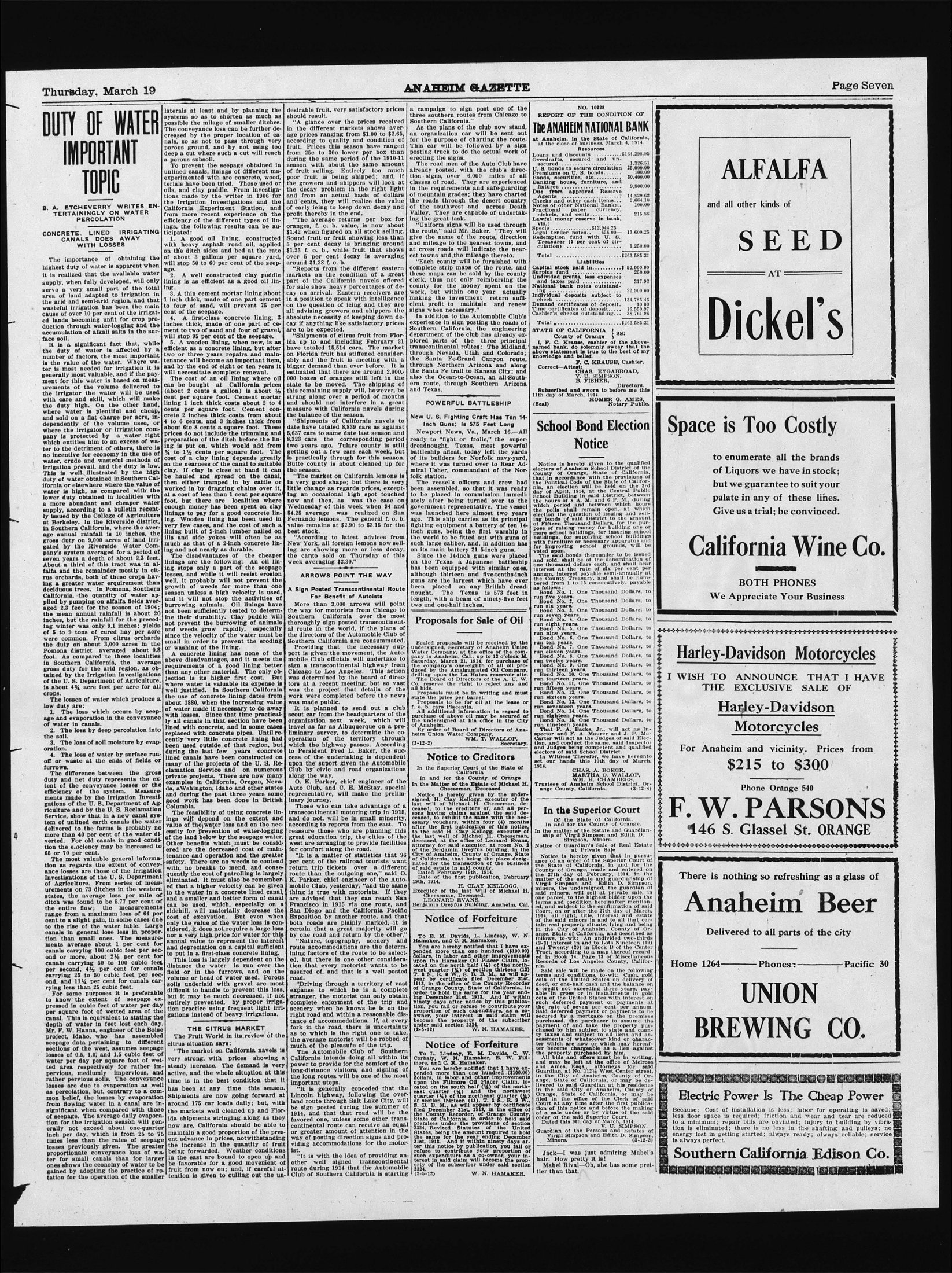
Searchable text
DUTY OF WATER IMPORTANT TOPIC
B. A. ETCHEVERRY WRITES ENTERTAININGLY ON WATER PERCOLATION
CONCRETE, LINED IRRIGATING CANALS DOES AWAY WITH LOSSES
The importance of obtaining the highest duty of water is apparent when it is realized that the available water supply, when fully developed, will only serve a very small part of the total area of land adapted to irrigation in the arid and semi-arid region, and that wasteful irrigation has been the main cause of over 10 per cent of the irrigated lands becoming unfit for crop production through water-logging and the accumulation of alkali salts in the surface soil.
It is a significant fact that, while the duty of water is affected by a number of factors, the most important is the value of the water. Where water is most needed for irrigation it is generally most valuable, and if the payment for this water is based on measurements of the volume delivered to the irrigator the water will be used with care and skill, which will make the duty high. On the other hand, where water is plentiful and cheap, and sold on a flat charge per acre, independently of the volume used, or where the irrigator or irrigation company is protected by a water right which entitles him to an excess of water to the detriment of others, there is no incentive for economy in the use of water, crude and wasteful methods of irrigation prevail, and the duty is low. This is well illustrated by the high laterals at least and by planning the systems so as to shorten as much as possible the milage of smaller ditches. The conveyance loss can be further decreased by the proper location of canals, so as not to pass through very porous ground, and by not using too deep a cut where such a cut will reach a porous subsoll.
To prevent the seepage obtained in unlined canals, linings of different materialized with are concrete, wood, materials have been tried. Those used or oils, and clay puddle. From investigations made by the writer in 1906 for the Irrigation Investigations and the California Experiment Station, and from more recent experience on the efficiency of the different types of linings, the following results can be anticipated:
1. A good oil lining, constructed with heavy asphalt road oil, applied on the ditch sides and bed at the rate of about 3 gallons per square yard, will stop 50 to 60 per cent of the seepage.
2. A well constructed clay puddle lining is as efficient as a good oil lining.
3. A thin cement mortar lining about 1 inch thick, made of one part cement to four of sand, will prevent 75 per cent of the seepage.
4. A first-class concrete lining, 3 inches thick, made of one part cement to two of sand and four of gravel, will stop 95 per cent of the seepage.
5. A wooden lining, when new, is as efficient as a concrete lining, but after two or three years repairs and maintenance will become an important item, and by the end of eight or ten years it will necessitate complete renewal.
The cost of an oil lining where oil can be bought at California prices (about 2 cents a gallon) is about ½ cent per square foot. Cement mortar lining 1 inch thick costs about 2 to 4 cents per square foot. Cement concrete 2 inches thick costs from about 4 to 6 cents, and 3 inches thick from about 6 to 8 cents a square foot. These prices do not include the trimming and preparation of the ditch before the lining is put on, which would add from ¾ to 1½ cents per square foot. The cost of a clay lining depends greatly on the nearness of the canal to suitable clay. If clay is close at hand it can desirable fruit, very sane should result.
"A glance over the in the different market prices ranging from according to quality and fruit. Prices this season from 25c to 30c lower during the same period season with about three of fruit selling. Entire poor fruit is being sold by the growers and shipping the decay problem in and from an actual bldg and cents, they will re yield early ice to keep up profit thereby in the end.
"The average return oranges, f. o. b. values $1.42 when figured on an Sound fruit or fruit shop 5 per cent decay is b $1.25 f. o. b., while fro over 5 per cent decrease around $1.28 f. o. b."
"Reports from the markets on the condition part of the California for sale show heavy peck cay on arrival. Eastern in a position to speak ww on the question of icing all advising growers an absolute necessity of k cay if anything like saff are to be expected.
"Shipments of citrus ida up to and including have totaled 15,514 cars on Florida fruit has stillably and the fruit is a bigger demand than ever estimated that there are 000 boxes of oranges state to be moved. This remaining supply ww strung along over a par and should not interfere measure with California balance of the season.
"Shipments of Calif date have totaled 8,839 5,637 cars to same date 8,323 cars the correct two years ago. Tulare getting out a few cars is practically through Butte county is about the season."
generally most valuable, and if the payment for this water is based on measurements of the volume delivered to the irrigator the water will be used with care and skill, which will make the duty high. On the other hand, where water is plentiful and cheap, and sold on a flat charge per acre, independently of the volume used, or where the irrigator or irrigation company is protected by a water right which entitles him to an excess of water to the detriment of others, there is no incentive for economy in the use of water, crude and wasteful methods of irrigation prevail, and the duty is low. This is well illustrated by the high duty of water obtained in Southern California or elsewhere where the value of water is high, as compared with the lower duty obtained in localities with a more abundant and cheaper water supply, according to a bulletin recently issued by the College of Agriculture at Berkeley. In the Riverside district, in Southern California, where the average annual rainfall is 10 inches, the gross duty on 9,000 acres of land irrigated by the Riverside Water Company's system averaged for a period of seven years a depth of about 2.3 feet. About a third of this tract was in alfalfa and the remainder mostly in citrus orchards, both of these crops having a greater water requirement than deciduous trees. In Pomona, Southern California, the quantity of water applied by pumping on alfalfa fields averaged 2.3 feet for the season of 1904; the mean annual rainfall is about 20 inches, but the rainfall for the preceding winter was only 9.1 inches; yields of 5 to 9 tons of cured hay per acre were common. From citrus orchards the duty on about 3,000 acres in the Pomona district averaged about 0.8 foot. As compared to these localities in Southern California, the average gross duty for the arid region, as obtained by the Irrigation Investigations of the U.S. Department of Agriculture, is about 4% acre feet per acre for all crops.
The losses of water which produce a low duty are:
1. The loss which occurs by seepage and evaporation in the conveyance of water in canals.
2. The loss by deep percolation into the soil.
3. The loss of soil moisture by evaporation.
4. The loss of water by surface runoff or waste at the ends of fields or furrows.
The difference between the gross duty and net duty represents the extent of the conveyance losses or the efficiency of the system. Measurements made by the Irrigation Investigations of the U.S. Department of Agriculture and by the U.S. Reclamation Service, show that in a new canal system of unlined earth canals the water delivered to the farms is probably no more than 40 per cent of the water diverted. For old canals in good condition the efficiency may be increased to 65 or 70 per cent.
The most valuable general information as regards the extent of conveyance losses are those of the Irrigation Investigations of the U.S. Department of Agriculture. From series of measurements on 73 ditches in the western states, the average loss per mile of generally most valuable, and if the payment for this water is based on measurements of the volume delivered to the irrigator the water will be used with care and skill, which will make the duty high. On the other hand, where water is plentiful and cheap, and sold on a flat charge per acre, independently of the volume used, or where the irrigator or irrigation company is protected by a water right which entitles him to an excess of water to the detriment of others, there is no incentive for economy in the use of water, crude and wasteful methods of irrigation prevail, and the duty is low. This is well illustrated by the high duty of water obtained in Southern California or elsewhere where the value of water is high, as compared with the lower duty obtained in localities with a more abundant and cheaper water supply, according to a bulletin recently issued by the College of Agriculture at Berkeley. In the Riverside district, in Southern California, where the average annual rainfall is 10 inches, the gross duty on 9,000 acres of land irrigated by the Riverside Water Company's system averaged for a period of seven years a depth of about 2.3 feet. About a third of this tract was in alfalfa and the remainder mostly in citrus orchards, both of these crops having a greater water requirement than deciduous trees. In Pomona, Southern California, the quantity of water applied by pumping on alfalfa fields averaged 2.3 feet for the season of 1904; the mean annual rainfall is about 20 inches, but the rainfall for the preceding winter was only 9.1 inches; yields of 5 to 9 tons of cured hay per acre were common. From citrus orchards the duty on about 3,000 acres in the Pomona district averaged about 0.8 foot. As compared to these localities in Southern California, the average gross duty for the arid region, as obtained by the Irrigation Investigations of the U.S. Department of Agriculture, is about 4% acre feet per acre for all crops.
The losses of water which produce a low duty are:
1. The loss which occurs by seepage and evaporation in the conveyance of water in canals.
2. The loss by deep percolation into the soil.
3. The loss of soil moisture by evaporation.
4. The loss of water by surface runoff or waste at the ends of fields or furrows.
The difference between the gross duty and net duty represents the extent of the conveyance losses or the efficiency of the system. Measurements made by the Irrigation Investigations of the U.S. Department of Agriculture and by the U.S. Reclamation Service, show that in a new canal system of unlined earth canals the water delivered to the farms is probably no more than 40 per cent of the water diverted. For old canals in good condition the efficiency may be increased to 65 or 70 per cent.
The most valuable general information as regards the extent of conveyance losses are those of the Irrigation Investigations of the U.S. Department of Agriculture. From series of measurements on 73 ditches in the western states, the average loss per mile of generally most valuable, and if the payment for this water is based on measurements of the volume delivered to the irrigator the water will be used with care and skill, which will make the duty high. On the other hand, where water is plentiful and cheap, and sold on a flat charge per acre, independently of the volume used, or where the irrigator or irrigation company is protected by a water right which entitles him to an excess of water to the detriment of others, there is no incentive for economy in the use of water, crude and wasteful methods of irrigation prevail, and the duty is low. This is well illustrated by the high duty of water obtained in Southern California or elsewhere where the value of water is high, as compared with the lower duty obtained in localities with a more abundant and cheaper water supply, according to a bulletin recently issued by the College of Agriculture at Berkeley. In the Riverside district, in Southern California, where the average annual rainfall is 10 inches, the gross duty on 9,000 acres of land irrigated by the Riverside Water Company's system averaged for a period of seven years a depth of about 2.3 feet. About a third of this tract was in alfalfa and the remainder mostly in citrus orchards, both of these crops having a greater water requirement than deciduous trees. In Pomona, Southern California, the quantity of water applied by pumping on alfalfa fields averaged 2.3 feet for the season of 1904;the mean annual rainfall is about 20 inches, but the rainfall for the preceding winter was only 9.1 inches; yields of 5 to 9 tons of cured hay per acre were common. From citrus orchards the duty on about 3,000 acres in the Pomona district averaged about 0.8 foot. As compared to these localities in Southern California, the average gross duty for the arid region, as obtained by the Irrigation Investigations of the U.S. Department of Agriculture, is about 4% acre feet per acre for all crops.
The losses of water which produce a low duty are:
1. The loss which occurs by seepage and evaporation in the conveyance of water in canals.
2. The loss by deep percolation into the soil.
3. The loss of soil moisture by evaporation.
4. The loss of water by surface runoff or waste at the ends of fields or furrows.
The difference between the gross duty and net duty represents the extent of conveyance losses or the efficiency of the system. Measurements made by the Irrigation Investigations of the U.S. Department of Agriculture and by the U.S. Reclamation Service, show that in a new canal system of unlined earth canals the水 delivered tothe farmsis probably no more than 40 per centofthewater diverted.Foroldcanalsingoodconditiontheencuencymaybeincreasedto65or70percent.
The most valuable general information as regardstheextentofconveyancelossesarethoseoftheIrrigationInvestigationsoftheU.S.DepartmentOfAgriculture.Fromseriesofmeasurementson73ditchesinthewesternstates,theaveragelosspermileofgeneralinformationasregardstheextentofconveyancelossesarethoseoftheIrrigationInvestigationsoftheU.S.DepartmentOfAgriculture.Fromseriesofmeasurementson73ditchesinthewesternstates,theaveragelosspermileofgeneralinformationasregardstheextentofconveyancelossesarethoseoftheIrrigationInvestigationsoftheU.S.DepartmentOfAgriculture.Fromseriesofmeasurementson73ditchesinthewesternstates,theaveragelosspermileofgeneralinformationasregardstheextentofconveyancelossesarethoseoftheIrrigationInvestigationsoftheU.S.DepartmentOfAgriculture.Fromseriesofmeasurementson73ditchesinthewesternstates,theaveragelosspermileofgeneralinformationasregardstheextentofconveyancelossesarethoseoftheIrrigationInvestigationsoftheU.S.DepartmentOfAgriculture.Fromseriesofmeasurementson73ditchesinthewesternstates,theaveragelosspermileofgeneralinformationasregardstheextentofconveyancelossesarethoseoftheIrrigationInvestigationsoftheU.S.DepartmentOfAgriculture.Fromseriesofmeasurementson73ditchesinthewesternstates,theaveragelosspermileofgeneralInformationasregardstheextentofconveyancelossesarethoseoftheIrrigationInvestigationsoftheU.S.DepartmentOfAgriculture.Fromseriesofmeasurementson73ditchesinthewesternstates,theaveragelosspermileofgeneralInformationasregardstheextentofconveyancelossesarethoseoftheIrrigationInvestigationsoftheU.S.DepartmentOfAgriculture.Fromseriesofmeasurementson73ditchesinthewesternstates,theaveragelosspermileofgeneralInformationasregardstheextentofconveyancelossesarethoseoftheIrrigationInvestigationsoftheU.S.DepartmentOfAgriculture.Fromseriesofmeasurementson73ditchesinthewesternstates,theaveragelosspermileofgeneralInformationasregardstheextentofconveyancelossesarethoseoftheIrrigationInvestigationsoftheU.S.DepartmentOfAgriculture.Fromseriesofmeasurementson73ditchesinthewesternstates,theaveragelosspermileofgeneralInformationasregardstheextentofconveyancelossesarethoseoftheIrrigationInvestigationsoftheU.S.DepartmentOfAgriculture.Fromseriesofmeasurementson73ditchesinthewesternstates,theaveragelosspermileofgeneralInformationasregardstheextentofconveyancelossesarethoseoftheIrrigationInvestigationsoftheU.S.DepartmentOfAgriculture.Fromseriesofmeasurementson73ditchesinthewesternstates,theaveragelosspermileofgeneralInformationasregardstheextentofconveyancelossesarethoseoftheIrrigationInvestigationsoftheU.S.DepartmentOfAgriculture.Fromseriesofmeasurementson73ditchesinthewesternstates,theaveragelosspermileofgeneralInformationasregardstheextentofconveyancelossesarethoseoftheIrrigationInvestigationsoftheU.S.DepartmentOfAgriculture.Fromseriesofmeasurementson73ditchesinthewesternstates,theaveragelosspermileofgeneralInformationasregardstheextentofconveyancelossesarethoseoftheIrrigationInvestigationsoftheU.S.DepartmentOfAgriculture.Fromseriesofmeasurementson73ditchesinthewesternstates,theaveragelosspermileofgeneralInformationasregardstheextentofconveyancelossesarethoseoftheIrrigationInvestigationsoftheU.S.DepartmentOfAgriculture.Fromseriesofmeasurementson73ditchesinthewesternstates,theaveragelosspermileOFgeneralInformationasregardstheextentofconveyancelossesarethoseoftheIrrigationInvestigationsoftheU.S.DepartmentOfAgriculture.Fromseries Ofmeasurementson73ditchesinthewesternstates,theaveragelosspermileOFgeneralInformationasregardstheextentOfconveyancelossesarethoseOftheIrrigationInvestigationsoftheU.S.DepartmentOfAgriculture.Fromseries Ofmeasurementson73ditchesinthewesternstates,theaveragelosspermileOFgeneralInformationasregardstHextentOfconveyancelossesarethoseOftheIrrigationInvestigationsoftheU.S.DepartmentOfAgriculture.Fromseries Ofmeasurementson73ditchesinthewesternstates,theaveragelosspermileOFgeneralInformationasregardstHextentOfconveyancelossesarethoseOftheIrrigationInvestigations oftHextentOfconveyancelossesarethoseOftheIrrigationInvestigations oftHextentOfconveyancelossesarethoseOftheIrrigationInvestigations oftHextentOfconveyancelossesarethoseOftheIrrigationInvestigations oftHextentOfconveyancelossesarethoseOftheIrrigationInvestigations oftHextentOfconveyancelossesarethoseOftheIrrigationInvestigations oftHextentOfconveyancelossesarethoseOftheIrrigationInvestigations oftHextentOfconveyancelossesarethoseOftheIrrigationInvestigations oftHextentOfconveyancelossesarethoseOftheIrrigationInvestigations oftHextentOfconveyancelossesarethoseOftheIrrigationInvestigations oftHextentOfconveyancelossesarethoseOftheIrrigationInvestigations oftHextentOfconveyancelossesarethoseOftheIrrigationInvestigations oftHextentOfconveyancelossesarethoseOftheIrrigationInvestigations oftHextentOfconveyancelossesarethoseOftheIrrigationInvestigations oftHextentOfconveyancelossesarethoseOftheIrrigationInvestigations oftHextentOfconveyancelossesarethoseOftheIrrigationInvestigations oftHextentOfconveyancelossesarethoseOftheIrrigationInvestigations oftHextentOfconveyancelossesarethoseOFtheIrrigationInvestigations oftHextentOFconveyancelossesarethoseOFtheIrrigationInvestigations oftHextentOFconveyancelossesarethoseOFtheIrrigationInvestigations oftHextentOFconveyancelossesarethoseOFtheIrrigationInvestigations oftHextentOFconveyancelossesarethoseOFtheIrrigationInvestigations oftHextentOFconveyancelossesarethoseOFtheIrrigationInvestigations oftHextentOFconveyancelossesarethoseOFtheIrrigationInvestigations oftHextentOFconveyancelossesarethoseOFtheIrrigationInvestigations oftHextentOFconveyancelossesarethoseOFtheIrrigationInvestigations oftHextentOFconveyancelossesarethoseOFtheIrrigationInvestigations oftHextentOFconveyancelossesarethoseOFtheIrrigationInvestigations oftHextentOFconveyancelossesarethoseOFtheIrrigationInvestigations oftHextentOFconveyancelossesarethoseOFtheIrrigationInvestigations oftHextentOFconveyancelossesarethoseOFtheIrrigationInvestigations oftHextentOFconveyancelossesarethoseOFtheIrrigationInvestigations oftHextentOFconveyancelossesarethoseOFtheIrrigationInvestigations oftHextentOFconveyance_lossesarethoseOFtheIrrigationInvestigations oftHextentOFconveyance_lossesarethoseOFtheIrrigationInvestigations oftHextentOFconveyance_lossesarethoseOFtheIrrigration Investigations oftHextentOFconveyance_lossesarethoseOFtheIrrigration Investigrations oftHextentOFconveyance_lossesaretheseOFtheIRRIGATION INSTITUTIONS OFTHE U.S.DEPARTMENT OF AGRICULTURE AND THE U.S.DEPARTMENT OF AGRICULTURE ARE REGISTERED BY THE U.S.DEPARTMENT OF AGRICULTURE AND THE U.S.DEPARTMENT OF AGRICULTURE ARE REGISTERED BY THE U.S.DEPARTMENT OF AGRICULTURE AND THE U.S.DEPARTMENT OF AGRICULTURE ARE REGISTERED BY THE U.S.DEPARTMENT OF AGRICULTURE AND THE U.S.DEPARTMENT OF AGRICULTURE ARE REGISTERED BY THE U.S.DEPARTMENT OF AGRICULTURE AND THE U.S.DEPARTMENT OF AGRICULTURE ARE REGISTERED BY THE U.S.DEPARTMENT OF AGRICULTURE AND THE U.S.DEPARTMENT OF AGRICULTURE ARE REGISTERED BY THE U.S.DEPARTMENT OF AGRICULTURE AND THE U.S.DEPARTMENT OF AGRICULTURE ARE REGISTERED BY THE U.S.DEPARTMENT OF AGRICULTURE AND THE U.S.DEPARTMENT OF AGRICULTURE ARE REGISTERED BY THE U.S.DEPARTMENT OF AGRICULTURE AND THE U.S.DEPARTMENT OF AGRICULTURE ARE REGISTERED BY THE U.S.DEPARTMENT OF AGRICULTURE AND THE U.S.DEPARTMENT OF AGRICULTURE ARE REGISTERED BY THE U.S.DEPARTMENT OF AGRICULTURE AND THE U.S.DEPARTMENT OF AGRICULTURE ARE REGISTERED BY THE U.S.DEPARTMENT OF AGRICULTURE AND THE U.S.DEPARTMENT OF AGRICULTURE ARE REGISTERED BY THE U.S.DEPARTMENT OF AGRICULTURE AND THE U.S.DEPARTMENT OF AGRICULTURE ARE REGISTERED BY THE U.S.DEPARTMENT OF AGRICULTURE AND THE U.S.DEPARTMENT OF AGRICULTURE ARE REGISTERED BY THE U.S.DEPARTMENT OF AGRICULTURE AND THE U.S.DEPARTMENT OF AGRICULTURE ARE REGISTERED BY THE U.S.DEPARTMENT OF AGRICULTURE AND THE U.S.DEPARTMENT OF AGRICULTURE ARE REGISTERED BY THE U.S.DEPARTMENT OF AGRICULTURE AND THE U.S.DEPARTMENT OF AGRICULTURE ARE REGISTERED BY THE U.S.DEPARTMENT OF AGRICULTURE AND THE U.S.DEPARTMENT OF AGRICULTURE ARE REGISTERED BY THE U.S.DEPARTMENT OF AGRICULTURE AND THE U.S.DEPARTMENT OF AGRICULTURE ARE REGISTERED BY THE U.S.DEPARTMENT OF AGRICULTURE AND THE U.S.DEPARTMENT OF AGRICULTURE ARE REGISTERED BY THE U.S.DEPARTMENT OF AGRICULTURE AND THE U.S.DEPARTMENT OF AGRICULTURE ARE REGISTERED BY THE U.S.DEPARTMENT OF AGRICULTURE AND THE U.S.DEPARTMENT OF AGRICULTURE ARE REGISTERED BY THE U.S.DEPARTMENT OF AGRICULTURE AND THE U.S.DEPARTMENT OF AGRICULTURE ARE REGISTERED BY THE U.S.DEPARTMENT OF AGRICULTURE AND THE U.S.DEPARTMENT OF AGRICULTURE ARE REGISTERED BY THE U.S.DEPARTMENT OF AGRICULTURE AND THE U.S.DEPARTMENT OF AGRICulturesAREREGISTEREDBYTHEU S D EPARTMENOFTHEU S D EPARTMENOFTHEU S D EPARTMENOFTHEU S D EPARTMENOFTHEU S D EPARTMENOFTHEU S D EPARTMENOFTHEU S D EPARTMENOFTHEU S D EPARTMENOFTHEU S D EPARTMENOFTHEU S D EPARTMENOFTHEU S D EPARTMENOFTHEU S D EPARTMENOFTHEU S D EPARTMENOFTHEU S D EPARTMENOFTHEU S D EPARTMENOFTHEU S D EPartMENOFTHEU S D EPartMENOFTHEU S D EPartMENOFTHEU S D EPartMENOFTHEU S D EPartMENOFTHEU S D EPartMENOFTHEU S D EPartMENOFTHEU S D EPartMENOFTHEU S D EPartMENOFTHEU S D EPartMENOFTHEU S D EPartMENOFTHEU S D EPartMENOFTHEU S D EPartMENOFTHEU S D EPartMENOFTHEU S D EPartMENOFTHEU S D EpartMENOFTHEU S D EPartMENOFTHEU S D EPartMENOFTHEU S D EPartMENOFTHEU S D EPartMENOFTHEU S D EPartMENOFTHEU S D EPartMENOFTHEU S D EPartMENOFTHEU S D EPartMENOFTHEU S D EPartMENOFTHEU S D EPartMENOFTHEU S D EPartMENOFTHEU S D EPartMENOFTHEU S D EPartMENOFTHEU S D EpartMENOFTHEU S D EpartMENOFTHEU S D EpartMENOFTHEU S D EpartMENOFTHEU S D EpartMENOFTHEU S D EpartMENOFTHEU S D EpartMENOFTTHEU S D EPartMENOFTTHEU S D EPartMENOFTTHEU S D EPartMENOFTTHEU S D EpartMENOFTTHEU S D EpartMENOftHEU S D epartMEnoftHEU S D epartMEnoftHEU S D epartMEnoftHEU S D epartMEnoftHEU S D epartMEnoftHEU S D epartMEnoftHEU S D epartMEnoftHEU S D epartMEnoftHEU S D epartMEnoftHEU S D epartMEnoftHEU S D epartMEnoft HEUsD epartMEnoft HEUsD epartMEnoft HEUsD epartMEnoft HEUsD epartMEnoft HEUsD epartMEnoft HEUsD epartMEnoft HEUsD epartMEnoft HEUsD epartMEnoft HEUsD epartMEnoft HEUsD epartMEnoft HEUsD ep art MEnoft HEUsD ep art MEnoft HEUsD ep art MEnoft HEUsD ep art MEnoft HEUsD ep art MEnoft HEUsD ep art MEnoft HEUsD ep art MEnoft HEUsD ep art MEnoft HEUsD ep art MEnoft HEUsD ep art MEnoft HEUsD ep art MEnoft HEUsD ep art MEnoft HeUsD ep art MEnoft HeUsD ep art MEnoft HeUsD ep art MEnoft HeUsD ep art MEnoft HeUsD ep art MEnoft HeUsD ep art MEnoft HeUsD ep art MEnoft HeUsD ep art MEnoft HeUsD ep art MEnoft HeUsD ep art MEnoft HeUsD ep art M Enoft HeUsD ep art MEnoft HeUsD ep art MEnoft HeUsD ep art MEnoft HeUsD ep art MEnoft HeUsD ep art MEnoft HeUsD ep art MEnoft HeUsD ep art MEnoft HeUsD ep art MEnoft HeUsD ep art MEnoft HeUsD ep art MEnoft He UsD ep art MEnoft He UsD ep art MEnoft He UsD ep art MEnoft He UsD ep art MEnoft He UsD ep art MEnoft He UsD ep art MEnoft He UsD ep art MEnoft He UsD ep art MEnoft He UsD ep art MEnoft He UsD ep art MEm olt he UsD ep art MEm olt he UsD ep art MEm olt he UsD ep art MEm olt he UsD ep art MEm olt he UsD ep art MEm olt he UsD ep art MEm olt he UsD ep art MEm olt he UsD ep art MEm olt he UsD ep art MEm olt he UsD ep art MEm olt he UsD ep art Me m olt he UsD ep art Me m olt he UsD ep art Me m olt he UsD
The most valuable general information as regards the extent of conveyance losses are those of the Irrigation Investigations of the U.S. Department of Agriculture. From series of measurements on 73 ditches in the western states, the average loss per mile of ditch was found to be 5.77 per cent of the entire flow; the measurements range from a maximum loss of 64 per cent to a slight gain, in some cases due to the rise of the water table. Large canals in general lose less in proportion than small ones. The measurements average about 1 per cent for canals carrying 100 cubic feet per second or more, about 2½ per cent for canals carrying 50 to 100 cubic feet per second, 4½ per cent for canals carrying 25 to 50 cubic feet per second, and 11¼ per cent for canals carrying less than 25 cubic feet.
For some purposes it is preferable to know the extent of seepage expressed in cubic feet of water per day per square foot of wetted area of the canal. This is equivalent to stating the depth of water in feet lost each day. Mr. F. W. Hanna, engineer of the Boise project, Idaho, who has assembled seepage data pertaining to different sections of the west, assumes seepage losses of 0.5, 1.0, and 1.5 cubic feet of water per day per square foot of wetted area respectively for rather impervious, mediumly impervious, and rather pervious solls. The conveyance losses are due to evaporation as well as percolation, but, contrary to a common belief, the losses by evaporation from flowing water in a canal are insignificant when compared with those of seepage. The average daily evaporation for the irrigation season will generally not exceed about one-quarter inch per day, which is from 25 to 75 times less than the rates of seepage losses previously given. The greater proportionate conveyance loss of water for small canals than for larger ones shows the economy of water to be gained by adopting the practice of rotation for the operation of the smaller good work has been done in British Columbia.
The feasibility of using concrete linings will depend on the extent and value of the water loss and on the necessity for prevention of water-logging of the land below by the seepage water. Other benefits which must be considered are the decreased cost of maintenance and operation and the greater safety. There are no weeds to contend with, no breaks to mend, and consequently the cost of patrolling is largely eliminated. It must also be remembered that a higher velocity can be given to the water in a concrete lined canal, and a smaller and better form of canal can be used, which, especially on a sidehill, will materially decrease the cost of excavation. But even when only the value of the water loss is considered, it does not require a large loss nor a very high price for water for this annual value to represent the interest and depreciation on a capital sufficient to put in a first-class concrete lining.
This loss is largely dependent on the distance the water is run over the field or in the furrows, and on the volume or head of water used. Porous soils underlaid with gravel are most difficult to handle to prevent this loss, but it may be much decreased, if not entirely prevented, by proper irrigation practice using frequent light irrigations instead of heavy irrigations.
THE CITRUS MARKET
The Fruit World in its review of the citrus situation says:
"The market on California navels is very strong, with prices showing a steady increase. The demand is very active, and the whole situation at this time is in the best condition that it has been at any time this season. Shipments are now going forward at around 175 car loads daily; but, with the markets well cleaned up and Florida shipments stringing along as they now are, California should be able to maintain a good proportion of the present advance in prices, notwithstanding the increase in the quantity of fruit being forwarded. Weather conditions in the east are bound to open up and be favorable for a good movement of fruit from now on; and, if careful attention is given to culling out the un-
desirable fruit, very satisfactory prices should result.
"A glance over the prices received in the different markets shows average prices ranging from $1.00 to $2.65, according to quality and condition of fruit. Prices this season have ranged from 25c to 30c lower per box than during the same period of the 1910-11 season with about the same amount of fruit selling. Entirely too much poor fruit is being shipped; and, if the growers and shippers will look at the decay problem in the right light and from an actual basis of dollars and cents, they will realize the value of early ice to keep down decay and profit thereby in the end.
"The average returns per box for oranges, f. o. b. value, is now about $1.42 when figured on all stock selling. Sound fruit or fruit showing less than 5 per cent decay is bringing around $1.25 f. o. b., while fruit that shows over 5 per cent decay is averaging around $1.28 f. o. b."
"Reports from the different eastern markets on the condition of a great part of the California navels offered for sale show heavy percentages of decay on arrival. Eastern receivers are in a position to speak with intelligence on the question of icing and they are all advising growers and shippers the absolute necessity of keeping down decay if anything like satisfactory prices are to be expected.
"Shipments of citrus fruit from Florida up to and including February 21 have totaled 15,514 cars. The market on Florida fruit has stiffened considerably and the fruit is meeting with a bigger demand than ever before. It is estimated that there are around 2,000-000 boxes of oranges still left in the state to be moved. The shipping of this remaining supply will, however, be strung along over a period of months and should not interfere in a great measure with California navels during the balance of the season.
"Shipments of California navels to date have totaled 8,839 cars as against 5,637 cars to same date last season and 8,323 cars the corresponding period two years ago. Tulare county is still getting out a few cars each week, but is practically through for this season. Butte county is about cleaned up for the season."
000 boxes of oranges still left in the state to be moved. The shipping of this remaining supply will, however, be strung along over a period of months and should not interfere in a great measure with California navels during the balance of the season.
"Shipments of California navels to date have totaled 8,839 cars as against 5,637 cars to same date last season and 8,323 cars the corresponding period two years ago. Tulare county is still getting out a few cars each week, but is practically through for this season. Butte county is about cleaned up for the season.
"The market on California lemons is in very good shape; but there is very little change as regards prices, excepting an occasional high spot touched now and then, as was the case on Wednesday of this week when $4 and $4.25 average was realized on San Fernando lemons. The general f. o. b. value remains at $2.90 to $3.15 for the best stock.
"According to latest advices from New York, all foreign lemons now selling are showing more or less decay, the cargo sold on Thursday of this week averaging $2.30."
ARROWS POINT THE WAY
A Sign Posted Transcontinental Route For Benefit of Autoists
More than 3,000 arrows will point the way for motorists from Chicago to Southern California over the most thoroughly sign posted transcontinental route in the world, if the plans of the directors of the Automobile Club of Southern California are consummated.
Providing that the necessary support is given the movement, the Automobile Club officials will undertake to sign a transcontinental highway from Chicago to Los Angeles. This action was determined by the board of directors at a recent meeting, but so vast was the project that details of the work were completed before the news was made public.
It is planned to send out a club scout car from the headquarters of the organization next week, which will travel as far as Albuquerque on a preliminary survey, to determine the cooperation of the territory through which the highway passes. According to Persident Fred L. Baker, the success of the undertaking is dependent upon the suport given the Automobile Club by civic and road organizations along the way.
O. K. Parker, chief engineer of the Auto Club, and C. E. McStay, special representative, will make the preliminary journey.
Those who can take advantage of a transcontinental motoring trip in 1915, and do not, will be in small minority, according to reports from the east. To reassure those who are planning this great education trip, the cities of the west are arranging to provide facilities for comfort along the road.
"It is a matter of statistics that 96 per cent of the railroad tourists want return trip tickets over a different route than the outgoing one," said O. K. Parker, chief engineer of the Automobile Club, yesterday, "and the same thing is true with motorists. If they are advised that they can reach San also the Ocean-to-Ocean, an all-Southern route through Southern Arizona and Texas.
POWERFUL BATTLESHIP
New U. S. Fighting Craft Has Ten 14-Inch Guns; Is 575 Feet Long
Newport News, Va., March 16.—All ready to "fight or frolic," the superdreadnought, Texas, most powerful battleship afloat, today left the yards of its builders for Norfolk navy-yard, where it was turned over to Rear Admiral Usher, commandant of the Norfolk station.
The vessel's officers and crew had been assembled, so that it was ready to be placed in commission immediately after being turned over to the government representative. The vessel was launched here almost two years ago. This ship carries as its principal fighting equipment a battery of ten 14-inch guns, being the first warship in the world to be fitted out with guns of such large caliber, and, in addition has on its main battery 21 5-inch guns.
Since the 14-inch guns were placed on the Texas a Japanese battleship has been equipped with similar ones, although thirteen and five-tenth-s-inch guns are the largest which have ever been placed on any British dreadnought. The Texas is 573 feet in length, with a beam of ninety-five feet two and one-half inches.
Proposals for Sale of Oil
Sealed proposals will be received by the undersigned, Secretary of Anaheim Union Water Company, at the office of the company in Anaheim, Cal., up to 12 o'clock M. Saturday, March 21, 1914, for purchase of the company's one-eighth of all oil produced by the Amalgamated Oil Company, drilling upon the La Habra reservoir site.
The Board of Directors of the A. U. W. Co. reserve the right to reject any and all bids.
Proposals must be in writing and must state the price per barrel.
Proposals to be for oil at the lease or f. o. b. cars Placentia.
All additional information in regard to purchase of above oil may be secured of the undersigned at his office in the City of Anaheim.
By order of Board of Directors of Anaheim Union Water Company.
WM. T. WALLOP,
Secretary.
Notice to Creditors
In the Superior Court of the State of California
In and for the County of Orange
In the Matter of the Estate of Michael H. Cheeseman, Deceased
Notice is hereby given by the undersigned, H. Clay Kellogg, executor of the last will of Michael H. Cheeseman, deceased, to the creditors of, and all persons having claims against the said deceased, to exhibit the same with the necessary vouchers, within four (4) months after the first publication of this notice, to the said H. Clay Kellogg, executor of the last well of Michael H. Cheeseman, deceased, at the office of Leonard Evans, attorney for said executor, at room No. 2 of Benjamin Dreyfus building, in the City of Anaheim, County of Orange, State of California, that being the place designated for the transaction of the business of said estate in said county.
Dated February 19th, 1914.
Date of the first publication, February 19th, 1914.
H. CLAY KELLOGG,
Executor of the last Will of Michael H. Cheeseman, Deceased.
V. U. SIMPSON,
B. FISHER,
Subscribed and sworn to before me this 11th day of March, 1914.
HOMER G. AMES,
Notary Public.
School Bond Election Notice
Notice is hereby given to the qualified electors of Anaheim School District of the County of Orange, State of California, that in accordance with the provisions of the Political Code of the State of California, an election will be held on the 3rd day of April, 1914, at the Central Public School Building in said District, between hours of 8 A.M. and 6 P.M., during which period and between which hours the polls shall remain open, at which election the question of issuing and selling bonds of said District to the amount Fifteen Thousand Dollars, for the purpose of raising money for building one or more school buildings, for insuring school buildings, for supplying school buildings with furniture or necessary apparatus and for improving school grounds, will be voted upon.
The said bonds thereunder to be issued and sold, shall be of the denomination of one thousand dollars each, and shall bear interest at the rate of six per cent per annum, interest payable semi-annually at the County Treasury, and shall be numbered from 1 to 15 consecutively, payable as follows:
Bond No. 1, One Thousand Dollars, to run five years.
Bond No. 2, One Thousand Dollars, to run six years.
Bond No. 3, One Thousand Dollars, to run seven years.
Bond No. 4, One Thousand Dollars, to run eight years.
Bond No. 5, One Thousand Dollars, to run nine years.
Bond No. 6, One Thousand Dollars, to run ten years.
Bond No. 7, One Thousand Dollars, to run eleven years.
Bond No. 8, One Thousand Dollars, to run twelve years.
Bond No. 9, One Thousand Dollars, to run thirteen years.
Bond No. 10, One Thousand Dollars, to run fourteen years.
Bond No. 11, One Thousand Dollars, to run fifteen years.
Bond No. 12, One Thousand Dollars, to run sixteen years.
Bond No. 13, One Thousand Dollars, to run seventeen years.
Bond No. 14, One Thousand Dollars, to run eighteen years.
Bond No. 15, One Thousand Dollars, to run nineteen years.
That F. A. Backs Jr., will act as Inspector and F. A. Maurer and J. P. McCarter will act as Judges of said Election,and conductthe same,saidInspector and Judgesbeing competent andqualified electorsof said School District.
In Witness Therefor we have hereunto set our hands this 10th day of March,1914.
CHAS.A.BOEGE,
MARTHA O.WALLOP,
WM.H.CHAMBERS,
TrusteesofAnaheimSchoolDistrictOrangeCountyCalifornia.(3-12-4)
IntheSuperior Court
OftheStateofCalifornia.
InandfortheCountyofOrange.
InthematteroftheEstateandGuardianshipofVirgilSimpsonandEdithD.SimpsonMinors.
NoticeofGuardian'SaleOfRealEstateatPrivateSale
NoticeisherebygiventhatinpursuanceofanorderoftheSuperiorCourtoftheStateofCalifornia.inandfortheCountyofOrange.madeandenteronthe27thdayofFebruary,1914.inthematteroftheEstateandGuardianshipofVirgilSimpsonandEdithD.Simpsonminors.will sellatprivate sale.inoneparcel,tothehighestbidderuponthe
Those who can take advantage of a transcontinental motoring trip in 1915, and do not, will be in small minority, according to reports from the east. To reassure those who are planning this great education trip, the cities of the west are arranging to provide facilities for comfort along the road.
"It is a matter of statistics that 96 per cent of the railroad tourists want return trip tickets over a different route than the outgoing one," said O. K. Parker, chief engineer of the Automobile Club, yesterday, "and the same thing is true with motorists. If they are advised that they can reach San Francisco in 1915 via one route, and San Diego and the California Pacific Exposition by another route, and that both roads are plainly marked, it is certain that a great majority will go by one road and return by the other."
"Nature, topography, scenery and route accommodations are the determining factors of the route to be selected, but there is one other consideration that every motorist wants to be assured of, and that is a well posted road.
"Driving through a territory of vast expanse to which he is a complete stranger, the motorist can only obtain complete enjoyment of the trip and scenery when he knows he is on the right road and within a reasonable distance of accommodations. If, at every fork in the road, there is uncertainty as to which is the right one to take, the average motorist will be robbed of much of the pleasure of the trip.
The Automobile Club of Southern California intends doing all within its power to provide for the comfort of the long-distance visitors, and signing of the long routes will be one of the most important steps.
"It is generally conceded that the Lincoln highway, following the overland route through Salt Lake City, will be sign posted during the summer of 1914, and that that road will be the favored one, unless some other transcontinental route can receive an equal or greater amount of attention in the way of posting direction signs and providing accommodations for the motorist.
"It is with the idea of providing another well signed transcontinental route during 1914 that the Automobile Club of Southern California is starting signed, H. Clay Kellogg, executor of the last will of Michael H. Cheeseman, deceased, to the creditors of, and all persons having claims against the said deceased, to exhibit the same with the necessary vouchers, within four (4) months after the first publication of this notice, to the said H. Clay Kellogg, executor of the last well of Michael H. Cheeseman, deceased, at the office of Leonard Evans, attorney for said executor, at room No. 2 of the Benjamin Dreyfus building, in the City of Anaheim, County of Orange, State of California, that being the place designated for the transaction of the business of said estate in said county.
Dated February 19th, 1914.
Date of the first publication, February 19th, 1914.
H. CLAY KELLOGG,
Executor of the last Will of Michael H. Cheeseman, Deceased.
LEONARD EVANS,
Benjamin Dreyfus Building, Anaheim, Cal.
Notice of Forfeiture
To E. M. Davids, L. Lindsay, W. N. Hamaker, and C. R. Hamaker.
You are hereby notified that I have expended more than one hundred ($100.00) dollars, in labor and other improvements upon the Hamaker Oil Placer Claim, located on the north half (%) of the northwest quarter (%) of section thirteen (13) T. S., R. 9 W., S. B. B. M., as will appear by certificate filed December 31st, 1913, in the office of the County Recorder of Orange County, State of California, in order to hold the same for the year ending December 31st, 1913. And if within ninety days after notice by this publication, you fall or refuse to contribute your proportion of such expenditure, as a co-owner, your interest in said claim will become the property of the subscriber under said section 2324.
(2-5-12)
W. N. HAMAKER.
Notice of Forfeiture
To L. Lindsay, E. M. Davids, C. W. Corbaly, W. N. Hamaker, E. W. Fillmore, and C. R. Hamaker.
You are hereby notified that I have expended more than one hundred ($100.00) dollars, in labor and other improvements upon the Fillmore Oil Placer Claim, located on the south half (%) of the northeast quarter (%) and the northwest quarter (%) of section thirteen (13), T. S., R. 9 W., S. B. B. M., as will appear by certificate filed December 31st, 1913, in the office of the County Recorder, Orange County, State of California, in order to hold said premises under the provisions of section 2324. Revised Statutes of the United States, being the amount required to hold the same for the year ending December 31st, 1913. And if within ninety days after notice by publication, you fall or refuse to contribute your proportion of such expenditure as a co-owner, your interest in said claim will become the property of the subscriber under said section 2324.
(2-5-12)
W. N. HAMAKER.
In the Superior Court
Of the State of California,
In and for the County of Orange.
In the matter of the Estate and Guardianship of Virgil Simpson and Edith D. Simpson, Minors.
Notice of Guardian's Sale of Real Estate at Private Sale
Notice is hereby given that in pursuance of an order of the Superior Court of the State of California, in and for the County of Orange, made and entered on the 27th day of February, 1914, in the matter of the estate and guardianship of Virgil Simpson and Edith D. Simpson, minors, the undersigned, the guardian of said minors, will sell at private sale, in one parcel, to the highest bidder upon the terms and condition hereinafter mentioned, and subject to the confirmation of said Court, on or after the 27th day of March, 1914, all right title, interest and estate of the said minors in and to all that certain real property situate lying and being in the City of Anaheim, County of Orange, State of California,and described as follows: to-wit: An undivided two-thirds (2-3) interest in and to Lots Nineteen (19) and Twenty (20) in Block B Of the Center Tract, according to a map thereof recorded in Book 14; Page 13 Of Miscellaneous Records Of Los Angeles County,California.
Said sale will be made on the following terms and conditions: to-wit: Cash,gold coin of the United States on delivery deed,或one-half cash andthe balance on a credit not exceeding three years,payable in gross or in installments in gold coins ofthe United States with interest on such deferred payment or payments atthe rateof seven per cent annum.Said deferred payment or payments tobe securedbya mortgageonthepremisespurchased,thepurchasertoassumethepaymentofandtakethepropertypurchasedbyhimsubjecttostateandcounty taxesandsubjecttoallliensandassessmentsofwhatsoeverkindorcharacterwhicharenoworwhichmayhereafterbechargeableasalienagainthepropertypurchasedbyhim.
All bids and offers must be in writing,and may be left attheofficeofMelroseandAmesEsq.,attorneysforsaidGuardian.atNo.112½WestCenterstreet,theCityofAnaheim,CountyOfOrange.StateOfCalifornia.ormaybedeliveredtosaidGuardianathisresidenceinthesaldCityofAnaheim,CountyOfOrange.StateOfCalifornia.ormaybefiledintheofficeoftheClerkofsaidCourtatanytimeafterthefirstpublicationofthisnoticeandbeforethemakingofa saleunderorbyvirtueofthesaidorderofthesaidSuperior Court.
Dated this 9th day of March,1914.
V.U.SIMPSON,
GuardianofthePersonsandEstatesofVirgilSimpsonandEdithD.SimpsonMinors.
Jack—I was just admiring Mabel's hair.How pretty it is!
MabelRival—Oh,shehassomepretterthanthat.
ALFALFA
and all other kinds of
SEED
AT
Dickel's
Space is Too Costly
to enumerate all the brands
of Liquors we have in stock;
Space is Too Costly
to enumerate all the brands
of Liquors we have in stock;
but we guarantee to suit your
palate in any of these lines.
Give us a trial; be convinced.
California Wine Co.
BOTH PHONES
We Appreciate Your Business
Harley-Davidson Motorcycles
I WISH TO ANNOUNCE THAT I HAVE
THE EXCLUSIVE SALE OF
Harley-Davidson
Motorcycles
For Anaheim and vicinity. Prices from
$215 to $300
Phone Orange 540
F. W. PARSONS
146 S. Glassel St. ORANGE
There is nothing so refreshing as a glass of
F. W. PARSONS
146 S. Glassel St. ORANGE
There is nothing so refreshing as a glass of
Anaheim Beer
Delivered to all parts of the city
Home 1264——Phones:——Pacific 30
UNION
BREWING CO.
Electric Power Is The Cheap Power
Because: Cost of installation is less; labor for operating is saved;
less floor space is required; friction and wear and tear are reduced
to a minimum; repair bills are obviated; injury to building by vibration is eliminated; there is no loss in the shafting and pulleys; no
energy lost in getting started; always ready; always reliable; service
is always perfect.
Southern California Edison Co.