anaheim-gazette 1914-03-19
Scanned page
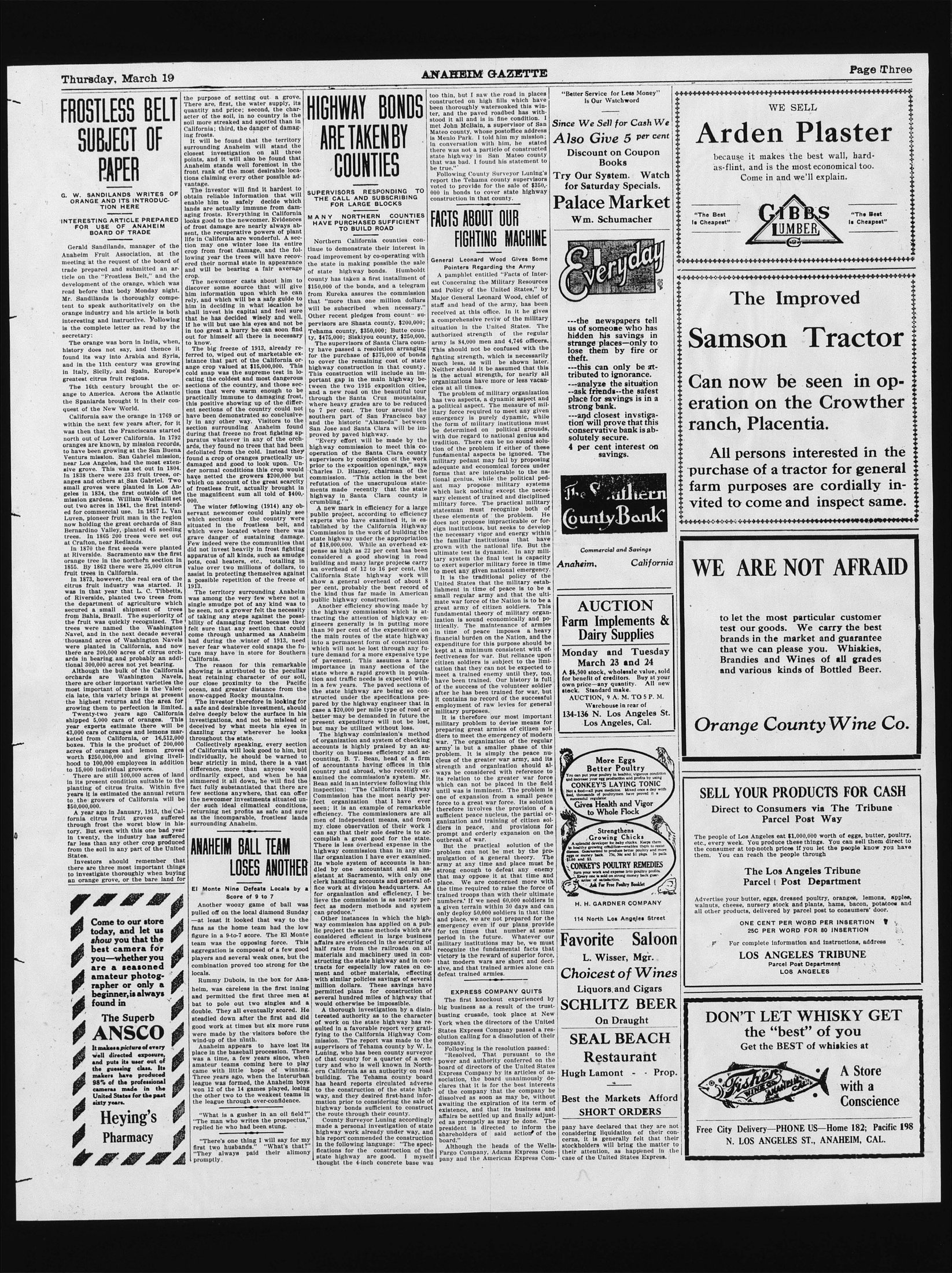
Searchable text
FROSTLESS BELT SUBJECT OF PAPER
G. W. SANDILANDS WRITES OF ORANGE AND ITS INTRODUCTION HERE
INTERESTING ARTICLE PREPARED FOR USE OF ANAHEIM BOARD OF TRADE
Gerald Sandilands, manager of the Anaheim Fruit Association, at the meeting at the request of the board of trade prepared and submitted an article on the "Frostless Belt," and the development of the orange, which was read before that body Monday night. Mr. Sandilands is thoroughly competent to speak authoritatively on the orange industry and his article is both interesting and instructive. Following is the complete letter as read by the secretary:
The orange was born in India, when history does not say, and thence it found its way into Arabia and Syria, and in the 11th century was growing in Italy, Sicily, and Spain, Europe's greatest citrus fruit regions.
The 16th century brought the orange to America. Across the Atlantic the Spaniards brought it in their conquest of the New World.
California saw the orange in 1769 or within the next few years after, for it was then that the Franciscans started north out of Lower California. In 1792 oranges are known, by mission records, to have been growing at the San Buena Venturs mission. San Gabriel mission, near Los Angeles, had the most extensive grove. This was set out in 1804.
the purpose of setting out a grove. There are, first, the water supply, its quantity and price; second, the character of the soil, in no country is the soil more streaked and spotted than in California; third, the danger of damaging frosts.
It will be found that the territory surrounding Anaheim will stand the closest investigation on all three points, and it will also be found that Anaheim stands well foremost in the front rank of the most desirable locations claiming every other possible advantage.
The investor will find it hardest to obtain reliable information that will enable him to safely decide which lands are actually immune from damaging frosts. Everything in California looks good to the newcomer. Evidences of frost damage are nearly always absent, the recuperative powers of plant life in California are wonderful. A section may one winter lose its entire crop from frost damage, and the following year the trees will have recovered their normal state in appearance and will be bearing a fair average crop.
The newcomer casts about him to discover some source that will give him information upon which he can rely, and which will be a safe guide to him in deciding in what location he shall invest his capital and feel sure that he has decided wisely and well. If he will but use his eyes and not be in too great a hurry he can soon find out for himself all there is necessary to know.
The big freeze of 1913, already referred to, wiped out of marketable existence that part of the California orange crop valued at $15,000,000. This cold snap was the supreme test in locating the coldest and most dangerous sections of the country, and those sections that were warm enough to be practically immune to damaging frost, this positive showing up of the different sections of the country could not have been demonstrated so conclusively in any other way. Visitors to the section surrounding Anaheim found during that freeze no frost fighting apparatus whatever in any of the orchards, they found no trees that had been defoliated from the cold. Instead they found a crop of oranges practically undamaged and good to look upon. Under normal conditions this crop would
The 16th century brought the orange to America. Across the Atlantic the Spaniards brought it in their conquest of the New World.
California saw the orange in 1769 or within the next few years after, for it was then that the Franciscans started north out of Lower California. In 1792 oranges are known, by mission records, to have been growing at the San Buena Venturs mission. San Gabriel mission, near Los Angeles, had the most extensive grove. This was set out in 1804. In 1838 there were 233 fruit trees, oranges and others at San Gabriel. Two small groves were planted in Los Angeles in 1834, the first outside of the mission gardens. William Wolfskill set out two acres in 1841, the first intended for commercial use. In 1857 L. Van Luven, pioneer fruit man in the region now holding the great orchards of San Bernardino Valley, planted 45 seeding trees. In 1865 200 trees were set out at Crafton, near Redlands.
In 1870 the first seeds were planted at Riverside. Sacramento saw the first orange tree in the northern section in 1855. By 1862 there were 25,000 citrus fruit trees in California.
In 1873, however, the real era of the citrus fruit industry was started. It was in that year that L. C. Tibbetts, of Riverside, planted two trees from the department of agriculture which secured a small shipment of trees from Bahia, Brazil. The superiority of the fruit was quickly recognized. The trees were named the Washington Navel, and in the next decade several thousand acres of Washington Navels were planted in California, and now there are 200,000 acres of citrus orchards in bearing and probably an additional 300,000 acres not yet bearing.
Although the bulk of the California orchards are Washington Navels, there are other important varieties the most important of these is the Valencia late, this variety brings at present the highest returns and the area for growing them to perfection is limited.
Twenty-two years ago California shipped 5,000 cars of oranges. This year experts estimate there will be 43,000 cars of oranges and lemons marketed from California, or 16,512,000 boxes. This is the product of 200,000 acres of oranges and lemon groves worth $250,000,000 and giving livelihood to 100,000 employees in addition to 15,000 individual growers.
There are still 100,000 acres of land in its present condition suitable to the planting of citrus fruits. Within five years it is estimated the annual return to the growers of California will be $50,000,000.
A year ago in January, 1913, the California citrus fruit groves suffered through frost the worst blow in history. But even with this one bad year in twenty, the industry has suffered far less than any other crop produced from the soil in any part of the United States.
Investors should remember that there are three most important things to investigate thoroughly when buying an orange grove, or the bare land for caging the coldest and most dangerous sections of the country, and those sections that were warm enough to be practically immune to damaging frost, this positive showing up of the different sections of the country could not have been demonstrated so conclusively in any other way. Visitors to the section surrounding Anaheim found during that freeze no frost fighting apparatus whatever in any of the orchards, they found no trees that had been defoliated from the cold. Instead they found a crop of oranges practically undamaged and good to look upon. Under normal conditions this crop would have netted the growers $200,000 but which on account of the great scarcity of frostless fruit, actually brought in the magnificent sum all told of $400,000.
The winter following (1914) any observant newcomer could plainly see which sections of the country were situated in the frostless belt, and which were located where there was grave danger of sustaining damage. Few indeed were the communities that did not invest heavily in frost fighting apparatus of all kinds, such as smudge pots, coal heaters, etc., totalling in value over two millions of dollars, to assist in protecting themselves against a possible repetition of the freeze of 1913.
The territory surrounding Anaheim was among the very few where not a single smudge pot of any kind was to be seen, not a grower felt the necessity of taking any steps against the possibility of damaging frost because they felt sure that any section that could come through unharmed as Anaheim had during the winter of 1913, need never fear whatever cold snaps the future may have in store for Southern California.
The reason for this remarkable showing is attributed to the peculiar heat retaining character of our soil, our close proximity to the Pacific ocean, and greater distance from the snow-capped Rocky mountains.
The investor therefore in looking for a safe and desirable investment, should delve deeply below the surface in his investigations, and not be mislead or deceived by what meets his eyes in dazzling array wherever he looks throughout the state.
Collectively speaking, every section of California will look good to him, but individually, he should be warned to bear strictly in mind, there is a vast difference, more than anyone would ordinarily expect, and when he has simmered it all down, he will find the fact fully substantiated that there are few sections anywhere, that can offer the newcomer investments situated under such ideal climatical conditions, returning net profits as safe and sure as the incomparable, frostless lands surrounding Anaheim.
ANAHEIM BALL TEAM LOSES ANOTHER
El Monte Nine Defeats Locals by a Score of 9 to 7
A year ago in January, 1913, the California citrus fruit groves suffered through frost the worst blow in history. But even with this one bad year in twenty, the industry has suffered far less than any other crop produced from the soil in any part of the United States.
Investors should remember that there are three most important things to investigate thoroughly when buying an orange grove, or the bare land for
Come to our store today, and let us show you that the best camera for you—whether you are a seasoned amateur photographer or only a beginner, is always found in
The Superb ANSCO
It makes a picture of every well directed exposure, and puts its user out of the guessing class. Its makers have produced 98% of the professional cameras made in the United States for the past sixty years.
Heying's Pharmacy
ANAHEIM BALL TEAM LOSES ANOTHER
El Monte Nine Defeats Locals by a Score of 9 to 7
Another woozy game of ball was pulled off on the local diamond Sunday—at least it looked that way to the fans as the home team had the low figure in a 9-to-7 score. The El Monte team was the opposing force. This aggregation is composed of a few good players and several weak ones, but the combination proved too strong for the locals.
Rummy Dubois, in the box for Anaheim, was careless in the first inning and permitted the first three men at bat to pole out two singles and a double. They all eventually scored. He steadied down after the first and did good work at times but six more runs were made by the visitors before the wind-up of the ninth.
Anaheim appears to have lost its place in the baseball procession. There was a time, a few years since, when amateur teams coming here to play came with little hope of winning. Three years ago, when the Interurban league was formed, the Anaheim boys won 12 of the 14 games played, losing the other two to the weakest teams in the league through over-confidence.
“What is a gusher in an oil field?” “The man who writes the prospectus,” replied he who had been stung.
“There’s one thing I will say for my first two husbands,” “What’s that?” “They always paid their alimony promptly.”
HIGHWAY BONDS ARE TAKEN BY COUNTIES
SUPERVISORS RESPONDING TO THE CALL AND SUBSCRIBING FOR LARGE BLOCKS
MANY NORTHERN COUNTIES HAVE PURCHASED SUFFICIENT TO BUILD ROAD
Northern California counties continue to demonstrate their interest in road improvement by co-operating with the state in making possible the sale of state highway bonds. Humboldt county has taken a first installment of $150,000 of the bonds, and a telegram from Eureka assures the commission that "more than one million dollars will be subscribed when necessary." Other recent pledges from county supervisors are Shasta county, $200,000; Tehama county, $350,000; Butte county, $475,000; Siskiyou county, $250,000.
The supervisors of Santa Clara county have passed a resolution arranging for the purchase of $375,000 of bonds to cover the remaining cost of state highway construction in that county. This construction will include an important gap in the main highway between the two 1915 exposition cities, and a new road on the beautiful tour through the Santa Cruz mountains, where heavy grades are to be reduced to 7 per cent. The tour around the southern part of San Francisco bay and the historic "Alameda" between San Jose and Santa Clara will be improved by paved highway.
"Every effort will be made by the highway commission to meet this cooperation of the Santa Clara county supervisors by completion of the work prior to the exposition openings," says Charles D. Blaney, chairman of the highway commission, but I saw the road in places constructed on high fills which have been thoroughly watersoaked this winter, and the paved roadbed has withstood it all and is in fine condition. I met John McBain, a supervisor of San Mateo county, whose postoffice address is Menlo Park. I told him my mission; in conversation with him, he stated there was not a particle of constructed state highway in San Mateo county that was bad. I found his statement to be true."
Following County Surveyor Luning's report the Tehama county supervisors voted to provide for the sale of $350,000 in bonds to cover state highway construction in that county.
FACTS ABOUT OUR FIGHTING MACHINE
General Leonard Wood Gives Some Pointers Regarding the Army
A pamphlet entitled "Facts of Interest Concerning the Military Resources and Policy of the United States," by Major General Leonard Wood, chief of staff and head of the army, has been received at this office. In it he gives a comprehensive revivw of the military situation in the United States. The authorized strength of the regular army is 84,000 men and 4,746 officers. This should not be confused with the fighting strength, which is necessarily much less, as will be shown later. Neither should it be assumed that this is the actual strength, for nearly all organizations have more or less vacancies at all times.
The problem of military organization has two aspects, a dynamic aspect and a political aspect. The measure of military force required to meet any given emergency is purely dynamic, while the form of military institutions must be determined on political grounds, with due regard to national genius and tradition. There can be no sound solution of the problem if either of these fundamental aspects be ignored. The military pedant may fail by proposing adequate and economical forces under forms that are intolerable to the na-
"Better Service for Less Money"
Is Our Watchword
Since We Sell for Cash We Also Give 5 per cent Discount on Coupon Books
Try Our System. Watch for Saturday Specials.
Palace Market
Wm. Schumacher
Everyday
---the newspapers tell us of someone who has hidden his savings in strange places—only to lose them by fire or theft.
---this can only be attributed to ignorance.
---analyze the situation --ask friends--the safest place for savings is in a strong bank.
---and closest instigation will prove that this conservative bank is absolutely secure.
4 per cent interest on savings.
This construction will include an important gap in the main highway between the two 1915 exposition cities, and a new road on the beautiful tour through the Santa Cruz mountains, where heavy grades are to be reduced to 7 per cent. The tour around the southern part of San Francisco bay and the historic "Alameda" between San Jose and Santa Clara will be improved by paved highway.
"Every effort will be made by the highway commission to meet this operation of the Santa Clara county supervisors by completion of the work prior to the exposition openings," says Charles D. Blaney, chairman of the commission. "This action is the best refutation of the unscrupulous statements made recently that the state highway in Santa Clara county is crumbling."
A new mark in efficiency for a large public project, according to efficiency experts who have examined it, is established by the California Highway Commission in the work of building the state highway under the appropriation of $18,000,000. While an overhead expense as high as 22 per cent has been considered a good showing in road building and many large projects carry an overhead of 12 to 16 per cent, the California State highway work will show a general overhead of about 8 per cent, probably the best record of the kind thus far made in American public highway construction.
Another efficiency showing made by the highway commission which is attracting the attention of highway engineers generally is in putting more than 90 per cent of the expenditure on the main routes of the state highway into a permanent form of construction which will not be lost through any future demand for a more expensive type of pavement. This assumes a large importance in many sections of the state where a rapid growth in population and traffic needs is expected within a few years. The paved sections of the state highway are being so constructed under the specifications prepared by the highway engineer that in case a $20,000 per mile type of road or better may be demanded in future the present expenditure will not be lost, but may be utilized without loss.
The highway commission's method of organization and system of checking accounts is highly praised by an authority on business efficiency and accounting, B. T. Bean, head of a firm of accountants having offices in this country and abroad, who recently examined the commission's system. Mr. Bean said in an interview following this inspection: "The California Highway Commission has the most nearly perfect organization that I have ever seen; it is an example of remarkable efficiency. The commissioners are all men of independent means, and from my close observation of their work I can say that their sole desire is to accomplish a great good for the state. There is less overhead expense in the highway commission than in any similar organization I have ever examined. Its whole system of accounts is handled by one accountant and an assistant at Sacramento, with only one clerk handling accounts and general office work at division headquarters. As for organization and efficiency, I believe the commission is as nearly per
The problem of military organization has two aspects, a dynamic aspect and a political aspect. The measure of military force required to meet any given emergency is purely dynamic, while the form of military institutions must be determined on political grounds, with due regard to national genius and tradition. There can be no sound solution of the problem if either of these fundamental aspects be ignored. The military pedant may fail by proposing adequate and economical forces under forms that are intolerable to the national genius, while the political pedant may propose military systems which lack nothing except the necessary element of trained and disciplined military force. The practical military statesman must recognize both of these elements of the problem. He does not propose impracticable or foreign institutions, but seeks to develop the necessary vigor and energy within the familiar institutions that have grown with the national life. But the ultimate test is dynamic. In any military system the final test is capacity to exert superior military force in time to meet any given national emergency.
It is the traditional policy of the United States that the military establishment in time of peace is to be a small regular army and that the ultimate war force of the Nation is to be a great army of citizen soldiers. This fundamental theory of military organization is sound economically and politically. The maintenance of armies in time of peace imposes a heavy financial burden on the Nation, and the expenditure for this purpose should be kept at a minimum consistent with effectiveness for war. But reliance upon citizen soldiers is subject to the limitation that they cannot be expected to meet a trained enemy until they, too, have been trained. Our history is full of success of the volunteer soldier after he has been trained for war, but it contains no record of the successful employment of raw levies for general military purposes.
It is therefore our most important military problem to devise means for preparing great armies of citizen soldiers to meet the emergency of modern war. The organization of the regular army is but a smaller phase of this problem. It is simply the peace nucleus of the greater war army, and its strength and organization should always be considered with reference to its relation to the greater war force which can not be placed in the field until was imminent. The problem is one of expansion from a small peace force to a great war force. Its solution therefore involves the provision of a sufficient peace nucleus, the partial organization and training of citizen soldiers in peace, and provisions for prompt and orderly expansion on the outbreak of war.
But the practical solution of the problem cannot be met by the mobilization of a general theory. The army at any time and place must be strong enough to defeat any enemy that may oppose it at that time and place. We are concerned more with the time required to raise the force of trained troops than with their ultimate strength, for nearly all organizations have more or less vacancies at all times.
The problem of military organization has two aspects, a dynamic aspect and a political aspect. The measure of military force required to meet any given emergency is purely dynamic, while the form of military institutions must be determined on political grounds, with due regard to national genius, while the political pedant may propose military systems which lack nothing except the necessary element of trained and disciplined military force. The practical military statesman must recognize both of these elements of the problem. He does not propose impracticable or foreign institutions, but seeks to develop the necessary vigor and energy within the familiar institutions that have grown with the national life. But the ultimate test is dynamic. In any military system the final test is capacity to exert superior military force in time to meet any given national emergency.
It is the traditional policy of the United States that the military establishment in time of peace is to be a small regular army and that the ultimate war force of the Nation is to be a great army of citizen soldiers. This fundamental theory of military organization is sound economically and politically. The maintenance of armies in time of peace imposes a heavy financial burden on the Nation, and the expenditure for this purpose should be kept at a minimum consistent with effectiveness for war. But reliance upon citizen soldiers is subject to the limitation that they cannot be expected to meet a trained enemy until they, too, have been trained. Our history is full of success of the volunteer soldier after he has been trained for war, but it contains no record of the successful employment of raw levies for general military purposes.
It is therefore our most important military problem to devise means for preparing great armies of citizen soldiers to meet the emergency of modern war. The organization of the regular army is but a smaller phase of this problem. It is simply the peace nucleus of the greater war army, and its strength and organization should always be considered with reference to its relation to the greater war force which can not be placed in the field until was imminent. The problem is one of expansion from a small peace force to a great war force. Its solution therefore involves the provision of a sufficient peace nucleus, the partial organization and training of citizen soldiers in peace, and provisions for prompt and orderly expansion on the outbreak of war.
But the practical solution of the problem cannot be met by the mobilization of a general theory. The army at any time and place must be strong enough to defeat any enemy that may oppose it at that time and place. We are concerned more with the time required to raise the force of trained troops than with their ultimate strength, for nearly all organizations have more or less vacancies at all times.
The problem of military organization has two aspects, a dynamic aspect and a political aspect. The measure of military force required to meet any given emergency is purely dynamic, while the form of military institutions must be determined on political grounds, with due regard to national genius, while the political pedant may propose military systems which lack nothing except the necessary element of trained and disciplined military force. The practical military statesman must recognize both of these elements of the problem. He does not propose impracticable or foreign institutions, but seeks to develop the necessary vigor and energy within the familiar institutions that have grown with the national life. But the ultimate test is dynamic. In any军事系统the final test is capacity to exert superior military force in time to meet any given national emergency.
It is the traditional policy of the United States that the military establishment in time of peace is to be a small regular army and that the ultimate war force of the Nation is to be a great army of citizen soldiers. This fundamental theory of military organization is sound economically and politically. The maintenance of armies in time of peace imposes a heavy financial burden on the Nation, and the expenditure for this purpose should be kept at a minimum consistent with effectiveness for war. But reliance upon citizen soldiers is subject to the limitation that they cannot be expected to meet a trained enemy until they, too, have been trained. Our history is full of success of the volunteer soldier after he has been trained for war, but it contains no record of the successful employment of raw levies for general military purposes.
It is therefore our most important military problem to devise means for preparing great armies of citizen soldiers to meet the emergency of modern war. The organization of the regular army is but a smaller phase of this problem. It is simply the peace nucleus of the greater war army, and its strength and organization should always be considered with reference to its relation to the greater war force which can not be placed in the field until was imminent. The problem is one of expansion from a small peace force to a great war force. Its solution therefore involves the provision of a sufficient peace nucleus, the partial organization and training of citizen soldiers in peace, and provisions for prompt and orderly expansion on the outbreak of war.
But the practical solution of the problem cannot be met by the mobilization of a general theory. The army at any time and place must be strong enough to defeat any enemy that may oppose it at that time and place. We are concerned more with the time required to raise the force of trained troops than with their ultimate strength, for nearly all organizations have more or less vacancies at all times.
The problemofmilitaryorganizationhastwoaspects,adynamicaspectandapoliticalaspect.Themeasureofmilitaryforcerequiredtomeanygivenemergencyispurelydynamic,而theformofmilitaryinstitutionsmustbemeterminedonpoliticalgrounds,以dueregardtonationalgenius,而thepoliticalpedantmayproposemilitarysystemswhichlacknothingexceptthenecessaryelementoftrainedanddisciplinedmilitaryforce.Thepracticalmilitarystatesmanmustrecognizebothoftheseelementsoftheproblem.Hewdoesnotproposeimpracticableorforeigninstitutions,但seekstodevelopthenecessaryvigorandenergywithinthefamiliarinstitutionsthathavegrownwiththenationallife.Buthedultestistisdynamic.Inanymilitarysystemthefinaltestiscapacitytoexertsuperiormilitaryforceintimetomeetanygivennationalemergency.
Itisthereforeourmostimportantmilitaryproblemtodevisemeansforpreparinggreatarmiesofcitizen Soldierstomeettheemergencyofmodernwar.Theorganizationoftheregulararmyisbutasmallphaseofthisproblem。它issimplythepeacenucleusofthegreaterwararmy,anditsstrengthandorganizationshouldalwaysbeconsideredwithreferencetoitsrelationtothegreaterwarforcewhichcannotbeplacedinthefielduntilwasimminent.TheproblemisoneofexpansionfromasmallpeaceforcetoaGreatwarforce.Itsolutionthereforeinvolvestheprovisionofa sufficientpeacenucleus,thepartialorganizationandtrainingofcitizen Soldiersinpeace,andprovisionsfordromptandorderlyexpansionontheoutbreakofwar.
Butthepracticalsolutionoftheproblemcannotbetmetbythepromulgationofageneral Theory.Thearmyatanytimeandplacemustbestrongenoughtodefeatanyenemythatmayopposeitatthattimeandplace.Wewareconcernedmorewiththetimerequiredtoraisetheforceoftrainedtroopsthanwiththeirultimatestrength.
---Analyzethe situation---askfriends--thesafestplacefor savingsisinabrongbank---
andclosestinvstigationwillprovethatthisconservativebankisabsolutelysecure.
4percentintereston savings.
AUCTIONFarmImplements&DairySupplies
MondayandTuesdayMarch23and24
A$6,$500stock,wholesalevalue,soldforbenefitofcreditors.Buyatyourownprice—anyquantity.Allnewstock Standardmake.
AUCTION,9A.M.TO5P.M.
Warehouseinrearof134-136N.LosAngelesSt.LosAngeles,Cal.
More EggsBetter Poultry
You can put your poultry in healthy,yogurous conditionandincreaseyoureggproductionandprofitsbyusingCONKEY'SLAYINGTONIC
Notafood—allpuremedicine.Mixed oncea daywithfeed,twohundredpoultryhavesproveditascuccessfulregulator.
GivesHealthandVigorToWholeFlock
StrengthensGrowingChicks
A splendid developer for baby chicks.Keeps theminhealthygrowingcondition-enablesthetomeshistresistantdisease.Guaranteedtoproducebetterpoultryandmoreeggsormoneyback25c.,50c和$1piga.Inpauls1.00and$3.
CONKEY'SPOULTRYREMEDIES
Turnyourworkandexpenseintothepuiltroffprofit.Everyoneissoldonstrongmoneybackguarantee.ofatisfaction.AugerForFreePoultryBooklet
fect organization that I have ever seen; it is an example of remarkable efficiency. The commissioners are all men of independent means, and from my close observation of their work I can say that their sole desire is to accomplish a great good for the state. There is less overhead expense in the highway commission than in any similar organization I have ever examined. Its whole system of accounts is handled by one accountant and an assistant at Sacramento, with only one clerk handling accounts and general office work at division headquarters. As for organization and efficiency, I believe the commission is as nearly perfect as modern methods and system can produce."
Other instances in which the highway commission has applied on a public project the same methods which are considered efficient in large business affairs are evidenced in the securing of half rates from the railroads on all materials and machinery used in constructing the state highway and in contracts for especially low rates on cement and other materials, effecting with similar policies savings of several million dollars. These savings have permitted plans for construction of several hundred miles of highway that would otherwise be impossible.
A thorough investigation by a disinterested authority as to the character of work on the state highway has resulted in a favorable report very gratifying to the California Highway Commission. The report was made to the supervisors of Tehama county by W. L. Luning, who has been county surveyor of that county for a quarter of a century and who is well known in Northern California as an authority on road building. The Tehama county board has heard reports circulated adverse to the construction of the state highway, and they desired first-hand information prior to considering the sale of highway bonds sufficient to construct the route through their county.
County Surveyor Luning accordingly made a personal investigation of state highway work already under way, and his report commended the construction in the following language: "The specifications for the construction of the state highway are good. I myself thought the 4-inch concrete base was force to a great war force. Its solution therefore involves the provision of a sufficient peace nucleus, the partial organization and training of citizen soldiers in peace, and provisions for prompt and orderly expansion on the outbreak of war.
But the practical solution of the problem can not be met by the promulgation of a general theory. The army at any time and place must be strong enough to defeat any enemy that may oppose it at that time and place. We are concerned more with the time required to raise the force of trained troops than with their ultimate numbers.' If we need 60,000 soldiers in a given terrain within 30 days and can only deploy 50,000 soldiers in that time and place, we are not prepared for the emergency even if our plans provide for ten times that number at some period in the future. Whatever our military institutions may be, we must recognize the fundamental facts that victory is the reward of superior force, that modern wars are short and decisive, and that trained armies alone can defeat trained armies.
EXPRESS COMPANY QUITS
The first knockout experienced by big business as a result of the trust-busting crusade, took place at New York when the directors of the United States Express Company passed a resolution calling for a dissolution of their company.
Following is the resolution passed:
"Resolved, That pursuant to the power and authority conferred on the board of directors of the United States Express Company by its articles of association, the board unanimously declares that it is for the best interests of the company that the company be dissolved as soon as may be, without awaiting the expiration of its term of existence, and that its business and affairs be settled up and finally adjusted as promptly as may be done. The president is directed to inform the shareholders of said action of the board."
Although the heads of the Wells-Fargo Company, Adams Express Company and the American Express Company have declared that they are now considering liquidation of their concerns, it is generally felt that the stockholders will bring the matter their attention, as happened in this case of the United States Express.
WE SELL
Arden Plaster
because it makes the best wall, hardas-flint, and is the most economical too.
Come in and we'll explain.
"The Best
Is Cheapest"
GIBBS
LUMBER
The Improved
Samson Tractor
Can now be seen in operation on the Crowther
ranch, Placentia.
All persons interested in the
purchase of a tractor for general
Can now be seen in operation on the Crowther ranch, Placentia.
All persons interested in the purchase of a tractor for general farm purposes are cordially invited to come and inspect same.
WE ARE NOT AFRAID
to let the most particular customer test our goods. We carry the best brands in the market and guarantee that we can please you. Whiskies, Brandies and Wines of all grades and various kinds of Bottled Beer.
Orange County Wine Co.
SELL YOUR PRODUCTS FOR CASH
Direct to Consumers via The Tribune
Parcel Post Way
The people of Los Angeles eat $1,000,000 worth of eggs, butter, poultry, etc., every week. You produce these things. You can sell them direct to the consumer at top-notch prices if you let the people know you have them. You can reach the people through
The Los Angeles Tribune
Parcel Post Department
Direct to Consumers via The Tribune
Parcel Post Way
The people of Los Angeles eat $1,000,000 worth of eggs, butter, poultry,
etc., every week. You produce these things. You can sell them direct to
the consumer at top-notch prices if you let the people know you have
them. You can reach the people through
The Los Angeles Tribune
Parcel Post Department
Advertise your butter, eggs, dressed poultry, oranges, lemons, apples,
walnuts, cheese, nursery stock and plants, hams, bacon, potatoes and
all other products, delivered by parcel post to consumers' door.
ONE CENT PER WORD PER INSERTION
25C PER WORD FOR 80 INSERTION
For complete information and instructions, address
LOS ANGELES TRIBUNE
Parcel Post Department
LOS ANGELES
DON'T LET WHISKY GET
the “best” of you
Get the BEST of whiskies at
A Store with a Conscience
Free City Delivery—PHONE US—Home 182; Pacific 198
N. LOS ANGELES ST., ANAHEIM, CAL.