anaheim-gazette 1914-03-12
Scanned page
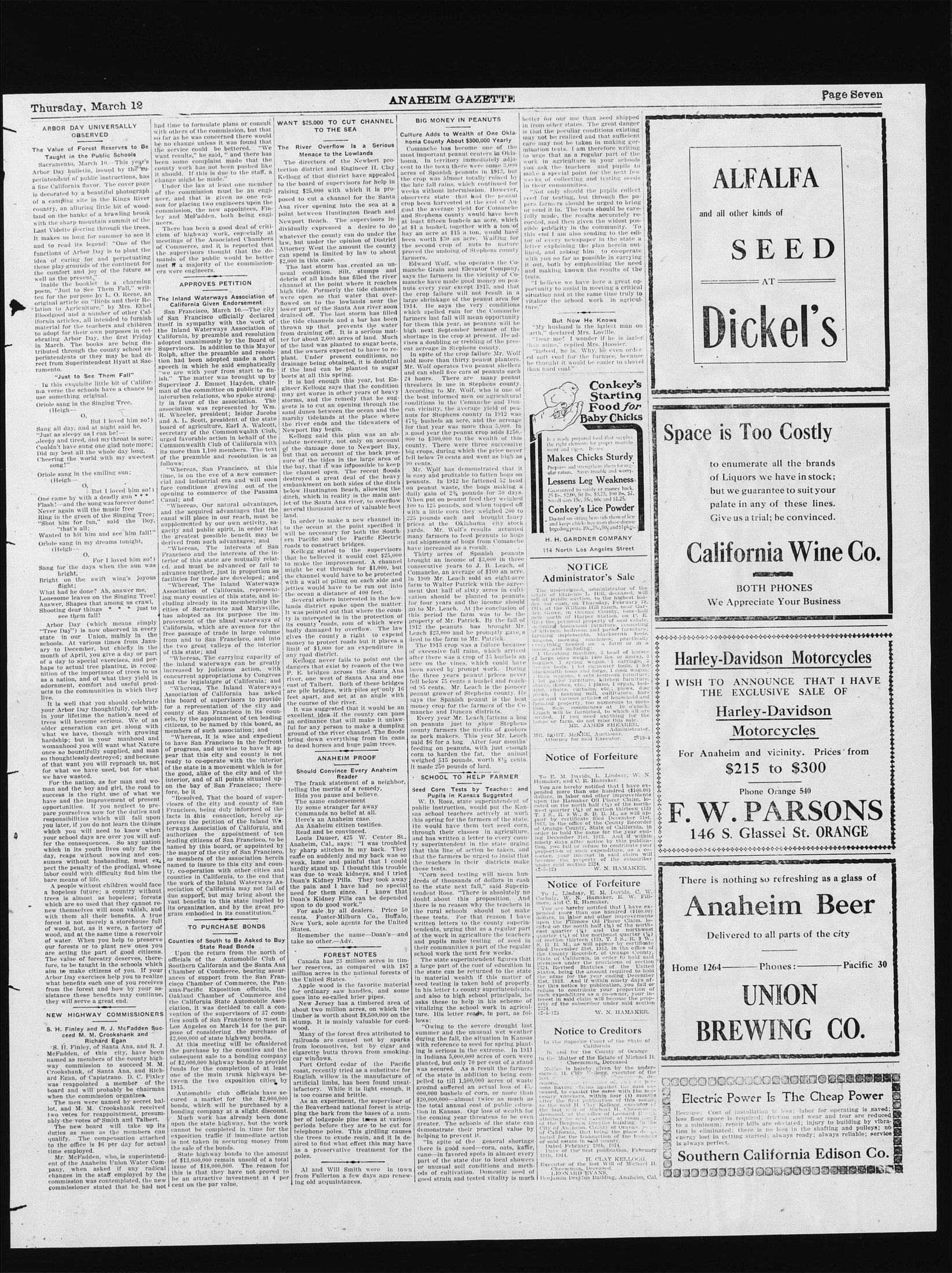
Searchable text
ARBOR DAY UNIVERSALLY OBSERVED
The Value of Forest Reserves to Be Taught in the Public Schools
Sacramento, March 10. This year's Arbor Day bulletin, issued by the superintendent of public instructions, has a fine California flavor. The cover page is decorated by a beautiful photograph of a camping site in the Kings River country, an alluring little bit of woodland on the banks of a brawling brook with the sharp mountain summit of the Last Vidette peering through the trees. It makes us long for summer to see it and to read its legend: "One of the functions of Arbor Day is to plant the idea of caring for and perpetuating these play-grounds of the continent for the comfort and joy of the future as well as the present."
Inside the booklet is a charming poem, "Just to See Them Fall," written for the purpose by L. O. Reese, an original article on "Birds and their Relation to Agriculture," by Mrs. Ethel Bloodgood and a number of other California articles, all intended to furnish material for the teachers and children to adopt for their own purposes in celebrating Arbor Day, the first Friday in March. The books are being distributed through the county school superintendents or they may be had direct from Superintendent Hyatt at Sacramento.
"Just to See Them Fall"
In this exquisite little bit of California verse the schools have a chance to use something original.
Oriole sang in the Singing Tree, (Heigh—O,
But I loved him so!) Sang all day, and at night said he,
"Just as sleepy as I can be!—Sleepy and tired, and my throat is sore; Couldn't have sung one glad not more; Did my best all the whole day long, Cheering the world with my sweetest song!"
Oriole sang in the smiling sun;
had time to formulate plans or consult with others of the commission, but that so far as he was concerned there would be no change unless it was found that the service could be bettered. "We want results," he said, "and there has been some complaint made that the county work has not been pushed like it should. If this is due to the staff, a change might be made."
Under the law at least one member of the commission must be an engineer, and that is given as one reason for placing two engineers upon the commission, the new appointees, Finley and McFadden, both being engineers.
There has been a good deal of criticism of highway work, especially at meetings of the Associated Chambers of Commerce, and it is reported that the supervisors thought that the demands of the public would be better met—a majority of the commissioners were engineers.
APPROVES PETITION
The Inland Waterways Association of California Given Endorsement
San Francisco, March 10.—The city of San Francisco officially declared itself in sympathy with the work of the Inland Waterways Association of California, by preamble and resolution adopted unanimously by the Board of Supervisors. In addition to this Mayor Rolph, after the preamble and resolution had been adopted made a short speech in which he said emphatically "we are with your from start to finish." The matter was brought up by Supervisor J. Emmet Hayden, chairman of the committee on publicity and interurban relations, who spoke strongly in favor of the association. The association was represented by Wm. R. Wheeler, president; Isidor Jacobs and A. L. Scott, president of the state board of agriculture, Earl A. Walcott, secretary of the Commonwealth Club, urged favorable action in behalf of the Commonwealth Club of California with its more than 1,100 members. The text of the preamble and resolution is as follows:
"Whereas, San Francisco, at this time is on the eve of a new commer-
WANT $25,000 TO CUT THE SEA
The River Overflow Is Menace to the Low
The directors of the Protection district and Engineer Kellogg of that district have to to the board of supervisors raising $25,000 with which posed to cut a channel fanning Ana river opening into a point between Huntington Newport Beach. The success dividually expressed a whatever the county can law, but under the opinion Attorney West the amount can spend is limited by $2,000 in this case.
The last storm has caused usual condition. Silt debris of all kinds has filled channel at the point where high tide. Formerly they were open so that water flowed on to the lowland part of the Santa Ana drained off. The last step in the tide channels and area thrown up that prevents drainage off. It is safer for about 2,000 acres of the land was planted than and the owners expected plant. Under present drainage being obtained if the land can be placed beets at all this spring.
It is bad enough this engineer Kellogg says that may get worse in other storms, and the remedy gestis is to cut an opening sand dunes between them marshy tidelands at the river ends and the Newport Bay begin.
Kellogg said this plaque solute necessity, not only of the damage done to but that on account of sure of the tides in the bay, that it was impaired the channel open.
"Just to See Them Fall"
In this exquisite little bit of California verse the schools have a chance to use something original.
Oriole sang in the Singing Tree,
(Heigh—
O,
But I loved him so!)
Sang all day, and at night said he,
"Just as sleepy as I can be!—
sleepy and tired, and my throat is sore;
Couldn't have sung one glad note more;
Did my best all the whole day long,
Cheering the world with my sweetest song!"
Oriole sang in the smiling sun;
(Heigh—
O,
But I loved him so!)
One came by with a deadly gun ***
Flash!—and the song was forever done!
Never again will the music free
Ring in the green of the Singing Tree;
"Shot him for fun," said the Boy,
"that's all;
Wanted to hit him and see him fall!"
Oriole sang in my dreams tonight,
(Heigh—
O,
For I loved him so!)
Sang for the days when the sun was bright,
Bright on the swift wing's joyous flight;
What had he done? Ah, answer me,
Lonesome leaves on the Singing Tree!
Answer, Shapes that among us crawl,
Shooting dear things **** just to see them fall!
Arbor Day (which means simply "Tree Day") is now observed in every state in our Union, mainly in the schools. At various times from January to December, but chiefly in the month of April, you give a day or part of a day to special exercises, and perhaps to actual tree planting, in recognition of the importance of trees to us as a nation, and of what they yield in adornment, comfort and useful products to the communities in which they live.
It is well that you should celebrate your Arbor Day thoughtfully, for within your lifetime the nation's need of trees will become serious. We of an older generation can get along with what we have, though with growing hardship; but in your manhood and womanhood you will want what Nature once so bountifully supplied, and man so thoughtlessly destroyed; and because of that want you will reproach us, not for what we have used, but for what we have wasted.
For the nation, as for man and woman and the boy and girl, the road to success is the right use of what we have and the improvement of present opportunities. If you neglect to prepare yourselves now for the duties and responsibilities which will fall upon you later, if you do not learn the things which you will need to know when your school days are over you will suffer the consequences. So any nation which in its youth lives only for the day, reaps without sowing and consumes without husbanding, must expect the penalty of the prodigal, whose labor could with difficulty find him the bare means of life.
A people without children would face a hopeless future; a country without trees is almost as hopeless; forests
The matter was brought up by Supervisor J. Emmet Hayden, chairman of the committee on publicity and interurban relations, who spoke strongly in favor of the association. The association was represented by Wm. R. Wheeler, president; Isidor Jacobs and A. L. Scott, president of the state board of agriculture, Earl A. Walcott, secretary of the Commonwealth Club, urged favorable action in behalf of the Commonwealth Club of California with its more than 1,100 members. The text of the preamble and resolution is as follows:
"Whereas, San Francisco, at this time, is on the eve of a new commercial and industrial era and will soon face conditions growing out of the opening to commerce of the Panama Canal; and
Whereas, Our natural advantages, and the acquired advantages that the canal will place in our reach, must be supplemented by our own activity, sagacity and public spirit, in order that the greatest possible benefit may be derived from such advantages; and
Whereas, The interests of San Francisco and the interests of the interior of this state are mutually related, and must be advanced or fail to advance together, just in proportion as facilities for trade are developed; and
Whereas, The Inland Waterways Association of California, representing many counties of this state, and including already in its membership the cities of Sacramento and Marysville, has adopted as its purpose the improvement of the inland waterways of California, which are avenues for the free passage of trade in large volume from and to San Francisco, and into the two great valleys of the interior of this state; and
Whereas, The carrying capacity of the inland waterways can be greatly increased by judicious action, with concurrent appropriations by Congress and the legislature of California; and
Whereas, The Inland Waterways Association of California has asked this board of supervisors to provide for a representation of the city and county of San Francisco in its counsels, by the appointment of ten leading citizens, to be named by this board, as members of such association; and
Whereas, It is wise and expedient to have San Francisco in the forefront of progress, and unwise to have it appear that this city and county is not ready to co-operate with the interior of the state in a movement which is for the good, alike of the city and of the interior, and of all points situated upon the bay of San Francisco; therefore, be it.
"Resolved, That the board of supervisors of the city and county of San Francisco, being duly informed of the facts in this connection, hereby approves the petition of the Inland Waterways Association of California, and authorizes the appointment of ten leading citizens of San Francisco, to be named by this board, or appointed by the mayor of the city of San Francisco, as members of the association herein named to insure to this city and county, co-operation with other cities and counties in California, to the end that the work of the Inland Waterways Association of California may not fail due support, but may bring about the beets at all this spring.
It is bad enough this gineer Kellogg says that may get worse in other storms, and the remedy gestis is to cut an opening sand dunes between these marshy tidelands at the river ends and the Newport Bay begin.
Kellogg said this plaque solute necessity, not one of the damage done to it but that on account of sure of the tides in these bay, that it was impaired channel open. The destroyed a great deal embankment on both sides below Huntington Beach ditch, which in reality let-of the Santa Ana river several thousand acres on land.
In order to make a move to the ocean at the point will be necessary for bern Pacific and the roads to construct bridges.
Kellogg stated to that he believed it would make the improvement might be cut through his channel would have with a wall of piling or jetties would have to be the ocean a distance of several others inter lands district spoke up. It was pointed out that it is interested in in its county roads, some badly damaged by overgives the county a rich money to protect roads limit $1,000 for any road district.
Kellogg never fails dangers that exist by re-P. E. bridges across a river, one west of San east of Talbert. Both are pile bridges, with feet apart, and set apart at the course of the river.
It was suggested that excellent idea if there an ordinance that will ful for any person to m ground of the river change bring down everything to dead horses and hung...
have and the improvement of present opportunities. If you neglect to prepare yourselves now for the duties and responsibilities which will fall upon you later, if you do not learn the things which you will need to know when your school days are over you will suffer the consequences. So any nation which in its youth lives only for the day, reaps without sowing and consumes without husbanding, must expect the penalty of the prodigal, whose labor could with difficulty find him the bare means of life.
A people without children would face a hopeless future; a country without trees is almost as hopeless; forests which are so used that they cannot renew themselves will soon vanish, and with them all their benefits. A true forest is not merely a storehouse full of wood, but, as it were, a factory of wood, and at the same time a reservoir of water. When you help to preserve our forests or to plant new ones you are acting the part of good citizens. The value of forestry deserves therefore, to be taught in the schools which aim to make citizens of you. If your Arbor Day exercises help you to realize what benefits each one of you receives from the forest and how by your assistance these benefits may continue, they will serve a great end.
NEW HIGHWAY COMMISSIONERS
S. H. Finley and R. J. McFadden Succeed M. M. Crookshank and Richard Egan
S. H. Finley, of Santa Ana, and R. J. McFadden, of this city, have been named as members of the county highway commission to succeed M. M. Crookshank, of Santa Ana, and Richard Egan, of Capistrano. D. C. Pixley was reappointed a member of the board and will probably be chairman when the commission organizes.
The men were named by secret ballot, and M. M. Crookshank received two votes for reappointment, presumably the votes of Smith and Talbert.
The new board will take up its duties as soon as the members can qualify. The compensation attached to the office is $6 per day for actual time employed.
Mr. McFadden, who is superintendent of the Anaheim Union Water Company, when asked if any radical changes in the staff employed by the commission was contemplated, the new commissioner stated that he had not resolved that the board of supervisors of the city and county of San Francisco, being duly informed of the facts in this connection, hereby approves the petition of the Inland Waterways Association of California, and authorizes the appointment of ten leading citizens of San Francisco, to be named by this board, or appointed by the mayor of the city of San Francisco, as members of the association herein named to insure to this city and county, co-operation with other cities and counties in California, to the end that the work of the Inland Waterways Association of California may not fail due support, but may bring about the vast benefits to this state implied by its organization, and by the great program embodied in its constitution."
TO PURCHASE BONDS
Counties of South to Be Asked to Buy State Road Bonds
Upon the return from the north of officials of the Automobile Club of Southern California and the Santa Ana Chamber of Commerce, bearing assurances of support from the San Francisco Chamber of Commerce, the Panama-Pacific Exposition officials, the Oakland Chamber of Commerce and the California State Automobile Association, it was decided to call a convention of the supervisors of 37 counties south of San Francisco to meet in Los Angeles on March 14 for the purpose of considering the purchase of $2,000,000 of state highway bonds.
At this meeting will be considered the purchase by the counties and the subsequent sale to a bonding company of $2,000,000 highway bonds to provide funds for the completion of at least one of the main trunk highways between the two exposition cities by 1915.
Automobile club officials have secured a market for the $2,000,000 bonds, which will be purchased by a bonding company at a slight discount.
Much work has already been done upon the state highway, but the work cannot be completed in time for the exposition traffic if immediate action is not taken in securing money from the sale of the bonds.
State highway bonds to the amount of $13,000,000 remain unsold of a total issue of $18,000,000. The reason for this is that they have not proved to be an attractive investment at 4 percent on the par value.
FOREST NATION
Canada has 23 million reserves, as compared with million acres in the United States.
Apple wood is there for ordinary saw hawsers into so-called brushes.
New Jersey has about two million acres timber is worth about stump. It is mainly wood.
Many of the forests railroads are caused by locomotives, cigarette butts throw car windows.
Port Orford cedar coast, recently tried English willow in artificial limbs, has its factory. While it is too coarse and brittle as an experiment, the Beaverhead national pine berries lodge pole pin periods before they telephone poles. The trees to exude resin sired to find what effuses as a preservative poles.
Al and Will Smith from Fullerton a feeding old acquaintance...
WANT $25,000 TO CUT CHANNEL TO THE SEA
The River Overflow Is a Serious Menace to the Lowlands
The directors of the Newbert protection district and Engineer H. Clay Kellogg of that district have appealed to the board of supervisors for help in raising $25,000 with which it is proposed to cut a channel for the Santa Ana river opening into the sea at a point between Huntington Beach and Newport Beach. The supervisors individually expressed a desire to do whatever the county can do under the law, but under the opinion of District Attorney West the amount the county can spend is limited by law to about $2,000 in this case.
The last storm has created an unusual condition. Silt, stumps and debris of all kinds has filled the river channel at the point where it reaches high tide. Formerly the tide channels were open so that water that overflowed on to the lowlands near the lower part of the Santa Ana river soon drained off. The last storm has filled the tide channels and a bar has been thrown up that prevents the water from draining off. It is a serious matter for about 2,000 acres of land. Much of the land was planted to sugar beets, and the owners expected to have to re-plant. Under present conditions, no drainage being obtained, it is doubtful if the land can be planted to sugar beets at all this spring.
It is bad enough this year, but Engineer Kellogg says that the condition may get worse in other years of heavy storms, and the remedy that he suggests is to cut an opening through the sand dunes between the ocean and the marshy tidelands at the place where the river ends and the tidewaters of Newport Bay begin.
Kellogg said this plan was an absolute necessity, not only on account of the damage done to Newport Bay, but that on account of the back pressure of the tides in the large area of the bay, that it was impossible to keep the channel open. The recent floods
BIG MONEY IN PEANUTS
Culture Adds to Wealth of One Oklahoma County About $300,000 Yearly
Comanche has become one of the most important peanut centers in Oklahoma. In territory immediately adjacent to the town there were some 3,000 acres of Spanish peanuts in 1913, but the crop was almost totally ruined by the late fall rains, which continued for weeks without intermission. However, observers state that had the peanut crop been harvested at the end of August the average yield for Comanche and Stephens county would have been at least fifteen bushels an acre, which at $1 a bushel, together with a ton of hay an acre at $15 a ton, would have been worth $30 an acre. Wapling for the second crop of nuts to mature proved the undoing of Stephens county farmers.
Edward Wolf, who operates the Comanche Grain and Elevator Company, says the farmers in the vicinity of Comanche have made good money on peanuts every year except 1913, and that the crop failure will not result in a large shrinkage of the peanut area for 1914. He says the very conditions which spelled ruin for the Comanche farmers last fall will mean opportunity for them this year, as peanuts will be high next September because of the shortage in the crop at present. He advises a doubling or trebling of the present acreage in Stephens county.
In spite of the crop failure Mr. Wolf sold more than thirty peanut planters. Mr. Wolf operates two peanut shellers and can shell five cars of peanuts each 24 hours. There are many peanut threshers in use in Stephens county. According to Mr. Wolf, who is one of the best informed men on agricultural conditions in the Comanche and Duncan vicinity, the average yield of peanuts for Stephens county in 1912 was 47½ bushels an acre, and the acreage for that year was more than 5,000. In a good year the peanut crop adds $250,000 to $300,000 to the wealth of this county. There were three successive big crops, during which the price never fell below 70 cents and went as high as 90 cents.
Mr. Wolf has demonstrated that it is easy and profitable to fatten hogs on better for our use than seed shipped in from other states. The great danger is that the peculiar conditions existing may not be realized and that sufficient care may not be taken in making germination tests. I am therefore writing to urge that as a regular part of the work in agriculture in your schools you ask the teachers and pupils to make a special point for the next few weeks of collecting and testing seeds in their communities.
"Not only should the pupils collect seed for testing, but through the papers farmers should be urged to bring or send it in. The tests should be carefully made, the results accurately recorded, and then given the widest possible publicity in the community. To this end I am also sending to the editor of every newspaper in the state a letter explaining the plan herein outlined, and asking him to co-operate with you so far as possible in carrying it out, both by emphasizing the need and making known the results of the tests.
"I believe we have here a great opportunity to assist in meeting a critical situation and at the same time truly to vitalize the school work in agriculture."
But Now He Knows
"My husband is the laziest man on earth," declared Mrs. Loville.
"Dear me! I wonder if he is lazier than mine," replied Mrs. Hoosier.
"Indeed, he is. Why, he even ordered soft coal for the furnace, because he thought it would easier to shovel than hard coal."
It is bad enough this year, but Engineer Kellogg says that the condition may get worse in other years of heavy storms, and the remedy that he suggests is to cut an opening through the sand dunes between the ocean and the marshy tidelands at the place where the river ends and the tidewaters of Newport Bay begin.
Kellogg said this plan was an absolute necessity, not only on account of the damage done to Newport Bay, but that on account of the back pressure of the tides in the large area of the bay, that it was impossible to keep the channel open. The recent floods destroyed a great deal of the heavy embankment on both sides of the ditch below Huntington Beach, allowing the ditch, which in reality is the main outlet of the Santa Ana river, to overflow several thousand acres of valuable beet land.
In order to make a new channel into the ocean at the point specified it will be necessary for both the Southern Pacific and the Pacific Electric roads to construct bridges.
Kellogg stated to the supervisors that he believed it would cost $25,000 to make the improvement. A channel might be cut through for $1,000, but the channel would have to be protected with a wall of piling on each side and jetties would have to be run out into the ocean a distance of 400 feet.
Several others interested in the lowlands district spoke upon the matter. It was pointed out that where the county is interested is in the protection of its county roads, som of which were badly damaged by overflow. The law gives the county a right to expend money to protect roads but it places a limit of $1,000 for an expenditure in any road district.
Kellogg never fails to point out the dangers that exist by reason of the two P. E. bridges across the Santa Ana river, one west of Santa Ana and one east of Talbert. Both of these bridges are pile bridges, with piles set only 16 feet apart, and set at an angle with the course of the river.
It was suggested that it would be an excellent idea if the county can pass an ordinance that will make it unlawful for any person to make a dumping ground of the river channel. The floods bring down everything from tin cans to dead horses and huge palm trees.
ANAHEIM PROOF
Should Convince Every Anaheim Reader
The frank statement of a neighbor, telling the merits of a remedy, Bids you pause and believe.
The same endorsement
By some stranger far away
Commands no belief at all.
Here's an Anaheim case.
An Anaheim citizen testifies.
Read and be convinced.
Louis Dauser, 425 W. Center St., Anaheim, Cal., says: "I was troubled by sharp stitches in my back. They came on suddenly and my back was so weak, lame and painful that I could hardly stand up. I thought this trouble was due to weak kidneys, and I tried Doan's Kidney Pills. They took away the pain and I have had no special need for them since. I know that Doan's Kidney Pills can be depended on."
There are many peanut threshers in use in Stephens county. According to Mr. Wolf, who is one of the best informed men on agricultural conditions in the Comanche and Duncan vicinity, the average yield of peanuts for Stephens county in 1912 was 47½ bushels an acre, and the acreage for that year was more than 5,000. In a good year the peanut crop adds $250,000 to $300,000 to the wealth of this county. There were three successive big crops, during which the price never fell below 70 cents and went as high as 90 cents.
Mr. Wolf has demonstrated that it is easy and profitable to fatten hogs on peanuts. In 1912 he fattened 52 head on peanut waste, the hogs making a daily gain of 2⅔ pounds for 30 days. When put on peanut feed they weighed 100 to 125 pounds, and when topped off with a little corn they weighed 200 to 225 pounds each and brought fancy prices at the Oklahoma city stock yards. Mr. Wolf's results actuated many farmers to feed peanuts to hogs and shipments of hogs from Comanche have increased as a result.
Thirty acres of Spanish peanuts brought an income of $3,000 in three consecutive years to J. B. Leach, of Comanche, an average of $100 an acre. In 1909 Mr. Leach sold an eight-acre farm to Walter Patrick with the agreement that half of sixty acres in cultivation should be planted to peanuts for four years and the income should go to Mr. Leach. At the conclusion of this period the farm was to be the property of Mr. Patrick. By the fall of 1912 the peanuts has brought Mr. Leach $23,000 and he promptly gave a deed to the farm to Mr. Patrick.
The 1913 crop was a failure because of excessive fall rains, which arrived after there was a crop of 15 bushels an acre on the vines, which could have been saved by prompt work. During the three years peanut prices never fell below 75 cents a bushel and reached 95 cents. Mr. Leach is the pioneer peanut grower of Stephens County. He says the Spanish peanut is the best money crop for the farmers of the Comanche and Duncan districts.
Every year Mr. Leach fattens a hog on peanuts just to show Stephens county farmers the merits of goobers as pork makers. This year Mr. Leach paid $6 for a hog. After four months' feeding on peanuts, with just enough corn to harden the fat, the animal weighed 515 pounds, worth $8½ cents. It made 250 pounds of lard.
SCHOOL TO HELP FARMER
Seed Corn Tests by Teachers and Pupils in Kansas Suggested
W. D. Ross, state superintendent of public instruction, would put the Kansas school teachers actively at work this spring for the farmers of the state. He would have them test seed corn, through their classes in agriculture, and has written a letter to every county superintendent in the state urging that this line of action be taken, and that the farmers be urged to insist that the teachers in their districts make these tests.
"Corn seed testing will mean hundreds of thousands of dollars in cash to the state next fall," said Superintendent Ross. "There is absolutely no doubt about this proposition." And
Makes Chicks Sturdy
Prepares and strengthens them for regular ration. Saves trouble and worry.
Lessens Leg Weakness
Guaranteed to satisfy or money back, 25 lbs., $2.00, 50 lbs., $3.75, 100 lbs., $7. Small sizes 15c, 35c, 60c and $1.25.
Conkey's Lice Powder
Dusted on sitting hens rids them of lice and keeps chicks free from these disease brigeding pests. 10c, 25c, 50c and $1pkg-
H. H. GARDNER COMPANY
114 North Los Angeles Street
NOTICE Administrator's Sale
The undersigned, administrator of the estate of Blanche L. Hill, deceased, will sell at public auction, to the highest bidder, for cash, on Thursday, February 19, 1914, at the William Hill ranch, near Garden Grove, in Orange County (one-half mile north of Harper Station), on P. E.(ty.) the personal property of said estate, including household furniture, consisting of kitchen, bedroom and parlor furniture; farming implements, blacksmith tools, wagons, mowing machines; practically everything needed on a farm or in a house, and including:
1 threshing machine; 3 head of horses (2 large ones weigh 1400 lbs.) or more); 3 buggies; 1 spring wagon; 1 carriage; 3 breecher beds; 1 lot carpenter tools; 1 lot blacksmith tools and forge; 1 cook wagon; 3 tank wagons; 6 sets bedroom furniture; 1 lot parlor furniture; kitchen furniture; stove; dishes, etc.; 1 piano; 1 organ; bedding; chairs; curtains; etc.; plows; disc plows; 1 farming mill; cultivators; harrows and various articles of household and farming property; too numerous to mention. Sale commences at 10 o'clock. Launch will be furnished, to which all are invited. If you need anything for the house or farm, do not miss this sale.
MR. JAMES SHEAKER,
Administrator,
MR. ROET. McKEE, Auctioneer,
Attorney for said Executor.
Notice of Forfeiture
To E. M. Davids, L. Lindsay, W. N. Hamaker, and C. R. Hamaker.
You are hereby notified that I have expended more than one hundred ($100.00) dollars in labor and other improvements upon the Hamaker Oil Place Claim, located on the north half (½) of the northwest quarter (¾) of section thirteen (13) T. S. R. W. S. B.B.M., as will appear by certificate filed December 31st, 1913, in the office of the County Recorder of Orange County, State of California, in order to hold the same for the year ending December 31st, 1913. And if within ninety days after notice by this publication you fail or refuse to contribute your proportion of such expenditure, as a cowhery your interest in said claim will become the property of the subscriber under said section 2324.
(2-5-12)
Notice of Forfeiture
To L. Lindsay, E. M. Davids, C.W. Corbaly, W.N.Hamaker, E.W.Fill-
The same endorsement
By some stranger far away
Commands no belief at all.
Here's an Anaheim case.
An Anaheim citizen testifies.
Read and be convinced.
Louis Dauer, 425 W. Center St., Anaheim, Cal., says: "I was troubled by sharp stitches in my back. They came on suddenly and my back was so weak, lame and painful that I could hardly stand up. I thought this trouble was due to weak kidneys, and I tried Doan's Kidney Pills. They took away the pain and I have had no special need for them since. I know that Doan's Kidney Pills can be depended upon to do good work."
For sale by all dealers. Price 50 cents. Foster-Milburn Co., Buffalo, New York, sole agents for the United States.
Remember the name—Doan's—and take no other.—Adv.
FOREST NOTES
Canada has 23 million acres in timber reserves, as compared with 187 million acres in the national forests of the United States.
Apple wood is the favorite material for ordinary saw handles, and some goes into so-called brier pipes.
New Jersey has a timbered area of about two million acres, on which the timber is worth about $8,500,000 on the stump. It is mainly valuable for cordwood.
Many of the forest fires attributed to railroads are caused not by sparks from locomotives, but by cigar and cigarette butts thrown from smoking-car windows.
Port Orford cedar of the Pacific coast, recently tried as a substitute for English willow in the manufacture of artificial limbs, has been found unsatisfactory. While it is light enough, it is too coarse and brittle.
As an experiment, the supervisor of the Beaverhead national forest is stripping the bark from the bases of a number of lodgepole pine trees at various periods before they are to be cut for telephone poles. This girdling causes the trees to exude resin, and it is desired to find what effect this may have as a preservative treatment for the poles.
Al and Will Smith were in town from Fullerton a few days ago renewing old acquaintances.
W. D. Ross, state superintendent of public instruction, would put the Kansas school teachers actively at work this spring for the farmers of the state. He would have them test seed corn, through their classes in agriculture, and has written a letter to every county superintendent in the state urging that this line of action be taken, and that the farmers be urged to insist that the teachers in their districts make these tests.
"Corn seed testing will mean hundreds of thousands of dollars in cash to the state next fall," said Superintendent Ross. "There is absolutely no doubt about this proposition. And there is no reason why the teachers in the rural schools should not make these tests. For that reason I have written letters to the county superintendents, urging that as a regular part of the work in agriculture the teachers and pupils make testing of seed in their communities a part of the regular school work the next few weeks.
The state superintendent figures that a large part of the cost of education in the state can be returned to the state in material wealth if this matter of seed testing is taken hold of properly. In his letter to county superintendents, and also to high school principals, he asks these to help in his scheme of vitalizing the school work in agriculture. His letter reads, in part, as follows:
"Owing to the severe drought last summer and the unusual wet weather during the fall, the situation in Kansas with reference to seed for spring planting is serious in the extreme. In 1911 in Indiana 5,000,000 acres of corn were planted, but only 70 per cent of a stand was secured. As a result the farmers of the state in addition to being compelled to till 1,500,000 acres of waste ground suffered an actual loss of 45,000,000 bushels of corn, or more than $20,000,000—almost twice as much as the total annual cost of public education in Kansas. Our loss of wealth for the coming year threatens to be even greater. The schools of the state can demonstrate their practical value by helping to prevent it.
In spite of the general shortage there is good seed—corn, oats, kaffir cane—in favored spots in almost every part of the state due to local showers or unusual soil conditions and methods of cultivation. Domestic seed of good strain and tested vitality is much upon the Hamaker Oil Placer Claim, located on the north half (½) of the northwest quarter (¼) of section thirteen (13) T. 3 S., R. 9 W., S. B. B. M., as will appear by certificate filed December 31st, 1913, in the office of the County Recorder of Orange County, State of California, in order to hold the same for the year ending December 31st, 1913. And if within ninety days after notice by this publication, you fail or refuse to contribute your proportion of such expenditure, as a co-owner, your interest in said claim will become the property of the subscriber under said section 2324.
W. N. HAMAKER.
Notice of Forfeiture
To L. Lindsay, E. M. Davids, C. W. Corbaly, W. N. Hamaker, E. W. Fillmore, and C. R. Hamaker.
You are hereby notified that I have expended more than one hundred ($100.00) dollars in labor and other improvements upon the Fillmore Oil Placer Claim, located on the south half (½) of the northeast quarter (¼) and the northwest quarter (¼) of the northeast quarter (¼) of section thirteen (13), T. 3 S., R. 9 W., S. B. B. M., as will appear by certificate filed December 31st, 1913, in the office of the County Recorder, of Orange County, State of California, in order to hold said premises under the provisions of section 2324. Revised Statutes of the United States, being the amount required to hold the same for the year ending December 31st, 1913. And if within ninety days after this notice by publication, you fail or refuse to contribute your proportion of such expenditure as a co-owner, your interest in said claim will become the property of the subscriber under said section 2324.
W. N. HAMAKER.
Notice to Creditors
In the Superior Court of the State of California
In and for the County of Orange
In the Matter of the Estate of Michael H. Cheeseman Deceased
Notice is hereby given by the undersigned, H. Clay Kellogg, executor of the last will of Michael H. Cheeseman deceased, at the office of Leonard E. Cheeseman attorney for sold executor; at room No. 2 of the Benjamin Dreyfus building, in the City of Anaheim, County of Orange State of California; that being the place designated for the transaction of the business of said estate in said county.
Dated February 19th, 1914.
Date of the first publication, February 19th, 1914.
H. CLAY KELLOGG.
Executor of the last Will of Michael H. Cheeseman Deceased.
LEONARD EVANS
Benjamin Dreyfus Building, Anaheim, Cal.
ALFALFA
and all other kinds of
SEED
AT
Dickel's
Space is Too Costly
to enumerate all the brands
Space is Too Costly
to enumerate all the brands
of Liquors we have in stock;
but we guarantee to suit your
palate in any of these lines.
Give us a trial; be convinced.
California Wine Co.
BOTH PHONES
We Appreciate Your Business
Harley-Davidson Motorcycles
I WISH TO ANNOUNCE THAT I HAVE
THE EXCLUSIVE SALE OF
Harley-Davidson
Motorcycles
For Anaheim and vicinity. Prices from
$215 to $300
Phone Orange 540
F. W. PARSONS
146 S. Glassel St. ORANGE
There is nothing so refreshing as a glass of
F. W. PARSONS
146 S. Glassel St. ORANGE
There is nothing so refreshing as a glass of
Anaheim Beer
Delivered to all parts of the city
Home 1264 Phones: Pacific 30
UNION
BREWING CO.
Electric Power Is The Cheap Power
Because: Cost of installation is less; labor for operating is saved;
less floor space is required; friction and wear and tear are reduced
to a minimum; repair bills are obviated; injury to building by vibration is eliminated; there is no loss in the shafting and pulleys; no
energy lost in getting started; always ready; always reliable; service
is always perfect.
Southern California Edison Co.