anaheim-gazette 1914-03-05
Scanned page
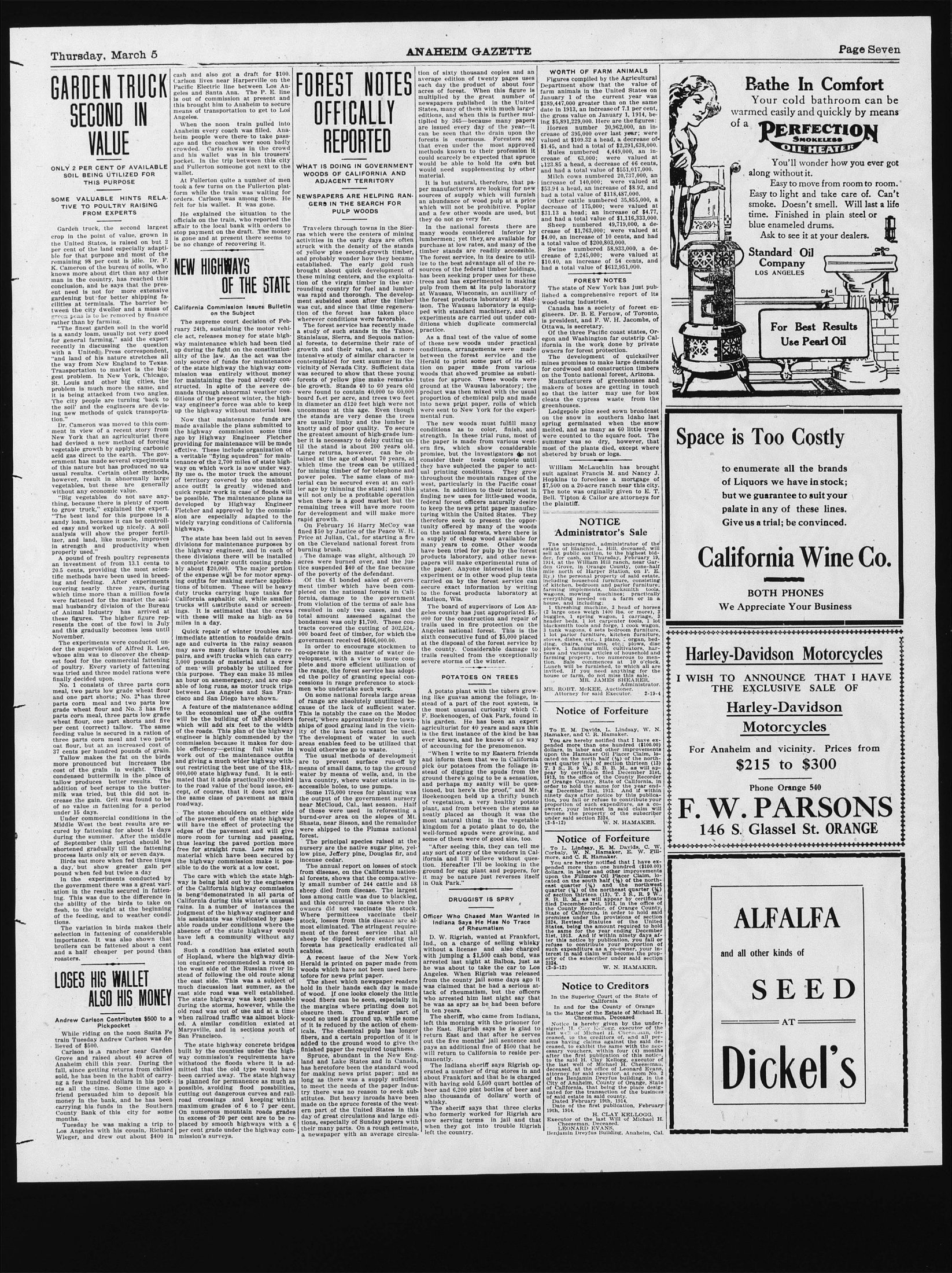
Searchable text
GARDEN TRUCK SECOND IN VALUE
ONLY 2 PER CENT OF AVAILABLE SOIL BEING UTILIZED FOR THIS PURPOSE
SOME VALUABLE HINTS RELATIVE TO POULTRY RAISING FROM EXPERTS
Garden truck, the second largest crop in the point of value, grown in the United States, is raised on but 2 per cent of the land especially adaptable for that purpose and most of the remaining 98 per cent is idle. Dr. F. K. Cameron of the bureau of soils, who knows more about dirt than any other man in the country, has reached this conclusion, and he says that the present need is not for more extensive gardening but for better shipping facilities at terminals. The barrier between the city dweller and a mass of green peas is to be removed by finance rather than by farming.
"The finest garden soil in the world is a sandy loam, usually not very good for general farming," said the expert recently in discussing the question with a United Press correspondent, "and land of his nature stretches all the way from New England to Texas. Transportation to market is the biggest problem. In New York, Chicago, St. Louis and other big cities, the problem is much more the same, and it is being attacked from two angles. The city people are turning 'back to the soil' and the engineers are devising new methods of quick transportation."
Dr. Cameron was moved to this comment in view of a recent story from New York that an agriculturist there had devised a new method of forcing vegetable growth by applying carbonic acid gas direct to the earth. The government has made several experiments of this nature but has produced no unusual results. Certain other methods,
cash and also got a draft for $100. Carlson lives near Harperville on the Pacific Electric line between Los Angeles and Santa Ana. The P. E. line is out of commission at present and this brought him to Anaheim to secure means of transportation to get to Los Angeles.
When the noon train pulled into Anaheim every coach was filled. Anaheim people were there to take passage and the coaches wer soon badly crowded. Carlo snwas in the crowd and his wallet was in his trousers' pocket. In the trip between this city and Fullerton someone got next to the wallet.
At Fullerton quite a number of men took a few turns on the Fullerton platform while the train was waiting for orders. Carlson was among them. He felt for his wallet. It was gone.
He explained the situation to the officials on the train, who reported the affair to the local bank with orders to stop payment on the draft. The money is gone and at present there seems to be no change of recovering it.
NEW HIGHWAYS OF THE STATE
California Commission Issues Bulletin on the Subject
The supreme court decision of February 24th, sustaining the motor vehicle act, releases money for state highway maintenance which had been tied up during the fight on the constitutionality of the law. As the act was the only source of funds for maintenance of the state highway the highway commission was entirely without money for maintaining the road already constructed. In spite of the severe demands through abnormal weather conditions of the present winter, the highway engineer's force was able to keep up the highway without material loss.
Now that maintenance funds are made available the plans submitted to the highway commission some time ago by Highway Engineer Fletcher providing for maintenance will be made effective. These include organization of a veritable "flying squadron" for maintenance of the 2,700 miles of state highway on which work is now under way.
FOREST OFFICE REPORT
WHAT IS DOING WITH WOODS OF CAKES ADJACENT TO NEWSPAPERS ARRANGEMENT GERS IN THE PULP VIEW
Travelers through ras which were their activities in the east struck with the desire of yellow pine secures probably wonder established. The brought about quick these mining centerion of the virgin rounding country fores was rapid and thorment subsided soon was cut, and since station of the forest wherever conditioned.
The forest service a study of such stains Stanislaus, Sierra, al forests, to deter growth and their intensive study of contouring country fores was secured to show forests of yellow pine growth. Stands were found to contain board feet per acre in diameter and d120 uncommon at this site the stands are very are usually limby knotty and of poor greatest amount ber it is necessary till the stand is ab Large returns, howtainted at the age o which time the tree for mining timber
In New York, Chicago, St. Louis and other big cities, the growth problem is much more the same, and it is being attacked from two angles. The city people are turning 'back to the soil' and the engineers are devising new methods of quick transportation.
Dr. Cameron was moved to this comment in view of a recent story from New York that an agriculturist there had devised a new method of forcing vegetable growth by applying carbonic acid gas direct to the earth. The government has made several experiments of this nature but has produced no unusual results. Certain other methods, however, result in abnormally large vegetables, but these are generally without any economic value.
"Big vegetables do not save anything, because there is plenty of room to grow truck," explained the expert. "The best land for this purpose is a sandy loam, because it can be controlled easy and worked up nicely. A soil analysis will show the proper fertilizer, and land, like muscle, improves in strength and productivity when properly used."
A pound of fresh poultry represents an investment of from 13.1 cents to 20.5 cents, providing the most scientific methods have been used in breeding and feeding. After experiments covering nearly three years, during which time more than a million fowls were fattened for the market the animal husbandry division of the Bureau of Animal Industry has arrived at these figures. The higher figure represents the cost of the fowl in July and this gradually becomes less until November.
The experiments were conducted under the supervision of Alfred R. Lee, whose aim was to discover the cheapest food for the commercial fattening of poultry. Every variety of fattening was tried and three model rations were finally decided upon.
No. 1 consists of three parts corn meal, two parts low grade wheat flour and one part shorts; No. 2 has three parts corn meal and two parts low grade wheat flour and No. 3 has five parts corn meal, three parts low grade wheat flour, one part shorts and five per cent (correct) tallow. The same feeding value is secured in a ration of three parts corn meal and two parts oat flour, but at an increased cost of 37 cents per hundred pounds of grain.
Tallow makes the fat on the birds more pronounced but increases the cost of the grain in weight. Thick condensed buttermilk in the place of tallow produces better results. The addition of beef scraps to the buttermilk was tried, but this did not increase the gain. Grit was found to be of no value in fattening for a period under 15 days.
Under commercial conditions in the Middle West the best results are secured by fattening for about 14 days during the summer. After the middle of September this period should be shortened gradually till the fattening process lasts only six or seven days.
Birds eat more when fed three times a day, but show greater gain per pound when fed but twice a day.
In the experiments conducted by the government there was a great variation in the results secured in fattening. This was due to the difference in mission was entirely without money for maintaining the road already constructed. In spite of the severe demands through abnormal weather conditions of the present winter, the highway engineer's force was able to keep up the highway without material loss.
Now that maintenance funds are made available the plans submitted to the highway commission some time ago by Highway Engineer Fletcher providing for maintenance will be made effective. These include organization of a veritable "flying squadron" for maintenance of the 2,700 miles of state highway on which work is now under way. By use o. the motor truck the amount of territory covered by one maintenance outfit is greatly widened and quick repair work in case of floods will be possible. The maintenance plans as developed by Highway Engineer Fletcher and approved by the commission are especially adapted to the widely varying conditions of California highways.
The state has been laid out in seven divisions for maintenance purposes by the highway engineer, and in each of these divisions there will be installed a complete repair outfit costing probably about $20,000. The major portion of the expense will be for motor spraying outfits for making surface applications of bitumen. These will be heavy duty trucks carrying huge tanks for California asphaltic oil, while smaller trucks will distribute sand or screenings. It is estimated that the crews with these will make as high-as 50 miles in a day.
Quick repair of winter troubles and immediate attention to roadside drainage and culverts in the rainy season may save many dollars in future repairs, and swift trucks which can carry 3,000 pounds of material and a crew of men will probably be utilized for this purpose. They can make 35 miles an hour on anemergency, and are capable of long runs, as motor truck trips between Los Angeles and San Francisco and San Diego have shown.
A feature of the maintenance adding to the economical use of the outfits will be the building of the shoulders which will add six feet to the width of the roads. This plan of the highway engineer is highly commended by the commission because it makes for double efficiency—getting full value in work out of the maintenance outfits and giving a much wider highway without restricting the best use of the $18,000,000 state highway fund. It is estimated that it adds practically one-third to the road value of the bond issue, except, of course, that it does not give the same class of pavement as main roadway.
The stone shoulders on either side of the pavement of the state highway will have the effect of protecting the edges of the pavement and will give more room for turning and passing, thus leaving the paved portion more free for straight runs. Low rates on material which have been secured by the highway commission make it possible to do the work at a low cost.
The care with which the state highway is being laid out by the engineers of the California highway commission is beng demonstrated in all parts of forests of yellow pine growth. Standards were found to contain board feet per acre in diameter an d120 uncommon at this stand are usually limbly knotty and of poor greatest amount ber it is necessary til the stand is ad Large returns, how trained at the age o which time the tree for mining timber or power poles. The material can be secure age by thinning will not only be a when there is a gap remaining trees will for development and rapid growth.
On February 16 defined $50 by Justice Price at Julian, Cali on the Cleveland m burning brush.
The damage was acres were burned once suspended $40 of the poverty of th
Of the 61 bondment timber which plotted on the national formia, damage to from violation of th resulted in only total amount ass bondsmen was only tracts covered th 000 board feet of th government receive.
In order to enco co-operate in th development, with aplete and more effe e range, the forest ed the policy of gcessions in range men who undertake.
On some national o range are absolue cause of th lack This is notably th forest, where appro puches of good grazing iity of th lava be The development areas enables feed w would otherwise go
The usual meth are to prevent means of small dam water by means o lava country, wheres accessible holes, to
Some 175,000 tre nthe output of th near McCloud, Cali of these were used burnd-over area o Shasta, near Sissor were shipped to th forest.
The principal sp nursery are th na low pine, Jeffery p incense cedar.
The annual report from disease, on th al forests, shows th ly small number o sheep died from loss among cattle
LOSES HIS WALLET
ALSO HIS MONEY
Andrew Carlson Contributes $500 to a Pickpocket
While riding on the noon Santa Fe train Tuesday Andrew Carlson was delivered of $500.
Carlson is a rancher near Garden Grove and raised about 40 acres of Anaheim chili this year. During the fall, since getting returns from chilies sold, he has been in the habit of carrying a few hundred dollars in his pockets all the time. Some time ago a friend persuaded him to deposit his money in the bank, and he has been carrying his funds in the Southern County Bank of this city for some months.
Tuesday he was making a trip to Los Angeles with his cousin, Richard Wieger, and drew out about $400 in crease the gain. Grit was found to be of no value in fattening for a period under 15 days.
Under commercial conditions in the Middle West the best results are secured by fattening for about 14 days during the summer. After the middle of September this period should be shortened gradually till the fattening process lasts only six or seven days.
Birds eat more when fed three times a day, but show greater gain per pound when fed but twice a day.
In the experiments conducted by the government there was a great variation in the results secured in fattening. This was due to the difference in the ability of the birds to take on flesh, to the weight at the beginning of the feeding, and to weather conditions.
The variation in birds makes their selection in fattening of considerable importance. It was also shown that broilers can be fattened about a cent and a half cheaper per pound than roasters.
The stone shoulders on either side of the pavement of the state highway will have the effect of protecting the edges of the pavement and will give more room for turning and passing, thus leaving the paved portion more free for straight runs. Low rates on material which have been secured by the highway commission make it possible to do the work at a low cost.
The care with which the state highway is being laid out by the engineers of the California highway commission is beng demonstrated in all parts of California during this winter's unusual rains. In a number of instances the judgment of the highway engineer and his assistants was vindicated by passable roads under conditions where the absence of the state highway would have left a community without any road.
Such a condition has existed south of Hopland, where the highway division engineer recommended a route on the west side of the Russian river instead of following the old route along the east side. This was a subject of much discussion last summer, as the east side road was well established. The state highway was kept passable during the storms, however, while the old road was out of use and at a time when railroad traffic was almost blocked. A similar condition existed at Marysville, and in sections south of San Francisco.
The state highway concrete bridges built by the counties under the highway commission's requirements have withstood the floods where it is admitted that the old type would have been carried away. The state highway is planned for permanence as much as possible, avoiding flood possibilities, cutting out dangerous curves and railroad crossings and keeping within maximum grades of 6 to 7 per cent. On numerous mountain roads grades in excess of 20 per cent are to be replaced by smooth highways with a 6 per cent grade under the highway commission's surveys.
The annual report from disease, on the al forests, shows that small number of sheep died from loss among cattle and this occurred among owners did not wilt. Where permittees stock, losses from most eliminated. The ment of the forest sheep be dipped into forests has practiced scabies.
A recent issue Herald is printed in woods which have tofore for news press.
The sheet which hold in their hand of wood. If one loot wood fibers can be the margins when obscure them. The wood so used is grief of it is reduced byicals. The chemical fibers, and a certain added to the group finished paper they Spruce, abundant land and Lake St has heretofore been for making news long as there was to meet the needs try there was no stitutes. But heavy made on the spruce part of the Uday of great circu tions, especially o their many parts.
FOREST NOTES OFFICALLY REPORTED
WHAT IS DOING IN GOVERNMENT WOODS OF CALIFORNIA AND ADJACENT TERRITORY
NEWSPAPERS ARE HELPING RANGERS IN THE SEARCH FOR PULP WOODS
Travelers through towns in the Sierra which were the centers of mining activities in the early days are often struck with the density of the stands of yellow pine second-growth timber, and probably wonder how they became established. The early gold rush brought about quick development of these mining centers, and the exploitation of the virgin timber in the surrounding country for fuel and lumber was rapid and thorough. The development subsided soon after the timber was cut, and since that time regeneration of the forest has taken place wherever conditions were favorable.
The forest service has recently made a study of such stands in the Tahoe, Stanislaus, Sierra, and Sequoia national forests, to determine their rate of growth and their value, and a more intensive study of similar character is contemplated for next summer in the vicinity of Nevada City. Sufficient data was secured to show that these young forests of yellow pine make remarkable growth. Stands 40 to 60 years old were found to contain 40,000 to 60,000 board feet per acre, and trees two feet in diameter an d120 feet high were not uncommon at this age. Even though the stands are very dense the trees are usually limb and the lumber is knotty and of poor quality. To secure the greatest amount of high-grade lumber it is necessary to delay cutting until the stand is about 200 years old. Large returns, however, can be obtained at the age of about 70 years, at which time the trees can be utilized for mining timber of for telephone and radio.
tion of sixty thousand copies and an average edition of twenty pages uses each day the product of about four acres of forest. When this figure is multiplied by the great number of newspapers published in the United States, many of them with much larger editions, and when this is further multiplied by 365—because many papers are issued every day of the year—it can be seen that the drain upon the forests is enormous. Foresters say that even under the most approved methods known to their profession it could scarcely be expected that spruce would be able to hold its own but would need supplementing by other material.
It is but natural, therefore, that paper manufacturers are looking for new sources of supply which will furnish an abundance of wood pulp at a price which will not be prohibitive. Poplar and a few other woods are used, but they do not go very far.
In the national forests there are many woods considered inferior by lumbermen; yet they are available for purchase at low rates, and many of the timber stands are readily accessible. The forest service, in its desire to utilize to the best advantage all of the resources of the federal timber holdings, has been seeking proper uses for these trees and has experimented in making pulp from them at its pulp laboratory at Wausau, Wisconsin, an auxiliary of the forest products laboratory at Madison. The Wausau laboratory is equipped with standard machinery, and all experiments are carried out under conditions which duplicate commercial practice.
As a final test of the value of some of these new woods under practical conditions, arrangements were made between the forest service and the Herald to print some part of its edition on paper made from various woods that showed promise as substitutes for spruce. These woods were ground at the Wausau laboratory; the product was then mixed with the usual proportion of chemical pulp and made into news print paper, rolls of which were sent to New York for the experimental run.
The new woods must fulfill many conditions as to color, finish, and strength. In these trial runs, most of the paper is made from various western firs, which show considerable promise, but the investigators do not consider their tests complete until they have subjected the paper to actual printing conditions. They grow
WORTH OF FARM ANIMALS
Figures compiled by the Agricultural Department show that the value of farm animals in the United States on January 1 of the current year was $389,447,000 greater than on the same date in 1913, an increase of 7.1 per cent, the gross value on January 1, 1914, being $5,891,229,000. Here are the figures:
Horses number 20,962,000, an increase of 395,000 over last year; were valued at $109.32 a head, a decrease of $1.45, and had a total of $2,291,638,000.
Mules numbered 4,449,000, an increase of 63,000; were valued at $123.85 a head, a decrease of 46 cents, and had a total value of $551,017,000.
Milch cows numbered 20,737,000, an increase of 140,000; were valued at $53.94 a head, an increase of $8.92, and had a total value of $118,487,000.
Other cattle numbered 35,855,000, a decrease of 175,000; were valued at $31.13 a head; an increase of $4.77, and had a total value of $1,116,333,000.
Sheep numbered 49,719,000, a decrease of $1,763,000; were valued at $4.00, an increase of 10 cents, and had a total value of $200,803,000.
Swine numbered 58,933,000, a decrease of 2,245,000; were valued at $10.40, an increase of 54 cents, and had a total value of $612,951,000.
FOREST NOTES
The state of New York has just published a comprehensive report of its wood-using industries.
Canada has a society of forest engineers. Dr. B. E. Fernow, of Toronto, is president, and F. W. H. Jacombs, of Ottawa, is secretary.
Of the three Pacific coast states, Oregon and Washington far outstrip California in the work done by private owners for forest protection.
The development of quicksilver mines promises to make large demands for cordwood and construction timbers on the Tonto national forest, Arizona.
Manufacturers of greenhouses and makers of boxes are getting in touch so that the latter may use for box cleats the cypress waste from the greenhouses.
Lodgepole pine seed sown broadcast on the snow in southern Idaho last spring germinated when the snow melted, and as many as 60 little trees were counted to the square foot. The summer was so dry, however, that most of the plants died, except where shetered by brush or logs.
William McLauchlin has brought suit against Francis M. and Nancy J.
On February 16 Harry McCoy was fined $50 by Justice of the Peace W. H. Price at Julian, Cal., for starting a fire on the Cleveland national forest from burning brush.
The damage was slight, although 20 acres were burned over, and the justice suspended $40 of the fine because of the poverty of the defendant.
Of the 61 bonded sales of government timber which have been completed on the national forests in California, damage to the government from violation of the terms of sale has resulted in only two cases, and the total amount assessed against the bondsmen was only $1,700. These contracts covered the cutting of 302,524,000 board feet of timber, for which the government received $666,000.00.
In order to encourage stockmen to co-operate in the matter of water development, with a view to more complete and more efficient utilization of the range, the forest service has adopted the policy of granting special concessions in range preference to stockmen who undertake such work.
On some national forests large areas of range are absolutely unutilized because of the lack of sufficient water. This is notably the case on the Modoc forest, where approximately five townships of good grazing land in the vicinity of the lava beds cannot be used. The development of water in such areas enables feed to be utilized that would otherwise go to waste.
The usual methods of development are to prevent surface run-off by means of small dams, to tap the ground water by means of wells, and, in the lava country, where water exists in accessible holes, to use pumps.
Some 175,000 trees for planting was the output of the government nursery near McCloud, Cal., last season. Half of these were used in reforestation a burnd-over area on the slopes of Mt. Shasta, near Sisson, and the remainder were shipped to the Plumas national forest.
The principal species raised at the nursery are the native sugar pine, yellow pine, Jeffery pine, Douglas fir, and incense cedar.
The annual report on losses of stock from disease, on the California national forests, shows that the comparatively small number of 244 cattle and 58 sheep died from disease. The largest loss among cattle was due to blackleg,
woods that showed promise as substitutes for spruce. These woods were ground at the Wausau laboratory; the product was then mixed with the usual proportion of chemical pulp and made into news print paper, rolls of which were sent to New York for the experimental run.
The new woods must fulfill many conditions as to color, finish, and strength. In this trial runs, most of the paper is made from various western firs, which show considerable promise, but the investigators do not consider their tests complete until they have subjected the paper to actual printing conditions. They grow throughout the mountain ranges of the west, particularly in the Pacific coast states. In addition to their interest in finding new uses for little-used woods, federal forest officers naturally desire to keep the news print paper manufacturing within the United States. They therefore seek to present the opportunity offered by many of the woods on the national forests, where there is a supply of cheap wood available for many years to come. Other woods have been tried for pulp by the forest products laboratory, and other newspapers will make experimental runs of the paper. Anyone interested in this experiment or in other wood plum tests carried on by the forest service can secure exact information by writing to the forest products laboratory at Madison, Wis.
The board of supervisors of Los Angeles county has just appropriated $5,000 for the construction and repair of trails used in fire protection on the Angeles national forest. This is the sixth consecutive fund of $5,000 placed at the disposal of the forest service by the county. Considerable damage to trails resulted from the exceptionally severe storms of the winter.
POTATOES ON TREES
A potato plant with tubers growing like guavas among the foliage, instead of a part of the root system, is the most unusual curiosity which C. F. Boekenoogen, of Oak Park, found in his garden. He has been an expert agriculturist for 40 years and says this is the first instance of the kind he has ever known, and he knows no way of accounting for the phenomenon.
"When I write to my Eastern friends and inform them that we in California pick our potatoes from the foliage instead of digging the spuds from the ground there's going to be a sensation, and perhaps my sanity will be questioned, but here's the proof," and Mr. Boekenoogen held up a thrifty bunch of vegetation, a very healthy potato plant, and from between the stems as neatly placed as though it was the most natural thing in the vegetable kingdom for a potato plant to do, the well-formed spuds were growing, and some of them were of good size, too.
"After seeing this, they can tell me any sort of story of the wonders in California and I'll believe without question. Hereafter I'll be looking in the ground for egg plant and peppers, for it may be nature just reverses itself in Oak Park."
NOTICE Administrator's Sale
The undersigned, administrator of the estate of Blanche L. Hill, deceased, will sell at public auction, to the highest bidder, for cash, on Thursday, February 19, 1914, at the William Hill ranch, near Garden Grove, in Orange County, (one-half mile north of Harper Station, on P. E. Ry.) The personal property of said estate, including household furniture, consisting of kitchen bedroom and parlor furniture; farming implements; blacksmith tools; wagons; mowing machines; practically everything needed on a farm or in a house, and including:
1. threshing machine; 3 head of horses (2 large ones weigh 1400 lbs. or more); 3 buggies; 1 spring wagon; 1 carriage; 3 header beds; 1 lot carpenter tools; 1 lot blacksmith tools and forge; 1 cook wagon; 3 tank wagons; 6 sets bedroom furniture; 1 lot parlor furniture; kitchen furniture; stoves, dishes etc.; 1 piano; organ; bedding; chairs; curtains; etc.; plows; discplows; 1 fanning mill; cultivators; harness and various articles of household and farming property; too numerous to mention. Sale commences at 10 o'clock. Lunch will be furnished, to which all are invited. If you need anything for the house or farm, do not miss this sale.
MR. JAMES SHEARER.
Administrator.
Attorney for said Executor.
Notice Of Forfeiture
To E. M. Davids, L. Lindsay, W. N. Hamaker, and C. R. Hamaker.
You are hereby notified that I have expended more than one hundred ($100.00) dollars in labor and other improvements upon the Hamaker Oil Placer Claim, located on the north half (%) of the northwest quarter (%) of section thirteen (13). T. S., R. 9 W., S. B. B.M., as will appear by certificate filed December 31st, 1913, in the office of the County Recorder of Orange County, State of California, in order to hold the same for the year ending December 31st, 1913. And if within ninety days after notice by this publication, you fail or refuse to contribute your proportion of such expenditure, as a cower, your interest in said claim will become the property of the subscriber under said section 2324.
(2-5-12)
W. N. HAMAKER.
Notice Of Forfeiture
To L. Lindsay, E. M. Davids, C. W. Corbaly, W. N. Hamaker, E. W. Fillmore, and C. R. Hamaker.
You are hereby notified that I have expended more than one hundred ($100.00) dollars in labor and other improvements upon the Filmore Oil Placer Claim, located on the south half (%) of the northeast quarter (%) and the northwest quarter (%) of section thirteen (13). T. S., R. 9 W., S. B. B.M., as will appear by certificate
The principal species raised at the nursery are the native sugar pine, yellow pine, Jeffery pine, Douglas fir, and incense cedar.
The annual report on losses of stock from disease, on the California national forests, shows that the comparatively small number of 244 cattle and 58 sheep died from disease. The largest loss among cattle was due to blackleg, and this occurred in cases where the owners did not vaccinate the stock. Where permittees vaccinate their stock, losses from this disease are almost eliminated. The stringent requirement of the forest service that all sheep be dipped before entering the forests has practically eradicated all scabies.
A recent issue of the New York Herald is printed on paper made from woods which have not been used herefore for news print paper.
The sheet which newspaper readers hold in their hands each day is made of wood. If one looks closely the little wood fibers can be seen, especially in the margins where printing does not obscure them. The greater part of wood so used is ground up, while some of it is reduced by the action of chemicals. The chemical pulp has longer fibers, and a certain proportion of it is added to the ground wood to give the finished paper the required toughness.
Spruce, abundant in the New England and Lake States and in Canada, has heretofore been the standard wood for making news print paper; and as long as there was a supply sufficient to meet the needs of the paper industry there was no reason to seek substitutes. But heavy inroads have been made on the spruce forests of the western part of the United States in this day of great circulations and large editions, especially of Sunday papers with their many parts. On a rough estimate, a newspaper with an average circulation of vegetation, a very healthy potato plant, and from between the stems as neatly placed as though it was the most natural thing in the vegetable kingdom for a potato plant to do, the well-formed spuds were growing, and some of them were of good size, too.
"After seeing this, they can tell me any sort of story of the wonders in California and I'll believe without question. Hereafter I'll be looking in the ground for egg plant and peppers, for it may be nature just reverses itself in Oak Park."
DRUGGIST IS SPRY
Officer Who Chased Man Wanted in Indiana Says He Has No Trace of Rheumatism
D. W. Rigrish, wanted at Frankfort, Ind., on a charge of selling whisky without a license and also charged with jumping a $1,500 cash bond, was arrested last night at Balboa, just as he was about to take the car to Los Angeles. When Rigrish was released from the county jail some days ago it was claimed that he had a serious attack of rheumatism, but the officers who arrested him last night say that he was as spry as he had been before in ten years.
The sheriff, who came from Indiana, left this morning with the prisoner for the East. Rigrish says he is glad to return East and that after he serves out the five months' jail sentence and pays an additional fine of $500 that he will return to California to reside permanently.
The Indiana sheriff says Rigrish operated a number of drug stores in and about Frankfort and that he is charged with having sold 5,500 quart bottles of beer and 6,200 pint bottles of beer and also thousands of dollars' worth of whisky.
The sheriff says that three clerks who formerly worked for Rigrish are now serving terms in jail and that when they got into trouble Rigrish left the country.
Notice to Creditors
In the Superior Court of the State of California
In and for the County of Orange
Notice is hereby given by the undersigned, H. Clay Kellogg, executor of the last well of Michael H. Cheeseman, deceased, to the creditors of, and all persons having claims against the said deceased, to exhibit the same with the necessary vouchers, within four (4) months after the first publication of this notice, to the said H. Clay Kellogg, executor of the last well of Michael H. Cheeseman, deceased, at the office of Leonard Evans, attorney for said executor, at room No. 2 of the Benjamin Dreyfus building, in the City of Anaheim, County of Orange, State of California, that being the place designated for the transaction of the business of said estate in said county.
Dated February 19th, 1914.
Date of the first publication, February 19th, 1914.
H. CLAY KELLOGG,
Executor of the last Will of Michael H.
Cheeseman, Deceased.
LEONARD EVANS,
Benjamin Dreyfus Building, Anaheim, Cal.
Bathe In Comfort
Your cold bathroom can be warmed easily and quickly by means of a PERFECTION SMOKELESS OIL HEATER
You’ll wonder how you ever got along without it.
Easy to move from room to room. Easy to light and take care of. Can’t smoke. Doesn’t smell. Will last a life time. Finished in plain steel or blue enameled drums.
Ask to see it at your dealers.
Standard Oil Company
LOS ANGELES
For Best Results Use Pearl Oil
Space is Too Costly
to enumerate all the brands
Space is Too Costly
to enumerate all the brands
of Liquors we have in stock;
but we guarantee to suit your
palate in any of these lines.
Give us a trial; be convinced.
California Wine Co.
BOTH PHONES
We Appreciate Your Business
Harley-Davidson Motorcycles
I WISH TO ANNOUNCE THAT I HAVE
THE EXCLUSIVE SALE OF
Harley-Davidson
Motorcycles
For Anaheim and vicinity. Prices from
$215 to $300
Phone Orange 540
F. W. PARSONS
146 S. Glassel St. ORANGE
F. W. PARSONS
146 S. Glassel St. ORANGE
ALFALFA
and all other kinds of
SEED
AT
Dickel's