anaheim-gazette 1914-02-26
Scanned page
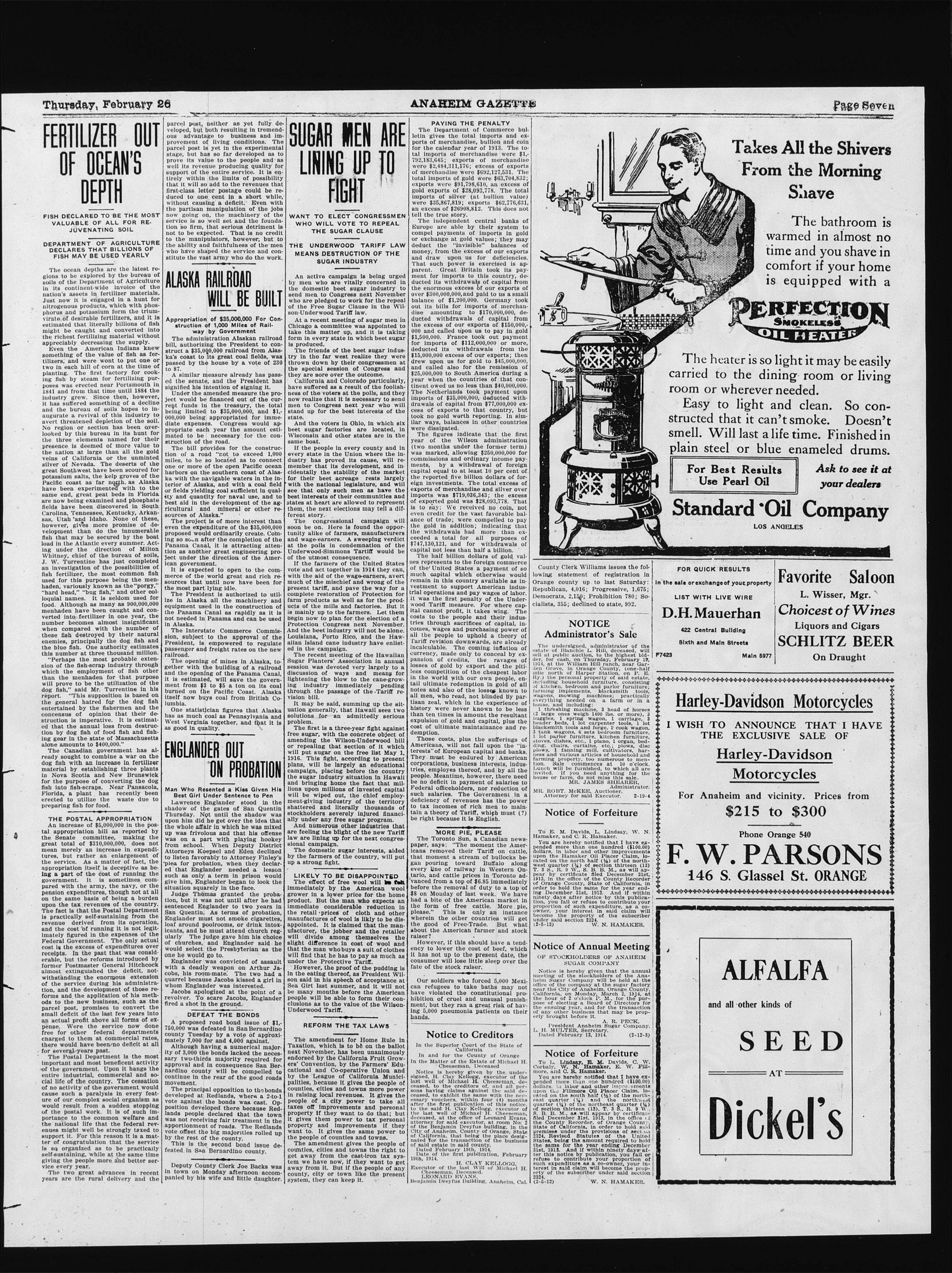
Searchable text
FERTILIZER OUT OF OCEAN'S DEPTH
FISH DECLARED TO BE THE MOST VALUABLE OF ALL FOR REJUVENATING SOIL
DEPARTMENT OF AGRICULTURE DECLARES THAT BILLIONS OF FISH MAY BE USED YEARLY
The ocean depths are the latest regions to be explored by the bureau of soils of the Department of Agriculture in its continent-wide invoice of the nation's assets in fertilizer materials. Just now it is engaged in a hunt for nitrogenous products, which with phosphorus and potassium form the triumvirate of desirable fertilizers, and it is estimated that literally billions of fish might be caught and converted into the richest fertilizing material without appreciably decreasing the supply.
Even the American Indians knew something of the value of fish as fertilizers; and were wont to put one or two in each hill of corn at the time of planting. The first factory for cooking fish by steam for fertilizing purposes was erected near Portsmouth in 1841 and from that time until 1884 the industry grew. Since then, however, it has suffered something of a decline and the bureau of soils hopes to inaugurate a revival of this industry to avert threatened depletion of the soil. No region or section has been overlooked by this bureau in its hunt for the three elements named for their presence is deemed of more value to the nation at large than all the gold veins of California or the unminted silver of Nevada. The deserts of the great Southwest have been scoured for parcel post, neither as yet fully developed, but both resulting in tremendous advantage to business and improvement of living conditions. The parcel post is yet in the experimental stage, but has so far developed as to prove its value to the people and as well its revenue producing quality for support of the entire service. It is entirely within the limits of possibility that it will so add to the revenues that first-class letter postage could be reduced to one cent in a short while, without causing a deficit. Even with the partisan manipulation of the jobs now going on, the machinery of the service is so well set and the foundation so firm, that serious detriment is not to be expected. That is no credit to the manipulators, however, but to the ability and faithfulness of the men who have shaped the service and constitute the vast army who do the work.
ALASKA RAILROAD WILL BE BUILT
Appropriation of $35,000,000 For Construction of 1,000 Miles of Railway by Government
The administration Alaskan railroad bill, authorizing the President to construct a $35,000,000 railroad from Alaska's coast to its great coal fields, was passed by the house by a vote of 230 to 87.
A similar measure already has passed the senate, and the President has signified his intention of signing it.
Under the amended measure the project would be financed out of the current funds in the treasury, the total being limited to $35,000,000, and $1,000,000 being appropriated for immediate expenses. Congress would appropriate each year the amount estimated to be necessary for the construction of the road.
The bill provides for the construction of a road "not to exceed 1,000 miles, to be so located as to connect one or more of the open Pacific ocean harbors on the southern coast of Alas-
The first factory for cooking fish by steam for fertilizing purposes was erected near Portsmouth in 1841 and from that time until 1884 the industry grew. Since then, however, it has suffered something of a decline and the bureau of soils hopes to inaugurate a revival of this industry to avert threatened depletion of the soil. No region or section has been overlooked by this bureau in its hunt for the three elements named for their presence is deemed of more value to the nation at large than all the gold veins of California or the unminted silver of Nevada. The deserts of the great Southwest have been scoured for potassium salts, the kelp groves of the Pacific coast as far north, as Alaska have been experimented with to the same end, great peat beds in Florida are now being examined and phosphate fields have been discovered in South Carolina, Tennessee, Kentucky, Arkansas, Utah and Idaho. None of these, however, gives more promise of development than do the innumerable fish that may be secured by the boat load in the Atlantic every summer. Acting under the direction of Milton Whitney, chief of the bureau of soils, J. W. Turrentine has just completed an investigation of the possibilities of fish fertilizer, the most common fish used for this purpose being the menhaden, variously known as the "porgy," "hard head," "bug fish," and other colloquial names. It is seldom used for food. Although as many as 900,000,000 menhaden have been caught and converted into fertilizer in one year, the number becomes almost insignificant when compared with the number of these fish destroyed by their natural enemies, principally the dog fish and the blue fish. One authority estimates this number at three thousand million.
"Perhaps the most probable extension of the fish-scrap industry through which the employment of fish other than the menhaden for that purpose will prove to be the utilization of the dog fish," said Mr. Turrentine in his report.
"This supposition is based on the general hatred for the dog fish entertained by the fishermen and the consensus of opinion that their destruction is imperative. It is estimated that the annual loss from destruction by dog fish of food fish and fishing gear in the state of Massachusetts alone amounts to $400,000."
The Canadian government has already sought to combine a war on the dog fish with an increase in fertilizer material by establishing three plants in Nova Scotia and New Brunswick for the purpose of converting the dog fish into fish-scraps. Near Pansacola, Florida, a plant has recently been erected to utilize the waste due to preparing fish for food.
THE POSTAL APPROPRIATION
An increase of $5,000,000 in the postal appropriation bill as reported by the Senate committee, making the great total of $310,000,000, does not mean merely an increase in expenditures, but rather an enlargement of the service. As a matter of fact, the appropriation itself is deceptive as being a part of the cost of running the government. It is sometimes compared with the army, the navy, or the pension expenditures, though not at all on the same basis of being a burden
A similar measure already has passed the senate, and the President has signified his intention of signing it.
Under the amended measure the project would be financed out of the current funds in the treasury, the total being limited to $35,000,000, and $1,000,000 being appropriated for immediate expenses. Congress would appropriate each year the amount estimated to be necessary for the construction of the road.
The bill provides for the construction of a road "not to exceed 1,000 miles, to be so located as to connect one or more of the open Pacific ocean harbors on the southern coast of Alaska with the navigable waters in the interior of Alaska, and with a coal field or fields yielding coal sufficient in quality and quantity for naval use, and to best aid in the development of the agricultural and mineral or other resources of Alaska."
The project is of more interest than even the expenditure of the $35,000,000 proposed would ordinarily create. Coming so soon after the completion of the Panama Canal, it is attracting attention as another great engineering project under the direction of the American government.
It is expected to open to the commerce of the world great and rich resources that until now have been for the most part lying idle.
The President is authorized to utilize in Alaska all the machinery and equipment used in the construction of the Panama Canal as rapidly as it is not needed in Panama and can be used in Alaska.
The Interstate Commerce Commission, subject to the approval of the President, is empowered to regulate passenger and freight rates on the new railroad.
The opening of mines in Alaska, together with the building of a railroad and the opening of the Panama Canal, it is estimated, will save the government from $3 to $5 a ton on its coal burned on the Pacific Coast. Alaska itself now buys coal from British Columbia.
One statistician figures that Alaska has as much coal as Pennsylvania and West Virginia together, and that it is as good in quality.
ENGLANDER OUT ON PROBATION
Man Who Resented a Kiss Given His Best Girl Under Sentence to Pen
Lawrence Englander stood in the shadow of the gates of San Quentin Thursday. Not until the shadow was upon him did he get over the idea that the whole affair in which he was mixed up was frivolous and that his offense was on a part with playing hookey from school. When Deputy District Attorneys Koepsel and Eden declined to listen favorably to Attorney Finley's plea for probation, when they declared that Englander needed a lesson such as only a term in prison would give him, England began to look at situation squarely in the face.
Judge Thomas granted the probation but it was not until he had they are sore over their California and Colorado have suffered as a resultness of the voters at that moment realize that it is no men to Congress next stand up for the best state.
And the voters in Ohio beet sugar factories in Wisconsin and other states same boat.
If people in every state in the United States has proved its member that its development incidentallythe stability for their beet acreage with the national legislature see that only such men best interests of their states at heart are allowed them,the next election ferent story.
The congressional session soon be on here. Here is fununity alike of farmers and wage-earners. A survey at the polls in conder Underwood-Simmons' office of utmost consequence.
If the farmers of this vote and act together with the aid of the wages much of the mischief as present tariff,and pave complete restoration on farm products as well as products of the mills and its mainly up tothe farm begin now to plan for Protection Congress now And beet industry ww Louisiana,Porto Ricci Italian island cane induced in the campaign.
The recent meeting Sugar Planters' Association session was devoted vv discussion of ways lightening the blow to lightening industry immediately through passage o vision bill.
It may be said,summation generallythat solutions for an adn problem.
The first is a three-year free sugar,withthe coamendingtheWilson or repealing that sect will put sugar onthe 1916. This fight,account planswill be largely campaign placing beforethe sugar industry situtand bringing home thie lions upon millionsof willbe wiped out,the ment-giving industry shattered and literally stockholders severelyally under any free suu
And numerous others are feelingthe blight on law are lining up for therational campaign.
The domestic sugarbythe farmersofthe cup up a strong fight.
LIKELY TO BE DID
The effect of free wine immediately bythe grower in a lower price productbut it was not until he had they are sore over thie California and Colorado have suffered as a resulnessofthe voters at that moment realize that it is no men to Congress next stand up forthe best state.
And the voters in Ohio beet sugar factories in Wisconsin and other states same boat.
If people in every state in the United States has proved its member that its develoption incidentallythe stability for their beet acreage withthe national legislature see that only such men best interests of their states at heart are allowe them,the next election ferent story.
The congressional session soon be on here. Here is fununity alike of farmers and wage-earners. A survey at the polls in conder Underwood-Simmons' office of utmost consequence.
If the farmers of this vote and act together withthe aid ofthe wages much ofthe mischief as present tariff,and pave complete restoration on farm products as well as products ofthe mills and its mainly up tothe farm begin now to plan for Protection Congress now And beet industry ww Louisiana,Porto Ricci Italian island cane induced in the campaign.
The recent meeting Sugar Planters' Association session was devoted vv discussion of ways lighteningthe blow to lightening industry immediatelythrough passage o vision bill.
It may be said,summation generallythat solutions for an adn problem.
The first is a three-year free sugar.withthe coamendingtheWilson or repealing that sect will put sugar onthe 1916. This fight,account planswill be largely campaign placing beforethe sugar industry situtand bringing home thie lions upon millionsof willbe wiped out,the ment-giving industry shattered and literally stockholders severelyally under any free suu
And numerous others are feelingthe blight on law are lining up for therational campaign.
The domestic sugarbythe farmersofthe cup up a strong fight.
THE POSTAL APPROPRIATION
An increase of $5,000,000 in the postal appropriation bill as reported by the Senate committee, making the great total of $310,000,000, does not mean merely an increase in expenditures, but rather an enlargement of the service. As a matter of fact, the appropriation itself is deceptive as being a part of the cost of running the government. It is sometimes compared with the army, the navy, or the pension expenditures, though not at all on the same basis of being a burden upon the tax revenues of the country. The fact is that the Postal Department is practically self-sustaining from the revenue derived from its operation, and the cost of running it is not legitimately figured in the expenses of the Federal Government. The only actual cost is the excess of expenditures over receipts. In the past that was considerable, but the reforms introduced by former Postmaster General Hitchcock almost extinguished the deficit, notwithstanding the enormous extension of the service during his administration, and the development of those reforms and the application of his methods to the new business, such as the parcel post, promises to convert the small deficit of the last few years into an actual profit above all forms of expense. Were the service now done free for other federal departments charged to them at commercial rates, there would have been no deficit at all for several years past.
The Postal Department is the most important and most beneficial activity of the government. Upon it hangs the entire industrial, commercial and social life of the country. The cessation of no activity of the government would cause such a paralysis in every feature of our complex social organism as would result from a sudden stopping of the postal work. It is of such importance to the common welfare and the national life that the federal revenues might well be strongly taxed to support it. For this reason it is a matter of congratulation that the service is so organized as to be practically self-sustaining, while at the same time giving the people more and better service every year.
The two great advances in recent years are the rural delivery and the Lawrence Englander stood in the shadow of the gates of San Quentin Thursday. Not until the shadow was upon him did he get over the idea that the whole affair in which he was mixed up was frivolous and that his offense was on a part with playing hookey from school. When Deputy District Attorneys Koepsel and Eden declined to listen favorably to Attorney Finley's plea for probation, when they declared that Englander needed a lesson such as only a term in prison would give him, Englander began to look the situation squarely in the face.
Judge Thomas granted the probation, but it was not until after he had sentenced Englander to two years in San Quentin. As terms of probation, Englander must not smoke cigarettes, loaf around poolrooms, or drink intoxicants, and he must attend church regularly. The judge gave him his choice of churches, and Englander said he would select the Presbyterian as the one he would go to.
Englander was convicted of assault with a deadly weapon on Arthur Jacobs, his room-mate. The two had a quarrel because Jacobs kissed a girl in whom Englander was interested.
Jacobs apologized at the point of a revolver. To scare Jacobs, Englander fired a shot in the ground.
DEFEAT THE BONDS
A proposed road bond issue of $1,750,000 was defeated in San Bernardino county Tuesday by a vote of approximately 7,000 for and 4,000 against.
Although having a numerical majority of 3,000 the bonds lacked the necessary two-thirds majority required for approval and in consequence San Bernardino county will be compelled to continue in the rear of the good roads movement.
The principal opposition to the bonds developed at Redlands, where a 2-to-1 vote against the bonds was cast. Opposition developed there because Redlands people declared that the town was not receiving fair treatment in the apportionment of roads. The Redlands vote offset the big majorities rolled up by the rest of the county.
This is the second bond issue defeated in San Bernardino county.
Deputy County Clerk Joe Backs was in town on Monday afternoon accompanied by his wife and little daughter.
LIKELY TO BE DISCIPLINED
The effect of free wage immediately by the grower in a lower price product. But the man immediate considerable in retail prices of manufactures of wool for appointed. It is claimedufacturer, the jobber will divide among slight difference in cost that the man who buys will find that he has to under the Protective Tape.
However, the proof in the eating thereof, as son said in his speech Sea Girt last summer, be many months before people will be able to clusions as to the value Underwood Tariff.
REFORM THE TAXATION
The amendment for Taxation, which is to be next November, has been endorsed by the Californiers' Convention, by the cational and Co-operated by the League of California palities, because it gives counties, cities and towns in raising local revenue people of a city power taxes off improvement property if they want it gives them power to improve property and improve want to. It gives them the people of counties.
The amendment gives counties, cities and towns get away from the central we have now, if they away from it. But if they county, city or town system, they can keep
SUGAR MEN ARE LINING UP TO FIGHT
WANT TO ELECT CONGRESSMEN WHO WILL VOTE TO REPEAL THE SUGAR CLAUSE
THE UNDERWOOD TARIFF LAW MEANS DESTRUCTION OF THE SUGAR INDUSTRY
An active campaign is being urged by men who are vitally concerned in the domestic beet sugar industry to send men to Congress next November who are pledged to work for the repeal of the Free Sugar Clause in the Wilson-Underwood Tariff law.
At a recent meeting of sugar men in Chicago a committee was appointed to take this matter up, and it is taking form in every state in which beet sugar is produced.
The friends of the beet sugar industry in the far west realize they were thrown down by their congressmen at the special session of Congress and they are sore over the outcome.
California and Colorado particularly, have suffered as a result of the foolishness of the voters at the polls, and they now realize that it is necessary to send men to Congress next year who will stand up for the best interests of the state.
And the voters in Ohio, in which six beet sugar factories are located, in Wisconsin and other states are in the same boat.
If the people in every county and in every state in the Union where the industry has proved its cause, will remember that its development, and incidentally the stability of the market
PAYING THE PENALTY
The Department of Commerce bulletin gives the total imports and exports of merchandise, bullion and coin for the calendar year of 1913. The total imports of merchandise were $1,792,183,645; exports of merchandise were $2,484,311,176; excess of exports of merchandise were $692,127,531. The total imports of gold were $63,704,832; exports were $91,798,610, an excess of gold exports of $28,093,778. The total imports of silver (at bullion value) were $35,867,819; exports $62,776,631, an excess of $26908,812. This does not tell the true story.
The independent central banks of Europe are able by their system to compel payments of imports in gold or exchange at gold values; they may deduct the "invisible" balances of money, from the excess of our exports and draw upon us for deficiencies. That such power is exercised is apparent. Great Britain took its payment for imports to this country, deducted its withdrawals of capital from the enormous excess of our exports of over $300,000,000, and paid to us a small balance of $1,200,000. Germany took out its bills for imports of merchandise amounting to $170,000,000, deducted withdrawals of capital from the excess of our exports of $150,000,-000 and called upon us to pay in gold $1,500,000. France took out payment for imports of $112,000,000 or more, deducted its withdrawals from the $15,000,000 excess of our exports; then drew upon us for gold to $45,000,000, and called also for the remission of $25,000,000 to South America during a year when the countries of that continent owed us no less than $40,000,000. The Netherlands took payment upon imports of $35,000,000, deducted withdrawals of capital from $77,000,000 excess of exports to that country, but took no gold worth reporting. In similar ways, balances in other countries were dissipated.
The figures indicate that the first year of the Wilson administration (two months under the former term) was marked, allowing $250,000,000 for commissions and ordinary income payments, by a withdrawal of foreign capital equal to at least 10 per cent of
California and Colorado particularly, have suffered as a result of the foolishness of the voters at the polls, and they now realize that it is necessary to send men to Congress next year who will stand up for the best interests of the state.
And the voters in Ohio, in which six beet sugar factories are located, in Wisconsin and other states are in the same boat.
If the people in every county and in every state in the Union where the industry has proved its cause, will remember that its development, and incidentally the stability of the market for their beet acreage rests largely with the national legislature, and will see that only such men as have the best interests of their communities and states at heart are allowed to represent them, the next elections may tell a different story.
The congressional campaign will soon be on. Here is found the opportunity alike of farmers, manufacturers and wage-earners. A sweeping verdict at the polls in condemnation of the Underwood-Simmons Tariff would be of the utmost consequence.
If the farmers of the United States vote and act together in 1914 they can, with the aid of the wage-earners, avert much of the mischief and wrong of the present tariff, and pave the way for a complete restoration of Protection for farm products as well as for the products of the mills and factories. But it is mainly up to the farmers. Let them begin now to plan for the election of a Protection Congress next November. And the beet industry will not be alone. Louisiana, Porto Rico, and the Hawaiian Island cane industry have enlisted in the campaign.
The recent meeting of the Hawaiian Sugar Planters' Association in annual session was devoted very largely to a discussion of ways and means for lightening the blow to the cane-growing industry immediately pending through the passage of the Tariff revision bill.
It may be said, summing up the situation generally, that Hawaii sees two solutions for an admittedly serious problem.
The first is a three-year fight against free sugar, with the concrete object of amending the Wilson-Underwood bill or repealing that section of it which will put sugar on the free list May 1, 1916. This fight, according to present plans, will be largely an educational campaign, placing before the country the sugar industry situation in Hawaii and bringing home the fact that millions upon millions of invested capital will be wiped out, the chief employment-giving industry of the territory shattered and literally thousands of stockholders severely injured financially under any free sugar program.
And numerous other industries that are feeling the blight of the new Tariff law are lining up for the next congressional campaign.
The domestic sugar interests, aided by the farmers of the country, will put up a strong fight.
LIKELY TO BE DISAPPOINTED
The effect of free wool will be felt immediately by the American wool grower in a lower price for the home product.
THE FIGURES indicate that the first year of the Wilson administration (two months under the former term) was marked, allowing $250,000,000 for commissions and ordinary income payments, by a withdrawal of foreign capital equal to at least 10 per cent of the reported five billion dollars of foreign investments. The total excess of exports of merchandise and silver over imports was $719,036,343; the excess of exported gold was $28,093,778. That is to say: We received no coin, not even credit for the vast favorable balance of trade; were compelled to pay the gold in addition; indicating that the withdrawals had more than exceeded a total for all purposes of $747,130,121, and for withdrawals of capital not less than half a billion.
The half billion dollars of gold values represents to the foreign commerce of the United States a payment of so much capital which otherwise would remain in this country available as investment to support American industrial operations and pay wages of labor. It was the first penalty of the Underwood Tariff measure. For where capital cannot profit, it takes wing. The costs to the people and their industries through sacrifices of capital, incomes, wages and purchasing power of all the people to uphold a theory of Tariff revision downwards, are already incalculable. The coming inflation of currency, made only to conceal by expansion of credits, the ravages of losses of gold by export and the pitiless competition of the cheapest labor in the world with our own people, entail ultimate redemption in gold of all notes and also of the losses known to all men, who read, not blinded by partisan zeal, which in the experience of history were never known to be less than ten times in amount the resultant expulsion of gold and capital, plus the cost of ultimate maintenance and redemption.
Those costs, plus the sufferings of Americans, will not fall upon the "interests" of European capital and banks. They must be endured by American corporations, business interests, industries, employees thereof, and by all the people. Meantime, however, there need be no deficit in payment of salaries to Federal officeholders, nor reduction of such salaries. The Government in a deficiency of revenues has the power to tax incomes of rich men to maintain a theory of Tariff, which must (?) be right because it is English.
MORE PIE, PLEASE
The Toronto Sun, a Canadian newspaper, says: "The moment the Americans removed their Tariff on cattle, that moment a stream of bullocks began pouring toward Buffalo along every line of railway in Western Ontario, and cattle prices in Toronto advanced from a top of $6.85 immediately before the removal of duty to a top of $8 on Monday of last week. We have had a bite of the American market in California during a year when the countries of that continent owed us no less than $40,000,000. The Netherlands took payment upon imports of $35,000,000, deducted withdrawals of capital from $77,000,000 excess of exports to that country, but took no gold worth reporting. In similar ways, balances in other countries were dissipated.
NOTICE Administrator's Sale
The undersigned, administrator of the estate of Blanchie L. Hill, deceased, will sell at public auction, to the highest bidder, for cash, on Thursday, February 19, 1914, at the William Hill ranch near Garden Grove, in Orange County (one-half mile north Harper Station), on P.E.Ry.) the personal property of said estate, including household furniture, consisting of kitchen, bedroom and parlor furniture; farming implements, blacksmith tools; wagons; mowing machines; practically everything needed on a farm or in a house, and including:
1. threshing machine; 3 head of horses (2 large ones weigh 1400 lbs. or more); 3 juggles; 1 spring wagon; 1 carriage; 3 header beds; 1 lot carpenter tools; 1 lot blacksmith tools and forge; 1 cook wagon; 3 tank wagons; 6 sets bedroom furniture; 1 lot parlor furniture; kitchen furniture; stoves, dishes, etc., 1 piano; 1 organ, bedding, chairs, curtains, etc.; plows; discplows; 1 fanning mill; cultivators; harness and various articles of household and farming property; too numerous to mention. Sale commences at 10 o'clock. Lunch will be furnished, to which all are invited. If you need anything for the house or farm, do not miss this sale.
MR. JAMES SHEARER,
Administrator.
MR. ROBT. McKEE, Auctioner.
Attorney for said Executor.
Notice of Forfeiture
To E. M. Davids, L. Lindsay, W. N. Hamaker, and C. R. Hamaker.
You are hereby notified that I have expended more than one hundred ($100.00) dollars in labor and other improvements upon the Hamaker Oil Placer Claim, located on the north half (%) of the northwest quarter (%) of section thirteen (13). T. S., R. 9 W., S. B. B. M., as will appear by certificate filed December 31st, 1913. In the office of the County Recorder of Orange County, State of California, in order to hold the same for the year ending December 31st, 1913. And if within ninety days after notice by this publica-
MENT-GIVING INDUSTRY OF THE TERRITORY SHATTERED AND LITERALLY THOUSANDS OF STOCKHOLDERS SEVERELY INJURED FINANCIALLY UNDER ANY FREE SUGAR PROGRAM.
AND NUMEROUS OTHER INSTITUTIONS THAT ARE FEELING THE BLIGHT OF THE NEW TARIFF LAW ARE LINING UP FOR THE NEXT CONGRESSIONAL CAMPAIGN.
THE DOMESTIC SUGAR INTERests, AIDED BY THE FARMERS OF THE COUNTRY, WILL PUT UP A STRONG FIGHT.
LIKELY TO BE DISAPPOINTED
The effect of free wool will be felt immediately by the American wool grower in a lower price for the home product. But the man who expects an immediate considerable reduction in the retail prices of cloth and other manufactures of wool is likely to be disappointed. It is claimed that the manufacturer, the jobber and the retailer will divide among themselves the slight difference in cost of wool and that the man who buys a suit of clothes will find that he has to pay as much as under the Protective Tariff.
However, the proof of the pudding is in the eating thereof, as President Wilson said in his speech of acceptance at Sea Girt last summer, and it will not be many months before the American people will be able to form their conclusions as to the value of the Wilson-Underwood Tariff.
REFORM THE TAX LAWS
The amendment for Home Rule in Taxation, which is to be on the ballot next November, has been unanimously endorsed by the California Fruit Growers' Convention, by the Farmers' Educational and Co-operative Union and by the League of California Municipalities, because it gives the people of counties, cities and towns more power in raising local revenues. It gives the people of a city power to take all taxes off improvements and personal property if they want to do that; but it gives them power to tax personal property and improvements if they want to. It gives the same power to the people of counties and towns.
The amendment gives the people of counties, cities and towns the right to get away from the cast-iron tax system we have now, if they want to get away from it. But if the people of any county, city or town like the present system, they can keep it.
MORE PIE, PLEASE
The Toronto Sun, a Canadian newspaper, says: "The moment the Americans removed their Tariff on cattle, that moment a stream of bullocks began pouring toward Buffalo along every line of railway in Western Ontario, and cattle prices in Toronto advanced from a top of $6.85 immediately before the removal of duty to a top of $8 on Monday of last week. We have had a bite of the American market in the form of free cattle. More pie, please." This is only an instance wherein the other countries will get the good of Free-Trade. But what about the American farmer and stock raiser?
However, if this should have a tendency to lower the cost of beef, which it has not up to the present date, the consumer will lose little sleep over the fate of the stock raiser.
Our soldiers who forced 5,000 Mexican refugees to take baths may not have violated the constitutional prohibition of cruel and unsusual punishment, but they ran a great risk of having 5,000 pneumonia patients on their hands.
Notice to Creditors
In the Superior Court of the State of California
In and for the County of Orange
In the Matter of the Estate of Michael H. Cheeseman, Deceased
Notice is hereby given by the undersigned, H. Clay Kellogg, executor of the last well of Michael H. Cheeseman, deceased, to the creditors of, and all persons having claims against the said deceased, to exhibit the same with the necessary vouchers, within four (4) months after the first publication of this notice, to the said H. Clay Kellogg, executor of the last well of Michael H. Cheeseman, deceased, at the office of Leonard Evans, attorney for said executor, at room No. 2 of the Benjamin Dreyfus building, in the City of Anaheim, County of Orange, State of California, that being the place designated for the transaction of the business of said estate in said county.
Dated February 19th, 1914.
Date of the first publication, February 19th, 1914.
H. CLAY KELLOGG,
Executor of the last Will of Michael H. Cheeseman, Deceased.
LEONARD EVANS,
Benjamin Dreyfus Building, Anaheim, Cal.
Notice of Forfeiture
To E. M. Davids, L. Lindsay, W. N. Hamaker, and C. R. Hamaker.
You are hereby notified that I have expended more than one hundred ($100.00) dollars in labor and other improvements upon the Hamaker Oil Placer Claim, located on the north half (½) of the northwest quarter (¼) of section thirteen (13). T. 3 S., R. 9 W., S. B. B. M., as will appear by certificate filed December 31st, 1913. In the office of the County Recorder of Orange County, State of California, in order to hold the same for the year ending December 31st, 1913. And if within ninety days after notice by this publication you fail or refuse to contribute your proportion of such expenditure, as a co-owner, your interest in said claim will become the property of the subscriber under said section 2324.
(2-5-12)
W. N. HAMAKER.
Notice of Annual Meeting
OF STOCKHOLDERS OF ANAHEIM SUGAR COMPANY
Notice is hereby given that the annual meeting of the stockholders of the Anaheim Sugar Company will be held at the office of the company at the sugar factory near the City of Anaheim, Orange County, on Monday, March 2, 1914, at the hour of 2 o'clock P.M., for the purpose of electing a Board of Directors for the ensuing year, and for the transaction of any other business that may be properly brought before it.
A. R. PECK,
President Anaheim Sugar Company.
L. H. MULTER, Secretary.
Dated February 12, 1914.
(2-12-3)
Notice of Forfeiture
To L. Lindsay, E. M. Davids, C. W. Corbaly, W. N. Hamaker, E. W. Fillmore,
You are hereby notified that I have expended more than one hundred ($100.00) dollars in labor and other improvements upon the Fillmore Oil Placer Claim, located on the south half (½) of the northeast quarter (¼) and the northwest quarter (¼) of section thirteen (13), T. 3 S., R. 9 W., S. B. B. M., as will appear by certificate filed December 31st, 1913. In the office of the County Recorder, or Orange County, State of California, in order to hold said premises under the provisions section 2324, Revised Statutes of the United States, being the amount required to hold the same for the year ending December 31st, 1913. And if within ninety days after this notice by publication you fail or refuse to contribute your proportion of such expenditure as a co-owner, your interest in said claim will become the property of the subscriber under said section 2324.
(2-5-12)
W. N. HAMAKER.
Takes All the Shivers
From the Morning
Shave
The bathroom is
warmed in almost no
time and you shave in
comfort if your home
is equipped with a
PERFECTION
SMOKELESS
OIL HEATER
The heater is so light it may be easily
carried to the dining room or living
room or wherever needed.
Easy to light and clean. So constructed that it can't smoke. Doesn't
smell. Will last a life time. Finished in
plain steel or blue enameled drums.
For Best Results Ask to see it at
carried to the dining room or living
room or wherever needed.
Easy to light and clean. So constructed that it can't smoke. Doesn't
smell. Will last a life time. Finished in
plain steel or blue enameled drums.
For Best Results
Use Pearl Oil
Ask to see it at
your dealers
Standard Oil Company
LOS ANGELES
FOR QUICK RESULTS
in the sale or exchange of your property
LIST WITH LIVE WIRE
D.H. Mauerhan
422 Central Building
Sixth and Main Streets
F7423 Main 5977
Favorite Saloon
L. Wisser, Mgr.
Choicest of Wines
Liquors and Cigars
SCHLITZ BEER
On Draught
Harley-Davidson Motorcycles
I WISH TO ANNOUNCE THAT I HAVE
THE EXCLUSIVE SALE OF
Harley-Davidson
Motorcycles
For Anaheim and vicinity. Prices from
$215 to $300
Phone Orange 540
F. W. PARSONS
146 S. Glassel St. ORANGE
$215 to $300
Phone Orange 540
F. W. PARSONS
146 S. Glassel St. ORANGE
ALFALFA
and all other kinds of
SEED
AT
Dickel's